
Suspected Tenofovir disoproxil fumarate
Associated Fanconi Syndrome in a Chronic
Hepatitis B Patient
加護病房查房日誌
ICU note
Outline
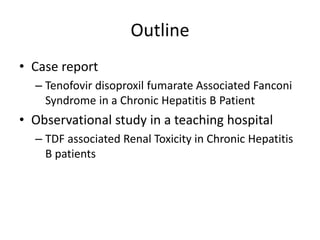
• Case report
– Tenofovir disoproxil fumarate Associated Fanconi
Syndrome in a Chronic Hepatitis B Patient
• Observational study in a teaching hospital
– TDF associated Renal Toxicity in Chronic Hepatitis
B patients
Case Report
Introduction
• Tenofovir disoproxil fumarate (TDF)
– A nucleoside reverse transcriptase inhibitor
• Human immunodeficiency virus (HIV) infection and
chronic hepatitis B (CHB) infection
• Side effects
– diarrhea (16%), asthenia (11%) and nausea (11%)
• Renal toxicity has been reported in HIV
infected patients, but rare in CHB infection
Ref: Viread (tenofovir) [package insert]. Foster City, CA: Gilead Sciences Inc; October 2013.
Case Summary
• A 72-year-old male had type 2 diabetes
mellitus (DM), hypertension (HTN) and CHB
infection
– TDF and entecavir for his CHB infection
– Insulin for type 2 DM
– Valsartan and carvedilol for HTN
• Without baseline renal function and other
electrolyte data
Two months later
• His serum creatinine (Scr) was 1.7 mg/dL
– Estimated glomerular filtration rate (eGFR) 42.32
ml/min/1.73m2
• Blood urea nitrogen (BUN) 20 mg/dL
• Sodium level (Na)135 mmol/L
• Potassium level (K) 3.8 mmol/L.
Four months later
• He was brought to our emergency department
due to general discomfort and vomiting.
– Body temperature (BT) 36 ℃, Heart rate (HR) 80
beats/min, blood pressure (BP) 148/88 mmHg and
respiratory rate (RR) 18 breaths/min
– Serum white blood count (WBC) 9,780/uL,
segment 72.8%
– Na 136 mmol/L, K 3.4 mmol/L, Scr 4.1 mg/dL
(eGFR 15.32 ml/min/1.73m2), and BUN 56 mg/dL.
The nephrologist considered
• His acute kidney injury might be due to pre-
renal factors besides the urinary tract
infection.
• After adequate hydration and antibiotics
treatment, the patient was stable with his
serum creatinine returning to 2.2 mg/dL
(eGFR 31.43 ml/min/1.73m2) and therefore
was discharged.
Unfortunately, 4 days after discharge
• He was brought to our emergency department
again.
• Chief complaint was dyspnea.
• BT 38.2 ℃, HR 125 beats/min, BP 78/47
mmHg and RR 36 breaths/min.
• Because of oxygen desaturation, emergent
intubation was conducted.
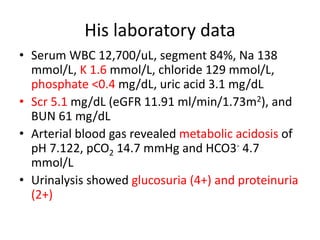
His laboratory data
• Serum WBC 12,700/uL, segment 84%, Na 138
mmol/L, K 1.6 mmol/L, chloride 129 mmol/L,
phosphate <0.4 mg/dL, uric acid 3.1 mg/dL
• Scr 5.1 mg/dL (eGFR 11.91 ml/min/1.73m2), and
BUN 61 mg/dL
• Arterial blood gas revealed metabolic acidosis of
pH 7.122, pCO2 14.7 mmHg and HCO3- 4.7
mmol/L
• Urinalysis showed glucosuria (4+) and proteinuria
(2+)
Transferred to intensive care unit
• Chest x-ray showed patch lesion on the right
middle lobe.
• He was diagnosed with pneumonia, septic shock
and acute respiratory failure.
– Broad-spectrum antibiotics (piperacillin/tazobactam
and teicoplanin) and norepinephrine were
administrated for his septic shock.
– Potassium supplements and sodium bicarbonate were
given to correct severe hypokalemia and metabolic
acidosis.
Renal tubular acidosis
• The nephrologist was consulted for acute
kidney injury, metabolic acidosis and
hypokalemia.
• The calculated serum anion gap (4.3 meq/L)
was not elevated and he had no history of
diarrhea.
• Renal tubular acidosis (Fanconi syndrome) was
highly recommended for the diagnosis by the
nephrologist.
Drug related ?
• The nephrologist considered drug related?
• Our clinical pharmacist was consulted to
review his medication history and tenofovir
was highly suspected due to previous adverse
drug reports of Fanconi syndrome.
Gastroenterologist was consulted
• After checking the total bilirubin, it was 0.57
mg/dL, nonreactive of HBe Ag (0.36), reactive
of HBs Ag (0.88) and undetectable of HBV DNA
• TDF and entecavir were discontinued upon
the suggestion of our gastroenterologist.
Five months later
• Entecavir was administrated again for two
weeks due to abnormal level of alanine
aminotransferase (ALT)
• But serum creatinine did not increase during
its use.
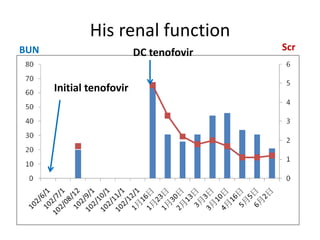
Six months after the discontinuation of TDF
• His Scr decreased to 1.2 mg/dL
• While the persistent hypokalemia and
metabolic acidosis returned to normal range
even without the supplements of potassium
and sodium bicarbonate.
• A renal biopsy was refused by the patient.
The Naranjo probability scale
• 5 points
– A probable relationship between TDF and Fanconi
in this patient
• Due to the rechallenge of entecavir without
recurrence of Fanconi syndrome, we highly
suspected the case to be TDF associated
Fanconi syndrome.
Ref: Naranjo CA et al. A method for estimating the probability of adverse drug reactions.
Clin Pharmacol Ther. 1981 Aug;30(2):239-45.
Discussion
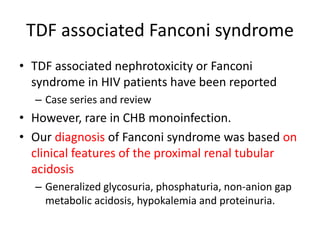
TDF associated Fanconi syndrome
• TDF associated nephrotoxicity or Fanconi
syndrome in HIV patients have been reported
– Case series and review
• However, rare in CHB monoinfection.
• Our diagnosis of Fanconi syndrome was based on
clinical features of the proximal renal tubular
acidosis
– Generalized glycosuria, phosphaturia, non-anion gap
metabolic acidosis, hypokalemia and proteinuria.
His renal function
Initial tenofovir
DC tenofovirBUN Scr
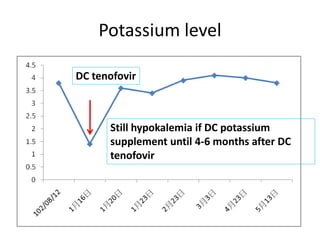
Potassium level
DC tenofovir
Still hypokalemia if DC potassium
supplement until 4-6 months after DC
tenofovir
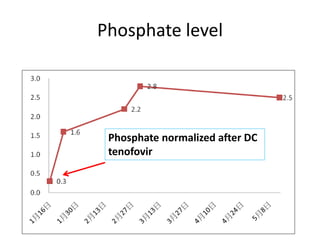
Phosphate level
Phosphate normalized after DC
tenofovir
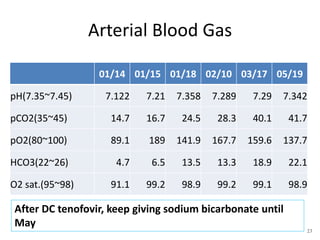
Arterial Blood Gas
23
01/14 01/15 01/18 02/10 03/17 05/19
pH(7.35~7.45) 7.122 7.21 7.358 7.289 7.29 7.342
pCO2(35~45) 14.7 16.7 24.5 28.3 40.1 41.7
pO2(80~100) 89.1 189 141.9 167.7 159.6 137.7
HCO3(22~26) 4.7 6.5 13.5 13.3 18.9 22.1
O2 sat.(95~98) 91.1 99.2 98.9 99.2 99.1 98.9
After DC tenofovir, keep giving sodium bicarbonate until
May
The pattern of TDF associated Fanconi
syndrome in CHB patients
• Delayed onset
• Recovery may take weeks to months after
stopping TDF treatment
• Gracey et al. reported two patients with CHB
infection and TDF associated Fanconi
syndrome
Ref: Gracey DM Tenofovir-associated Fanconi syndrome in patients with chronic hepatitis B monoinfection.
Antivir Ther. 2013;18(7):945-8. doi: 10.3851/IMP2649. Epub 013 Jul 10.
First patient
• Scr increased from 1.06 mg/dL to a peak of
1.7 mg/dL about 6 months after commencing
TDF
• His renal function had improved but not
returned to normal range and he had no
features of Fanconi syndrome 24 months after
discontinuing TDF
Ref: Gracey DM Tenofovir-associated Fanconi syndrome in patients with chronic hepatitis B monoinfection.
Antivir Ther. 2013;18(7):945-8. doi: 10.3851/IMP2649. Epub 013 Jul 10.
Second patient
• His serum creatinine increased from 1.06 to 1.53
mg/dL and he had aminoaciduria, glycosuria, low-
grade proteinuria, hypophosphatemia (0.68
mmol/l) and hypouricemia (0.08 mmol/l) 24
months after commencing TDF
• At 3 months after switching from TDF to entecavir,
the serum creatinine decreased to 1.20 mg/dL
with no features of Fanconi syndrome.
Ref: Gracey DM Tenofovir-associated Fanconi syndrome in patients with chronic hepatitis B monoinfection.
Antivir Ther. 2013;18(7):945-8. doi: 10.3851/IMP2649. Epub 013 Jul 10.
Our patient
• His serum creatinine increased to 5.1 mg/dl
– much higher than the previous reports
– In addition to TDF, it could be related to septic shock
– Similar clinical features of Fanconi syndrome
• including metabolic acidosis, hypokalemia,
hypophosphatemia, hypouricemia, glycosuria and
proteinuria
– The complete recovery of renal function and Fanconi
syndrome in our patient
• 4 months after stopping TDF
Mechanism
• Current evidences suggest that TDF can be
toxic to proximal tubule mitochondria.
• If proximal tubule mitochondria is injured,
tubular cells cannot ensure reabsorption of
ions and small molecules such as potassium,
glucose, phosphate, uric acid, and amino acids
Ref: Fernandez-Fernandez B, et al. Tenofovir nephrotoxicity: 2011 update. AIDS Res
Treat. 2011:354908.(doi):10.1155/2011/354908. Epub 2011 Jun 7.
Risk factors
• The development of TDF associated Fanconi
syndrome in HIV-infected patients
– Age
– Pre-existing renal impairment
– Concomitant use of nephrotoxic medications
– Comorbidities such as diabetes and hypertension
– The use of certain protease inhibitors
Ref: Fernandez-Fernandez B, et al. Tenofovir nephrotoxicity: 2011 update. AIDS Res
Treat. 2011:354908.(doi):10.1155/2011/354908. Epub 2011 Jun 7.
Prevention
• Dose reduction is advised when GFR is low
• The European Society for the Study of the
Liver recommends
– Monitoring of Scr and serum phosphate levels in
all patients with CHB taking TDF
– every 3 months in the first year and every 6
months thereafter
– Any detection of renal dysfunction and there is an
effective alternative agent, TDF treatment should
be discontinued immediately
Ref: EASL Clinical Practice Guidelines: management of chronic hepatitis B. J Hepatol. 2009 Feb;50(2):227-42.
Management
• TDF discontinuation is the most effective
treatment of TDF associated Fanconi
syndrome.
Ref: Fernandez-Fernandez B, et al. Tenofovir nephrotoxicity: 2011 update. AIDS Res
Treat. 2011:354908.(doi):10.1155/2011/354908. Epub 2011 Jun 7.
Conclusion
• TDF associated Fanconi syndrome still could
happen in a CHB patient
• Discontinuing TDF and giving supportive care
may recover the renal function and normalize
the Fanconi syndrome completely
Observational Study of TDF
associated Renal Toxicity in Chronic
Hepatitis B patients
Purpose
• To evaluate the renal function of a chronic
hepatitis B patients who received TDF
Methods
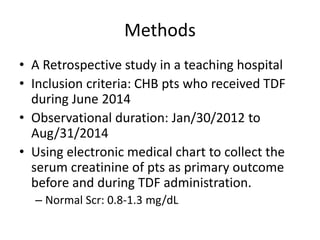
• A Retrospective study in a teaching hospital
• Inclusion criteria: CHB pts who received TDF
during June 2014
• Observational duration: Jan/30/2012 to
Aug/31/2014
• Using electronic medical chart to collect the
serum creatinine of pts as primary outcome
before and during TDF administration.
– Normal Scr: 0.8-1.3 mg/dL
Results
Baseline Characteristics
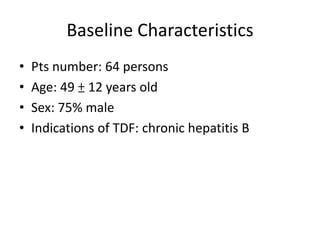
• Pts number: 64 persons
• Age: 49 ± 12 years old
• Sex: 75% male
• Indications of TDF: chronic hepatitis B
Monitor Scr Before and During TDF Use
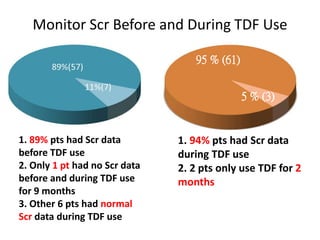
1. 89% pts had Scr data
before TDF use
2. Only 1 pt had no Scr data
before and during TDF use
for 9 months
3. Other 6 pts had normal
Scr data during TDF use
95 % (61)
5 % (3)
1. 94% pts had Scr data
during TDF use
2. 2 pts only use TDF for 2
months
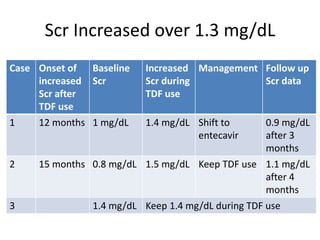
Scr Increased over 1.3 mg/dL
Case Onset of
increased
Scr after
TDF use
Baseline
Scr
Increased
Scr during
TDF use
Management Follow up
Scr data
1 12 months 1 mg/dL 1.4 mg/dL Shift to
entecavir
0.9 mg/dL
after 3
months
2 15 months 0.8 mg/dL 1.5 mg/dL Keep TDF use 1.1 mg/dL
after 4
months
3 1.4 mg/dL Keep 1.4 mg/dL during TDF use
Conclusions
• Most pts had Scr monitoring regularly and had
normal Scr data.
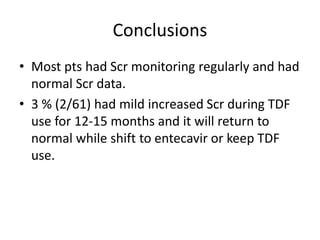
• 3 % (2/61) had mild increased Scr during TDF
use for 12-15 months and it will return to
normal while shift to entecavir or keep TDF
use.
Thank you for listening
41

TDF associated Fanconi syndrome

  • 1.
    Suspected Tenofovir disoproxilfumarate Associated Fanconi Syndrome in a Chronic Hepatitis B Patient 加護病房查房日誌 ICU note
  • 2.
    Outline • Case report –Tenofovir disoproxil fumarate Associated Fanconi Syndrome in a Chronic Hepatitis B Patient • Observational study in a teaching hospital – TDF associated Renal Toxicity in Chronic Hepatitis B patients
  • 3.
  • 4.
    Introduction • Tenofovir disoproxilfumarate (TDF) – A nucleoside reverse transcriptase inhibitor • Human immunodeficiency virus (HIV) infection and chronic hepatitis B (CHB) infection • Side effects – diarrhea (16%), asthenia (11%) and nausea (11%) • Renal toxicity has been reported in HIV infected patients, but rare in CHB infection Ref: Viread (tenofovir) [package insert]. Foster City, CA: Gilead Sciences Inc; October 2013.
  • 5.
    Case Summary • A72-year-old male had type 2 diabetes mellitus (DM), hypertension (HTN) and CHB infection – TDF and entecavir for his CHB infection – Insulin for type 2 DM – Valsartan and carvedilol for HTN • Without baseline renal function and other electrolyte data
  • 6.
    Two months later •His serum creatinine (Scr) was 1.7 mg/dL – Estimated glomerular filtration rate (eGFR) 42.32 ml/min/1.73m2 • Blood urea nitrogen (BUN) 20 mg/dL • Sodium level (Na)135 mmol/L • Potassium level (K) 3.8 mmol/L.
  • 7.
    Four months later •He was brought to our emergency department due to general discomfort and vomiting. – Body temperature (BT) 36 ℃, Heart rate (HR) 80 beats/min, blood pressure (BP) 148/88 mmHg and respiratory rate (RR) 18 breaths/min – Serum white blood count (WBC) 9,780/uL, segment 72.8% – Na 136 mmol/L, K 3.4 mmol/L, Scr 4.1 mg/dL (eGFR 15.32 ml/min/1.73m2), and BUN 56 mg/dL.
  • 8.
    The nephrologist considered •His acute kidney injury might be due to pre- renal factors besides the urinary tract infection. • After adequate hydration and antibiotics treatment, the patient was stable with his serum creatinine returning to 2.2 mg/dL (eGFR 31.43 ml/min/1.73m2) and therefore was discharged.
  • 9.
    Unfortunately, 4 daysafter discharge • He was brought to our emergency department again. • Chief complaint was dyspnea. • BT 38.2 ℃, HR 125 beats/min, BP 78/47 mmHg and RR 36 breaths/min. • Because of oxygen desaturation, emergent intubation was conducted.
  • 10.
    His laboratory data •Serum WBC 12,700/uL, segment 84%, Na 138 mmol/L, K 1.6 mmol/L, chloride 129 mmol/L, phosphate <0.4 mg/dL, uric acid 3.1 mg/dL • Scr 5.1 mg/dL (eGFR 11.91 ml/min/1.73m2), and BUN 61 mg/dL • Arterial blood gas revealed metabolic acidosis of pH 7.122, pCO2 14.7 mmHg and HCO3- 4.7 mmol/L • Urinalysis showed glucosuria (4+) and proteinuria (2+)
  • 11.
    Transferred to intensivecare unit • Chest x-ray showed patch lesion on the right middle lobe. • He was diagnosed with pneumonia, septic shock and acute respiratory failure. – Broad-spectrum antibiotics (piperacillin/tazobactam and teicoplanin) and norepinephrine were administrated for his septic shock. – Potassium supplements and sodium bicarbonate were given to correct severe hypokalemia and metabolic acidosis.
  • 12.
    Renal tubular acidosis •The nephrologist was consulted for acute kidney injury, metabolic acidosis and hypokalemia. • The calculated serum anion gap (4.3 meq/L) was not elevated and he had no history of diarrhea. • Renal tubular acidosis (Fanconi syndrome) was highly recommended for the diagnosis by the nephrologist.
  • 13.
    Drug related ? •The nephrologist considered drug related? • Our clinical pharmacist was consulted to review his medication history and tenofovir was highly suspected due to previous adverse drug reports of Fanconi syndrome.
  • 14.
    Gastroenterologist was consulted •After checking the total bilirubin, it was 0.57 mg/dL, nonreactive of HBe Ag (0.36), reactive of HBs Ag (0.88) and undetectable of HBV DNA • TDF and entecavir were discontinued upon the suggestion of our gastroenterologist.
  • 15.
    Five months later •Entecavir was administrated again for two weeks due to abnormal level of alanine aminotransferase (ALT) • But serum creatinine did not increase during its use.
  • 16.
    Six months afterthe discontinuation of TDF • His Scr decreased to 1.2 mg/dL • While the persistent hypokalemia and metabolic acidosis returned to normal range even without the supplements of potassium and sodium bicarbonate. • A renal biopsy was refused by the patient.
  • 17.
    The Naranjo probabilityscale • 5 points – A probable relationship between TDF and Fanconi in this patient • Due to the rechallenge of entecavir without recurrence of Fanconi syndrome, we highly suspected the case to be TDF associated Fanconi syndrome. Ref: Naranjo CA et al. A method for estimating the probability of adverse drug reactions. Clin Pharmacol Ther. 1981 Aug;30(2):239-45.
  • 18.
  • 19.
    TDF associated Fanconisyndrome • TDF associated nephrotoxicity or Fanconi syndrome in HIV patients have been reported – Case series and review • However, rare in CHB monoinfection. • Our diagnosis of Fanconi syndrome was based on clinical features of the proximal renal tubular acidosis – Generalized glycosuria, phosphaturia, non-anion gap metabolic acidosis, hypokalemia and proteinuria.
  • 20.
    His renal function Initialtenofovir DC tenofovirBUN Scr
  • 21.
    Potassium level DC tenofovir Stillhypokalemia if DC potassium supplement until 4-6 months after DC tenofovir
  • 22.
  • 23.
    Arterial Blood Gas 23 01/1401/15 01/18 02/10 03/17 05/19 pH(7.35~7.45) 7.122 7.21 7.358 7.289 7.29 7.342 pCO2(35~45) 14.7 16.7 24.5 28.3 40.1 41.7 pO2(80~100) 89.1 189 141.9 167.7 159.6 137.7 HCO3(22~26) 4.7 6.5 13.5 13.3 18.9 22.1 O2 sat.(95~98) 91.1 99.2 98.9 99.2 99.1 98.9 After DC tenofovir, keep giving sodium bicarbonate until May
  • 24.
    The pattern ofTDF associated Fanconi syndrome in CHB patients • Delayed onset • Recovery may take weeks to months after stopping TDF treatment • Gracey et al. reported two patients with CHB infection and TDF associated Fanconi syndrome Ref: Gracey DM Tenofovir-associated Fanconi syndrome in patients with chronic hepatitis B monoinfection. Antivir Ther. 2013;18(7):945-8. doi: 10.3851/IMP2649. Epub 013 Jul 10.
  • 25.
    First patient • Scrincreased from 1.06 mg/dL to a peak of 1.7 mg/dL about 6 months after commencing TDF • His renal function had improved but not returned to normal range and he had no features of Fanconi syndrome 24 months after discontinuing TDF Ref: Gracey DM Tenofovir-associated Fanconi syndrome in patients with chronic hepatitis B monoinfection. Antivir Ther. 2013;18(7):945-8. doi: 10.3851/IMP2649. Epub 013 Jul 10.
  • 26.
    Second patient • Hisserum creatinine increased from 1.06 to 1.53 mg/dL and he had aminoaciduria, glycosuria, low- grade proteinuria, hypophosphatemia (0.68 mmol/l) and hypouricemia (0.08 mmol/l) 24 months after commencing TDF • At 3 months after switching from TDF to entecavir, the serum creatinine decreased to 1.20 mg/dL with no features of Fanconi syndrome. Ref: Gracey DM Tenofovir-associated Fanconi syndrome in patients with chronic hepatitis B monoinfection. Antivir Ther. 2013;18(7):945-8. doi: 10.3851/IMP2649. Epub 013 Jul 10.
  • 27.
    Our patient • Hisserum creatinine increased to 5.1 mg/dl – much higher than the previous reports – In addition to TDF, it could be related to septic shock – Similar clinical features of Fanconi syndrome • including metabolic acidosis, hypokalemia, hypophosphatemia, hypouricemia, glycosuria and proteinuria – The complete recovery of renal function and Fanconi syndrome in our patient • 4 months after stopping TDF
  • 28.
    Mechanism • Current evidencessuggest that TDF can be toxic to proximal tubule mitochondria. • If proximal tubule mitochondria is injured, tubular cells cannot ensure reabsorption of ions and small molecules such as potassium, glucose, phosphate, uric acid, and amino acids Ref: Fernandez-Fernandez B, et al. Tenofovir nephrotoxicity: 2011 update. AIDS Res Treat. 2011:354908.(doi):10.1155/2011/354908. Epub 2011 Jun 7.
  • 29.
    Risk factors • Thedevelopment of TDF associated Fanconi syndrome in HIV-infected patients – Age – Pre-existing renal impairment – Concomitant use of nephrotoxic medications – Comorbidities such as diabetes and hypertension – The use of certain protease inhibitors Ref: Fernandez-Fernandez B, et al. Tenofovir nephrotoxicity: 2011 update. AIDS Res Treat. 2011:354908.(doi):10.1155/2011/354908. Epub 2011 Jun 7.
  • 30.
    Prevention • Dose reductionis advised when GFR is low • The European Society for the Study of the Liver recommends – Monitoring of Scr and serum phosphate levels in all patients with CHB taking TDF – every 3 months in the first year and every 6 months thereafter – Any detection of renal dysfunction and there is an effective alternative agent, TDF treatment should be discontinued immediately Ref: EASL Clinical Practice Guidelines: management of chronic hepatitis B. J Hepatol. 2009 Feb;50(2):227-42.
  • 31.
    Management • TDF discontinuationis the most effective treatment of TDF associated Fanconi syndrome. Ref: Fernandez-Fernandez B, et al. Tenofovir nephrotoxicity: 2011 update. AIDS Res Treat. 2011:354908.(doi):10.1155/2011/354908. Epub 2011 Jun 7.
  • 32.
    Conclusion • TDF associatedFanconi syndrome still could happen in a CHB patient • Discontinuing TDF and giving supportive care may recover the renal function and normalize the Fanconi syndrome completely
  • 33.
    Observational Study ofTDF associated Renal Toxicity in Chronic Hepatitis B patients
  • 34.
    Purpose • To evaluatethe renal function of a chronic hepatitis B patients who received TDF
  • 35.
    Methods • A Retrospectivestudy in a teaching hospital • Inclusion criteria: CHB pts who received TDF during June 2014 • Observational duration: Jan/30/2012 to Aug/31/2014 • Using electronic medical chart to collect the serum creatinine of pts as primary outcome before and during TDF administration. – Normal Scr: 0.8-1.3 mg/dL
  • 36.
  • 37.
    Baseline Characteristics • Ptsnumber: 64 persons • Age: 49 ± 12 years old • Sex: 75% male • Indications of TDF: chronic hepatitis B
  • 38.
    Monitor Scr Beforeand During TDF Use 1. 89% pts had Scr data before TDF use 2. Only 1 pt had no Scr data before and during TDF use for 9 months 3. Other 6 pts had normal Scr data during TDF use 95 % (61) 5 % (3) 1. 94% pts had Scr data during TDF use 2. 2 pts only use TDF for 2 months
  • 39.
    Scr Increased over1.3 mg/dL Case Onset of increased Scr after TDF use Baseline Scr Increased Scr during TDF use Management Follow up Scr data 1 12 months 1 mg/dL 1.4 mg/dL Shift to entecavir 0.9 mg/dL after 3 months 2 15 months 0.8 mg/dL 1.5 mg/dL Keep TDF use 1.1 mg/dL after 4 months 3 1.4 mg/dL Keep 1.4 mg/dL during TDF use
  • 40.
    Conclusions • Most ptshad Scr monitoring regularly and had normal Scr data. • 3 % (2/61) had mild increased Scr during TDF use for 12-15 months and it will return to normal while shift to entecavir or keep TDF use.
  • 41.
    Thank you forlistening 41