TDC 1
Pedagogical Grammar
Class 2
Review
 Definitions of Grammar
 English Studied by Native Speakers
  X
  English Studied as a Foreign Language
 The History of English
 Direct Approach X Indirect Approach
 Prescriptive Grammar X Descriptive Grammar
 Deductive Teaching X Inductive Teaching
Parts of Speech
• Noun
• Pronoun
• Adjective
• Verb
• Adverb
• Preposition
• Conjunction
• Interjection
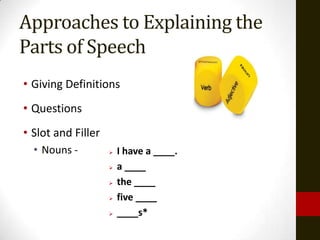
Approaches to Explaining the
Parts of Speech
• Giving Definitions
• Questions
• Slot and Filler
  • Nouns -            I have a ____.
                       a ____
                       the ____
                       five ____
                       ____s*
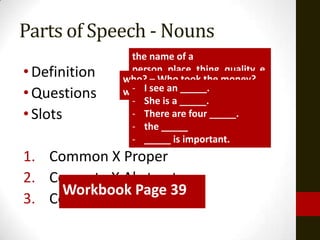
Parts of Speech - Nouns
                the name of a
• Definition    person, place, thing, quality, e
               who? – Who took the money?
                motion...
• Questions    what?see an _____. eat?
                - I – What did you
                - She is a _____.
• Slots         - There are four _____.
                - the _____
                - _____ is important.
1. Common X Proper
2. Concrete X Abstract
     Workbook Page 39
     ELLs’XUsual Errors?
3. Count Non-count
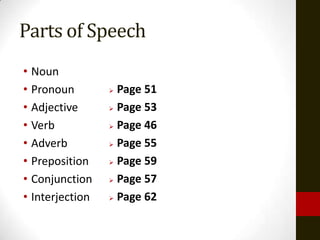
Parts of Speech
• Noun
• Pronoun         Page 51
• Adjective       Page 53

• Verb            Page 46

• Adverb          Page 55

• Preposition     Page 59

• Conjunction     Page 57

• Interjection    Page 62
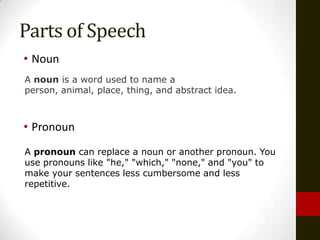
Parts of Speech
• Noun
A noun is a word used to name a
person, animal, place, thing, and abstract idea.


• Pronoun
A pronoun can replace a noun or another pronoun. You
use pronouns like "he," "which," "none," and "you" to
make your sentences less cumbersome and less
repetitive.
Parts of Speech
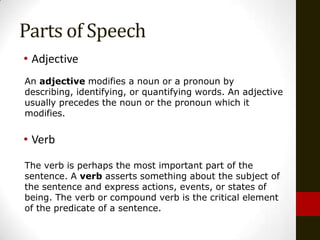
• Adjective
An adjective modifies a noun or a pronoun by
describing, identifying, or quantifying words. An adjective
usually precedes the noun or the pronoun which it
modifies.


• Verb

The verb is perhaps the most important part of the
sentence. A verb asserts something about the subject of
the sentence and express actions, events, or states of
being. The verb or compound verb is the critical element
of the predicate of a sentence.
Parts of Speech
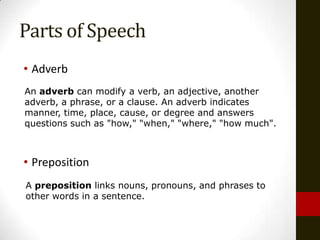
• Adverb
An adverb can modify a verb, an adjective, another
adverb, a phrase, or a clause. An adverb indicates
manner, time, place, cause, or degree and answers
questions such as "how," "when," "where," "how much".


• Preposition
A preposition links nouns, pronouns, and phrases to
other words in a sentence.
Parts of Speech
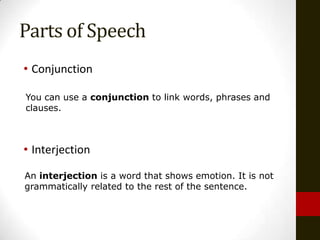
• Conjunction

You can use a conjunction to link words, phrases and
clauses.


• Interjection

An interjection is a word that shows emotion. It is not
grammatically related to the rest of the sentence.
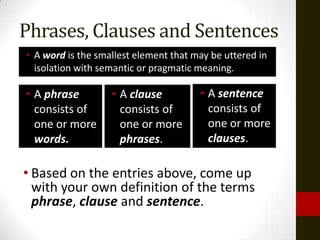
Phrases, Clauses and Sentences
• A word is the smallest element that may be uttered in
  isolation with semantic or pragmatic meaning.

• A phrase         • A clause          • A sentence
  consists of        consists of         consists of
  one or more        one or more         one or more
  words.             phrases.            clauses.

• Based on the entries above, come up
  with your own definition of the terms
  phrase, clause and sentence.
Phrases, Clauses and Sentences
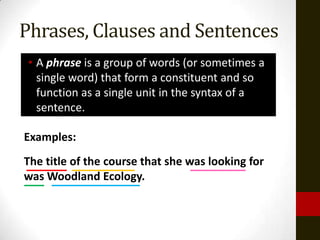
 • A phrase is a group of words (or sometimes a
   single word) that form a constituent and so
   function as a single unit in the syntax of a
   sentence.

Examples:
The title of the course that she was looking for
was Woodland Ecology.
Phrases, Clauses and Sentences
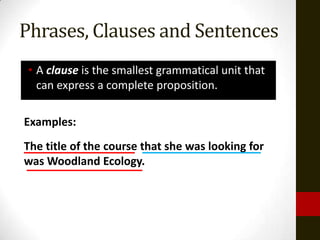
 • A clause is the smallest grammatical unit that
   can express a complete proposition.

Examples:
The title of the course that she was looking for
was Woodland Ecology.
Phrases, Clauses and Sentences
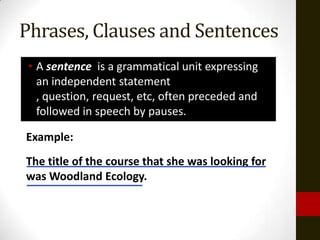
 • A sentence is a grammatical unit expressing
   an independent statement
   , question, request, etc, often preceded and
   followed in speech by pauses.

Example:
The title of the course that she was looking for
was Woodland Ecology.
Homework
Book:
- Pages 42 – 73 (Self-study)
    “Parts of Speech”

Workbook:
- Pages 38 – 62 (Self-study)
    “Parts of Speech”

Extra Exercise:
-   “Parts of Speech”
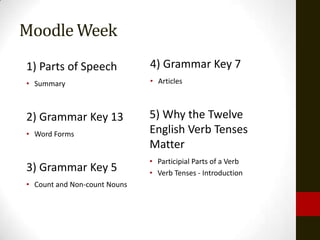
Moodle Week
1) Parts of Speech            4) Grammar Key 7
• Summary                     • Articles


2) Grammar Key 13             5) Why the Twelve
• Word Forms                  English Verb Tenses
                              Matter
                              • Participial Parts of a Verb
3) Grammar Key 5              • Verb Tenses - Introduction
• Count and Non-count Nouns

TDC 1 - Class 2

  • 1.
  • 2.
    Review  Definitions ofGrammar  English Studied by Native Speakers X English Studied as a Foreign Language  The History of English  Direct Approach X Indirect Approach  Prescriptive Grammar X Descriptive Grammar  Deductive Teaching X Inductive Teaching
  • 3.
    Parts of Speech •Noun • Pronoun • Adjective • Verb • Adverb • Preposition • Conjunction • Interjection
  • 4.
    Approaches to Explainingthe Parts of Speech • Giving Definitions • Questions • Slot and Filler • Nouns -  I have a ____.  a ____  the ____  five ____  ____s*
  • 5.
    Parts of Speech- Nouns the name of a • Definition person, place, thing, quality, e who? – Who took the money? motion... • Questions what?see an _____. eat? - I – What did you - She is a _____. • Slots - There are four _____. - the _____ - _____ is important. 1. Common X Proper 2. Concrete X Abstract Workbook Page 39 ELLs’XUsual Errors? 3. Count Non-count
  • 6.
    Parts of Speech •Noun • Pronoun  Page 51 • Adjective  Page 53 • Verb  Page 46 • Adverb  Page 55 • Preposition  Page 59 • Conjunction  Page 57 • Interjection  Page 62
  • 7.
    Parts of Speech •Noun A noun is a word used to name a person, animal, place, thing, and abstract idea. • Pronoun A pronoun can replace a noun or another pronoun. You use pronouns like "he," "which," "none," and "you" to make your sentences less cumbersome and less repetitive.
  • 8.
    Parts of Speech •Adjective An adjective modifies a noun or a pronoun by describing, identifying, or quantifying words. An adjective usually precedes the noun or the pronoun which it modifies. • Verb The verb is perhaps the most important part of the sentence. A verb asserts something about the subject of the sentence and express actions, events, or states of being. The verb or compound verb is the critical element of the predicate of a sentence.
  • 9.
    Parts of Speech •Adverb An adverb can modify a verb, an adjective, another adverb, a phrase, or a clause. An adverb indicates manner, time, place, cause, or degree and answers questions such as "how," "when," "where," "how much". • Preposition A preposition links nouns, pronouns, and phrases to other words in a sentence.
  • 10.
    Parts of Speech •Conjunction You can use a conjunction to link words, phrases and clauses. • Interjection An interjection is a word that shows emotion. It is not grammatically related to the rest of the sentence.
  • 11.
    Phrases, Clauses andSentences • A word is the smallest element that may be uttered in isolation with semantic or pragmatic meaning. • A phrase • A clause • A sentence consists of consists of consists of one or more one or more one or more words. phrases. clauses. • Based on the entries above, come up with your own definition of the terms phrase, clause and sentence.
  • 12.
    Phrases, Clauses andSentences • A phrase is a group of words (or sometimes a single word) that form a constituent and so function as a single unit in the syntax of a sentence. Examples: The title of the course that she was looking for was Woodland Ecology.
  • 13.
    Phrases, Clauses andSentences • A clause is the smallest grammatical unit that can express a complete proposition. Examples: The title of the course that she was looking for was Woodland Ecology.
  • 14.
    Phrases, Clauses andSentences • A sentence is a grammatical unit expressing an independent statement , question, request, etc, often preceded and followed in speech by pauses. Example: The title of the course that she was looking for was Woodland Ecology.
  • 15.
    Homework Book: - Pages 42– 73 (Self-study) “Parts of Speech” Workbook: - Pages 38 – 62 (Self-study) “Parts of Speech” Extra Exercise: - “Parts of Speech”
  • 16.
    Moodle Week 1) Partsof Speech 4) Grammar Key 7 • Summary • Articles 2) Grammar Key 13 5) Why the Twelve • Word Forms English Verb Tenses Matter • Participial Parts of a Verb 3) Grammar Key 5 • Verb Tenses - Introduction • Count and Non-count Nouns