
CASE ANALYSISCASE ANALYSIS
METHOD:METHOD:
ASSESSING THEASSESSING THE
EXTERNAL BUSINESSEXTERNAL BUSINESS
ENVIRONMENTENVIRONMENT
Prof.Stephen OngProf.Stephen Ong
BSc(Hons)Econs (LSE), MBABSc(Hons)Econs (LSE), MBA
(Bradford)(Bradford)
Visiting Professor, ShenzhenVisiting Professor, Shenzhen
UniversityUniversity
MBAMBA
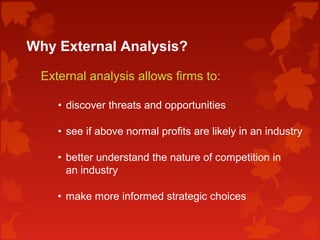
Why External Analysis?
External analysis allows firms to:
• discover threats and opportunities
• see if above normal profits are likely in an industry
• better understand the nature of competition in
an industry
• make more informed strategic choices
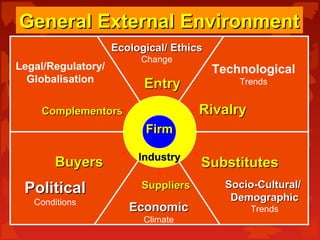
FirmFirm
BuyersBuyers
SuppliersSuppliers
EntryEntry
RivalryRivalry
SubstitutesSubstitutes
ComplementorsComplementors
Technological
Trends
Ecological/ EthicsEcological/ Ethics
Change
Socio-Cultural/Socio-Cultural/
DemographicDemographic
TrendsEconomicEconomic
Climate
PoliticalPolitical
Conditions
Legal/Regulatory/
Globalisation
IndustryIndustry
General External EnvironmentGeneral External Environment
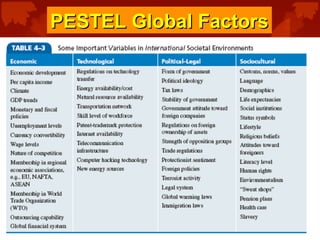
PESTELPESTEL
AnalysisAnalysis
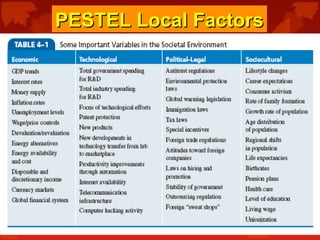
PESTEL Local FactorsPESTEL Local Factors
PESTEL Global FactorsPESTEL Global Factors
Porter’s 5 ForcesPorter’s 5 Forces
Industry AnalysisIndustry Analysis
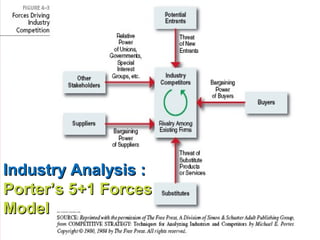
Industry Analysis :Industry Analysis :
Porter’s 5+1 ForcesPorter’s 5+1 Forces
ModelModel
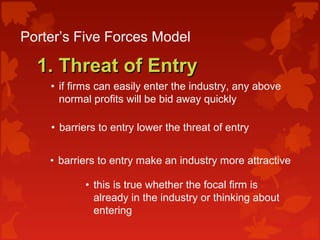
Porter’s Five Forces Model
1. Threat of Entry1. Threat of Entry
• if firms can easily enter the industry, any above
normal profits will be bid away quickly
• barriers to entry lower the threat of entry
• barriers to entry make an industry more attractive
• this is true whether the focal firm is
already in the industry or thinking about
entering
Porter’s Five Forces Model
1. Threat of Entry1. Threat of Entry
Barriers to Entry:
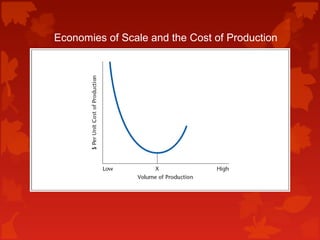
• economies of scale—firm that can’t produce
the minimum efficient scale will be at a
disadvantage
• product differentiation—entrants are forced to
overcome customer loyalties to existing products
• cost advantages independent of scale—incumbents
may have learning advantages, etc.
• government policies—governments may impose
trade restrictions and/or grant monopolies
Economies of Scale and the Cost of Production
Porter’s Five Forces Model
2. Threat of Rivalry2. Threat of Rivalry
• high rivalry means firms compete vigorously—and
compete away above average profits
Industry conditions that facilitate rivalry:
• large numbers of competitors
• slow or declining growth
• high fixed costs and/or high storage costs
• low product differentiation
• industry capacity added in large increments
Porter’s Five Forces Model
3. Threat of Substitutes3. Threat of Substitutes
• substitutes fill the same need but in a different way
- Coke and Pepsi are rivals, milk is a
substitute for both
• substitutes create a price ceiling because consumers
switch to the substitute if prices rise
• substitutes will likely come from outside the
industry—be sure to look
Porter’s Five Forces Model
4. Threat of Powerful Suppliers4. Threat of Powerful Suppliers
• powerful suppliers can ‘squeeze’ (lower profits)
the focal firm
Industry conditions that facilitate supplier power:
• small number of firms in supplier’s industry
• highly differentiated product
• lack of close substitutes for suppliers’ products
• supplier could integrate forward
• focal firm is an insignificant customer of supplier
Porter’s Five Forces Model
5. Threat of Powerful Buyers5. Threat of Powerful Buyers
• powerful buyers can ‘squeeze’ (lower profits)
the focal firm by demanding lower prices and/or
higher levels of quality and service
Industry conditions that facilitate buyer power:
• small number of buyers for focal firm’s output
• lack of a differentiated product
• the product is significant to the buyer
Porter’s Five Forces Model
5. Threat of Powerful Buyers5. Threat of Powerful Buyers
Industry conditions that facilitate buyer power:
• buyers operate in a competitive market—they are
not earning above normal profits
• buyers can vertically integrate backwards
• many small buyers can be united around an issue
to act as a block
Example: Monsanto’s Life Sciences Strategy
6. Other Stakeholders :6. Other Stakeholders :
Complementors As Another ForceComplementors As Another Force
Complementors Increase the Value of
the Firm’s Product
• customers perceive more value in the focal firm’s
product when it is combined with the complementor’s
product
• complementors may be found outside the focal firm’s
industry
Example: Goodyear Tires on Corvette
ReferencesReferences
• Johnson, Gerry, Whittington, Richard & Scholes,
Kevan (2011) Exploring Strategy, 9th edition, FT
Prentice Hall/Pearson UK.
• Barney, J.B. & Hesterley,W.S.(2012) Strategic
Management and Competitive Advantage, 4th
edition, Prentice Hall
• Wheelen & Hunger (2011) Essentials of Strategic
Management, 5th
edition, Pearson
• Porter, M.E., (2008) On Competition, Harvard
Business Press.

Mba case analysis pestel 5 forces 2015

  • 1.
    CASE ANALYSISCASE ANALYSIS METHOD:METHOD: ASSESSINGTHEASSESSING THE EXTERNAL BUSINESSEXTERNAL BUSINESS ENVIRONMENTENVIRONMENT Prof.Stephen OngProf.Stephen Ong BSc(Hons)Econs (LSE), MBABSc(Hons)Econs (LSE), MBA (Bradford)(Bradford) Visiting Professor, ShenzhenVisiting Professor, Shenzhen UniversityUniversity MBAMBA
  • 2.
    Why External Analysis? Externalanalysis allows firms to: • discover threats and opportunities • see if above normal profits are likely in an industry • better understand the nature of competition in an industry • make more informed strategic choices
  • 3.
  • 4.
  • 5.
  • 6.
  • 7.
    Porter’s 5 ForcesPorter’s5 Forces Industry AnalysisIndustry Analysis
  • 8.
    Industry Analysis :IndustryAnalysis : Porter’s 5+1 ForcesPorter’s 5+1 Forces ModelModel
  • 9.
    Porter’s Five ForcesModel 1. Threat of Entry1. Threat of Entry • if firms can easily enter the industry, any above normal profits will be bid away quickly • barriers to entry lower the threat of entry • barriers to entry make an industry more attractive • this is true whether the focal firm is already in the industry or thinking about entering
  • 10.
    Porter’s Five ForcesModel 1. Threat of Entry1. Threat of Entry Barriers to Entry: • economies of scale—firm that can’t produce the minimum efficient scale will be at a disadvantage • product differentiation—entrants are forced to overcome customer loyalties to existing products • cost advantages independent of scale—incumbents may have learning advantages, etc. • government policies—governments may impose trade restrictions and/or grant monopolies
  • 11.
    Economies of Scaleand the Cost of Production
  • 12.
    Porter’s Five ForcesModel 2. Threat of Rivalry2. Threat of Rivalry • high rivalry means firms compete vigorously—and compete away above average profits Industry conditions that facilitate rivalry: • large numbers of competitors • slow or declining growth • high fixed costs and/or high storage costs • low product differentiation • industry capacity added in large increments
  • 13.
    Porter’s Five ForcesModel 3. Threat of Substitutes3. Threat of Substitutes • substitutes fill the same need but in a different way - Coke and Pepsi are rivals, milk is a substitute for both • substitutes create a price ceiling because consumers switch to the substitute if prices rise • substitutes will likely come from outside the industry—be sure to look
  • 14.
    Porter’s Five ForcesModel 4. Threat of Powerful Suppliers4. Threat of Powerful Suppliers • powerful suppliers can ‘squeeze’ (lower profits) the focal firm Industry conditions that facilitate supplier power: • small number of firms in supplier’s industry • highly differentiated product • lack of close substitutes for suppliers’ products • supplier could integrate forward • focal firm is an insignificant customer of supplier
  • 15.
    Porter’s Five ForcesModel 5. Threat of Powerful Buyers5. Threat of Powerful Buyers • powerful buyers can ‘squeeze’ (lower profits) the focal firm by demanding lower prices and/or higher levels of quality and service Industry conditions that facilitate buyer power: • small number of buyers for focal firm’s output • lack of a differentiated product • the product is significant to the buyer
  • 16.
    Porter’s Five ForcesModel 5. Threat of Powerful Buyers5. Threat of Powerful Buyers Industry conditions that facilitate buyer power: • buyers operate in a competitive market—they are not earning above normal profits • buyers can vertically integrate backwards • many small buyers can be united around an issue to act as a block Example: Monsanto’s Life Sciences Strategy
  • 17.
    6. Other Stakeholders:6. Other Stakeholders : Complementors As Another ForceComplementors As Another Force Complementors Increase the Value of the Firm’s Product • customers perceive more value in the focal firm’s product when it is combined with the complementor’s product • complementors may be found outside the focal firm’s industry Example: Goodyear Tires on Corvette
  • 18.
    ReferencesReferences • Johnson, Gerry,Whittington, Richard & Scholes, Kevan (2011) Exploring Strategy, 9th edition, FT Prentice Hall/Pearson UK. • Barney, J.B. & Hesterley,W.S.(2012) Strategic Management and Competitive Advantage, 4th edition, Prentice Hall • Wheelen & Hunger (2011) Essentials of Strategic Management, 5th edition, Pearson • Porter, M.E., (2008) On Competition, Harvard Business Press.