




Startup Growth
Strategy
‫حیم‬ ‫ه‬‫الر‬ ‫حمن‬ ‫ه‬‫الر‬ ‫ه‬‫اّلل‬ ‫بسم‬
Mohammad Milani
ElecomTalks 2019
Startup Growth
Strategy
Startup is a young
company, has stablished by
one or some peoples to
build a high return
business.
Types:
• Born to be big
• Born to be bought
Startup Growth
Strategy
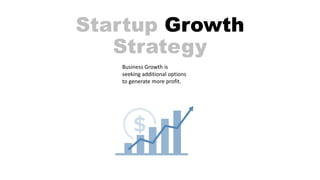
Business Growth is
seeking additional options
to generate more profit.
Startup Growth
Strategy
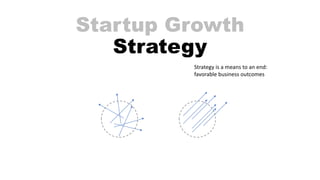
Strategy is a means to an end:
favorable business outcomes
Startup Growth
Strategy
Which Strategic approach is appropriate for growing up a startup?
1. Before Growth
Get Proofed!
1-1. Solution/Problem Fit
• Customer Discovery: the objective is to take the startup founder’s
vision and list out the assumptions that must be proven true in order
to successfully execute. By listing and then prioritizing the
assumptions, the team can decide which are the most critical ones
that need to be tested first. They can conduct research and design
experiments to test hypotheses and gather real-world evidence
• Value Hypothesis: “A value hypothesis is an attempt to articulate the
key assumption that underlies why a customer is likely to use your
product” Andy Rachleff
1-2. Product/Market Fit
• “Product/market fit means being in a good market with a product
that can satisfy that market.” Mark Andreessen
• “It does not mean launching the product. It means getting to the
point where the market accepts your product and wants more of
it.” Fred Wilson
• PMF starts with MVP
• PMF is an art rather than a science
1-2. Product/Market Fit
• How to Measure Product/Market Fit?
• Are you growing organically?
• What shows the conversion rates?
• Do your Customers Recommend you to Friends?*
• Do customers care if your company died tomorrow?
• How Many Customers Leave & How Soon?
Ref: https://medium.com/evergreen-business-weekly/product-market-fit-what-it-really-means-how-to-measure-it-and-where-to-find-it-70e746be907b
* NPS (Net Promoter Score)
2. Focus on growth and
Penetrate the
Market
Market Penetration
Market penetration involves focusing on
selling your existing products or services
into your existing markets
to gain a higher market share.
Ref: www.free-management-ebooks.com
4 Ways:
• maintaining or increasing the market share of current products
• increasing usage by existing customers
• securing dominance of growth markets
• restructuring a mature market by driving out competitors
Ref: www.free-management-ebooks.com
• Selling more products or services to established customers
• Finding new customers within existing markets.
• This can be accomplished by:
• Price decrease
• Increase in promotion and distribution support
• Acquisition of a rival in the same market
• Modest product refinements
3. Grow even more…
Expand
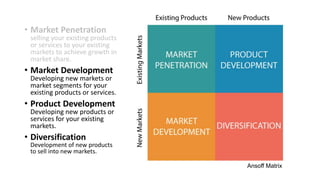
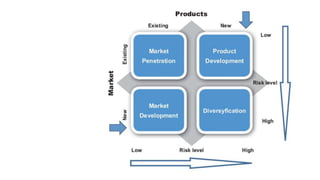
Ansoff Matrix
• Market Penetration
selling your existing products
or services to your existing
markets to achieve growth in
market share.
• Market Development
Developing new markets or
market segments for your
existing products or services.
• Product Development
Developing new products or
services for your existing
markets.
• Diversification
Development of new products
to sell into new markets.
Market development
• A company tries to expand into new markets using its existing offerings and
also, with minimal product/services development.
• This can be accomplished by:
• Different customer segments
• Industrial buyers for a good that was previously sold only to the households;
• New areas or regions of the country
• Foreign markets.
• This strategy is more likely to be successful where:
• The firm has a unique product technology it can leverage in the new market
• It benefits from economies of scale if it increases output
• The new market is not too different from the one it has experience of
• The buyers in the market are intrinsically profitable.
Product development
• A company tries to create new products and services targeted at its
existing markets to achieve growth. This involves extending the
product range available to the firm's existing markets.
• These products may be obtained by:
• Investment in research and development of additional products;
• Acquisition of rights to produce someone else's product;
• Buying in the product and “badging” it as one’s own brand;
• Joint development with ownership of another company who need access to
the firm's distribution channels or brands.
Diversification
• A company tries to introduce new offerings in new markets.
• Related Diversification: there is relationship and, therefore, potential
synergy, between the firms in existing business and the new
product/market space. Concentric diversification, and Vertical
integration.
• Unrelated Diversification: This is otherwise termed conglomerate
growth because the resulting corporation is a conglomerate, i.e. a
collection of businesses without any relationship to one another. A
strategy for company growth by starting up or acquiring businesses
outside the company’s current products and markets.
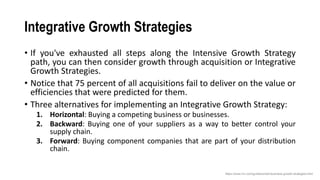
Integrative Growth Strategies
• If you've exhausted all steps along the Intensive Growth Strategy
path, you can then consider growth through acquisition or Integrative
Growth Strategies.
• Notice that 75 percent of all acquisitions fail to deliver on the value or
efficiencies that were predicted for them.
• Three alternatives for implementing an Integrative Growth Strategy:
1. Horizontal: Buying a competing business or businesses.
2. Backward: Buying one of your suppliers as a way to better control your
supply chain.
3. Forward: Buying component companies that are part of your distribution
chain.
https://www.inc.com/guides/small-business-growth-strategies.html
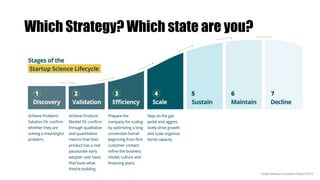
Which Strategy? Which state are you?
Global Startup Ecosystem Report 2019
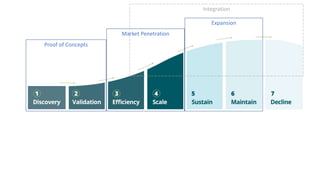
Proof of Concepts
Market Penetration
Expansion
Integration
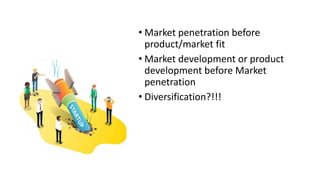
Strategic mistakes that
kill your startup
• Market penetration before
product/market fit
• Market development or product
development before Market
penetration
• Diversification?!!!
• Prematurity
“Startups need 2-3 times longer to validate
their market than most founders expect. This
underestimation creates the pressure to scale
prematurely”
“70% of startups scaled prematurely along
some dimension. While this number seemed
high, this may go a long way towards
explaining the 90% failure rate of startups.”
Startup Genome
Find your own path…

Startup Growth Strategy

  • 1.
    Startup Growth Strategy ‫حیم‬ ‫ه‬‫الر‬‫حمن‬ ‫ه‬‫الر‬ ‫ه‬‫اّلل‬ ‫بسم‬ Mohammad Milani ElecomTalks 2019
  • 2.
    Startup Growth Strategy Startup isa young company, has stablished by one or some peoples to build a high return business. Types: • Born to be big • Born to be bought
  • 3.
    Startup Growth Strategy Business Growthis seeking additional options to generate more profit.
  • 4.
    Startup Growth Strategy Strategy isa means to an end: favorable business outcomes
  • 5.
    Startup Growth Strategy Which Strategicapproach is appropriate for growing up a startup?
  • 6.
  • 7.
    1-1. Solution/Problem Fit •Customer Discovery: the objective is to take the startup founder’s vision and list out the assumptions that must be proven true in order to successfully execute. By listing and then prioritizing the assumptions, the team can decide which are the most critical ones that need to be tested first. They can conduct research and design experiments to test hypotheses and gather real-world evidence • Value Hypothesis: “A value hypothesis is an attempt to articulate the key assumption that underlies why a customer is likely to use your product” Andy Rachleff
  • 8.
    1-2. Product/Market Fit •“Product/market fit means being in a good market with a product that can satisfy that market.” Mark Andreessen • “It does not mean launching the product. It means getting to the point where the market accepts your product and wants more of it.” Fred Wilson • PMF starts with MVP • PMF is an art rather than a science
  • 9.
    1-2. Product/Market Fit •How to Measure Product/Market Fit? • Are you growing organically? • What shows the conversion rates? • Do your Customers Recommend you to Friends?* • Do customers care if your company died tomorrow? • How Many Customers Leave & How Soon? Ref: https://medium.com/evergreen-business-weekly/product-market-fit-what-it-really-means-how-to-measure-it-and-where-to-find-it-70e746be907b * NPS (Net Promoter Score)
  • 10.
    2. Focus ongrowth and Penetrate the Market
  • 11.
    Market Penetration Market penetrationinvolves focusing on selling your existing products or services into your existing markets to gain a higher market share. Ref: www.free-management-ebooks.com
  • 12.
    4 Ways: • maintainingor increasing the market share of current products • increasing usage by existing customers • securing dominance of growth markets • restructuring a mature market by driving out competitors Ref: www.free-management-ebooks.com
  • 13.
    • Selling moreproducts or services to established customers • Finding new customers within existing markets. • This can be accomplished by: • Price decrease • Increase in promotion and distribution support • Acquisition of a rival in the same market • Modest product refinements
  • 14.
    3. Grow evenmore… Expand
  • 15.
    Ansoff Matrix • MarketPenetration selling your existing products or services to your existing markets to achieve growth in market share. • Market Development Developing new markets or market segments for your existing products or services. • Product Development Developing new products or services for your existing markets. • Diversification Development of new products to sell into new markets.
  • 16.
    Market development • Acompany tries to expand into new markets using its existing offerings and also, with minimal product/services development. • This can be accomplished by: • Different customer segments • Industrial buyers for a good that was previously sold only to the households; • New areas or regions of the country • Foreign markets. • This strategy is more likely to be successful where: • The firm has a unique product technology it can leverage in the new market • It benefits from economies of scale if it increases output • The new market is not too different from the one it has experience of • The buyers in the market are intrinsically profitable.
  • 17.
    Product development • Acompany tries to create new products and services targeted at its existing markets to achieve growth. This involves extending the product range available to the firm's existing markets. • These products may be obtained by: • Investment in research and development of additional products; • Acquisition of rights to produce someone else's product; • Buying in the product and “badging” it as one’s own brand; • Joint development with ownership of another company who need access to the firm's distribution channels or brands.
  • 18.
    Diversification • A companytries to introduce new offerings in new markets. • Related Diversification: there is relationship and, therefore, potential synergy, between the firms in existing business and the new product/market space. Concentric diversification, and Vertical integration. • Unrelated Diversification: This is otherwise termed conglomerate growth because the resulting corporation is a conglomerate, i.e. a collection of businesses without any relationship to one another. A strategy for company growth by starting up or acquiring businesses outside the company’s current products and markets.
  • 20.
    Integrative Growth Strategies •If you've exhausted all steps along the Intensive Growth Strategy path, you can then consider growth through acquisition or Integrative Growth Strategies. • Notice that 75 percent of all acquisitions fail to deliver on the value or efficiencies that were predicted for them. • Three alternatives for implementing an Integrative Growth Strategy: 1. Horizontal: Buying a competing business or businesses. 2. Backward: Buying one of your suppliers as a way to better control your supply chain. 3. Forward: Buying component companies that are part of your distribution chain. https://www.inc.com/guides/small-business-growth-strategies.html
  • 21.
    Which Strategy? Whichstate are you? Global Startup Ecosystem Report 2019
  • 22.
    Proof of Concepts MarketPenetration Expansion Integration
  • 23.
  • 24.
    • Market penetrationbefore product/market fit • Market development or product development before Market penetration • Diversification?!!!
  • 25.
    • Prematurity “Startups need2-3 times longer to validate their market than most founders expect. This underestimation creates the pressure to scale prematurely” “70% of startups scaled prematurely along some dimension. While this number seemed high, this may go a long way towards explaining the 90% failure rate of startups.” Startup Genome
  • 26.

Editor's Notes

  • #7 استراتژی به چه درد می‌خورد؟
  • #8 https://valuer.ai/blog/customer-discovery-the-hidden-key-to-a-successful-startup/
  • #9 “If you address a market that really wants your product — if the dogs are eating the dog food — then you can screw up almost everything in the company and you will succeed. Conversely, if you’re really good at execution but the dogs don’t want to eat the dog food, you have no chance of winning.” Andy Rachleff
  • #13 Maintain or increase the market share of current products You can achieve this by adopting a strategy that is made up of a combination of competitive pricing strategies, advertising, and sales promotion. This would involve focusing on the areas of sales and marketing responsible for managing the pricing and promotion of the product. Secure dominance of growth markets Another approach you could take is identify a new demographic for your product, for example another age group. An excellent example of such a strategy would be for you to identify a change in the age distribution of your product users and to then aggressively market your product to this age group. This was exactly what happened in the cell phone market when it was realized that teenagers were emerging as a key demographic. Previously it had been users in their 20s who were seen as the biggest group of first-time users. Substantial growth in market share and dominance in this sector was achieved by ensuring cell phone companies' promotions met the needs of this younger group. Your role in the discussion senior executives will have in defining their strategy is that of providing the market intelligence or customer feedback that helps to inform the executive team of the current dynamics of the market. The data you provide will help the team decide whether a growth market is an extension of the current market or is truly a 'new' market. This decision is likely to be based on how your organization is going to approach this growth market. If the team's chosen approach defines the growth market as a 'new' one then a market penetration strategy will be replaced with one of market development, which is covered in the next section. Restructure a mature market by driving out competitors Many organizations find themselves in a mature or saturated market and to achieve further market share requires a different approach. This strategy requires an aggressive promotional campaign, supported by a pricing strategy designed to make the market unattractive for smaller competitors. With a mature market there are no more demographic sectors to exploit and the only way to attain market share is to take it from competitors. Examples of this strategy can be seen in the newspaper, telecoms, and cable TV industries, where the larger players now dominate. Another good example is the rapid growth of the supermarket chains, which have taken market share from small high street grocers who are unable to compete on price and product range. More recently there has been the introduction of loyalty campaigns, where the supermarkets compete for market share through customer loyalty programs. Increase usage by existing customers Another approach to market penetration is to persuade your existing customers to use your product or service more frequently. There are several tactics you could use to do this, including loyalty schemes, adding value to the current product, or making alterations to the product that encourage greater use. The tactics of this approach all aim to 'tie in' your customers to your product or service by making it more difficult for them to move to another supplier. The ability of your organization to achieve higher usage by customers can be greatly enhanced by rapidly changing technologies that encourage users to upgrade or that offer more reasons to use the product or service. A good example of this would be cell phones: models are now upgraded every six to 12 months with the addition of new features and capabilities. Ref: http://www.free-management-ebooks.com/faqst/ansoff-02.htm#ixzz5tdDRNuJy
  • #16 Intensive Growth Strategies
  • #17 Ref: http://www.free-management-ebooks.com/faqst/ansoff-01.htm#ixzz5tdDjAEM2