
VALUATION I :VALUATION I :
PROCESS,PROCESS,
TERMSHEET &TERMSHEET &
PREFERREDPREFERRED
STOCKSTOCK
Prof.Stephen OngProf.Stephen Ong
BSc(Hons)Econs (LSE), MBA (Bradford)BSc(Hons)Econs (LSE), MBA (Bradford)
Visiting Professor, Shenzhen UniversityVisiting Professor, Shenzhen University
Academic Fellow, Entrepreneurship & Innovation,Academic Fellow, Entrepreneurship & Innovation,
The Lord Ashcroft International Business School,The Lord Ashcroft International Business School,
Anglia Ruskin University Cambridge UKAnglia Ruskin University Cambridge UK
MSC TECHNOPRENEURSHIP :MSC TECHNOPRENEURSHIP :
VENTURE CAPITAL FINANCINGVENTURE CAPITAL FINANCING
Today’s OverviewToday’s Overview
LEARNING OBJECTIVESLEARNING OBJECTIVES
To analyse the investment process byTo analyse the investment process by
VC;VC;
To understand the features of a VCTo understand the features of a VC
term sheet;term sheet;
To discuss the different types ofTo discuss the different types of
preferred stock structures and theirpreferred stock structures and their
anti-dilution protection for investors.anti-dilution protection for investors.
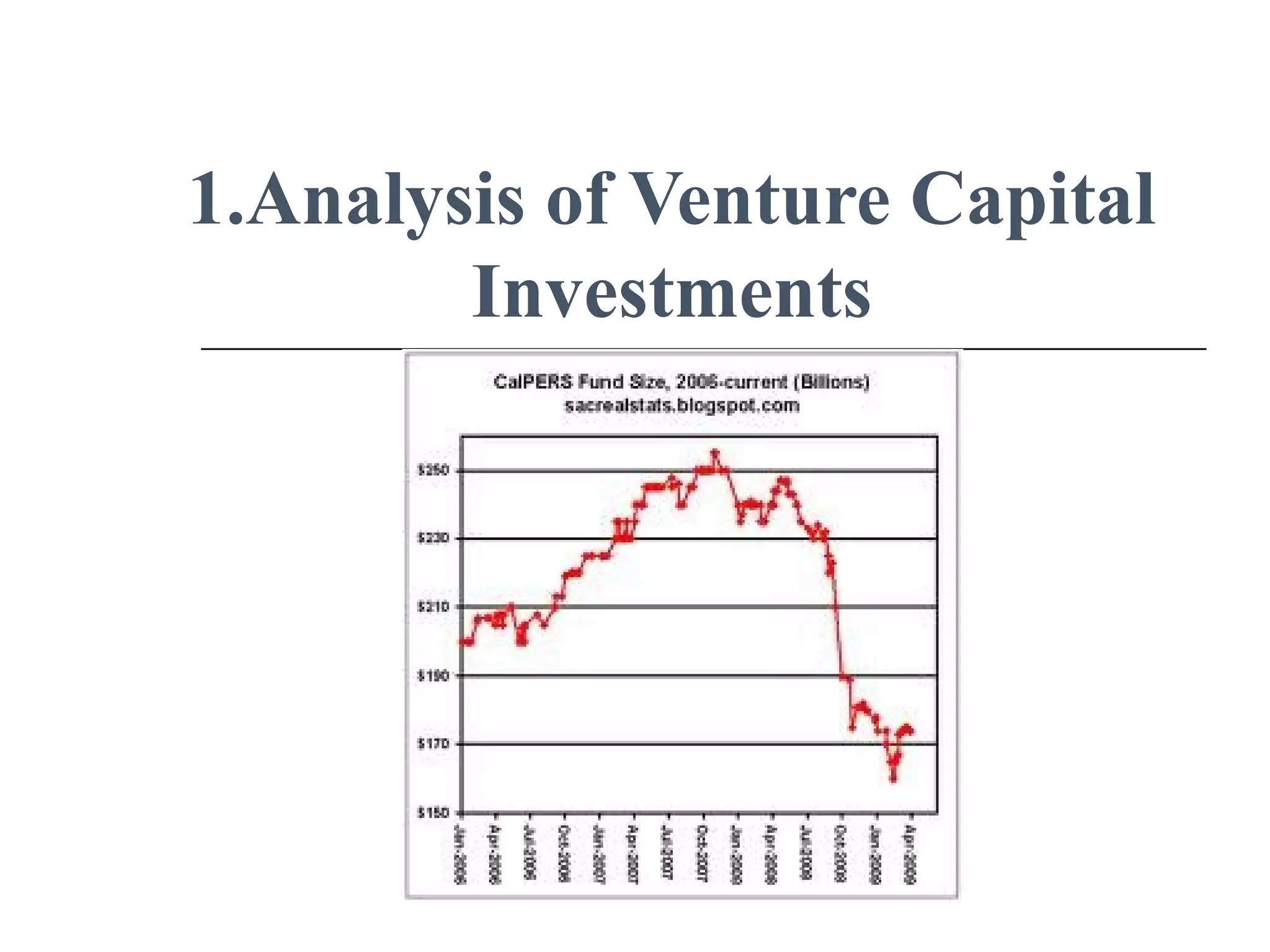
1.Analysis of Venture Capital
Investments
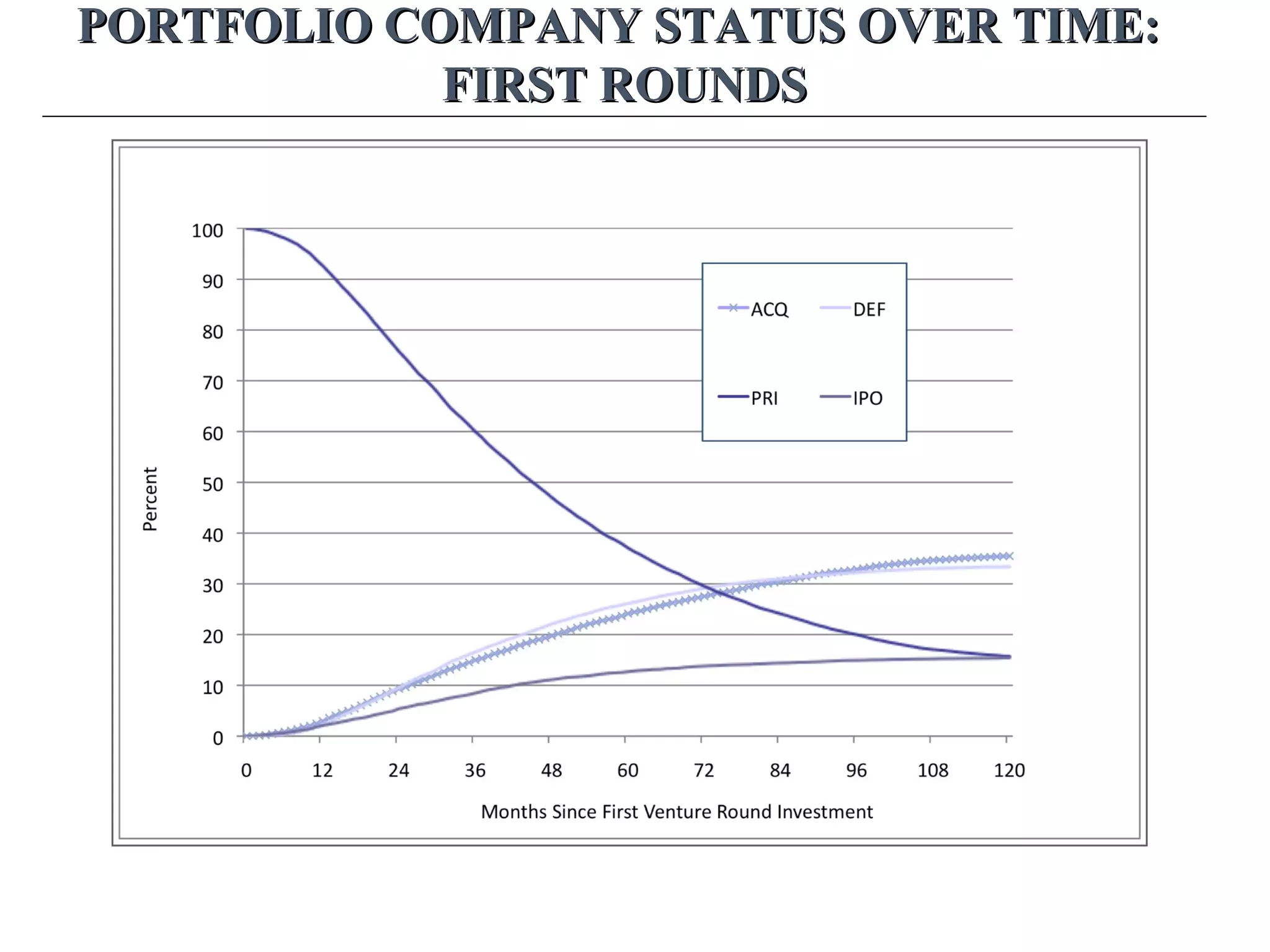
PORTFOLIO COMPANY STATUS OVER TIME:PORTFOLIO COMPANY STATUS OVER TIME:
FIRST ROUNDSFIRST ROUNDS
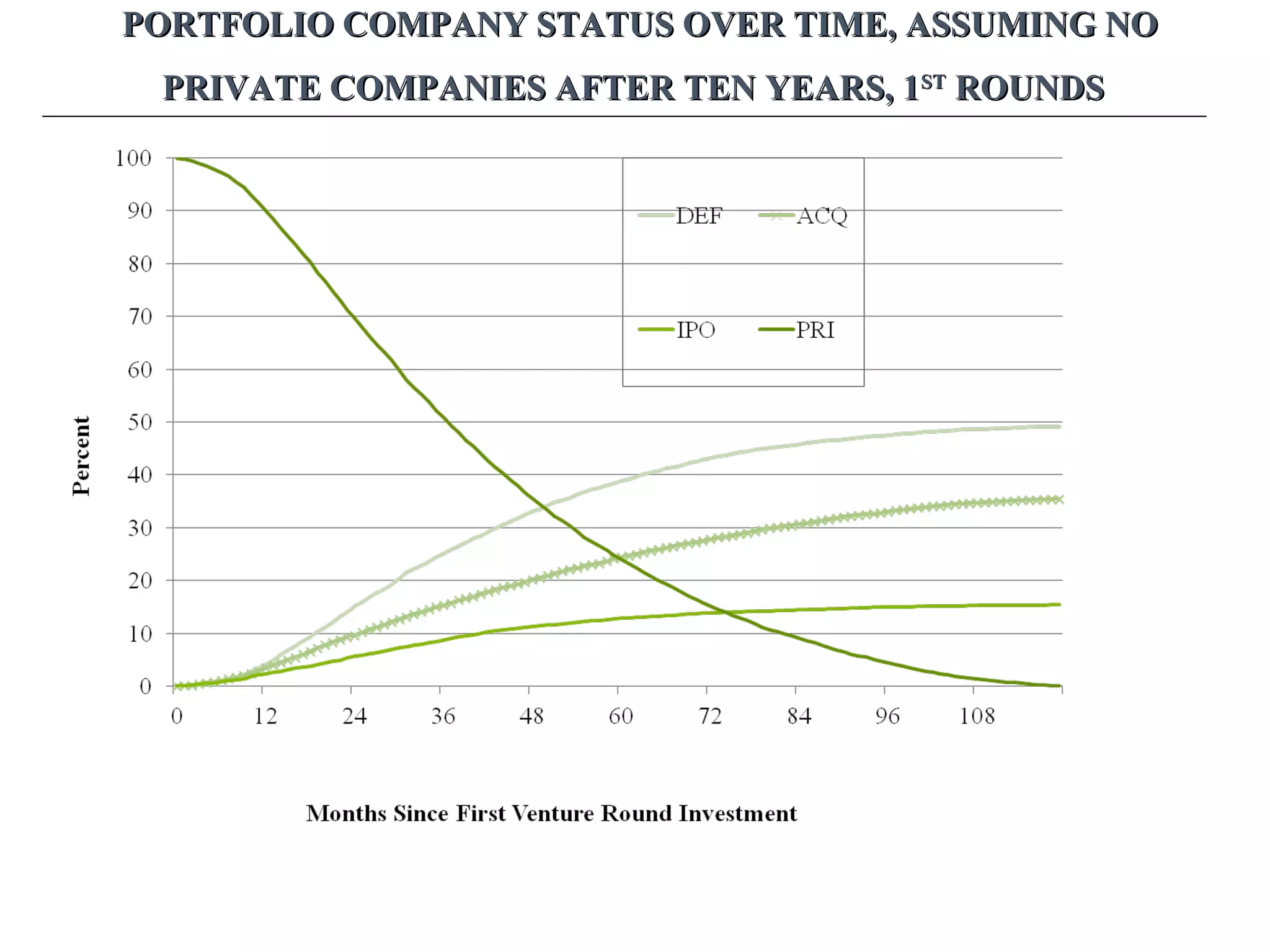
PORTFOLIO COMPANY STATUS OVER TIME, ASSUMING NOPORTFOLIO COMPANY STATUS OVER TIME, ASSUMING NO
PRIVATE COMPANIES AFTER TEN YEARS, 1PRIVATE COMPANIES AFTER TEN YEARS, 1STST
ROUNDSROUNDS
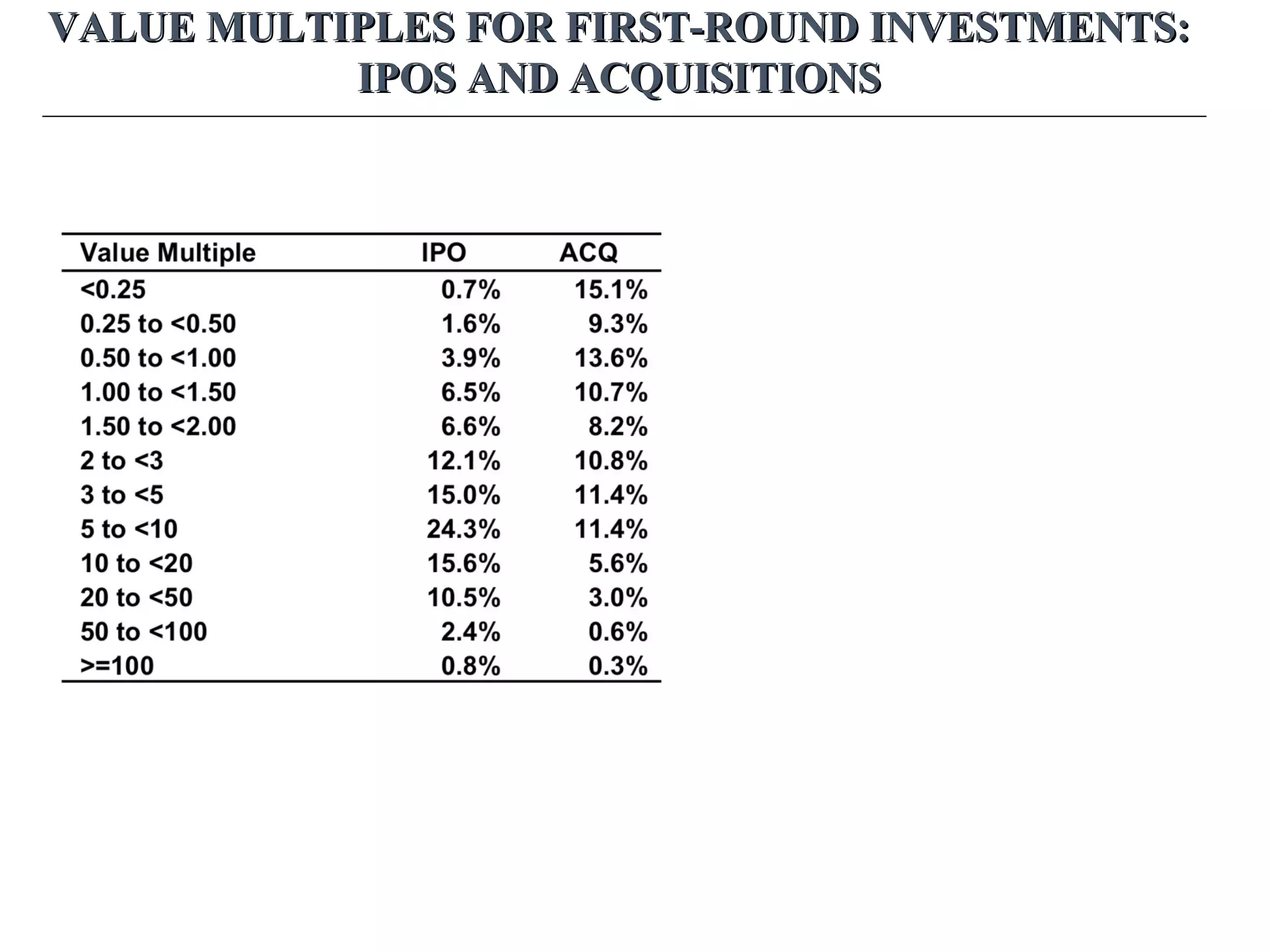
VALUE MULTIPLES FOR FIRST-ROUND INVESTMENTS:VALUE MULTIPLES FOR FIRST-ROUND INVESTMENTS:
IPOS AND ACQUISITIONSIPOS AND ACQUISITIONS
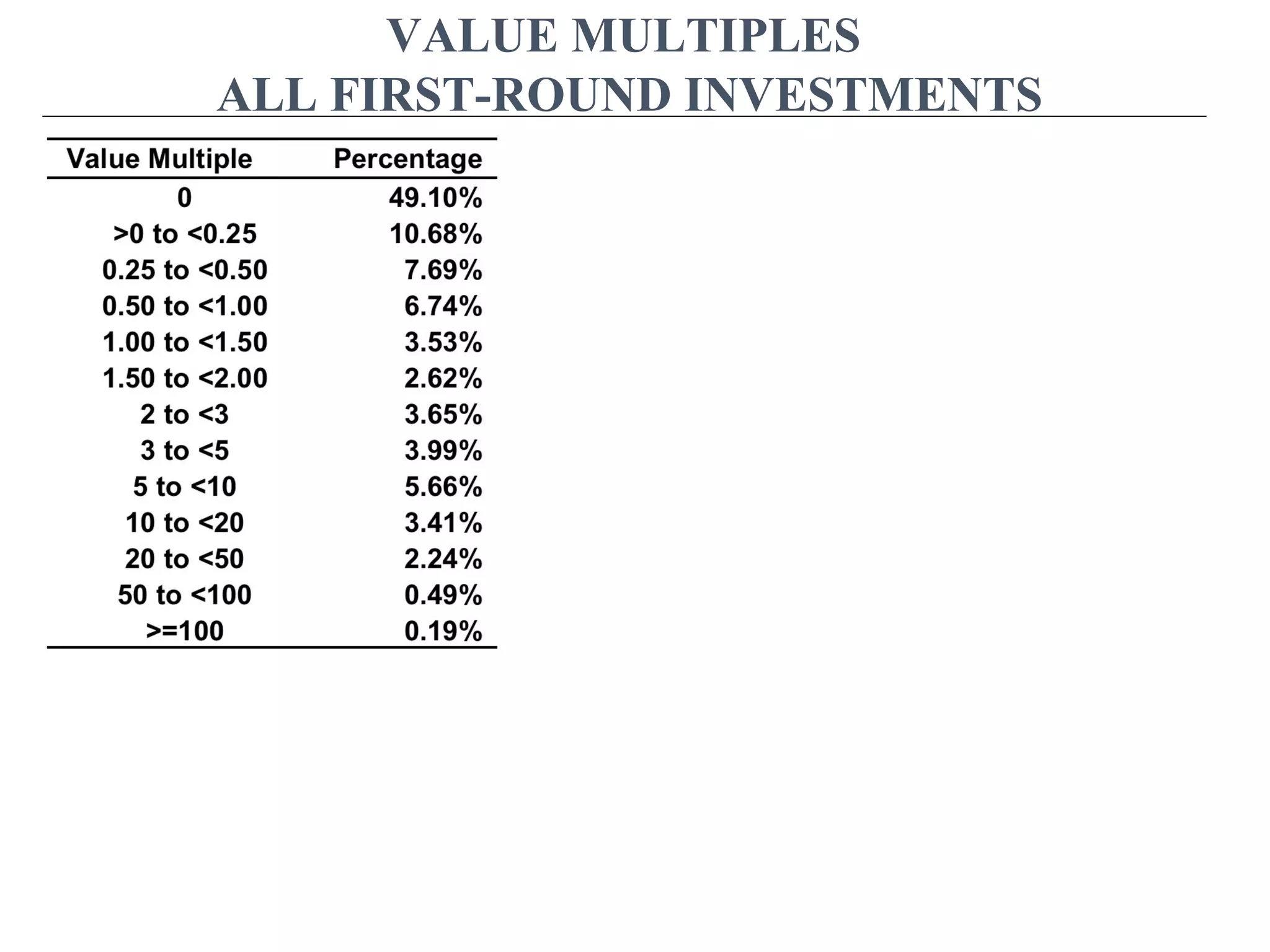
VALUE MULTIPLES
ALL FIRST-ROUND INVESTMENTS
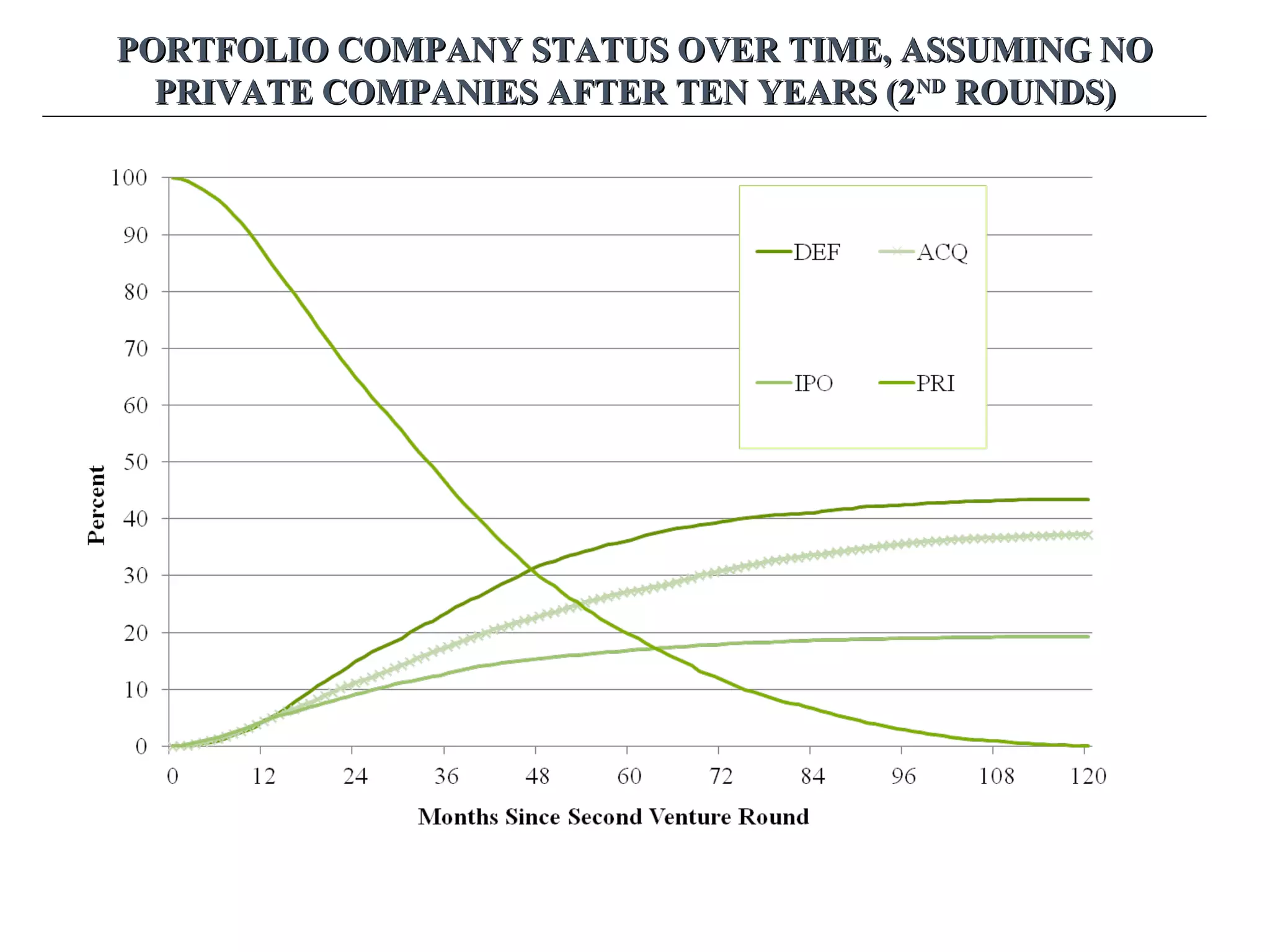
PORTFOLIO COMPANY STATUS OVER TIME, ASSUMING NOPORTFOLIO COMPANY STATUS OVER TIME, ASSUMING NO
PRIVATE COMPANIES AFTER TEN YEARS (2PRIVATE COMPANIES AFTER TEN YEARS (2NDND
ROUNDS)ROUNDS)
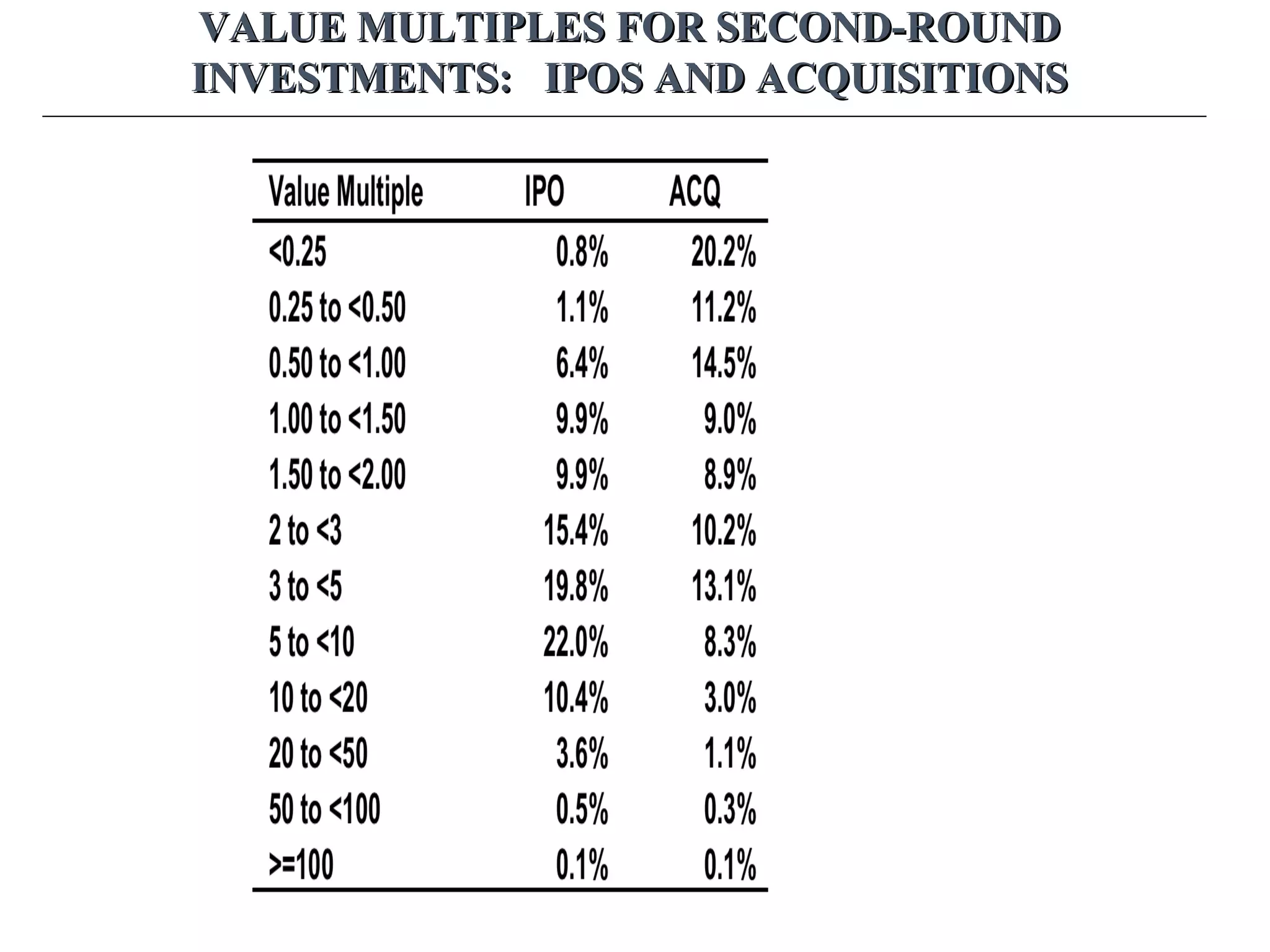
VALUE MULTIPLES FOR SECOND-ROUNDVALUE MULTIPLES FOR SECOND-ROUND
INVESTMENTS: IPOS AND ACQUISITIONSINVESTMENTS: IPOS AND ACQUISITIONS
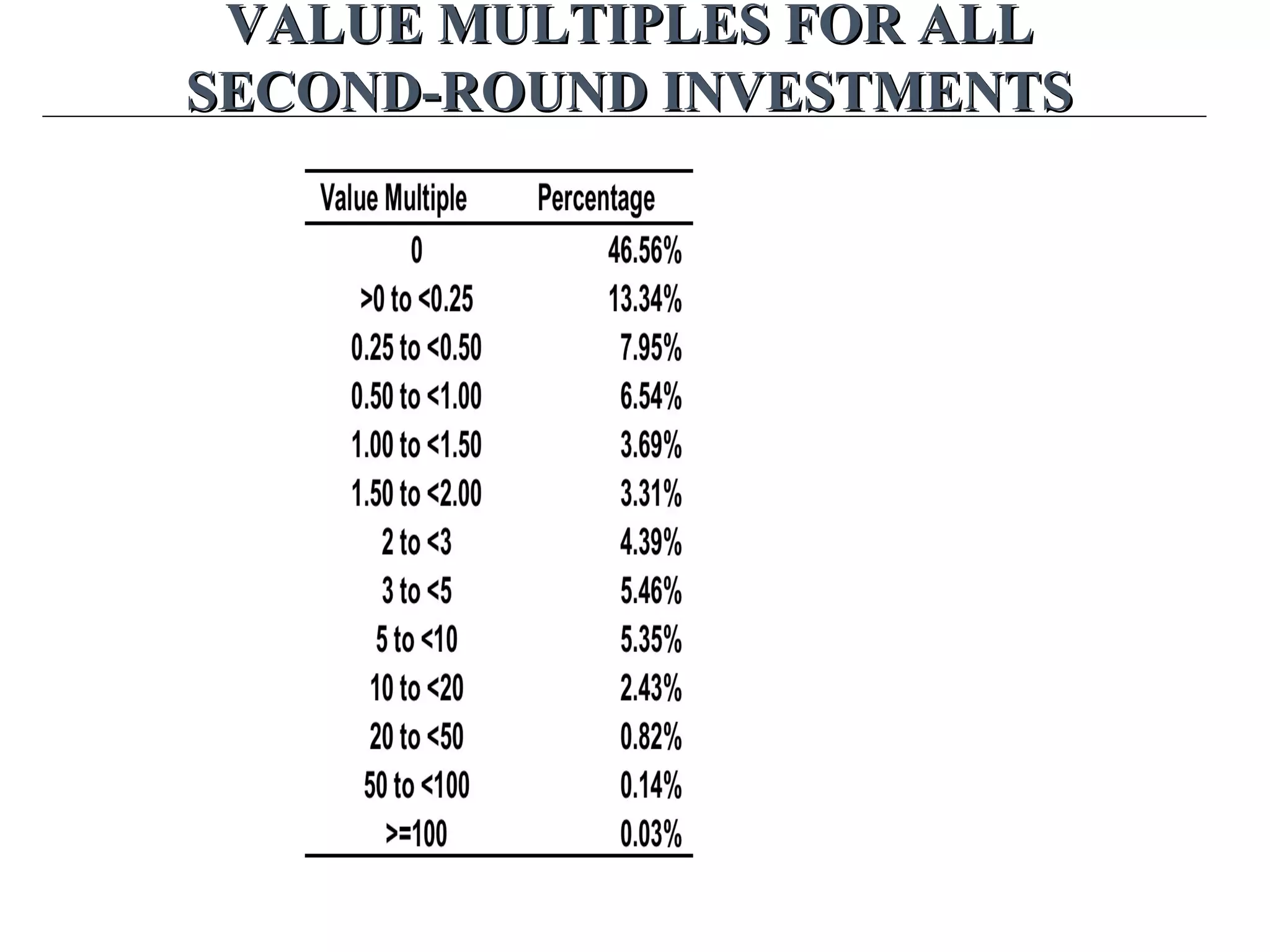
VALUE MULTIPLES FOR ALLVALUE MULTIPLES FOR ALL
SECOND-ROUND INVESTMENTSSECOND-ROUND INVESTMENTS
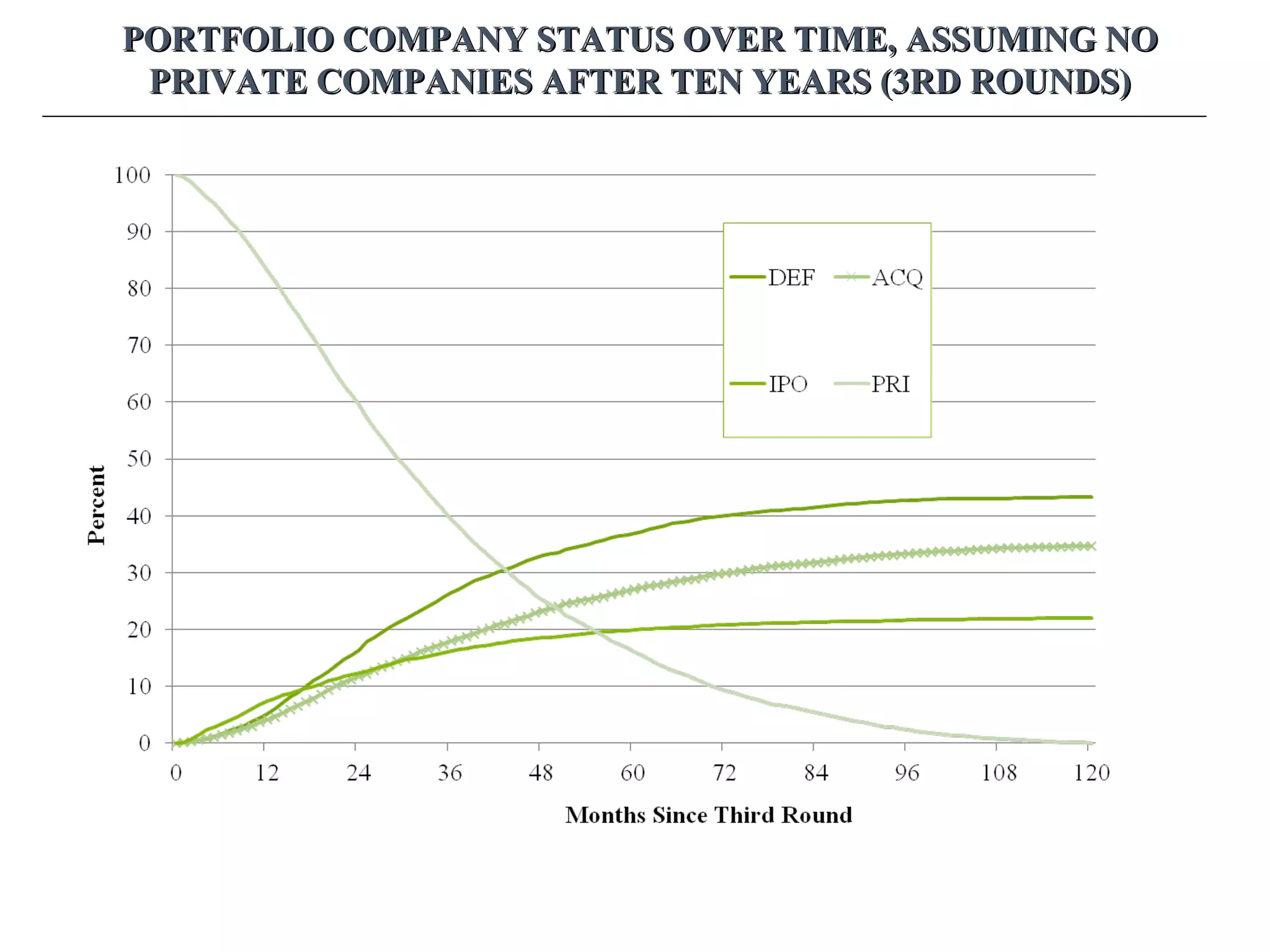
PORTFOLIO COMPANY STATUS OVER TIME, ASSUMING NOPORTFOLIO COMPANY STATUS OVER TIME, ASSUMING NO
PRIVATE COMPANIES AFTER TEN YEARS (3RD ROUNDS)PRIVATE COMPANIES AFTER TEN YEARS (3RD ROUNDS)
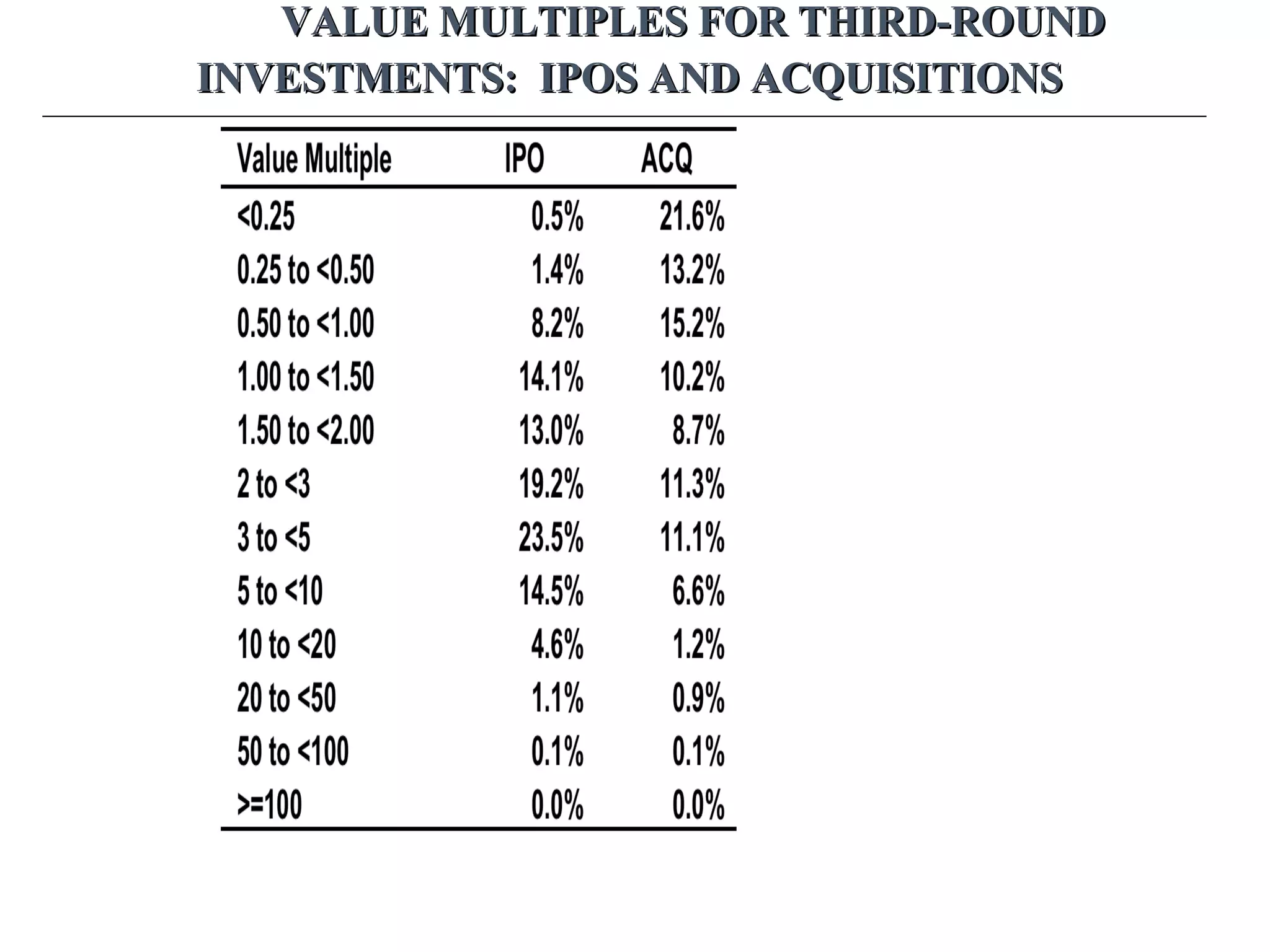
VALUE MULTIPLES FOR THIRD-ROUNDVALUE MULTIPLES FOR THIRD-ROUND
INVESTMENTS: IPOS AND ACQUISITIONSINVESTMENTS: IPOS AND ACQUISITIONS
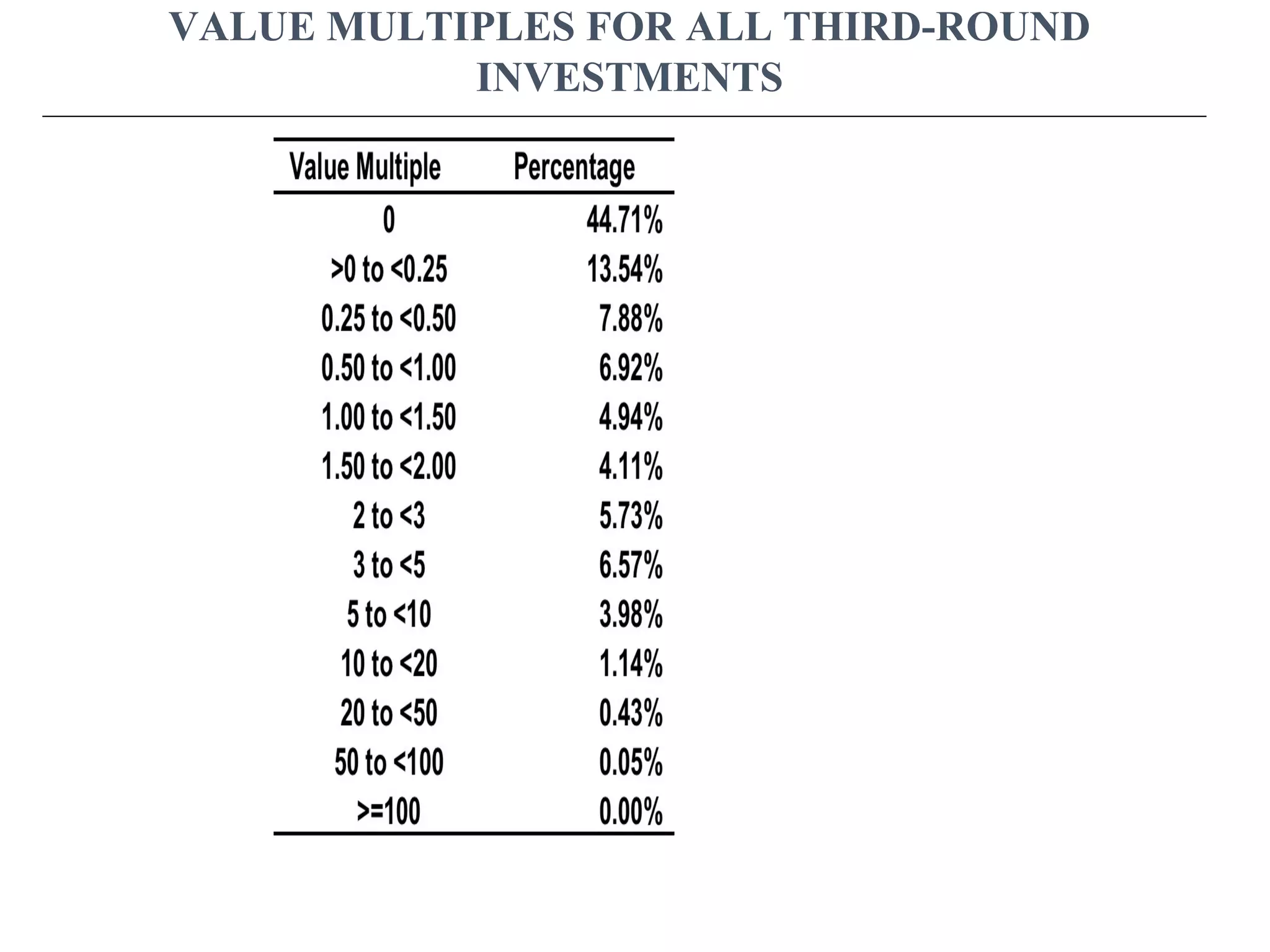
VALUE MULTIPLES FOR ALL THIRD-ROUND
INVESTMENTS
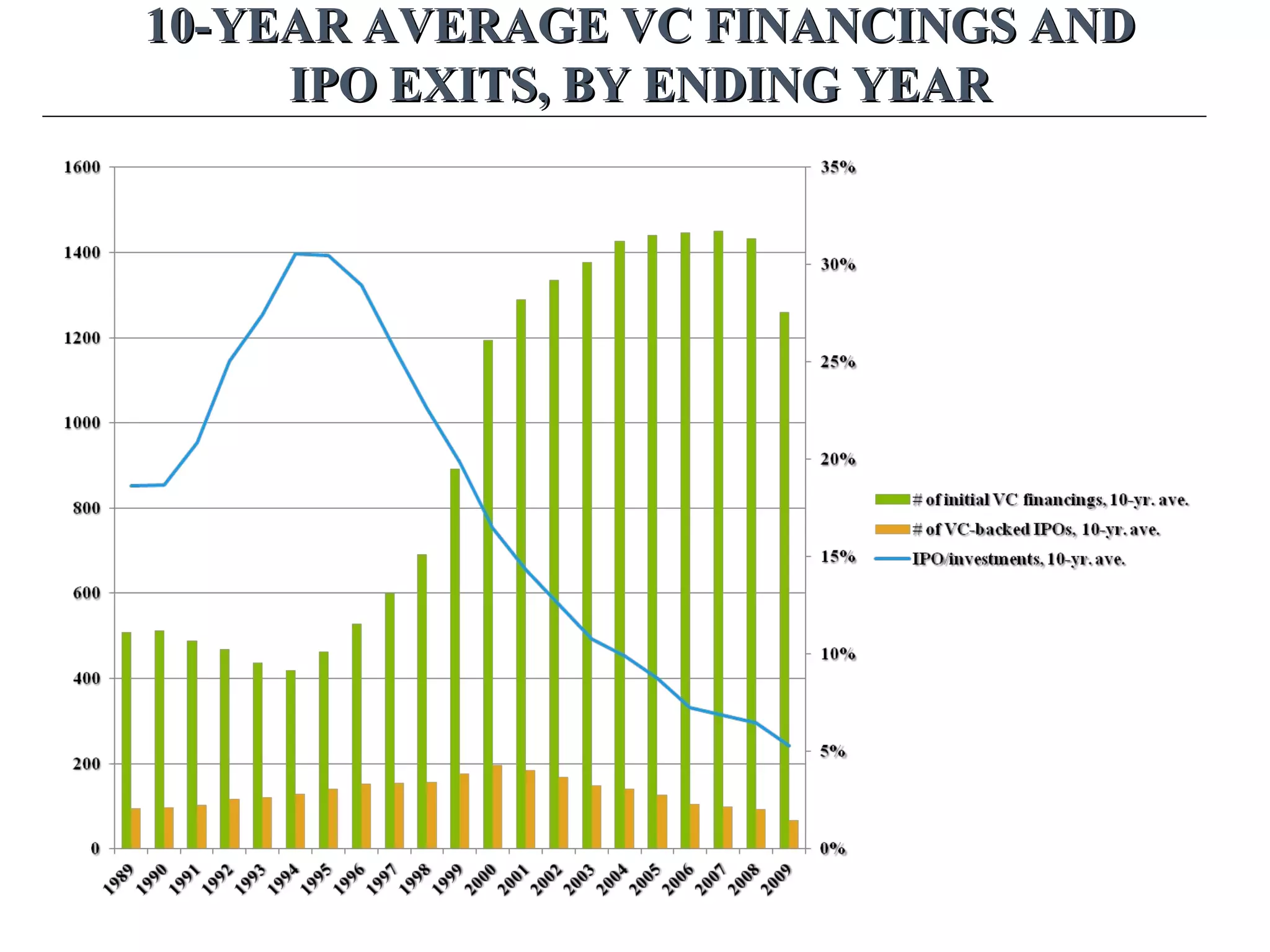
10-YEAR AVERAGE VC FINANCINGS AND10-YEAR AVERAGE VC FINANCINGS AND
IPO EXITS, BY ENDING YEARIPO EXITS, BY ENDING YEAR
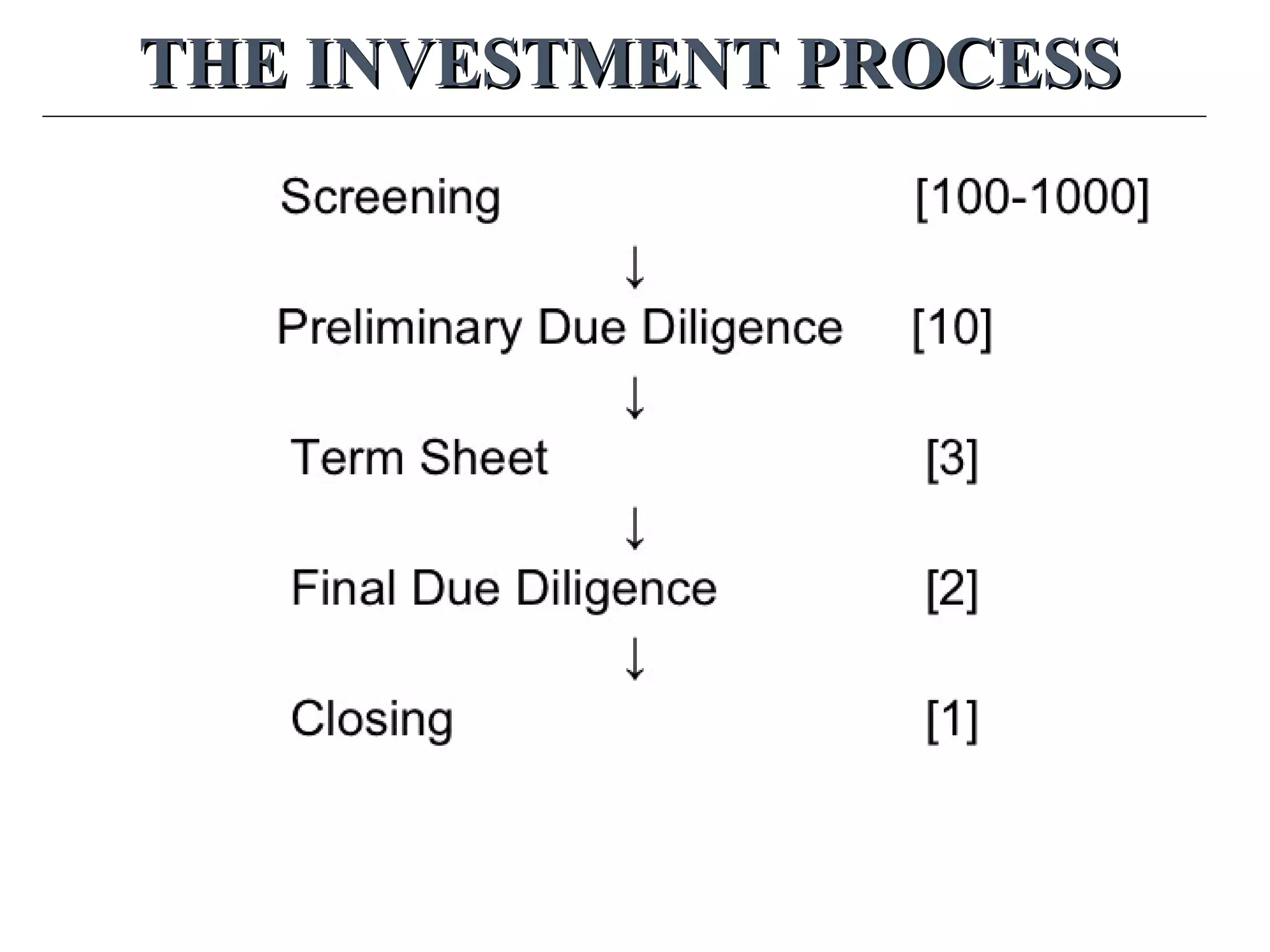
THE INVESTMENT PROCESSTHE INVESTMENT PROCESS
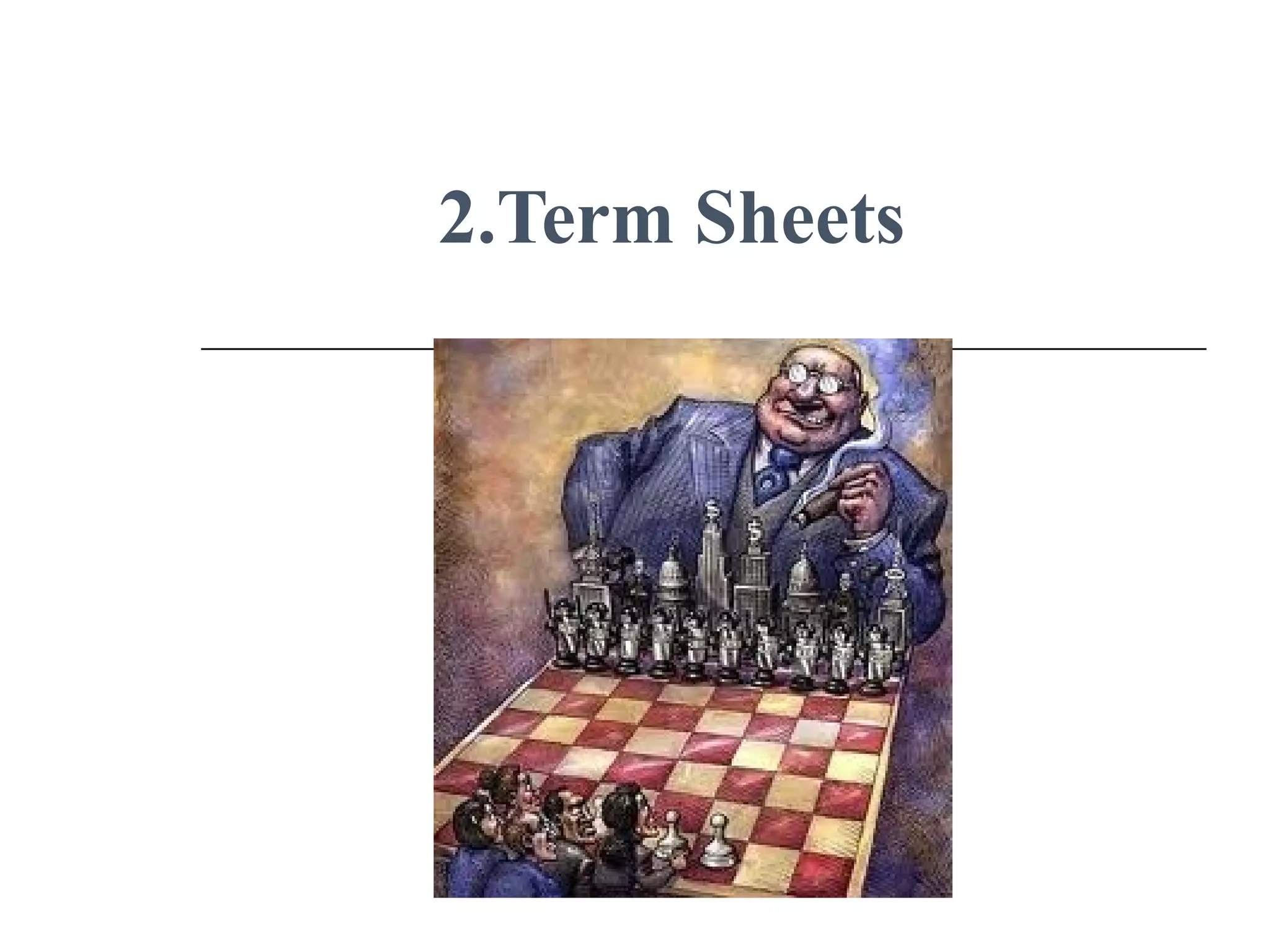
2.Term Sheets
Term Sheets – The BasicsTerm Sheets – The Basics
ExpropriationExpropriation
CharterCharter
Investor Rights AgreementInvestor Rights Agreement
RoundsRounds
Series A, Series B, etc.Series A, Series B, etc.
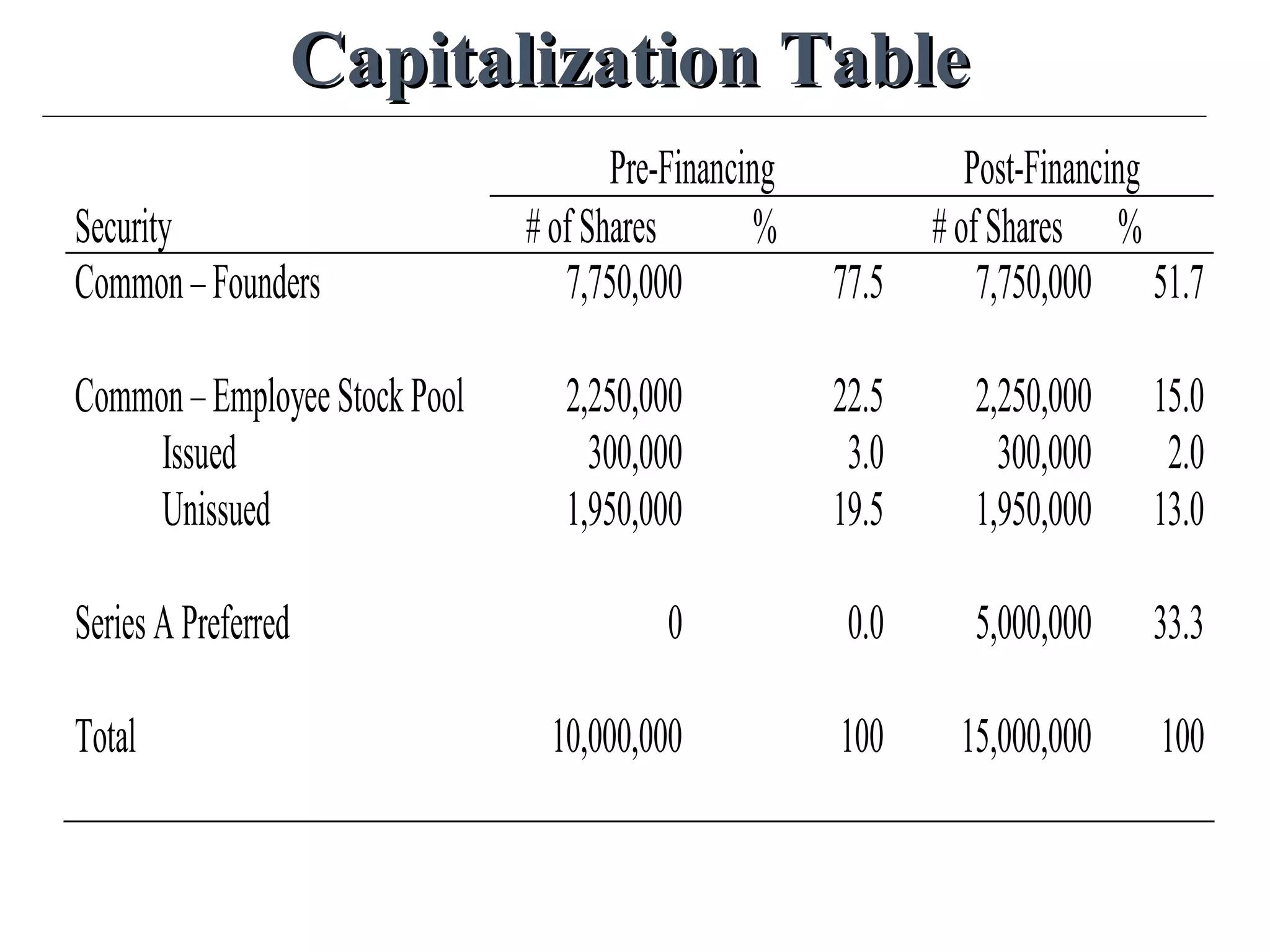
Capitalization TableCapitalization Table
Pre-Financing Post-Financing
Security #ofShares % #ofShares %
Common – Founders 7,750,000 77.5 7,750,000 51.7
Common – EmployeeStockPool
Issued
Unissued
2,250,000
300,000
1,950,000
22.5
3.0
19.5
2,250,000
300,000
1,950,000
15.0
2.0
13.0
SeriesAPreferred 0 0.0 5,000,000 33.3
Total 10,000,000 100 15,000,000 100
Investors and PricesInvestors and Prices
$investment$investment
Fully diluted share countFully diluted share count
Proposed ownership percentageProposed ownership percentage
Original purchase price (OPP)Original purchase price (OPP)
Aggregate purchase price (APP)Aggregate purchase price (APP)
TrancheTranche
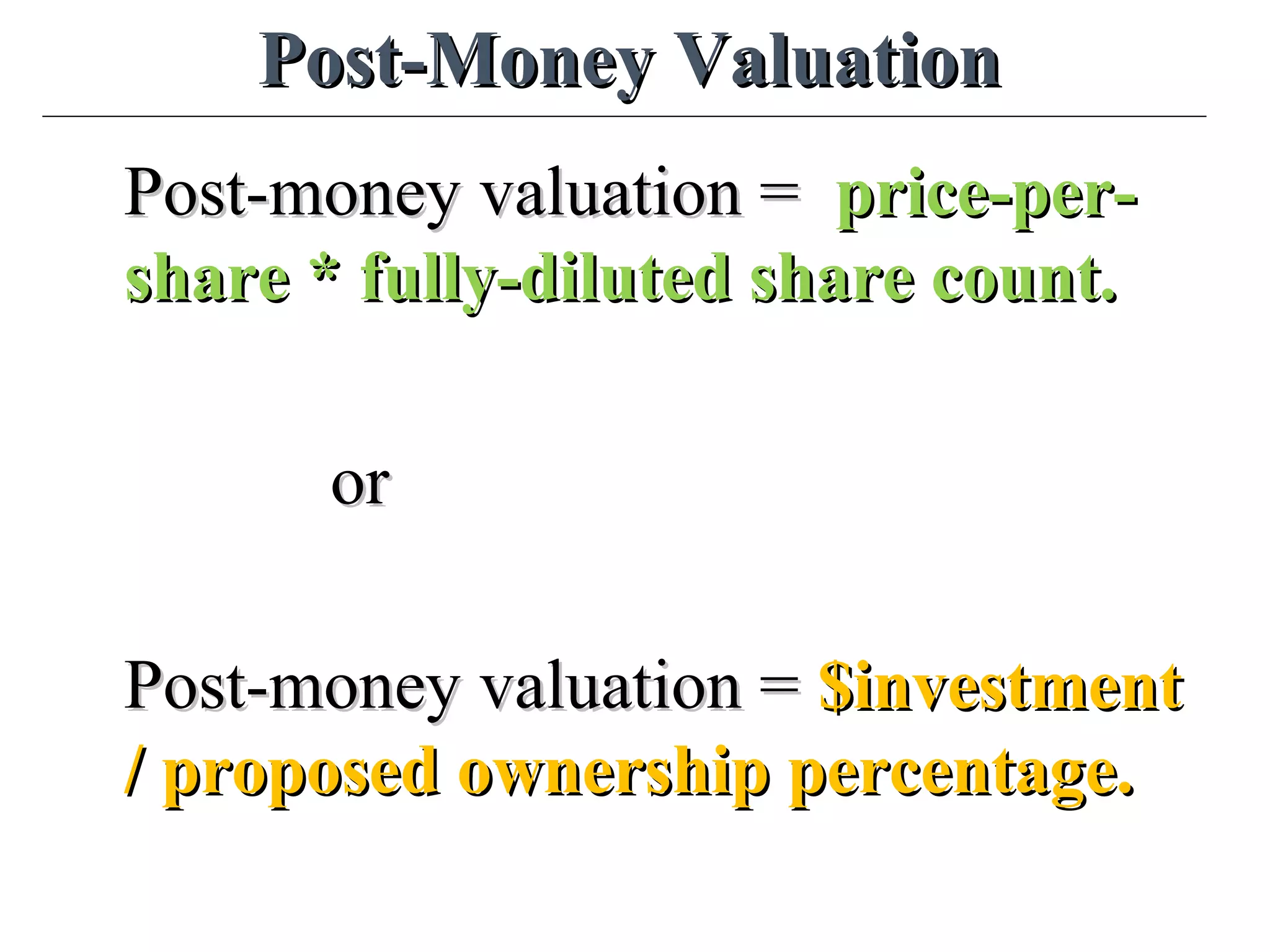
Post-Money ValuationPost-Money Valuation
Post-money valuation =Post-money valuation = price-per-price-per-
share * fully-diluted share count.share * fully-diluted share count.
oror
Post-money valuation =Post-money valuation = $investment$investment
/ proposed ownership percentage./ proposed ownership percentage.
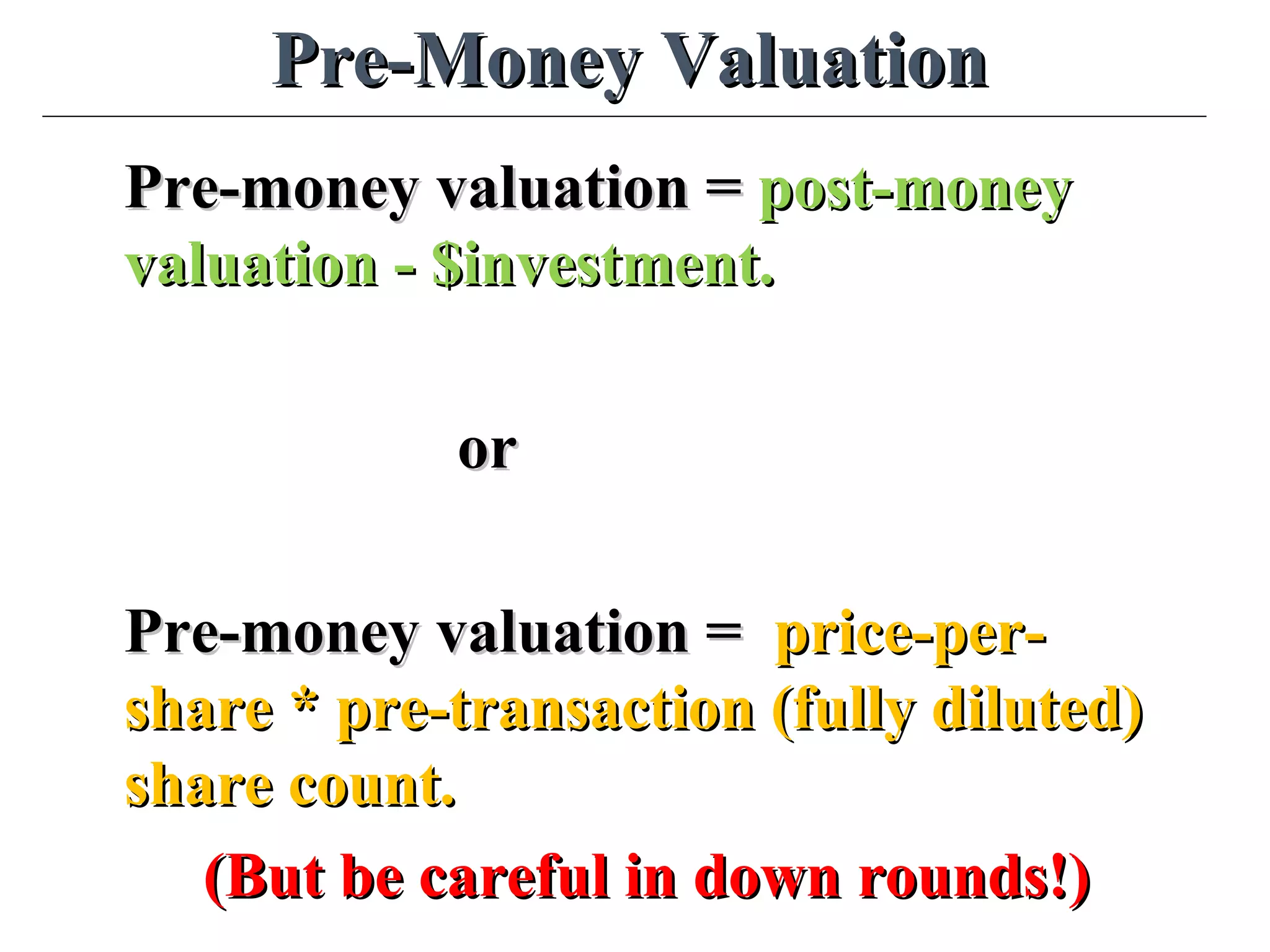
Pre-Money ValuationPre-Money Valuation
Pre-money valuation =Pre-money valuation = post-moneypost-money
valuation - $investment.valuation - $investment.
oror
Pre-money valuation =Pre-money valuation = price-per-price-per-
share * pre-transaction (fully diluted)share * pre-transaction (fully diluted)
share count.share count.
(But be careful in down rounds!)(But be careful in down rounds!)
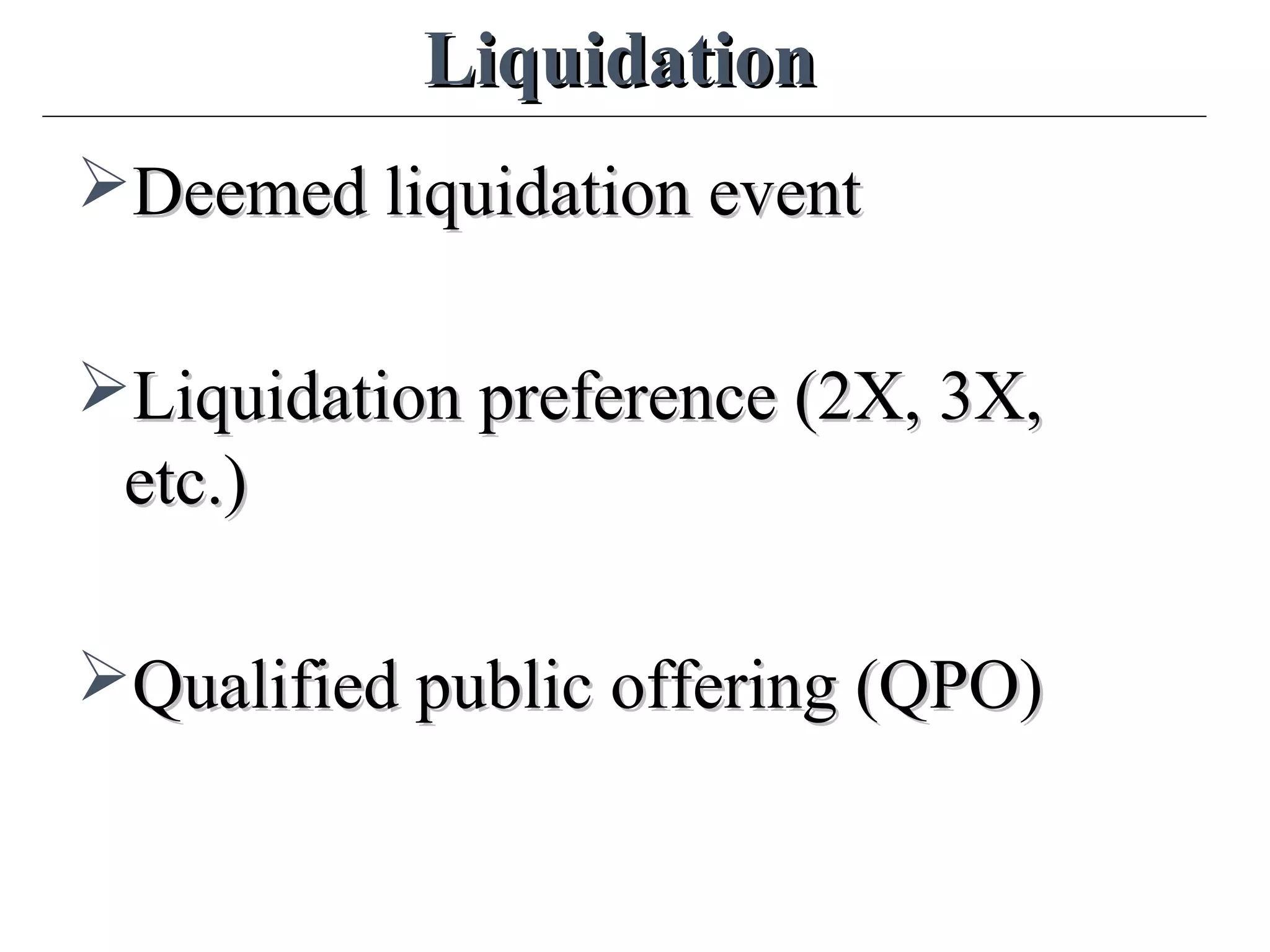
LiquidationLiquidation
Deemed liquidation eventDeemed liquidation event
Liquidation preference (2X, 3X,Liquidation preference (2X, 3X,
etc.)etc.)
Qualified public offering (QPO)Qualified public offering (QPO)
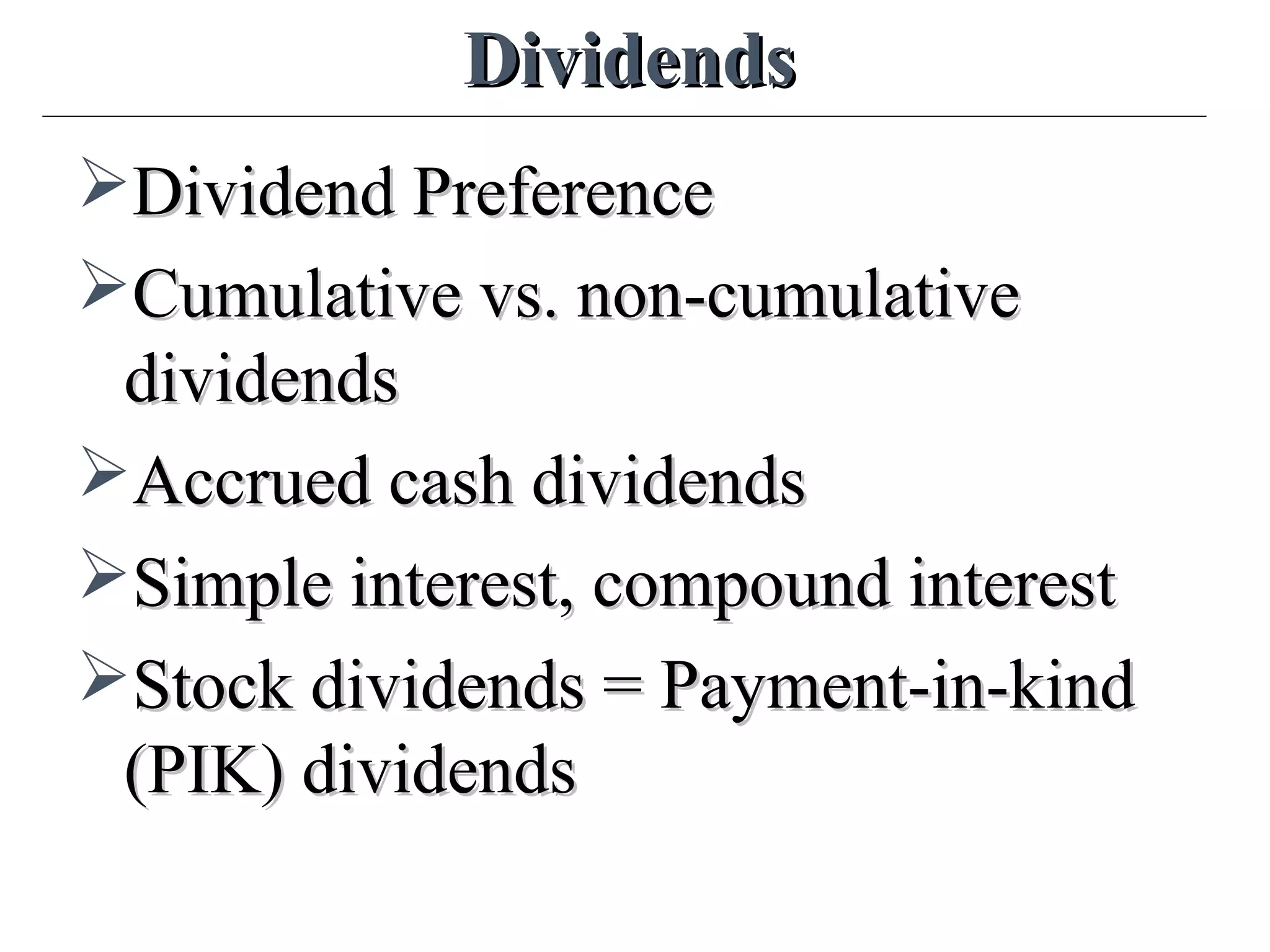
DividendsDividends
Dividend PreferenceDividend Preference
Cumulative vs. non-cumulativeCumulative vs. non-cumulative
dividendsdividends
Accrued cash dividendsAccrued cash dividends
Simple interest, compound interestSimple interest, compound interest
Stock dividends = Payment-in-kindStock dividends = Payment-in-kind
(PIK) dividends(PIK) dividends
Restricted Stock & Registration RightsRestricted Stock & Registration Rights
Registration rightsRegistration rights
DemandDemand
S-3S-3
PiggybackPiggyback
Redemption rightsRedemption rights
In-kind distributionsIn-kind distributions
Rule 144, rule 144ARule 144, rule 144A
Qualified Institutional Buyers (QIBs)Qualified Institutional Buyers (QIBs)
Lockup restrictionsLockup restrictions
Other issuesOther issues
Step vesting, cliff vestingStep vesting, cliff vesting
Right of first refusal, Right of firstRight of first refusal, Right of first
offeroffer
Drag-along rightsDrag-along rights
Take-me-along = tag-along rightsTake-me-along = tag-along rights
Anti-dilution rights, down roundsAnti-dilution rights, down rounds
Pay-to-PlayPay-to-Play
No ShopNo Shop
3.Preferred Stock
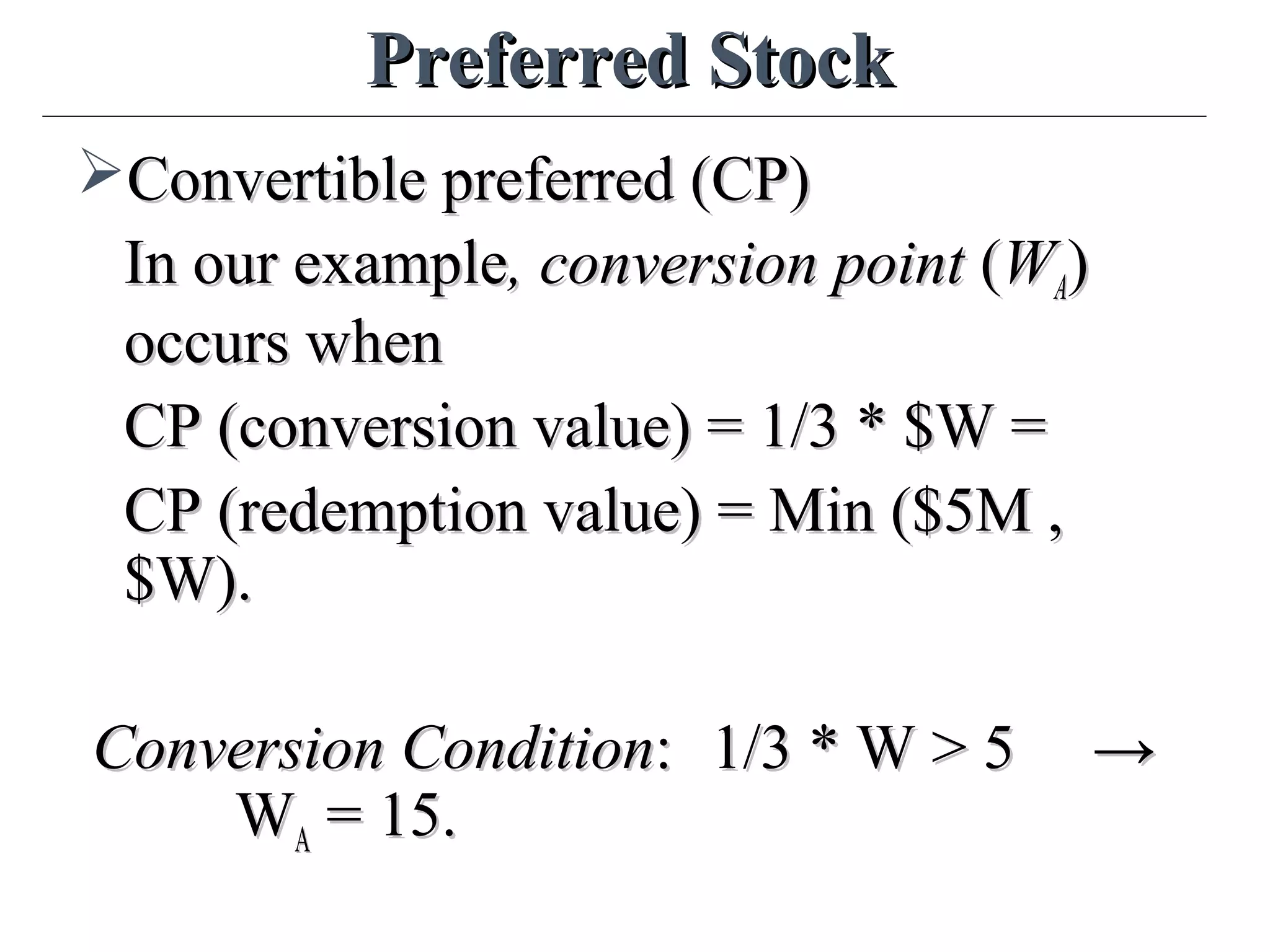
Preferred StockPreferred Stock
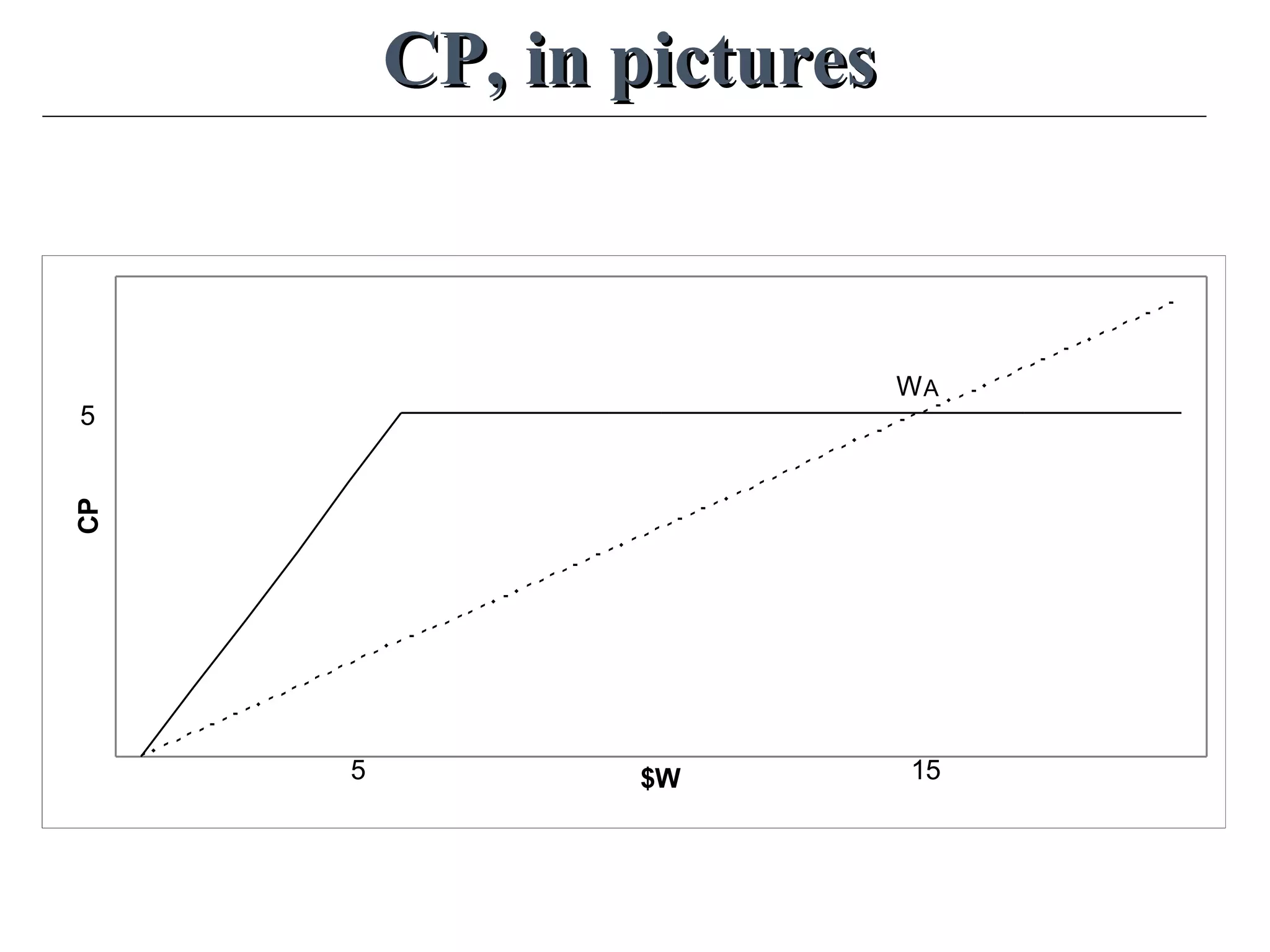
Convertible preferred (CP)Convertible preferred (CP)
In our exampleIn our example, conversion point, conversion point ((WWAA))
occurs whenoccurs when
CP (conversion value) = 1/3 * $W =CP (conversion value) = 1/3 * $W =
CP (redemption value) = Min ($5M ,CP (redemption value) = Min ($5M ,
$W).$W).
Conversion ConditionConversion Condition:: 1/3 * W > 51/3 * W > 5 →→
WWAA = 15.= 15.
CP, in picturesCP, in pictures
$W
CP
5 15
WA
5
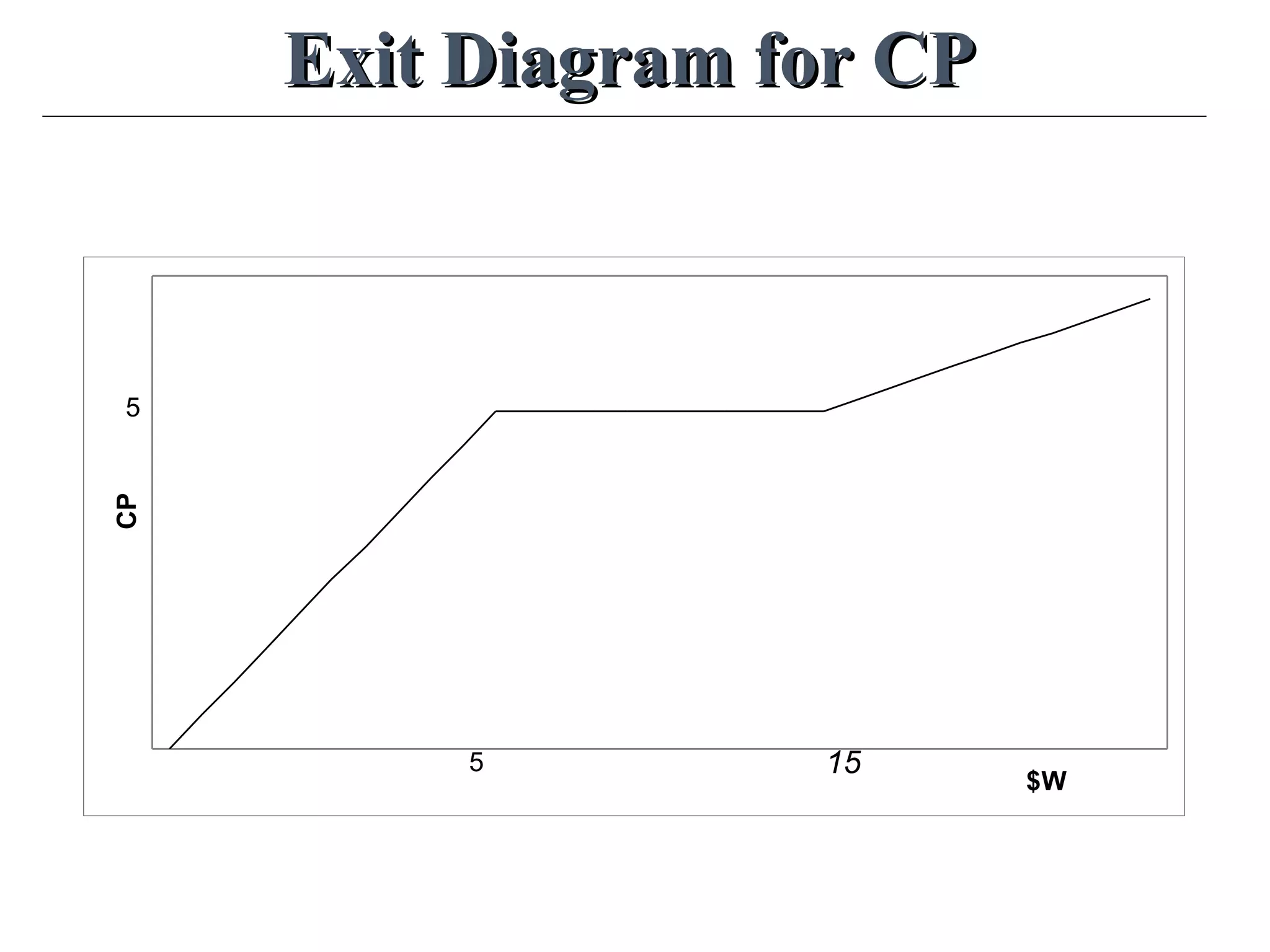
Exit Diagram for CPExit Diagram for CP
$W
CP
5
5
15
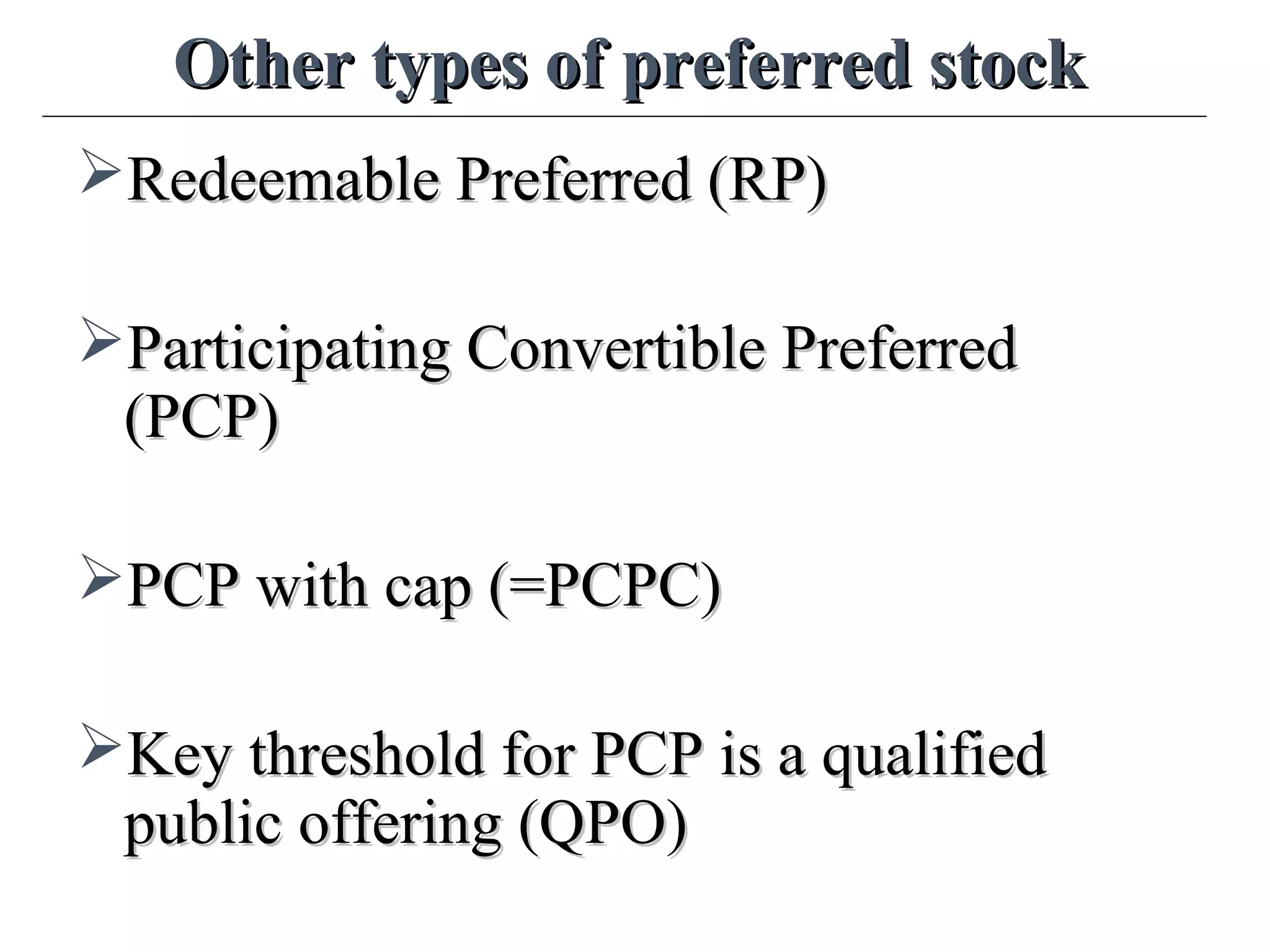
Other types of preferred stockOther types of preferred stock
Redeemable Preferred (RP)Redeemable Preferred (RP)
Participating Convertible PreferredParticipating Convertible Preferred
(PCP)(PCP)
PCP with cap (=PCPC)PCP with cap (=PCPC)
Key threshold for PCP is a qualifiedKey threshold for PCP is a qualified
public offering (QPO)public offering (QPO)
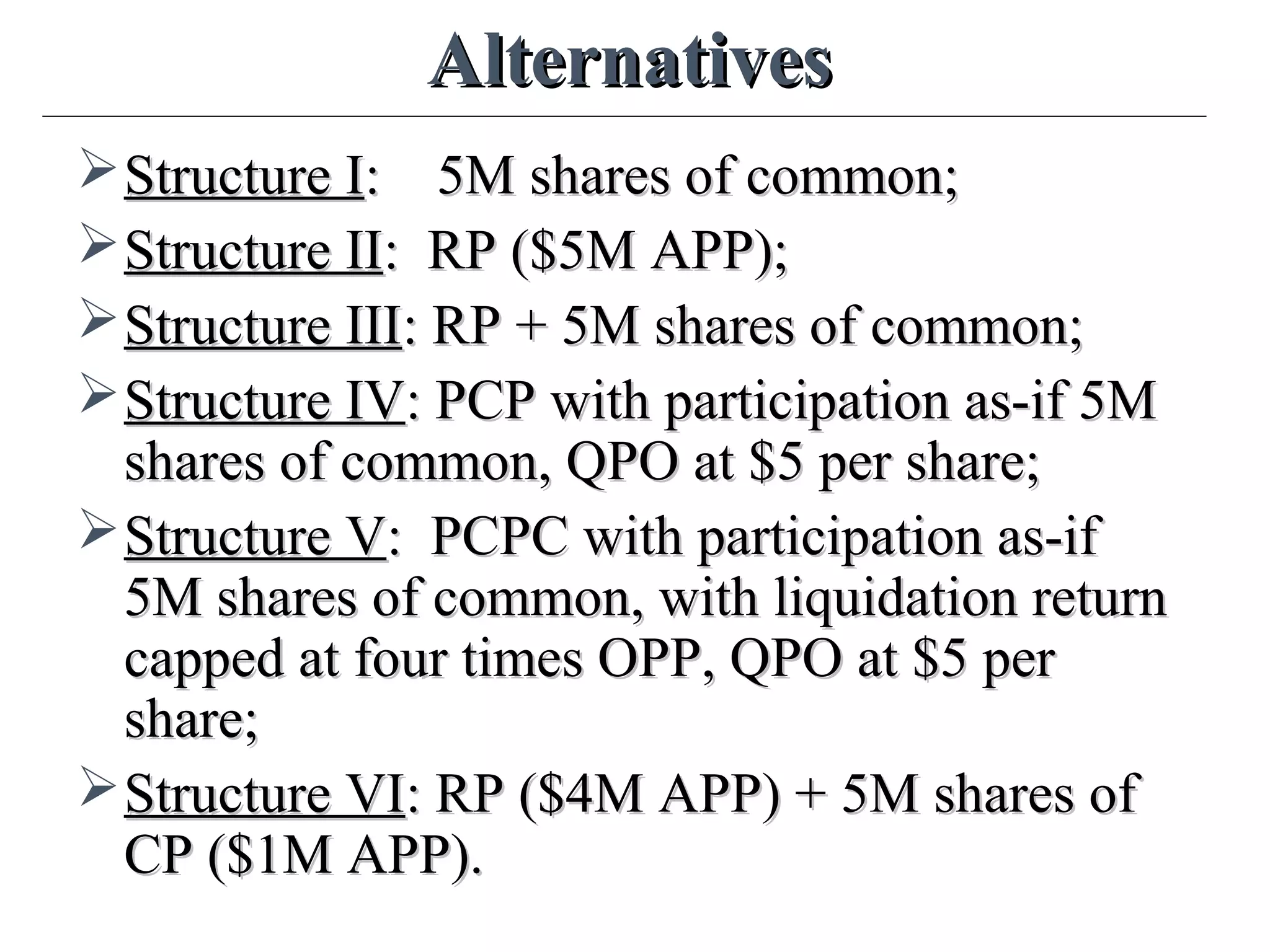
AlternativesAlternatives
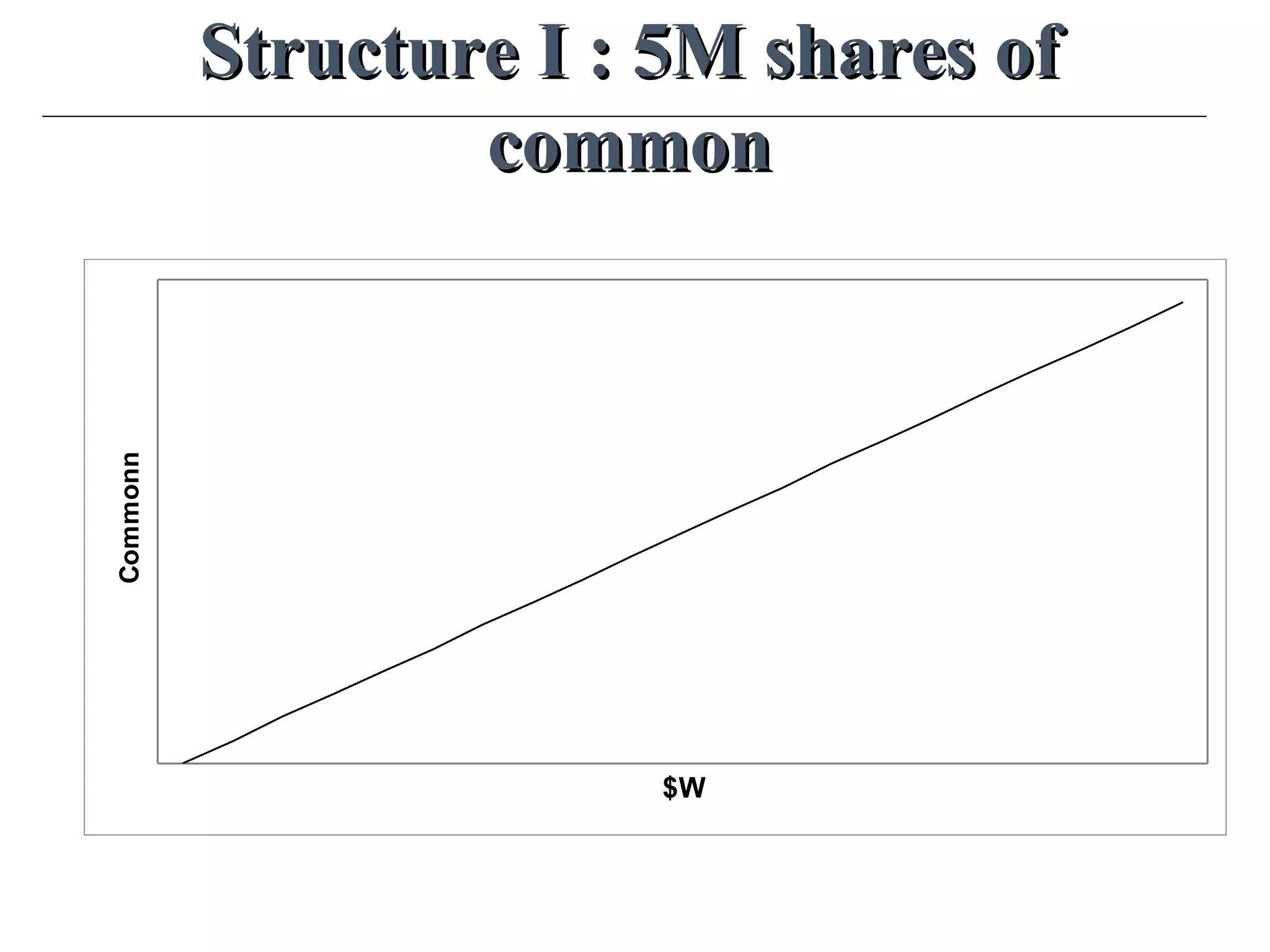
Structure IStructure I: 5M shares of common;: 5M shares of common;
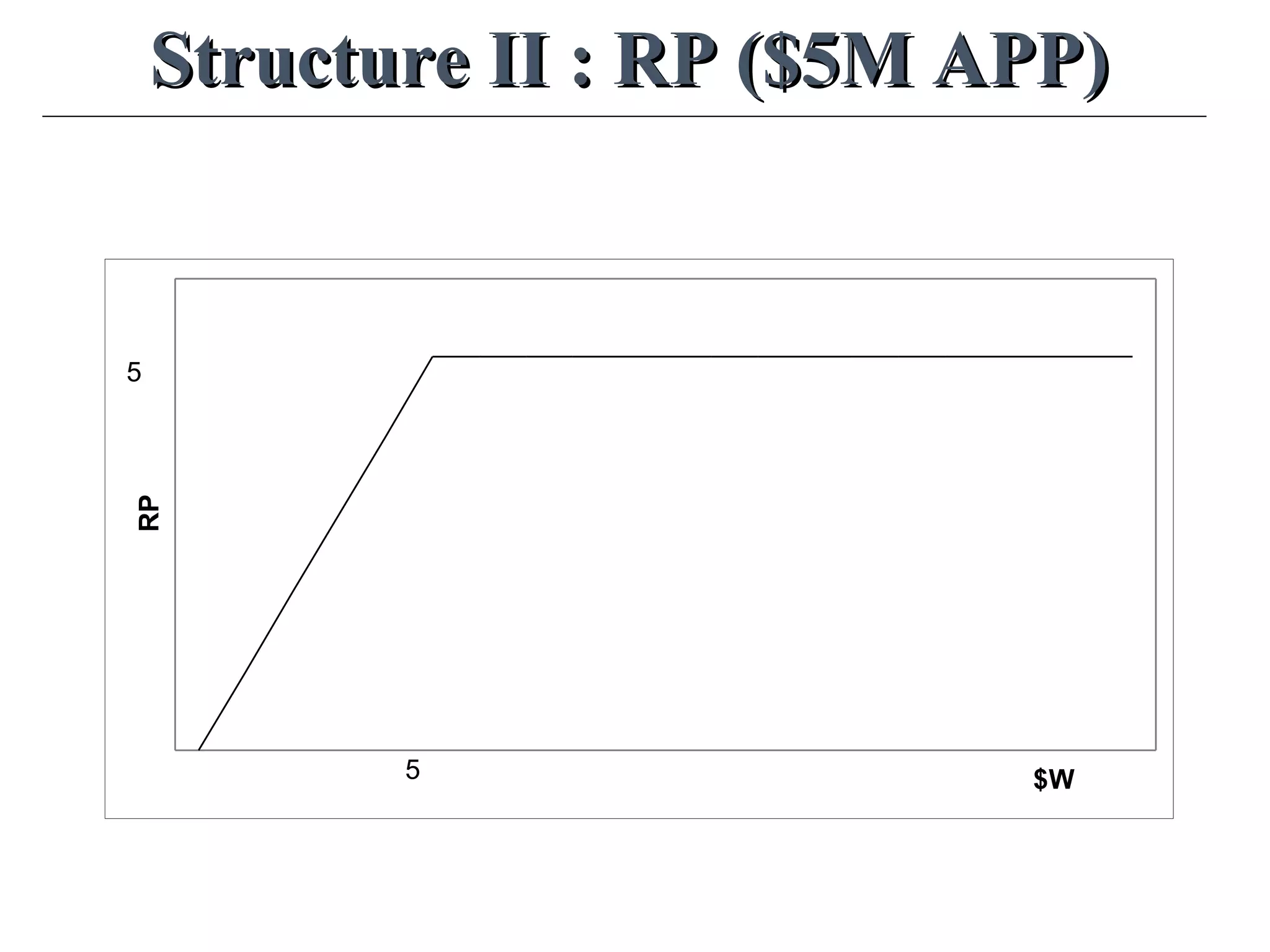
Structure IIStructure II: RP ($5M APP);: RP ($5M APP);
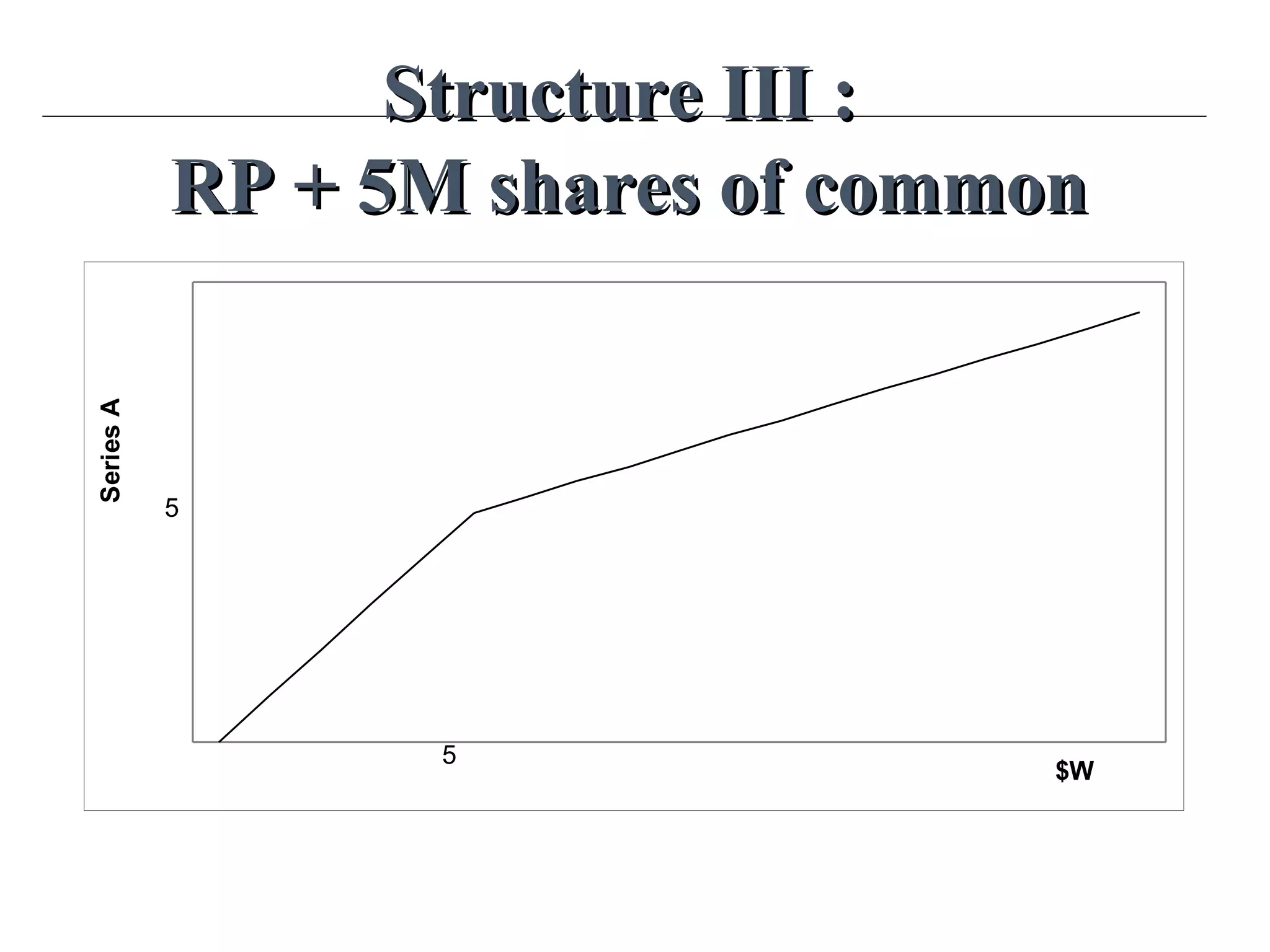
Structure IIIStructure III: RP + 5M shares of common;: RP + 5M shares of common;
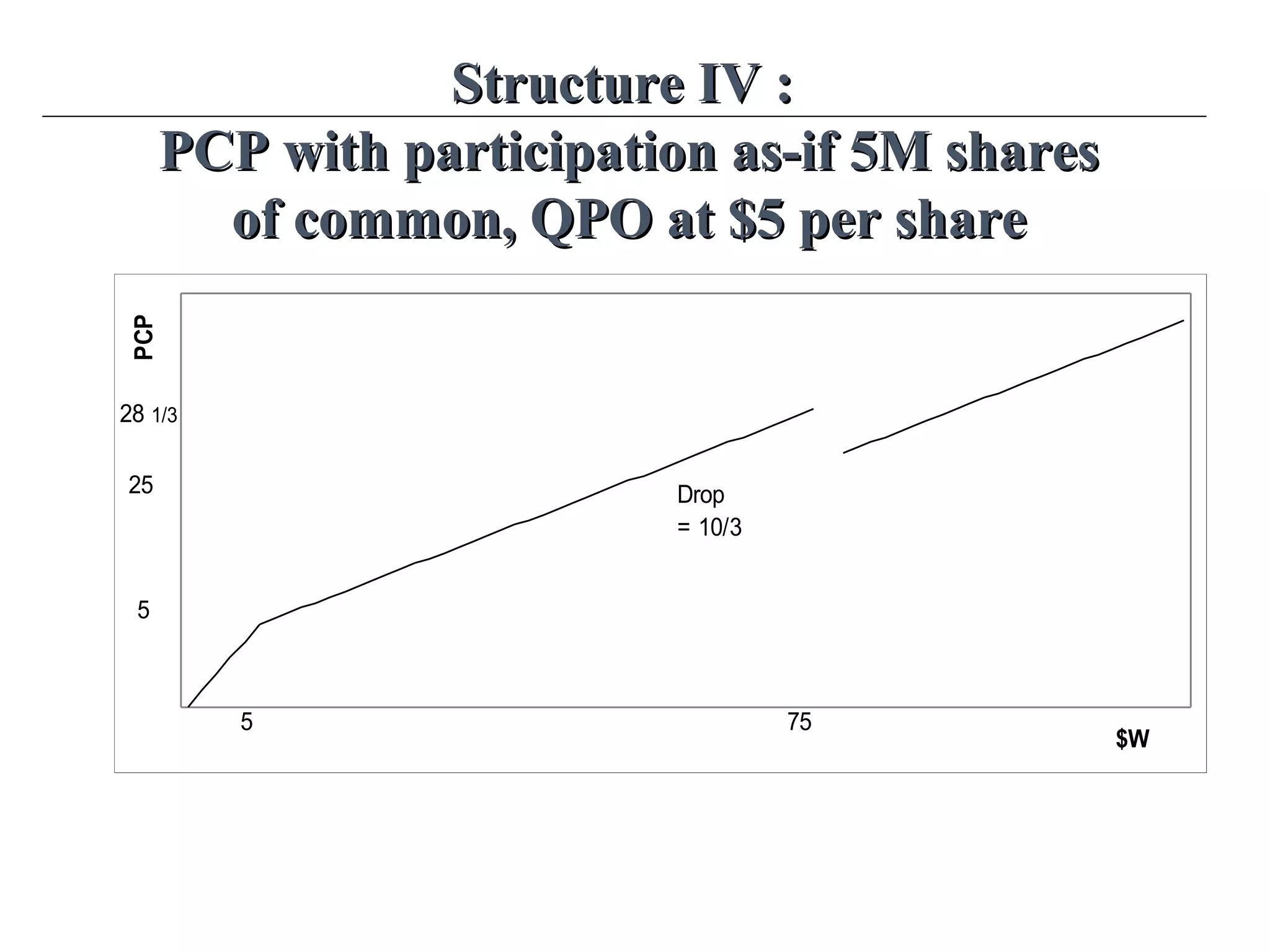
Structure IVStructure IV: PCP with participation as-if 5M: PCP with participation as-if 5M
shares of common, QPO at $5 per share;shares of common, QPO at $5 per share;
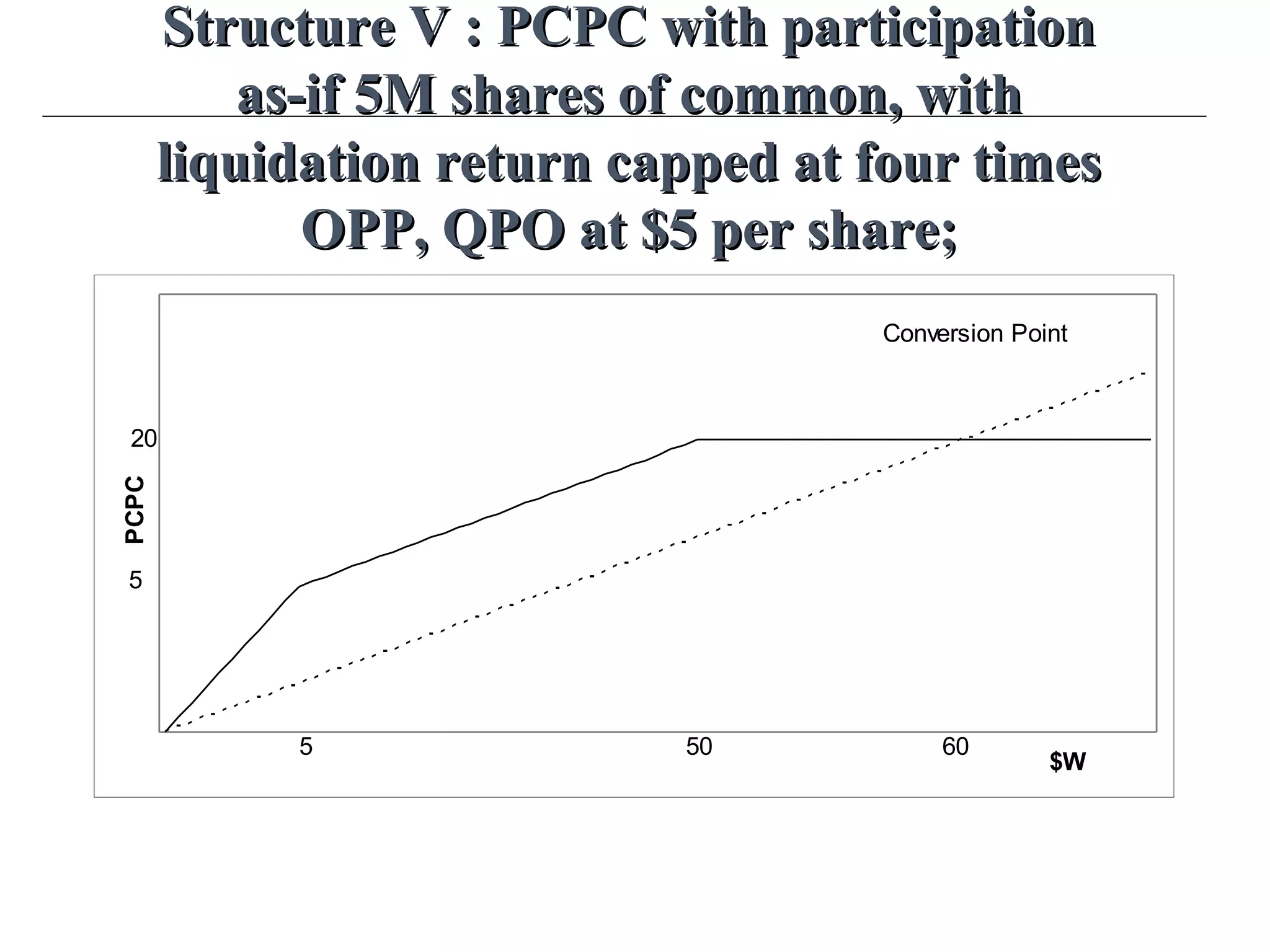
Structure VStructure V: PCPC with participation as-if: PCPC with participation as-if
5M shares of common, with liquidation return5M shares of common, with liquidation return
capped at four times OPP, QPO at $5 percapped at four times OPP, QPO at $5 per
share;share;
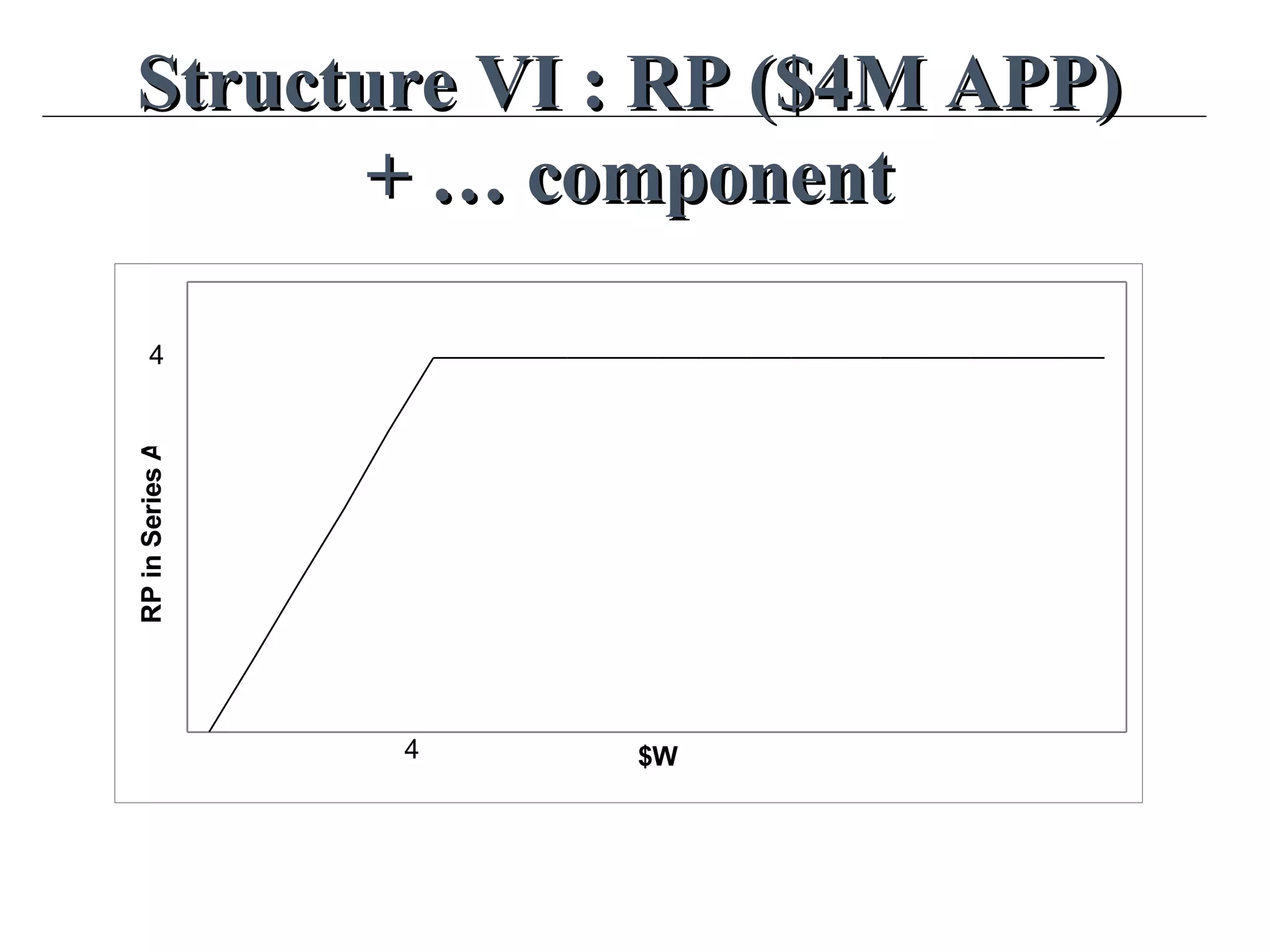
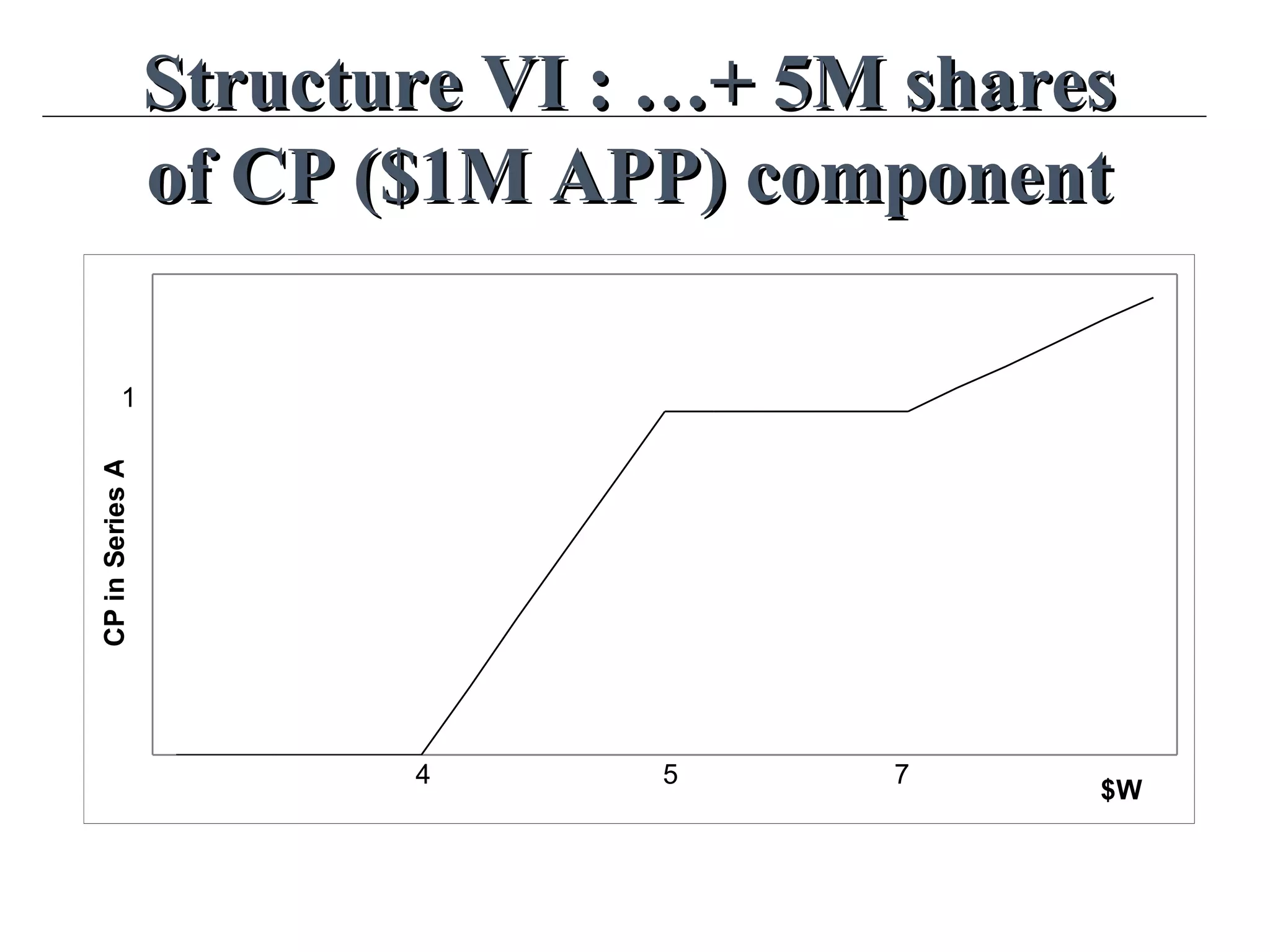
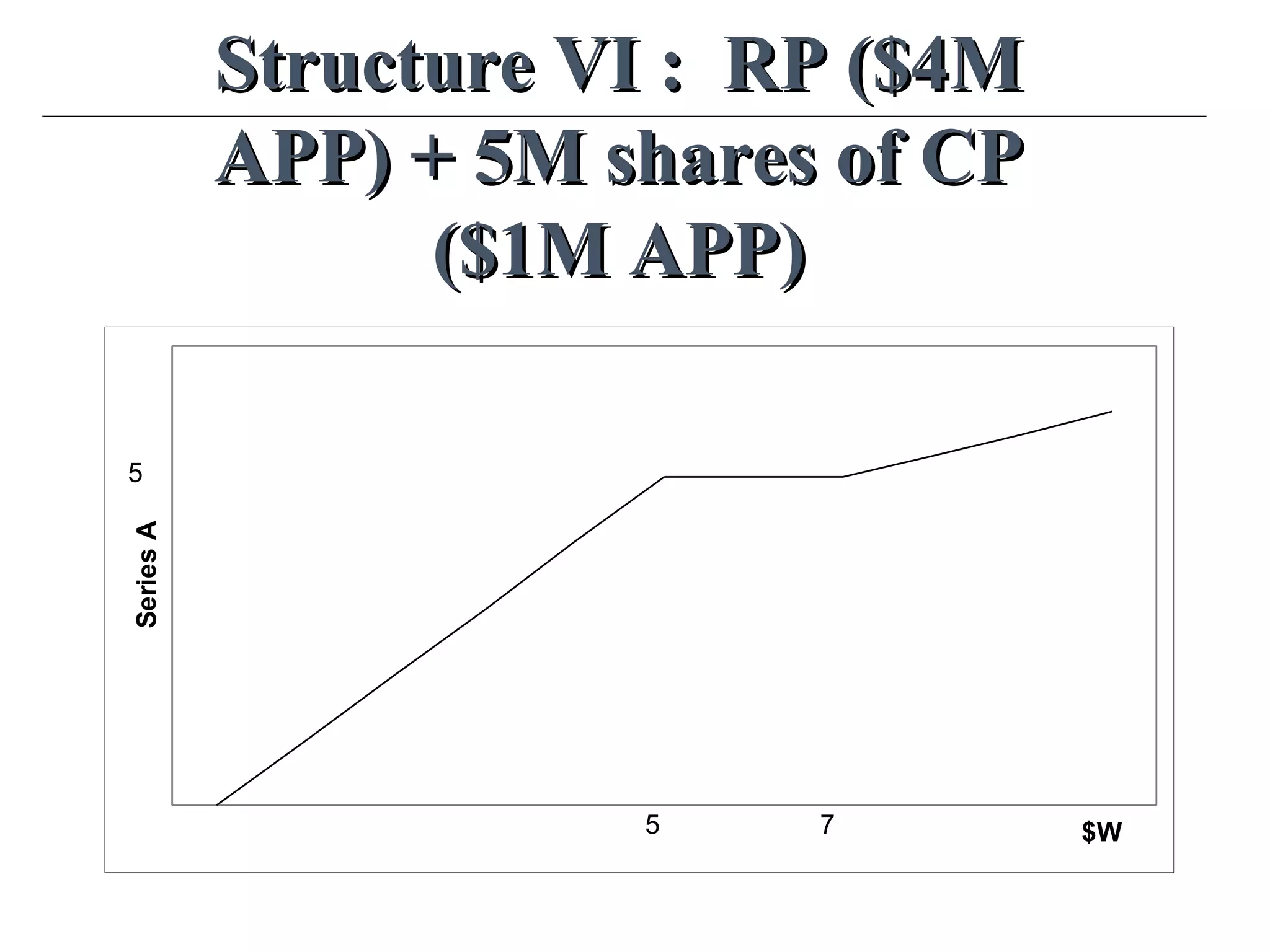
Structure VIStructure VI: RP ($4M APP) + 5M shares of: RP ($4M APP) + 5M shares of
CP ($1M APP).CP ($1M APP).
Structure I : 5M shares ofStructure I : 5M shares of
commoncommon
$W
Commonn
Structure II : RP ($5M APP)Structure II : RP ($5M APP)
$W
RP
5
5
Structure III :Structure III :
RP + 5M shares of commonRP + 5M shares of common
$W
SeriesA
5
5
Structure IV :Structure IV :
PCP with participation as-if 5M sharesPCP with participation as-if 5M shares
of common, QPO at $5 per shareof common, QPO at $5 per share
$W
PCP
5 75
Drop
= 10/3
28 1/3
25
5
Structure V : PCPC with participationStructure V : PCPC with participation
as-if 5M shares of common, withas-if 5M shares of common, with
liquidation return capped at four timesliquidation return capped at four times
OPP, QPO at $5 per share;OPP, QPO at $5 per share;
$W
PCPC
5 50 60
Conversion Point
20
5
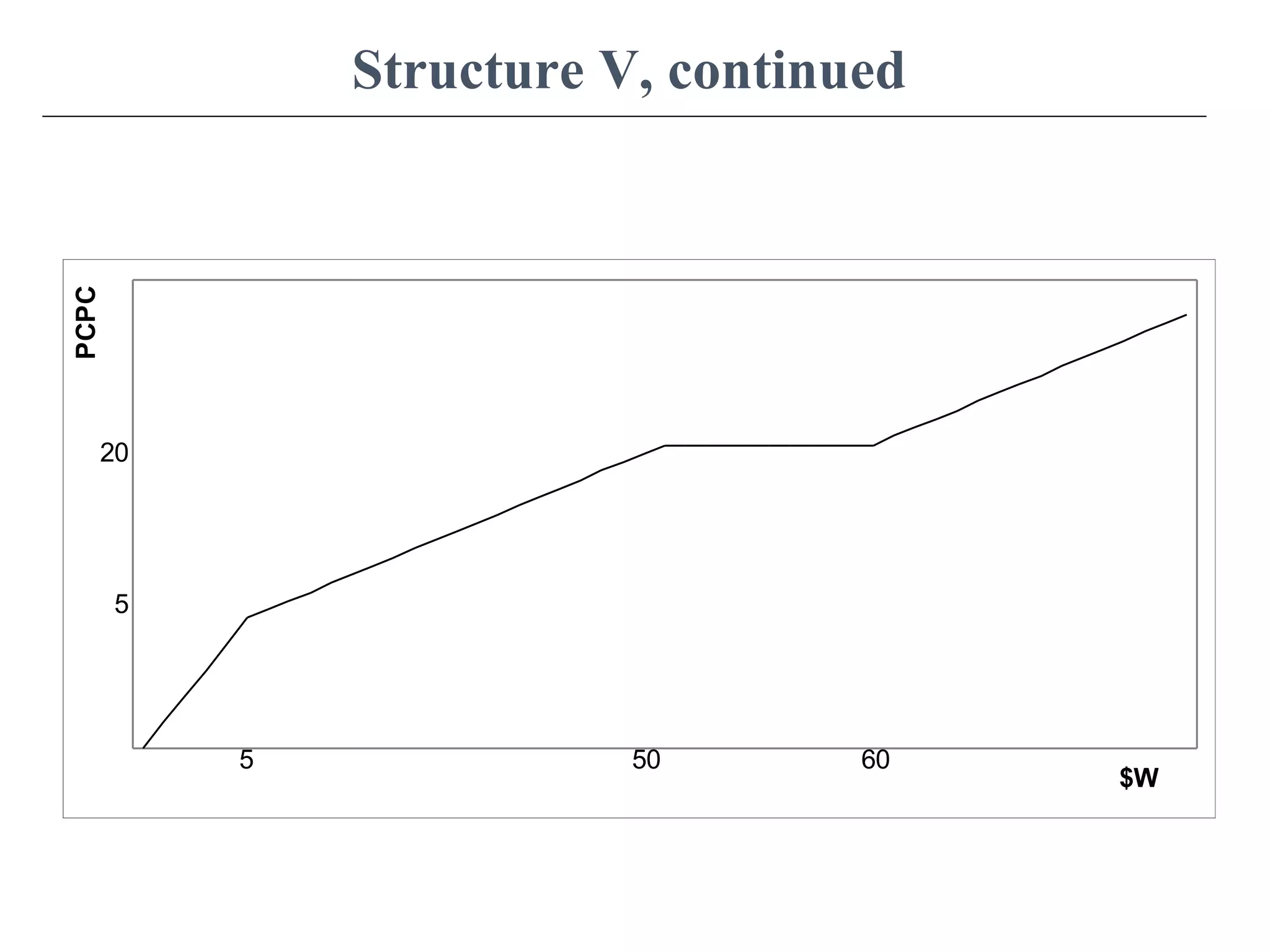
Structure V, continued
$W
PCPC
5 50 60
5
20
Structure VI : RP ($4M APP)Structure VI : RP ($4M APP)
+ … component+ … component
$W
RPinSeriesA
4
4
Structure VI : …+ 5M sharesStructure VI : …+ 5M shares
of CP ($1M APP) componentof CP ($1M APP) component
$W
CPinSeriesA
4 5 7
1
Structure VI : RP ($4MStructure VI : RP ($4M
APP) + 5M shares of CPAPP) + 5M shares of CP
($1M APP)($1M APP)
$W
SeriesA
5 7
5
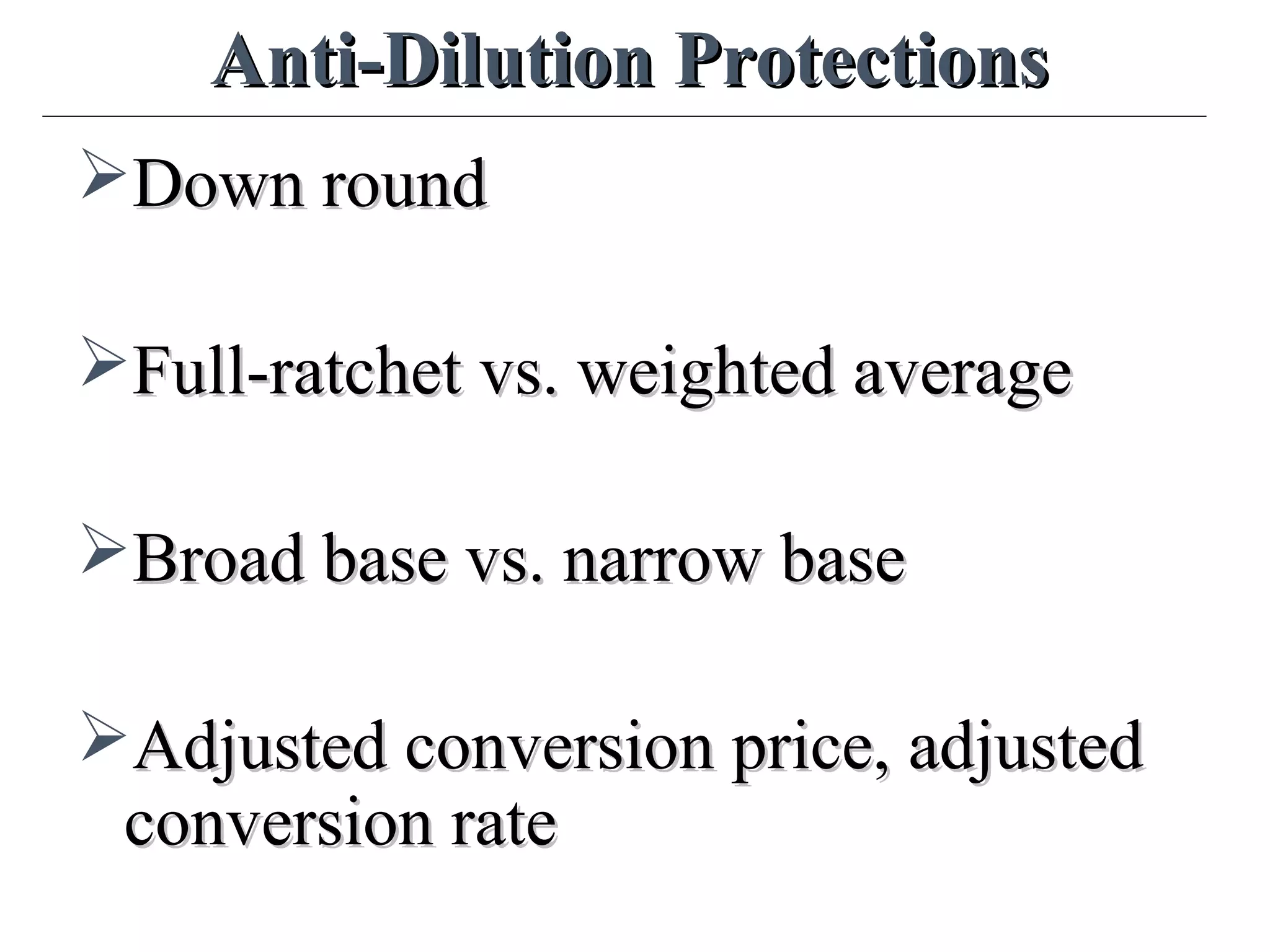
Anti-Dilution ProtectionsAnti-Dilution Protections
Down roundDown round
Full-ratchet vs. weighted averageFull-ratchet vs. weighted average
Broad base vs. narrow baseBroad base vs. narrow base
Adjusted conversion price, adjustedAdjusted conversion price, adjusted
conversion rateconversion rate
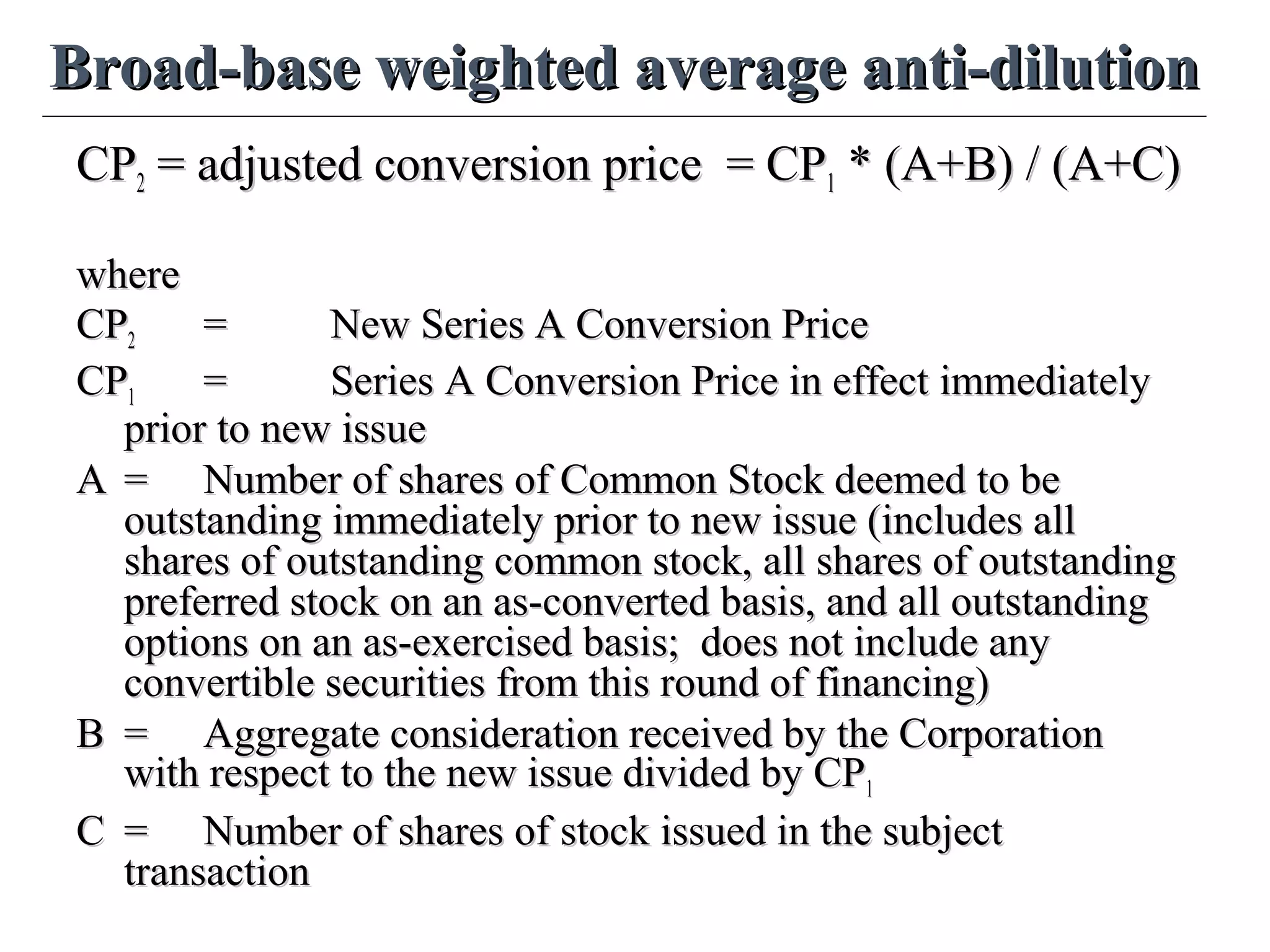
Broad-base weighted average anti-dilutionBroad-base weighted average anti-dilution
CPCP22 = adjusted conversion price = CP= adjusted conversion price = CP11 * (A+B) / (A+C)* (A+B) / (A+C)
wherewhere
CPCP22 == New Series A Conversion PriceNew Series A Conversion Price
CPCP11 == Series A Conversion Price in effect immediatelySeries A Conversion Price in effect immediately
prior to new issueprior to new issue
AA == Number of shares of Common Stock deemed to beNumber of shares of Common Stock deemed to be
outstanding immediately prior to new issue (includes alloutstanding immediately prior to new issue (includes all
shares of outstanding common stock, all shares of outstandingshares of outstanding common stock, all shares of outstanding
preferred stock on an as-converted basis, and all outstandingpreferred stock on an as-converted basis, and all outstanding
options on an as-exercised basis; does not include anyoptions on an as-exercised basis; does not include any
convertible securities from this round of financing)convertible securities from this round of financing)
BB == Aggregate consideration received by the CorporationAggregate consideration received by the Corporation
with respect to the new issue divided by CPwith respect to the new issue divided by CP11
CC == Number of shares of stock issued in the subjectNumber of shares of stock issued in the subject
transactiontransaction
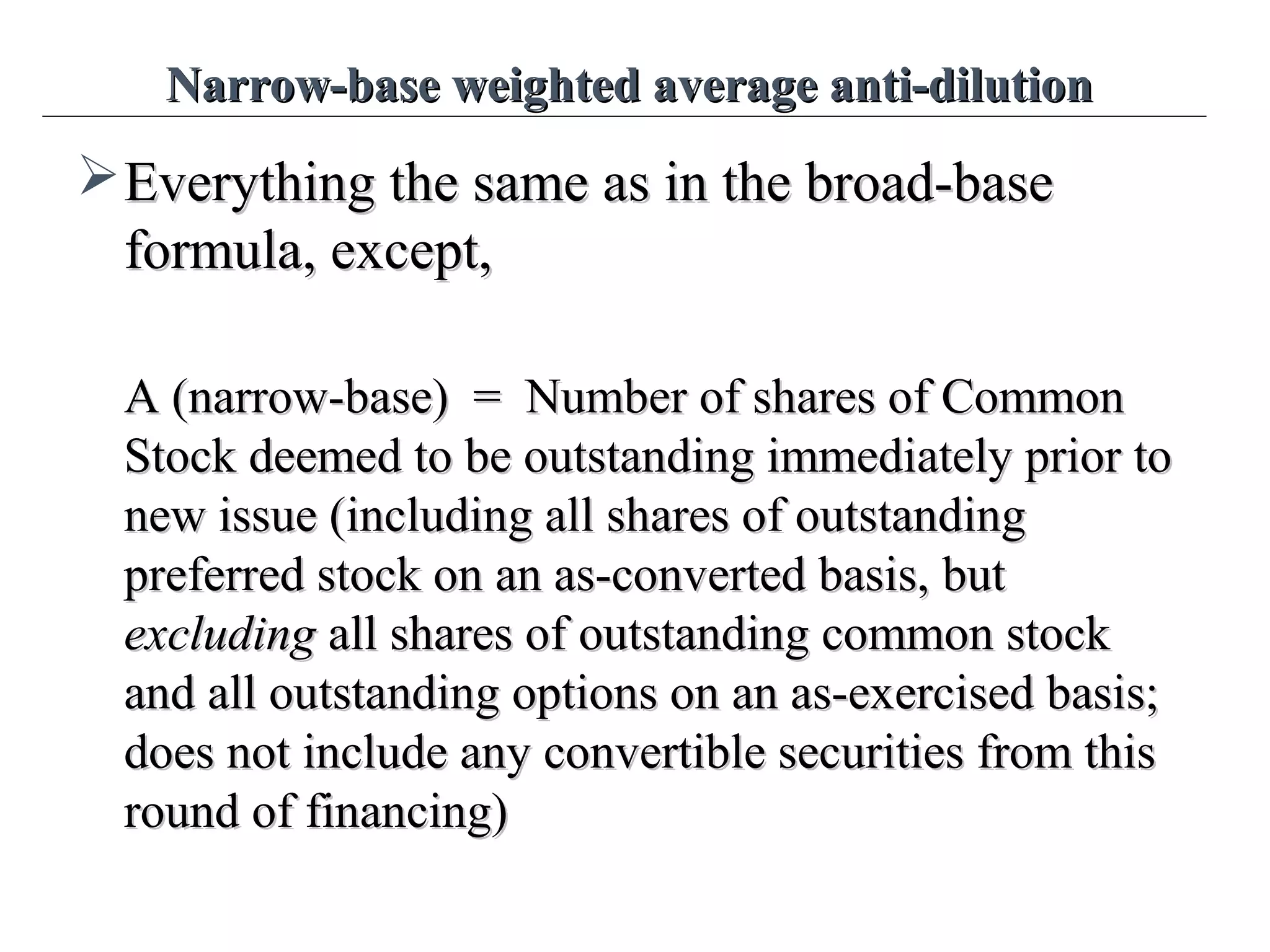
Narrow-base weighted average anti-dilutionNarrow-base weighted average anti-dilution
Everything the same as in the broad-baseEverything the same as in the broad-base
formula, except,formula, except,
A (narrow-base) = Number of shares of CommonA (narrow-base) = Number of shares of Common
Stock deemed to be outstanding immediately prior toStock deemed to be outstanding immediately prior to
new issue (including all shares of outstandingnew issue (including all shares of outstanding
preferred stock on an as-converted basis,preferred stock on an as-converted basis, butbut
excludingexcluding all shares of outstanding common stockall shares of outstanding common stock
and all outstanding options on an as-exercised basis;and all outstanding options on an as-exercised basis;
does not include any convertible securities from thisdoes not include any convertible securities from this
round of financing)round of financing)
EXERCISEEXERCISE
Anti-dilution:Anti-dilution:
Exercise 9.2 (Metrick 2011)Exercise 9.2 (Metrick 2011)
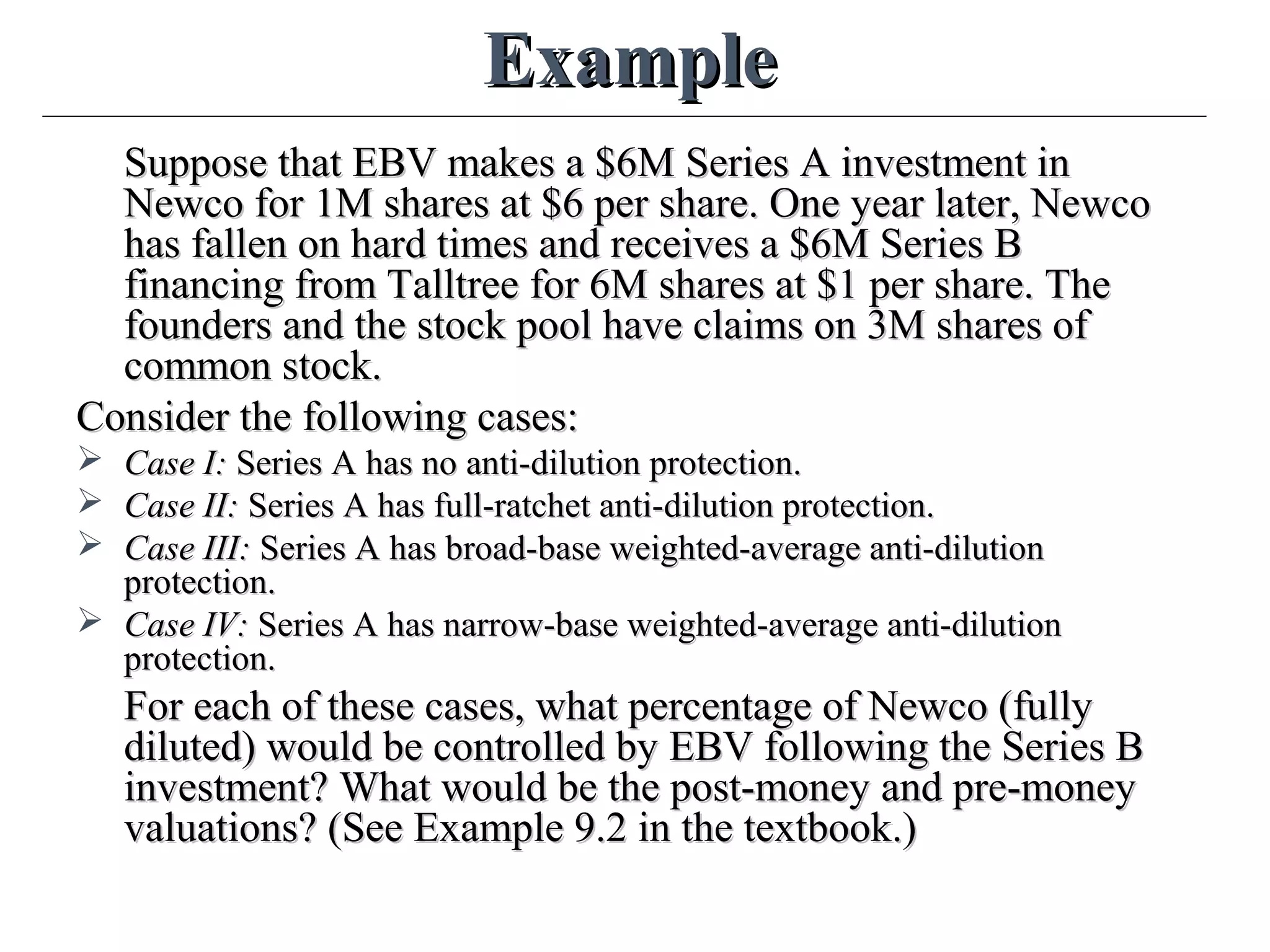
ExampleExample
Suppose that EBV makes a $6M Series A investment inSuppose that EBV makes a $6M Series A investment in
Newco for 1M shares at $6 per share. One year later, NewcoNewco for 1M shares at $6 per share. One year later, Newco
has fallen on hard times and receives a $6M Series Bhas fallen on hard times and receives a $6M Series B
financing from Talltree for 6M shares at $1 per share. Thefinancing from Talltree for 6M shares at $1 per share. The
founders and the stock pool have claims on 3M shares offounders and the stock pool have claims on 3M shares of
common stock.common stock.
Consider the following cases:Consider the following cases:
 Case I:Case I: Series A has no anti-dilution protection.Series A has no anti-dilution protection.
 Case II:Case II: Series A has full-ratchet anti-dilution protection.Series A has full-ratchet anti-dilution protection.
 Case III:Case III: Series A has broad-base weighted-average anti-dilutionSeries A has broad-base weighted-average anti-dilution
protection.protection.
 Case IV:Case IV: Series A has narrow-base weighted-average anti-dilutionSeries A has narrow-base weighted-average anti-dilution
protection.protection.
For each of these cases, what percentage of Newco (fullyFor each of these cases, what percentage of Newco (fully
diluted) would be controlled by EBV following the Series Bdiluted) would be controlled by EBV following the Series B
investment? What would be the post-money and pre-moneyinvestment? What would be the post-money and pre-money
valuations? (See Example 9.2 in the textbook.)valuations? (See Example 9.2 in the textbook.)
Further ReadingFurther Reading
 Metrick, Andrew and Yasuda, Ayako (2011) Venture
Capital & the Finance of Innovation. 2nd
Edition. John
Wiley & Sons.
 Lerner,Losh, Hardymon, Felda and Leamon, Ann
(2012). Venture Capital and Private Equity : A
Casebook. 5th
Edition. John Wiley & Sons.
 Dorf, R.C. and Byers, T.H. (2008) Technology
Ventures – From Idea to Enterprise 2nd
Edition,
McGraw Hill
QUESTIONS?

Gs503 vcf lecture 3 valuation i 020215

  • 1.
    VALUATION I :VALUATIONI : PROCESS,PROCESS, TERMSHEET &TERMSHEET & PREFERREDPREFERRED STOCKSTOCK Prof.Stephen OngProf.Stephen Ong BSc(Hons)Econs (LSE), MBA (Bradford)BSc(Hons)Econs (LSE), MBA (Bradford) Visiting Professor, Shenzhen UniversityVisiting Professor, Shenzhen University Academic Fellow, Entrepreneurship & Innovation,Academic Fellow, Entrepreneurship & Innovation, The Lord Ashcroft International Business School,The Lord Ashcroft International Business School, Anglia Ruskin University Cambridge UKAnglia Ruskin University Cambridge UK MSC TECHNOPRENEURSHIP :MSC TECHNOPRENEURSHIP : VENTURE CAPITAL FINANCINGVENTURE CAPITAL FINANCING
  • 2.
  • 3.
    LEARNING OBJECTIVESLEARNING OBJECTIVES Toanalyse the investment process byTo analyse the investment process by VC;VC; To understand the features of a VCTo understand the features of a VC term sheet;term sheet; To discuss the different types ofTo discuss the different types of preferred stock structures and theirpreferred stock structures and their anti-dilution protection for investors.anti-dilution protection for investors.
  • 4.
    1.Analysis of VentureCapital Investments
  • 5.
    PORTFOLIO COMPANY STATUSOVER TIME:PORTFOLIO COMPANY STATUS OVER TIME: FIRST ROUNDSFIRST ROUNDS
  • 6.
    PORTFOLIO COMPANY STATUSOVER TIME, ASSUMING NOPORTFOLIO COMPANY STATUS OVER TIME, ASSUMING NO PRIVATE COMPANIES AFTER TEN YEARS, 1PRIVATE COMPANIES AFTER TEN YEARS, 1STST ROUNDSROUNDS
  • 7.
    VALUE MULTIPLES FORFIRST-ROUND INVESTMENTS:VALUE MULTIPLES FOR FIRST-ROUND INVESTMENTS: IPOS AND ACQUISITIONSIPOS AND ACQUISITIONS
  • 8.
  • 9.
    PORTFOLIO COMPANY STATUSOVER TIME, ASSUMING NOPORTFOLIO COMPANY STATUS OVER TIME, ASSUMING NO PRIVATE COMPANIES AFTER TEN YEARS (2PRIVATE COMPANIES AFTER TEN YEARS (2NDND ROUNDS)ROUNDS)
  • 10.
    VALUE MULTIPLES FORSECOND-ROUNDVALUE MULTIPLES FOR SECOND-ROUND INVESTMENTS: IPOS AND ACQUISITIONSINVESTMENTS: IPOS AND ACQUISITIONS
  • 11.
    VALUE MULTIPLES FORALLVALUE MULTIPLES FOR ALL SECOND-ROUND INVESTMENTSSECOND-ROUND INVESTMENTS
  • 12.
    PORTFOLIO COMPANY STATUSOVER TIME, ASSUMING NOPORTFOLIO COMPANY STATUS OVER TIME, ASSUMING NO PRIVATE COMPANIES AFTER TEN YEARS (3RD ROUNDS)PRIVATE COMPANIES AFTER TEN YEARS (3RD ROUNDS)
  • 13.
    VALUE MULTIPLES FORTHIRD-ROUNDVALUE MULTIPLES FOR THIRD-ROUND INVESTMENTS: IPOS AND ACQUISITIONSINVESTMENTS: IPOS AND ACQUISITIONS
  • 14.
    VALUE MULTIPLES FORALL THIRD-ROUND INVESTMENTS
  • 15.
    10-YEAR AVERAGE VCFINANCINGS AND10-YEAR AVERAGE VC FINANCINGS AND IPO EXITS, BY ENDING YEARIPO EXITS, BY ENDING YEAR
  • 16.
    THE INVESTMENT PROCESSTHEINVESTMENT PROCESS
  • 17.
  • 18.
    Term Sheets –The BasicsTerm Sheets – The Basics ExpropriationExpropriation CharterCharter Investor Rights AgreementInvestor Rights Agreement RoundsRounds Series A, Series B, etc.Series A, Series B, etc.
  • 19.
    Capitalization TableCapitalization Table Pre-FinancingPost-Financing Security #ofShares % #ofShares % Common – Founders 7,750,000 77.5 7,750,000 51.7 Common – EmployeeStockPool Issued Unissued 2,250,000 300,000 1,950,000 22.5 3.0 19.5 2,250,000 300,000 1,950,000 15.0 2.0 13.0 SeriesAPreferred 0 0.0 5,000,000 33.3 Total 10,000,000 100 15,000,000 100
  • 20.
    Investors and PricesInvestorsand Prices $investment$investment Fully diluted share countFully diluted share count Proposed ownership percentageProposed ownership percentage Original purchase price (OPP)Original purchase price (OPP) Aggregate purchase price (APP)Aggregate purchase price (APP) TrancheTranche
  • 21.
    Post-Money ValuationPost-Money Valuation Post-moneyvaluation =Post-money valuation = price-per-price-per- share * fully-diluted share count.share * fully-diluted share count. oror Post-money valuation =Post-money valuation = $investment$investment / proposed ownership percentage./ proposed ownership percentage.
  • 22.
    Pre-Money ValuationPre-Money Valuation Pre-moneyvaluation =Pre-money valuation = post-moneypost-money valuation - $investment.valuation - $investment. oror Pre-money valuation =Pre-money valuation = price-per-price-per- share * pre-transaction (fully diluted)share * pre-transaction (fully diluted) share count.share count. (But be careful in down rounds!)(But be careful in down rounds!)
  • 23.
    LiquidationLiquidation Deemed liquidation eventDeemedliquidation event Liquidation preference (2X, 3X,Liquidation preference (2X, 3X, etc.)etc.) Qualified public offering (QPO)Qualified public offering (QPO)
  • 24.
    DividendsDividends Dividend PreferenceDividend Preference Cumulativevs. non-cumulativeCumulative vs. non-cumulative dividendsdividends Accrued cash dividendsAccrued cash dividends Simple interest, compound interestSimple interest, compound interest Stock dividends = Payment-in-kindStock dividends = Payment-in-kind (PIK) dividends(PIK) dividends
  • 25.
    Restricted Stock &Registration RightsRestricted Stock & Registration Rights Registration rightsRegistration rights DemandDemand S-3S-3 PiggybackPiggyback Redemption rightsRedemption rights In-kind distributionsIn-kind distributions Rule 144, rule 144ARule 144, rule 144A Qualified Institutional Buyers (QIBs)Qualified Institutional Buyers (QIBs) Lockup restrictionsLockup restrictions
  • 26.
    Other issuesOther issues Stepvesting, cliff vestingStep vesting, cliff vesting Right of first refusal, Right of firstRight of first refusal, Right of first offeroffer Drag-along rightsDrag-along rights Take-me-along = tag-along rightsTake-me-along = tag-along rights Anti-dilution rights, down roundsAnti-dilution rights, down rounds Pay-to-PlayPay-to-Play No ShopNo Shop
  • 27.
  • 28.
    Preferred StockPreferred Stock Convertiblepreferred (CP)Convertible preferred (CP) In our exampleIn our example, conversion point, conversion point ((WWAA)) occurs whenoccurs when CP (conversion value) = 1/3 * $W =CP (conversion value) = 1/3 * $W = CP (redemption value) = Min ($5M ,CP (redemption value) = Min ($5M , $W).$W). Conversion ConditionConversion Condition:: 1/3 * W > 51/3 * W > 5 →→ WWAA = 15.= 15.
  • 29.
    CP, in picturesCP,in pictures $W CP 5 15 WA 5
  • 30.
    Exit Diagram forCPExit Diagram for CP $W CP 5 5 15
  • 31.
    Other types ofpreferred stockOther types of preferred stock Redeemable Preferred (RP)Redeemable Preferred (RP) Participating Convertible PreferredParticipating Convertible Preferred (PCP)(PCP) PCP with cap (=PCPC)PCP with cap (=PCPC) Key threshold for PCP is a qualifiedKey threshold for PCP is a qualified public offering (QPO)public offering (QPO)
  • 32.
    AlternativesAlternatives Structure IStructure I:5M shares of common;: 5M shares of common; Structure IIStructure II: RP ($5M APP);: RP ($5M APP); Structure IIIStructure III: RP + 5M shares of common;: RP + 5M shares of common; Structure IVStructure IV: PCP with participation as-if 5M: PCP with participation as-if 5M shares of common, QPO at $5 per share;shares of common, QPO at $5 per share; Structure VStructure V: PCPC with participation as-if: PCPC with participation as-if 5M shares of common, with liquidation return5M shares of common, with liquidation return capped at four times OPP, QPO at $5 percapped at four times OPP, QPO at $5 per share;share; Structure VIStructure VI: RP ($4M APP) + 5M shares of: RP ($4M APP) + 5M shares of CP ($1M APP).CP ($1M APP).
  • 33.
    Structure I :5M shares ofStructure I : 5M shares of commoncommon $W Commonn
  • 34.
    Structure II :RP ($5M APP)Structure II : RP ($5M APP) $W RP 5 5
  • 35.
    Structure III :StructureIII : RP + 5M shares of commonRP + 5M shares of common $W SeriesA 5 5
  • 36.
    Structure IV :StructureIV : PCP with participation as-if 5M sharesPCP with participation as-if 5M shares of common, QPO at $5 per shareof common, QPO at $5 per share $W PCP 5 75 Drop = 10/3 28 1/3 25 5
  • 37.
    Structure V :PCPC with participationStructure V : PCPC with participation as-if 5M shares of common, withas-if 5M shares of common, with liquidation return capped at four timesliquidation return capped at four times OPP, QPO at $5 per share;OPP, QPO at $5 per share; $W PCPC 5 50 60 Conversion Point 20 5
  • 38.
  • 39.
    Structure VI :RP ($4M APP)Structure VI : RP ($4M APP) + … component+ … component $W RPinSeriesA 4 4
  • 40.
    Structure VI :…+ 5M sharesStructure VI : …+ 5M shares of CP ($1M APP) componentof CP ($1M APP) component $W CPinSeriesA 4 5 7 1
  • 41.
    Structure VI :RP ($4MStructure VI : RP ($4M APP) + 5M shares of CPAPP) + 5M shares of CP ($1M APP)($1M APP) $W SeriesA 5 7 5
  • 42.
    Anti-Dilution ProtectionsAnti-Dilution Protections DownroundDown round Full-ratchet vs. weighted averageFull-ratchet vs. weighted average Broad base vs. narrow baseBroad base vs. narrow base Adjusted conversion price, adjustedAdjusted conversion price, adjusted conversion rateconversion rate
  • 43.
    Broad-base weighted averageanti-dilutionBroad-base weighted average anti-dilution CPCP22 = adjusted conversion price = CP= adjusted conversion price = CP11 * (A+B) / (A+C)* (A+B) / (A+C) wherewhere CPCP22 == New Series A Conversion PriceNew Series A Conversion Price CPCP11 == Series A Conversion Price in effect immediatelySeries A Conversion Price in effect immediately prior to new issueprior to new issue AA == Number of shares of Common Stock deemed to beNumber of shares of Common Stock deemed to be outstanding immediately prior to new issue (includes alloutstanding immediately prior to new issue (includes all shares of outstanding common stock, all shares of outstandingshares of outstanding common stock, all shares of outstanding preferred stock on an as-converted basis, and all outstandingpreferred stock on an as-converted basis, and all outstanding options on an as-exercised basis; does not include anyoptions on an as-exercised basis; does not include any convertible securities from this round of financing)convertible securities from this round of financing) BB == Aggregate consideration received by the CorporationAggregate consideration received by the Corporation with respect to the new issue divided by CPwith respect to the new issue divided by CP11 CC == Number of shares of stock issued in the subjectNumber of shares of stock issued in the subject transactiontransaction
  • 44.
    Narrow-base weighted averageanti-dilutionNarrow-base weighted average anti-dilution Everything the same as in the broad-baseEverything the same as in the broad-base formula, except,formula, except, A (narrow-base) = Number of shares of CommonA (narrow-base) = Number of shares of Common Stock deemed to be outstanding immediately prior toStock deemed to be outstanding immediately prior to new issue (including all shares of outstandingnew issue (including all shares of outstanding preferred stock on an as-converted basis,preferred stock on an as-converted basis, butbut excludingexcluding all shares of outstanding common stockall shares of outstanding common stock and all outstanding options on an as-exercised basis;and all outstanding options on an as-exercised basis; does not include any convertible securities from thisdoes not include any convertible securities from this round of financing)round of financing)
  • 45.
  • 46.
    ExampleExample Suppose that EBVmakes a $6M Series A investment inSuppose that EBV makes a $6M Series A investment in Newco for 1M shares at $6 per share. One year later, NewcoNewco for 1M shares at $6 per share. One year later, Newco has fallen on hard times and receives a $6M Series Bhas fallen on hard times and receives a $6M Series B financing from Talltree for 6M shares at $1 per share. Thefinancing from Talltree for 6M shares at $1 per share. The founders and the stock pool have claims on 3M shares offounders and the stock pool have claims on 3M shares of common stock.common stock. Consider the following cases:Consider the following cases:  Case I:Case I: Series A has no anti-dilution protection.Series A has no anti-dilution protection.  Case II:Case II: Series A has full-ratchet anti-dilution protection.Series A has full-ratchet anti-dilution protection.  Case III:Case III: Series A has broad-base weighted-average anti-dilutionSeries A has broad-base weighted-average anti-dilution protection.protection.  Case IV:Case IV: Series A has narrow-base weighted-average anti-dilutionSeries A has narrow-base weighted-average anti-dilution protection.protection. For each of these cases, what percentage of Newco (fullyFor each of these cases, what percentage of Newco (fully diluted) would be controlled by EBV following the Series Bdiluted) would be controlled by EBV following the Series B investment? What would be the post-money and pre-moneyinvestment? What would be the post-money and pre-money valuations? (See Example 9.2 in the textbook.)valuations? (See Example 9.2 in the textbook.)
  • 47.
    Further ReadingFurther Reading Metrick, Andrew and Yasuda, Ayako (2011) Venture Capital & the Finance of Innovation. 2nd Edition. John Wiley & Sons.  Lerner,Losh, Hardymon, Felda and Leamon, Ann (2012). Venture Capital and Private Equity : A Casebook. 5th Edition. John Wiley & Sons.  Dorf, R.C. and Byers, T.H. (2008) Technology Ventures – From Idea to Enterprise 2nd Edition, McGraw Hill
  • 48.