 Income from Salary
 All income received as salary under Employer-
  Employee relationship is taxed under this head.
  Employers must withhold tax compulsorily, if
  income exceeds minimum exemption limit, as Tax
  Deducted at Source (TDS)
 and provide their employees with a Form 16 which
  shows the tax deductions and net paid income.
   In addition, the Form 16 will contain any other deductions
    provided from salary such as:
   Medical reimbursement: Up to 15,000 per year is tax free if supported by
    bills.
   Transport allowance: Up to 800 per month (9,600 per year) is tax free if
    provided as transport allowance. No bills are required for this amount.
   Conveyance allowance: is tax exempt.
   Professional taxes: Most states tax employment on a per-professional
    basis, usually a slabbed amount based on gross income. Such taxes paid
    are deductible from income tax.
   House rent allowance: the least of the following is available as exemption
     Actual HRA received
     50%/40%(metro/non-metro) of basic salary
   Income from House property is computed by
    taking into account what is called Gross
    Annual Value of the property.
   The annual value (Annual value in case of a
    self occupied house is to be taken as NIL.
    (However if there is more than one self
    occupied house then the annual value of the
    other house/s is taxable.)
   From this, deduct Municipal Tax paid and you get the
    Net Annual Value.
   From this Net Annual Value, deduct :
   30% of Net value as repair cost (This is a mandatory
    deduction)
   No other deduction available
   Interest paid or payable on a housing loan against
    this house
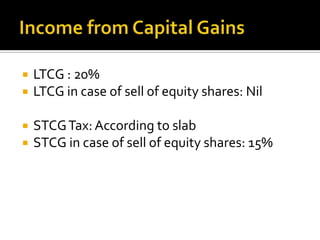
   LTCG : 20%
   LTCG in case of sell of equity shares: Nil

   STCG Tax: According to slab
   STCG in case of sell of equity shares: 15%
   Income by way of Dividends
   Income from horse races
   Income from winning bull races
   Income from shares (dividend other than
    Indian company)
   Section 80C Deductions
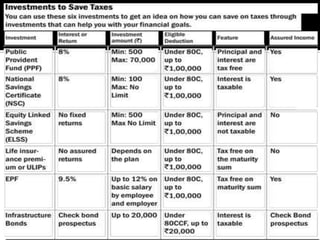
   Section 80C of the Income Tax Act [1] allows certain investments and
    expenditure to be deducted from total income up to the maximum of 1 lac. The
    total limit under this section is ₹ 100,000 ) which can be any combination of
    the below.
   Contribution to Provident Fund or Public Provident Fund
   Payment of life insurance premium
   Investment in pension Plans
   Investment in Equity Linked Savings schemes (ELSS) of mutual funds.
   Investment in National Savings Certificates
   Tax saving Fixed Deposits provided by banks for a tenure of 5 years
   Payments towards principal repayment of housing loans. Also any
    registration fee or stamp duty paid.
   Payments towards tuition fees for children to any school or college or
    university or similar institution (Only for 2 children)
   Post office investments
   From April, 1 2011, a maximum of ₹  20,000 is
    deductible under section 80CCF provided that
    amount is invested in infrastructure bonds.
    This is in addition to the 100,000 deduction
    allowed under Section 80C.
   Health insurance, popularly known as
    Mediclaim Policies, provides a deduction of
    up to 35,000.00 (₹    15,000.00 for premium
    payments towards policies on self, spouse and
    children and ₹      15,000.00 for premium
    payment towards non-senior citizen dependent
    parents or ₹ 20,000.00 for premium payment
    towards senior citizen dependent).
Interest on Housing Loans Section
For self occupied properties, interest paid on a
 housing loan up to Rs 150,000 per year is
 exempt from tax. This deduction is in addition
 to the deductions under sections 80C, 80CCF
 and 80D. However, this is only applicable for
 a residence constructed within three financial
 years after the loan is taken and also the loan
 if taken after April 1, 1999.
   Income tax calculation for the year 2012 2013 :
    You entered : Income = 905730, Gender = female,
    Seniority = none
     Tax for amount above 500000 at rate of 20% is : 81146
     Tax for amount above 200000 at rate of 10% is : 30000
     Total Tax = 111146
    Income tax calculation for previous year (2011 2012) :
    You entered : Income = 905730, Gender = female,
    Seniority = none
     Tax for amount above 800000 at rate of 30% is : 31719
     Tax for amount above 500000 at rate of 20% is : 60000
     Tax for amount above 190000 at rate of 10% is : 31000
     Total Tax = 122719
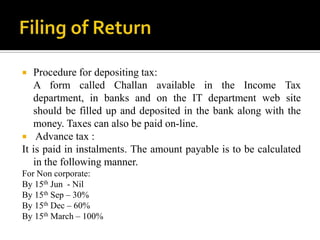
  Procedure for depositing tax:
   A form called Challan available in the Income Tax
   department, in banks and on the IT department web site
   should be filled up and deposited in the bank along with the
   money. Taxes can also be paid on-line.
 Advance tax :
It is paid in instalments. The amount payable is to be calculated
   in the following manner.
For Non corporate:
By 15th Jun - Nil
By 15th Sep – 30%
By 15th Dec – 60%
By 15th March – 100%
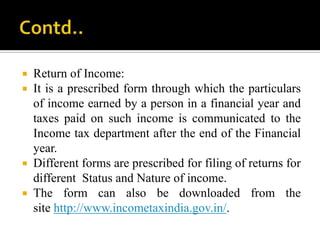
 Return of Income:
 It is a prescribed form through which the particulars
  of income earned by a person in a financial year and
  taxes paid on such income is communicated to the
  Income tax department after the end of the Financial
  year.
 Different forms are prescribed for filing of returns for
  different Status and Nature of income.
 The form can also be downloaded from the
  site http://www.incometaxindia.gov.in/.
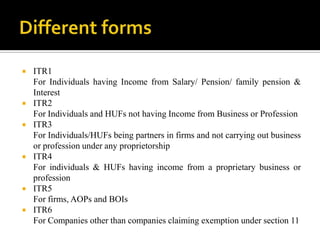
   ITR1
    For Individuals having Income from Salary/ Pension/ family pension &
    Interest
   ITR2
    For Individuals and HUFs not having Income from Business or Profession
   ITR3
    For Individuals/HUFs being partners in firms and not carrying out business
    or profession under any proprietorship
   ITR4
    For individuals & HUFs having income from a proprietary business or
    profession
   ITR5
    For firms, AOPs and BOIs
   ITR6
    For Companies other than companies claiming exemption under section 11
   ITR7
    For persons including companies required to furnish return under section
    139(4A) or section 139(4B) or section 139(4C) or section 139(4D)
   ITR8
    Return for Fringe Benefits
   ITRV
    Where the data of the Return of Income/Fringe Benefits in Form ITR-1,
    ITR-2, ITR-3, ITR-4, ITR-5, ITR-6 & ITR-8 transmitted electronically
    without digital signature
   Documents to be enclosed along with the return of
    income
    The new return form numbering 1 to 8 is annexure
    less. Hence no documents need to be attached
 Companies & their Directors       31st October
 Other business entities,
  other than companies,
  if their accounts are auditable
  & their working partners          31st October
 In all other case                 31st July
 Companies and firms are compulsorily required to
  file their return electronically.
 e-filing is compulsory for the A.Y. 2012-13 onwards,
  for an individual or a Hindu Undivided Family if the
  total income exceeded Rs. 10 lakh.
 digital signature is not mandatory. Taxpayers, can
  also transmit the data in the return electronically, and
  thereafter submit verification of the return in Form
  ITR-V.
 E-filing offers convenience of time and place to tax
  payers.
 This facility is available round the clock and returns
  could be filed from any place in the world.
 It also eliminates/ reduces interface between assessee
  and tax officials.
   Visit ITD e-filing website https://incometaxindiaefiling.gov.in
   Select appropriate type of Return Form based on Sources of
    Income and status of taxpayer. Download the excel based
    utility from the ITD e-filing website.
   Fill your return offline in the downloaded excel sheet and
    generate a XML file. Register your PAN on the ITD e-filing
    website, if you are using it for the first time. User id / Login id
    will be the PAN itself. After successful registration an
    activation link will be sent to your registered email id. Upon
    activation you can avail various facilities available on e-filing
    website including submission of income tax return.
   After login, click on "Submit Return". Select the AY and
    type of form to be uploaded.
   Browse to select XML file for uploading in the ITD e-filing
    website and click on "Upload" button.
   On successful upload, acknowledgement details would be
    displayed. Click on "Download" to download the
    acknowledgement i.e. ITR-V Form for the taxpayers, who are
    not using digital signature. This is an acknowledgement cum
    verification form.
   The tax payer has to print and duly sign the same and
    send it to "Income Tax Department – CPC, Post Bag
    No - 1, Electronic City Post Office, Bengaluru -
    560100, Karnataka" within 120 days of uploading the
    return on the ITD e-filing website by ordinary post or
    speed post only. Upon receipt of the ITR-V, the ITD will
    send an e-mail acknowledging the receipt of ITR-V to the
    email id entered in the return form. No Form ITR-V shall
    be received in any other office of the Income-tax
    Department or in any other manner. This completes the
    return filing process for non-digitally signed returns.
   For the taxpayers using digital signature for uploading the
    form, taxpayer has to register the DSC before uploading the
    return. In these cases, no ITR-V will be generated. Website
    will generate "Acknowledgement" instead and return will be
    treated as filed. Taxpayer may take a printout of the
    "Acknowledgement" for his/her record.
                               
 Yes. It may be furnished at any time before the
  expiry of two years from the end of the financial year
  in which the income was earned.
 For example, in case of income earned during FY
  2006-07, the belated return can be filed before
  31st March 2009.
   The excess tax can be claimed as refund by
    filing your income tax return. It will be
    refunded by issue of cheque or by crediting to
    your bank account.
   The department has been making efforts to
    settle refund claims within four months from
    the month of filing return.
   Am I required to keep a copy of the return
    filed as proof and for how long?
   Yes. Since legal proceedings under the income
    tax act can be initiated up to six years prior to
    the current financial year, you must maintain
    such documents at least for this period.
   Non-payment of tax attracts interests, penalty
    and prosecution.
   The prosecution can lead to rigorous
    imprisonment from 6 months to 7 years and
    fine.
   Based on information available with the
    department a small percentage of returns are
    picked up for verification. This process is
    called scrutiny.
   You will be given full opportunity to put forth
    views and evidences to support your claims.
 What recourse is available to me if I am unhappy
  with the order passed by my Assessing officer?
 The Income tax Act has provided for filing appeals in
  such cases. The first appellate authority is the
  Commissioner (Appeals). Subsequently the matter
  can be taken to the Income Tax Appellate Tribunal,
  then to the High Court and Supreme Court.
A salaried employee is not required to file Income Tax Return for
  A.Y.2012-13 provided all the following conditions are met:-
 He has earned only Salary and Income from Saving Bank
  Account and the annual interest earned from SB A/c is less than Rs.
  10,000/-.
 His Total Income does not exceed Rs. 5 lacs (Total Income
  means Gross Total Income less Deductions under Chapter VIA).
 He has reported his PAN and interest on Saving Bank Account to
  his employer.
 He has received Form-16 from his employer and his TDS has been
  deposited with Central Govt.
 He has received salary only form One Employer and has No
  Refund claim
 He has not received any notice from Income Tax Department for
  filing of Income Tax Returns.
   Practice tax avoidance.
     Legitimate methods to reduce your tax obligation to
      your fair share but no more.
     Financial decisions related to purchasing, investing,
      and retirement planning are the most heavily affected
      by tax laws.
 Tax Evasion.
   Illegally not paying all the taxes you owe, such as not
    reporting all income.
 Salary Restructuring
  Restructuring a few components could reduce your
  tax liability.
E.g. Opt for food coupons instead of lunch allowances,
  as they are exempt from tax up to Rs 60,000 p.a.
 Include medical allowance, transport allowance,
  education allowance, uniform expenses (if any), and
  telephone expenses as part of salary. Produce bills of
  actual expenses incurred for these allowances to
  reduce tax.
   Utilizing Section 80C
   Section 80C offers a maximum deduction of up to
    Rs. 1, 00,000. Utilize this section to the fullest by investing
    in any of the available investment options
 Options beyond 80C
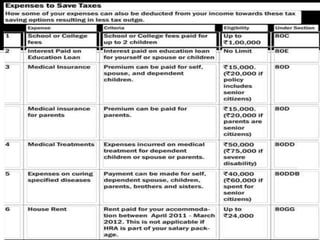
 Section 80D – Deduction of Rs. 15,000 for medical
  insurance of self, spouse and dependent children and Rs.
  20,000 for medical insurance of parents above 65 years.
 Section 80CCF- Deduction of Rs 20,000, in addition to the
  Rs 1 lakh under 80C, for investments in
  notified infrastructure bonds.
 Section 80G- Donations to specified funds or charitable
  institutions.
   House Rent Allowance
   Are you paying rent, yet not receiving any HRA from your
    company? The least of the following could be claimed under
    Section 80GG.
   25% of the total income or,
   Rs 2,000 per month or,
   Excess of rent paid over 10% of total income
   This deduction will however not be allowed, if you, your
    spouse or minor child owns a residential accommodation in
    the location where you reside or perform office duties.
   If HRA forms part of your salary, then the
    minimum of the following three is available as
    exemption.
   The actual HRA received from your employer
   The actual rent paid by you for the house,
    minus 10% of your salary (this includes basic
    + dearness allowance, if any)
   50% of your basic salary (for a metro) or 40%
    of your basic salary (for non-metro).
   Tax Saving from Home Loans
   Use your home loan efficiently to save more
    tax. The principal component of your loan, is
    included under Section 80c, offering a
    deduction up to Rs. 1, 00,000.
    The interest portion offers a deduction up to
    Rs. 1, 50,000 separately under Section 24.
   To minimize taxes owed...
     If you expect to have the same or a lower tax rate next year,
      accelerate deductions into the current year.
     If you expect to have a lower or the same tax rate next year,
      delay the receipt of income until next year.
     If you expect to have a higher tax rate next year, delay
      deductions since they will have a greater benefit.
     If you expect to have a higher tax rate next year, accelerate
      the receipt of income to have it taxed at the current lower
      rate

Tax computation

  • 2.
     Income fromSalary  All income received as salary under Employer- Employee relationship is taxed under this head. Employers must withhold tax compulsorily, if income exceeds minimum exemption limit, as Tax Deducted at Source (TDS)  and provide their employees with a Form 16 which shows the tax deductions and net paid income.
  • 3.
    In addition, the Form 16 will contain any other deductions provided from salary such as:  Medical reimbursement: Up to 15,000 per year is tax free if supported by bills.  Transport allowance: Up to 800 per month (9,600 per year) is tax free if provided as transport allowance. No bills are required for this amount.  Conveyance allowance: is tax exempt.  Professional taxes: Most states tax employment on a per-professional basis, usually a slabbed amount based on gross income. Such taxes paid are deductible from income tax.  House rent allowance: the least of the following is available as exemption  Actual HRA received  50%/40%(metro/non-metro) of basic salary
  • 4.
    Income from House property is computed by taking into account what is called Gross Annual Value of the property.  The annual value (Annual value in case of a self occupied house is to be taken as NIL. (However if there is more than one self occupied house then the annual value of the other house/s is taxable.)
  • 5.
    From this, deduct Municipal Tax paid and you get the Net Annual Value.  From this Net Annual Value, deduct :  30% of Net value as repair cost (This is a mandatory deduction)  No other deduction available  Interest paid or payable on a housing loan against this house
  • 6.
    LTCG : 20%  LTCG in case of sell of equity shares: Nil  STCG Tax: According to slab  STCG in case of sell of equity shares: 15%
  • 7.
    Income by way of Dividends  Income from horse races  Income from winning bull races  Income from shares (dividend other than Indian company)
  • 8.
    Section 80C Deductions  Section 80C of the Income Tax Act [1] allows certain investments and expenditure to be deducted from total income up to the maximum of 1 lac. The total limit under this section is ₹ 100,000 ) which can be any combination of the below.  Contribution to Provident Fund or Public Provident Fund  Payment of life insurance premium  Investment in pension Plans  Investment in Equity Linked Savings schemes (ELSS) of mutual funds.  Investment in National Savings Certificates  Tax saving Fixed Deposits provided by banks for a tenure of 5 years  Payments towards principal repayment of housing loans. Also any registration fee or stamp duty paid.  Payments towards tuition fees for children to any school or college or university or similar institution (Only for 2 children)  Post office investments
  • 9.
    From April, 1 2011, a maximum of ₹ 20,000 is deductible under section 80CCF provided that amount is invested in infrastructure bonds. This is in addition to the 100,000 deduction allowed under Section 80C.
  • 10.
    Health insurance, popularly known as Mediclaim Policies, provides a deduction of up to 35,000.00 (₹ 15,000.00 for premium payments towards policies on self, spouse and children and ₹ 15,000.00 for premium payment towards non-senior citizen dependent parents or ₹ 20,000.00 for premium payment towards senior citizen dependent).
  • 11.
    Interest on HousingLoans Section For self occupied properties, interest paid on a housing loan up to Rs 150,000 per year is exempt from tax. This deduction is in addition to the deductions under sections 80C, 80CCF and 80D. However, this is only applicable for a residence constructed within three financial years after the loan is taken and also the loan if taken after April 1, 1999.
  • 12.
    Income tax calculation for the year 2012 2013 : You entered : Income = 905730, Gender = female, Seniority = none Tax for amount above 500000 at rate of 20% is : 81146 Tax for amount above 200000 at rate of 10% is : 30000 Total Tax = 111146 Income tax calculation for previous year (2011 2012) : You entered : Income = 905730, Gender = female, Seniority = none Tax for amount above 800000 at rate of 30% is : 31719 Tax for amount above 500000 at rate of 20% is : 60000 Tax for amount above 190000 at rate of 10% is : 31000 Total Tax = 122719
  • 15.
     Procedurefor depositing tax: A form called Challan available in the Income Tax department, in banks and on the IT department web site should be filled up and deposited in the bank along with the money. Taxes can also be paid on-line.  Advance tax : It is paid in instalments. The amount payable is to be calculated in the following manner. For Non corporate: By 15th Jun - Nil By 15th Sep – 30% By 15th Dec – 60% By 15th March – 100%
  • 16.
     Return ofIncome:  It is a prescribed form through which the particulars of income earned by a person in a financial year and taxes paid on such income is communicated to the Income tax department after the end of the Financial year.  Different forms are prescribed for filing of returns for different Status and Nature of income.  The form can also be downloaded from the site http://www.incometaxindia.gov.in/.
  • 17.
    ITR1 For Individuals having Income from Salary/ Pension/ family pension & Interest  ITR2 For Individuals and HUFs not having Income from Business or Profession  ITR3 For Individuals/HUFs being partners in firms and not carrying out business or profession under any proprietorship  ITR4 For individuals & HUFs having income from a proprietary business or profession  ITR5 For firms, AOPs and BOIs  ITR6 For Companies other than companies claiming exemption under section 11
  • 18.
    ITR7 For persons including companies required to furnish return under section 139(4A) or section 139(4B) or section 139(4C) or section 139(4D)  ITR8 Return for Fringe Benefits  ITRV Where the data of the Return of Income/Fringe Benefits in Form ITR-1, ITR-2, ITR-3, ITR-4, ITR-5, ITR-6 & ITR-8 transmitted electronically without digital signature
  • 19.
    Documents to be enclosed along with the return of income The new return form numbering 1 to 8 is annexure less. Hence no documents need to be attached
  • 20.
     Companies &their Directors 31st October  Other business entities, other than companies, if their accounts are auditable & their working partners 31st October  In all other case 31st July
  • 21.
     Companies andfirms are compulsorily required to file their return electronically.  e-filing is compulsory for the A.Y. 2012-13 onwards, for an individual or a Hindu Undivided Family if the total income exceeded Rs. 10 lakh.  digital signature is not mandatory. Taxpayers, can also transmit the data in the return electronically, and thereafter submit verification of the return in Form ITR-V.
  • 22.
     E-filing offersconvenience of time and place to tax payers.  This facility is available round the clock and returns could be filed from any place in the world.  It also eliminates/ reduces interface between assessee and tax officials.
  • 23.
    Visit ITD e-filing website https://incometaxindiaefiling.gov.in  Select appropriate type of Return Form based on Sources of Income and status of taxpayer. Download the excel based utility from the ITD e-filing website.  Fill your return offline in the downloaded excel sheet and generate a XML file. Register your PAN on the ITD e-filing website, if you are using it for the first time. User id / Login id will be the PAN itself. After successful registration an activation link will be sent to your registered email id. Upon activation you can avail various facilities available on e-filing website including submission of income tax return.
  • 24.
    After login, click on "Submit Return". Select the AY and type of form to be uploaded.  Browse to select XML file for uploading in the ITD e-filing website and click on "Upload" button.  On successful upload, acknowledgement details would be displayed. Click on "Download" to download the acknowledgement i.e. ITR-V Form for the taxpayers, who are not using digital signature. This is an acknowledgement cum verification form.
  • 25.
    The tax payer has to print and duly sign the same and send it to "Income Tax Department – CPC, Post Bag No - 1, Electronic City Post Office, Bengaluru - 560100, Karnataka" within 120 days of uploading the return on the ITD e-filing website by ordinary post or speed post only. Upon receipt of the ITR-V, the ITD will send an e-mail acknowledging the receipt of ITR-V to the email id entered in the return form. No Form ITR-V shall be received in any other office of the Income-tax Department or in any other manner. This completes the return filing process for non-digitally signed returns.
  • 26.
    For the taxpayers using digital signature for uploading the form, taxpayer has to register the DSC before uploading the return. In these cases, no ITR-V will be generated. Website will generate "Acknowledgement" instead and return will be treated as filed. Taxpayer may take a printout of the "Acknowledgement" for his/her record. 
  • 27.
     Yes. Itmay be furnished at any time before the expiry of two years from the end of the financial year in which the income was earned.  For example, in case of income earned during FY 2006-07, the belated return can be filed before 31st March 2009.
  • 28.
    The excess tax can be claimed as refund by filing your income tax return. It will be refunded by issue of cheque or by crediting to your bank account.  The department has been making efforts to settle refund claims within four months from the month of filing return.
  • 29.
    Am I required to keep a copy of the return filed as proof and for how long?  Yes. Since legal proceedings under the income tax act can be initiated up to six years prior to the current financial year, you must maintain such documents at least for this period.
  • 30.
    Non-payment of tax attracts interests, penalty and prosecution.  The prosecution can lead to rigorous imprisonment from 6 months to 7 years and fine.
  • 31.
    Based on information available with the department a small percentage of returns are picked up for verification. This process is called scrutiny.  You will be given full opportunity to put forth views and evidences to support your claims.
  • 32.
     What recourseis available to me if I am unhappy with the order passed by my Assessing officer?  The Income tax Act has provided for filing appeals in such cases. The first appellate authority is the Commissioner (Appeals). Subsequently the matter can be taken to the Income Tax Appellate Tribunal, then to the High Court and Supreme Court.
  • 33.
    A salaried employeeis not required to file Income Tax Return for A.Y.2012-13 provided all the following conditions are met:-  He has earned only Salary and Income from Saving Bank Account and the annual interest earned from SB A/c is less than Rs. 10,000/-.  His Total Income does not exceed Rs. 5 lacs (Total Income means Gross Total Income less Deductions under Chapter VIA).  He has reported his PAN and interest on Saving Bank Account to his employer.  He has received Form-16 from his employer and his TDS has been deposited with Central Govt.  He has received salary only form One Employer and has No Refund claim  He has not received any notice from Income Tax Department for filing of Income Tax Returns.
  • 34.
    Practice tax avoidance.  Legitimate methods to reduce your tax obligation to your fair share but no more.  Financial decisions related to purchasing, investing, and retirement planning are the most heavily affected by tax laws.  Tax Evasion.  Illegally not paying all the taxes you owe, such as not reporting all income.
  • 35.
     Salary Restructuring  Restructuring a few components could reduce your tax liability. E.g. Opt for food coupons instead of lunch allowances, as they are exempt from tax up to Rs 60,000 p.a.  Include medical allowance, transport allowance, education allowance, uniform expenses (if any), and telephone expenses as part of salary. Produce bills of actual expenses incurred for these allowances to reduce tax.
  • 36.
    Utilizing Section 80C  Section 80C offers a maximum deduction of up to Rs. 1, 00,000. Utilize this section to the fullest by investing in any of the available investment options  Options beyond 80C  Section 80D – Deduction of Rs. 15,000 for medical insurance of self, spouse and dependent children and Rs. 20,000 for medical insurance of parents above 65 years.  Section 80CCF- Deduction of Rs 20,000, in addition to the Rs 1 lakh under 80C, for investments in notified infrastructure bonds.  Section 80G- Donations to specified funds or charitable institutions.
  • 37.
    House Rent Allowance  Are you paying rent, yet not receiving any HRA from your company? The least of the following could be claimed under Section 80GG.  25% of the total income or,  Rs 2,000 per month or,  Excess of rent paid over 10% of total income  This deduction will however not be allowed, if you, your spouse or minor child owns a residential accommodation in the location where you reside or perform office duties.
  • 38.
    If HRA forms part of your salary, then the minimum of the following three is available as exemption.  The actual HRA received from your employer  The actual rent paid by you for the house, minus 10% of your salary (this includes basic + dearness allowance, if any)  50% of your basic salary (for a metro) or 40% of your basic salary (for non-metro).
  • 39.
    Tax Saving from Home Loans  Use your home loan efficiently to save more tax. The principal component of your loan, is included under Section 80c, offering a deduction up to Rs. 1, 00,000.  The interest portion offers a deduction up to Rs. 1, 50,000 separately under Section 24.
  • 40.
    To minimize taxes owed...  If you expect to have the same or a lower tax rate next year, accelerate deductions into the current year.  If you expect to have a lower or the same tax rate next year, delay the receipt of income until next year.  If you expect to have a higher tax rate next year, delay deductions since they will have a greater benefit.  If you expect to have a higher tax rate next year, accelerate the receipt of income to have it taxed at the current lower rate