Basics of International Taxation
By
Shailendra Kumar Mishra
ASC Group
Contents
• Section 5 of Income Tax Act, 1961
• Section 9 of Income Tax Act, 1961
• Section 195 of Income Tax Act, 1961
• Types of Model Convention for different Treaties
• A brief on Most Favoured Nation
• Double Taxation Avoidance Agreements
• LOB Clause in DTAA’s
Meaning of International
Taxation
International taxation is the study or determination
of tax on a person or business subject to the tax laws
of different countries or the international aspects of
an individual country's tax laws.
Section 5 – Incidence of Tax
This section is mainly used to identify the taxability of a particular
transaction.
Very much relevant in identify the taxability of income of Expats.
Two step process:-
• Identify whether it is Indian Income or Foreign Income
• Determine taxability of both the incomes by identifying the control
of business
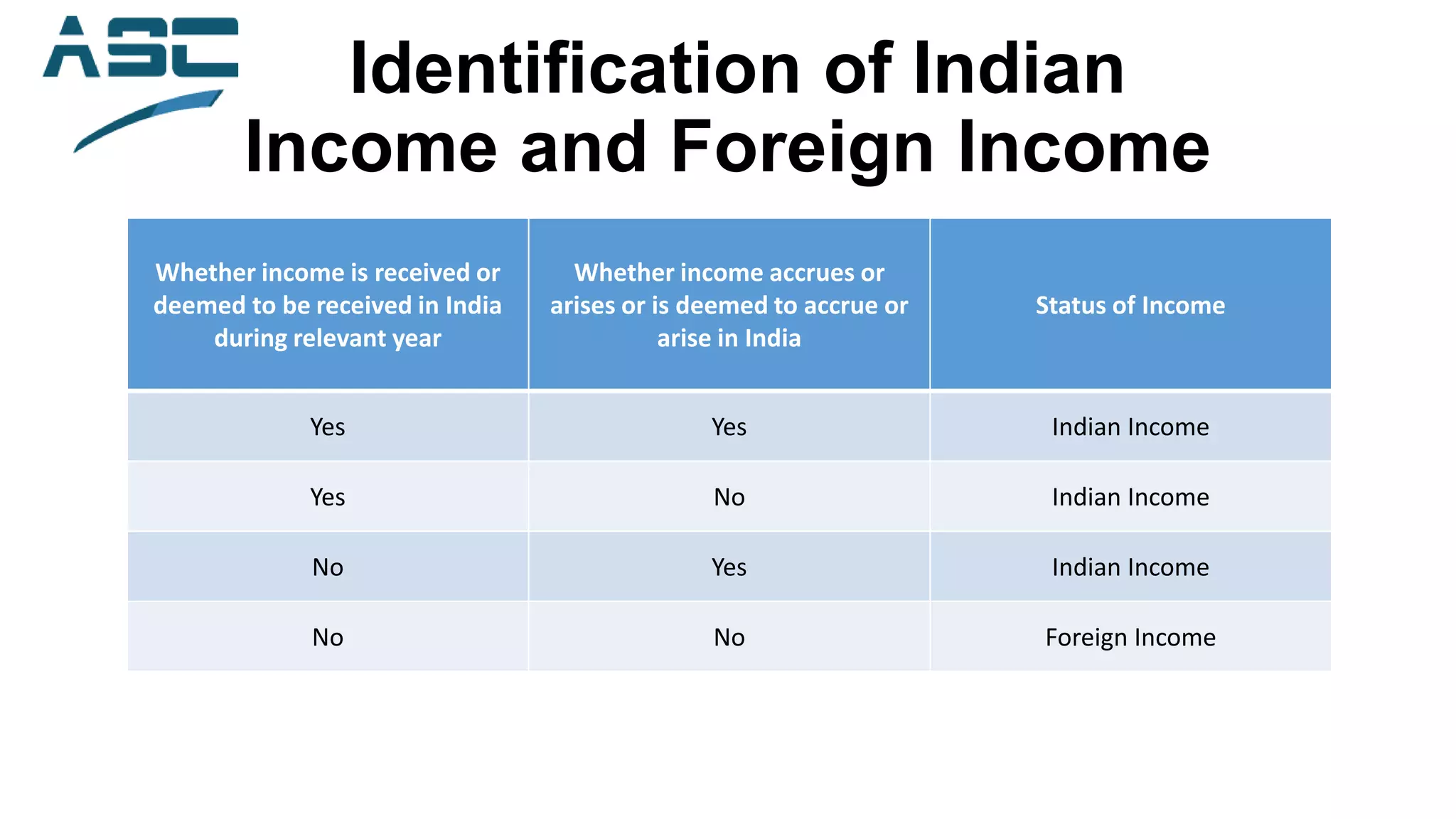
Identification of Indian
Income and Foreign Income
Whether income is received or
deemed to be received in India
during relevant year
Whether income accrues or
arises or is deemed to accrue or
arise in India
Status of Income
Yes Yes Indian Income
Yes No Indian Income
No Yes Indian Income
No No Foreign Income
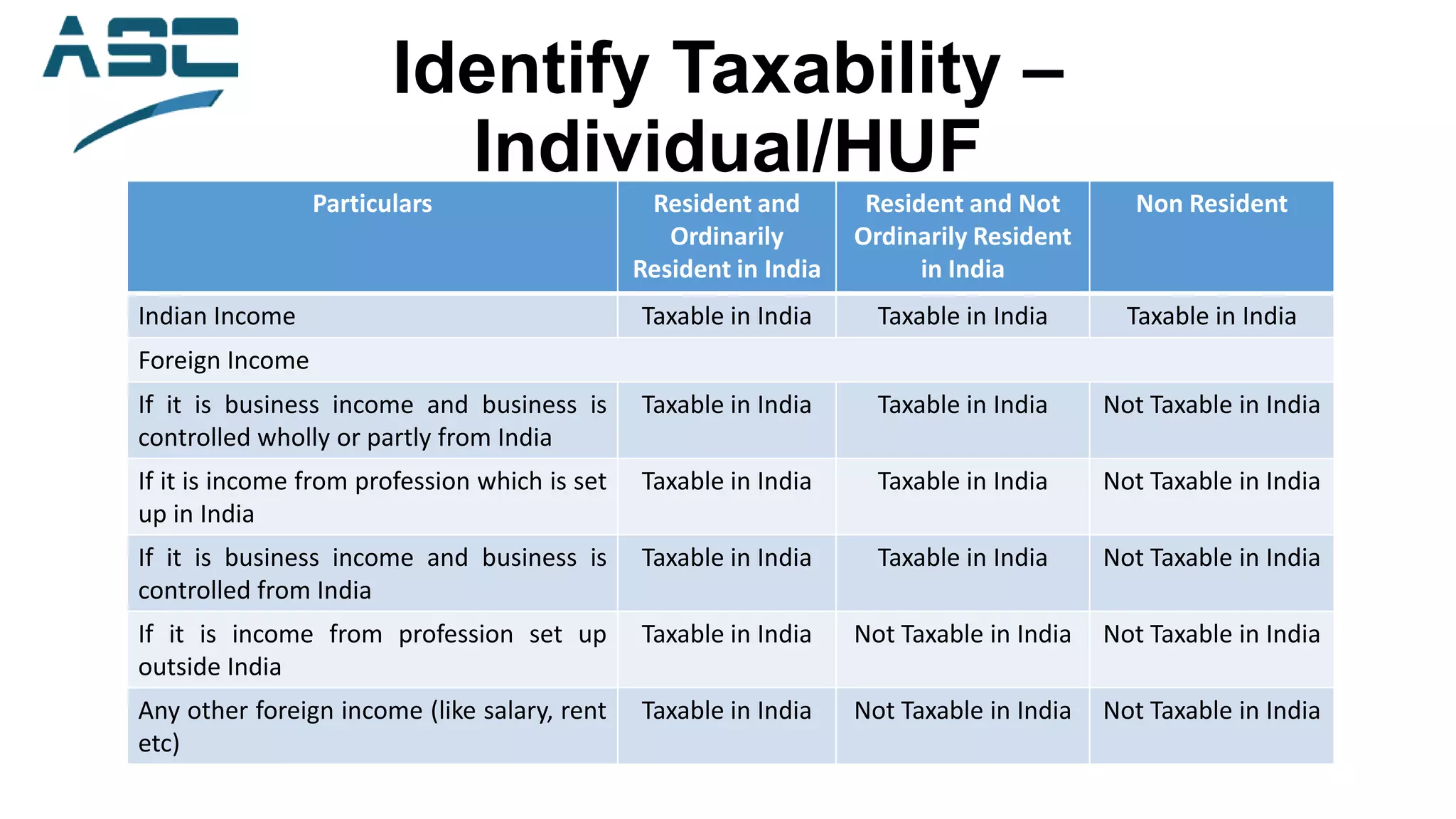
Identify Taxability –
Individual/HUF
Particulars Resident and
Ordinarily
Resident in India
Resident and Not
Ordinarily Resident
in India
Non Resident
Indian Income Taxable in India Taxable in India Taxable in India
Foreign Income
If it is business income and business is
controlled wholly or partly from India
Taxable in India Taxable in India Not Taxable in India
If it is income from profession which is set
up in India
Taxable in India Taxable in India Not Taxable in India
If it is business income and business is
controlled from India
Taxable in India Taxable in India Not Taxable in India
If it is income from profession set up
outside India
Taxable in India Not Taxable in India Not Taxable in India
Any other foreign income (like salary, rent
etc)
Taxable in India Not Taxable in India Not Taxable in India
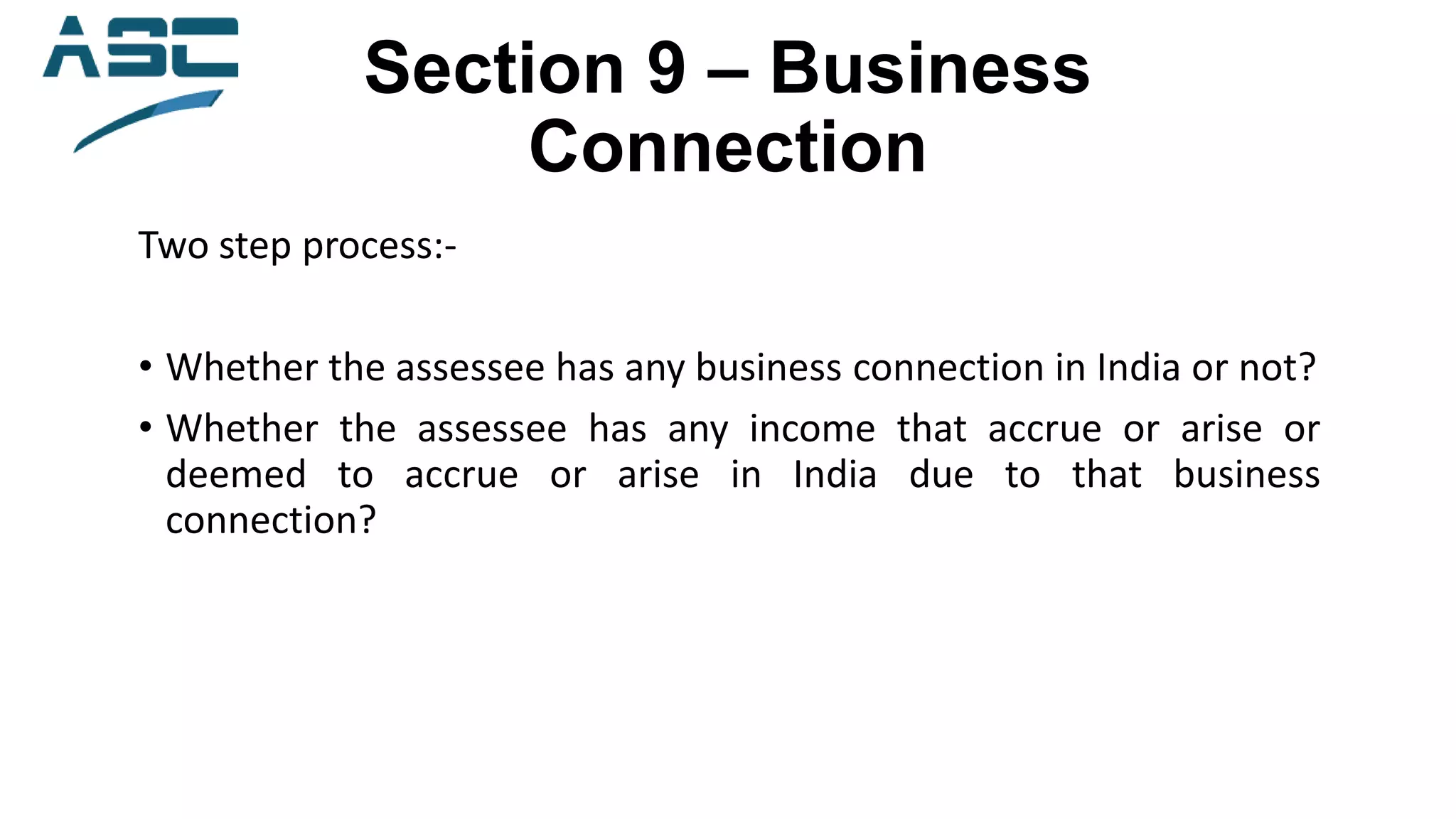
Section 9 – Business
Connection
Two step process:-
• Whether the assessee has any business connection in India or not?
• Whether the assessee has any income that accrue or arise or
deemed to accrue or arise in India due to that business
connection?
General principles of Section
9
Mere existence of business connection may not result in income to
non-resident assessee from transaction with such a business
connection accruing or arising in India.
It would be wrong to equate permanent establishment with a
business connection, since former is for purpose of assessment of
income of a non-resident under a Double Taxation Avoidance
Agreement, and latter is for application of section 9.
For attracting taxing statute, there has to be some activity through
permanent establishment and, if income arises without any activity
of permanent establishment, even under DTAA, taxation liability in
respect of overseas services would not arise in India.
Section 195 – Foreign
Remittances
Determines that a particular transaction should be taxed if the
income is chargeable to tax in India. Rates has been prescribed.
Rates prescribed in First Schedule of Relevant Finance Act.
Types of Model Convention
• Organization for Economic Co-operation of Development (OECD)
Model
• United Nations (UN) Model
• Vienna Convention
OECD & UN Model
Convention
What is OECD?
Organization for economic cooperation and development. A
platform for different governments to share experiences and seek
solutions to common problems.
OECD & UN Model
Convention
After World War II was over, European leaders began to feel that the
best way to ensure lasting peace was to encourage co-operation and
reconstruction, rather than punish the defeated. This organization
for European Economic Cooperation (OEEC) was established in 1948
to run the US financed Marshall Plan for reconstruction of a
continent ravaged by war. By making individual governments
recognise the interdependence of their economies, it paved the way
for a new era of cooperation that was to change the face of Europe.
OECD & UN Model
Convention
Encouraged by its success and the prospect of carrying its work
forward on a global stage, Canada and the US joined OEEC members
on 14th December 1960 and OECD was born then with US and
Canada. The official launch of OECD was on 30th September 1961
when a model convention was launched and agreed to between all
the member countries. Slowly and gradually many countries joined
OECD and today there are 34 member countries which does not
include India.
OECD & UN Model
Convention
In 1960’s developing countries began to feel that the provisions of
the OECD model were more favourable to a developed country
rather than to a developing country because the main base of the
OECD model is source based taxation rather than Residence based
taxation. Thus developing countries together formed a UN model
Tax convention for the benefit of Developing countries. As the
investment flow was from developed to developing countries,
therefore, there was a need of a model convention which would
more benefit the developing countries in terms of taxation.
OECD & UN Model
Convention
The growth of investment flows from developed to developing countries
depends to a large extent on what has been referred to as the
international investment climate. The prevention or elimination of
international double taxation—i.e., the imposition of similar taxes in two
or more States on the same taxpayer in respect of the same base—whose
effects are harmful to the exchange of goods and services and to the
movement of capital and persons, constitutes a significant component of
such a climate.
Thus UN Model Tax Convention was formed between developed
countries and developing countries to protect the interest of developing
countries and improve the relations between developed and developing
countries. In 2011, the UN model convention was revised.
Vienna Convention
Vienna convention was drafted by the International Law
Commission of the United Nations. This applies only to treaties
entered into between states. This was signed in 1969 and came into
effect in 1980.
This convention comprises of provisions which are used for
interpretation of law of treaties between governments. This helps in
interpretation of the treaty.
Most Favoured Nation
Clause
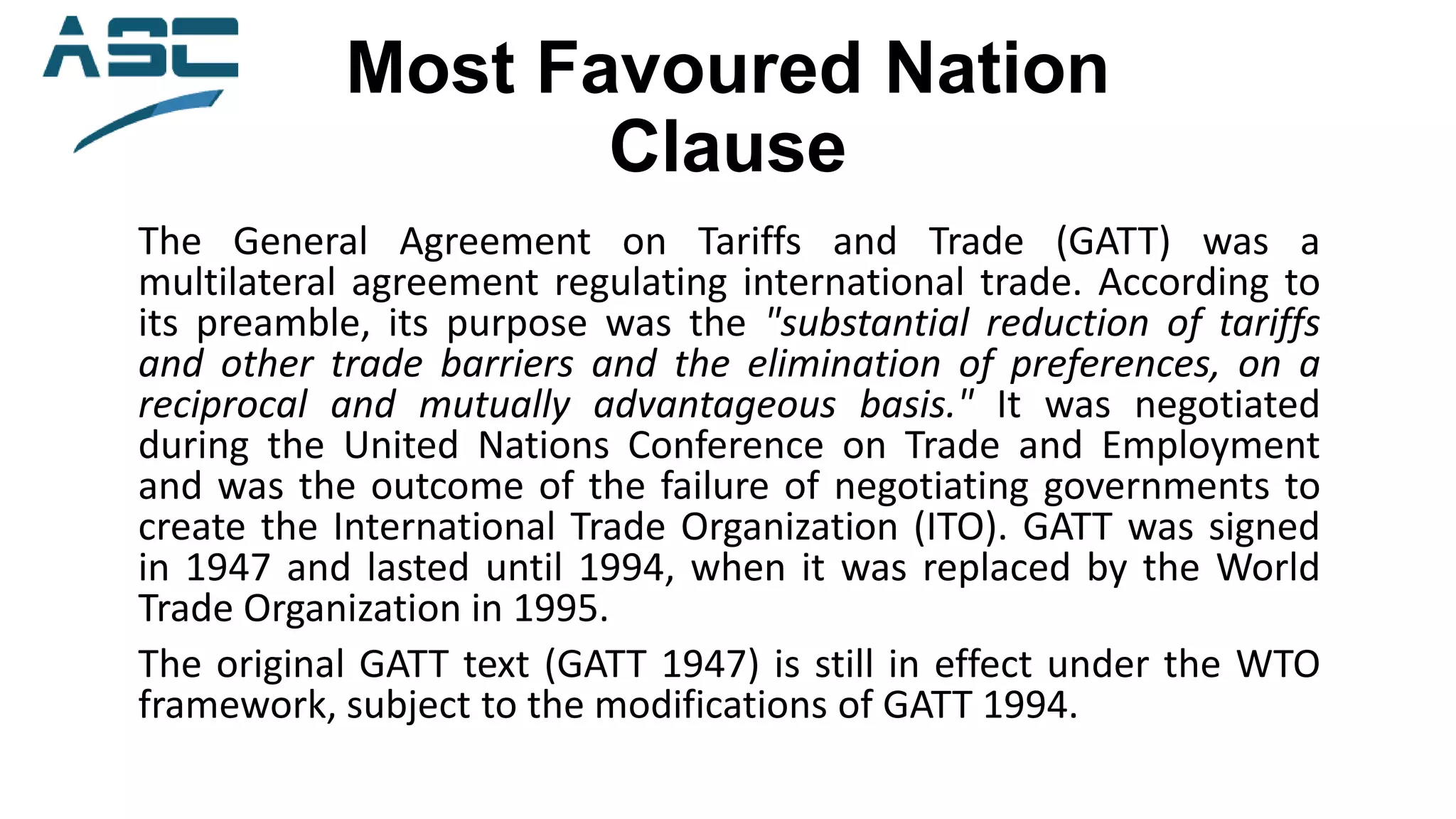
The General Agreement on Tariffs and Trade (GATT) was a
multilateral agreement regulating international trade. According to
its preamble, its purpose was the "substantial reduction of tariffs
and other trade barriers and the elimination of preferences, on a
reciprocal and mutually advantageous basis." It was negotiated
during the United Nations Conference on Trade and Employment
and was the outcome of the failure of negotiating governments to
create the International Trade Organization (ITO). GATT was signed
in 1947 and lasted until 1994, when it was replaced by the World
Trade Organization in 1995.
The original GATT text (GATT 1947) is still in effect under the WTO
framework, subject to the modifications of GATT 1994.
DTAA’s
Types of Agreements:-
Bilateral Agreements vs. Multilateral Agreements
Bilateral Agreements:- Between two countries
Multilateral Agreements:- Between more than two countries
DTAA’s
Kinds of DTAA’s
• Comprehensive Agreements
• Limited Agreements
• Tax Information Exchange Agreements
Comprehensive Agreements
Different Articles present in DTAA’s
• Permanent Establishments
• Business Profits
• Dividends
• Interest
• Income from Immovable Property
• Fees for Technical Services and Royalty
• Dependent Professional Services
• Independent Professional Services
• And others etc.
Permanent Establishment
What is Permanent Establishment?
A permanent establishment (PE) is a fixed place of business which
generally gives rise to income or value added tax liability in a
particular jurisdiction.
Permanent Establishment
Types of Permanent Establishment
• Fixed Place PE
• Agency PE
• Service PE
Definitions has already been given in the DTAA between the
countries.
Fees for Technical
Services/Royalty
FTS/Royalty is one of the articles of all the DTAA’s which is
frequently used while signing Form 15CB.
Some countries has mentioned “Make Available Clause” in their
Articles so as to define the taxability in this Article.
Relevance of “Make Available Clause” has been explained in many
case laws of various courts.
Fees for Technical
Services/Royalty
Relevance of “Make Available Clause” explained in the case of Raymond
Ltd. vs. DCIT [86 ITD 791] (Mum)
• Does not mean mere rendering of services
• Person utilising the service is able to make use of technical
knowledge independently, without recourse to the performer of
services in future
• Transmission of technical knowledge, skill, etc. from person
rendering the services to the person utilising the services
• Technical knowledge, skill, must remain with the person utilising the
service even after rendering of services has come to an end
Limitation of Benefits Clause
This clause is based on three principal tests in all the DTAA’s
• Public Company Test
• Ownership/Base Erosion Test; and
• Active Business Test/Economic Substance Doctrine
Only one test needs to be fulfilled.
Thank You
Shailendra Kumar Mishra
Mobile No.:- +91 9891 255 399
Skype ID:- Shailendra.mishra68
Blogger:- Shailendramishra87.blogspot.com
Linkedin:- http://www.linkedin.com/pub/shailendra-kumar-mishra/28/baa/649

BASICS OF INTERNATIONAL TAXATION

  • 1.
    Basics of InternationalTaxation By Shailendra Kumar Mishra ASC Group
  • 2.
    Contents • Section 5of Income Tax Act, 1961 • Section 9 of Income Tax Act, 1961 • Section 195 of Income Tax Act, 1961 • Types of Model Convention for different Treaties • A brief on Most Favoured Nation • Double Taxation Avoidance Agreements • LOB Clause in DTAA’s
  • 3.
    Meaning of International Taxation Internationaltaxation is the study or determination of tax on a person or business subject to the tax laws of different countries or the international aspects of an individual country's tax laws.
  • 4.
    Section 5 –Incidence of Tax This section is mainly used to identify the taxability of a particular transaction. Very much relevant in identify the taxability of income of Expats. Two step process:- • Identify whether it is Indian Income or Foreign Income • Determine taxability of both the incomes by identifying the control of business
  • 5.
    Identification of Indian Incomeand Foreign Income Whether income is received or deemed to be received in India during relevant year Whether income accrues or arises or is deemed to accrue or arise in India Status of Income Yes Yes Indian Income Yes No Indian Income No Yes Indian Income No No Foreign Income
  • 6.
    Identify Taxability – Individual/HUF ParticularsResident and Ordinarily Resident in India Resident and Not Ordinarily Resident in India Non Resident Indian Income Taxable in India Taxable in India Taxable in India Foreign Income If it is business income and business is controlled wholly or partly from India Taxable in India Taxable in India Not Taxable in India If it is income from profession which is set up in India Taxable in India Taxable in India Not Taxable in India If it is business income and business is controlled from India Taxable in India Taxable in India Not Taxable in India If it is income from profession set up outside India Taxable in India Not Taxable in India Not Taxable in India Any other foreign income (like salary, rent etc) Taxable in India Not Taxable in India Not Taxable in India
  • 7.
    Section 9 –Business Connection Two step process:- • Whether the assessee has any business connection in India or not? • Whether the assessee has any income that accrue or arise or deemed to accrue or arise in India due to that business connection?
  • 8.
    General principles ofSection 9 Mere existence of business connection may not result in income to non-resident assessee from transaction with such a business connection accruing or arising in India. It would be wrong to equate permanent establishment with a business connection, since former is for purpose of assessment of income of a non-resident under a Double Taxation Avoidance Agreement, and latter is for application of section 9. For attracting taxing statute, there has to be some activity through permanent establishment and, if income arises without any activity of permanent establishment, even under DTAA, taxation liability in respect of overseas services would not arise in India.
  • 9.
    Section 195 –Foreign Remittances Determines that a particular transaction should be taxed if the income is chargeable to tax in India. Rates has been prescribed. Rates prescribed in First Schedule of Relevant Finance Act.
  • 10.
    Types of ModelConvention • Organization for Economic Co-operation of Development (OECD) Model • United Nations (UN) Model • Vienna Convention
  • 11.
    OECD & UNModel Convention What is OECD? Organization for economic cooperation and development. A platform for different governments to share experiences and seek solutions to common problems.
  • 12.
    OECD & UNModel Convention After World War II was over, European leaders began to feel that the best way to ensure lasting peace was to encourage co-operation and reconstruction, rather than punish the defeated. This organization for European Economic Cooperation (OEEC) was established in 1948 to run the US financed Marshall Plan for reconstruction of a continent ravaged by war. By making individual governments recognise the interdependence of their economies, it paved the way for a new era of cooperation that was to change the face of Europe.
  • 13.
    OECD & UNModel Convention Encouraged by its success and the prospect of carrying its work forward on a global stage, Canada and the US joined OEEC members on 14th December 1960 and OECD was born then with US and Canada. The official launch of OECD was on 30th September 1961 when a model convention was launched and agreed to between all the member countries. Slowly and gradually many countries joined OECD and today there are 34 member countries which does not include India.
  • 14.
    OECD & UNModel Convention In 1960’s developing countries began to feel that the provisions of the OECD model were more favourable to a developed country rather than to a developing country because the main base of the OECD model is source based taxation rather than Residence based taxation. Thus developing countries together formed a UN model Tax convention for the benefit of Developing countries. As the investment flow was from developed to developing countries, therefore, there was a need of a model convention which would more benefit the developing countries in terms of taxation.
  • 15.
    OECD & UNModel Convention The growth of investment flows from developed to developing countries depends to a large extent on what has been referred to as the international investment climate. The prevention or elimination of international double taxation—i.e., the imposition of similar taxes in two or more States on the same taxpayer in respect of the same base—whose effects are harmful to the exchange of goods and services and to the movement of capital and persons, constitutes a significant component of such a climate. Thus UN Model Tax Convention was formed between developed countries and developing countries to protect the interest of developing countries and improve the relations between developed and developing countries. In 2011, the UN model convention was revised.
  • 16.
    Vienna Convention Vienna conventionwas drafted by the International Law Commission of the United Nations. This applies only to treaties entered into between states. This was signed in 1969 and came into effect in 1980. This convention comprises of provisions which are used for interpretation of law of treaties between governments. This helps in interpretation of the treaty.
  • 17.
    Most Favoured Nation Clause TheGeneral Agreement on Tariffs and Trade (GATT) was a multilateral agreement regulating international trade. According to its preamble, its purpose was the "substantial reduction of tariffs and other trade barriers and the elimination of preferences, on a reciprocal and mutually advantageous basis." It was negotiated during the United Nations Conference on Trade and Employment and was the outcome of the failure of negotiating governments to create the International Trade Organization (ITO). GATT was signed in 1947 and lasted until 1994, when it was replaced by the World Trade Organization in 1995. The original GATT text (GATT 1947) is still in effect under the WTO framework, subject to the modifications of GATT 1994.
  • 18.
    DTAA’s Types of Agreements:- BilateralAgreements vs. Multilateral Agreements Bilateral Agreements:- Between two countries Multilateral Agreements:- Between more than two countries
  • 19.
    DTAA’s Kinds of DTAA’s •Comprehensive Agreements • Limited Agreements • Tax Information Exchange Agreements
  • 20.
    Comprehensive Agreements Different Articlespresent in DTAA’s • Permanent Establishments • Business Profits • Dividends • Interest • Income from Immovable Property • Fees for Technical Services and Royalty • Dependent Professional Services • Independent Professional Services • And others etc.
  • 21.
    Permanent Establishment What isPermanent Establishment? A permanent establishment (PE) is a fixed place of business which generally gives rise to income or value added tax liability in a particular jurisdiction.
  • 22.
    Permanent Establishment Types ofPermanent Establishment • Fixed Place PE • Agency PE • Service PE Definitions has already been given in the DTAA between the countries.
  • 23.
    Fees for Technical Services/Royalty FTS/Royaltyis one of the articles of all the DTAA’s which is frequently used while signing Form 15CB. Some countries has mentioned “Make Available Clause” in their Articles so as to define the taxability in this Article. Relevance of “Make Available Clause” has been explained in many case laws of various courts.
  • 24.
    Fees for Technical Services/Royalty Relevanceof “Make Available Clause” explained in the case of Raymond Ltd. vs. DCIT [86 ITD 791] (Mum) • Does not mean mere rendering of services • Person utilising the service is able to make use of technical knowledge independently, without recourse to the performer of services in future • Transmission of technical knowledge, skill, etc. from person rendering the services to the person utilising the services • Technical knowledge, skill, must remain with the person utilising the service even after rendering of services has come to an end
  • 25.
    Limitation of BenefitsClause This clause is based on three principal tests in all the DTAA’s • Public Company Test • Ownership/Base Erosion Test; and • Active Business Test/Economic Substance Doctrine Only one test needs to be fulfilled.
  • 26.
    Thank You Shailendra KumarMishra Mobile No.:- +91 9891 255 399 Skype ID:- Shailendra.mishra68 Blogger:- Shailendramishra87.blogspot.com Linkedin:- http://www.linkedin.com/pub/shailendra-kumar-mishra/28/baa/649