COMPANIES ACT, 1956
Introduction
Objects of Company Law

1.   To encourage investments
2.   To ensure proper administration
3.   To prevent malpractices
4.   To allow for investigations
Meaning of Company

   “A company is defined as a form of business
    organization in which the funds of a large number
    of investors are managed by a few persons for the
    purpose of earning profits which are shared by all
    investors”
Characteristics of a Company
   Registration
   Separate legal entity
   Perpetual Succession
   Transferable shares
   Limited liability
   Common seal
   Separate property
   Capacity to sue
Types of Companies
A.   From the point of view of Incorporation

B.   From the point of view of Liability

C.   From the viewpoint of Nationality

D.   From the view point of Public Interest
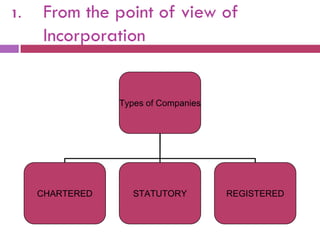
1.   From the point of view of
     Incorporation


                 Types of Companies


     CHARTERED      STATUTORY         REGISTERED
Chartered Company

    Historically, most of the early companies were set up
     through a Royal Charter.
    For example, the East India Company, the Chartered
     Bank of Australia, India and China, etc., were
     incorporated by the grant of a special Royal Charter.
    In India, this form of organization does not exist now
     because there is no monarchy.
    Even in England, this method is rarely used now.
     Companies of this kind may be called chartered
     companies.
Statutory Company

    In this case, a special law is passed to establish the
     company.
    This is done only in special cases when it is necessary to
     regulate the working of the company for some specific
     purposes.
    These are mostly concerned with public utilities
    Examples of such companies in India are: the Industrial
     Finance Corporation, the Life Insurance Corporation of
     India, the Air India, Reserve Bank of India, etc.
    The provisions of Indian companies act 1956 apply to them
     if they are not inconsistent with the provisions of their
     special Acts.
Registered Company


   The Companies Act, 1956, lays down procedures by
    which a company can be brought into existence.
    Anybody who wants to incorporate a company can
    do so by taking necessary steps outlined therein.
   By far the largest number of companies is
    incorporated under the Companies Act. These
    companies may be called registered companies.
2.    From the point of view of
      Liability


                   TYPES


     UNLIMITED   GUARANTEE    LIMITED
Unlimited Company


   Do not have any limit on the extent of liability of its
    members.
   Liability of each member extends to whole amount of
    the company‟s debts and liabilities.
   However, the members cannot be sued upon the
    directly by the company's creditors.
Company Limited By Guarantee


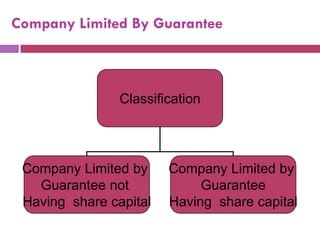
                Classification


 Company Limited by     Company Limited by
   Guarantee not             Guarantee
 Having share capital   Having share capital
Company Limited By Guarantee
    Not Having Share Capital

   Memorandum Limits the member‟s liability.
   It is limited to the amount as may have been undertaken
    by MOA to contribute in the case of winding up.
Company Limited By Guarantee
Having Share Capital

   Memorandum Limits the member‟s liability.
   Moreover, liability would also extend to the unpaid
    value of the shares held by the member.
Limited Company

   The liability of the members of the company is limited
    to the amount remaining unpaid on the shares.
   Hence the holders of the fully paid up shares cannot
    be called upon for the further contribution.
   The liability of the members holding the partly paid
    up shares exists even if the company is in process of
    winding up.
3.   From the viewpoint of
     Nationality


                TYPES


     NATIONAL       MULTI-NATIONAL
National Company


   In this case, the control and the management of the
    affairs of the company are to be carried out within
    the geographical boundaries of the country.
Multinational Company


   The branch is not an Independent entity and is linked
    up to the parent company existing in some other
    country.
4. From the view point of Public
   Interest


                TYPES


   PRIVATE     PUBLIC    GOVERNEMENT
Private Company

   Private Company is a company Which by its
    Articles :-
    i.     Restricts the rights of the members to transfer the
           shares,
    ii.    Limits the membership to 50, excluding the past and
           present employees of the company who are the
           members of the company, and
    iii.   Prohibits the invitation to public, for subscription of
           shares or debentures of the company.
Public Company

   Public Company is a company Which by its
    Articles :-
    i.     Does not restrict the rights of the members to
           transfer the shares,
    ii.    Does not limit the membership to 50, excluding the
           past and present employees of the company who
           are the members of the company, and
    iii.   Invites the public, for subscription of shares or
           debentures of the company.
Government Company

It is a company in which not less than 51% of the paid-
   up share capital is held by one or more of the
   following or any combination thereof:-
   The Central Gov. & one or more Govt. Co.
   Any State Gov. or Govts and one or more Govt. Co.;
   The Central Govt., one or more State Govt. and one or more Govt.
    Companies;
   The Central Govt. and one or more corporations owned or controlled by
    Central Govt.;
   The Central Govt., one or more State Govt. and one or more Corps.
    Owned or controlled by the Central Govt.
   One or more corps. Owned or controlled by Central Govt. or State Govt.
   More than one Govt. Company
Distinction Between Private Ltd. &
    Public Ltd. Company
             Private Ltd.                                 Public Ltd.
   Minimum capital required is 1,00,000        Minimum capital required is
                                                 5,00,000
   Minimum 2 and maximum 50
    members                                     Minimum 7 members. No limit on
                                                 maximum members
   At least 2 directors                        At least 3 directors
   No restriction on appointment of            No restriction on appointment of
    directors                                    directors
   Non-transferable shares                     Transferable shares
   Restriction on invitation to subscribe      Invitation to subscribe for shares is
    for shares                                   allowed
   No restriction on managerial                Managerial remuneration cannot
    remuneration                                 exceed 11% of net profit
   Can start business without obtaining        Can start business only after
                                                 obtaining certificate of
    certificate of commencement                  comencement
Special Privileges of a Private Company
Over Public Company
1.   Can be started with minimum 2 members
2.   No provision regarding minimum subscription
3.   No need to file a Prospectus or Statement in Lieu of Prospectus.
4.   Further share issue
5.   It can issue share capital of any kinds
6.   Commence business immediately after getting certificate of
     incorporation
7.   Need not to keep index of members
8.   Need not to hold a statutory meeting or file statutory report
9.   Provision regarding maximum limit of Director‟s or Manager‟s
     remuneration does not apply
Special Privileges of a Private
      Company Over Public Company
10.   Retirement by rotation for directors not there
11.   Director‟s consent to act as such not required
12.   Qualification shares not needed for appointment of directors
13.   Government approval to appointment or amendment do not apply
14.   Director‟s contract to take qualification share not to be filed with the
      registrar
15.   Provisions regarding loans to directors do not apply
16.   No provision regarding interested director not to participate or vote
      in board proceedings
17.   No provisions for Govt. approval for increasing remuneration
18.   No prohibition regarding appointment of MD for more than 5 years
      at a time
19.   No restrictions on advancing loans to other company
Procedure for Converting Private
Company Into A Public Company
   Alter the articles of the company by special resolution to
    eliminate restrictions of private company under sec(3) (iii)
   If the number of members is less than 7, it must be raised at
    least to 7
   If the number of directors is less than 3 it must be raised at
    least to 3.
   It must file within 30 days with the Registrar prospectus or
    statement in lieu of prospectus & the resolution altering the
    articles.
Procedure for Converting Public Company
Into A Private Company
   Pass a special resolution authorizing conversion of the
    company and altering the articles so as to contain the
    restrictions under section 3(1) (iii) of the Act
   Change the name of the company by a special resolution
   Obtain Central Government approval
   File the altered articles with the Registrar within 30 days of
    the receipt of the approval from the Central Government
When A Private Company Becomes a
Public Company
   By default of Provisions
   Subsidiary Company Deemed to be Public
   By Provisions of Law
     Where not less than 25% of paid-up capital of pvt. Company
      is held by one or more bodies corporate
     Where the average turnover of a private company is not less
      than Rs.10 cr. During the relevant period – after 3 months
     When a private company holds not less than 25% of the paid
      up capital of a public company
   By Conversion
Holding Company & Subsidiary Company

When one company controls another company it is called holding
  company.
Control may be in any following ways:
 Where it controls the composition of the Board of Directors of
  another company; or
 Where it controls more than half of the total voting power of
  the other company; or
 Where it holds more than half of the nominal value of equity
  share capital of the other company; or
 Where it is a subsidiary of any company which is the
  subsidiary of some other company.
One Man Company

WHEN A SINGLE PERSON HOLDS ALMOST ALL THE
SHARES OF THE COMPANY IT IS CALLED ONE MAN
COMPANY. SUCH A COMPANY HAS ITS LEGAL
PERSONALITY IF IT COMPLIES WITH THE NECESSARY
REQUIREMENTS OF REGISTRATION, IT MAY BE A
PUBLIC OR PRIVATE COMPANY.
Illegal Association

ANY COMPANY, ASSOCIATION OR PARTNERSHIP CARRYING
ON BANKING BUSINESS WITH MORE THAN TEN MEMBERS OR
CARRYING ON ANY OTHER BUSINESS WITH MORE THAN
TWENTY   MEMBERS   THAT   HAS   FOR   ITS   OBJECT   THE
ACQUISITION OF GAIN, WITHOUT BEING REGISTERED UNDER
THE COMPANIES ACT, SHALL BE CONSIDERED AN ILLEGAL
ASSOCIATION.
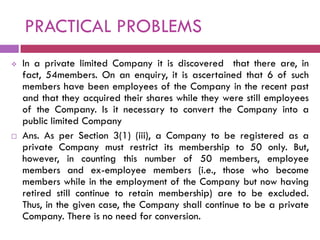
PRACTICAL PROBLEMS
   In a private limited Company it is discovered that there are, in
    fact, 54members. On an enquiry, it is ascertained that 6 of such
    members have been employees of the Company in the recent past
    and that they acquired their shares while they were still employees
    of the Company. Is it necessary to convert the Company into a
    public limited Company
   Ans. As per Section 3(1) (iii), a Company to be registered as a
    private Company must restrict its membership to 50 only. But,
    however, in counting this number of 50 members, employee
    members and ex-employee members (i.e., those who become
    members while in the employment of the Company but now having
    retired still continue to retain membership) are to be excluded.
    Thus, in the given case, the Company shall continue to be a private
    Company. There is no need for conversion.
DOCUMENTS OF COMPANY
Documents


            Documents


     MOA                AOA
Memorandum of Association

   Main document of the company.
   It defines the objects of the company for which it is
    established.
   Lays down the conditions upon which alone the company
    allowed to be formed.
   Charter of the constitution of the company.
   It defines the scope of its activity and also states that
    anything beyond it is unauthorized and illegal.
   The memorandum shall be one of the forms given in
    Tables B, C, D and E in schedule 1 of the Act.
How MOA Looks?
   The Memorandum of Association must be
    o   printed,
    o   divided into paragraphs,
    o   numbered consecutively,
    o   and signed by each subscriber (seven or more in case of a
        public company),
    o   who must add his name, address and description
    o   in the presence of at lease one witness who is to attest the
        signature.
Clauses of MOA
   Name clause
   Registered office or Situation clause
   Object clause
   Liability clause
   Capital clause
   Subscription clause
Name Clause
   The Company is a legal entity. Therefore, it must have
    its name to establish its identity.
   The name of the company should not be Similar,
    Undesirable, or which will mislead the public. E.g. Indian
    National flag, name or pictorial representation of
    Mahatma Gandhi or Prime Minister of India, etc.
   Its use has been, therefore, prohibited by the
    Government under the Emblems and Names (Prevention
    of Improper Use) Act, 1950.
   The company can change its name by passing a special
    resolution and obtaining he approval of the Central
    Government.
Registered Office Clause
   Every company must have a registered office from the
    day it starts its business or within 30 days of getting
    the Certificate of Incorporation, whichever is earlier.
   Memorandum of Association must state the name of
    the State in which the registered office of the
    company is situated.
   This clause is important as it mentions the residence for
    the purpose of the communication with the company.
   It determines the jurisdiction of the company and also
    mentions the place where all the records of company
    are maintained.
Registered Office Clause
   Where the company wants to change its registered
    office from one state to another then it can do so by
    passing a special resolution as well as by confirmation
    of Company Law Board.
   Such confirmation will be given provided debenture
    holders and creditors are satisfied and such alteration
    is fair.
Object Clause
   It is the most important clause in the Memorandum of Association.
   It defines and limits the scope and sphere of the operation of the
    company and affords protection of its funds.
   It states the main objects as well as incidental objects of the
    company.
   The transaction which does not fall within the scope of the main
    objects of the company will not be valid and binding on the
    company simply because it is not beneficial for the company.
   As regards to the alteration of object clause a special resolution
    must be passed and the confirmation by the Company Law Board
    must also be obtained.
   The alteration is done to obtain a main purpose by new means or
    to enlarge the area of its operation, or to restrict the objects or
    sell or dispose of or amalgamate the undertaking.
Liability Clause

   The liability clause states that the member or the
    shareholder will be liable to pay only the unpaid value
    of shares held by him.
   If it is a company limited by guarantee, Memorandum of
    Association must further state that each member
    undertakes to contribute to the assets of the company at
    the time of the winding up while he is a member.
   Ordinarily this clause cannot be altered except that the
    liability of the directors may be made unlimited under
    certain circumstances.
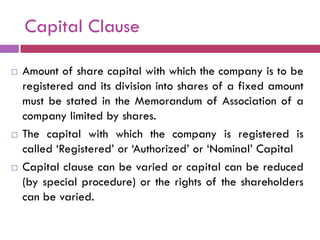
Capital Clause

   Amount of share capital with which the company is to be
    registered and its division into shares of a fixed amount
    must be stated in the Memorandum of Association of a
    company limited by shares.
   The capital with which the company is registered is
    called „Registered‟ or „Authorized‟ or „Nominal‟ Capital
   Capital clause can be varied or capital can be reduced
    (by special procedure) or the rights of the shareholders
    can be varied.
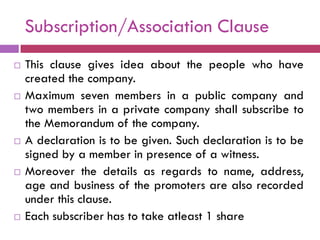
Subscription/Association Clause
   This clause gives idea about the people who have
    created the company.
   Maximum seven members in a public company and
    two members in a private company shall subscribe to
    the Memorandum of the company.
   A declaration is to be given. Such declaration is to be
    signed by a member in presence of a witness.
   Moreover the details as regards to name, address,
    age and business of the promoters are also recorded
    under this clause.
   Each subscriber has to take atleast 1 share
PROBLEMS & SOLUTIONS
(1)
  A company altered Its Memorandum of Association according to
   the procedure laid down by law and the alteration was also
   confirmed by the Company Law Board. A certified copy of the
   order of the Company Law Board was filed 4-months after the
   order was passed by the Company Law Board. Can the
   Registrar register the alteration?
Ans. Yes. He can do so as per provisions mentioned under
   Sec.18.
  As per Section 18 company shall file with the Registrar, a
   certified copy of the order of the company law board
   confirming the alteration within 3 months of the order. The
   registrar shall register the same and certify the registration
   within 1 month from the date of filing such documents.
  However the company can be allowed the extension of time if
   the company law board thinks fit.
(2)
  A company was started with the object of building 'a hall
   with shops'. The building was destroyed by fire and the
   company wanted to alter the objects clause in the
   Memorandum by substituting the words 'a hall with shops'
   with the words 'shops, dwelling houses and warehouses for
   letting purposes.' Should this alteration be allowed?
Ans. No,
  As the alteration exceeds object mentioned by the
   company on its incorporation. (Strathspey Public
   Assembly etc. Hall Co. Ltd. v. Anderson's Trustees,
   (1934) S.C. 385).
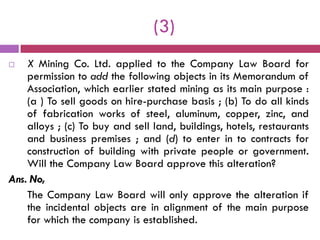
(3)
   X Mining Co. Ltd. applied to the Company Law Board for
    permission to add the following objects in its Memorandum of
    Association, which earlier stated mining as its main purpose :
    (a ) To sell goods on hire-purchase basis ; (b) To do all kinds
    of fabrication works of steel, aluminum, copper, zinc, and
    alloys ; (c) To buy and sell land, buildings, hotels, restaurants
    and business premises ; and (d) to enter in to contracts for
    construction of building with private people or government.
    Will the Company Law Board approve this alteration?
Ans. No,
    The Company Law Board will only approve the alteration if
    the incidental objects are in alignment of the main purpose
    for which the company is established.
(4)
  A Ltd. applies to the Company Law Board for approving an
   alteration in situation clause of its Memorandum and thus
   permitting it to change its registered office from Calcutta to
   Delhi. The Government of West Bengal requests the Company
   Law Board not to allow this change, for it would lead to a loss of
   revenue of the Government. Decide.
Ans. No, The request of Government of West Bengal won‟t be
   considered.
  The change will be allowed if it is warranted by the interests of
   the company [Rank Film Distributors of India Ltd. v. Registrar of
   Companies]
  The court observed that the state has no statutory right to oppose
   the shifting of the registered office from one state to another.
   Members of the company will decide whether the registered
   office of the company is to be transferred from one state to
   another. Moreover the shifting should be in the interest of the
   company.
(5)
  A company put up telephone wires in a certain area. There
   was no power in the Memorandum to put up wires there.
   The defendants cut them down. Can the company sue for
   the damage done to the wires?
Ans. Yes
  In case National Telephone Co. v. St Peter Port
   Constables, it was held that company being a corporate
   person should not be fined or punished for its own act or
   the act of its agents unless the authority conferred on the
   company by the Memorandum, the whole transaction would
   be altered by doctrine of ultra vires and it would be void.
   Moreover there is nothing to prevent the company from
   protecting its property.
(6)
  The Memorandum of Association of a company formed to
   Improve and encourage the breeding of poultry contained
   a provision that no remuneration should be paid to the
   members of the governing body of the company. But the
   company owing to Its Increase in the business passed a
   special resolution providing for equitable remuneration to
   such members for services rendered, Can this alteration of
   the Memorandum be confirmed? If so, state why and when.
Ans. Yes
  It was decided that alteration is valid as it will help to
   carry the business more economically or more efficiently
   and any resolution passed will be within the scope of MOA.
   [Scientific Poultry Breeders' Assn. Ltd.].
(7)
  X Ltd a cotton textile company, enters into a contract with
   A Ltd, adjacent cotton textile mills, to supply electricity
   from their power generation plant. After the supplies have
   been made for 3 months it is discovered that this activity is
   beyond the scope of the object clause of memorandum of
   association of X Ltd. Shareholders of X Ltd ratify the
   above contract in their general body meeting. Can A Ltd.
   which refuses to make payment on the ground that the
   contract is wholly null and void be legally compelled to
   make payment?
Ans. No, as the transaction is ultra vires X Ltd.
  The transaction which does not fall within the scope of the
   main objects of the company will not be valid and binding
   on the company.
ARTICLES OF ASSOCIATION
SCOPE
   The articles of association are subordinate to the
    memorandum of association of the company.
   The articles contain the internal regulations of the
    company.
   The provisions of the articles must not be inconsistent
    with or repugnant to any of the provisions of the
    memorandum of the Act.
   AOA can be altered at any time according to the
    wishes of the member.
CONTENTS
Articles usually contain provisions relating to the following
matters.
 Share capital, rights of shareholders, variation of these rights,
  and payment of commissions, share certificates
 Lien on shares

 Calls on shares

 Transfer of shares

 Transmission of shares

 Forfeiture of shares

 Conversion of shares into stock

 Alteration of Capital
CONTENTS
   General meetings and proceedings thereat
   Voting rights of members, voting poll and proxies
   Directors, their appointment, remuneration, qualification,
    powers and proceedings of Boards of Directors
   Manager
   Secretary
   Dividends and reserves
   Accounts, audit and borrowing powers
   Capitalization‟s of profits
   Winding up
ALTERATION
   Pass the Special Resolution
   File the copy of the Special Resolution with the Registrar
    within 30 days of passing the special resolution
   Attach the resolution with every copy of AOA
   Must not be inconsistent with the Act
   Must not conflict with MOA
   Must not sanction anything illegal
   Must be for benefit of the company
   Must not increase the liability of the members
   Must not result into breach of contract
CONSTRUCTIVE NOTICE
   Every outsider dealing with the company is deemed to
    have the notice of the contents of MOA & AOA.
   These documents, on registration with the Registrar,
    assume the character of public documents.
   This is known as Constructive Notice of Memorandum and
    Articles.
INDOOR MANAGEMENT
   There is one limitation to the doctrine of constructive notice of the
    MOA & AOA of the company.
   The outsiders dealing with the company are entitled to assume that
    as far as internal proceedings are concerned, everything has been
    regularly done.
   They are presumed to have read these documents and to see that
    the proposed dealing is not inconsistent therewith.
   They cannot inquire into the regularity of internal proceedings as
    required by MOA & AOA. They can presume all is being regularly
    done.
   This limitation of doctrine of constructive notice is known as
    “DOCTRINE OF INDOOR MANAGEMENT”
   It is also called Turquand Rule.
CASE: ROYAL BRITISH BANK VS.
TURQUAND
   The directors of a company had issued a bond to T. They
    had the powers under the Articles to issue such bond
    provided they were authorized by a resolution passed
    by the shareholders at a general meeting of the
    company. No such resolution was passed by the company.
   Held, T could recover the amount of the bond from the
    company on the ground that he was entitled to assume
    that the resolution had been passed.
   Thus doctrine of indoor management seeks to protect the
    outsiders of the company.
Exceptions to the Doctrine of Indoor
Management

    Ultra Vires Act
    Knowledge of Irregularity
    Act of an agent outside the scope of his authority
    Negligence
Doctrine of Ultra Vires

   Any act done by the company which is neither
    authorized by its object nor by the Companies Act, that
    act is called „Ultra Vires‟ the powers and authority of
    the company.
   An act which is ultra vires the company is void and
    cannot bind the company.
   Since the act is void, it cannot be ratified even by the
    shareholders.
Doctrine of Ultra Vires
   If the directors do any act which are outside the object
    clause of the company then the shareholders are not
    liable. The directors are personally liable for the ultra
    vires act done by them.
   Act Ultr Vires to MOA cannot be ratified by the
    shareholders but acts Ultra Vires to AOA can be
    ratified by them.
   Any shareholder can bring court injunction to prevent
    the company from doing an Ultra Vires Act.
Give the Legal Advice
 Under the Articles, the directors of the company had the
 power to borrow up to Rs. 10,000 without the consent of
 the directors of the general meeting. The directors
 themselves lent Rs. 35,000 to the company without such
 consent and took debentures. Is the company liable to
 pay Rs.35,000.
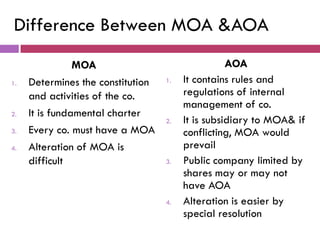
Difference Between MOA &AOA
                MOA                                AOA
1.   Determines the constitution   1.   It contains rules and
     and activities of the co.          regulations of internal
                                        management of co.
2.   It is fundamental charter
                                   2.   It is subsidiary to MOA& if
3.   Every co. must have a MOA          conflicting, MOA would
4.   Alteration of MOA is               prevail
     difficult                     3.   Public company limited by
                                        shares may or may not
                                        have AOA
                                   4.   Alteration is easier by
                                        special resolution
PROSPECTUS
General Interpretation

 Any Document,
 Any Notice,

 Any Circular,

 Any Advertisement,

  Inviting the money to be raised from the public
Meaning

   It is a device for the public ltd company to collect the
    capital after its incorporation.
   When the public company or the promoters of the
    public company decide that the money should be
    raised from the public by the way of the invitation
    for offers to the subscription of the shares or
    debentures of the company, a document is drawn up
    which is known as prospectus.
Objective Behind Issuing Prospectus

   The objective of issuing the prospectus is to let the
    public know of the establishment of the company, its
    objects, its prospects, to induce the investors to
    purchase its shares or debentures.
Dating of Prospectus
   A prospectus issued by or on the behalf of the
    company shall be dated and that date shall be
    taken as the date of the publication of the
    prospectus.
Registration of Prospectus

   No prospectus shall be issued unless on or before the
    date of its publication, a copy of the prospectus has
    been delivered to the Registrar for registration, duly
    signed by every person who is named therein as a
    Director or proposed Director of the company.
   Registration of the Prospectus
       Experts Consent
       Delivery for Registration
       News paper advertisement
Contents of the Prospectus
        It contains the following details about the company:
    1.     Name and Address of the Registered Office
    2.     Name of the Stock Exchange where the application for the
           listing is made
    3.     Details related to the Minimum Subscription
    4.     Capital Structure of the Company
    5.     Terms of the present issue.
    6.     Particulars about the Issue.
    7.     Company Management and the Project.
    8.     Financial Information of the company.
    9.     Statutory information as per the provisions of Section 56 of
           the Companies Act,1956
Misstatements in Prospectus

   Misstatements include:-
     Untrue statements;
     Statements which produce wrong impression;

     Statements which are misleading;

     Concealment of material facts; and

     Omission of facts
Who are liable for Mis-statements in
Prospectus?

   Every person who is:-
    i.     Director of the company at the time of issue of
           prospectus;
    ii.    Promoter of the company;
    iii.   Any other person who has authorized the issue of the
           prospectus.
Consequences of Misstatements in
Prospectus


               Consequences


   Civil Liability     Criminal Liability
Civil Liability
    If the person has purchased the shares on the basis
     of the misleading prospectus, then there will be civil
     liability arising which are as follows:
      1.   Compensation
      2.   Damages for deceit or fraud
      3.   Recession of the contract for misrepresentation
      4.   Liability for non compliance with section 56
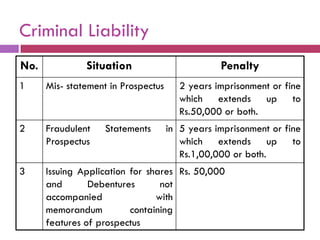
Criminal Liability
No.            Situation                         Penalty
1     Mis- statement in Prospectus      2 years imprisonment or fine
                                        which extends up to
                                        Rs.50,000 or both.
2     Fraudulent    Statements       in 5 years imprisonment or fine
      Prospectus                        which extends up to
                                        Rs.1,00,000 or both.
3     Issuing Application for shares Rs. 50,000
      and       Debentures       not
      accompanied               with
      memorandum          containing
      features of prospectus
Defenses Against Civil Liability

   Withdrawal of consent after issue
   Reasonable belief
   Statement by an expert
   Statement by an official person or extract from a
    public official document
Defenses Against Criminal Liability

   The statement was immaterial.
   He had reasonable ground to believe and did up to
    the time of the issue of the prospectus believe that
    the statement was true.
Statement in Lieu of Prospectus

   A company having a share capital which does not issue a
    prospectus or which has issued a prospectus but has not proceeded
    to allot any of the shares offered to the public for subscription,
    shall not allot any of its shares or debentures, unless at least 3
    days before the allotment of shares or debentures, there has been
    delivered to the Registrar for registration a „statement in lieu of
    prospectus‟ signed by every person who is named therein as a
    director or proposed director of the company or by his agent
    authorized in writing, in the form and containing the particulars
    setout in Part I of schedule III and setting out the reports specified
    in Part II of schedule III subject to the provisions contained in Part III
    of that schedule.
Shelf Prospectus

   Any public financial institution, public sector bank or
    scheduled bank whose main object is financing shall
    file a shelf prospectus.
   „Shelf Prospectus‟ means a prospectus issued by any
    financial institution or bank for one or more issues of
    the securities or class of securities specified in that
    prospectus.
Minimum Subscription
   No allotment shall be made of any share capital of a company offered to the public for
    subscription, unless a minimum amount is raised. This minimum amount is called
    “MINIMUM SUBSCRIPTION”
   It is decided taking into account:
       Purchase price of any property
       Any preliminary expenses payable
       Any commission payable towards subscription of any shares
       The repayment of any money borrowed by the company
       Working capital
       Any other expenditure

   All moneys received from applicants for shares shall be deposited and kept deposited in
    a Scheduled Bank-
       Until the certificate of commencement business is obtained and
       Until the entire amount payable on applications for shares in respect of minimum subscription is received
        (interest 6% after 130 days)
Types of Company Meetings
Kinds of Company Meeting
   General Meetings
    A.   Statutory General Meeting
    B.   Annual General Meeting
    C.   Extra ordinary General Meeting
   Meetings of Creditors Debenture-holder‟s
   Class Meeting
   Meetings of Board of Directors
Statutory General meeting

   A public limited company having share capital is
    required to hold a statutory meeting.
   Such a statutory meeting is held only once in the
    lifetime of the company.
   Such a meeting must be held within a period of not
    less than one month or within a period not more than
    six months from the date on which it is entitled to
    commence business i.e. it obtains certificate of
    commencement of business.
Purpose of Statutory Meeting

To enable members to know all important matters
  pertaining to the formation of the company like:-
 which shares have been taken up

 what money has been received

 what contracts have been entered into

 what sums have been spent on preliminary expenses
Statutory Report
   The Board of Directors must prepare and send to every
    member a report called the "Statutory Report" at least 21
    days before the day on which the meeting is to be held.
   The report should be certified as correct by at least two
    directors, one of whom must be the managing director, where
    there is one, and must also be certified as correct by the
    auditors of the company with respect to the shares allotted by
    the company, the cash received in respect of such shares and
    the receipts and payments of the company.
   A certified copy of the report must be sent to the Registrar
    for registration immediately after copies have been sent to
    the members of the company.
Contents of Statutory Report
   The total number of shares allotted, distinguishing those fully
    or partly paid-up, otherwise than in cash, the extent to which
    partly paid shares are paid-up.
   The total amount of cash received in respect of all shares
    allotted.
   An abstract of the receipts and payments made within 7 days
    of the date of report.
   An account of preliminary expenses.
   The names, addresses and occupations of directors, auditors,
    manager and secretary, if any, of the company and the
    changes which have taken place in the names, addresses and
    occupations of the above since the date of incorporation.
Contents of Statutory Report
   Any commission or discount paid or to be paid on the issue or
    sale of shares or debentures.
   Particulars of any contracts to be submitted to the meeting
    for approval and modifications done or proposed.
   If the company has entered into any underwriting contracts,
    the extent, if any, to which they have not been carried out
    and the reasons for the failure.
   The arrears, if any, due on calls from every director and
    from the manager.
   The particulars of any commission or brokerage paid or to
    be paid, in connection with the issue or sale of shares or
    debentures to any director or to the manager.
   The auditors have to certify that all information regarding
    calls and allotment of shares are correct.
Proceedings at the Meeting

   At the commencement of the statutory meeting, the Board
    shall produce a list showing the names, addresses and
    occupations of the members of the company and number of
    shares held by them respectively. The list shall remain open
    and accessible to any member of the company during the
    continuance of the meeting.
   Discussion of matters relating to formational aspect. They may
    also discuss any matter arising out of the statutory report.
   Adjournment. The meeting may adjourn from time to time. At
    any adjourned meeting, any resolution (of which notice has
    been given), may be passed. An adjourned meeting shall
    have the same powers as the original meeting. The object of
    the adjournment may be to provide members with additional
    information as to the company's affairs.
Annual General Meeting (AGM)
   Must be held by every type of company, public or private once a
    year.
   Not more than 15 months must elapse between two AGMs.
    However, a company may hold its first annual general meeting
    within 18 months from the date of its incorporation.
   A notice of at least 21 days before the meeting must be given to
    members unless consent is accorded to a shorter notice by members,
    holding not less than 95% of voting rights in the company.
   The notice of the meeting must be accompanied by a copy of the
    annual accounts of the company, director‟s report on the position of
    the company for the year and auditor‟s report on the accounts.
Annual General Meeting
   The notice must state that the meeting is an annual general
    meeting. The time, date and place of the meeting must be
    mentioned in the notice.
   Companies having share capital should also state in the notice
    that a member is entitled to attend and vote at the meeting
    and is also entitled to appoint proxies in his absence.
   A proxy need not be a member of that company. A proxy
    form should be enclosed with the notice.
   The proxy forms are required to be submitted to the company
    at least 48 hours before the meeting.
   The AGM must be held on a working day during business
    hours at the registered office of the company or at some other
    place within the city, town or village in which the registered
    office of the company is situated.
Purpose of Holding Annual General
    Meeting
   It is only at the annual general meeting of a company that the
    shareholders can exercise any control over the affairs of the
    company.
   They also get an opportunity to discuss the affairs and review the
    working of the company and can also take the necessary steps for
    the protection of their interests. They may, for example, refuse to
    re-elect a director whose actions and policy they disapprove.
   They can also take up any other business relating to the affairs of
    the company for discussion.
   Appointment of auditors is also made at the annual general
    meeting.
   Annual accounts are presented for the consideration of
    shareholders and dividends are declared in the annual general
    meeting.
Business Transacted at AGM
   The following matters constitute ordinary business at
    an AGM:-
    o   Consideration of annual accounts, director‟s report and
        the auditor‟s report
    o   Declaration of dividend
    o   Appointment of directors in the place of those retiring
    o   Appointment of and the fixing of the remuneration of the
        statutory auditors.
Extra ordinary General meeting
   Every general meeting (i.e. meeting of members of the
    company) other than the statutory meeting and the
    annual general meeting or any adjournment thereof, is
    an extraordinary general meeting.
   Such meeting is usually called by the Board of Directors
    for some urgent business which cannot wait to be
    decided till the next AGM.
   Every business transacted at such a meeting is special
    business.
   An explanatory statement of the special business must
    also accompany the notice calling the meeting.
Debentures Holder‟s Meeting
   A company issuing debentures may provide for the
    holding of meetings of the debenture holders.
   At such meetings, generally any matters pertaining to the
    variation in terms of security or to alteration of their rights
    are discussed.
   All matters connected with the holding, conduct and
    proceedings of the meetings of the debenture holders are
    normally specified in the Debenture Trust Deed.
   The decisions at the meeting made by the prescribed
    majority are valid and lawful and binding upon the
    minority.
Purpose of Holding Debenture
Holder‟s Meeting
   These meetings are called from time to time
    where the interests of debenture holders are
    involved
    -at the time of reconstruction
    -reorganization
    -amalgamation
    -winding up of the company.
Creditor‟s Meeting
   Sometimes, a company, either as a running concern or
    in the event of winding up, has to make certain
    arrangements with its creditors. Meetings of creditors
    may be called for this purpose.
   E.g. in case of winding up of a company, a meeting of
    creditors and of contributories is held to ascertain the
    total amount due by the company and also to appoint
    a liquidator to wind up the affairs of the company.
Class meetings
   Class meetings are meetings which are held by
    holders of a particular class of shares, e.g.,
    preference shareholders.
   Such meetings are normally called when it is
    proposed to vary the rights of that particular class of
    shares.
   At such meetings, these members discuss the pros and
    cons of the proposal and vote accordingly.
   Class meetings are held to pass resolution which will
    bind only the members of the class concerned, and
    only members of that class can attend and vote.
Meeting of Board of Directors
   For efficient management of the affairs of the company, the
    directors are required to meet frequently to discuss and
    review important matters and to decide number of meetings.
   A Board meeting can be held on a public holiday or outside
    business hours for convenience.
   It need not be held at the registered office of the company. It
    may be held at any place convenient to the directors.
   Period: A Board meeting must be held at least once in every
    three months, and at least four such meetings must be held in a
    calendar year.
Meeting of Board of Directors

   Notice: Notice of every meeting of the board of directors of
    company has to be sent to all the directors at their usual
    address in India. Failure to do so will render the resolutions
    passed at such meeting, null and void.
   Quorum: The quorum for a meeting of the board of directors
    of company shall be one-third of its total strength or two
    directors whichever is higher. If the meeting cannot be held for
    want of quorum it stands adjourned till the same day of the
    next week at the same time and place.
   Every meeting of the board must have a chairman to preside
    over it. The articles usually name the chairman who shall
    preside over the board meeting. If the articles do not name
    the chairman, the director may elect a chairman of the
    meeting.
Requisites of a Valid Meeting
   To be convened by Board
   Notice
   Quorum
   Chairman of the meeting
   Minutes of the previous meeting must be properly
    kept
Quorum
   Unless the AOA provides for a larger number, 5
    members physically present in case of public
    company and 2 members in private company shall
    be the quorum for the meeting.
   If the meeting is called upon the requisition of
    members, and the quorum is not maintained within
    half an hour of time of holding the meeting then the
    meeting shall stand ‘dissolved’.
   In other cases it shall be ‘adjourned’ to the same day
    in the next week at the same time and place.
Minutes

   Minutes of the proceedings of meetings are statutorily
    required to be maintained under Section 193 of the
    Companies Act.
   Under this section the minutes of a meeting must be recorded
    within 14 days of the meeting concerned.
   The minutes of each meeting are required to contain a fair
    and correct summary of the proceeding of the meeting.
   Minutes of all the meetings are signed by the chairman of the
    meeting.
   The chairman enjoys absolute discretion regarding the
    exclusion of matters which are irrelevant to the interests of
    the company.
Minutes
   The minutes must be recorded in a proper minute‟s book
    which has pages consecutively numbered. Pasting of
    minutes to any other book is prohibited.
   The minutes of general meetings are required to be kept
    at the registered office of the company and must be
    open to inspection by members without charge at least
    for two hours every day.
   If a member wants a copy of the minutes, he can get it
    within seven days of the request on payment.
Proxies
   The term proxy is used to refer to the person who is
    nominated by a shareholder to represent him at a
    general meeting of the company.
   Under Section 176 (1) every member of the company is
    entitled to appoint another person (member or a non-
    member) to attend a general meeting and vote if need
    be.
   Unless a provision to the contrary is made in the Articles,
    the members of companies not having a share capital
    cannot appoint proxies to represent them.
   A proxy shall not have any right to speak at the meeting.
   A proxy can only vote through a secret poll.
Proxies
   Table 'A' lays down that an instrument appointing a
    proxy must be deposited with the company not less than
    48 hours before the time for the meeting.
   The Act also requires that the instrument appointing a
    proxy must be in writing and must be signed by the
    appointer or his legally authorized representatives.
   Two types of proxies may be distinguished, A proxy
    authorized to vote only upon a particular resolution is
    called a 'special proxy' while a proxy empowered to
    vote on all resolutions in a meeting may be called a
    'general proxy'.
Resolutions
   Matters in a company are decided by resolutions in the
    meetings. E.g. giving authorities to directors
   A resolution is proposed either by the chairman or by
    any other member.
   Kinds of resolutions:
    1.   Ordinary resolution
    2.   Special resolution
1.        Ordinary Resolution

   A resolution passed at a meeting by a simple majority of votes,
    including the casting vote of the chairman is an ordinary resolution
   The following are some of the examples of acts, which a company can
    do by passing an ordinary resolution:
       To change its name where it has been registered with a name very nearly like
        that of another existing company.
       To authorize the issue of shares at a discount.
       To alter the share capital by increase, consolidation and conversion of shares
        into shares of larger amount, conversion of fully paid shares into stock or vice-
        versa, subdivision of shares and cancellation of unissued shares
       To appoint or remove directors.
       To appoint the auditor at the annual general meeting.
       To declare dividend recommended by the directors.
       To wind-up the company voluntarily when the period fixed for its duration has
        expired.
2. Special Resolution
   It is a resolution which is passed at general meeting by a majority of
    three fourth of the members present. The notice of the general meeting
    at which a special resolution is to be moved must expressly state that
    the resolution is to be moved as a special resolution.
   A company can do the following acts only by passing special resolution:
       To transfer the registered office of the company from one state to
        another or to alter its objects.
       To alter the Articles of Association.
       To reduce share capital.
       To shift the registered office from one place to another in the same
        state.
       To make the liability of directors or managers unlimited.
       To approve the making of loans to other companies.
       To resolve that the company be wound up by the court.
       To wind up a company voluntarily.
MEMBERSHIP
Membership of a Company
   The subscribers to the memorandum of a company shall
    be deemed to have agreed to become members of the
    company and on its registration, shall be entered as
    members in the Registrar of Members;
   Every other person who agrees in writing to become
    member of a company and whose name is entered in its
    register of members, shall be a member of company;
   Every person holding equity share capital of company
    and whose name is entered as beneficial owner in the
    records of the depository shall be deemed to be a
    member of the concerned company.
How Membership Ceases?
   By transfer of shares;
   By forfeiture of shares;
   By surrender of shares;
   By sale of shares by the company after it exercises its right of lien on the
    shares or in execution of a decree by Court or other proper authority;
   By insolvency;
   By death;
   By rescission of the contract to take shares on the ground of
    misrepresentation in the prospectus;
   When the company redeems its redeemable preference shares;
   On issue of share warrants by company in place of certificates;
   On winding up of the company
Who Can Be A Member?

   Minor
   Company & Subsidiary Co.
   Trust
   Partnership firm
   Society
   Non-Resident
Rights of Members
   To receive notices of all general meetings
   To attend and vote at general meetings, appoint directors and
    auditors of the company
   To receive copies of accounts of the company
   In case of a statutory meeting, he is entitled to a copy of statutory
    report
   To inspect the minutes of proceedings of any general meeting
   To inspect the register and index of members and debenture
    holders and copies of annual returns
   If his name is omitted in the register of members, he can apply to
    the Court for the rectification of the register
   To transfer his shares
   Priority to have shares offered to him in case of increase of
    capital by the company
Rights Contd..
   To receive share certificate
   To receive dividends in case of preference shares
   To rescind the contract and claim damages in case of his acquiring
    shares on account of mis-statements in prospectus
   To make an application to Central Government for ordering
    investigation into the affairs of the Co.
   To present a petition to the Court for relief in cases of mis
    management & oppression
   If the company declares dividend, the right to participate in the
    dividend distribution
   To apply to the Central Govt. to convene the AGM when Board of
    Directors fail to convene the same
   To present a petition to the Court for winding up of the Co.
   Entitled to share in the surplus assets, if available, on liquidation
Liabilities, Duties and Obligation of
Members
   To pay calls on the shares whenever demanded by the
    company
   To pay the full nominal value of the shares held by him
    in case of a company limited by shares
   To pay all the debts of the company in case of a
    company unlimited by liability
DIRECTORS
What Does Company Law Speak?
   Section 2(13) defines director as "director includes any person
    occupying the position of a director by whatever name called."
   Director is not servant of the company. He is rather an officer
    of the company.
   The articles of association of the company and provisions of
    the companies Act will govern the selection of the directors of
    the company.
   The management or the affairs of the company will be in the
    hands of the directors. The directors are collectively called the
    Board of Directors.
   The articles will determine the number of directors to be
    appointed to the Board of Directors of a company. As per the
    Act, minimum three directors will be there in a public
    company and two directors in a private company.
Position of Director


               Position


As a Trustee   As an Agent   As a Partner
AS A TRUSTEE
   The directors are not owner of the company and they
    do not function as an owner, while entering into contract
    with the third person.
   The directors have to use their powers in the interest of
    the company. The directors are expected to show the
    capacity and diligence as a trustee.
   If the directors misuse the position, they are held liable.
    The directors are the trustees in connection with the
    transfer and distribution of shares. The directors have to
    disclose the details of his interest.
AS AN AGENT

   The position of director is like an agent. They have
    to function as per the provisions contain in the
    Articles of the company and the Company Law.
   Their actions are not their personal transactions, but
    they are the transactions done for and on behalf of
    the company. Therefore, they cannot be sued for the
    all intra vires acts done by them on behalf of the
    company .
AS A PARTNER

   Directors held shares. The members of the company
    also hold shares. The directors work as the
    representatives of the members. Thus, they are liked
    partners of the members of the company.
Appointment of Directors
   Appointment as First Directors
   Appointment by Election in General Meetings
   Appointment by Nomination by BOD
   Appointment by Nomination by Central Government
   Appointment by Nomination in Statutory
    Corporations
   Appointment on the basis of Qualification shares
   Appointment by Proportional Representation
   Alternate Directors
First Directors

 Persons named in the articles of association as
 directors become the first directors of the company
 or in the absence of the provision in the articles
 regarding persons to be appointed First Directors,
 the subscribers to the memorandum of association
 will become the first directors.
Appointment by Election in General
Meetings

    The members at the general meeting of the
     company will elect the directors.
    At the general meetings generally directors are
     appointed in place of retiring directors.
    This is the most common and usual mode of
     appointing directors. Section 255 provides for the
     procedure for election
Appointment by Nomination by BOD

    The Board of Directors will fill up the casual
     vacancy arising among the directors by nomination.
    A casual vacancy arises in case o death,
     resignation, disqualification or any other reason
     than retirement by rotation.
    Directors so appointed will remain in the office
     only for the unexpired period for which the
     director whose post is vacant, would have
     remained in the office.
Appointment by Nomination by
Central Government

 Under Section 408 of the Act, the Central
 Government can nominate some directors to the
 Board in case of mismanagement and oppression.
Appointment by Nominations in
Statutory Corporations
 Certain statutory corporations possess similar powers
 e.g. the Industrial Finance Corporations Act of 1947
 empowers the Corporation to nominate a director to
 the Board of a company to which it has advanced
 moneys.
Appointment on the Basis of
Qualification Shares
  Where a person holds minimum number of shares as
  provided in the articles then he is said to have
  obtained 'qualification shares'. A person can be
  appointed as a director on the basis of such
  qualification shares.
Appointment by Proportional
    Representation
   The articles of the company may provide for the
    appointment of not less than 2/3rd of the total
    number of directors of a public company, according
    to the principles of proportional representation.
   The appointments must be done once in every 3
    years and interim casual vacancies must be filled by
    the BOD in Board meetings.
Alternate Directors
   The Board of Directors of a Company, may, if so
    authorized by its articles or by resolution passed by a
    company in general meeting, appoint alternate
    director during absence of the existing director for a
    period not less than three months from the State in
    which meeting of the Board are ordinarily held.
   The alternate director cannot hold office longer than
    the original director. He will vacate his office if and
    when the original director returns to the State.
Qualification to be a Director

   A director must be-
    i.     An individual,
    ii.    Competent to contract, and
    iii.   Hold a share qualification, if so required by the
           articles
Disqualification for Directors
   A person shall not be capable of being appointed as
    director of the company, if
    I.     He has been found to be of unsound mind
    II.    He is an undischarged insolvent.
    III.   He has applied to be adjudicated as an insolvent and his application is
           pending.
    IV.    He is convicted by a Court, of any offence involving moral turpitude and
           sentenced in respect thereof, to imprisonment for not less than six months
           and period of five years has not elapsed from the date of the expiry of
           the sentence.
    V.     He has not paid any call in respect of shares of the company held by him
           and six months have elapsed from the last date fixed for the payment of
           the call.
    VI.    An order disqualifying him from appointment as director has been passed
           by a Court in pursuance of Section 203
Removal of Directors

   By Shareholders
   By Central Government
   By Company Law Board
Removal By Shareholders
   A company may by ordinary resolution remove a
    director before the expiry of period of office on the
    intent of the shareholders in the annual general
    meeting by:-
     Giving special notice to the director at least 14 days
      before the meeting in which they are to be removed,
     A copy of the notice to be sent to the shareholders and to
      other directors,
     Shareholders can remove the director by appointing a
      new director in his place who will hold the office only for
      the unexpired tenure of the previous director.
Directors who cannot be removed
    by Shareholders
   An additional director appointed by the Central
    Government under Section 408 in case of
    mismanagement and oppression) cannot be removed.
   In a private company a director appointed for life
    and holding office as such on 1st April 1952 cannot
    be removed by member's resolution.
   Where the articles of a company provide for
    the    election   of directors    by    proportional
    representation, a director elected by that method
    cannot be removed by the resolution.
Remuneration to the Director for his
Removal
 If a director, by an agreement or otherwise is
 entitled to receive compensation for the premature
 termination of his service, he can enforce his claim
 notwithstanding the removal by the resolution.
Removal By Central Government


  The Central Government shall by order remove
  from the office any directors against whom there is
  a decision of the High Court, holding that he is not a
  fit or proper person to hold the office of director
Removal By Company Law Board
   Section 402 read with Sections 397 and 398 gives
    wide power to the court including the removal of the
    directors.
   On an application by any member/members of the
    company in cases of mismanagement or oppression, the
    Company Law Board may terminate any Director.
   Directors so terminated cannot be appointed as
    directors of other companies also upto a period of 5
    years of their termination.
   Such directors are not entitled to any damages or
    compensation for loss of office.
Retirement
   Proportion of Directors to retire by rotation-2/3rd only
    in first AGM the ratio is 1/3rd
   Vacancy to be filled at AGM, if not then retiring
    directors will be deemed to be re-elected
   Resignation of office of director

RESTRICTION- HOLDING OFFICE OF DIRECTOR FOR NOT
  MORE THAN 20 COMPANIES.
Managing Director
   The director who is entrusted with substantial powers
    of management and includes a director occupying the
    position of Managing Director by whatever name
    called.
   He is contract with company for his services and is a
    whole time director entrusted with certain duties and
    responsibilities.
Modes of Appointment of MD

   BY AGREEMENT WITH COMPANY
   BY A CLAUSE IN MOA. OR AOA.
   BY A RESOLUTION PASSED BY COMPANY IN
    GENERAL MEETING
   BY A RESOLUTION PASSED BY B.O.D.
Disqualification of MD
   INSOLVENT
   SUSPENDED PAYMENT OF HIS CREDITOR
   CONVICTED BY COURT
   ALL DISQUALIFICTIONS OF DIRECTOR

LIMIT:-ONLY ONE PUBLIC CO. & SECOND WITH:
1.   A RESOLUTION OF BOD.
2.   OR SPECIAL ORDER BY CENTRAL GOVERNMENT

TERM:- NOT EXCEEDING 5 YEARS
Remuneration

   As determined in the Articles
   Not to exceed 11% of Net profit
   Director other than MD may be allowed commission
    not exceeding 1% of net profit
Powers of Directors

   MAKE CALLS
   ISSUE DEBENTURES
   BORROW MONEY
   INVEST FUNDS
   MARKET LOANS
Limitations of Directors

   Sell, lease, etc. the whole undertaking
   Remit or give time for the repayment of any debt by
    a director
   Invest or borrow money in contravention of the act.
   Charity of more than Rs. 50,000.
Rights & Duties of Directors
RIGHTS:
1.    TO TAKE PART IN MEETINGS OF BOARD & IN THE AFFAIRS OF THE
      CO.
2.    RIGHT OF REMUNERATION
3.    COMPENSATION IN CASE OF PREMATURE TERMINATION OF
      SERVICES
DUTIES:
1.    DISTRIBUTE WORK ON BUSINESS LINES
2.    ACT IN GOOD FAITH
3.    EXERCISE REASONABLE CARE
4.    MUST EXERCISE THAT SKILL WHICH IS REASONABLY EXPECTED OF
      HIM
5.    ATTEND MEETING
Liabilities
    CIVIL:
    1.   FALSE STATEMENT IN A PROSPECTUS
    2.   EXCEED AUTHORITY
    3.   IN CASE OF ULTRA-VIRES ACTS
    4.   WHERE HE IS NEGLIGENT AND CO. SUFFERS
    5.   MAKES A SECRET PROFIT
    6.   COMMITS ANY BREACH OF TRUST
    CRIMINAL: FALSIFICATION OF BOOKS & REPORTS
     FAILURE TO KEEP CERTAIN REGISTER
Issue of Capital
Types of Share Capital
   Authorized or Nominal Capital
   Issued Capital
   Subscribed Capital
   Paid-up Capital
   Un-called Capital
Example
   A company is registered with Rs. 5 lacs initially as the total share capital. This is
    Authorized or Nominal capital. This capital is divided in shares of different
    denominations, for example, Rs. 5 lacs may be divided into 5000 equity shares of
    Rs. 100 each. The face value of the shares is, therefore, Rs. 100 each.
   The company may require only about Rs. 2.5 lacs immediately for carrying out its
    objects and activities. It may, therefore, issue only 2,500 shares of Rs. 100 each.
    This is „Issued capital‟.
   If all the shares offered or issued are taken up by the public it becomes' subscribed
    capital‟.
   Further the minimum requirement of the company initially may be only Rs. 1 lac. It
    may, therefore, call up only Rs. 25 on each subscribed share. This will be a „Called-
    up capital‟.
   When all the 2500 shares are paid up by Rs. 25 on each share i.e., Rs. 1 lac will be
    „Paid up capital‟. Rs. 1.5 lacs is „Uncalled capital‟.
Difference Between Shares & Stocks

            SHARE                            STOCK
1.   Shares cannot be           1.   Stock can be divided into
                                     unequal amount and
     issued or transferred in        therefore can be issued
     fragments                       and transferred in
2.   Shares need not be              fragments
     fully paid up              2.   Stock is always fully paid
3.   Shares bear distinctive         up
     numbers                    3.   Fractions of stock do not
                                     bear distinctive numbers
4.   Shares are issued
     directly                   4.   Stock cannot be issued
                                     directly
CLASSIFICATION OF SHARES

I.     PREFERENCE SHARES
       Are   those which have two characteristics, viz; (i) they
        have a preferential right to be paid dividend during the
        lifetime of the company and (ii)they have a preferential
        right to the return of capital when the company goes into
        liquidation
       Cumulative/Non Cumulative, Redeemable/Non-
        redeemable, Participating/Non Participating,
        Convertible/ Non Convertible
II.    EQUITY SHARES
   Further issue of capital:
     At any time after the expiry of two years from the formation
      of a comp or at any time after the expiry of one year from
      the allotment of shares in that comp made for the first time
      after its formation – whichever is earlier
     Offers to present share holders
     Time limit 15 days.

   Issue of shares at Premium
       Securities premium account
   Issue of shares at Discount
       Maximum rate 10%
   Issue of shares for consideration
Transfer of Shares

   Instrument of Transfer
   Transfer of instrument in prescribed form and
    presentation
   Time limit for presentation
   Application for transfer
   Transfer by legal representative
   Transmission by operation of law
   Registration of transfer
   Share Certificate
Amalgamation & Reconstruction
Reconstruction & Amalgamation
   Reconstruction: Occurs when a company transfers the
    whole of its undertaking and property to a new
    company under an arrangement by which the
    shareholders of the old company are entitled to receive
    some shares or other similar interests in the new
    company.
   Amalgamation: Takes place when 2 or more
    companies combine into one company, the shareholders
    in the amalgamating companies becoming substantially
    the shareholders in the amalgamated company.
Procedure to Be Followed
1.       Approval of scheme by shareholders of 3/4th in the value of
         shares
2.       Court‟s sanction on any of the following matters
     o     Transfer of the whole or any part of the undertaking, property or
           liabilities
     o     Allotment or appropriation of any shares, debentures, policies, etc
           under compromise or arrangement
     o     The continuation by or against the transferee company of any legal
           proceedings pending by or against the transferor company
     o     Dissolution, without winding up, of the transferor company
     o     Provision to be made for any persons who dissent from the
           compromise or arrangement
3.       A certified copy of Tribunal order to be filed with the
         Registrar
Acquisition of Shares of Shareholders
Dissenting From Scheme Approved By Majority

   In case of amalgamation or reconstruction, the
    transferee company makes an offer to the shareholders
    of the transferor company to purchase their shares at a
    stated price.
   The offer may be to buy the shares either for cash or in
    exchange of shares of the transferee company.
   Dissenting shareholders are the shareholders who have
    not agreed to the scheme or arrangement between the
    transferee company and the transferor company.
Conti..
   Approval of shareholders of not less than 9/10ths in value of
    the shares required within 4 months
    After the transferee company makes an offer to the shareholders of the
    transferor company to acquire their shares, the offer shall have to be
    approved within 4 months by the shareholders holding not less than 9/10ths of
    the total value of such shares.
   Notice to Dissenting Shareholders
    Within 2 months after the expiry of 4 months(the period for the approval of offer
    to take shares), the transferee company shall give notice to the dissenting
    shareholders that it desires to acquire their shares. Within 1 month of the notice
    any dissenting shareholder may apply to the Tribunal to investigate into the
    matter. If no application is made by any holder or if the Tribunal refuses it, the
    transferee company shall be entitled to acquire the shares of all persons.
Amalgamation of Companies Under
National Interest
   Sec 396 provides for the powers of the Central Govt. for
    the amalgamation of 2 or more companies in the national
    interest.
   Where the central govt. is satisfied that it is essential in the
    public interest that 2 or more companies should
    amalgamate, it may, by order in the Official Gazette,
    provide for the amalgamation of those companies as a
    single company.
   In such case, the members and creditors of the company
    shall have the same interests or rights in the amalgamated
    company which they enjoyed before the amalgamation.
Conti..
   Appeal to the Tribunal:
    Any person aggrieved by the assessment of
    compensation , may within 30 days from the date of
    publication of the assessment in the Official Gazette,
    prefer an appeal to the Tribunal.

Companies act,1956

  • 1.
  • 2.
  • 3.
    Objects of CompanyLaw 1. To encourage investments 2. To ensure proper administration 3. To prevent malpractices 4. To allow for investigations
  • 4.
    Meaning of Company  “A company is defined as a form of business organization in which the funds of a large number of investors are managed by a few persons for the purpose of earning profits which are shared by all investors”
  • 5.
    Characteristics of aCompany  Registration  Separate legal entity  Perpetual Succession  Transferable shares  Limited liability  Common seal  Separate property  Capacity to sue
  • 6.
    Types of Companies A. From the point of view of Incorporation B. From the point of view of Liability C. From the viewpoint of Nationality D. From the view point of Public Interest
  • 7.
    1. From the point of view of Incorporation Types of Companies CHARTERED STATUTORY REGISTERED
  • 8.
    Chartered Company  Historically, most of the early companies were set up through a Royal Charter.  For example, the East India Company, the Chartered Bank of Australia, India and China, etc., were incorporated by the grant of a special Royal Charter.  In India, this form of organization does not exist now because there is no monarchy.  Even in England, this method is rarely used now. Companies of this kind may be called chartered companies.
  • 9.
    Statutory Company  In this case, a special law is passed to establish the company.  This is done only in special cases when it is necessary to regulate the working of the company for some specific purposes.  These are mostly concerned with public utilities  Examples of such companies in India are: the Industrial Finance Corporation, the Life Insurance Corporation of India, the Air India, Reserve Bank of India, etc.  The provisions of Indian companies act 1956 apply to them if they are not inconsistent with the provisions of their special Acts.
  • 10.
    Registered Company  The Companies Act, 1956, lays down procedures by which a company can be brought into existence.  Anybody who wants to incorporate a company can do so by taking necessary steps outlined therein.  By far the largest number of companies is incorporated under the Companies Act. These companies may be called registered companies.
  • 11.
    2. From the point of view of Liability TYPES UNLIMITED GUARANTEE LIMITED
  • 12.
    Unlimited Company  Do not have any limit on the extent of liability of its members.  Liability of each member extends to whole amount of the company‟s debts and liabilities.  However, the members cannot be sued upon the directly by the company's creditors.
  • 13.
    Company Limited ByGuarantee Classification Company Limited by Company Limited by Guarantee not Guarantee Having share capital Having share capital
  • 14.
    Company Limited ByGuarantee Not Having Share Capital  Memorandum Limits the member‟s liability.  It is limited to the amount as may have been undertaken by MOA to contribute in the case of winding up.
  • 15.
    Company Limited ByGuarantee Having Share Capital  Memorandum Limits the member‟s liability.  Moreover, liability would also extend to the unpaid value of the shares held by the member.
  • 16.
    Limited Company  The liability of the members of the company is limited to the amount remaining unpaid on the shares.  Hence the holders of the fully paid up shares cannot be called upon for the further contribution.  The liability of the members holding the partly paid up shares exists even if the company is in process of winding up.
  • 17.
    3. From the viewpoint of Nationality TYPES NATIONAL MULTI-NATIONAL
  • 18.
    National Company  In this case, the control and the management of the affairs of the company are to be carried out within the geographical boundaries of the country.
  • 19.
    Multinational Company  The branch is not an Independent entity and is linked up to the parent company existing in some other country.
  • 20.
    4. From theview point of Public Interest TYPES PRIVATE PUBLIC GOVERNEMENT
  • 21.
    Private Company  Private Company is a company Which by its Articles :- i. Restricts the rights of the members to transfer the shares, ii. Limits the membership to 50, excluding the past and present employees of the company who are the members of the company, and iii. Prohibits the invitation to public, for subscription of shares or debentures of the company.
  • 22.
    Public Company  Public Company is a company Which by its Articles :- i. Does not restrict the rights of the members to transfer the shares, ii. Does not limit the membership to 50, excluding the past and present employees of the company who are the members of the company, and iii. Invites the public, for subscription of shares or debentures of the company.
  • 23.
    Government Company It isa company in which not less than 51% of the paid- up share capital is held by one or more of the following or any combination thereof:-  The Central Gov. & one or more Govt. Co.  Any State Gov. or Govts and one or more Govt. Co.;  The Central Govt., one or more State Govt. and one or more Govt. Companies;  The Central Govt. and one or more corporations owned or controlled by Central Govt.;  The Central Govt., one or more State Govt. and one or more Corps. Owned or controlled by the Central Govt.  One or more corps. Owned or controlled by Central Govt. or State Govt.  More than one Govt. Company
  • 24.
    Distinction Between PrivateLtd. & Public Ltd. Company Private Ltd. Public Ltd.  Minimum capital required is 1,00,000  Minimum capital required is 5,00,000  Minimum 2 and maximum 50 members  Minimum 7 members. No limit on maximum members  At least 2 directors  At least 3 directors  No restriction on appointment of  No restriction on appointment of directors directors  Non-transferable shares  Transferable shares  Restriction on invitation to subscribe  Invitation to subscribe for shares is for shares allowed  No restriction on managerial  Managerial remuneration cannot remuneration exceed 11% of net profit  Can start business without obtaining  Can start business only after obtaining certificate of certificate of commencement comencement
  • 25.
    Special Privileges ofa Private Company Over Public Company 1. Can be started with minimum 2 members 2. No provision regarding minimum subscription 3. No need to file a Prospectus or Statement in Lieu of Prospectus. 4. Further share issue 5. It can issue share capital of any kinds 6. Commence business immediately after getting certificate of incorporation 7. Need not to keep index of members 8. Need not to hold a statutory meeting or file statutory report 9. Provision regarding maximum limit of Director‟s or Manager‟s remuneration does not apply
  • 26.
    Special Privileges ofa Private Company Over Public Company 10. Retirement by rotation for directors not there 11. Director‟s consent to act as such not required 12. Qualification shares not needed for appointment of directors 13. Government approval to appointment or amendment do not apply 14. Director‟s contract to take qualification share not to be filed with the registrar 15. Provisions regarding loans to directors do not apply 16. No provision regarding interested director not to participate or vote in board proceedings 17. No provisions for Govt. approval for increasing remuneration 18. No prohibition regarding appointment of MD for more than 5 years at a time 19. No restrictions on advancing loans to other company
  • 27.
    Procedure for ConvertingPrivate Company Into A Public Company  Alter the articles of the company by special resolution to eliminate restrictions of private company under sec(3) (iii)  If the number of members is less than 7, it must be raised at least to 7  If the number of directors is less than 3 it must be raised at least to 3.  It must file within 30 days with the Registrar prospectus or statement in lieu of prospectus & the resolution altering the articles.
  • 28.
    Procedure for ConvertingPublic Company Into A Private Company  Pass a special resolution authorizing conversion of the company and altering the articles so as to contain the restrictions under section 3(1) (iii) of the Act  Change the name of the company by a special resolution  Obtain Central Government approval  File the altered articles with the Registrar within 30 days of the receipt of the approval from the Central Government
  • 29.
    When A PrivateCompany Becomes a Public Company  By default of Provisions  Subsidiary Company Deemed to be Public  By Provisions of Law  Where not less than 25% of paid-up capital of pvt. Company is held by one or more bodies corporate  Where the average turnover of a private company is not less than Rs.10 cr. During the relevant period – after 3 months  When a private company holds not less than 25% of the paid up capital of a public company  By Conversion
  • 30.
    Holding Company &Subsidiary Company When one company controls another company it is called holding company. Control may be in any following ways:  Where it controls the composition of the Board of Directors of another company; or  Where it controls more than half of the total voting power of the other company; or  Where it holds more than half of the nominal value of equity share capital of the other company; or  Where it is a subsidiary of any company which is the subsidiary of some other company.
  • 31.
    One Man Company WHENA SINGLE PERSON HOLDS ALMOST ALL THE SHARES OF THE COMPANY IT IS CALLED ONE MAN COMPANY. SUCH A COMPANY HAS ITS LEGAL PERSONALITY IF IT COMPLIES WITH THE NECESSARY REQUIREMENTS OF REGISTRATION, IT MAY BE A PUBLIC OR PRIVATE COMPANY.
  • 32.
    Illegal Association ANY COMPANY,ASSOCIATION OR PARTNERSHIP CARRYING ON BANKING BUSINESS WITH MORE THAN TEN MEMBERS OR CARRYING ON ANY OTHER BUSINESS WITH MORE THAN TWENTY MEMBERS THAT HAS FOR ITS OBJECT THE ACQUISITION OF GAIN, WITHOUT BEING REGISTERED UNDER THE COMPANIES ACT, SHALL BE CONSIDERED AN ILLEGAL ASSOCIATION.
  • 33.
    PRACTICAL PROBLEMS  In a private limited Company it is discovered that there are, in fact, 54members. On an enquiry, it is ascertained that 6 of such members have been employees of the Company in the recent past and that they acquired their shares while they were still employees of the Company. Is it necessary to convert the Company into a public limited Company  Ans. As per Section 3(1) (iii), a Company to be registered as a private Company must restrict its membership to 50 only. But, however, in counting this number of 50 members, employee members and ex-employee members (i.e., those who become members while in the employment of the Company but now having retired still continue to retain membership) are to be excluded. Thus, in the given case, the Company shall continue to be a private Company. There is no need for conversion.
  • 34.
  • 35.
    Documents Documents MOA AOA
  • 36.
    Memorandum of Association  Main document of the company.  It defines the objects of the company for which it is established.  Lays down the conditions upon which alone the company allowed to be formed.  Charter of the constitution of the company.  It defines the scope of its activity and also states that anything beyond it is unauthorized and illegal.  The memorandum shall be one of the forms given in Tables B, C, D and E in schedule 1 of the Act.
  • 37.
    How MOA Looks?  The Memorandum of Association must be o printed, o divided into paragraphs, o numbered consecutively, o and signed by each subscriber (seven or more in case of a public company), o who must add his name, address and description o in the presence of at lease one witness who is to attest the signature.
  • 38.
    Clauses of MOA  Name clause  Registered office or Situation clause  Object clause  Liability clause  Capital clause  Subscription clause
  • 39.
    Name Clause  The Company is a legal entity. Therefore, it must have its name to establish its identity.  The name of the company should not be Similar, Undesirable, or which will mislead the public. E.g. Indian National flag, name or pictorial representation of Mahatma Gandhi or Prime Minister of India, etc.  Its use has been, therefore, prohibited by the Government under the Emblems and Names (Prevention of Improper Use) Act, 1950.  The company can change its name by passing a special resolution and obtaining he approval of the Central Government.
  • 40.
    Registered Office Clause  Every company must have a registered office from the day it starts its business or within 30 days of getting the Certificate of Incorporation, whichever is earlier.  Memorandum of Association must state the name of the State in which the registered office of the company is situated.  This clause is important as it mentions the residence for the purpose of the communication with the company.  It determines the jurisdiction of the company and also mentions the place where all the records of company are maintained.
  • 41.
    Registered Office Clause  Where the company wants to change its registered office from one state to another then it can do so by passing a special resolution as well as by confirmation of Company Law Board.  Such confirmation will be given provided debenture holders and creditors are satisfied and such alteration is fair.
  • 42.
    Object Clause  It is the most important clause in the Memorandum of Association.  It defines and limits the scope and sphere of the operation of the company and affords protection of its funds.  It states the main objects as well as incidental objects of the company.  The transaction which does not fall within the scope of the main objects of the company will not be valid and binding on the company simply because it is not beneficial for the company.  As regards to the alteration of object clause a special resolution must be passed and the confirmation by the Company Law Board must also be obtained.  The alteration is done to obtain a main purpose by new means or to enlarge the area of its operation, or to restrict the objects or sell or dispose of or amalgamate the undertaking.
  • 43.
    Liability Clause  The liability clause states that the member or the shareholder will be liable to pay only the unpaid value of shares held by him.  If it is a company limited by guarantee, Memorandum of Association must further state that each member undertakes to contribute to the assets of the company at the time of the winding up while he is a member.  Ordinarily this clause cannot be altered except that the liability of the directors may be made unlimited under certain circumstances.
  • 44.
    Capital Clause  Amount of share capital with which the company is to be registered and its division into shares of a fixed amount must be stated in the Memorandum of Association of a company limited by shares.  The capital with which the company is registered is called „Registered‟ or „Authorized‟ or „Nominal‟ Capital  Capital clause can be varied or capital can be reduced (by special procedure) or the rights of the shareholders can be varied.
  • 45.
    Subscription/Association Clause  This clause gives idea about the people who have created the company.  Maximum seven members in a public company and two members in a private company shall subscribe to the Memorandum of the company.  A declaration is to be given. Such declaration is to be signed by a member in presence of a witness.  Moreover the details as regards to name, address, age and business of the promoters are also recorded under this clause.  Each subscriber has to take atleast 1 share
  • 46.
  • 47.
    (1)  Acompany altered Its Memorandum of Association according to the procedure laid down by law and the alteration was also confirmed by the Company Law Board. A certified copy of the order of the Company Law Board was filed 4-months after the order was passed by the Company Law Board. Can the Registrar register the alteration? Ans. Yes. He can do so as per provisions mentioned under Sec.18.  As per Section 18 company shall file with the Registrar, a certified copy of the order of the company law board confirming the alteration within 3 months of the order. The registrar shall register the same and certify the registration within 1 month from the date of filing such documents.  However the company can be allowed the extension of time if the company law board thinks fit.
  • 48.
    (2)  Acompany was started with the object of building 'a hall with shops'. The building was destroyed by fire and the company wanted to alter the objects clause in the Memorandum by substituting the words 'a hall with shops' with the words 'shops, dwelling houses and warehouses for letting purposes.' Should this alteration be allowed? Ans. No,  As the alteration exceeds object mentioned by the company on its incorporation. (Strathspey Public Assembly etc. Hall Co. Ltd. v. Anderson's Trustees, (1934) S.C. 385).
  • 49.
    (3)  X Mining Co. Ltd. applied to the Company Law Board for permission to add the following objects in its Memorandum of Association, which earlier stated mining as its main purpose : (a ) To sell goods on hire-purchase basis ; (b) To do all kinds of fabrication works of steel, aluminum, copper, zinc, and alloys ; (c) To buy and sell land, buildings, hotels, restaurants and business premises ; and (d) to enter in to contracts for construction of building with private people or government. Will the Company Law Board approve this alteration? Ans. No, The Company Law Board will only approve the alteration if the incidental objects are in alignment of the main purpose for which the company is established.
  • 50.
    (4)  ALtd. applies to the Company Law Board for approving an alteration in situation clause of its Memorandum and thus permitting it to change its registered office from Calcutta to Delhi. The Government of West Bengal requests the Company Law Board not to allow this change, for it would lead to a loss of revenue of the Government. Decide. Ans. No, The request of Government of West Bengal won‟t be considered.  The change will be allowed if it is warranted by the interests of the company [Rank Film Distributors of India Ltd. v. Registrar of Companies]  The court observed that the state has no statutory right to oppose the shifting of the registered office from one state to another. Members of the company will decide whether the registered office of the company is to be transferred from one state to another. Moreover the shifting should be in the interest of the company.
  • 51.
    (5)  Acompany put up telephone wires in a certain area. There was no power in the Memorandum to put up wires there. The defendants cut them down. Can the company sue for the damage done to the wires? Ans. Yes  In case National Telephone Co. v. St Peter Port Constables, it was held that company being a corporate person should not be fined or punished for its own act or the act of its agents unless the authority conferred on the company by the Memorandum, the whole transaction would be altered by doctrine of ultra vires and it would be void. Moreover there is nothing to prevent the company from protecting its property.
  • 52.
    (6)  TheMemorandum of Association of a company formed to Improve and encourage the breeding of poultry contained a provision that no remuneration should be paid to the members of the governing body of the company. But the company owing to Its Increase in the business passed a special resolution providing for equitable remuneration to such members for services rendered, Can this alteration of the Memorandum be confirmed? If so, state why and when. Ans. Yes  It was decided that alteration is valid as it will help to carry the business more economically or more efficiently and any resolution passed will be within the scope of MOA. [Scientific Poultry Breeders' Assn. Ltd.].
  • 53.
    (7)  XLtd a cotton textile company, enters into a contract with A Ltd, adjacent cotton textile mills, to supply electricity from their power generation plant. After the supplies have been made for 3 months it is discovered that this activity is beyond the scope of the object clause of memorandum of association of X Ltd. Shareholders of X Ltd ratify the above contract in their general body meeting. Can A Ltd. which refuses to make payment on the ground that the contract is wholly null and void be legally compelled to make payment? Ans. No, as the transaction is ultra vires X Ltd.  The transaction which does not fall within the scope of the main objects of the company will not be valid and binding on the company.
  • 54.
  • 55.
    SCOPE  The articles of association are subordinate to the memorandum of association of the company.  The articles contain the internal regulations of the company.  The provisions of the articles must not be inconsistent with or repugnant to any of the provisions of the memorandum of the Act.  AOA can be altered at any time according to the wishes of the member.
  • 56.
    CONTENTS Articles usually containprovisions relating to the following matters.  Share capital, rights of shareholders, variation of these rights, and payment of commissions, share certificates  Lien on shares  Calls on shares  Transfer of shares  Transmission of shares  Forfeiture of shares  Conversion of shares into stock  Alteration of Capital
  • 57.
    CONTENTS  General meetings and proceedings thereat  Voting rights of members, voting poll and proxies  Directors, their appointment, remuneration, qualification, powers and proceedings of Boards of Directors  Manager  Secretary  Dividends and reserves  Accounts, audit and borrowing powers  Capitalization‟s of profits  Winding up
  • 58.
    ALTERATION  Pass the Special Resolution  File the copy of the Special Resolution with the Registrar within 30 days of passing the special resolution  Attach the resolution with every copy of AOA  Must not be inconsistent with the Act  Must not conflict with MOA  Must not sanction anything illegal  Must be for benefit of the company  Must not increase the liability of the members  Must not result into breach of contract
  • 59.
    CONSTRUCTIVE NOTICE  Every outsider dealing with the company is deemed to have the notice of the contents of MOA & AOA.  These documents, on registration with the Registrar, assume the character of public documents.  This is known as Constructive Notice of Memorandum and Articles.
  • 60.
    INDOOR MANAGEMENT  There is one limitation to the doctrine of constructive notice of the MOA & AOA of the company.  The outsiders dealing with the company are entitled to assume that as far as internal proceedings are concerned, everything has been regularly done.  They are presumed to have read these documents and to see that the proposed dealing is not inconsistent therewith.  They cannot inquire into the regularity of internal proceedings as required by MOA & AOA. They can presume all is being regularly done.  This limitation of doctrine of constructive notice is known as “DOCTRINE OF INDOOR MANAGEMENT”  It is also called Turquand Rule.
  • 61.
    CASE: ROYAL BRITISHBANK VS. TURQUAND  The directors of a company had issued a bond to T. They had the powers under the Articles to issue such bond provided they were authorized by a resolution passed by the shareholders at a general meeting of the company. No such resolution was passed by the company.  Held, T could recover the amount of the bond from the company on the ground that he was entitled to assume that the resolution had been passed.  Thus doctrine of indoor management seeks to protect the outsiders of the company.
  • 62.
    Exceptions to theDoctrine of Indoor Management  Ultra Vires Act  Knowledge of Irregularity  Act of an agent outside the scope of his authority  Negligence
  • 63.
    Doctrine of UltraVires  Any act done by the company which is neither authorized by its object nor by the Companies Act, that act is called „Ultra Vires‟ the powers and authority of the company.  An act which is ultra vires the company is void and cannot bind the company.  Since the act is void, it cannot be ratified even by the shareholders.
  • 64.
    Doctrine of UltraVires  If the directors do any act which are outside the object clause of the company then the shareholders are not liable. The directors are personally liable for the ultra vires act done by them.  Act Ultr Vires to MOA cannot be ratified by the shareholders but acts Ultra Vires to AOA can be ratified by them.  Any shareholder can bring court injunction to prevent the company from doing an Ultra Vires Act.
  • 65.
    Give the LegalAdvice Under the Articles, the directors of the company had the power to borrow up to Rs. 10,000 without the consent of the directors of the general meeting. The directors themselves lent Rs. 35,000 to the company without such consent and took debentures. Is the company liable to pay Rs.35,000.
  • 66.
    Difference Between MOA&AOA MOA AOA 1. Determines the constitution 1. It contains rules and and activities of the co. regulations of internal management of co. 2. It is fundamental charter 2. It is subsidiary to MOA& if 3. Every co. must have a MOA conflicting, MOA would 4. Alteration of MOA is prevail difficult 3. Public company limited by shares may or may not have AOA 4. Alteration is easier by special resolution
  • 67.
  • 68.
    General Interpretation  AnyDocument,  Any Notice,  Any Circular,  Any Advertisement, Inviting the money to be raised from the public
  • 69.
    Meaning  It is a device for the public ltd company to collect the capital after its incorporation.  When the public company or the promoters of the public company decide that the money should be raised from the public by the way of the invitation for offers to the subscription of the shares or debentures of the company, a document is drawn up which is known as prospectus.
  • 70.
    Objective Behind IssuingProspectus  The objective of issuing the prospectus is to let the public know of the establishment of the company, its objects, its prospects, to induce the investors to purchase its shares or debentures.
  • 71.
    Dating of Prospectus  A prospectus issued by or on the behalf of the company shall be dated and that date shall be taken as the date of the publication of the prospectus.
  • 72.
    Registration of Prospectus  No prospectus shall be issued unless on or before the date of its publication, a copy of the prospectus has been delivered to the Registrar for registration, duly signed by every person who is named therein as a Director or proposed Director of the company.  Registration of the Prospectus  Experts Consent  Delivery for Registration  News paper advertisement
  • 73.
    Contents of theProspectus  It contains the following details about the company: 1. Name and Address of the Registered Office 2. Name of the Stock Exchange where the application for the listing is made 3. Details related to the Minimum Subscription 4. Capital Structure of the Company 5. Terms of the present issue. 6. Particulars about the Issue. 7. Company Management and the Project. 8. Financial Information of the company. 9. Statutory information as per the provisions of Section 56 of the Companies Act,1956
  • 74.
    Misstatements in Prospectus  Misstatements include:-  Untrue statements;  Statements which produce wrong impression;  Statements which are misleading;  Concealment of material facts; and  Omission of facts
  • 75.
    Who are liablefor Mis-statements in Prospectus?  Every person who is:- i. Director of the company at the time of issue of prospectus; ii. Promoter of the company; iii. Any other person who has authorized the issue of the prospectus.
  • 76.
    Consequences of Misstatementsin Prospectus Consequences Civil Liability Criminal Liability
  • 77.
    Civil Liability  If the person has purchased the shares on the basis of the misleading prospectus, then there will be civil liability arising which are as follows: 1. Compensation 2. Damages for deceit or fraud 3. Recession of the contract for misrepresentation 4. Liability for non compliance with section 56
  • 78.
    Criminal Liability No. Situation Penalty 1 Mis- statement in Prospectus 2 years imprisonment or fine which extends up to Rs.50,000 or both. 2 Fraudulent Statements in 5 years imprisonment or fine Prospectus which extends up to Rs.1,00,000 or both. 3 Issuing Application for shares Rs. 50,000 and Debentures not accompanied with memorandum containing features of prospectus
  • 79.
    Defenses Against CivilLiability  Withdrawal of consent after issue  Reasonable belief  Statement by an expert  Statement by an official person or extract from a public official document
  • 80.
    Defenses Against CriminalLiability  The statement was immaterial.  He had reasonable ground to believe and did up to the time of the issue of the prospectus believe that the statement was true.
  • 81.
    Statement in Lieuof Prospectus  A company having a share capital which does not issue a prospectus or which has issued a prospectus but has not proceeded to allot any of the shares offered to the public for subscription, shall not allot any of its shares or debentures, unless at least 3 days before the allotment of shares or debentures, there has been delivered to the Registrar for registration a „statement in lieu of prospectus‟ signed by every person who is named therein as a director or proposed director of the company or by his agent authorized in writing, in the form and containing the particulars setout in Part I of schedule III and setting out the reports specified in Part II of schedule III subject to the provisions contained in Part III of that schedule.
  • 82.
    Shelf Prospectus  Any public financial institution, public sector bank or scheduled bank whose main object is financing shall file a shelf prospectus.  „Shelf Prospectus‟ means a prospectus issued by any financial institution or bank for one or more issues of the securities or class of securities specified in that prospectus.
  • 83.
    Minimum Subscription  No allotment shall be made of any share capital of a company offered to the public for subscription, unless a minimum amount is raised. This minimum amount is called “MINIMUM SUBSCRIPTION”  It is decided taking into account:  Purchase price of any property  Any preliminary expenses payable  Any commission payable towards subscription of any shares  The repayment of any money borrowed by the company  Working capital  Any other expenditure  All moneys received from applicants for shares shall be deposited and kept deposited in a Scheduled Bank-  Until the certificate of commencement business is obtained and  Until the entire amount payable on applications for shares in respect of minimum subscription is received (interest 6% after 130 days)
  • 84.
  • 85.
    Kinds of CompanyMeeting  General Meetings A. Statutory General Meeting B. Annual General Meeting C. Extra ordinary General Meeting  Meetings of Creditors Debenture-holder‟s  Class Meeting  Meetings of Board of Directors
  • 86.
    Statutory General meeting  A public limited company having share capital is required to hold a statutory meeting.  Such a statutory meeting is held only once in the lifetime of the company.  Such a meeting must be held within a period of not less than one month or within a period not more than six months from the date on which it is entitled to commence business i.e. it obtains certificate of commencement of business.
  • 87.
    Purpose of StatutoryMeeting To enable members to know all important matters pertaining to the formation of the company like:-  which shares have been taken up  what money has been received  what contracts have been entered into  what sums have been spent on preliminary expenses
  • 88.
    Statutory Report  The Board of Directors must prepare and send to every member a report called the "Statutory Report" at least 21 days before the day on which the meeting is to be held.  The report should be certified as correct by at least two directors, one of whom must be the managing director, where there is one, and must also be certified as correct by the auditors of the company with respect to the shares allotted by the company, the cash received in respect of such shares and the receipts and payments of the company.  A certified copy of the report must be sent to the Registrar for registration immediately after copies have been sent to the members of the company.
  • 89.
    Contents of StatutoryReport  The total number of shares allotted, distinguishing those fully or partly paid-up, otherwise than in cash, the extent to which partly paid shares are paid-up.  The total amount of cash received in respect of all shares allotted.  An abstract of the receipts and payments made within 7 days of the date of report.  An account of preliminary expenses.  The names, addresses and occupations of directors, auditors, manager and secretary, if any, of the company and the changes which have taken place in the names, addresses and occupations of the above since the date of incorporation.
  • 90.
    Contents of StatutoryReport  Any commission or discount paid or to be paid on the issue or sale of shares or debentures.  Particulars of any contracts to be submitted to the meeting for approval and modifications done or proposed.  If the company has entered into any underwriting contracts, the extent, if any, to which they have not been carried out and the reasons for the failure.  The arrears, if any, due on calls from every director and from the manager.  The particulars of any commission or brokerage paid or to be paid, in connection with the issue or sale of shares or debentures to any director or to the manager.  The auditors have to certify that all information regarding calls and allotment of shares are correct.
  • 91.
    Proceedings at theMeeting  At the commencement of the statutory meeting, the Board shall produce a list showing the names, addresses and occupations of the members of the company and number of shares held by them respectively. The list shall remain open and accessible to any member of the company during the continuance of the meeting.  Discussion of matters relating to formational aspect. They may also discuss any matter arising out of the statutory report.  Adjournment. The meeting may adjourn from time to time. At any adjourned meeting, any resolution (of which notice has been given), may be passed. An adjourned meeting shall have the same powers as the original meeting. The object of the adjournment may be to provide members with additional information as to the company's affairs.
  • 92.
    Annual General Meeting(AGM)  Must be held by every type of company, public or private once a year.  Not more than 15 months must elapse between two AGMs. However, a company may hold its first annual general meeting within 18 months from the date of its incorporation.  A notice of at least 21 days before the meeting must be given to members unless consent is accorded to a shorter notice by members, holding not less than 95% of voting rights in the company.  The notice of the meeting must be accompanied by a copy of the annual accounts of the company, director‟s report on the position of the company for the year and auditor‟s report on the accounts.
  • 93.
    Annual General Meeting  The notice must state that the meeting is an annual general meeting. The time, date and place of the meeting must be mentioned in the notice.  Companies having share capital should also state in the notice that a member is entitled to attend and vote at the meeting and is also entitled to appoint proxies in his absence.  A proxy need not be a member of that company. A proxy form should be enclosed with the notice.  The proxy forms are required to be submitted to the company at least 48 hours before the meeting.  The AGM must be held on a working day during business hours at the registered office of the company or at some other place within the city, town or village in which the registered office of the company is situated.
  • 94.
    Purpose of HoldingAnnual General Meeting  It is only at the annual general meeting of a company that the shareholders can exercise any control over the affairs of the company.  They also get an opportunity to discuss the affairs and review the working of the company and can also take the necessary steps for the protection of their interests. They may, for example, refuse to re-elect a director whose actions and policy they disapprove.  They can also take up any other business relating to the affairs of the company for discussion.  Appointment of auditors is also made at the annual general meeting.  Annual accounts are presented for the consideration of shareholders and dividends are declared in the annual general meeting.
  • 95.
    Business Transacted atAGM  The following matters constitute ordinary business at an AGM:- o Consideration of annual accounts, director‟s report and the auditor‟s report o Declaration of dividend o Appointment of directors in the place of those retiring o Appointment of and the fixing of the remuneration of the statutory auditors.
  • 96.
    Extra ordinary Generalmeeting  Every general meeting (i.e. meeting of members of the company) other than the statutory meeting and the annual general meeting or any adjournment thereof, is an extraordinary general meeting.  Such meeting is usually called by the Board of Directors for some urgent business which cannot wait to be decided till the next AGM.  Every business transacted at such a meeting is special business.  An explanatory statement of the special business must also accompany the notice calling the meeting.
  • 97.
    Debentures Holder‟s Meeting  A company issuing debentures may provide for the holding of meetings of the debenture holders.  At such meetings, generally any matters pertaining to the variation in terms of security or to alteration of their rights are discussed.  All matters connected with the holding, conduct and proceedings of the meetings of the debenture holders are normally specified in the Debenture Trust Deed.  The decisions at the meeting made by the prescribed majority are valid and lawful and binding upon the minority.
  • 98.
    Purpose of HoldingDebenture Holder‟s Meeting  These meetings are called from time to time where the interests of debenture holders are involved -at the time of reconstruction -reorganization -amalgamation -winding up of the company.
  • 99.
    Creditor‟s Meeting  Sometimes, a company, either as a running concern or in the event of winding up, has to make certain arrangements with its creditors. Meetings of creditors may be called for this purpose.  E.g. in case of winding up of a company, a meeting of creditors and of contributories is held to ascertain the total amount due by the company and also to appoint a liquidator to wind up the affairs of the company.
  • 100.
    Class meetings  Class meetings are meetings which are held by holders of a particular class of shares, e.g., preference shareholders.  Such meetings are normally called when it is proposed to vary the rights of that particular class of shares.  At such meetings, these members discuss the pros and cons of the proposal and vote accordingly.  Class meetings are held to pass resolution which will bind only the members of the class concerned, and only members of that class can attend and vote.
  • 101.
    Meeting of Boardof Directors  For efficient management of the affairs of the company, the directors are required to meet frequently to discuss and review important matters and to decide number of meetings.  A Board meeting can be held on a public holiday or outside business hours for convenience.  It need not be held at the registered office of the company. It may be held at any place convenient to the directors.  Period: A Board meeting must be held at least once in every three months, and at least four such meetings must be held in a calendar year.
  • 102.
    Meeting of Boardof Directors  Notice: Notice of every meeting of the board of directors of company has to be sent to all the directors at their usual address in India. Failure to do so will render the resolutions passed at such meeting, null and void.  Quorum: The quorum for a meeting of the board of directors of company shall be one-third of its total strength or two directors whichever is higher. If the meeting cannot be held for want of quorum it stands adjourned till the same day of the next week at the same time and place.  Every meeting of the board must have a chairman to preside over it. The articles usually name the chairman who shall preside over the board meeting. If the articles do not name the chairman, the director may elect a chairman of the meeting.
  • 103.
    Requisites of aValid Meeting  To be convened by Board  Notice  Quorum  Chairman of the meeting  Minutes of the previous meeting must be properly kept
  • 104.
    Quorum  Unless the AOA provides for a larger number, 5 members physically present in case of public company and 2 members in private company shall be the quorum for the meeting.  If the meeting is called upon the requisition of members, and the quorum is not maintained within half an hour of time of holding the meeting then the meeting shall stand ‘dissolved’.  In other cases it shall be ‘adjourned’ to the same day in the next week at the same time and place.
  • 105.
    Minutes  Minutes of the proceedings of meetings are statutorily required to be maintained under Section 193 of the Companies Act.  Under this section the minutes of a meeting must be recorded within 14 days of the meeting concerned.  The minutes of each meeting are required to contain a fair and correct summary of the proceeding of the meeting.  Minutes of all the meetings are signed by the chairman of the meeting.  The chairman enjoys absolute discretion regarding the exclusion of matters which are irrelevant to the interests of the company.
  • 106.
    Minutes  The minutes must be recorded in a proper minute‟s book which has pages consecutively numbered. Pasting of minutes to any other book is prohibited.  The minutes of general meetings are required to be kept at the registered office of the company and must be open to inspection by members without charge at least for two hours every day.  If a member wants a copy of the minutes, he can get it within seven days of the request on payment.
  • 107.
    Proxies  The term proxy is used to refer to the person who is nominated by a shareholder to represent him at a general meeting of the company.  Under Section 176 (1) every member of the company is entitled to appoint another person (member or a non- member) to attend a general meeting and vote if need be.  Unless a provision to the contrary is made in the Articles, the members of companies not having a share capital cannot appoint proxies to represent them.  A proxy shall not have any right to speak at the meeting.  A proxy can only vote through a secret poll.
  • 108.
    Proxies  Table 'A' lays down that an instrument appointing a proxy must be deposited with the company not less than 48 hours before the time for the meeting.  The Act also requires that the instrument appointing a proxy must be in writing and must be signed by the appointer or his legally authorized representatives.  Two types of proxies may be distinguished, A proxy authorized to vote only upon a particular resolution is called a 'special proxy' while a proxy empowered to vote on all resolutions in a meeting may be called a 'general proxy'.
  • 109.
    Resolutions  Matters in a company are decided by resolutions in the meetings. E.g. giving authorities to directors  A resolution is proposed either by the chairman or by any other member.  Kinds of resolutions: 1. Ordinary resolution 2. Special resolution
  • 110.
    1. Ordinary Resolution  A resolution passed at a meeting by a simple majority of votes, including the casting vote of the chairman is an ordinary resolution  The following are some of the examples of acts, which a company can do by passing an ordinary resolution:  To change its name where it has been registered with a name very nearly like that of another existing company.  To authorize the issue of shares at a discount.  To alter the share capital by increase, consolidation and conversion of shares into shares of larger amount, conversion of fully paid shares into stock or vice- versa, subdivision of shares and cancellation of unissued shares  To appoint or remove directors.  To appoint the auditor at the annual general meeting.  To declare dividend recommended by the directors.  To wind-up the company voluntarily when the period fixed for its duration has expired.
  • 111.
    2. Special Resolution  It is a resolution which is passed at general meeting by a majority of three fourth of the members present. The notice of the general meeting at which a special resolution is to be moved must expressly state that the resolution is to be moved as a special resolution.  A company can do the following acts only by passing special resolution:  To transfer the registered office of the company from one state to another or to alter its objects.  To alter the Articles of Association.  To reduce share capital.  To shift the registered office from one place to another in the same state.  To make the liability of directors or managers unlimited.  To approve the making of loans to other companies.  To resolve that the company be wound up by the court.  To wind up a company voluntarily.
  • 112.
  • 113.
    Membership of aCompany  The subscribers to the memorandum of a company shall be deemed to have agreed to become members of the company and on its registration, shall be entered as members in the Registrar of Members;  Every other person who agrees in writing to become member of a company and whose name is entered in its register of members, shall be a member of company;  Every person holding equity share capital of company and whose name is entered as beneficial owner in the records of the depository shall be deemed to be a member of the concerned company.
  • 114.
    How Membership Ceases?  By transfer of shares;  By forfeiture of shares;  By surrender of shares;  By sale of shares by the company after it exercises its right of lien on the shares or in execution of a decree by Court or other proper authority;  By insolvency;  By death;  By rescission of the contract to take shares on the ground of misrepresentation in the prospectus;  When the company redeems its redeemable preference shares;  On issue of share warrants by company in place of certificates;  On winding up of the company
  • 115.
    Who Can BeA Member?  Minor  Company & Subsidiary Co.  Trust  Partnership firm  Society  Non-Resident
  • 116.
    Rights of Members  To receive notices of all general meetings  To attend and vote at general meetings, appoint directors and auditors of the company  To receive copies of accounts of the company  In case of a statutory meeting, he is entitled to a copy of statutory report  To inspect the minutes of proceedings of any general meeting  To inspect the register and index of members and debenture holders and copies of annual returns  If his name is omitted in the register of members, he can apply to the Court for the rectification of the register  To transfer his shares  Priority to have shares offered to him in case of increase of capital by the company
  • 117.
    Rights Contd..  To receive share certificate  To receive dividends in case of preference shares  To rescind the contract and claim damages in case of his acquiring shares on account of mis-statements in prospectus  To make an application to Central Government for ordering investigation into the affairs of the Co.  To present a petition to the Court for relief in cases of mis management & oppression  If the company declares dividend, the right to participate in the dividend distribution  To apply to the Central Govt. to convene the AGM when Board of Directors fail to convene the same  To present a petition to the Court for winding up of the Co.  Entitled to share in the surplus assets, if available, on liquidation
  • 118.
    Liabilities, Duties andObligation of Members  To pay calls on the shares whenever demanded by the company  To pay the full nominal value of the shares held by him in case of a company limited by shares  To pay all the debts of the company in case of a company unlimited by liability
  • 119.
  • 120.
    What Does CompanyLaw Speak?  Section 2(13) defines director as "director includes any person occupying the position of a director by whatever name called."  Director is not servant of the company. He is rather an officer of the company.  The articles of association of the company and provisions of the companies Act will govern the selection of the directors of the company.  The management or the affairs of the company will be in the hands of the directors. The directors are collectively called the Board of Directors.  The articles will determine the number of directors to be appointed to the Board of Directors of a company. As per the Act, minimum three directors will be there in a public company and two directors in a private company.
  • 121.
    Position of Director Position As a Trustee As an Agent As a Partner
  • 122.
    AS A TRUSTEE  The directors are not owner of the company and they do not function as an owner, while entering into contract with the third person.  The directors have to use their powers in the interest of the company. The directors are expected to show the capacity and diligence as a trustee.  If the directors misuse the position, they are held liable. The directors are the trustees in connection with the transfer and distribution of shares. The directors have to disclose the details of his interest.
  • 123.
    AS AN AGENT  The position of director is like an agent. They have to function as per the provisions contain in the Articles of the company and the Company Law.  Their actions are not their personal transactions, but they are the transactions done for and on behalf of the company. Therefore, they cannot be sued for the all intra vires acts done by them on behalf of the company .
  • 124.
    AS A PARTNER  Directors held shares. The members of the company also hold shares. The directors work as the representatives of the members. Thus, they are liked partners of the members of the company.
  • 125.
    Appointment of Directors  Appointment as First Directors  Appointment by Election in General Meetings  Appointment by Nomination by BOD  Appointment by Nomination by Central Government  Appointment by Nomination in Statutory Corporations  Appointment on the basis of Qualification shares  Appointment by Proportional Representation  Alternate Directors
  • 126.
    First Directors Personsnamed in the articles of association as directors become the first directors of the company or in the absence of the provision in the articles regarding persons to be appointed First Directors, the subscribers to the memorandum of association will become the first directors.
  • 127.
    Appointment by Electionin General Meetings  The members at the general meeting of the company will elect the directors.  At the general meetings generally directors are appointed in place of retiring directors.  This is the most common and usual mode of appointing directors. Section 255 provides for the procedure for election
  • 128.
    Appointment by Nominationby BOD  The Board of Directors will fill up the casual vacancy arising among the directors by nomination.  A casual vacancy arises in case o death, resignation, disqualification or any other reason than retirement by rotation.  Directors so appointed will remain in the office only for the unexpired period for which the director whose post is vacant, would have remained in the office.
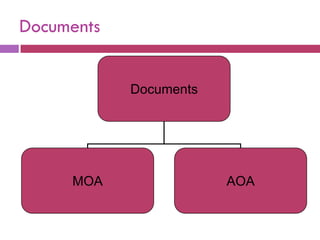
  • 129.
    Appointment by Nominationby Central Government Under Section 408 of the Act, the Central Government can nominate some directors to the Board in case of mismanagement and oppression.
  • 130.
    Appointment by Nominationsin Statutory Corporations Certain statutory corporations possess similar powers e.g. the Industrial Finance Corporations Act of 1947 empowers the Corporation to nominate a director to the Board of a company to which it has advanced moneys.
  • 131.
    Appointment on theBasis of Qualification Shares Where a person holds minimum number of shares as provided in the articles then he is said to have obtained 'qualification shares'. A person can be appointed as a director on the basis of such qualification shares.
  • 132.
    Appointment by Proportional Representation  The articles of the company may provide for the appointment of not less than 2/3rd of the total number of directors of a public company, according to the principles of proportional representation.  The appointments must be done once in every 3 years and interim casual vacancies must be filled by the BOD in Board meetings.
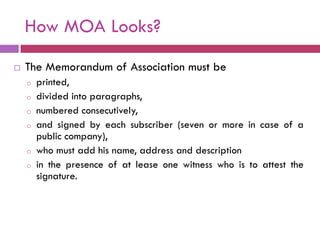
  • 133.
    Alternate Directors  The Board of Directors of a Company, may, if so authorized by its articles or by resolution passed by a company in general meeting, appoint alternate director during absence of the existing director for a period not less than three months from the State in which meeting of the Board are ordinarily held.  The alternate director cannot hold office longer than the original director. He will vacate his office if and when the original director returns to the State.
  • 134.
    Qualification to bea Director  A director must be- i. An individual, ii. Competent to contract, and iii. Hold a share qualification, if so required by the articles
  • 135.
    Disqualification for Directors  A person shall not be capable of being appointed as director of the company, if I. He has been found to be of unsound mind II. He is an undischarged insolvent. III. He has applied to be adjudicated as an insolvent and his application is pending. IV. He is convicted by a Court, of any offence involving moral turpitude and sentenced in respect thereof, to imprisonment for not less than six months and period of five years has not elapsed from the date of the expiry of the sentence. V. He has not paid any call in respect of shares of the company held by him and six months have elapsed from the last date fixed for the payment of the call. VI. An order disqualifying him from appointment as director has been passed by a Court in pursuance of Section 203
  • 136.
    Removal of Directors  By Shareholders  By Central Government  By Company Law Board
  • 137.
    Removal By Shareholders  A company may by ordinary resolution remove a director before the expiry of period of office on the intent of the shareholders in the annual general meeting by:-  Giving special notice to the director at least 14 days before the meeting in which they are to be removed,  A copy of the notice to be sent to the shareholders and to other directors,  Shareholders can remove the director by appointing a new director in his place who will hold the office only for the unexpired tenure of the previous director.
  • 138.
    Directors who cannotbe removed by Shareholders  An additional director appointed by the Central Government under Section 408 in case of mismanagement and oppression) cannot be removed.  In a private company a director appointed for life and holding office as such on 1st April 1952 cannot be removed by member's resolution.  Where the articles of a company provide for the election of directors by proportional representation, a director elected by that method cannot be removed by the resolution.
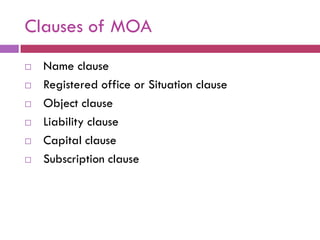
  • 139.
    Remuneration to theDirector for his Removal If a director, by an agreement or otherwise is entitled to receive compensation for the premature termination of his service, he can enforce his claim notwithstanding the removal by the resolution.
  • 140.
    Removal By CentralGovernment The Central Government shall by order remove from the office any directors against whom there is a decision of the High Court, holding that he is not a fit or proper person to hold the office of director
  • 141.
    Removal By CompanyLaw Board  Section 402 read with Sections 397 and 398 gives wide power to the court including the removal of the directors.  On an application by any member/members of the company in cases of mismanagement or oppression, the Company Law Board may terminate any Director.  Directors so terminated cannot be appointed as directors of other companies also upto a period of 5 years of their termination.  Such directors are not entitled to any damages or compensation for loss of office.
  • 142.
    Retirement  Proportion of Directors to retire by rotation-2/3rd only in first AGM the ratio is 1/3rd  Vacancy to be filled at AGM, if not then retiring directors will be deemed to be re-elected  Resignation of office of director RESTRICTION- HOLDING OFFICE OF DIRECTOR FOR NOT MORE THAN 20 COMPANIES.
  • 143.
    Managing Director  The director who is entrusted with substantial powers of management and includes a director occupying the position of Managing Director by whatever name called.  He is contract with company for his services and is a whole time director entrusted with certain duties and responsibilities.
  • 144.
    Modes of Appointmentof MD  BY AGREEMENT WITH COMPANY  BY A CLAUSE IN MOA. OR AOA.  BY A RESOLUTION PASSED BY COMPANY IN GENERAL MEETING  BY A RESOLUTION PASSED BY B.O.D.
  • 145.
    Disqualification of MD  INSOLVENT  SUSPENDED PAYMENT OF HIS CREDITOR  CONVICTED BY COURT  ALL DISQUALIFICTIONS OF DIRECTOR LIMIT:-ONLY ONE PUBLIC CO. & SECOND WITH: 1. A RESOLUTION OF BOD. 2. OR SPECIAL ORDER BY CENTRAL GOVERNMENT TERM:- NOT EXCEEDING 5 YEARS
  • 146.
    Remuneration  As determined in the Articles  Not to exceed 11% of Net profit  Director other than MD may be allowed commission not exceeding 1% of net profit
  • 147.
    Powers of Directors  MAKE CALLS  ISSUE DEBENTURES  BORROW MONEY  INVEST FUNDS  MARKET LOANS
  • 148.
    Limitations of Directors  Sell, lease, etc. the whole undertaking  Remit or give time for the repayment of any debt by a director  Invest or borrow money in contravention of the act.  Charity of more than Rs. 50,000.
  • 149.
    Rights & Dutiesof Directors RIGHTS: 1. TO TAKE PART IN MEETINGS OF BOARD & IN THE AFFAIRS OF THE CO. 2. RIGHT OF REMUNERATION 3. COMPENSATION IN CASE OF PREMATURE TERMINATION OF SERVICES DUTIES: 1. DISTRIBUTE WORK ON BUSINESS LINES 2. ACT IN GOOD FAITH 3. EXERCISE REASONABLE CARE 4. MUST EXERCISE THAT SKILL WHICH IS REASONABLY EXPECTED OF HIM 5. ATTEND MEETING
  • 150.
    Liabilities  CIVIL: 1. FALSE STATEMENT IN A PROSPECTUS 2. EXCEED AUTHORITY 3. IN CASE OF ULTRA-VIRES ACTS 4. WHERE HE IS NEGLIGENT AND CO. SUFFERS 5. MAKES A SECRET PROFIT 6. COMMITS ANY BREACH OF TRUST  CRIMINAL: FALSIFICATION OF BOOKS & REPORTS FAILURE TO KEEP CERTAIN REGISTER
  • 151.
  • 152.
    Types of ShareCapital  Authorized or Nominal Capital  Issued Capital  Subscribed Capital  Paid-up Capital  Un-called Capital
  • 153.
    Example  A company is registered with Rs. 5 lacs initially as the total share capital. This is Authorized or Nominal capital. This capital is divided in shares of different denominations, for example, Rs. 5 lacs may be divided into 5000 equity shares of Rs. 100 each. The face value of the shares is, therefore, Rs. 100 each.  The company may require only about Rs. 2.5 lacs immediately for carrying out its objects and activities. It may, therefore, issue only 2,500 shares of Rs. 100 each. This is „Issued capital‟.  If all the shares offered or issued are taken up by the public it becomes' subscribed capital‟.  Further the minimum requirement of the company initially may be only Rs. 1 lac. It may, therefore, call up only Rs. 25 on each subscribed share. This will be a „Called- up capital‟.  When all the 2500 shares are paid up by Rs. 25 on each share i.e., Rs. 1 lac will be „Paid up capital‟. Rs. 1.5 lacs is „Uncalled capital‟.
  • 154.
    Difference Between Shares& Stocks SHARE STOCK 1. Shares cannot be 1. Stock can be divided into unequal amount and issued or transferred in therefore can be issued fragments and transferred in 2. Shares need not be fragments fully paid up 2. Stock is always fully paid 3. Shares bear distinctive up numbers 3. Fractions of stock do not bear distinctive numbers 4. Shares are issued directly 4. Stock cannot be issued directly
  • 155.
    CLASSIFICATION OF SHARES I. PREFERENCE SHARES  Are those which have two characteristics, viz; (i) they have a preferential right to be paid dividend during the lifetime of the company and (ii)they have a preferential right to the return of capital when the company goes into liquidation  Cumulative/Non Cumulative, Redeemable/Non- redeemable, Participating/Non Participating, Convertible/ Non Convertible II. EQUITY SHARES
  • 156.
    Further issue of capital:  At any time after the expiry of two years from the formation of a comp or at any time after the expiry of one year from the allotment of shares in that comp made for the first time after its formation – whichever is earlier  Offers to present share holders  Time limit 15 days.  Issue of shares at Premium  Securities premium account  Issue of shares at Discount  Maximum rate 10%  Issue of shares for consideration
  • 157.
    Transfer of Shares  Instrument of Transfer  Transfer of instrument in prescribed form and presentation  Time limit for presentation  Application for transfer  Transfer by legal representative  Transmission by operation of law  Registration of transfer  Share Certificate
  • 158.
  • 159.
    Reconstruction & Amalgamation  Reconstruction: Occurs when a company transfers the whole of its undertaking and property to a new company under an arrangement by which the shareholders of the old company are entitled to receive some shares or other similar interests in the new company.  Amalgamation: Takes place when 2 or more companies combine into one company, the shareholders in the amalgamating companies becoming substantially the shareholders in the amalgamated company.
  • 160.
    Procedure to BeFollowed 1. Approval of scheme by shareholders of 3/4th in the value of shares 2. Court‟s sanction on any of the following matters o Transfer of the whole or any part of the undertaking, property or liabilities o Allotment or appropriation of any shares, debentures, policies, etc under compromise or arrangement o The continuation by or against the transferee company of any legal proceedings pending by or against the transferor company o Dissolution, without winding up, of the transferor company o Provision to be made for any persons who dissent from the compromise or arrangement 3. A certified copy of Tribunal order to be filed with the Registrar
  • 161.
    Acquisition of Sharesof Shareholders Dissenting From Scheme Approved By Majority  In case of amalgamation or reconstruction, the transferee company makes an offer to the shareholders of the transferor company to purchase their shares at a stated price.  The offer may be to buy the shares either for cash or in exchange of shares of the transferee company.  Dissenting shareholders are the shareholders who have not agreed to the scheme or arrangement between the transferee company and the transferor company.
  • 162.
    Conti..  Approval of shareholders of not less than 9/10ths in value of the shares required within 4 months After the transferee company makes an offer to the shareholders of the transferor company to acquire their shares, the offer shall have to be approved within 4 months by the shareholders holding not less than 9/10ths of the total value of such shares.  Notice to Dissenting Shareholders Within 2 months after the expiry of 4 months(the period for the approval of offer to take shares), the transferee company shall give notice to the dissenting shareholders that it desires to acquire their shares. Within 1 month of the notice any dissenting shareholder may apply to the Tribunal to investigate into the matter. If no application is made by any holder or if the Tribunal refuses it, the transferee company shall be entitled to acquire the shares of all persons.
  • 163.
    Amalgamation of CompaniesUnder National Interest  Sec 396 provides for the powers of the Central Govt. for the amalgamation of 2 or more companies in the national interest.  Where the central govt. is satisfied that it is essential in the public interest that 2 or more companies should amalgamate, it may, by order in the Official Gazette, provide for the amalgamation of those companies as a single company.  In such case, the members and creditors of the company shall have the same interests or rights in the amalgamated company which they enjoyed before the amalgamation.
  • 164.
    Conti..  Appeal to the Tribunal: Any person aggrieved by the assessment of compensation , may within 30 days from the date of publication of the assessment in the Official Gazette, prefer an appeal to the Tribunal.