Tax Payers Information Series 31
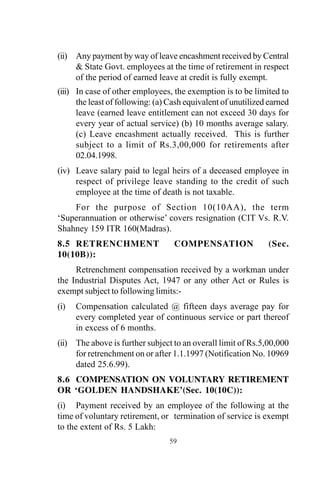
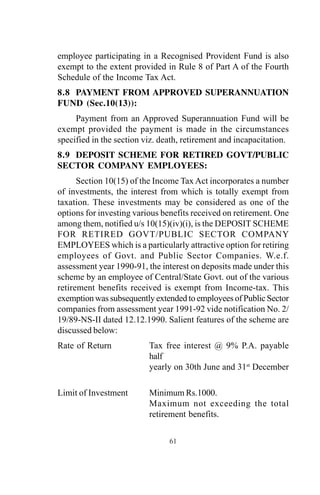
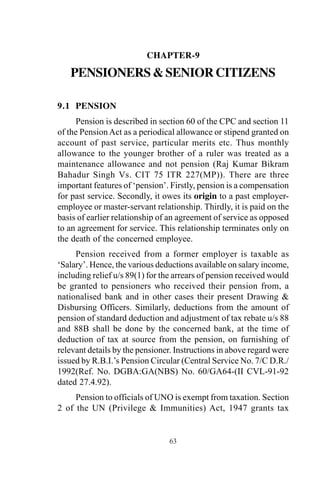
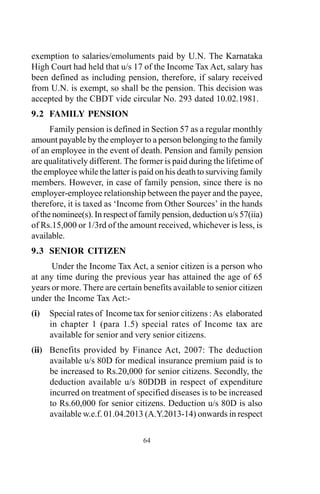
Taxation of
Salaried Employees,
Pensioners
and
Senior Citizens
INCOME TAX DEPARTMENT
Directorate of Income Tax (PR, PP & OL)
6th
Floor, Mayur Bhawan, Connaught Circus
New Delhi-110001
This publication should not be construed as an
exhaustive statement of the Law. In case of doubt,
reference should always be made to the relevant
provisions of the Income Tax Act, 1961, Income Tax
Rules, 1962, Wealth Tax Act, 1957 and Wealth Tax
Rules, 1957 and wherever necessary, to Notifications
issued from time to time.
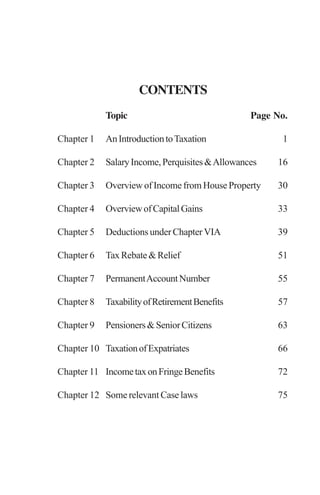
CONTENTS
Topic Page No.
Chapter 1 AnIntroductiontoTaxation 1
Chapter 2 SalaryIncome,Perquisites&Allowances 16
Chapter 3 Overview of Income from House Property 30
Chapter 4 OverviewofCapitalGains 33
Chapter 5 Deductions under Chapter VIA 39
Chapter 6 TaxRebate&Relief 51
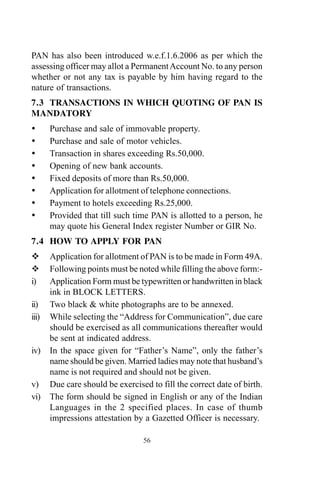
Chapter 7 PermanentAccountNumber 55
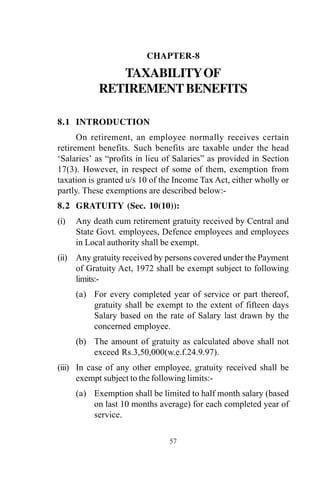
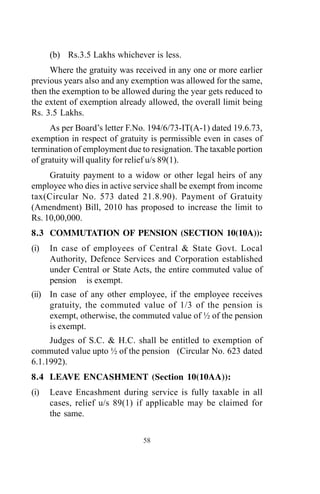
Chapter 8 TaxabilityofRetirementBenefits 57
Chapter 9 Pensioners&SeniorCitizens 63
Chapter 10 TaxationofExpatriates 66
Chapter 11 IncometaxonFringeBenefits 72
Chapter 12 Some relevant Case laws 75
CHAPTER 1
ANINTRODUCTIONTOTAXATION
1.1 INTRODUCTION
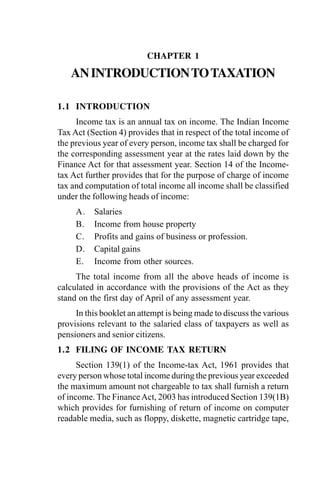
Income tax is an annual tax on income. The Indian Income
Tax Act (Section 4) provides that in respect of the total income of
the previous year of every person, income tax shall be charged for
the corresponding assessment year at the rates laid down by the
Finance Act for that assessment year. Section 14 of the Income-
tax Act further provides that for the purpose of charge of income
tax and computation of total income all income shall be classified
under the following heads of income:
A. Salaries
B. Income from house property
C. Profits and gains of business or profession.
D. Capital gains
E. Income from other sources.
The total income from all the above heads of income is
calculated in accordance with the provisions of the Act as they
stand on the first day of April of any assessment year.
In this booklet an attempt is being made to discuss the various
provisions relevant to the salaried class of taxpayers as well as
pensioners and senior citizens.
1.2 FILING OF INCOME TAX RETURN
Section 139(1) of the Income-tax Act, 1961 provides that
every person whose total income during the previous year exceeded
the maximum amount not chargeable to tax shall furnish a return
of income. The FinanceAct, 2003 has introduced Section 139(1B)
which provides for furnishing of return of income on computer
readable media, such as floppy, diskette, magnetic cartridge tape,
2
CD- ROM etc., in accordance with the e-filing scheme specified
by the Board in this regard.
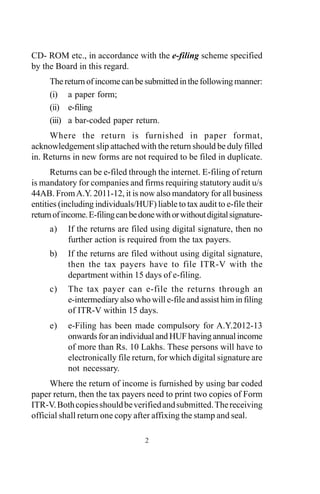
The return of income can be submitted in the following manner:
(i) a paper form;
(ii) e-filing
(iii) a bar-coded paper return.
Where the return is furnished in paper format,
acknowledgement slip attached with the return should be duly filled
in. Returns in new forms are not required to be filed in duplicate.
Returns can be e-filed through the internet. E-filing of return
is mandatory for companies and firms requiring statutory audit u/s
44AB. FromA.Y. 2011-12, it is now also mandatory for all business
entities (including individuals/HUF) liable to tax audit to e-file their
returnofincome.E-filingcanbedonewithorwithoutdigitalsignature-
a) If the returns are filed using digital signature, then no
further action is required from the tax payers.
b) If the returns are filed without using digital signature,
then the tax payers have to file ITR-V with the
department within 15 days of e-filing.
c) The tax payer can e-file the returns through an
e-intermediary also who will e-file and assist him in filing
of ITR-V within 15 days.
e) e-Filing has been made compulsory for A.Y.2012-13
onwards for an individual and HUF having annual income
of more than Rs. 10 Lakhs. These persons will have to
electronically file return, for which digital signature are
not necessary.
Where the return of income is furnished by using bar coded
paper return, then the tax payers need to print two copies of Form
ITR-V.Bothcopiesshouldbeverifiedandsubmitted.Thereceiving
official shall return one copy after affixing the stamp and seal.
3
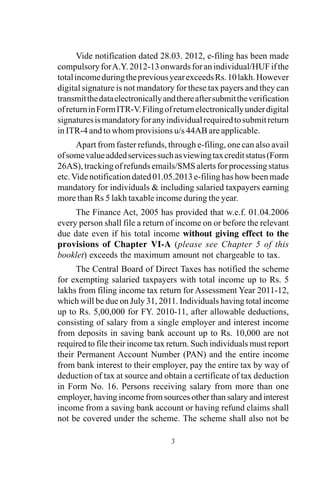
Vide notification dated 28.03. 2012, e-filing has been made
compulsoryforA.Y.2012-13onwardsforanindividual/HUFifthe
totalincomeduringthepreviousyearexceedsRs.10lakh.However
digital signature is not mandatory for these tax payers and they can
transmitthedataelectronicallyandthereaftersubmittheverification
ofreturninFormITR-V.Filingofreturnelectronicallyunderdigital
signaturesismandatoryforanyindividualrequiredtosubmitreturn
in ITR-4 and to whom provisions u/s 44AB are applicable.
Apart from faster refunds, through e-filing, one can also avail
ofsomevalueaddedservicessuchasviewingtaxcreditstatus(Form
26AS),trackingofrefundsemails/SMSalertsforprocessingstatus
etc.Videnotificationdated01.05.2013e-filinghashowbeenmade
mandatory for individuals & including salaried taxpayers earning
more than Rs 5 lakh taxable income during the year.
The Finance Act, 2005 has provided that w.e.f. 01.04.2006
every person shall file a return of income on or before the relevant
due date even if his total income without giving effect to the
provisions of Chapter VI-A (please see Chapter 5 of this
booklet) exceeds the maximum amount not chargeable to tax.
The Central Board of Direct Taxes has notified the scheme
for exempting salaried taxpayers with total income up to Rs. 5
lakhs from filing income tax return for Assessment Year 2011-12,
which will be due on July 31, 2011. Individuals having total income
up to Rs. 5,00,000 for FY. 2010-11, after allowable deductions,
consisting of salary from a single employer and interest income
from deposits in saving bank account up to Rs. 10,000 are not
required to file their income tax return. Such individuals must report
their Permanent Account Number (PAN) and the entire income
from bank interest to their employer, pay the entire tax by way of
deduction of tax at source and obtain a certificate of tax deduction
in Form No. 16. Persons receiving salary from more than one
employer, having income from sources other than salary and interest
income from a saving bank account or having refund claims shall
not be covered under the scheme. The scheme shall also not be
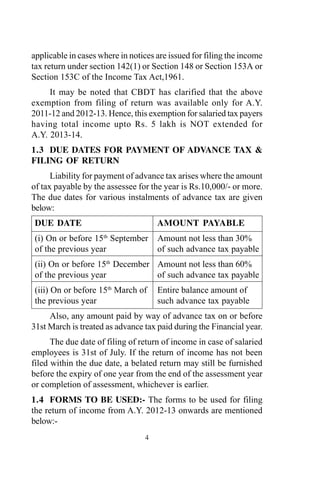
applicable in cases where in notices are issued for filing the income
tax return under section 142(1) or Section 148 or Section 153A or
Section 153C of the Income Tax Act,1961.
It may be noted that CBDT has clarified that the above
exemption from filing of return was available only for A.Y.
2011-12 and 2012-13. Hence, this exemption for salaried tax payers
having total income upto Rs. 5 lakh is NOT extended for
A.Y. 2013-14.
1.3 DUE DATES FOR PAYMENT OF ADVANCE TAX &
FILING OF RETURN
Liability for payment of advance tax arises where the amount
of tax payable by the assessee for the year is Rs.10,000/- or more.
The due dates for various instalments of advance tax are given
below:
DUE DATE AMOUNT PAYABLE
(i) On or before 15th
September Amount not less than 30%
of the previous year of such advance tax payable
(ii) On or before 15th
December Amount not less than 60%
of the previous year of such advance tax payable
(iii) On or before 15th
March of Entire balance amount of
the previous year such advance tax payable
Also, any amount paid by way of advance tax on or before
31st March is treated as advance tax paid during the Financial year.
The due date of filing of return of income in case of salaried
employees is 31st of July. If the return of income has not been
filed within the due date, a belated return may still be furnished
before the expiry of one year from the end of the assessment year
or completion of assessment, whichever is earlier.
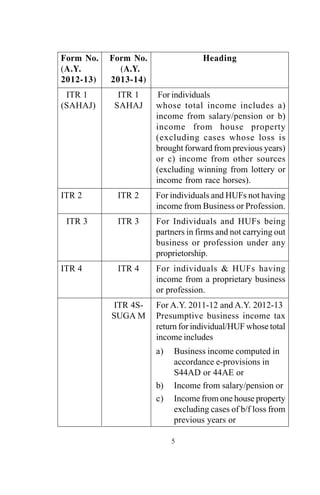
1.4 FORMS TO BE USED:- The forms to be used for filing
the return of income from A.Y. 2012-13 onwards are mentioned
below:-
4
5
Form No. Form No. Heading
(A.Y. (A.Y.
2012-13) 2013-14)
ITR 1 ITR 1 For individuals
(SAHAJ) SAHAJ whose total income includes a)
income from salary/pension or b)
income from house property
(excluding cases whose loss is
brought forward from previous years)
or c) income from other sources
(excluding winning from lottery or
income from race horses).
ITR 2 ITR 2 For individuals and HUFs not having
income from Business or Profession.
ITR 3 ITR 3 For Individuals and HUFs being
partners in firms and not carrying out
business or profession under any
proprietorship.
ITR 4 ITR 4 For individuals & HUFs having
income from a proprietary business
or profession.
ITR 4S- For A.Y. 2011-12 and A.Y. 2012-13
SUGA M Presumptive business income tax
return for individual/HUF whose total
income includes
a) Business income computed in
accordance e-provisions in
S44AD or 44AE or
b) Income from salary/pension or
c) Income from one house property
excluding cases of b/f loss from
previous years or
d) Income from other sources
excluding winning from lottery
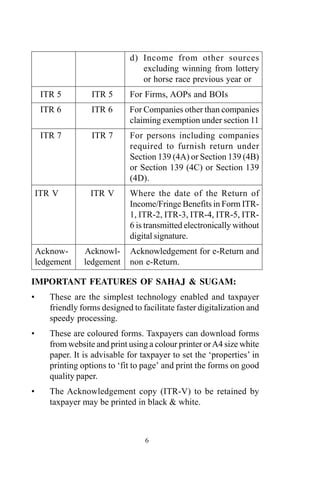
or horse race previous year or
ITR 5 ITR 5 For Firms, AOPs and BOIs
ITR 6 ITR 6 For Companies other than companies
claiming exemption under section 11
ITR 7 ITR 7 For persons including companies
required to furnish return under
Section 139 (4A) or Section 139 (4B)
or Section 139 (4C) or Section 139
(4D).
ITR V ITR V Where the date of the Return of
Income/Fringe Benefits in Form ITR-
1, ITR-2, ITR-3, ITR-4, ITR-5, ITR-
6 is transmitted electronically without
digital signature.
Acknow- Acknowl- Acknowledgement for e-Return and
ledgement ledgement non e-Return.
IMPORTANT FEATURES OF SAHAJ & SUGAM:
• These are the simplest technology enabled and taxpayer
friendly forms designed to facilitate faster digitalization and
speedy processing.
• These are coloured forms. Taxpayers can download forms
from website and print using a colour printer orA4 size white
paper. It is advisable for taxpayer to set the ‘properties’ in
printing options to ‘fit to page’ and print the forms on good
quality paper.
• The Acknowledgement copy (ITR-V) to be retained by
taxpayer may be printed in black & white.
6
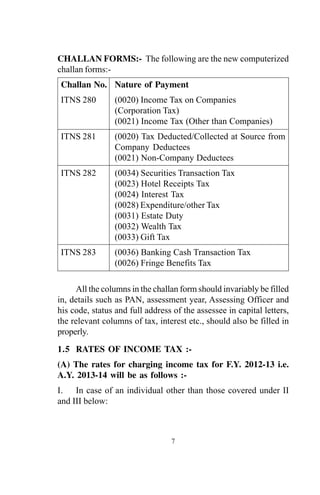
CHALLAN FORMS:- The following are the new computerized
challan forms:-
Challan No. Nature of Payment
ITNS 280 (0020) Income Tax on Companies
(Corporation Tax)
(0021) Income Tax (Other than Companies)
ITNS 281 (0020) Tax Deducted/Collected at Source from
Company Deductees
(0021) Non-Company Deductees
ITNS 282 (0034) Securities Transaction Tax
(0023) Hotel Receipts Tax
(0024) Interest Tax
(0028) Expenditure/other Tax
(0031) Estate Duty
(0032) Wealth Tax
(0033) Gift Tax
ITNS 283 (0036) Banking Cash Transaction Tax
(0026) Fringe Benefits Tax
7
All the columns in the challan form should invariably be filled
in, details such as PAN, assessment year, Assessing Officer and
his code, status and full address of the assessee in capital letters,
the relevant columns of tax, interest etc., should also be filled in
properly.
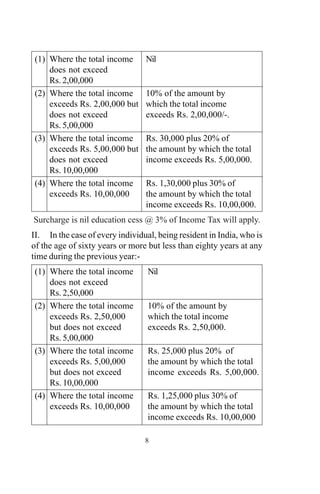
1.5 RATES OF INCOME TAX :-
(A) The rates for charging income tax for F.Y. 2012-13 i.e.
A.Y. 2013-14 will be as follows :-
I. In case of an individual other than those covered under II
and III below:
(1) Where the total income Nil
does not exceed
Rs. 2,00,000
(2) Where the total income 10% of the amount by
exceeds Rs. 2,00,000 but which the total income
does not exceed exceeds Rs. 2,00,000/-.
Rs. 5,00,000
(3) Where the total income Rs. 30,000 plus 20% of
exceeds Rs. 5,00,000 but the amount by which the total
does not exceed income exceeds Rs. 5,00,000.
Rs. 10,00,000
(4) Where the total income Rs. 1,30,000 plus 30% of
exceeds Rs. 10,00,000 the amount by which the total
income exceeds Rs. 10,00,000.
Surcharge is nil education cess @ 3% of Income Tax will apply.
II. In the case of every individual, being resident in India, who is
of the age of sixty years or more but less than eighty years at any
time during the previous year:-
(1) Where the total income Nil
does not exceed
Rs. 2,50,000
(2) Where the total income 10% of the amount by
exceeds Rs. 2,50,000 which the total income
but does not exceed exceeds Rs. 2,50,000.
Rs. 5,00,000
(3) Where the total income Rs. 25,000 plus 20% of
exceeds Rs. 5,00,000 the amount by which the total
but does not exceed income exceeds Rs. 5,00,000.
Rs. 10,00,000
(4) Where the total income Rs. 1,25,000 plus 30% of
exceeds Rs. 10,00,000 the amount by which the total
income exceeds Rs. 10,00,000
8
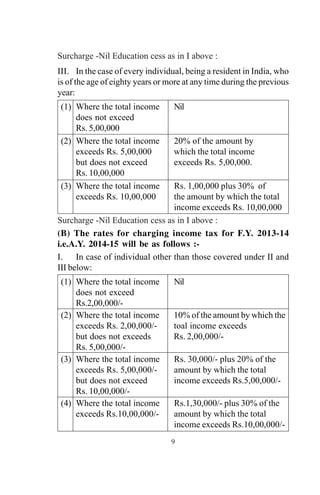
Surcharge -Nil Education cess as in I above :
III. In the case of every individual, being a resident in India, who
is of the age of eighty years or more at any time during the previous
year:
(1) Where the total income Nil
does not exceed
Rs. 5,00,000
(2) Where the total income 20% of the amount by
exceeds Rs. 5,00,000 which the total income
but does not exceed exceeds Rs. 5,00,000.
Rs. 10,00,000
(3) Where the total income Rs. 1,00,000 plus 30% of
exceeds Rs. 10,00,000 the amount by which the total
income exceeds Rs. 10,00,000
Surcharge -Nil Education cess as in I above :
(B) The rates for charging income tax for F.Y. 2013-14
i.e.A.Y. 2014-15 will be as follows :-
I. In case of individual other than those covered under II and
III below:
(1) Where the total income Nil
does not exceed
Rs.2,00,000/-
(2) Where the total income 10% of the amount by which the
exceeds Rs. 2,00,000/- toal income exceeds
but does not exceeds Rs. 2,00,000/-
Rs. 5,00,000/-
(3) Where the total income Rs. 30,000/- plus 20% of the
exceeds Rs. 5,00,000/- amount by which the total
but does not exceed income exceeds Rs.5,00,000/-
Rs. 10,00,000/-
(4) Where the total income Rs.1,30,000/- plus 30% of the
exceeds Rs.10,00,000/- amount by which the total
income exceeds Rs.10,00,000/-
9
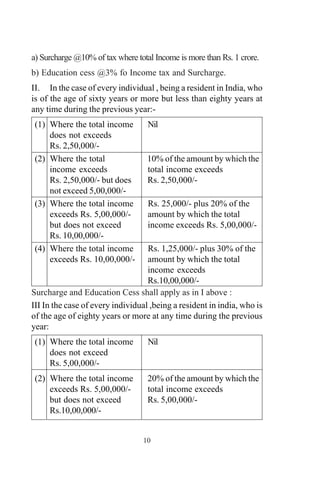
a) Surcharge @10% of tax where total Income is more than Rs. 1 crore.
b) Education cess @3% fo Income tax and Surcharge.
II. In the case of every individual , being a resident in India, who
is of the age of sixty years or more but less than eighty years at
any time during the previous year:-
(1) Where the total income Nil
does not exceeds
Rs. 2,50,000/-
(2) Where the total 10% of the amount by which the
income exceeds total income exceeds
Rs. 2,50,000/- but does Rs. 2,50,000/-
not exceed 5,00,000/-
(3) Where the total income Rs. 25,000/- plus 20% of the
exceeds Rs. 5,00,000/- amount by which the total
but does not exceed income exceeds Rs. 5,00,000/-
Rs. 10,00,000/-
(4) Where the total income Rs. 1,25,000/- plus 30% of the
exceeds Rs. 10,00,000/- amount by which the total
income exceeds
Rs.10,00,000/-
Surcharge and Education Cess shall apply as in I above :
III In the case of every individual ,being a resident in india, who is
of the age of eighty years or more at any time during the previous
year:
(1) Where the total income Nil
does not exceed
Rs. 5,00,000/-
(2) Where the total income 20% of the amount by which the
exceeds Rs. 5,00,000/- total income exceeds
but does not exceed Rs. 5,00,000/-
Rs.10,00,000/-
10
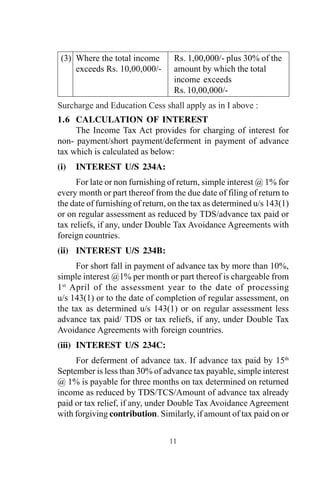
(3) Where the total income Rs. 1,00,000/- plus 30% of the
exceeds Rs. 10,00,000/- amount by which the total
income exceeds
Rs. 10,00,000/-
Surcharge and Education Cess shall apply as in I above :
1.6 CALCULATION OF INTEREST
The Income Tax Act provides for charging of interest for
non- payment/short payment/deferment in payment of advance
tax which is calculated as below:
(i) INTEREST U/S 234A:
For late or non furnishing of return, simple interest @ 1% for
every month or part thereof from the due date of filing of return to
the date of furnishing of return, on the tax as determined u/s 143(1)
or on regular assessment as reduced by TDS/advance tax paid or
tax reliefs, if any, under Double Tax Avoidance Agreements with
foreign countries.
(ii) INTEREST U/S 234B:
For short fall in payment of advance tax by more than 10%,
simple interest @1% per month or part thereof is chargeable from
1st
April of the assessment year to the date of processing
u/s 143(1) or to the date of completion of regular assessment, on
the tax as determined u/s 143(1) or on regular assessment less
advance tax paid/ TDS or tax reliefs, if any, under Double Tax
Avoidance Agreements with foreign countries.
(iii) INTEREST U/S 234C:
For deferment of advance tax. If advance tax paid by 15th
September is less than 30% of advance tax payable, simple interest
@ 1% is payable for three months on tax determined on returned
income as reduced by TDS/TCS/Amount of advance tax already
paid or tax relief, if any, under Double Tax Avoidance Agreement
with forgiving contribution. Similarly, if amount of tax paid on or
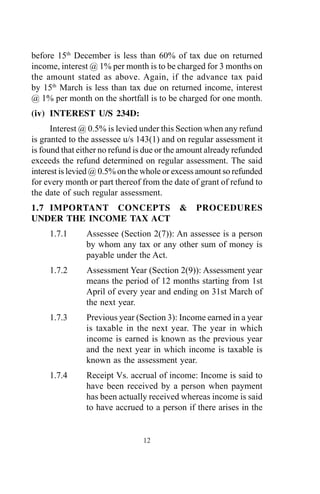
11
before 15th
December is less than 60% of tax due on returned
income, interest @ 1% per month is to be charged for 3 months on
the amount stated as above. Again, if the advance tax paid
by 15th
March is less than tax due on returned income, interest
@ 1% per month on the shortfall is to be charged for one month.
(iv) INTEREST U/S 234D:
Interest @ 0.5% is levied under this Section when any refund
is granted to the assessee u/s 143(1) and on regular assessment it
is found that either no refund is due or the amount already refunded
exceeds the refund determined on regular assessment. The said
interest is levied @ 0.5% on the whole or excess amount so refunded
for every month or part thereof from the date of grant of refund to
the date of such regular assessment.
1.7 IMPORTANT CONCEPTS & PROCEDURES
UNDER THE INCOME TAX ACT
1.7.1 Assessee (Section 2(7)): An assessee is a person
by whom any tax or any other sum of money is
payable under the Act.
1.7.2 Assessment Year (Section 2(9)): Assessment year
means the period of 12 months starting from 1st
April of every year and ending on 31st March of
the next year.
1.7.3 Previous year (Section 3): Income earned in a year
is taxable in the next year. The year in which
income is earned is known as the previous year
and the next year in which income is taxable is
known as the assessment year.
1.7.4 Receipt Vs. accrual of income: Income is said to
have been received by a person when payment
has been actually received whereas income is said
to have accrued to a person if there arises in the
12
person a fixed and unconditional right to receive
such income.
1.7.5 Belated Return: Section 139(4) provides that a
return which has not been furnished by the due
date may still be furnished as a belated return
before the expiry of one year from the end of the
assessment year or before the completion of
assessment, whichever is earlier. However, on any
return of income that has not been filed by the end
of the relevant assessment year, penalty of
Rs.5000/- u/s 271F shall be levied.
1.7.6 Revised Return: If a person having filed his return
within the due date, discovers any omission or
wrong statement therein, he may file a revised
return before the expiry of one year from the end
of the assessment year or completion of
assessment whichever is earlier.
1.7.7 Processing u/s 143(1): The Finance Act 2008 has
reintroduced provisions in respect of correcting
arithmetical mistakes or internal inconsistencies at
the stage of processing of returns. It has, thus
been provided that, during the stage of processing,
the total income shall be computed after making
adjustments in respect of any arithmetical error in
the return or any incorrect claim apparent from
information in the return and if on such computation,
any tax or interest or refund is found due on
adjustment of TDS or advance tax or self
assessment tax, then an intimation specifying the
amount payable shall be prepared/generated or
issued to the assessee. If any refund is found due,
it is to be sent along with an intimation to such
effect. If no demand or no refund arises, the
13
acknowledgement of the return is deemed to be
an intimation. Such intimation is to be sent within
one year from the end of the financial year in which
the return is filed.
1.7.8 Assessment u/s 143(3): If the Assessing Officer,
on the basis of the return filed by the assessee,
considers that it is necessary to ensure that the
assessee has not understated his income, he shall
serve on the assessee a notice u/s 143(2) and, after
obtaining such information as he may require,
complete the assessment ( commonly referred as
scrutiny assessment) u/s 143(3).
1.7.9 Rectification of mistake u/s 154: If any order passed
by an income tax authority suffers from a mistake
apparent from record, the assessee may make an
application for rectifying the same before the expiry
of four years from the end of the financial year in
which the above order was passed. The Finance
Act 2001 has provided that where an application
for rectification under this Section is made by the
assessee on or after 1.6.2001, the same shall have
to be acted upon by the income tax authority within
a period of six months from the end of the month
in which the application is received.
1.7.10 Interest on refunds u/s 244A: If the refund due to
the assessee is more than 10% of the tax payable
by him, he shall be entitled to receive simple interest
thereon at rate of 0.5% per month (substituted in
place of 0.67% per month w.e.f. 8.9.2003) or part
thereof, from 1st
April of the assessment year to
the date on which the refund is granted.
1.7.11 Tax Return Preparers Scheme:- For enabling
specified classes of tax payers in preparing and
14
furnishing income tax returns, the Board has
notified the ‘Tax Return Preparer Scheme’ under
which specially trained and authorized Tax Return
Preparers will provide assistance to tax payers in
this regard. Details of the Scheme may be viewed
at www.incometaxindia.gov.in. Individuals or
HUFs may furnish his return of income through a
Tax Return Preparer who has been authorized and
certified for this purpose.
1.7.12 Set off of refund: It may be mentioned here that
the Income tax Act provides that in case there in
any demand payable by an assessee, any refund
arising to him in any other assessment year may
be set off after giving an intimation in writing to
such person of such proposed action.
1.7.13 The FinanceAct 2013 has provided that if, any tax
or interest that is payable under the Act has not
been paid on or before the date of furnishing or
return, then such return will be a defective return
and, hence, invalid.
1.7.14 W.e.f. 1.4.2013 a new section 115JC has been
introduced which is applicable an individual or HUF
with ‘adjusted total income’ not below Rs. 20 lakh.
Adjusted total income is total income as increased
by deductions claimed under chaper VI A. In such
case, the tax payable shall be regular income tax
payable or 18.5% of the adjusted total income,
whichever is higher.
15
CHAPTER-2
SALARYINCOME,PERQUISITES
&ALLOWANCES
2.1 WHAT IS “SALARY”
Salary is the remuneration received by or accruing to an
individual, periodically, for service rendered as a result of an express
or implied contract. The actual receipt of salary in the previous
year is not material as far as its taxability is concerned. The
existence of employer-employee relationship is the sine-qua-non
for taxing a particular receipt under the head “salaries”. For
instance, the salary received by a partner from his partnership
firm carrying on a business is not chargeable as “Salaries” but as
“Profits & Gains from Business or Profession”. Similarly, salary
received by a person as MP or MLA is taxable as “ Income from
other sources”, but if a person received salary as Minister of State/
Central Government, the same shall be charged to tax under the
head “Salaries”. Pension received by an assessee from his former
employer is taxable as “Salaries” whereas pension received on his
death by members of his family (Family Pension) is taxed as
“Income from other sources”.
2.2 WHAT DOES “SALARY” INCLUDE
Section 17(1) of the Income tax Act gives an inclusive and
not exhaustive definition of “Salaries” including therein (i) Wages
(ii) Annuity or pension (iii) Gratuity (iv) Fees, Commission,
perquisites or profits in lieu of salary (v) Advance of Salary (vi)
Amount transferred from unrecognized provident fund to
recognized provident fund (vii) Contribution of employer to a
Recognised Provident Fund in excess of the prescribed limit (viii)
Leave Encashment (ix) Compensation as a result of variation in
Service contract etc. (x) Contribution made by the Central
16
Government to the account of an employee under a notified
pension scheme.
2.3 DEDUCTION FROM SALARY INCOME
The following deductions from salary income are admissible
as per Section 16 of the Income-tax Act.
(i) Professional/Employment tax levied by the State Govt.
(ii) Entertainment Allowance- Deduction in respect of this
is available to a government employee to the extent of Rs.
5000/- or 20% of his salary or actual amount received,
whichever is less.
It is to be noted that no standard deduction is available
from salary income w.e.f. 01.04.2006 i.e. A.Y.2006-07
onwards.
2.4 PERQUISITES
“Perquisite” may be defined as any casual emolument or
benefit attached to an office or position in addition to salary or
wages.
“Perquisite” is defined in the section17(2) of the Income tax
Act as including:
(i) Value of rent-free/concessional rent accommodation provided
by the employer.
(ii) Any sum paid by employer in respect of an obligation which
was actually payable by the assessee.
(iii) Value of any benefit/amenity granted free or at concessional
rate to specified employees etc.
(iv) The value of any specified security or sweat equity shares
allotted or transferred, directly or indirectly, by the employer,
or former employer, free of cost or at concessional rate to
the assesssee.
17
(v) The amount of any contribution to an approved superannuation
fund by the employer in respect of the assessee, to the extent
it exceeds one lakh rupees; and
(vi) the value of any other fringe benefit or amenity as may be
prescribed.
2.5 VALUATION OF PERQUISITES
As a general rule, the taxable value of perquisites in the hands
of the employees is its cost to the employer. However, specific
rules for valuation of certain perquisites have been laid down in
Rule 3 of the I.T. Rules. These are briefly given below.
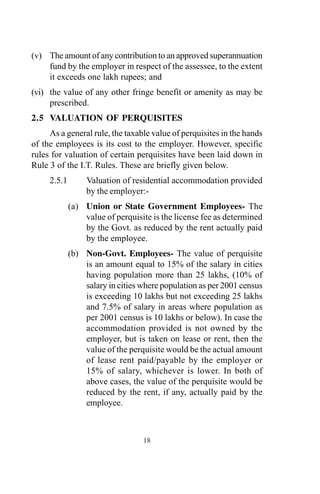
2.5.1 Valuation of residential accommodation provided
by the employer:-
(a) Union or State Government Employees- The
value of perquisite is the license fee as determined
by the Govt. as reduced by the rent actually paid
by the employee.
(b) Non-Govt. Employees- The value of perquisite
is an amount equal to 15% of the salary in cities
having population more than 25 lakhs, (10% of
salary in cities where population as per 2001 census
is exceeding 10 lakhs but not exceeding 25 lakhs
and 7.5% of salary in areas where population as
per 2001 census is 10 lakhs or below). In case the
accommodation provided is not owned by the
employer, but is taken on lease or rent, then the
value of the perquisite would be the actual amount
of lease rent paid/payable by the employer or
15% of salary, whichever is lower. In both of
above cases, the value of the perquisite would be
reduced by the rent, if any, actually paid by the
employee.
18
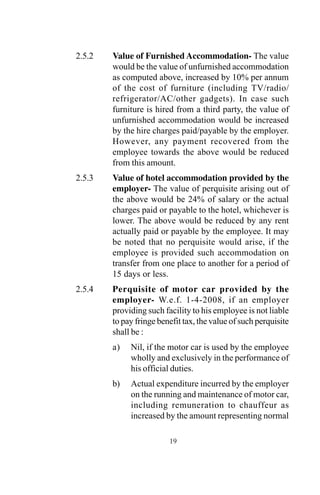
2.5.2 Value of Furnished Accommodation- The value
would be the value of unfurnished accommodation
as computed above, increased by 10% per annum
of the cost of furniture (including TV/radio/
refrigerator/AC/other gadgets). In case such
furniture is hired from a third party, the value of
unfurnished accommodation would be increased
by the hire charges paid/payable by the employer.
However, any payment recovered from the
employee towards the above would be reduced
from this amount.
2.5.3 Value of hotel accommodation provided by the
employer- The value of perquisite arising out of
the above would be 24% of salary or the actual
charges paid or payable to the hotel, whichever is
lower. The above would be reduced by any rent
actually paid or payable by the employee. It may
be noted that no perquisite would arise, if the
employee is provided such accommodation on
transfer from one place to another for a period of
15 days or less.
2.5.4 Perquisite of motor car provided by the
employer- W.e.f. 1-4-2008, if an employer
providing such facility to his employee is not liable
to pay fringe benefit tax, the value of such perquisite
shall be :
a) Nil, if the motor car is used by the employee
wholly and exclusively in the performance of
his official duties.
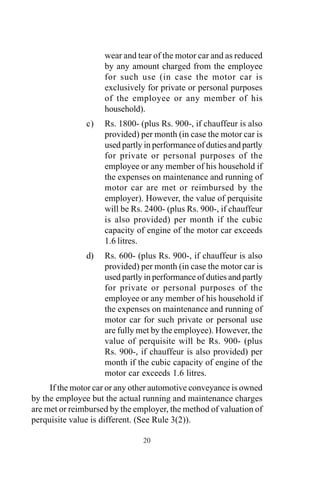
b) Actual expenditure incurred by the employer
on the running and maintenance of motor car,
including remuneration to chauffeur as
increased by the amount representing normal
19
wear and tear of the motor car and as reduced
by any amount charged from the employee
for such use (in case the motor car is
exclusively for private or personal purposes
of the employee or any member of his
household).
c) Rs. 1800- (plus Rs. 900-, if chauffeur is also
provided) per month (in case the motor car is
used partly in performance of duties and partly
for private or personal purposes of the
employee or any member of his household if
the expenses on maintenance and running of
motor car are met or reimbursed by the
employer). However, the value of perquisite
will be Rs. 2400- (plus Rs. 900-, if chauffeur
is also provided) per month if the cubic
capacity of engine of the motor car exceeds
1.6 litres.
d) Rs. 600- (plus Rs. 900-, if chauffeur is also
provided) per month (in case the motor car is
used partly in performance of duties and partly
for private or personal purposes of the
employee or any member of his household if
the expenses on maintenance and running of
motor car for such private or personal use
are fully met by the employee). However, the
value of perquisite will be Rs. 900- (plus
Rs. 900-, if chauffeur is also provided) per
month if the cubic capacity of engine of the
motor car exceeds 1.6 litres.
If the motor car or any other automotive conveyance is owned
by the employee but the actual running and maintenance charges
are met or reimbursed by the employer, the method of valuation of
perquisite value is different. (See Rule 3(2)).
20
2.5.5 Perquisite arising out of supply of gas, electric
energy or water: This shall be determined as the
amount paid by the employer to the agency
supplying the same. If the supply is from the
employer’s own resources, the value of the
perquisite would be the manufacturing cost per unit
incurred by the employer. However, any payment
received from the employee towards the above
would be reduced from the amount [Rule 3(4)]
2.5.6 Free/Concessional Educational Facility: Value of
the perquisite would be the expenditure incurred
by the employer. If the education institution is
maintained & owned by the employer, the value
would be nil if the value of the benefit per child is
below Rs. 1000/- P.M. or else the reasonable cost
of such education in a similar institution in or near
the locality. [Rule 3(5)].
2.5.7 Free/Concessional journeys provided by an
undertaking engaged in carriage of passengers or
goods: Value of perquisite would be the value at
which such amenity is offered to general public as
reduced by any amount, if recovered from the
employee. However, these provisions are not
applicable to the employees of an airline or the
railways.
2.5.8 Provision for sweeper, gardener, watchman or
personal attendant: The value of benefit resulting
from provision of any of these shall be the actual
cost borne by the employer in this respect as
reduced by any amount paid by the employee for
such services. (Cost to the employer in respect
to the above will be salary paid/payable).
[Rule 3(3)].
21
2.5.9 Value of certain other fringe benefits:
(a) Interest free/concessional loans- The value of the
perquisite shall be the excess of interest payable
at the prescribed interest rate over, interest, if any,
actually paid by the employee or any member of
his household. The prescribed interest rate would
be the rate charged by State Bank of India as on
the 1st
Day of the relevant Previous Year in respect
of loans of the same type and for same purpose
advanced by it to general public. Perquisite to be
calculated on the basis of the maximum outstanding
monthly balance method. However, loans upto Rs.
20,000/-, loans for medical treatment specified in
Rule 3A are exempt provided the same are not
reimbursed under medical insurance.
(b) Value of free meals- The perquisite value in respect
of free food and non-alcoholic beverages provided
by the employer, not liable to pay fringe benefit
tax, to an employee shall be the expenditure
incurred by the employer as reduced by the amount
paid or recovered from the employee for such
benefit or amenity. However, no perquisite value
will be taken if food and non-alcoholic beverages
are provided during working hours and certain
conditions specified under Rule 3(7)(iii) are
satisfied.
(c) Value of gift or voucher or token- The perquisite
value in respect of any gift, or voucher, or taken in
lieu of which such gift may be received by the
employee or member of his household from the
employer, not liable to pay fringe benefit tax, shall
be the sum equal to the amount of such gift, voucher
or token. However, no perquisite value will be taken
22
23
if the value of such gift, voucher or taken is below
Rs. 5000/- in the aggregate during the previous
years.
(d) Credit card provided by the employer- The
perquisite value in respect of expenses incurred
by the employee or any of his household members,
which are charged to a credit card provided by the
employer, not liable to pay fringe benefit tax, which
are paid or reimbursed by such employer to an
employee shall be taken to be such amount paid or
reimbursed by the employer. However, no
perquisite value will be taken if the expenses are
incurredwhollyandexclusivelyforofficialpurposes
and certain conditions mentioned in Rule 3(7)(v)
are satisfied.
(e) Club membership provided by the employer- The
perquisite value in respect of amount paid or
reimbursed to an employee by an employer, not
liable to pay fringe benefit tax, against the expenses
incurred in a club by such employee or any of his
household members shall be taken to be such
amount incurred or reimbursed by the employer as
reduced by any amount paid or recovered from
the employee on such account. However, no
perquisite value will be taken if the expenditure is
incurred wholly any exclusively for business
purposes and certain conditions mentioned in Rule
3(7)(vi) are satisfied.
2.5.10 The value of any other benefit or amenity provided
by the employer shall be determined on the basis
of cost to the employer under an arms’ length
transaction as reduced by the employee’s
contribution.
2.5.11 The fair market value of any specified security or
sweat equity share, being an equity share in a
company, on the date on which the option is
exercised by the employee, shall be determined
as follows:-
(a) In a case where,on the date of exercising of the
option, the share in the company is listed on a
recognized stock exchange, the fair market value
shall be the average of the opening price and closing
price of the share on the date on the said stock
exchange.
(b) In a case where, on the date of exercising of the
option, the share in the company is not listed on a
recognized stock exchange, the fair market value
shall be such value of the share in the company as
determined by a merchant banker on the specified
date.
(c) The fair market value of any specified security,
not being an equity share in a company, on the date
on which the option is exercised by the employee,
shall be such value as determined by a merchant
banker on the specified date.
2.6 PERQUISITES EXEMPT FROM INCOME TAX
Some instances of perquisites exempt from tax are given
below:
Provision of medical facilities (Proviso to Sec. 17(2)): Value
of medical treatment in any hospital maintained by the Government
or any local authority or approved by the Chief Commissioner of
Income-tax. Besides, any sum paid by the employer towards
medical reimbursement other than as discussed above is exempt
upto Rs.15,000/-.
24
Perquisites allowed outside India by the Government to a
citizen of India for rendering services outside India (Sec. 10(7)).
Rent free official residence provided to a Judge of High Court
or Supreme Court or an Official of Parliament, Union Minister or
Leader of Opposition in Parliament.
No perquisite shall arise if interest free/concessional loans
are made available for medical treatment of specified diseases in
Rule 3A or where the loan is petty not exceeding in the aggregate
Rs.20,000/-
No perquisite shall arise in relation to expenses on telephones
including a mobile phone incurred on behalf of the employee by
the employer.
2.7 ALLOWANCES
Allowance is defined as a fixed quantity of money or other
substance given regularly in addition to salary for meeting specific
requirements of the employees. As a general rule, all allowances
are to be included in the total income unless specifically exempted.
Exemption in respect of following allowances is allowable to the
exent mentioned against each :-
2.7.1 House RentAllowance:- Provided that expenditure
on rent is actually incurred, exemption available
shall be the least of the following :
(i) HRA received.
(ii) Rent paid less 10% of salary.
(iii) 40% of Salary (50% in case of Mumbai, Chennai,
Kolkata, Delhi) Salary here means Basic +
Dearness Allowance, if dearness allowance is
provided by the terms of employment.
2.7.2 Leave Travel Allowance: The amount actually
incurred on performance of travel on leave to any
25
26
place in India by the shortest route to that place is
exempt. This is subject to a maximum of the air
economy fare or AC 1st
Class fare (if journey is
performed by mode other than air) by such route,
provided that the exemption shall be available only
in respect of two journeys performed in a block of
4 calendar years.
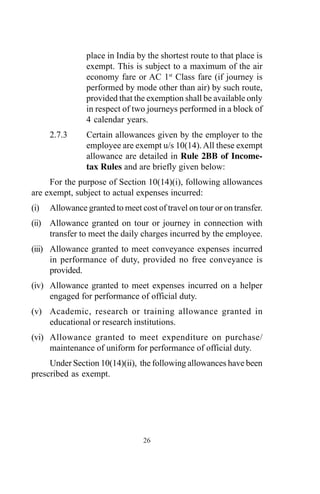
2.7.3 Certain allowances given by the employer to the
employee are exempt u/s 10(14).All these exempt
allowance are detailed in Rule 2BB of Income-
tax Rules and are briefly given below:
For the purpose of Section 10(14)(i), following allowances
are exempt, subject to actual expenses incurred:
(i) Allowance granted to meet cost of travel on tour or on transfer.
(ii) Allowance granted on tour or journey in connection with
transfer to meet the daily charges incurred by the employee.
(iii) Allowance granted to meet conveyance expenses incurred
in performance of duty, provided no free conveyance is
provided.
(iv) Allowance granted to meet expenses incurred on a helper
engaged for performance of official duty.
(v) Academic, research or training allowance granted in
educational or research institutions.
(vi) Allowance granted to meet expenditure on purchase/
maintenance of uniform for performance of official duty.
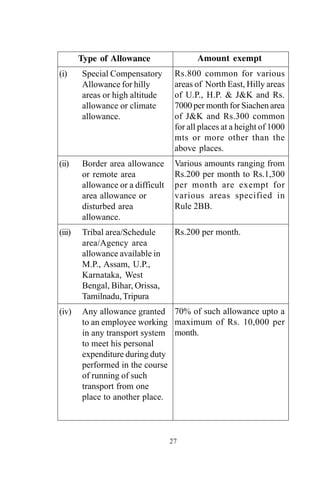
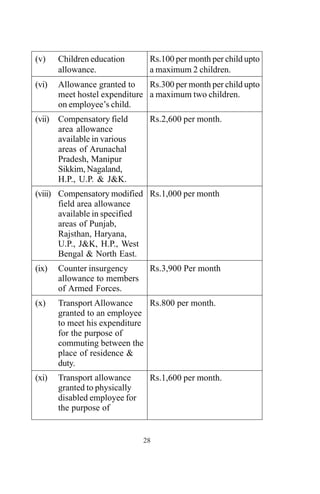
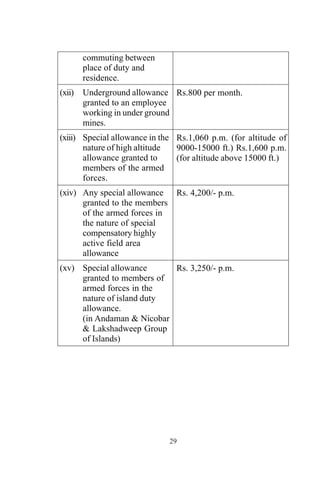
Under Section 10(14)(ii), the following allowances have been
prescribed as exempt.
27
Type of Allowance
(i) Special Compensatory
Allowance for hilly
areas or high altitude
allowance or climate
allowance.
(ii) Border area allowance
or remote area
allowance or a difficult
area allowance or
disturbed area
allowance.
(iii) Tribal area/Schedule
area/Agency area
allowance available in
M.P., Assam, U.P.,
Karnataka, West
Bengal, Bihar, Orissa,
Tamilnadu,Tripura
(iv) Any allowance granted
to an employee working
in any transport system
to meet his personal
expenditure during duty
performed in the course
of running of such
transport from one
place to another place.
Amount exempt
Rs.800 common for various
areas of North East, Hilly areas
of U.P., H.P. & J&K and Rs.
7000 per month for Siachen area
of J&K and Rs.300 common
for all places at a height of 1000
mts or more other than the
above places.
Various amounts ranging from
Rs.200 per month to Rs.1,300
per month are exempt for
various areas specified in
Rule 2BB.
Rs.200 per month.
70% of such allowance upto a
maximum of Rs. 10,000 per
month.
28
(v) Children education
allowance.
(vi) Allowance granted to
meet hostel expenditure
on employee’s child.
(vii) Compensatory field
area allowance
available in various
areas of Arunachal
Pradesh, Manipur
Sikkim, Nagaland,
H.P., U.P. & J&K.
(viii) Compensatory modified
field area allowance
available in specified
areas of Punjab,
Rajsthan, Haryana,
U.P., J&K, H.P., West
Bengal & North East.
(ix) Counter insurgency
allowance to members
of Armed Forces.
(x) Transport Allowance
granted to an employee
to meet his expenditure
for the purpose of
commuting between the
place of residence &
duty.
(xi) Transport allowance
granted to physically
disabled employee for
the purpose of
Rs.100 per month per child upto
a maximum 2 children.
Rs.300 per month per child upto
a maximum two children.
Rs.2,600 per month.
Rs.1,000 per month
Rs.3,900 Per month
Rs.800 per month.
Rs.1,600 per month.
29
commuting between
place of duty and
residence.
(xii) Underground allowance
granted to an employee
working in under ground
mines.
(xiii) Special allowance in the
nature of high altitude
allowance granted to
members of the armed
forces.
(xiv) Any special allowance
granted to the members
of the armed forces in
the nature of special
compensatory highly
active field area
allowance
(xv) Special allowance
granted to members of
armed forces in the
nature of island duty
allowance.
(in Andaman & Nicobar
& Lakshadweep Group
of Islands)
Rs.800 per month.
Rs.1,060 p.m. (for altitude of
9000-15000 ft.) Rs.1,600 p.m.
(for altitude above 15000 ft.)
Rs. 4,200/- p.m.
Rs. 3,250/- p.m.
CHAPTER-3
OVERVIEWOFINCOMEFROM
HOUSE PROPERTY
3.1 INTRODUCTION
Under the Income Tax Act what is taxed under the head
‘Income from House Property’ is the inherent capacity of the
property to earn income called the Annual Value of the property.
The above is taxed in the hands of the owner of the property.
3.2 COMPUTATION OF ANNUAL VALUE
(i) GROSS ANNUAL VALUE(G.A.V.) is the highest of
(a) Rent received or receivable
(b) Fair Market Value.
(c) Municipal valuation.
(If however, the Rent Control Act is applicable, the G.A.V. is
the standard rent or rent received, whichever is higher).
It may be noted that if the let out property was vacant for
whole or any part of the previous year and owing to such vacancy
the actual rent received or receivable is less than the sum referred
to in clause(a) above, then the amount actually received/receivable
shall be taken into account while computing the G.A.V. If any
portion of the rent is unrealisable, (condition of unrealisability of
rent are laid down in Rule 4 of I.T. Rules) then the same shall not
be included in the actual rent received/receivable while computing
the G.A.V.
(ii) NET VALUE (N.A.V.) is the GAV less the municipal taxes
paid by the owner.
Provided that the taxes were paid during the year.
30
(iii) ANNUALVALUE is the N.A.V. less the deductions available
u/s 24.
3.3 DEDUCTIONS U/S 24:- Are exhaustive and no other
deductions are available:-
(i) A sum equal to 30% of the annual value as computed above.
(ii) Interest on money borrowed for acquisition/construction/
repair/renovation of property is deductible on accrual basis.
Interest paid during the pre construction/acquisition period
will be allowed in five successive financial years starting with
the financial year in which construction/acquisition is
completed. This deduction is also available in respect of a
self occupied property and can be claimed up to maximum of
Rs.30,000/-. The Finance Act, 2001 had provided that w.e.f.
A.Y. 2002-03 the amount of deduction available under this
clause would be available up to Rs.1,50,000/- in case the
property is acquired or constructed with capital borrowed on
or after 1.4.99 and such acquisition or construction is
completed before 1.4.2003. The FinanceAct 2002 has further
removed the requirement of acquisition/ construction being
completed before 1.4.2003 and has simply provided that
the acquisition/construction of the property must be completed
within three years from the end of the financial year in which
the capital was borrowed.
3.4 SOME NOTABLE POINTS
In case of one self occupied property, the annual value is
taken as nil. Deduction u/s 24 for interest paid may still be claimed
therefrom. The resulting loss may be set off against income under
other heads but can not be carried forward.
If more than one property is owned and all are used for self
occupation purposes only, then any one can be opted as self
occupied, the others are deemed to be let out.
31
32
Annual value of one house away from workplace which is
not let out can be taken as NIL provided that it is the only house
owned and it is not let out.
If a let out property is partly self occupied or is self occupied
for a part of the year, then the value in proportion to the portion of
self occupied property or period of self occupation, as the case
may be is to be excluded from the annual value.
FromAssessment year 1999-2000 onwards, an assessee who
apart from his salary income has loss under the head “Income
from house property”, may furnish the particulars of the same in
the prescribed form to his Drawing and Disbursing Officer who
shall then take the above loss also into account for the purpose of
TDS from salary.
A new section 25B has been inserted with effect from
assessment year 2001-2002 which provides that where the
assessee, being the owner of any property consisting of any
buildings or lands appurtenant thereto which may have been let to
a tenant, receives any arrears of rent not charged to income tax
for any previous year, then such arrears shall be taxed as the
income of the previous year in which the same is received after
deducting therefrom a sum equal to 30% of the amount of arrears
in respect of repairs/collection charges. It may be noted that the
above provision shall apply whether or not the assessee remains
the owner of the property in the year of receipt of such arrears.
3.5 PROPERTY INCOME EXEMPT FROM TAX
Income from farm house (Sec.2(1A)(c) read with sec. 10(1)).
Annual value of any one palace of an ex-ruler (Sec.10(19A)).
Property income of a local authority (Sec.10(20)), university/
educational institution (Sec.10(23C)), approved scientific research
association (Sec.10(21)), political party (Sec.13A). Property used
for own business or profession (Sec.22). One self occupied property
(Sec.23(2)). House property held for charitable purposes (Sec.11).
CHAPTER-4
OVERVIEWOFCAPITALGAINS
4.1 CAPITAL GAINS
Profits or gains arising from the transfer of a capital asset
during the previous year are taxable as “Capital Gains” under section
45(1) of the Income Tax Act. The taxability of capital gains is in
the year of transfer of the capital asset.
4.2 CAPITAL ASSET
As defined in section 2(14) of the Income Tax Act, it means
property of any kind held by the assessee except:
(a) Stock in trade, consumable stores or raw materials held for
the purpose of business or profession.
(b) Personal effects, being moveable property (excluding
Jewellery, archaeological collections, drawings, paintings,
sculptures or any other work of art) held for personal use.
(c) Agricultural land, except land situated within or in area upto
8 kms, from a municipality, municipal corporation, notified
area committee, town committee or a cantonment board with
population of at least 10,000.
(d) Six and half percent Gold Bonds, National Defence Gold
Bonds and Special Bearer Bonds.
4.3 TYPES OF CAPITAL GAINS
When a capital asset is transferred by an assessee after having
held it for at least 36 months, the Capital Gains arising from this
transfer are known as Long Term Capital Gains. In case of shares
of a company or units of UTI or units of a Mutual Fund, the
minimum period of holding for long term capital gains to arise is 12
months. If the period of holding is less than above, the capital
gains arising therefrom are known as Short Term Capital Gains.
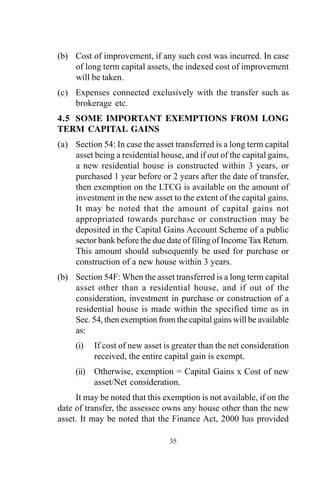
33
4.4 COMPUTATION OF CAPITAL GAINS (Sec.48)
Capital gain is computed by deducting from the full value of
consideration, for the transfer of a capital asset, the following:-
(a) Cost of acquisition of the asset(COA):- In case of Long Term
Capital Gains, the cost of acquisition is indexed by a factor
which is equal to the ratio of the cost inflation index of the
year of transfer to the cost inflation index of the year of
acquisition of the asset. Normally, the cost of acquisition is
the cost that a person has incurred to acquire the capital asset.
However, in certain cases, it is taken as following:
(i) When the capital asset becomes a property of an
assessee under a gift or will or by succession or
inheritance or on partition of Hindu Undivided Family or
on distribution of assets, or dissolution of a firm, or
liquidation of a company, the COA shall be the cost for
which the previous owner acquired it, as increased by
the cost of improvement till the date of acquisition of
the asset by the assessee.
(ii) When shares in an amalgamated Indian company had
become the property of the assessee in a scheme of
amalgamation, the COA shall be the cost of acquisition
of shares in the amalgamating company.
(iii) Where the capital asset is goodwill of a business, tenancy
right, stage carriage permits or loom hours the COA is
the purchase price paid, if any or else nil.
(iv) The COA of rights shares is the amount which is paid
by the subscriber to get them. In case of bonus shares,
the COA is nil.
(v) If a capital asset has become the property of the
assessee before 1.4.81, the assessee may choose either
the fair market value as on 1.4.81 or the actual cost of
acquisition of the asset as the COA.
34
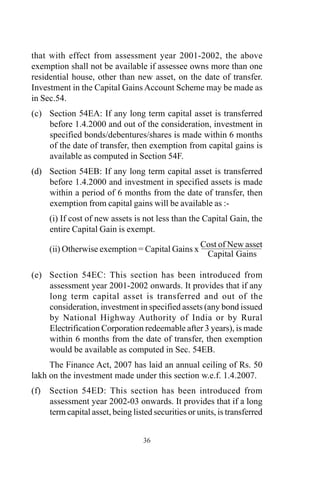
(b) Cost of improvement, if any such cost was incurred. In case
of long term capital assets, the indexed cost of improvement
will be taken.
(c) Expenses connected exclusively with the transfer such as
brokerage etc.
4.5 SOME IMPORTANT EXEMPTIONS FROM LONG
TERM CAPITAL GAINS
(a) Section 54: In case the asset transferred is a long term capital
asset being a residential house, and if out of the capital gains,
a new residential house is constructed within 3 years, or
purchased 1 year before or 2 years after the date of transfer,
then exemption on the LTCG is available on the amount of
investment in the new asset to the extent of the capital gains.
It may be noted that the amount of capital gains not
appropriated towards purchase or construction may be
deposited in the Capital Gains Account Scheme of a public
sector bank before the due date of filing of Income Tax Return.
This amount should subsequently be used for purchase or
construction of a new house within 3 years.
(b) Section 54F: When the asset transferred is a long term capital
asset other than a residential house, and if out of the
consideration, investment in purchase or construction of a
residential house is made within the specified time as in
Sec. 54, then exemption from the capital gains will be available
as:
(i) If cost of new asset is greater than the net consideration
received, the entire capital gain is exempt.
(ii) Otherwise, exemption = Capital Gains x Cost of new
asset/Net consideration.
It may be noted that this exemption is not available, if on the
date of transfer, the assessee owns any house other than the new
asset. It may be noted that the Finance Act, 2000 has provided
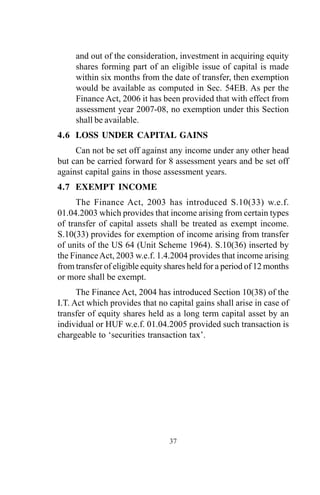
35
that with effect from assessment year 2001-2002, the above
exemption shall not be available if assessee owns more than one
residential house, other than new asset, on the date of transfer.
Investment in the Capital Gains Account Scheme may be made as
in Sec.54.
(c) Section 54EA: If any long term capital asset is transferred
before 1.4.2000 and out of the consideration, investment in
specified bonds/debentures/shares is made within 6 months
of the date of transfer, then exemption from capital gains is
available as computed in Section 54F.
(d) Section 54EB: If any long term capital asset is transferred
before 1.4.2000 and investment in specified assets is made
within a period of 6 months from the date of transfer, then
exemption from capital gains will be available as :-
(i) If cost of new assets is not less than the Capital Gain, the
entire Capital Gain is exempt.
(ii) Otherwise exemption = Capital Gains x
Cost of New asset
Capital Gains
(e) Section 54EC: This section has been introduced from
assessment year 2001-2002 onwards. It provides that if any
long term capital asset is transferred and out of the
consideration, investment in specified assets (any bond issued
by National Highway Authority of India or by Rural
Electrification Corporation redeemable after 3 years), is made
within 6 months from the date of transfer, then exemption
would be available as computed in Sec. 54EB.
The Finance Act, 2007 has laid an annual ceiling of Rs. 50
lakh on the investment made under this section w.e.f. 1.4.2007.
(f) Section 54ED: This section has been introduced from
assessment year 2002-03 onwards. It provides that if a long
term capital asset, being listed securities or units, is transferred
36
and out of the consideration, investment in acquiring equity
shares forming part of an eligible issue of capital is made
within six months from the date of transfer, then exemption
would be available as computed in Sec. 54EB. As per the
Finance Act, 2006 it has been provided that with effect from
assessment year 2007-08, no exemption under this Section
shall be available.
4.6 LOSS UNDER CAPITAL GAINS
Can not be set off against any income under any other head
but can be carried forward for 8 assessment years and be set off
against capital gains in those assessment years.
4.7 EXEMPT INCOME
The Finance Act, 2003 has introduced S.10(33) w.e.f.
01.04.2003 which provides that income arising from certain types
of transfer of capital assets shall be treated as exempt income.
S.10(33) provides for exemption of income arising from transfer
of units of the US 64 (Unit Scheme 1964). S.10(36) inserted by
the FinanceAct, 2003 w.e.f. 1.4.2004 provides that income arising
from transfer of eligible equity shares held for a period of 12 months
or more shall be exempt.
The Finance Act, 2004 has introduced Section 10(38) of the
I.T. Act which provides that no capital gains shall arise in case of
transfer of equity shares held as a long term capital asset by an
individual or HUF w.e.f. 01.04.2005 provided such transaction is
chargeable to ‘securities transaction tax’.
37
38
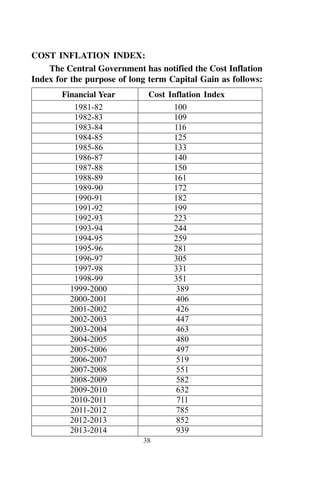
COST INFLATION INDEX:
The Central Government has notified the Cost Inflation
Index for the purpose of long term Capital Gain as follows:
Financial Year Cost Inflation Index
1981-82 100
1982-83 109
1983-84 116
1984-85 125
1985-86 133
1986-87 140
1987-88 150
1988-89 161
1989-90 172
1990-91 182
1991-92 199
1992-93 223
1993-94 244
1994-95 259
1995-96 281
1996-97 305
1997-98 331
1998-99 351
1999-2000 389
2000-2001 406
2001-2002 426
2002-2003 447
2003-2004 463
2004-2005 480
2005-2006 497
2006-2007 519
2007-2008 551
2008-2009 582
2009-2010 632
2010-2011 711
2011-2012 785
2012-2013 852
2013-2014 939
39
CHAPTER-5
DEDUCTIONSUNDERCHAPTER-VIA
5.1 INTRODUCTION
The Income Tax Act provides that on determination of the
gross total income of an assessee after considering income from
all the heads, certain deductions therefrom may be allowed. These
deductions detailed in chapter VIA of the Income Tax Act must
be distinguished from the exemptions provides in Section 10 of the
Act. While the former are to be reduced from the gross total income,
the latter do not form part of the income at all.
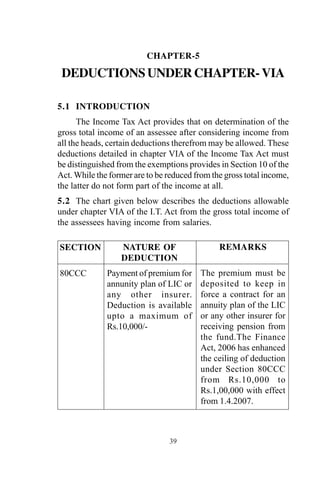
5.2 The chart given below describes the deductions allowable
under chapter VIA of the I.T. Act from the gross total income of
the assessees having income from salaries.
SECTION
80CCC
NATURE OF
DEDUCTION
Payment of premium for
annunity plan of LIC or
any other insurer.
Deduction is available
upto a maximum of
Rs.10,000/-
REMARKS
The premium must be
deposited to keep in
force a contract for an
annuity plan of the LIC
or any other insurer for
receiving pension from
the fund.The Finance
Act, 2006 has enhanced
the ceiling of deduction
under Section 80CCC
from Rs.10,000 to
Rs.1,00,000 with effect
from 1.4.2007.
40
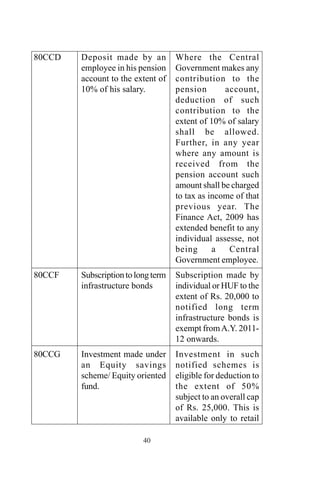
80CCD
80CCF
80CCG
Deposit made by an
employee in his pension
account to the extent of
10% of his salary.
Subscriptiontolongterm
infrastructure bonds
Investment made under
an Equity savings
scheme/ Equity oriented
fund.
Where the Central
Government makes any
contribution to the
pension account,
deduction of such
contribution to the
extent of 10% of salary
shall be allowed.
Further, in any year
where any amount is
received from the
pension account such
amount shall be charged
to tax as income of that
previous year. The
Finance Act, 2009 has
extended benefit to any
individual assesse, not
being a Central
Government employee.
Subscription made by
individual or HUF to the
extent of Rs. 20,000 to
notified long term
infrastructure bonds is
exempt fromA.Y. 2011-
12 onwards.
Investment in such
notified schemes is
eligible for deduction to
the extent of 50%
subject to an overall cap
of Rs. 25,000. This is
available only to retail
41
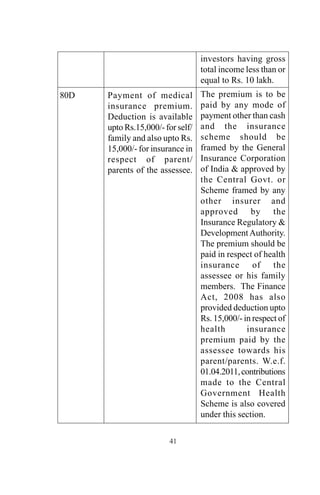
investors having gross
total income less than or
equal to Rs. 10 lakh.
The premium is to be
paid by any mode of
payment other than cash
and the insurance
scheme should be
framed by the General
Insurance Corporation
of India & approved by
the Central Govt. or
Scheme framed by any
other insurer and
approved by the
Insurance Regulatory &
DevelopmentAuthority.
The premium should be
paid in respect of health
insurance of the
assessee or his family
members. The Finance
Act, 2008 has also
provided deduction upto
Rs. 15,000/- in respect of
health insurance
premium paid by the
assessee towards his
parent/parents. W.e.f.
01.04.2011,contributions
made to the Central
Government Health
Scheme is also covered
under this section.
80D Payment of medical
insurance premium.
Deduction is available
upto Rs.15,000/- for self/
family and also upto Rs.
15,000/- for insurance in
respect of parent/
parents of the assessee.
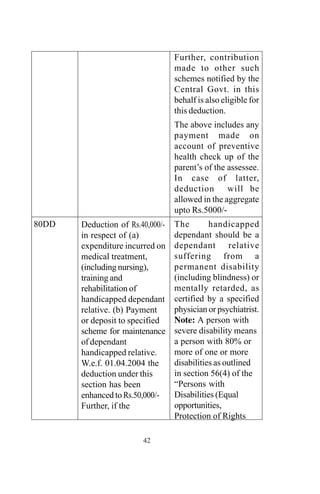
42
Deduction of Rs.40,000/-
in respect of (a)
expenditure incurred on
medical treatment,
(including nursing),
training and
rehabilitation of
handicapped dependant
relative. (b) Payment
or deposit to specified
scheme for maintenance
of dependant
handicapped relative.
W.e.f. 01.04.2004 the
deduction under this
section has been
enhanced to Rs.50,000/-
Further, if the
Further, contribution
made to other such
schemes notified by the
Central Govt. in this
behalf is also eligible for
this deduction.
The above includes any
payment made on
account of preventive
health check up of the
parent’s of the assessee.
In case of latter,
deduction will be
allowed in the aggregate
upto Rs.5000/-
The handicapped
dependant should be a
dependant relative
suffering from a
permanent disability
(including blindness) or
mentally retarded, as
certified by a specified
physician or psychiatrist.
Note: A person with
severe disability means
a person with 80% or
more of one or more
disabilities as outlined
in section 56(4) of the
“Persons with
Disabilities (Equal
opportunities,
Protection of Rights
80DD
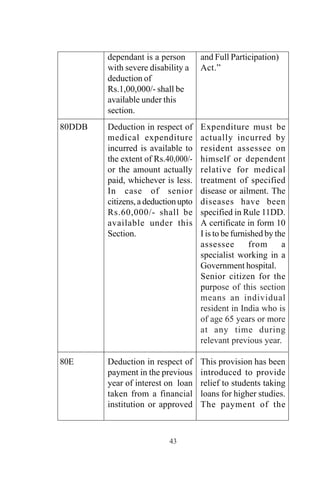
43
and Full Participation)
Act.”
Expenditure must be
actually incurred by
resident assessee on
himself or dependent
relative for medical
treatment of specified
disease or ailment. The
diseases have been
specified in Rule 11DD.
A certificate in form 10
I is to be furnished by the
assessee from a
specialist working in a
Government hospital.
Senior citizen for the
purpose of this section
means an individual
resident in India who is
of age 65 years or more
at any time during
relevant previous year.
This provision has been
introduced to provide
relief to students taking
loans for higher studies.
The payment of the
dependant is a person
with severe disability a
deduction of
Rs.1,00,000/- shall be
available under this
section.
Deduction in respect of
medical expenditure
incurred is available to
the extent of Rs.40,000/-
or the amount actually
paid, whichever is less.
In case of senior
citizens,adeductionupto
Rs.60,000/- shall be
available under this
Section.
Deduction in respect of
payment in the previous
year of interest on loan
taken from a financial
institution or approved
80DDB
80E
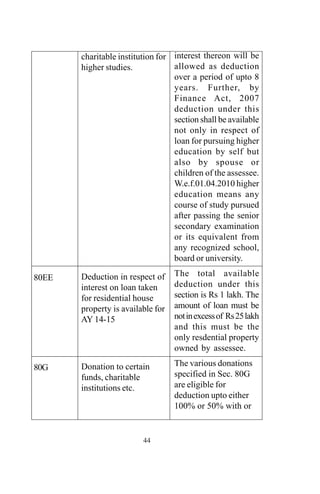
44
80EE
80G
charitable institution for
higher studies.
Deduction in respect of
interest on loan taken
for residential house
property is available for
AY 14-15
Donation to certain
funds, charitable
institutions etc.
interest thereon will be
allowed as deduction
over a period of upto 8
years. Further, by
Finance Act, 2007
deduction under this
section shall be available
not only in respect of
loan for pursuing higher
education by self but
also by spouse or
children of the assessee.
W.e.f.01.04.2010 higher
education means any
course of study pursued
after passing the senior
secondary examination
or its equivalent from
any recognized school,
board or university.
The total available
deduction under this
section is Rs 1 lakh. The
amount of loan must be
notinexcessof Rs25lakh
and this must be the
only resdential property
owned by assessee.
The various donations
specified in Sec. 80G
are eligible for
deduction upto either
100% or 50% with or
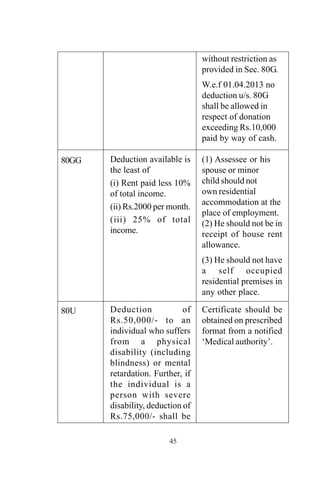
45
80GG
80U
Deduction available is
the least of
(i) Rent paid less 10%
of total income.
(ii) Rs.2000 per month.
(iii) 25% of total
income.
Deduction of
Rs.50,000/- to an
individual who suffers
from a physical
disability (including
blindness) or mental
retardation. Further, if
the individual is a
person with severe
disability, deduction of
Rs.75,000/- shall be
without restriction as
provided in Sec. 80G.
W.e.f 01.04.2013 no
deduction u/s. 80G
shall be allowed in
respect of donation
exceeding Rs.10,000
paid by way of cash.
(1) Assessee or his
spouse or minor
child should not
own residential
accommodation at the
place of employment.
(2) He should not be in
receipt of house rent
allowance.
(3) He should not have
a self occupied
residential premises in
any other place.
Certificate should be
obtained on prescribed
format from a notified
‘Medical authority’.
46
80RRB
80QQB
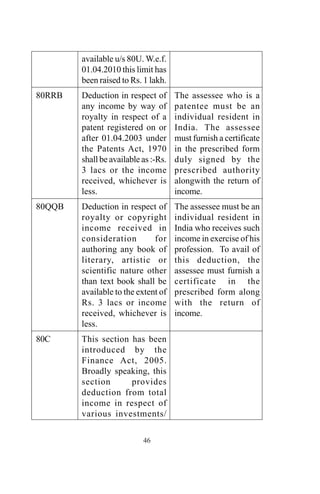
80C
available u/s 80U. W.e.f.
01.04.2010 this limit has
been raised to Rs. 1 lakh.
Deduction in respect of
any income by way of
royalty in respect of a
patent registered on or
after 01.04.2003 under
the Patents Act, 1970
shall be available as :-Rs.
3 lacs or the income
received, whichever is
less.
Deduction in respect of
royalty or copyright
income received in
consideration for
authoring any book of
literary, artistic or
scientific nature other
than text book shall be
available to the extent of
Rs. 3 lacs or income
received, whichever is
less.
This section has been
introduced by the
Finance Act, 2005.
Broadly speaking, this
section provides
deduction from total
income in respect of
various investments/
The assessee who is a
patentee must be an
individual resident in
India. The assessee
must furnish a certificate
in the prescribed form
duly signed by the
prescribed authority
alongwith the return of
income.
The assessee must be an
individual resident in
India who receives such
income in exercise of his
profession. To avail of
this deduction, the
assessee must furnish a
certificate in the
prescribed form along
with the return of
income.
47
expenditures/payments
in respect of which tax
rebate u/s 88 was
earlier available. The
total deduction under
this section is limited to
Rs.1 lakh only.
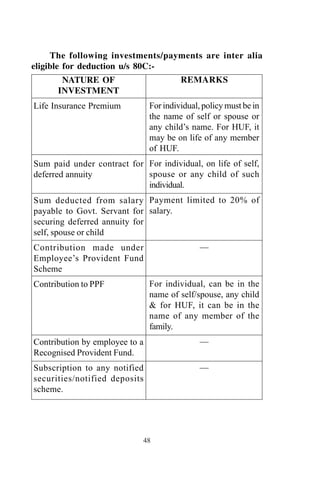
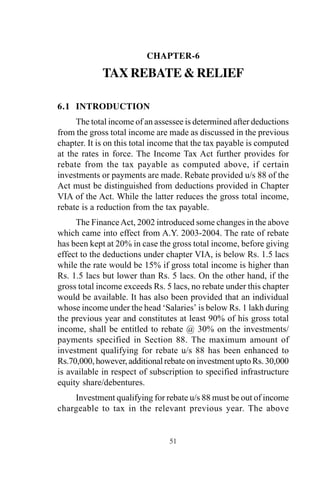
The following investments/payments are inter alia
eligible for deduction u/s 80C:-
NATURE OF
INVESTMENT
Life Insurance Premium
Sum paid under contract for
deferred annuity
Sum deducted from salary
payable to Govt. Servant for
securing deferred annuity for
self, spouse or child
Contribution made under
Employee’s Provident Fund
Scheme
Contribution to PPF
Contribution by employee to a
Recognised Provident Fund.
Subscription to any notified
securities/notified deposits
scheme.
REMARKS
For individual, policy must be in
the name of self or spouse or
any child’s name. For HUF, it
may be on life of any member
of HUF.
For individual, on life of self,
spouse or any child of such
individual.
Payment limited to 20% of
salary.
—
For individual, can be in the
name of self/spouse, any child
& for HUF, it can be in the
name of any member of the
family.
—
—
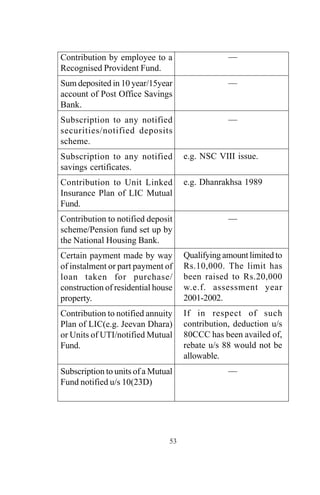
48
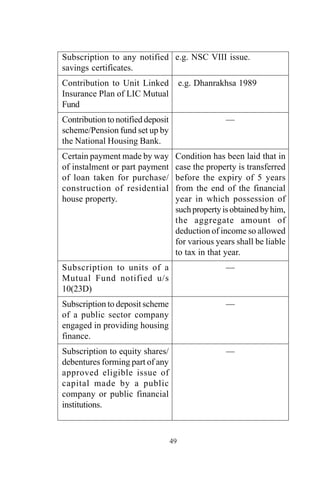
Subscription to any notified
savings certificates.
Contribution to Unit Linked
Insurance Plan of LIC Mutual
Fund
Contribution to notified deposit
scheme/Pension fund set up by
the National Housing Bank.
Certain payment made by way
of instalment or part payment
of loan taken for purchase/
construction of residential
house property.
Subscription to units of a
Mutual Fund notified u/s
10(23D)
Subscription to deposit scheme
of a public sector company
engaged in providing housing
finance.
Subscription to equity shares/
debentures forming part of any
approved eligible issue of
capital made by a public
company or public financial
institutions.
e.g. NSC VIII issue.
e.g. Dhanrakhsa 1989
—
Condition has been laid that in
case the property is transferred
before the expiry of 5 years
from the end of the financial
year in which possession of
suchpropertyisobtainedbyhim,
the aggregate amount of
deduction of income so allowed
for various years shall be liable
to tax in that year.
—
—
—
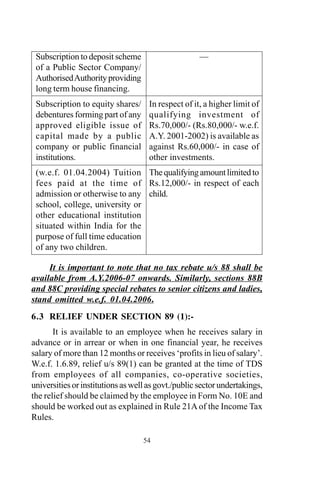
49
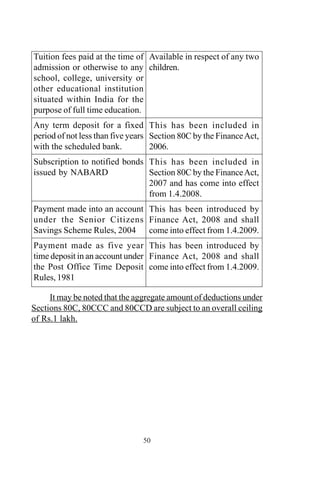
Tuition fees paid at the time of
admission or otherwise to any
school, college, university or
other educational institution
situated within India for the
purpose of full time education.
Any term deposit for a fixed
period of not less than five years
with the scheduled bank.
Subscription to notified bonds
issued by NABARD
Payment made into an account
under the Senior Citizens
Savings Scheme Rules, 2004
Payment made as five year
time deposit in an account under
the Post Office Time Deposit
Rules, 1981
Available in respect of any two
children.
This has been included in
Section 80C by the FinanceAct,
2006.
This has been included in
Section 80C by the FinanceAct,
2007 and has come into effect
from 1.4.2008.
This has been introduced by
Finance Act, 2008 and shall
come into effect from 1.4.2009.
This has been introduced by
Finance Act, 2008 and shall
come into effect from 1.4.2009.
It may be noted that the aggregate amount of deductions under
Sections 80C, 80CCC and 80CCD are subject to an overall ceiling
of Rs.1 lakh.
50
51
CHAPTER-6
TAX REBATE & RELIEF
6.1 INTRODUCTION
The total income of an assessee is determined after deductions
from the gross total income are made as discussed in the previous
chapter. It is on this total income that the tax payable is computed
at the rates in force. The Income Tax Act further provides for
rebate from the tax payable as computed above, if certain
investments or payments are made. Rebate provided u/s 88 of the
Act must be distinguished from deductions provided in Chapter
VIA of the Act. While the latter reduces the gross total income,
rebate is a reduction from the tax payable.
The FinanceAct, 2002 introduced some changes in the above
which came into effect from A.Y. 2003-2004. The rate of rebate
has been kept at 20% in case the gross total income, before giving
effect to the deductions under chapter VIA, is below Rs. 1.5 lacs
while the rate would be 15% if gross total income is higher than
Rs. 1.5 lacs but lower than Rs. 5 lacs. On the other hand, if the
gross total income exceeds Rs. 5 lacs, no rebate under this chapter
would be available. It has also been provided that an individual
whose income under the head ‘Salaries’ is below Rs. 1 lakh during
the previous year and constitutes at least 90% of his gross total
income, shall be entitled to rebate @ 30% on the investments/
payments specified in Section 88. The maximum amount of
investment qualifying for rebate u/s 88 has been enhanced to
Rs.70,000, however, additional rebate on investment upto Rs. 30,000
is available in respect of subscription to specified infrastructure
equity share/debentures.
Investment qualifying for rebate u/s 88 must be out of income
chargeable to tax in the relevant previous year. The above
52
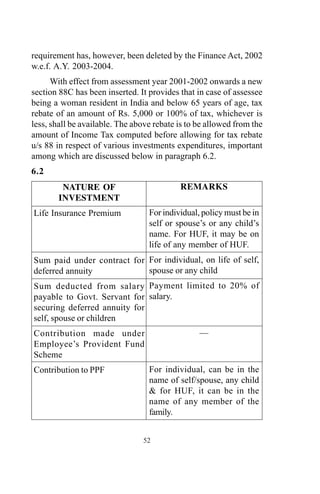
NATURE OF
INVESTMENT
Life Insurance Premium
Sum paid under contract for
deferred annuity
Sum deducted from salary
payable to Govt. Servant for
securing deferred annuity for
self, spouse or children
Contribution made under
Employee’s Provident Fund
Scheme
Contribution to PPF
REMARKS
For individual, policy must be in
self or spouse’s or any child’s
name. For HUF, it may be on
life of any member of HUF.
For individual, on life of self,
spouse or any child
Payment limited to 20% of
salary.
—
For individual, can be in the
name of self/spouse, any child
& for HUF, it can be in the
name of any member of the
family.
requirement has, however, been deleted by the Finance Act, 2002
w.e.f. A.Y. 2003-2004.
With effect from assessment year 2001-2002 onwards a new
section 88C has been inserted. It provides that in case of assessee
being a woman resident in India and below 65 years of age, tax
rebate of an amount of Rs. 5,000 or 100% of tax, whichever is
less, shall be available. The above rebate is to be allowed from the
amount of Income Tax computed before allowing for tax rebate
u/s 88 in respect of various investments expenditures, important
among which are discussed below in paragraph 6.2.
6.2
53
Contribution by employee to a
Recognised Provident Fund.
Sum deposited in 10 year/15year
account of Post Office Savings
Bank.
Subscription to any notified
securities/notified deposits
scheme.
Subscription to any notified
savings certificates.
Contribution to Unit Linked
Insurance Plan of LIC Mutual
Fund.
Contribution to notified deposit
scheme/Pension fund set up by
the National Housing Bank.
Certain payment made by way
of instalment or part payment of
loan taken for purchase/
construction of residential house
property.
Contribution to notified annuity
Plan of LIC(e.g. Jeevan Dhara)
or Units of UTI/notified Mutual
Fund.
Subscription to units of a Mutual
Fund notified u/s 10(23D)
—
—
—
e.g. NSC VIII issue.
e.g. Dhanrakhsa 1989
—
Qualifying amount limited to
Rs.10,000. The limit has
been raised to Rs.20,000
w.e.f. assessment year
2001-2002.
If in respect of such
contribution, deduction u/s
80CCC has been availed of,
rebate u/s 88 would not be
allowable.
—
54
Subscription to deposit scheme
of a Public Sector Company/
AuthorisedAuthorityproviding
long term house financing.
Subscription to equity shares/
debentures forming part of any
approved eligible issue of
capital made by a public
company or public financial
institutions.
(w.e.f. 01.04.2004) Tuition
fees paid at the time of
admission or otherwise to any
school, college, university or
other educational institution
situated within India for the
purpose of full time education
of any two children.
—
In respect of it, a higher limit of
qualifying investment of
Rs.70,000/- (Rs.80,000/- w.e.f.
A.Y. 2001-2002) is available as
against Rs.60,000/- in case of
other investments.
Thequalifyingamountlimitedto
Rs.12,000/- in respect of each
child.
It is important to note that no tax rebate u/s 88 shall be
available from A.Y.2006-07 onwards. Similarly, sections 88B
and 88C providing special rebates to senior citizens and ladies,
stand omitted w.e.f. 01.04.2006.
6.3 RELIEF UNDER SECTION 89 (1):-
It is available to an employee when he receives salary in
advance or in arrear or when in one financial year, he receives
salary of more than 12 months or receives ‘profits in lieu of salary’.
W.e.f. 1.6.89, relief u/s 89(1) can be granted at the time of TDS
from employees of all companies, co-operative societies,
universitiesorinstitutionsaswellasgovt./publicsectorundertakings,
the relief should be claimed by the employee in Form No. 10E and
should be worked out as explained in Rule 21Aof the Income Tax
Rules.
55
CHAPTER-7
PERMANENTACCOUNTNUMBER
7.1 WHAT IS P.A.N.
P.A.N. or Permanent Account Number is a number allotted
to a person by the Assessing Officer for the purpose of
identification. P.A.N. of the new series has 10 alphanumeric
characters and is issued in the form of laminated card.
7.2 WHO SHALL APPLY FOR P.A.N.
Section 139A of the Income Tax Act provides that every
person whose total income exceeds the maximum amount not
chargeable to tax or every person who carries on any business or
profession whose total turnover or gross receipts exceed Rs.5 lakhs
in any previous year or any person required to file a return of
income u/s 139(4A) shall apply for PAN. Besides, any person not
fulfilling the above conditions may also apply for allotment of PAN.
With effect from 01.06.2000, the Central Government may by
notification specify any class/classes of person including importers
and exporters, whether or not any tax is payable by them, and
such persons shall also then apply to the Assessing Officer for
allotment of PAN.
W.e.f. 01.04.2006 a person liable to furnish a return of fringe
benefits under the newly introduced section 115WD of the I.T.
Act is also required to apply for allotment of PAN. Of course, if
such a person already has been allotted a PAN he shall not be
required to obtain another PAN.
The Finance Act, 2006 has provided that for the purpose of
collecting any information, the Central Govt. may by way of
notification specify any class or classes of persons for allotment
of PAN and such persons shall apply to the Assessing Officer
within the prescribed time. Provision for Suo moto allotment of
PAN has also been introduced w.e.f.1.6.2006 as per which the
assessing officer may allot a PermanentAccount No. to any person
whether or not any tax is payable by him having regard to the
nature of transactions.
7.3 TRANSACTIONS IN WHICH QUOTING OF PAN IS
MANDATORY
Purchase and sale of immovable property.
Purchase and sale of motor vehicles.
Transaction in shares exceeding Rs.50,000.
Opening of new bank accounts.
Fixed deposits of more than Rs.50,000.
Application for allotment of telephone connections.
Payment to hotels exceeding Rs.25,000.
Provided that till such time PAN is allotted to a person, he
may quote his General Index register Number or GIR No.
7.4 HOW TO APPLY FOR PAN
Application for allotment of PAN is to be made in Form 49A.
Following points must be noted while filling the above form:-
i) Application Form must be typewritten or handwritten in black
ink in BLOCK LETTERS.
ii) Two black & white photographs are to be annexed.
iii) While selecting the “Address for Communication”, due care
should be exercised as all communications thereafter would
be sent at indicated address.
iv) In the space given for “Father’s Name”, only the father’s
name should be given. Married ladies may note that husband’s
name is not required and should not be given.
v) Due care should be exercised to fill the correct date of birth.
vi) The form should be signed in English or any of the Indian
Languages in the 2 specified places. In case of thumb
impressions attestation by a Gazetted Officer is necessary.
56
57
CHAPTER-8
TAXABILITYOF
RETIREMENTBENEFITS
8.1 INTRODUCTION
On retirement, an employee normally receives certain
retirement benefits. Such benefits are taxable under the head
‘Salaries’ as “profits in lieu of Salaries” as provided in Section
17(3). However, in respect of some of them, exemption from
taxation is granted u/s 10 of the Income Tax Act, either wholly or
partly. These exemptions are described below:-
8.2 GRATUITY (Sec. 10(10)):
(i) Any death cum retirement gratuity received by Central and
State Govt. employees, Defence employees and employees
in Local authority shall be exempt.
(ii) Any gratuity received by persons covered under the Payment
of Gratuity Act, 1972 shall be exempt subject to following
limits:-
(a) For every completed year of service or part thereof,
gratuity shall be exempt to the extent of fifteen days
Salary based on the rate of Salary last drawn by the
concerned employee.
(b) The amount of gratuity as calculated above shall not
exceed Rs.3,50,000(w.e.f.24.9.97).
(iii) In case of any other employee, gratuity received shall be
exempt subject to the following limits:-
(a) Exemption shall be limited to half month salary (based
on last 10 months average) for each completed year of
service.
(b) Rs.3.5 Lakhs whichever is less.
Where the gratuity was received in any one or more earlier
previous years also and any exemption was allowed for the same,
then the exemption to be allowed during the year gets reduced to
the extent of exemption already allowed, the overall limit being
Rs. 3.5 Lakhs.
As per Board’s letter F.No. 194/6/73-IT(A-1) dated 19.6.73,
exemption in respect of gratuity is permissible even in cases of
termination of employment due to resignation. The taxable portion
of gratuity will quality for relief u/s 89(1).
Gratuity payment to a widow or other legal heirs of any
employee who dies in active service shall be exempt from income
tax(Circular No. 573 dated 21.8.90). Payment of Gratuity
(Amendment) Bill, 2010 has proposed to increase the limit to
Rs. 10,00,000.
8.3 COMMUTATION OF PENSION (SECTION 10(10A)):
(i) In case of employees of Central & State Govt. Local
Authority, Defence Services and Corporation established
under Central or State Acts, the entire commuted value of
pension is exempt.
(ii) In case of any other employee, if the employee receives
gratuity, the commuted value of 1/3 of the pension is
exempt, otherwise, the commuted value of ½ of the pension
is exempt.
Judges of S.C. & H.C. shall be entitled to exemption of
commuted value upto ½ of the pension (Circular No. 623 dated
6.1.1992).
8.4 LEAVE ENCASHMENT (Section 10(10AA)):
(i) Leave Encashment during service is fully taxable in all
cases, relief u/s 89(1) if applicable may be claimed for
the same.
58
59
(ii) Any payment by way of leave encashment received by Central
& State Govt. employees at the time of retirement in respect
of the period of earned leave at credit is fully exempt.
(iii) In case of other employees, the exemption is to be limited to
the least of following: (a) Cash equivalent of unutilized earned
leave (earned leave entitlement can not exceed 30 days for
every year of actual service) (b) 10 months average salary.
(c) Leave encashment actually received. This is further
subject to a limit of Rs.3,00,000 for retirements after
02.04.1998.
(iv) Leave salary paid to legal heirs of a deceased employee in
respect of privilege leave standing to the credit of such
employee at the time of death is not taxable.
For the purpose of Section 10(10AA), the term
‘Superannuation or otherwise’ covers resignation (CIT Vs. R.V.
Shahney 159 ITR 160(Madras).
8.5 RETRENCHMENT COMPENSATION (Sec.
10(10B)):
Retrenchment compensation received by a workman under
the Industrial Disputes Act, 1947 or any other Act or Rules is
exempt subject to following limits:-
(i) Compensation calculated @ fifteen days average pay for
every completed year of continuous service or part thereof
in excess of 6 months.
(ii) The above is further subject to an overall limit of Rs.5,00,000
for retrenchment on or after 1.1.1997 (Notification No. 10969
dated 25.6.99).
8.6 COMPENSATION ON VOLUNTARY RETIREMENT
OR ‘GOLDEN HANDSHAKE’(Sec. 10(10C)):
(i) Payment received by an employee of the following at the
time of voluntary retirement, or termination of service is exempt
to the extent of Rs. 5 Lakh:
(a) Public Sector Company.
(b) Any other company.
(c) Authority established under State, Central or Provincial
Act.
(d) LocalAuthority.
(e) Co-operative Societies, Universities, IITs and Notified
Institutes of Management.
(f) Any State Government or the Central Government.
(ii) The voluntary retirement Scheme under which the payment
is being made must be framed in accordance with the
guidelines prescribed in Rule 2BAof Income Tax Rules. In
case of a company other than a public sector company and a
co-operative society, such scheme must be approved by the
Chief Commissioner/Director General of Income-tax.
However, such approval is not necessary from A.Y. 2001-
2002 onwards.
(iii) Where exemption has been allowed under above section for
anyAssessment year, no exemption shall be allowed in relation
to any other Assessment year. Further, where any relief u/s
89 for anyAssessment year in respect of any amount received
or receivable or voluntary retirement or termination of service
has been allowed, no exemption under this clause shall be
allowed for any Assessment year.
8.7 PAYMENT FROM PROVIDENT FUND (Sec. 10(11),
Sec. 10(12)):
Any payment received from a Provident Fund, (i.e. to which
the Provident Fund Act, 1925 applies) is exempt. Any payment
from any other provident fund notified by the Central Govt. is also
exempt. The Public Provident Fund(PPF) established under the
PPF Scheme, 1968 has been notified for this purpose. Besides the
above, the accumulated balance due and becoming payable to an
60
61
employee participating in a Recognised Provident Fund is also
exempt to the extent provided in Rule 8 of Part A of the Fourth
Schedule of the Income Tax Act.
8.8 PAYMENT FROM APPROVED SUPERANNUATION
FUND (Sec.10(13)):
Payment from an Approved Superannuation Fund will be
exempt provided the payment is made in the circumstances
specified in the section viz. death, retirement and incapacitation.
8.9 DEPOSIT SCHEME FOR RETIRED GOVT/PUBLIC
SECTOR COMPANY EMPLOYEES:
Section 10(15) of the Income Tax Act incorporates a number
of investments, the interest from which is totally exempt from
taxation. These investments may be considered as one of the
options for investing various benefits received on retirement. One
among them, notified u/s 10(15)(iv)(i), is the DEPOSIT SCHEME
FOR RETIRED GOVT/PUBLIC SECTOR COMPANY
EMPLOYEES which is a particularly attractive option for retiring
employees of Govt. and Public Sector Companies. W.e.f.
assessment year 1990-91, the interest on deposits made under this
scheme by an employee of Central/State Govt. out of the various
retirement benefits received is exempt from Income-tax. This
exemption was subsequently extended to employees of Public Sector
companies from assessment year 1991-92 vide notification No. 2/
19/89-NS-II dated 12.12.1990. Salient features of the scheme are
discussed below:
Rate of Return Tax free interest @ 9% P.A. payable
half
yearly on 30th June and 31st
December
Limit of Investment Minimum Rs.1000.
Maximum not exceeding the total
retirement benefits.
Liquidity Entire balance can be withdrawn after
expiry of 3 years from the date of
deposit. Premature encashment can be,
made after one year from the date of
deposit in which case interest on amount
withdrawn will be payable @ 4% from
the date of deposit to the date of
withdrawal.
Other considerations: Only 1 account can be opened in own
name or jointly with spouse. Account is
to be opened within 3 months of
receiving retirement benefits. Scheme is
operated through branches of SBI and
its subsidiaries and selected branches of
nationalised banks.
[This scheme has been discontinued w.e.f. 10.07.2004 vide
notification F. No.15-01/2004-NS-2, dated 09.07.2004.]
62
63
CHAPTER-9
PENSIONERS&SENIORCITIZENS
9.1 PENSION
Pension is described in section 60 of the CPC and section 11
of the PensionAct as a periodical allowance or stipend granted on
account of past service, particular merits etc. Thus monthly
allowance to the younger brother of a ruler was treated as a
maintenance allowance and not pension (Raj Kumar Bikram
Bahadur Singh Vs. CIT 75 ITR 227(MP)). There are three
important features of ‘pension’. Firstly, pension is a compensation
for past service. Secondly, it owes its origin to a past employer-
employee or master-servant relationship. Thirdly, it is paid on the
basis of earlier relationship of an agreement of service as opposed
to an agreement for service. This relationship terminates only on
the death of the concerned employee.
Pension received from a former employer is taxable as
‘Salary’. Hence, the various deductions available on salary income,
including relief u/s 89(1) for the arrears of pension received would
be granted to pensioners who received their pension from, a
nationalised bank and in other cases their present Drawing &
Disbursing Officers. Similarly, deductions from the amount of
pension of standard deduction and adjustment of tax rebate u/s 88
and 88B shall be done by the concerned bank, at the time of
deduction of tax at source from the pension, on furnishing of
relevant details by the pensioner. Instructions in above regard were
issued by R.B.I.’s Pension Circular (Central Service No. 7/C D.R./
1992(Ref. No. DGBA:GA(NBS) No. 60/GA64-(II CVL-91-92
dated 27.4.92).
Pension to officials of UNO is exempt from taxation. Section
2 of the UN (Privilege & Immunities) Act, 1947 grants tax
exemption to salaries/emoluments paid by U.N. The Karnataka
High Court had held that u/s 17 of the Income Tax Act, salary has
been defined as including pension, therefore, if salary received
from U.N. is exempt, so shall be the pension. This decision was
accepted by the CBDT vide circular No. 293 dated 10.02.1981.
9.2 FAMILY PENSION
Family pension is defined in Section 57 as a regular monthly
amount payable by the employer to a person belonging to the family
of an employee in the event of death. Pension and family pension
are qualitatively different. The former is paid during the lifetime of
the employee while the latter is paid on his death to surviving family
members. However, in case of family pension, since there is no
employer-employee relationship between the payer and the payee,
therefore, it is taxed as ‘Income from Other Sources’ in the hands
of the nominee(s). In respect of family pension, deduction u/s 57(iia)
of Rs.15,000 or 1/3rd of the amount received, whichever is less, is
available.
9.3 SENIOR CITIZEN
Under the Income Tax Act, a senior citizen is a person who
at any time during the previous year has attained the age of 65
years or more. There are certain benefits available to senior citizen
under the Income Tax Act:-
(i) Special rates of Income tax for senior citizens :As elaborated
in chapter 1 (para 1.5) special rates of Income tax are
available for senior and very senior citizens.
(ii) Benefits provided by Finance Act, 2007: The deduction
available u/s 80D for medical insurance premium paid is to
be increased to Rs.20,000 for senior citizens. Secondly, the
deduction available u/s 80DDB in respect of expenditure
incurred on treatment of specified diseases is to be increased
to Rs.60,000 for senior citizens. Deduction u/s 80D is also
available w.e.f. 01.04.2013 (A.Y.2013-14) onwards in respect
64
65
of payment made towards preventive health of the parents
of the assessee.
(iii) In order to resolve the tax issues arising out of the
reverse mortgage scheme introduced by the National
Housing Bank (NHB), the Finance Act 2008 has added
a new clause (xvi) in Section 47 of the I.T. Act which
provides that any transfer of a capital asset in a
transaction of reverse mortgage under a notified
scheme shall not be regarded as a transfer and shall,
therefore, not attract capital gains tax. This ensures
that the intention of a reverse mortgage which is to
secure a stream of cash flow against the mortgage is
not contradicted by treating the same as transfer.
The second issue is whether the loan, either in lump
sum or in instalments, received under a reverse mortgage
scheme amounts to income. Receipt of such loan is in the
nature of a capital receipt. However, with a view to providing
certainty in the tax regime pertaining to the senior citizens,
the Finance Act, 2008 has amended section 10 of the Income
Tax Act to provide that such loan amounts will be exempt
from income tax.
Consequent to these amendments, a borrower, under
a reverse mortgage scheme, will be liable to income tax (in
the nature of tax on capital gains) only at the point of
alienation of the mortgaged property by the mortgagee for
the purposes of recovering the loan.
These amendments will take effect from the 1st
day of
April, 2008 and will accordingly apply in relation to
Assessment year 2008-09 and subsequent Assessment
years.
CHAPTER-10
TAXATIONOFEXPATRIATES
10.1 INTRODUCTION
With the globalisation of the world trade and liberalisation of
the Indian economy, the number of persons moving in or out of
India in the exercise of their business, profession or employment is
on the increase. A brief discussion of the taxation of these
expatriates is being attempted below:
10.2 RESIDENTIAL STATUS
As in most of the countries, the liability under the Indian
Income tax law is also co-related to the residential status of the
concerned tax payer. Section 6 of the Indian Income-Tax Act
creates 3 categories as far as residential status is concerned.
10.2.1 Resident An Individual is said to be resident in
India in any previous year if he is in India
for at least 182 days in that year or during
that year he is in India for a period of at
least 60 days & has been in India for at
least 365 days during the 4 years
preceding that year. However, the period
of 60 days referred to above is increased
to 182 days in case of Indian citizens
who leave India as members of the crew
of an Indian Ship or for Indian citizens
or persons of Indian origin who, being
outside India, come to visit India in any
previous year.
10.2.2 Non- Resident A person who is not a resident in terms
of the above provisions is a non-resident.
66
10.2.3 Resident but A person who is otherwise resident as
Not Ordinarily defined in para 10.2.1 would be RNOR
Resident (RNOR) if he satisfies any of the following two
conditions:
(i) He has not been resident in India in 9
out of 10 preceding previous years.
or
(ii) He has not been in India for an aggregate
period of 730 days or more in the
preceding 7 previous years.
W.e.f. 01.04.2004, the status ‘RNOR’
has been redefined as follows:-
An individual shall be said to be RNOR
if he has been a non-resident in India in
9 out of 10 previous years preceding or
period amounting to 729 days or less
during the 7 previous years preceding
that year.
10.3 SCOPE OF TAXATION:
Based on the residential status of payer, his tax liability will
be as follows:-
Residential status Taxability of Income
(i) Resident All income of the previous year wherever
accruing or arising or received by him
including incomes deemed to have accrued
or arisen.
(ii) Non-Resident All income accruing, arising to or deemed
to have accrued or arisen or received in
India.
67
(iii) Resident but All Income accruing or arising or deemed
not ordinary to have accrued or arisen or received in
Resident India. Moreover, all income earned outside
India will also be included if the same is
derived from a business or profession
controlled or set up in India.
10.4 EXPATRIATES WORKING IN INDIA
In case of foreign expatriate working in India, the
remuneration received by him, assessable under the head ‘Salaries’,
is deemed to be earned in India if it is payable to him for service
rendered in India as provided in Section 9(1)(ii) of the Income Tax
Act. The explanation to the aforesaid law clarifies that income in
the nature of salaries payable for services rendered in India shall
be regarded as income earned in India. Further, from assessment
year 2000-2001 onwards income payable for the leave period which
is preceded and succeeded by services rendered in India and forms
part of the service contract shall also be regarded as income earned
in India. Thus, irrespective of the residential status of the expatriate
employee, the amount received by him as salary for services
rendered in India shall be liable to tax in India being income accruing
or arising in India, regardless of the place where the salary is actually
received. However, there are certain exceptions to the rule which
are briefly discussed below:-
10.4.1 Remuneration of an employee of a foreign enterprise is
exempt from tax if his stay in India is less than 90 days
in aggregate during the financial year [Sec.10(6)(vi)].
This is subject to further relaxation under the provisions
of Double Taxation Avoidance Agreement entered into
by India with the respective country.
10.4.2 Remuneration received by a foreign expatriate as an
official of an embassy or high commission or consulate
or trade representative of a foreign state is exempt on
reciprocal basis [Sec.10(6)(ii)].
68
10.4.3 Remuneration from employment on a foreign ship
provided the stay of the employee does not exceed 90
days in the financial year [Sec. 10(6)(viii)].
10.4.4 Training stipends received from foreign government
(Sec.10(6)(xi)).
10.4.5 Remuneration under co-operative technical assistance
programme or technical assistance grants agreements
(Sec. 10(8) & (10(8B)).
10.5 SPECIAL PROVISIONS RELATING TO NON-
RESIDENTS
Chapter XIIA of the Income Tax Act deals with special
provisions relating to certain incomes of non-residents. Sec. 115D
deals with special provisions regarding computation of investment
income of NRIs. Section 115E relates to investments income and
long term capital gains of NRIs, such income being taxed at
concessional flat rates. As per section 115F, capital gain is not
chargeable on transfer of foreign exchange assets under certain
circumstances. The NRIs need not file their return of income if
their total income consist only of investment income or long term
capital gains or both and proper tax has been deducted from this
income(Sec. 115G). Benefits under this chapter are available even
after the assessee becomes a resident (Sec.115H). The provisions
of this chapter would not apply if the assessee so chooses (Sec.
115I).
10.6 DOUBLE TAXATION AVOIDANCE AGREEMENT
(DTAA)
The Central Government acting under the authority of Law
(Sec. 90) has entered into DTAAs with more than 85 countries.
Such treaties serve the purpose of providing protection to the tax
payers from double taxation.As per section 90(2), in relation to an
assessee to whom any DTAA applies, the provisions of the Act
shall apply only to the extent they are more beneficial to the
69
assessee. The provisions of these DTAAs thus prevail over the
statutory provisions.
10.7 INDIAN RESIDENTS POSTED ABROAD
Indian residents who have taken up employment in countries
with which India has got DTAA are entitled to the benefit of the
DTAA entered into by India with the country of employment.
Accordingly, their tax liability is decided.
Indian expatriates working abroad have been granted several
special tax concessions under the Act. Professors, teachers and
research workers working abroad in any university or any
educational institutions are entitled to deduction of 75% of their
foreign remuneration provided the same is brought into India in
convertible foreign exchange within a period of 6 months from the
end of the previous year or such extended time as may be
allowed(Sec. 80-R). Similarly, in case of an Indian Citizen having
received remuneration for services rendered outside India, 75%
of his foreign remuneration is deductible from his taxable income
provided such remuneration is brought to India in convertible foreign
exchange within the time specified above (Sec. 80 RRA).
From assessment year 2001-2002 onwards, there has been a
change in the amount of deduction available under sections 80R/
80RRA. For details, reference may be made to the sections
concerned of the Income Tax Act. No deduction u/s 80R/80RRA
shall be allowed in respect of A.Y. 2005-06 onwards.
It may also be mentioned here that as per section 9(1)(iii)
income chargeable under the head ‘Salary’ payable by the
Government to a citizen of India for services rendered outside
India is deemed to accrue or arise in India. However, allowances
or perquisites paid or allowed outside India by the Govt. to a citizen
of India for rendering services abroad is exempt from taxation
u/s 10(7).
70
10.8 INCOME TAX CLEARANCE CERTIFICATE
An expatriate before leaving the territory of India is required
to obtain a tax clearance certificate from a competent authority
stating that he does not have any outstanding tax liability. Such a
certificate is necessary in case the continuous presence in India
exceeds 120 days. An application is to be made in a prescribed
form to the IncomeTaxAuthority having jurisdiction for assessment
of the expatriate to grant a tax clearance certificate. This is to be
exchanged for final tax clearance certificate from the foreign section
of the Income Tax Department. Tax Clearance certificate is valid
for a period of 1 month from the date of issue and is necessary to
get a confirmed booking from an airline or travel agency and may
be required to be produced before the customs authorities at the
airport.
71
CHAPTER- 11
INCOMETAXON
‘FRINGE BENEFITS’
11.1 INTRODUCTION :-
The Finance Act, 2005 has introduced a new tax called
‘Income-tax on fringe benefits’w.e.f. 01.04.2006. This shall be in
the form of additional income tax levied on fringe benefits provided
or deemed to have been provided by an employer to his employees
during the previous year.
11.2 RATE OF TAX :-
The tax on fringe benefits shall be levied at the rate of 30%
on the value of fringe benefits provided.
11.3 LIABILITY TO PAY :-
The liability to pay this tax is to be borne by the employer
including:-
i) a company
ii) a firm
iii) an association of persons or body of individuals excluding
any fund or trust or institution eligible for exemption u/s
10(23C) or 12AA.
iv) a local authority
v) an artificial juridical person
11.4 WHAT IS INCLUDED IN ‘FRINGE BENEFITS’ :-
Fringe benefits have been defined as including any
consideration for employment provided by way of
a) any privilege, service, facility or amenity provided by an
employer directly or indirectly including reimbursements.
72
b) any free or concessional ticket provided by the employer for
private journeys of his employees or their family members.
c) any contribution by the employer to an approved
superannuation fund for employees.
d) any specified security or sweat equity shares allotted/
transferred, directly or indirectly by the employers free of
cost or at concessional rate to his employees. The detailed
provisions in respect of this are included in Chapter XII H of
the I.T. Act.
Further, fringe benefits shall be deemed to have been provided
if the employer has incurred any expenses or made any payments
for various purposes namely, entertainment, provision of hospitality,
conference, sales promotion including publicity, employees welfare,
conveyance, tour & travel, use of hotel, boarding & lodging etc.
Various provisions relating to income tax on ‘fringe benefits’
have been modified by the FinanceAct, 2006. Exceptions in respect
of certain expenditures have been introduced including expenditure
incurred on distribution of free/concessional samples and payments
to any person of repute for promoting the sale of goods or services
of the business of the employer. Similarly, it has been proposed
that expenditure incurred on providing free or subsidized transport
or any such allowance provided by the employer to his employees
for journeys from residence to the place of work shall not be part
of fringe benefits.Another significant amendment is regarding the
contribution by an employer to an approved superannuation fund
to the extent of Rs.1 lakh per employee which shall not be liable to
fringe benefit tax. Further, in the case of some other expenses
incurred such as expenses incurred on tour and travel, lower rates
for valuation of fringe benefits @ 5% have been provided for.
The FinanceAct, 2008 has introduced further exemption in respect
of certain expenditures from the purview of Fringe Benefit Tax.
These include payments through non-transferable electronic meal
cards, provision of crèche facility, organizing sports events or
73
sponsoring a sportsman being an employee. These provisions shall
come into effect from A.Y. 2009-10 onwards.
The Finance act, 2009 has withdrawn the Fringe Benefit Tax.
Thus, the FBT stands abolished w.e.f.A.Y. 2010-11 and now such
perquisites are taxable in hands of employees.
74
CHAPTER- 12
SOMERELEVANTCASE-LAWS
12.1 EMPLOYER-EMPLOYEE RELATIONSHIP:
The nature and extent of control which is the basic requisite
to establish employer- employee relationship would vary from
business to business. The test which is uniformly applied in order
to determine the relationship is the existence of a “right to control”
in respect of the manner in which the work is to be done.
(Dharangadhra Commercial Works v State of Saurashtra 1957
SCR 152)
12.2 LEAVE ENCASHMENT (S.10(10AA)):
“Retirement” includes resignation. What is relevant is
retirement: how it took place is immaterial for the purpose of this
clause. Therefore, even on resignation, if an employee gets any
amount by way of leave encashment, S.10(10AA) would
apply.(CIT v D.P. Malhotra (1997) 142 CTR 325(Bom)).
(CIT v R.J. Shahney(1986) 159 ITR 160(Mad.))
12.3 HOUSE RENT ALLOWANCE (S.10(13A)):
When commission is paid to a person based upon fixed
percentage of turnover achieved by the employee it would amount
to “Salary” for the purpose of Rule 2 (h) of part A of IV Schedule
(Gestetner Duplicators v CIT 117 ITR 1 (SC)).
12.4 PERQUISITE (S. 17):
12.4.1 One can not be said to allow a perquisite to an
employee if the employee has no vested right to
the same.
(CIT v L.W. Russel (1964) 531 ITR 91 (SC)).
75
12.4.2 Reimbursement of expenses incurred by the
employee has been intended to be roped in the
definitionof“Salary”bybringingitaspartof“Profit
in lieu of salary.”
(I.E. I Ltd. v CIT (1993) 204 ITR 386(Cal.)
12.5 RENT FREE ACCOMMODATION:
A rent free accommodation was provided to the assessee by
his employer but he never occupied it. Held that, unless the employee
expressly forgoes his right to occupying it, the perk value would be
taxable even though he never occupies it.
(CIT v B.S. Chauhan 150 ITR 8(Del)).
12.6 DEDUCTION UNDER S.80G:
By the very nature of calculation required to be made u/s
80G(4) it is necessary that all deduction under chapter VIA be
first ascertained and deducted before granting deduction u/s 80G.
(Scindia Steam Navigation Co v CIT (1994) 75 Taxman
495(Bom.)).
12.7 DEDUCTION U/S 80RRA:
Fees received by a consultant or technical for rendering
services abroad would also come within the purview of S. 80RRA
(CBDT v Aditya V. Birla (1988) 170 ITR 137(SC)).
12.8 RELIEF U/S 89:
Where arrears of salary are paid under orders of court, the
employee would be entitled to relief u/s 89.
(K.C. Joshi v Union of India (1987) 163 ITR 597(SC).
76
12.9 REVISED RETURN:
A belated return filed u/s 139(4) can not be revised u/s 139(5).
(Kumar J.C. Sinha v CIT (1996) (86 Taxman 122(SC)).
12.10 Return showing income below taxable limit is a valid return.
(CIT v Ranchhoddas Karosands (1959) (361 ITR 869 (SC)).
77
Designed and Produced by the Directorate of Advertising and Visual Publicity,
Ministry of Information and Broadcasting, Govt.of India,
for Directorate of IncomeTax (PR, PP& OL)
Printed at I G Printers Pvt. Ltd., New Delhi-110020
No. 2/7/2013-14 PPII English 10,000 February 2014
job
job

job

  • 3.
    Tax Payers InformationSeries 31 Taxation of Salaried Employees, Pensioners and Senior Citizens INCOME TAX DEPARTMENT Directorate of Income Tax (PR, PP & OL) 6th Floor, Mayur Bhawan, Connaught Circus New Delhi-110001
  • 4.
    This publication shouldnot be construed as an exhaustive statement of the Law. In case of doubt, reference should always be made to the relevant provisions of the Income Tax Act, 1961, Income Tax Rules, 1962, Wealth Tax Act, 1957 and Wealth Tax Rules, 1957 and wherever necessary, to Notifications issued from time to time.
  • 7.
    CONTENTS Topic Page No. Chapter1 AnIntroductiontoTaxation 1 Chapter 2 SalaryIncome,Perquisites&Allowances 16 Chapter 3 Overview of Income from House Property 30 Chapter 4 OverviewofCapitalGains 33 Chapter 5 Deductions under Chapter VIA 39 Chapter 6 TaxRebate&Relief 51 Chapter 7 PermanentAccountNumber 55 Chapter 8 TaxabilityofRetirementBenefits 57 Chapter 9 Pensioners&SeniorCitizens 63 Chapter 10 TaxationofExpatriates 66 Chapter 11 IncometaxonFringeBenefits 72 Chapter 12 Some relevant Case laws 75
  • 9.
    CHAPTER 1 ANINTRODUCTIONTOTAXATION 1.1 INTRODUCTION Incometax is an annual tax on income. The Indian Income Tax Act (Section 4) provides that in respect of the total income of the previous year of every person, income tax shall be charged for the corresponding assessment year at the rates laid down by the Finance Act for that assessment year. Section 14 of the Income- tax Act further provides that for the purpose of charge of income tax and computation of total income all income shall be classified under the following heads of income: A. Salaries B. Income from house property C. Profits and gains of business or profession. D. Capital gains E. Income from other sources. The total income from all the above heads of income is calculated in accordance with the provisions of the Act as they stand on the first day of April of any assessment year. In this booklet an attempt is being made to discuss the various provisions relevant to the salaried class of taxpayers as well as pensioners and senior citizens. 1.2 FILING OF INCOME TAX RETURN Section 139(1) of the Income-tax Act, 1961 provides that every person whose total income during the previous year exceeded the maximum amount not chargeable to tax shall furnish a return of income. The FinanceAct, 2003 has introduced Section 139(1B) which provides for furnishing of return of income on computer readable media, such as floppy, diskette, magnetic cartridge tape,
  • 10.
    2 CD- ROM etc.,in accordance with the e-filing scheme specified by the Board in this regard. The return of income can be submitted in the following manner: (i) a paper form; (ii) e-filing (iii) a bar-coded paper return. Where the return is furnished in paper format, acknowledgement slip attached with the return should be duly filled in. Returns in new forms are not required to be filed in duplicate. Returns can be e-filed through the internet. E-filing of return is mandatory for companies and firms requiring statutory audit u/s 44AB. FromA.Y. 2011-12, it is now also mandatory for all business entities (including individuals/HUF) liable to tax audit to e-file their returnofincome.E-filingcanbedonewithorwithoutdigitalsignature- a) If the returns are filed using digital signature, then no further action is required from the tax payers. b) If the returns are filed without using digital signature, then the tax payers have to file ITR-V with the department within 15 days of e-filing. c) The tax payer can e-file the returns through an e-intermediary also who will e-file and assist him in filing of ITR-V within 15 days. e) e-Filing has been made compulsory for A.Y.2012-13 onwards for an individual and HUF having annual income of more than Rs. 10 Lakhs. These persons will have to electronically file return, for which digital signature are not necessary. Where the return of income is furnished by using bar coded paper return, then the tax payers need to print two copies of Form ITR-V.Bothcopiesshouldbeverifiedandsubmitted.Thereceiving official shall return one copy after affixing the stamp and seal.
  • 11.
    3 Vide notification dated28.03. 2012, e-filing has been made compulsoryforA.Y.2012-13onwardsforanindividual/HUFifthe totalincomeduringthepreviousyearexceedsRs.10lakh.However digital signature is not mandatory for these tax payers and they can transmitthedataelectronicallyandthereaftersubmittheverification ofreturninFormITR-V.Filingofreturnelectronicallyunderdigital signaturesismandatoryforanyindividualrequiredtosubmitreturn in ITR-4 and to whom provisions u/s 44AB are applicable. Apart from faster refunds, through e-filing, one can also avail ofsomevalueaddedservicessuchasviewingtaxcreditstatus(Form 26AS),trackingofrefundsemails/SMSalertsforprocessingstatus etc.Videnotificationdated01.05.2013e-filinghashowbeenmade mandatory for individuals & including salaried taxpayers earning more than Rs 5 lakh taxable income during the year. The Finance Act, 2005 has provided that w.e.f. 01.04.2006 every person shall file a return of income on or before the relevant due date even if his total income without giving effect to the provisions of Chapter VI-A (please see Chapter 5 of this booklet) exceeds the maximum amount not chargeable to tax. The Central Board of Direct Taxes has notified the scheme for exempting salaried taxpayers with total income up to Rs. 5 lakhs from filing income tax return for Assessment Year 2011-12, which will be due on July 31, 2011. Individuals having total income up to Rs. 5,00,000 for FY. 2010-11, after allowable deductions, consisting of salary from a single employer and interest income from deposits in saving bank account up to Rs. 10,000 are not required to file their income tax return. Such individuals must report their Permanent Account Number (PAN) and the entire income from bank interest to their employer, pay the entire tax by way of deduction of tax at source and obtain a certificate of tax deduction in Form No. 16. Persons receiving salary from more than one employer, having income from sources other than salary and interest income from a saving bank account or having refund claims shall not be covered under the scheme. The scheme shall also not be
  • 12.
    applicable in caseswhere in notices are issued for filing the income tax return under section 142(1) or Section 148 or Section 153A or Section 153C of the Income Tax Act,1961. It may be noted that CBDT has clarified that the above exemption from filing of return was available only for A.Y. 2011-12 and 2012-13. Hence, this exemption for salaried tax payers having total income upto Rs. 5 lakh is NOT extended for A.Y. 2013-14. 1.3 DUE DATES FOR PAYMENT OF ADVANCE TAX & FILING OF RETURN Liability for payment of advance tax arises where the amount of tax payable by the assessee for the year is Rs.10,000/- or more. The due dates for various instalments of advance tax are given below: DUE DATE AMOUNT PAYABLE (i) On or before 15th September Amount not less than 30% of the previous year of such advance tax payable (ii) On or before 15th December Amount not less than 60% of the previous year of such advance tax payable (iii) On or before 15th March of Entire balance amount of the previous year such advance tax payable Also, any amount paid by way of advance tax on or before 31st March is treated as advance tax paid during the Financial year. The due date of filing of return of income in case of salaried employees is 31st of July. If the return of income has not been filed within the due date, a belated return may still be furnished before the expiry of one year from the end of the assessment year or completion of assessment, whichever is earlier. 1.4 FORMS TO BE USED:- The forms to be used for filing the return of income from A.Y. 2012-13 onwards are mentioned below:- 4
  • 13.
    5 Form No. FormNo. Heading (A.Y. (A.Y. 2012-13) 2013-14) ITR 1 ITR 1 For individuals (SAHAJ) SAHAJ whose total income includes a) income from salary/pension or b) income from house property (excluding cases whose loss is brought forward from previous years) or c) income from other sources (excluding winning from lottery or income from race horses). ITR 2 ITR 2 For individuals and HUFs not having income from Business or Profession. ITR 3 ITR 3 For Individuals and HUFs being partners in firms and not carrying out business or profession under any proprietorship. ITR 4 ITR 4 For individuals & HUFs having income from a proprietary business or profession. ITR 4S- For A.Y. 2011-12 and A.Y. 2012-13 SUGA M Presumptive business income tax return for individual/HUF whose total income includes a) Business income computed in accordance e-provisions in S44AD or 44AE or b) Income from salary/pension or c) Income from one house property excluding cases of b/f loss from previous years or
  • 14.
    d) Income fromother sources excluding winning from lottery or horse race previous year or ITR 5 ITR 5 For Firms, AOPs and BOIs ITR 6 ITR 6 For Companies other than companies claiming exemption under section 11 ITR 7 ITR 7 For persons including companies required to furnish return under Section 139 (4A) or Section 139 (4B) or Section 139 (4C) or Section 139 (4D). ITR V ITR V Where the date of the Return of Income/Fringe Benefits in Form ITR- 1, ITR-2, ITR-3, ITR-4, ITR-5, ITR- 6 is transmitted electronically without digital signature. Acknow- Acknowl- Acknowledgement for e-Return and ledgement ledgement non e-Return. IMPORTANT FEATURES OF SAHAJ & SUGAM: • These are the simplest technology enabled and taxpayer friendly forms designed to facilitate faster digitalization and speedy processing. • These are coloured forms. Taxpayers can download forms from website and print using a colour printer orA4 size white paper. It is advisable for taxpayer to set the ‘properties’ in printing options to ‘fit to page’ and print the forms on good quality paper. • The Acknowledgement copy (ITR-V) to be retained by taxpayer may be printed in black & white. 6
  • 15.
    CHALLAN FORMS:- Thefollowing are the new computerized challan forms:- Challan No. Nature of Payment ITNS 280 (0020) Income Tax on Companies (Corporation Tax) (0021) Income Tax (Other than Companies) ITNS 281 (0020) Tax Deducted/Collected at Source from Company Deductees (0021) Non-Company Deductees ITNS 282 (0034) Securities Transaction Tax (0023) Hotel Receipts Tax (0024) Interest Tax (0028) Expenditure/other Tax (0031) Estate Duty (0032) Wealth Tax (0033) Gift Tax ITNS 283 (0036) Banking Cash Transaction Tax (0026) Fringe Benefits Tax 7 All the columns in the challan form should invariably be filled in, details such as PAN, assessment year, Assessing Officer and his code, status and full address of the assessee in capital letters, the relevant columns of tax, interest etc., should also be filled in properly. 1.5 RATES OF INCOME TAX :- (A) The rates for charging income tax for F.Y. 2012-13 i.e. A.Y. 2013-14 will be as follows :- I. In case of an individual other than those covered under II and III below:
  • 16.
    (1) Where thetotal income Nil does not exceed Rs. 2,00,000 (2) Where the total income 10% of the amount by exceeds Rs. 2,00,000 but which the total income does not exceed exceeds Rs. 2,00,000/-. Rs. 5,00,000 (3) Where the total income Rs. 30,000 plus 20% of exceeds Rs. 5,00,000 but the amount by which the total does not exceed income exceeds Rs. 5,00,000. Rs. 10,00,000 (4) Where the total income Rs. 1,30,000 plus 30% of exceeds Rs. 10,00,000 the amount by which the total income exceeds Rs. 10,00,000. Surcharge is nil education cess @ 3% of Income Tax will apply. II. In the case of every individual, being resident in India, who is of the age of sixty years or more but less than eighty years at any time during the previous year:- (1) Where the total income Nil does not exceed Rs. 2,50,000 (2) Where the total income 10% of the amount by exceeds Rs. 2,50,000 which the total income but does not exceed exceeds Rs. 2,50,000. Rs. 5,00,000 (3) Where the total income Rs. 25,000 plus 20% of exceeds Rs. 5,00,000 the amount by which the total but does not exceed income exceeds Rs. 5,00,000. Rs. 10,00,000 (4) Where the total income Rs. 1,25,000 plus 30% of exceeds Rs. 10,00,000 the amount by which the total income exceeds Rs. 10,00,000 8
  • 17.
    Surcharge -Nil Educationcess as in I above : III. In the case of every individual, being a resident in India, who is of the age of eighty years or more at any time during the previous year: (1) Where the total income Nil does not exceed Rs. 5,00,000 (2) Where the total income 20% of the amount by exceeds Rs. 5,00,000 which the total income but does not exceed exceeds Rs. 5,00,000. Rs. 10,00,000 (3) Where the total income Rs. 1,00,000 plus 30% of exceeds Rs. 10,00,000 the amount by which the total income exceeds Rs. 10,00,000 Surcharge -Nil Education cess as in I above : (B) The rates for charging income tax for F.Y. 2013-14 i.e.A.Y. 2014-15 will be as follows :- I. In case of individual other than those covered under II and III below: (1) Where the total income Nil does not exceed Rs.2,00,000/- (2) Where the total income 10% of the amount by which the exceeds Rs. 2,00,000/- toal income exceeds but does not exceeds Rs. 2,00,000/- Rs. 5,00,000/- (3) Where the total income Rs. 30,000/- plus 20% of the exceeds Rs. 5,00,000/- amount by which the total but does not exceed income exceeds Rs.5,00,000/- Rs. 10,00,000/- (4) Where the total income Rs.1,30,000/- plus 30% of the exceeds Rs.10,00,000/- amount by which the total income exceeds Rs.10,00,000/- 9
  • 18.
    a) Surcharge @10%of tax where total Income is more than Rs. 1 crore. b) Education cess @3% fo Income tax and Surcharge. II. In the case of every individual , being a resident in India, who is of the age of sixty years or more but less than eighty years at any time during the previous year:- (1) Where the total income Nil does not exceeds Rs. 2,50,000/- (2) Where the total 10% of the amount by which the income exceeds total income exceeds Rs. 2,50,000/- but does Rs. 2,50,000/- not exceed 5,00,000/- (3) Where the total income Rs. 25,000/- plus 20% of the exceeds Rs. 5,00,000/- amount by which the total but does not exceed income exceeds Rs. 5,00,000/- Rs. 10,00,000/- (4) Where the total income Rs. 1,25,000/- plus 30% of the exceeds Rs. 10,00,000/- amount by which the total income exceeds Rs.10,00,000/- Surcharge and Education Cess shall apply as in I above : III In the case of every individual ,being a resident in india, who is of the age of eighty years or more at any time during the previous year: (1) Where the total income Nil does not exceed Rs. 5,00,000/- (2) Where the total income 20% of the amount by which the exceeds Rs. 5,00,000/- total income exceeds but does not exceed Rs. 5,00,000/- Rs.10,00,000/- 10
  • 19.
    (3) Where thetotal income Rs. 1,00,000/- plus 30% of the exceeds Rs. 10,00,000/- amount by which the total income exceeds Rs. 10,00,000/- Surcharge and Education Cess shall apply as in I above : 1.6 CALCULATION OF INTEREST The Income Tax Act provides for charging of interest for non- payment/short payment/deferment in payment of advance tax which is calculated as below: (i) INTEREST U/S 234A: For late or non furnishing of return, simple interest @ 1% for every month or part thereof from the due date of filing of return to the date of furnishing of return, on the tax as determined u/s 143(1) or on regular assessment as reduced by TDS/advance tax paid or tax reliefs, if any, under Double Tax Avoidance Agreements with foreign countries. (ii) INTEREST U/S 234B: For short fall in payment of advance tax by more than 10%, simple interest @1% per month or part thereof is chargeable from 1st April of the assessment year to the date of processing u/s 143(1) or to the date of completion of regular assessment, on the tax as determined u/s 143(1) or on regular assessment less advance tax paid/ TDS or tax reliefs, if any, under Double Tax Avoidance Agreements with foreign countries. (iii) INTEREST U/S 234C: For deferment of advance tax. If advance tax paid by 15th September is less than 30% of advance tax payable, simple interest @ 1% is payable for three months on tax determined on returned income as reduced by TDS/TCS/Amount of advance tax already paid or tax relief, if any, under Double Tax Avoidance Agreement with forgiving contribution. Similarly, if amount of tax paid on or 11
  • 20.
    before 15th December isless than 60% of tax due on returned income, interest @ 1% per month is to be charged for 3 months on the amount stated as above. Again, if the advance tax paid by 15th March is less than tax due on returned income, interest @ 1% per month on the shortfall is to be charged for one month. (iv) INTEREST U/S 234D: Interest @ 0.5% is levied under this Section when any refund is granted to the assessee u/s 143(1) and on regular assessment it is found that either no refund is due or the amount already refunded exceeds the refund determined on regular assessment. The said interest is levied @ 0.5% on the whole or excess amount so refunded for every month or part thereof from the date of grant of refund to the date of such regular assessment. 1.7 IMPORTANT CONCEPTS & PROCEDURES UNDER THE INCOME TAX ACT 1.7.1 Assessee (Section 2(7)): An assessee is a person by whom any tax or any other sum of money is payable under the Act. 1.7.2 Assessment Year (Section 2(9)): Assessment year means the period of 12 months starting from 1st April of every year and ending on 31st March of the next year. 1.7.3 Previous year (Section 3): Income earned in a year is taxable in the next year. The year in which income is earned is known as the previous year and the next year in which income is taxable is known as the assessment year. 1.7.4 Receipt Vs. accrual of income: Income is said to have been received by a person when payment has been actually received whereas income is said to have accrued to a person if there arises in the 12
  • 21.
    person a fixedand unconditional right to receive such income. 1.7.5 Belated Return: Section 139(4) provides that a return which has not been furnished by the due date may still be furnished as a belated return before the expiry of one year from the end of the assessment year or before the completion of assessment, whichever is earlier. However, on any return of income that has not been filed by the end of the relevant assessment year, penalty of Rs.5000/- u/s 271F shall be levied. 1.7.6 Revised Return: If a person having filed his return within the due date, discovers any omission or wrong statement therein, he may file a revised return before the expiry of one year from the end of the assessment year or completion of assessment whichever is earlier. 1.7.7 Processing u/s 143(1): The Finance Act 2008 has reintroduced provisions in respect of correcting arithmetical mistakes or internal inconsistencies at the stage of processing of returns. It has, thus been provided that, during the stage of processing, the total income shall be computed after making adjustments in respect of any arithmetical error in the return or any incorrect claim apparent from information in the return and if on such computation, any tax or interest or refund is found due on adjustment of TDS or advance tax or self assessment tax, then an intimation specifying the amount payable shall be prepared/generated or issued to the assessee. If any refund is found due, it is to be sent along with an intimation to such effect. If no demand or no refund arises, the 13
  • 22.
    acknowledgement of thereturn is deemed to be an intimation. Such intimation is to be sent within one year from the end of the financial year in which the return is filed. 1.7.8 Assessment u/s 143(3): If the Assessing Officer, on the basis of the return filed by the assessee, considers that it is necessary to ensure that the assessee has not understated his income, he shall serve on the assessee a notice u/s 143(2) and, after obtaining such information as he may require, complete the assessment ( commonly referred as scrutiny assessment) u/s 143(3). 1.7.9 Rectification of mistake u/s 154: If any order passed by an income tax authority suffers from a mistake apparent from record, the assessee may make an application for rectifying the same before the expiry of four years from the end of the financial year in which the above order was passed. The Finance Act 2001 has provided that where an application for rectification under this Section is made by the assessee on or after 1.6.2001, the same shall have to be acted upon by the income tax authority within a period of six months from the end of the month in which the application is received. 1.7.10 Interest on refunds u/s 244A: If the refund due to the assessee is more than 10% of the tax payable by him, he shall be entitled to receive simple interest thereon at rate of 0.5% per month (substituted in place of 0.67% per month w.e.f. 8.9.2003) or part thereof, from 1st April of the assessment year to the date on which the refund is granted. 1.7.11 Tax Return Preparers Scheme:- For enabling specified classes of tax payers in preparing and 14
  • 23.
    furnishing income taxreturns, the Board has notified the ‘Tax Return Preparer Scheme’ under which specially trained and authorized Tax Return Preparers will provide assistance to tax payers in this regard. Details of the Scheme may be viewed at www.incometaxindia.gov.in. Individuals or HUFs may furnish his return of income through a Tax Return Preparer who has been authorized and certified for this purpose. 1.7.12 Set off of refund: It may be mentioned here that the Income tax Act provides that in case there in any demand payable by an assessee, any refund arising to him in any other assessment year may be set off after giving an intimation in writing to such person of such proposed action. 1.7.13 The FinanceAct 2013 has provided that if, any tax or interest that is payable under the Act has not been paid on or before the date of furnishing or return, then such return will be a defective return and, hence, invalid. 1.7.14 W.e.f. 1.4.2013 a new section 115JC has been introduced which is applicable an individual or HUF with ‘adjusted total income’ not below Rs. 20 lakh. Adjusted total income is total income as increased by deductions claimed under chaper VI A. In such case, the tax payable shall be regular income tax payable or 18.5% of the adjusted total income, whichever is higher. 15
  • 24.
    CHAPTER-2 SALARYINCOME,PERQUISITES &ALLOWANCES 2.1 WHAT IS“SALARY” Salary is the remuneration received by or accruing to an individual, periodically, for service rendered as a result of an express or implied contract. The actual receipt of salary in the previous year is not material as far as its taxability is concerned. The existence of employer-employee relationship is the sine-qua-non for taxing a particular receipt under the head “salaries”. For instance, the salary received by a partner from his partnership firm carrying on a business is not chargeable as “Salaries” but as “Profits & Gains from Business or Profession”. Similarly, salary received by a person as MP or MLA is taxable as “ Income from other sources”, but if a person received salary as Minister of State/ Central Government, the same shall be charged to tax under the head “Salaries”. Pension received by an assessee from his former employer is taxable as “Salaries” whereas pension received on his death by members of his family (Family Pension) is taxed as “Income from other sources”. 2.2 WHAT DOES “SALARY” INCLUDE Section 17(1) of the Income tax Act gives an inclusive and not exhaustive definition of “Salaries” including therein (i) Wages (ii) Annuity or pension (iii) Gratuity (iv) Fees, Commission, perquisites or profits in lieu of salary (v) Advance of Salary (vi) Amount transferred from unrecognized provident fund to recognized provident fund (vii) Contribution of employer to a Recognised Provident Fund in excess of the prescribed limit (viii) Leave Encashment (ix) Compensation as a result of variation in Service contract etc. (x) Contribution made by the Central 16
  • 25.
    Government to theaccount of an employee under a notified pension scheme. 2.3 DEDUCTION FROM SALARY INCOME The following deductions from salary income are admissible as per Section 16 of the Income-tax Act. (i) Professional/Employment tax levied by the State Govt. (ii) Entertainment Allowance- Deduction in respect of this is available to a government employee to the extent of Rs. 5000/- or 20% of his salary or actual amount received, whichever is less. It is to be noted that no standard deduction is available from salary income w.e.f. 01.04.2006 i.e. A.Y.2006-07 onwards. 2.4 PERQUISITES “Perquisite” may be defined as any casual emolument or benefit attached to an office or position in addition to salary or wages. “Perquisite” is defined in the section17(2) of the Income tax Act as including: (i) Value of rent-free/concessional rent accommodation provided by the employer. (ii) Any sum paid by employer in respect of an obligation which was actually payable by the assessee. (iii) Value of any benefit/amenity granted free or at concessional rate to specified employees etc. (iv) The value of any specified security or sweat equity shares allotted or transferred, directly or indirectly, by the employer, or former employer, free of cost or at concessional rate to the assesssee. 17
  • 26.
    (v) The amountof any contribution to an approved superannuation fund by the employer in respect of the assessee, to the extent it exceeds one lakh rupees; and (vi) the value of any other fringe benefit or amenity as may be prescribed. 2.5 VALUATION OF PERQUISITES As a general rule, the taxable value of perquisites in the hands of the employees is its cost to the employer. However, specific rules for valuation of certain perquisites have been laid down in Rule 3 of the I.T. Rules. These are briefly given below. 2.5.1 Valuation of residential accommodation provided by the employer:- (a) Union or State Government Employees- The value of perquisite is the license fee as determined by the Govt. as reduced by the rent actually paid by the employee. (b) Non-Govt. Employees- The value of perquisite is an amount equal to 15% of the salary in cities having population more than 25 lakhs, (10% of salary in cities where population as per 2001 census is exceeding 10 lakhs but not exceeding 25 lakhs and 7.5% of salary in areas where population as per 2001 census is 10 lakhs or below). In case the accommodation provided is not owned by the employer, but is taken on lease or rent, then the value of the perquisite would be the actual amount of lease rent paid/payable by the employer or 15% of salary, whichever is lower. In both of above cases, the value of the perquisite would be reduced by the rent, if any, actually paid by the employee. 18
  • 27.
    2.5.2 Value ofFurnished Accommodation- The value would be the value of unfurnished accommodation as computed above, increased by 10% per annum of the cost of furniture (including TV/radio/ refrigerator/AC/other gadgets). In case such furniture is hired from a third party, the value of unfurnished accommodation would be increased by the hire charges paid/payable by the employer. However, any payment recovered from the employee towards the above would be reduced from this amount. 2.5.3 Value of hotel accommodation provided by the employer- The value of perquisite arising out of the above would be 24% of salary or the actual charges paid or payable to the hotel, whichever is lower. The above would be reduced by any rent actually paid or payable by the employee. It may be noted that no perquisite would arise, if the employee is provided such accommodation on transfer from one place to another for a period of 15 days or less. 2.5.4 Perquisite of motor car provided by the employer- W.e.f. 1-4-2008, if an employer providing such facility to his employee is not liable to pay fringe benefit tax, the value of such perquisite shall be : a) Nil, if the motor car is used by the employee wholly and exclusively in the performance of his official duties. b) Actual expenditure incurred by the employer on the running and maintenance of motor car, including remuneration to chauffeur as increased by the amount representing normal 19
  • 28.
    wear and tearof the motor car and as reduced by any amount charged from the employee for such use (in case the motor car is exclusively for private or personal purposes of the employee or any member of his household). c) Rs. 1800- (plus Rs. 900-, if chauffeur is also provided) per month (in case the motor car is used partly in performance of duties and partly for private or personal purposes of the employee or any member of his household if the expenses on maintenance and running of motor car are met or reimbursed by the employer). However, the value of perquisite will be Rs. 2400- (plus Rs. 900-, if chauffeur is also provided) per month if the cubic capacity of engine of the motor car exceeds 1.6 litres. d) Rs. 600- (plus Rs. 900-, if chauffeur is also provided) per month (in case the motor car is used partly in performance of duties and partly for private or personal purposes of the employee or any member of his household if the expenses on maintenance and running of motor car for such private or personal use are fully met by the employee). However, the value of perquisite will be Rs. 900- (plus Rs. 900-, if chauffeur is also provided) per month if the cubic capacity of engine of the motor car exceeds 1.6 litres. If the motor car or any other automotive conveyance is owned by the employee but the actual running and maintenance charges are met or reimbursed by the employer, the method of valuation of perquisite value is different. (See Rule 3(2)). 20
  • 29.
    2.5.5 Perquisite arisingout of supply of gas, electric energy or water: This shall be determined as the amount paid by the employer to the agency supplying the same. If the supply is from the employer’s own resources, the value of the perquisite would be the manufacturing cost per unit incurred by the employer. However, any payment received from the employee towards the above would be reduced from the amount [Rule 3(4)] 2.5.6 Free/Concessional Educational Facility: Value of the perquisite would be the expenditure incurred by the employer. If the education institution is maintained & owned by the employer, the value would be nil if the value of the benefit per child is below Rs. 1000/- P.M. or else the reasonable cost of such education in a similar institution in or near the locality. [Rule 3(5)]. 2.5.7 Free/Concessional journeys provided by an undertaking engaged in carriage of passengers or goods: Value of perquisite would be the value at which such amenity is offered to general public as reduced by any amount, if recovered from the employee. However, these provisions are not applicable to the employees of an airline or the railways. 2.5.8 Provision for sweeper, gardener, watchman or personal attendant: The value of benefit resulting from provision of any of these shall be the actual cost borne by the employer in this respect as reduced by any amount paid by the employee for such services. (Cost to the employer in respect to the above will be salary paid/payable). [Rule 3(3)]. 21
  • 30.
    2.5.9 Value ofcertain other fringe benefits: (a) Interest free/concessional loans- The value of the perquisite shall be the excess of interest payable at the prescribed interest rate over, interest, if any, actually paid by the employee or any member of his household. The prescribed interest rate would be the rate charged by State Bank of India as on the 1st Day of the relevant Previous Year in respect of loans of the same type and for same purpose advanced by it to general public. Perquisite to be calculated on the basis of the maximum outstanding monthly balance method. However, loans upto Rs. 20,000/-, loans for medical treatment specified in Rule 3A are exempt provided the same are not reimbursed under medical insurance. (b) Value of free meals- The perquisite value in respect of free food and non-alcoholic beverages provided by the employer, not liable to pay fringe benefit tax, to an employee shall be the expenditure incurred by the employer as reduced by the amount paid or recovered from the employee for such benefit or amenity. However, no perquisite value will be taken if food and non-alcoholic beverages are provided during working hours and certain conditions specified under Rule 3(7)(iii) are satisfied. (c) Value of gift or voucher or token- The perquisite value in respect of any gift, or voucher, or taken in lieu of which such gift may be received by the employee or member of his household from the employer, not liable to pay fringe benefit tax, shall be the sum equal to the amount of such gift, voucher or token. However, no perquisite value will be taken 22
  • 31.
    23 if the valueof such gift, voucher or taken is below Rs. 5000/- in the aggregate during the previous years. (d) Credit card provided by the employer- The perquisite value in respect of expenses incurred by the employee or any of his household members, which are charged to a credit card provided by the employer, not liable to pay fringe benefit tax, which are paid or reimbursed by such employer to an employee shall be taken to be such amount paid or reimbursed by the employer. However, no perquisite value will be taken if the expenses are incurredwhollyandexclusivelyforofficialpurposes and certain conditions mentioned in Rule 3(7)(v) are satisfied. (e) Club membership provided by the employer- The perquisite value in respect of amount paid or reimbursed to an employee by an employer, not liable to pay fringe benefit tax, against the expenses incurred in a club by such employee or any of his household members shall be taken to be such amount incurred or reimbursed by the employer as reduced by any amount paid or recovered from the employee on such account. However, no perquisite value will be taken if the expenditure is incurred wholly any exclusively for business purposes and certain conditions mentioned in Rule 3(7)(vi) are satisfied. 2.5.10 The value of any other benefit or amenity provided by the employer shall be determined on the basis of cost to the employer under an arms’ length transaction as reduced by the employee’s contribution.
  • 32.
    2.5.11 The fairmarket value of any specified security or sweat equity share, being an equity share in a company, on the date on which the option is exercised by the employee, shall be determined as follows:- (a) In a case where,on the date of exercising of the option, the share in the company is listed on a recognized stock exchange, the fair market value shall be the average of the opening price and closing price of the share on the date on the said stock exchange. (b) In a case where, on the date of exercising of the option, the share in the company is not listed on a recognized stock exchange, the fair market value shall be such value of the share in the company as determined by a merchant banker on the specified date. (c) The fair market value of any specified security, not being an equity share in a company, on the date on which the option is exercised by the employee, shall be such value as determined by a merchant banker on the specified date. 2.6 PERQUISITES EXEMPT FROM INCOME TAX Some instances of perquisites exempt from tax are given below: Provision of medical facilities (Proviso to Sec. 17(2)): Value of medical treatment in any hospital maintained by the Government or any local authority or approved by the Chief Commissioner of Income-tax. Besides, any sum paid by the employer towards medical reimbursement other than as discussed above is exempt upto Rs.15,000/-. 24
  • 33.
    Perquisites allowed outsideIndia by the Government to a citizen of India for rendering services outside India (Sec. 10(7)). Rent free official residence provided to a Judge of High Court or Supreme Court or an Official of Parliament, Union Minister or Leader of Opposition in Parliament. No perquisite shall arise if interest free/concessional loans are made available for medical treatment of specified diseases in Rule 3A or where the loan is petty not exceeding in the aggregate Rs.20,000/- No perquisite shall arise in relation to expenses on telephones including a mobile phone incurred on behalf of the employee by the employer. 2.7 ALLOWANCES Allowance is defined as a fixed quantity of money or other substance given regularly in addition to salary for meeting specific requirements of the employees. As a general rule, all allowances are to be included in the total income unless specifically exempted. Exemption in respect of following allowances is allowable to the exent mentioned against each :- 2.7.1 House RentAllowance:- Provided that expenditure on rent is actually incurred, exemption available shall be the least of the following : (i) HRA received. (ii) Rent paid less 10% of salary. (iii) 40% of Salary (50% in case of Mumbai, Chennai, Kolkata, Delhi) Salary here means Basic + Dearness Allowance, if dearness allowance is provided by the terms of employment. 2.7.2 Leave Travel Allowance: The amount actually incurred on performance of travel on leave to any 25
  • 34.
    26 place in Indiaby the shortest route to that place is exempt. This is subject to a maximum of the air economy fare or AC 1st Class fare (if journey is performed by mode other than air) by such route, provided that the exemption shall be available only in respect of two journeys performed in a block of 4 calendar years. 2.7.3 Certain allowances given by the employer to the employee are exempt u/s 10(14).All these exempt allowance are detailed in Rule 2BB of Income- tax Rules and are briefly given below: For the purpose of Section 10(14)(i), following allowances are exempt, subject to actual expenses incurred: (i) Allowance granted to meet cost of travel on tour or on transfer. (ii) Allowance granted on tour or journey in connection with transfer to meet the daily charges incurred by the employee. (iii) Allowance granted to meet conveyance expenses incurred in performance of duty, provided no free conveyance is provided. (iv) Allowance granted to meet expenses incurred on a helper engaged for performance of official duty. (v) Academic, research or training allowance granted in educational or research institutions. (vi) Allowance granted to meet expenditure on purchase/ maintenance of uniform for performance of official duty. Under Section 10(14)(ii), the following allowances have been prescribed as exempt.
  • 35.
    27 Type of Allowance (i)Special Compensatory Allowance for hilly areas or high altitude allowance or climate allowance. (ii) Border area allowance or remote area allowance or a difficult area allowance or disturbed area allowance. (iii) Tribal area/Schedule area/Agency area allowance available in M.P., Assam, U.P., Karnataka, West Bengal, Bihar, Orissa, Tamilnadu,Tripura (iv) Any allowance granted to an employee working in any transport system to meet his personal expenditure during duty performed in the course of running of such transport from one place to another place. Amount exempt Rs.800 common for various areas of North East, Hilly areas of U.P., H.P. & J&K and Rs. 7000 per month for Siachen area of J&K and Rs.300 common for all places at a height of 1000 mts or more other than the above places. Various amounts ranging from Rs.200 per month to Rs.1,300 per month are exempt for various areas specified in Rule 2BB. Rs.200 per month. 70% of such allowance upto a maximum of Rs. 10,000 per month.
  • 36.
    28 (v) Children education allowance. (vi)Allowance granted to meet hostel expenditure on employee’s child. (vii) Compensatory field area allowance available in various areas of Arunachal Pradesh, Manipur Sikkim, Nagaland, H.P., U.P. & J&K. (viii) Compensatory modified field area allowance available in specified areas of Punjab, Rajsthan, Haryana, U.P., J&K, H.P., West Bengal & North East. (ix) Counter insurgency allowance to members of Armed Forces. (x) Transport Allowance granted to an employee to meet his expenditure for the purpose of commuting between the place of residence & duty. (xi) Transport allowance granted to physically disabled employee for the purpose of Rs.100 per month per child upto a maximum 2 children. Rs.300 per month per child upto a maximum two children. Rs.2,600 per month. Rs.1,000 per month Rs.3,900 Per month Rs.800 per month. Rs.1,600 per month.
  • 37.
    29 commuting between place ofduty and residence. (xii) Underground allowance granted to an employee working in under ground mines. (xiii) Special allowance in the nature of high altitude allowance granted to members of the armed forces. (xiv) Any special allowance granted to the members of the armed forces in the nature of special compensatory highly active field area allowance (xv) Special allowance granted to members of armed forces in the nature of island duty allowance. (in Andaman & Nicobar & Lakshadweep Group of Islands) Rs.800 per month. Rs.1,060 p.m. (for altitude of 9000-15000 ft.) Rs.1,600 p.m. (for altitude above 15000 ft.) Rs. 4,200/- p.m. Rs. 3,250/- p.m.
  • 38.
    CHAPTER-3 OVERVIEWOFINCOMEFROM HOUSE PROPERTY 3.1 INTRODUCTION Underthe Income Tax Act what is taxed under the head ‘Income from House Property’ is the inherent capacity of the property to earn income called the Annual Value of the property. The above is taxed in the hands of the owner of the property. 3.2 COMPUTATION OF ANNUAL VALUE (i) GROSS ANNUAL VALUE(G.A.V.) is the highest of (a) Rent received or receivable (b) Fair Market Value. (c) Municipal valuation. (If however, the Rent Control Act is applicable, the G.A.V. is the standard rent or rent received, whichever is higher). It may be noted that if the let out property was vacant for whole or any part of the previous year and owing to such vacancy the actual rent received or receivable is less than the sum referred to in clause(a) above, then the amount actually received/receivable shall be taken into account while computing the G.A.V. If any portion of the rent is unrealisable, (condition of unrealisability of rent are laid down in Rule 4 of I.T. Rules) then the same shall not be included in the actual rent received/receivable while computing the G.A.V. (ii) NET VALUE (N.A.V.) is the GAV less the municipal taxes paid by the owner. Provided that the taxes were paid during the year. 30
  • 39.
    (iii) ANNUALVALUE isthe N.A.V. less the deductions available u/s 24. 3.3 DEDUCTIONS U/S 24:- Are exhaustive and no other deductions are available:- (i) A sum equal to 30% of the annual value as computed above. (ii) Interest on money borrowed for acquisition/construction/ repair/renovation of property is deductible on accrual basis. Interest paid during the pre construction/acquisition period will be allowed in five successive financial years starting with the financial year in which construction/acquisition is completed. This deduction is also available in respect of a self occupied property and can be claimed up to maximum of Rs.30,000/-. The Finance Act, 2001 had provided that w.e.f. A.Y. 2002-03 the amount of deduction available under this clause would be available up to Rs.1,50,000/- in case the property is acquired or constructed with capital borrowed on or after 1.4.99 and such acquisition or construction is completed before 1.4.2003. The FinanceAct 2002 has further removed the requirement of acquisition/ construction being completed before 1.4.2003 and has simply provided that the acquisition/construction of the property must be completed within three years from the end of the financial year in which the capital was borrowed. 3.4 SOME NOTABLE POINTS In case of one self occupied property, the annual value is taken as nil. Deduction u/s 24 for interest paid may still be claimed therefrom. The resulting loss may be set off against income under other heads but can not be carried forward. If more than one property is owned and all are used for self occupation purposes only, then any one can be opted as self occupied, the others are deemed to be let out. 31
  • 40.
    32 Annual value ofone house away from workplace which is not let out can be taken as NIL provided that it is the only house owned and it is not let out. If a let out property is partly self occupied or is self occupied for a part of the year, then the value in proportion to the portion of self occupied property or period of self occupation, as the case may be is to be excluded from the annual value. FromAssessment year 1999-2000 onwards, an assessee who apart from his salary income has loss under the head “Income from house property”, may furnish the particulars of the same in the prescribed form to his Drawing and Disbursing Officer who shall then take the above loss also into account for the purpose of TDS from salary. A new section 25B has been inserted with effect from assessment year 2001-2002 which provides that where the assessee, being the owner of any property consisting of any buildings or lands appurtenant thereto which may have been let to a tenant, receives any arrears of rent not charged to income tax for any previous year, then such arrears shall be taxed as the income of the previous year in which the same is received after deducting therefrom a sum equal to 30% of the amount of arrears in respect of repairs/collection charges. It may be noted that the above provision shall apply whether or not the assessee remains the owner of the property in the year of receipt of such arrears. 3.5 PROPERTY INCOME EXEMPT FROM TAX Income from farm house (Sec.2(1A)(c) read with sec. 10(1)). Annual value of any one palace of an ex-ruler (Sec.10(19A)). Property income of a local authority (Sec.10(20)), university/ educational institution (Sec.10(23C)), approved scientific research association (Sec.10(21)), political party (Sec.13A). Property used for own business or profession (Sec.22). One self occupied property (Sec.23(2)). House property held for charitable purposes (Sec.11).
  • 41.
    CHAPTER-4 OVERVIEWOFCAPITALGAINS 4.1 CAPITAL GAINS Profitsor gains arising from the transfer of a capital asset during the previous year are taxable as “Capital Gains” under section 45(1) of the Income Tax Act. The taxability of capital gains is in the year of transfer of the capital asset. 4.2 CAPITAL ASSET As defined in section 2(14) of the Income Tax Act, it means property of any kind held by the assessee except: (a) Stock in trade, consumable stores or raw materials held for the purpose of business or profession. (b) Personal effects, being moveable property (excluding Jewellery, archaeological collections, drawings, paintings, sculptures or any other work of art) held for personal use. (c) Agricultural land, except land situated within or in area upto 8 kms, from a municipality, municipal corporation, notified area committee, town committee or a cantonment board with population of at least 10,000. (d) Six and half percent Gold Bonds, National Defence Gold Bonds and Special Bearer Bonds. 4.3 TYPES OF CAPITAL GAINS When a capital asset is transferred by an assessee after having held it for at least 36 months, the Capital Gains arising from this transfer are known as Long Term Capital Gains. In case of shares of a company or units of UTI or units of a Mutual Fund, the minimum period of holding for long term capital gains to arise is 12 months. If the period of holding is less than above, the capital gains arising therefrom are known as Short Term Capital Gains. 33
  • 42.
    4.4 COMPUTATION OFCAPITAL GAINS (Sec.48) Capital gain is computed by deducting from the full value of consideration, for the transfer of a capital asset, the following:- (a) Cost of acquisition of the asset(COA):- In case of Long Term Capital Gains, the cost of acquisition is indexed by a factor which is equal to the ratio of the cost inflation index of the year of transfer to the cost inflation index of the year of acquisition of the asset. Normally, the cost of acquisition is the cost that a person has incurred to acquire the capital asset. However, in certain cases, it is taken as following: (i) When the capital asset becomes a property of an assessee under a gift or will or by succession or inheritance or on partition of Hindu Undivided Family or on distribution of assets, or dissolution of a firm, or liquidation of a company, the COA shall be the cost for which the previous owner acquired it, as increased by the cost of improvement till the date of acquisition of the asset by the assessee. (ii) When shares in an amalgamated Indian company had become the property of the assessee in a scheme of amalgamation, the COA shall be the cost of acquisition of shares in the amalgamating company. (iii) Where the capital asset is goodwill of a business, tenancy right, stage carriage permits or loom hours the COA is the purchase price paid, if any or else nil. (iv) The COA of rights shares is the amount which is paid by the subscriber to get them. In case of bonus shares, the COA is nil. (v) If a capital asset has become the property of the assessee before 1.4.81, the assessee may choose either the fair market value as on 1.4.81 or the actual cost of acquisition of the asset as the COA. 34
  • 43.
    (b) Cost ofimprovement, if any such cost was incurred. In case of long term capital assets, the indexed cost of improvement will be taken. (c) Expenses connected exclusively with the transfer such as brokerage etc. 4.5 SOME IMPORTANT EXEMPTIONS FROM LONG TERM CAPITAL GAINS (a) Section 54: In case the asset transferred is a long term capital asset being a residential house, and if out of the capital gains, a new residential house is constructed within 3 years, or purchased 1 year before or 2 years after the date of transfer, then exemption on the LTCG is available on the amount of investment in the new asset to the extent of the capital gains. It may be noted that the amount of capital gains not appropriated towards purchase or construction may be deposited in the Capital Gains Account Scheme of a public sector bank before the due date of filing of Income Tax Return. This amount should subsequently be used for purchase or construction of a new house within 3 years. (b) Section 54F: When the asset transferred is a long term capital asset other than a residential house, and if out of the consideration, investment in purchase or construction of a residential house is made within the specified time as in Sec. 54, then exemption from the capital gains will be available as: (i) If cost of new asset is greater than the net consideration received, the entire capital gain is exempt. (ii) Otherwise, exemption = Capital Gains x Cost of new asset/Net consideration. It may be noted that this exemption is not available, if on the date of transfer, the assessee owns any house other than the new asset. It may be noted that the Finance Act, 2000 has provided 35
  • 44.
    that with effectfrom assessment year 2001-2002, the above exemption shall not be available if assessee owns more than one residential house, other than new asset, on the date of transfer. Investment in the Capital Gains Account Scheme may be made as in Sec.54. (c) Section 54EA: If any long term capital asset is transferred before 1.4.2000 and out of the consideration, investment in specified bonds/debentures/shares is made within 6 months of the date of transfer, then exemption from capital gains is available as computed in Section 54F. (d) Section 54EB: If any long term capital asset is transferred before 1.4.2000 and investment in specified assets is made within a period of 6 months from the date of transfer, then exemption from capital gains will be available as :- (i) If cost of new assets is not less than the Capital Gain, the entire Capital Gain is exempt. (ii) Otherwise exemption = Capital Gains x Cost of New asset Capital Gains (e) Section 54EC: This section has been introduced from assessment year 2001-2002 onwards. It provides that if any long term capital asset is transferred and out of the consideration, investment in specified assets (any bond issued by National Highway Authority of India or by Rural Electrification Corporation redeemable after 3 years), is made within 6 months from the date of transfer, then exemption would be available as computed in Sec. 54EB. The Finance Act, 2007 has laid an annual ceiling of Rs. 50 lakh on the investment made under this section w.e.f. 1.4.2007. (f) Section 54ED: This section has been introduced from assessment year 2002-03 onwards. It provides that if a long term capital asset, being listed securities or units, is transferred 36
  • 45.
    and out ofthe consideration, investment in acquiring equity shares forming part of an eligible issue of capital is made within six months from the date of transfer, then exemption would be available as computed in Sec. 54EB. As per the Finance Act, 2006 it has been provided that with effect from assessment year 2007-08, no exemption under this Section shall be available. 4.6 LOSS UNDER CAPITAL GAINS Can not be set off against any income under any other head but can be carried forward for 8 assessment years and be set off against capital gains in those assessment years. 4.7 EXEMPT INCOME The Finance Act, 2003 has introduced S.10(33) w.e.f. 01.04.2003 which provides that income arising from certain types of transfer of capital assets shall be treated as exempt income. S.10(33) provides for exemption of income arising from transfer of units of the US 64 (Unit Scheme 1964). S.10(36) inserted by the FinanceAct, 2003 w.e.f. 1.4.2004 provides that income arising from transfer of eligible equity shares held for a period of 12 months or more shall be exempt. The Finance Act, 2004 has introduced Section 10(38) of the I.T. Act which provides that no capital gains shall arise in case of transfer of equity shares held as a long term capital asset by an individual or HUF w.e.f. 01.04.2005 provided such transaction is chargeable to ‘securities transaction tax’. 37
  • 46.
    38 COST INFLATION INDEX: TheCentral Government has notified the Cost Inflation Index for the purpose of long term Capital Gain as follows: Financial Year Cost Inflation Index 1981-82 100 1982-83 109 1983-84 116 1984-85 125 1985-86 133 1986-87 140 1987-88 150 1988-89 161 1989-90 172 1990-91 182 1991-92 199 1992-93 223 1993-94 244 1994-95 259 1995-96 281 1996-97 305 1997-98 331 1998-99 351 1999-2000 389 2000-2001 406 2001-2002 426 2002-2003 447 2003-2004 463 2004-2005 480 2005-2006 497 2006-2007 519 2007-2008 551 2008-2009 582 2009-2010 632 2010-2011 711 2011-2012 785 2012-2013 852 2013-2014 939
  • 47.
    39 CHAPTER-5 DEDUCTIONSUNDERCHAPTER-VIA 5.1 INTRODUCTION The IncomeTax Act provides that on determination of the gross total income of an assessee after considering income from all the heads, certain deductions therefrom may be allowed. These deductions detailed in chapter VIA of the Income Tax Act must be distinguished from the exemptions provides in Section 10 of the Act. While the former are to be reduced from the gross total income, the latter do not form part of the income at all. 5.2 The chart given below describes the deductions allowable under chapter VIA of the I.T. Act from the gross total income of the assessees having income from salaries. SECTION 80CCC NATURE OF DEDUCTION Payment of premium for annunity plan of LIC or any other insurer. Deduction is available upto a maximum of Rs.10,000/- REMARKS The premium must be deposited to keep in force a contract for an annuity plan of the LIC or any other insurer for receiving pension from the fund.The Finance Act, 2006 has enhanced the ceiling of deduction under Section 80CCC from Rs.10,000 to Rs.1,00,000 with effect from 1.4.2007.
  • 48.
    40 80CCD 80CCF 80CCG Deposit made byan employee in his pension account to the extent of 10% of his salary. Subscriptiontolongterm infrastructure bonds Investment made under an Equity savings scheme/ Equity oriented fund. Where the Central Government makes any contribution to the pension account, deduction of such contribution to the extent of 10% of salary shall be allowed. Further, in any year where any amount is received from the pension account such amount shall be charged to tax as income of that previous year. The Finance Act, 2009 has extended benefit to any individual assesse, not being a Central Government employee. Subscription made by individual or HUF to the extent of Rs. 20,000 to notified long term infrastructure bonds is exempt fromA.Y. 2011- 12 onwards. Investment in such notified schemes is eligible for deduction to the extent of 50% subject to an overall cap of Rs. 25,000. This is available only to retail
  • 49.
    41 investors having gross totalincome less than or equal to Rs. 10 lakh. The premium is to be paid by any mode of payment other than cash and the insurance scheme should be framed by the General Insurance Corporation of India & approved by the Central Govt. or Scheme framed by any other insurer and approved by the Insurance Regulatory & DevelopmentAuthority. The premium should be paid in respect of health insurance of the assessee or his family members. The Finance Act, 2008 has also provided deduction upto Rs. 15,000/- in respect of health insurance premium paid by the assessee towards his parent/parents. W.e.f. 01.04.2011,contributions made to the Central Government Health Scheme is also covered under this section. 80D Payment of medical insurance premium. Deduction is available upto Rs.15,000/- for self/ family and also upto Rs. 15,000/- for insurance in respect of parent/ parents of the assessee.
  • 50.
    42 Deduction of Rs.40,000/- inrespect of (a) expenditure incurred on medical treatment, (including nursing), training and rehabilitation of handicapped dependant relative. (b) Payment or deposit to specified scheme for maintenance of dependant handicapped relative. W.e.f. 01.04.2004 the deduction under this section has been enhanced to Rs.50,000/- Further, if the Further, contribution made to other such schemes notified by the Central Govt. in this behalf is also eligible for this deduction. The above includes any payment made on account of preventive health check up of the parent’s of the assessee. In case of latter, deduction will be allowed in the aggregate upto Rs.5000/- The handicapped dependant should be a dependant relative suffering from a permanent disability (including blindness) or mentally retarded, as certified by a specified physician or psychiatrist. Note: A person with severe disability means a person with 80% or more of one or more disabilities as outlined in section 56(4) of the “Persons with Disabilities (Equal opportunities, Protection of Rights 80DD
  • 51.
    43 and Full Participation) Act.” Expendituremust be actually incurred by resident assessee on himself or dependent relative for medical treatment of specified disease or ailment. The diseases have been specified in Rule 11DD. A certificate in form 10 I is to be furnished by the assessee from a specialist working in a Government hospital. Senior citizen for the purpose of this section means an individual resident in India who is of age 65 years or more at any time during relevant previous year. This provision has been introduced to provide relief to students taking loans for higher studies. The payment of the dependant is a person with severe disability a deduction of Rs.1,00,000/- shall be available under this section. Deduction in respect of medical expenditure incurred is available to the extent of Rs.40,000/- or the amount actually paid, whichever is less. In case of senior citizens,adeductionupto Rs.60,000/- shall be available under this Section. Deduction in respect of payment in the previous year of interest on loan taken from a financial institution or approved 80DDB 80E
  • 52.
    44 80EE 80G charitable institution for higherstudies. Deduction in respect of interest on loan taken for residential house property is available for AY 14-15 Donation to certain funds, charitable institutions etc. interest thereon will be allowed as deduction over a period of upto 8 years. Further, by Finance Act, 2007 deduction under this section shall be available not only in respect of loan for pursuing higher education by self but also by spouse or children of the assessee. W.e.f.01.04.2010 higher education means any course of study pursued after passing the senior secondary examination or its equivalent from any recognized school, board or university. The total available deduction under this section is Rs 1 lakh. The amount of loan must be notinexcessof Rs25lakh and this must be the only resdential property owned by assessee. The various donations specified in Sec. 80G are eligible for deduction upto either 100% or 50% with or
  • 53.
    45 80GG 80U Deduction available is theleast of (i) Rent paid less 10% of total income. (ii) Rs.2000 per month. (iii) 25% of total income. Deduction of Rs.50,000/- to an individual who suffers from a physical disability (including blindness) or mental retardation. Further, if the individual is a person with severe disability, deduction of Rs.75,000/- shall be without restriction as provided in Sec. 80G. W.e.f 01.04.2013 no deduction u/s. 80G shall be allowed in respect of donation exceeding Rs.10,000 paid by way of cash. (1) Assessee or his spouse or minor child should not own residential accommodation at the place of employment. (2) He should not be in receipt of house rent allowance. (3) He should not have a self occupied residential premises in any other place. Certificate should be obtained on prescribed format from a notified ‘Medical authority’.
  • 54.
    46 80RRB 80QQB 80C available u/s 80U.W.e.f. 01.04.2010 this limit has been raised to Rs. 1 lakh. Deduction in respect of any income by way of royalty in respect of a patent registered on or after 01.04.2003 under the Patents Act, 1970 shall be available as :-Rs. 3 lacs or the income received, whichever is less. Deduction in respect of royalty or copyright income received in consideration for authoring any book of literary, artistic or scientific nature other than text book shall be available to the extent of Rs. 3 lacs or income received, whichever is less. This section has been introduced by the Finance Act, 2005. Broadly speaking, this section provides deduction from total income in respect of various investments/ The assessee who is a patentee must be an individual resident in India. The assessee must furnish a certificate in the prescribed form duly signed by the prescribed authority alongwith the return of income. The assessee must be an individual resident in India who receives such income in exercise of his profession. To avail of this deduction, the assessee must furnish a certificate in the prescribed form along with the return of income.
  • 55.
    47 expenditures/payments in respect ofwhich tax rebate u/s 88 was earlier available. The total deduction under this section is limited to Rs.1 lakh only.
  • 56.
    The following investments/paymentsare inter alia eligible for deduction u/s 80C:- NATURE OF INVESTMENT Life Insurance Premium Sum paid under contract for deferred annuity Sum deducted from salary payable to Govt. Servant for securing deferred annuity for self, spouse or child Contribution made under Employee’s Provident Fund Scheme Contribution to PPF Contribution by employee to a Recognised Provident Fund. Subscription to any notified securities/notified deposits scheme. REMARKS For individual, policy must be in the name of self or spouse or any child’s name. For HUF, it may be on life of any member of HUF. For individual, on life of self, spouse or any child of such individual. Payment limited to 20% of salary. — For individual, can be in the name of self/spouse, any child & for HUF, it can be in the name of any member of the family. — — 48
  • 57.
    Subscription to anynotified savings certificates. Contribution to Unit Linked Insurance Plan of LIC Mutual Fund Contribution to notified deposit scheme/Pension fund set up by the National Housing Bank. Certain payment made by way of instalment or part payment of loan taken for purchase/ construction of residential house property. Subscription to units of a Mutual Fund notified u/s 10(23D) Subscription to deposit scheme of a public sector company engaged in providing housing finance. Subscription to equity shares/ debentures forming part of any approved eligible issue of capital made by a public company or public financial institutions. e.g. NSC VIII issue. e.g. Dhanrakhsa 1989 — Condition has been laid that in case the property is transferred before the expiry of 5 years from the end of the financial year in which possession of suchpropertyisobtainedbyhim, the aggregate amount of deduction of income so allowed for various years shall be liable to tax in that year. — — — 49
  • 58.
    Tuition fees paidat the time of admission or otherwise to any school, college, university or other educational institution situated within India for the purpose of full time education. Any term deposit for a fixed period of not less than five years with the scheduled bank. Subscription to notified bonds issued by NABARD Payment made into an account under the Senior Citizens Savings Scheme Rules, 2004 Payment made as five year time deposit in an account under the Post Office Time Deposit Rules, 1981 Available in respect of any two children. This has been included in Section 80C by the FinanceAct, 2006. This has been included in Section 80C by the FinanceAct, 2007 and has come into effect from 1.4.2008. This has been introduced by Finance Act, 2008 and shall come into effect from 1.4.2009. This has been introduced by Finance Act, 2008 and shall come into effect from 1.4.2009. It may be noted that the aggregate amount of deductions under Sections 80C, 80CCC and 80CCD are subject to an overall ceiling of Rs.1 lakh. 50
  • 59.
    51 CHAPTER-6 TAX REBATE &RELIEF 6.1 INTRODUCTION The total income of an assessee is determined after deductions from the gross total income are made as discussed in the previous chapter. It is on this total income that the tax payable is computed at the rates in force. The Income Tax Act further provides for rebate from the tax payable as computed above, if certain investments or payments are made. Rebate provided u/s 88 of the Act must be distinguished from deductions provided in Chapter VIA of the Act. While the latter reduces the gross total income, rebate is a reduction from the tax payable. The FinanceAct, 2002 introduced some changes in the above which came into effect from A.Y. 2003-2004. The rate of rebate has been kept at 20% in case the gross total income, before giving effect to the deductions under chapter VIA, is below Rs. 1.5 lacs while the rate would be 15% if gross total income is higher than Rs. 1.5 lacs but lower than Rs. 5 lacs. On the other hand, if the gross total income exceeds Rs. 5 lacs, no rebate under this chapter would be available. It has also been provided that an individual whose income under the head ‘Salaries’ is below Rs. 1 lakh during the previous year and constitutes at least 90% of his gross total income, shall be entitled to rebate @ 30% on the investments/ payments specified in Section 88. The maximum amount of investment qualifying for rebate u/s 88 has been enhanced to Rs.70,000, however, additional rebate on investment upto Rs. 30,000 is available in respect of subscription to specified infrastructure equity share/debentures. Investment qualifying for rebate u/s 88 must be out of income chargeable to tax in the relevant previous year. The above
  • 60.
    52 NATURE OF INVESTMENT Life InsurancePremium Sum paid under contract for deferred annuity Sum deducted from salary payable to Govt. Servant for securing deferred annuity for self, spouse or children Contribution made under Employee’s Provident Fund Scheme Contribution to PPF REMARKS For individual, policy must be in self or spouse’s or any child’s name. For HUF, it may be on life of any member of HUF. For individual, on life of self, spouse or any child Payment limited to 20% of salary. — For individual, can be in the name of self/spouse, any child & for HUF, it can be in the name of any member of the family. requirement has, however, been deleted by the Finance Act, 2002 w.e.f. A.Y. 2003-2004. With effect from assessment year 2001-2002 onwards a new section 88C has been inserted. It provides that in case of assessee being a woman resident in India and below 65 years of age, tax rebate of an amount of Rs. 5,000 or 100% of tax, whichever is less, shall be available. The above rebate is to be allowed from the amount of Income Tax computed before allowing for tax rebate u/s 88 in respect of various investments expenditures, important among which are discussed below in paragraph 6.2. 6.2
  • 61.
    53 Contribution by employeeto a Recognised Provident Fund. Sum deposited in 10 year/15year account of Post Office Savings Bank. Subscription to any notified securities/notified deposits scheme. Subscription to any notified savings certificates. Contribution to Unit Linked Insurance Plan of LIC Mutual Fund. Contribution to notified deposit scheme/Pension fund set up by the National Housing Bank. Certain payment made by way of instalment or part payment of loan taken for purchase/ construction of residential house property. Contribution to notified annuity Plan of LIC(e.g. Jeevan Dhara) or Units of UTI/notified Mutual Fund. Subscription to units of a Mutual Fund notified u/s 10(23D) — — — e.g. NSC VIII issue. e.g. Dhanrakhsa 1989 — Qualifying amount limited to Rs.10,000. The limit has been raised to Rs.20,000 w.e.f. assessment year 2001-2002. If in respect of such contribution, deduction u/s 80CCC has been availed of, rebate u/s 88 would not be allowable. —
  • 62.
    54 Subscription to depositscheme of a Public Sector Company/ AuthorisedAuthorityproviding long term house financing. Subscription to equity shares/ debentures forming part of any approved eligible issue of capital made by a public company or public financial institutions. (w.e.f. 01.04.2004) Tuition fees paid at the time of admission or otherwise to any school, college, university or other educational institution situated within India for the purpose of full time education of any two children. — In respect of it, a higher limit of qualifying investment of Rs.70,000/- (Rs.80,000/- w.e.f. A.Y. 2001-2002) is available as against Rs.60,000/- in case of other investments. Thequalifyingamountlimitedto Rs.12,000/- in respect of each child. It is important to note that no tax rebate u/s 88 shall be available from A.Y.2006-07 onwards. Similarly, sections 88B and 88C providing special rebates to senior citizens and ladies, stand omitted w.e.f. 01.04.2006. 6.3 RELIEF UNDER SECTION 89 (1):- It is available to an employee when he receives salary in advance or in arrear or when in one financial year, he receives salary of more than 12 months or receives ‘profits in lieu of salary’. W.e.f. 1.6.89, relief u/s 89(1) can be granted at the time of TDS from employees of all companies, co-operative societies, universitiesorinstitutionsaswellasgovt./publicsectorundertakings, the relief should be claimed by the employee in Form No. 10E and should be worked out as explained in Rule 21Aof the Income Tax Rules.
  • 63.
    55 CHAPTER-7 PERMANENTACCOUNTNUMBER 7.1 WHAT ISP.A.N. P.A.N. or Permanent Account Number is a number allotted to a person by the Assessing Officer for the purpose of identification. P.A.N. of the new series has 10 alphanumeric characters and is issued in the form of laminated card. 7.2 WHO SHALL APPLY FOR P.A.N. Section 139A of the Income Tax Act provides that every person whose total income exceeds the maximum amount not chargeable to tax or every person who carries on any business or profession whose total turnover or gross receipts exceed Rs.5 lakhs in any previous year or any person required to file a return of income u/s 139(4A) shall apply for PAN. Besides, any person not fulfilling the above conditions may also apply for allotment of PAN. With effect from 01.06.2000, the Central Government may by notification specify any class/classes of person including importers and exporters, whether or not any tax is payable by them, and such persons shall also then apply to the Assessing Officer for allotment of PAN. W.e.f. 01.04.2006 a person liable to furnish a return of fringe benefits under the newly introduced section 115WD of the I.T. Act is also required to apply for allotment of PAN. Of course, if such a person already has been allotted a PAN he shall not be required to obtain another PAN. The Finance Act, 2006 has provided that for the purpose of collecting any information, the Central Govt. may by way of notification specify any class or classes of persons for allotment of PAN and such persons shall apply to the Assessing Officer within the prescribed time. Provision for Suo moto allotment of
  • 64.
    PAN has alsobeen introduced w.e.f.1.6.2006 as per which the assessing officer may allot a PermanentAccount No. to any person whether or not any tax is payable by him having regard to the nature of transactions. 7.3 TRANSACTIONS IN WHICH QUOTING OF PAN IS MANDATORY Purchase and sale of immovable property. Purchase and sale of motor vehicles. Transaction in shares exceeding Rs.50,000. Opening of new bank accounts. Fixed deposits of more than Rs.50,000. Application for allotment of telephone connections. Payment to hotels exceeding Rs.25,000. Provided that till such time PAN is allotted to a person, he may quote his General Index register Number or GIR No. 7.4 HOW TO APPLY FOR PAN Application for allotment of PAN is to be made in Form 49A. Following points must be noted while filling the above form:- i) Application Form must be typewritten or handwritten in black ink in BLOCK LETTERS. ii) Two black & white photographs are to be annexed. iii) While selecting the “Address for Communication”, due care should be exercised as all communications thereafter would be sent at indicated address. iv) In the space given for “Father’s Name”, only the father’s name should be given. Married ladies may note that husband’s name is not required and should not be given. v) Due care should be exercised to fill the correct date of birth. vi) The form should be signed in English or any of the Indian Languages in the 2 specified places. In case of thumb impressions attestation by a Gazetted Officer is necessary. 56
  • 65.
    57 CHAPTER-8 TAXABILITYOF RETIREMENTBENEFITS 8.1 INTRODUCTION On retirement,an employee normally receives certain retirement benefits. Such benefits are taxable under the head ‘Salaries’ as “profits in lieu of Salaries” as provided in Section 17(3). However, in respect of some of them, exemption from taxation is granted u/s 10 of the Income Tax Act, either wholly or partly. These exemptions are described below:- 8.2 GRATUITY (Sec. 10(10)): (i) Any death cum retirement gratuity received by Central and State Govt. employees, Defence employees and employees in Local authority shall be exempt. (ii) Any gratuity received by persons covered under the Payment of Gratuity Act, 1972 shall be exempt subject to following limits:- (a) For every completed year of service or part thereof, gratuity shall be exempt to the extent of fifteen days Salary based on the rate of Salary last drawn by the concerned employee. (b) The amount of gratuity as calculated above shall not exceed Rs.3,50,000(w.e.f.24.9.97). (iii) In case of any other employee, gratuity received shall be exempt subject to the following limits:- (a) Exemption shall be limited to half month salary (based on last 10 months average) for each completed year of service.
  • 66.
    (b) Rs.3.5 Lakhswhichever is less. Where the gratuity was received in any one or more earlier previous years also and any exemption was allowed for the same, then the exemption to be allowed during the year gets reduced to the extent of exemption already allowed, the overall limit being Rs. 3.5 Lakhs. As per Board’s letter F.No. 194/6/73-IT(A-1) dated 19.6.73, exemption in respect of gratuity is permissible even in cases of termination of employment due to resignation. The taxable portion of gratuity will quality for relief u/s 89(1). Gratuity payment to a widow or other legal heirs of any employee who dies in active service shall be exempt from income tax(Circular No. 573 dated 21.8.90). Payment of Gratuity (Amendment) Bill, 2010 has proposed to increase the limit to Rs. 10,00,000. 8.3 COMMUTATION OF PENSION (SECTION 10(10A)): (i) In case of employees of Central & State Govt. Local Authority, Defence Services and Corporation established under Central or State Acts, the entire commuted value of pension is exempt. (ii) In case of any other employee, if the employee receives gratuity, the commuted value of 1/3 of the pension is exempt, otherwise, the commuted value of ½ of the pension is exempt. Judges of S.C. & H.C. shall be entitled to exemption of commuted value upto ½ of the pension (Circular No. 623 dated 6.1.1992). 8.4 LEAVE ENCASHMENT (Section 10(10AA)): (i) Leave Encashment during service is fully taxable in all cases, relief u/s 89(1) if applicable may be claimed for the same. 58
  • 67.
    59 (ii) Any paymentby way of leave encashment received by Central & State Govt. employees at the time of retirement in respect of the period of earned leave at credit is fully exempt. (iii) In case of other employees, the exemption is to be limited to the least of following: (a) Cash equivalent of unutilized earned leave (earned leave entitlement can not exceed 30 days for every year of actual service) (b) 10 months average salary. (c) Leave encashment actually received. This is further subject to a limit of Rs.3,00,000 for retirements after 02.04.1998. (iv) Leave salary paid to legal heirs of a deceased employee in respect of privilege leave standing to the credit of such employee at the time of death is not taxable. For the purpose of Section 10(10AA), the term ‘Superannuation or otherwise’ covers resignation (CIT Vs. R.V. Shahney 159 ITR 160(Madras). 8.5 RETRENCHMENT COMPENSATION (Sec. 10(10B)): Retrenchment compensation received by a workman under the Industrial Disputes Act, 1947 or any other Act or Rules is exempt subject to following limits:- (i) Compensation calculated @ fifteen days average pay for every completed year of continuous service or part thereof in excess of 6 months. (ii) The above is further subject to an overall limit of Rs.5,00,000 for retrenchment on or after 1.1.1997 (Notification No. 10969 dated 25.6.99). 8.6 COMPENSATION ON VOLUNTARY RETIREMENT OR ‘GOLDEN HANDSHAKE’(Sec. 10(10C)): (i) Payment received by an employee of the following at the time of voluntary retirement, or termination of service is exempt to the extent of Rs. 5 Lakh:
  • 68.
    (a) Public SectorCompany. (b) Any other company. (c) Authority established under State, Central or Provincial Act. (d) LocalAuthority. (e) Co-operative Societies, Universities, IITs and Notified Institutes of Management. (f) Any State Government or the Central Government. (ii) The voluntary retirement Scheme under which the payment is being made must be framed in accordance with the guidelines prescribed in Rule 2BAof Income Tax Rules. In case of a company other than a public sector company and a co-operative society, such scheme must be approved by the Chief Commissioner/Director General of Income-tax. However, such approval is not necessary from A.Y. 2001- 2002 onwards. (iii) Where exemption has been allowed under above section for anyAssessment year, no exemption shall be allowed in relation to any other Assessment year. Further, where any relief u/s 89 for anyAssessment year in respect of any amount received or receivable or voluntary retirement or termination of service has been allowed, no exemption under this clause shall be allowed for any Assessment year. 8.7 PAYMENT FROM PROVIDENT FUND (Sec. 10(11), Sec. 10(12)): Any payment received from a Provident Fund, (i.e. to which the Provident Fund Act, 1925 applies) is exempt. Any payment from any other provident fund notified by the Central Govt. is also exempt. The Public Provident Fund(PPF) established under the PPF Scheme, 1968 has been notified for this purpose. Besides the above, the accumulated balance due and becoming payable to an 60
  • 69.
    61 employee participating ina Recognised Provident Fund is also exempt to the extent provided in Rule 8 of Part A of the Fourth Schedule of the Income Tax Act. 8.8 PAYMENT FROM APPROVED SUPERANNUATION FUND (Sec.10(13)): Payment from an Approved Superannuation Fund will be exempt provided the payment is made in the circumstances specified in the section viz. death, retirement and incapacitation. 8.9 DEPOSIT SCHEME FOR RETIRED GOVT/PUBLIC SECTOR COMPANY EMPLOYEES: Section 10(15) of the Income Tax Act incorporates a number of investments, the interest from which is totally exempt from taxation. These investments may be considered as one of the options for investing various benefits received on retirement. One among them, notified u/s 10(15)(iv)(i), is the DEPOSIT SCHEME FOR RETIRED GOVT/PUBLIC SECTOR COMPANY EMPLOYEES which is a particularly attractive option for retiring employees of Govt. and Public Sector Companies. W.e.f. assessment year 1990-91, the interest on deposits made under this scheme by an employee of Central/State Govt. out of the various retirement benefits received is exempt from Income-tax. This exemption was subsequently extended to employees of Public Sector companies from assessment year 1991-92 vide notification No. 2/ 19/89-NS-II dated 12.12.1990. Salient features of the scheme are discussed below: Rate of Return Tax free interest @ 9% P.A. payable half yearly on 30th June and 31st December Limit of Investment Minimum Rs.1000. Maximum not exceeding the total retirement benefits.
  • 70.
    Liquidity Entire balancecan be withdrawn after expiry of 3 years from the date of deposit. Premature encashment can be, made after one year from the date of deposit in which case interest on amount withdrawn will be payable @ 4% from the date of deposit to the date of withdrawal. Other considerations: Only 1 account can be opened in own name or jointly with spouse. Account is to be opened within 3 months of receiving retirement benefits. Scheme is operated through branches of SBI and its subsidiaries and selected branches of nationalised banks. [This scheme has been discontinued w.e.f. 10.07.2004 vide notification F. No.15-01/2004-NS-2, dated 09.07.2004.] 62
  • 71.
    63 CHAPTER-9 PENSIONERS&SENIORCITIZENS 9.1 PENSION Pension isdescribed in section 60 of the CPC and section 11 of the PensionAct as a periodical allowance or stipend granted on account of past service, particular merits etc. Thus monthly allowance to the younger brother of a ruler was treated as a maintenance allowance and not pension (Raj Kumar Bikram Bahadur Singh Vs. CIT 75 ITR 227(MP)). There are three important features of ‘pension’. Firstly, pension is a compensation for past service. Secondly, it owes its origin to a past employer- employee or master-servant relationship. Thirdly, it is paid on the basis of earlier relationship of an agreement of service as opposed to an agreement for service. This relationship terminates only on the death of the concerned employee. Pension received from a former employer is taxable as ‘Salary’. Hence, the various deductions available on salary income, including relief u/s 89(1) for the arrears of pension received would be granted to pensioners who received their pension from, a nationalised bank and in other cases their present Drawing & Disbursing Officers. Similarly, deductions from the amount of pension of standard deduction and adjustment of tax rebate u/s 88 and 88B shall be done by the concerned bank, at the time of deduction of tax at source from the pension, on furnishing of relevant details by the pensioner. Instructions in above regard were issued by R.B.I.’s Pension Circular (Central Service No. 7/C D.R./ 1992(Ref. No. DGBA:GA(NBS) No. 60/GA64-(II CVL-91-92 dated 27.4.92). Pension to officials of UNO is exempt from taxation. Section 2 of the UN (Privilege & Immunities) Act, 1947 grants tax
  • 72.
    exemption to salaries/emolumentspaid by U.N. The Karnataka High Court had held that u/s 17 of the Income Tax Act, salary has been defined as including pension, therefore, if salary received from U.N. is exempt, so shall be the pension. This decision was accepted by the CBDT vide circular No. 293 dated 10.02.1981. 9.2 FAMILY PENSION Family pension is defined in Section 57 as a regular monthly amount payable by the employer to a person belonging to the family of an employee in the event of death. Pension and family pension are qualitatively different. The former is paid during the lifetime of the employee while the latter is paid on his death to surviving family members. However, in case of family pension, since there is no employer-employee relationship between the payer and the payee, therefore, it is taxed as ‘Income from Other Sources’ in the hands of the nominee(s). In respect of family pension, deduction u/s 57(iia) of Rs.15,000 or 1/3rd of the amount received, whichever is less, is available. 9.3 SENIOR CITIZEN Under the Income Tax Act, a senior citizen is a person who at any time during the previous year has attained the age of 65 years or more. There are certain benefits available to senior citizen under the Income Tax Act:- (i) Special rates of Income tax for senior citizens :As elaborated in chapter 1 (para 1.5) special rates of Income tax are available for senior and very senior citizens. (ii) Benefits provided by Finance Act, 2007: The deduction available u/s 80D for medical insurance premium paid is to be increased to Rs.20,000 for senior citizens. Secondly, the deduction available u/s 80DDB in respect of expenditure incurred on treatment of specified diseases is to be increased to Rs.60,000 for senior citizens. Deduction u/s 80D is also available w.e.f. 01.04.2013 (A.Y.2013-14) onwards in respect 64
  • 73.
    65 of payment madetowards preventive health of the parents of the assessee. (iii) In order to resolve the tax issues arising out of the reverse mortgage scheme introduced by the National Housing Bank (NHB), the Finance Act 2008 has added a new clause (xvi) in Section 47 of the I.T. Act which provides that any transfer of a capital asset in a transaction of reverse mortgage under a notified scheme shall not be regarded as a transfer and shall, therefore, not attract capital gains tax. This ensures that the intention of a reverse mortgage which is to secure a stream of cash flow against the mortgage is not contradicted by treating the same as transfer. The second issue is whether the loan, either in lump sum or in instalments, received under a reverse mortgage scheme amounts to income. Receipt of such loan is in the nature of a capital receipt. However, with a view to providing certainty in the tax regime pertaining to the senior citizens, the Finance Act, 2008 has amended section 10 of the Income Tax Act to provide that such loan amounts will be exempt from income tax. Consequent to these amendments, a borrower, under a reverse mortgage scheme, will be liable to income tax (in the nature of tax on capital gains) only at the point of alienation of the mortgaged property by the mortgagee for the purposes of recovering the loan. These amendments will take effect from the 1st day of April, 2008 and will accordingly apply in relation to Assessment year 2008-09 and subsequent Assessment years.
  • 74.
    CHAPTER-10 TAXATIONOFEXPATRIATES 10.1 INTRODUCTION With theglobalisation of the world trade and liberalisation of the Indian economy, the number of persons moving in or out of India in the exercise of their business, profession or employment is on the increase. A brief discussion of the taxation of these expatriates is being attempted below: 10.2 RESIDENTIAL STATUS As in most of the countries, the liability under the Indian Income tax law is also co-related to the residential status of the concerned tax payer. Section 6 of the Indian Income-Tax Act creates 3 categories as far as residential status is concerned. 10.2.1 Resident An Individual is said to be resident in India in any previous year if he is in India for at least 182 days in that year or during that year he is in India for a period of at least 60 days & has been in India for at least 365 days during the 4 years preceding that year. However, the period of 60 days referred to above is increased to 182 days in case of Indian citizens who leave India as members of the crew of an Indian Ship or for Indian citizens or persons of Indian origin who, being outside India, come to visit India in any previous year. 10.2.2 Non- Resident A person who is not a resident in terms of the above provisions is a non-resident. 66
  • 75.
    10.2.3 Resident butA person who is otherwise resident as Not Ordinarily defined in para 10.2.1 would be RNOR Resident (RNOR) if he satisfies any of the following two conditions: (i) He has not been resident in India in 9 out of 10 preceding previous years. or (ii) He has not been in India for an aggregate period of 730 days or more in the preceding 7 previous years. W.e.f. 01.04.2004, the status ‘RNOR’ has been redefined as follows:- An individual shall be said to be RNOR if he has been a non-resident in India in 9 out of 10 previous years preceding or period amounting to 729 days or less during the 7 previous years preceding that year. 10.3 SCOPE OF TAXATION: Based on the residential status of payer, his tax liability will be as follows:- Residential status Taxability of Income (i) Resident All income of the previous year wherever accruing or arising or received by him including incomes deemed to have accrued or arisen. (ii) Non-Resident All income accruing, arising to or deemed to have accrued or arisen or received in India. 67
  • 76.
    (iii) Resident butAll Income accruing or arising or deemed not ordinary to have accrued or arisen or received in Resident India. Moreover, all income earned outside India will also be included if the same is derived from a business or profession controlled or set up in India. 10.4 EXPATRIATES WORKING IN INDIA In case of foreign expatriate working in India, the remuneration received by him, assessable under the head ‘Salaries’, is deemed to be earned in India if it is payable to him for service rendered in India as provided in Section 9(1)(ii) of the Income Tax Act. The explanation to the aforesaid law clarifies that income in the nature of salaries payable for services rendered in India shall be regarded as income earned in India. Further, from assessment year 2000-2001 onwards income payable for the leave period which is preceded and succeeded by services rendered in India and forms part of the service contract shall also be regarded as income earned in India. Thus, irrespective of the residential status of the expatriate employee, the amount received by him as salary for services rendered in India shall be liable to tax in India being income accruing or arising in India, regardless of the place where the salary is actually received. However, there are certain exceptions to the rule which are briefly discussed below:- 10.4.1 Remuneration of an employee of a foreign enterprise is exempt from tax if his stay in India is less than 90 days in aggregate during the financial year [Sec.10(6)(vi)]. This is subject to further relaxation under the provisions of Double Taxation Avoidance Agreement entered into by India with the respective country. 10.4.2 Remuneration received by a foreign expatriate as an official of an embassy or high commission or consulate or trade representative of a foreign state is exempt on reciprocal basis [Sec.10(6)(ii)]. 68
  • 77.
    10.4.3 Remuneration fromemployment on a foreign ship provided the stay of the employee does not exceed 90 days in the financial year [Sec. 10(6)(viii)]. 10.4.4 Training stipends received from foreign government (Sec.10(6)(xi)). 10.4.5 Remuneration under co-operative technical assistance programme or technical assistance grants agreements (Sec. 10(8) & (10(8B)). 10.5 SPECIAL PROVISIONS RELATING TO NON- RESIDENTS Chapter XIIA of the Income Tax Act deals with special provisions relating to certain incomes of non-residents. Sec. 115D deals with special provisions regarding computation of investment income of NRIs. Section 115E relates to investments income and long term capital gains of NRIs, such income being taxed at concessional flat rates. As per section 115F, capital gain is not chargeable on transfer of foreign exchange assets under certain circumstances. The NRIs need not file their return of income if their total income consist only of investment income or long term capital gains or both and proper tax has been deducted from this income(Sec. 115G). Benefits under this chapter are available even after the assessee becomes a resident (Sec.115H). The provisions of this chapter would not apply if the assessee so chooses (Sec. 115I). 10.6 DOUBLE TAXATION AVOIDANCE AGREEMENT (DTAA) The Central Government acting under the authority of Law (Sec. 90) has entered into DTAAs with more than 85 countries. Such treaties serve the purpose of providing protection to the tax payers from double taxation.As per section 90(2), in relation to an assessee to whom any DTAA applies, the provisions of the Act shall apply only to the extent they are more beneficial to the 69
  • 78.
    assessee. The provisionsof these DTAAs thus prevail over the statutory provisions. 10.7 INDIAN RESIDENTS POSTED ABROAD Indian residents who have taken up employment in countries with which India has got DTAA are entitled to the benefit of the DTAA entered into by India with the country of employment. Accordingly, their tax liability is decided. Indian expatriates working abroad have been granted several special tax concessions under the Act. Professors, teachers and research workers working abroad in any university or any educational institutions are entitled to deduction of 75% of their foreign remuneration provided the same is brought into India in convertible foreign exchange within a period of 6 months from the end of the previous year or such extended time as may be allowed(Sec. 80-R). Similarly, in case of an Indian Citizen having received remuneration for services rendered outside India, 75% of his foreign remuneration is deductible from his taxable income provided such remuneration is brought to India in convertible foreign exchange within the time specified above (Sec. 80 RRA). From assessment year 2001-2002 onwards, there has been a change in the amount of deduction available under sections 80R/ 80RRA. For details, reference may be made to the sections concerned of the Income Tax Act. No deduction u/s 80R/80RRA shall be allowed in respect of A.Y. 2005-06 onwards. It may also be mentioned here that as per section 9(1)(iii) income chargeable under the head ‘Salary’ payable by the Government to a citizen of India for services rendered outside India is deemed to accrue or arise in India. However, allowances or perquisites paid or allowed outside India by the Govt. to a citizen of India for rendering services abroad is exempt from taxation u/s 10(7). 70
  • 79.
    10.8 INCOME TAXCLEARANCE CERTIFICATE An expatriate before leaving the territory of India is required to obtain a tax clearance certificate from a competent authority stating that he does not have any outstanding tax liability. Such a certificate is necessary in case the continuous presence in India exceeds 120 days. An application is to be made in a prescribed form to the IncomeTaxAuthority having jurisdiction for assessment of the expatriate to grant a tax clearance certificate. This is to be exchanged for final tax clearance certificate from the foreign section of the Income Tax Department. Tax Clearance certificate is valid for a period of 1 month from the date of issue and is necessary to get a confirmed booking from an airline or travel agency and may be required to be produced before the customs authorities at the airport. 71
  • 80.
    CHAPTER- 11 INCOMETAXON ‘FRINGE BENEFITS’ 11.1INTRODUCTION :- The Finance Act, 2005 has introduced a new tax called ‘Income-tax on fringe benefits’w.e.f. 01.04.2006. This shall be in the form of additional income tax levied on fringe benefits provided or deemed to have been provided by an employer to his employees during the previous year. 11.2 RATE OF TAX :- The tax on fringe benefits shall be levied at the rate of 30% on the value of fringe benefits provided. 11.3 LIABILITY TO PAY :- The liability to pay this tax is to be borne by the employer including:- i) a company ii) a firm iii) an association of persons or body of individuals excluding any fund or trust or institution eligible for exemption u/s 10(23C) or 12AA. iv) a local authority v) an artificial juridical person 11.4 WHAT IS INCLUDED IN ‘FRINGE BENEFITS’ :- Fringe benefits have been defined as including any consideration for employment provided by way of a) any privilege, service, facility or amenity provided by an employer directly or indirectly including reimbursements. 72
  • 81.
    b) any freeor concessional ticket provided by the employer for private journeys of his employees or their family members. c) any contribution by the employer to an approved superannuation fund for employees. d) any specified security or sweat equity shares allotted/ transferred, directly or indirectly by the employers free of cost or at concessional rate to his employees. The detailed provisions in respect of this are included in Chapter XII H of the I.T. Act. Further, fringe benefits shall be deemed to have been provided if the employer has incurred any expenses or made any payments for various purposes namely, entertainment, provision of hospitality, conference, sales promotion including publicity, employees welfare, conveyance, tour & travel, use of hotel, boarding & lodging etc. Various provisions relating to income tax on ‘fringe benefits’ have been modified by the FinanceAct, 2006. Exceptions in respect of certain expenditures have been introduced including expenditure incurred on distribution of free/concessional samples and payments to any person of repute for promoting the sale of goods or services of the business of the employer. Similarly, it has been proposed that expenditure incurred on providing free or subsidized transport or any such allowance provided by the employer to his employees for journeys from residence to the place of work shall not be part of fringe benefits.Another significant amendment is regarding the contribution by an employer to an approved superannuation fund to the extent of Rs.1 lakh per employee which shall not be liable to fringe benefit tax. Further, in the case of some other expenses incurred such as expenses incurred on tour and travel, lower rates for valuation of fringe benefits @ 5% have been provided for. The FinanceAct, 2008 has introduced further exemption in respect of certain expenditures from the purview of Fringe Benefit Tax. These include payments through non-transferable electronic meal cards, provision of crèche facility, organizing sports events or 73
  • 82.
    sponsoring a sportsmanbeing an employee. These provisions shall come into effect from A.Y. 2009-10 onwards. The Finance act, 2009 has withdrawn the Fringe Benefit Tax. Thus, the FBT stands abolished w.e.f.A.Y. 2010-11 and now such perquisites are taxable in hands of employees. 74
  • 83.
    CHAPTER- 12 SOMERELEVANTCASE-LAWS 12.1 EMPLOYER-EMPLOYEERELATIONSHIP: The nature and extent of control which is the basic requisite to establish employer- employee relationship would vary from business to business. The test which is uniformly applied in order to determine the relationship is the existence of a “right to control” in respect of the manner in which the work is to be done. (Dharangadhra Commercial Works v State of Saurashtra 1957 SCR 152) 12.2 LEAVE ENCASHMENT (S.10(10AA)): “Retirement” includes resignation. What is relevant is retirement: how it took place is immaterial for the purpose of this clause. Therefore, even on resignation, if an employee gets any amount by way of leave encashment, S.10(10AA) would apply.(CIT v D.P. Malhotra (1997) 142 CTR 325(Bom)). (CIT v R.J. Shahney(1986) 159 ITR 160(Mad.)) 12.3 HOUSE RENT ALLOWANCE (S.10(13A)): When commission is paid to a person based upon fixed percentage of turnover achieved by the employee it would amount to “Salary” for the purpose of Rule 2 (h) of part A of IV Schedule (Gestetner Duplicators v CIT 117 ITR 1 (SC)). 12.4 PERQUISITE (S. 17): 12.4.1 One can not be said to allow a perquisite to an employee if the employee has no vested right to the same. (CIT v L.W. Russel (1964) 531 ITR 91 (SC)). 75
  • 84.
    12.4.2 Reimbursement ofexpenses incurred by the employee has been intended to be roped in the definitionof“Salary”bybringingitaspartof“Profit in lieu of salary.” (I.E. I Ltd. v CIT (1993) 204 ITR 386(Cal.) 12.5 RENT FREE ACCOMMODATION: A rent free accommodation was provided to the assessee by his employer but he never occupied it. Held that, unless the employee expressly forgoes his right to occupying it, the perk value would be taxable even though he never occupies it. (CIT v B.S. Chauhan 150 ITR 8(Del)). 12.6 DEDUCTION UNDER S.80G: By the very nature of calculation required to be made u/s 80G(4) it is necessary that all deduction under chapter VIA be first ascertained and deducted before granting deduction u/s 80G. (Scindia Steam Navigation Co v CIT (1994) 75 Taxman 495(Bom.)). 12.7 DEDUCTION U/S 80RRA: Fees received by a consultant or technical for rendering services abroad would also come within the purview of S. 80RRA (CBDT v Aditya V. Birla (1988) 170 ITR 137(SC)). 12.8 RELIEF U/S 89: Where arrears of salary are paid under orders of court, the employee would be entitled to relief u/s 89. (K.C. Joshi v Union of India (1987) 163 ITR 597(SC). 76
  • 85.
    12.9 REVISED RETURN: Abelated return filed u/s 139(4) can not be revised u/s 139(5). (Kumar J.C. Sinha v CIT (1996) (86 Taxman 122(SC)). 12.10 Return showing income below taxable limit is a valid return. (CIT v Ranchhoddas Karosands (1959) (361 ITR 869 (SC)). 77
  • 86.
    Designed and Producedby the Directorate of Advertising and Visual Publicity, Ministry of Information and Broadcasting, Govt.of India, for Directorate of IncomeTax (PR, PP& OL) Printed at I G Printers Pvt. Ltd., New Delhi-110020 No. 2/7/2013-14 PPII English 10,000 February 2014