Task-based Language Teaching
Saliha Khebizi
A piece of work undertaken for oneself or for others, freely or for some
reward: Painting a fence, dressing a child, filling out a form, buying a pair of
shoes, making an airline reservation, borrowing a library book, taking a
driving test, typing a letter, weighing a patient, sorting letters, making a hotel
reservation, writing a cheque, finding a street destination and helping
someone across a road. In other words, by ‘task’ is meant the hundred and
one things people do in everyday life, at work, at play and in between.
TARGET / REAL WORLD TASKS
Long1985 :89
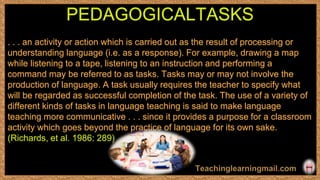
. . . an activity or action which is carried out as the result of processing or
understanding language (i.e. as a response). For example, drawing a map
while listening to a tape, listening to an instruction and performing a
command may be referred to as tasks. Tasks may or may not involve the
production of language. A task usually requires the teacher to specify what
will be regarded as successful completion of the task. The use of a variety of
different kinds of tasks in language teaching is said to make language
teaching more communicative . . . since it provides a purpose for a classroom
activity which goes beyond the practice of language for its own sake.
(Richards, et al. 1986: 289)
PEDAGOGICALTASKS
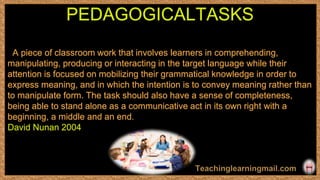
A piece of classroom work that involves learners in comprehending,
manipulating, producing or interacting in the target language while their
attention is focused on mobilizing their grammatical knowledge in order to
express meaning, and in which the intention is to convey meaning rather than
to manipulate form. The task should also have a sense of completeness,
being able to stand alone as a communicative act in its own right with a
beginning, a middle and an end.
David Nunan 2004
PEDAGOGICALTASKS
Tasks and functions are obviously closely related.
Any task will be underpinned by at least one (and
sometimes several) functions. Tasks can be thought of
as functions + context. They allow for functions (and
grammar) to be activated in a particular communicative
context.
TASKS & FUNCTIONS
Tasks differ from grammatical exercises in
that learners are free to use a range of
language structures to achieve task
outcomes – the forms are not specified in
advance.
Willis 2001
TASKS VS GRAMMATICAL EXERCISES
Communicative activities represent a kind of ‘half-way house’
between language exercises and pedagogical tasks. They are
similar to language exercises in that they provide manipulative
practice of a restricted set of language items. They resemble
pedagogical tasks in that they have an element of meaningful
communication.
David Nunan 2004
TASKS VS COMMUNICATIVE ACTIVITIES
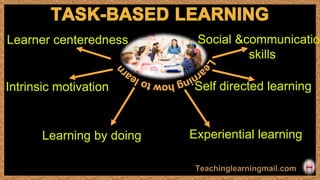
Learning by doing Experiential learning
Self directed learning
Learner centeredness
Intrinsic motivation
Social &communication
skills
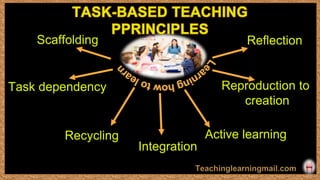
Recycling Active learning
Reproduction to
creation
Scaffolding
Task dependency
Integration
Reflection
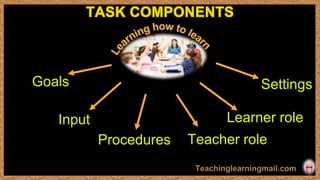
Input
Settings
Goals
Procedures Teacher role
Learner role
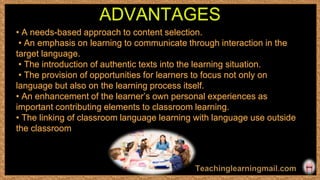
• A needs-based approach to content selection.
• An emphasis on learning to communicate through interaction in the
target language.
• The introduction of authentic texts into the learning situation.
• The provision of opportunities for learners to focus not only on
language but also on the learning process itself.
• An enhancement of the learner’s own personal experiences as
important contributing elements to classroom learning.
• The linking of classroom language learning with language use outside
the classroom
ADVANTAGES
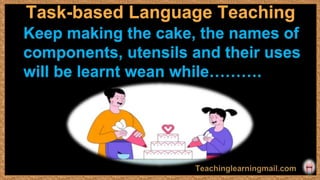
Task-based Language Teaching
Keep making the cake, the names of
components, utensils and their uses
will be learnt wean while……….
Task-based Language Teaching
Keep practising the language,
Lexis, structure and pronunciation
will be learnt wean while……….
Task based language teaching

Task based language teaching

  • 1.
  • 2.
    A piece ofwork undertaken for oneself or for others, freely or for some reward: Painting a fence, dressing a child, filling out a form, buying a pair of shoes, making an airline reservation, borrowing a library book, taking a driving test, typing a letter, weighing a patient, sorting letters, making a hotel reservation, writing a cheque, finding a street destination and helping someone across a road. In other words, by ‘task’ is meant the hundred and one things people do in everyday life, at work, at play and in between. TARGET / REAL WORLD TASKS Long1985 :89
  • 3.
    . . .an activity or action which is carried out as the result of processing or understanding language (i.e. as a response). For example, drawing a map while listening to a tape, listening to an instruction and performing a command may be referred to as tasks. Tasks may or may not involve the production of language. A task usually requires the teacher to specify what will be regarded as successful completion of the task. The use of a variety of different kinds of tasks in language teaching is said to make language teaching more communicative . . . since it provides a purpose for a classroom activity which goes beyond the practice of language for its own sake. (Richards, et al. 1986: 289) PEDAGOGICALTASKS
  • 4.
    A piece ofclassroom work that involves learners in comprehending, manipulating, producing or interacting in the target language while their attention is focused on mobilizing their grammatical knowledge in order to express meaning, and in which the intention is to convey meaning rather than to manipulate form. The task should also have a sense of completeness, being able to stand alone as a communicative act in its own right with a beginning, a middle and an end. David Nunan 2004 PEDAGOGICALTASKS
  • 5.
    Tasks and functionsare obviously closely related. Any task will be underpinned by at least one (and sometimes several) functions. Tasks can be thought of as functions + context. They allow for functions (and grammar) to be activated in a particular communicative context. TASKS & FUNCTIONS
  • 6.
    Tasks differ fromgrammatical exercises in that learners are free to use a range of language structures to achieve task outcomes – the forms are not specified in advance. Willis 2001 TASKS VS GRAMMATICAL EXERCISES
  • 7.
    Communicative activities representa kind of ‘half-way house’ between language exercises and pedagogical tasks. They are similar to language exercises in that they provide manipulative practice of a restricted set of language items. They resemble pedagogical tasks in that they have an element of meaningful communication. David Nunan 2004 TASKS VS COMMUNICATIVE ACTIVITIES
  • 8.
    Learning by doingExperiential learning Self directed learning Learner centeredness Intrinsic motivation Social &communication skills
  • 9.
    Recycling Active learning Reproductionto creation Scaffolding Task dependency Integration Reflection
  • 10.
  • 11.
    • A needs-basedapproach to content selection. • An emphasis on learning to communicate through interaction in the target language. • The introduction of authentic texts into the learning situation. • The provision of opportunities for learners to focus not only on language but also on the learning process itself. • An enhancement of the learner’s own personal experiences as important contributing elements to classroom learning. • The linking of classroom language learning with language use outside the classroom ADVANTAGES
  • 12.
    Task-based Language Teaching Keepmaking the cake, the names of components, utensils and their uses will be learnt wean while……….
  • 13.
    Task-based Language Teaching Keeppractising the language, Lexis, structure and pronunciation will be learnt wean while……….