Universidad Marítima del Caribe
Language Coordination
English VII
Operations
Edited by Cesar Rivas
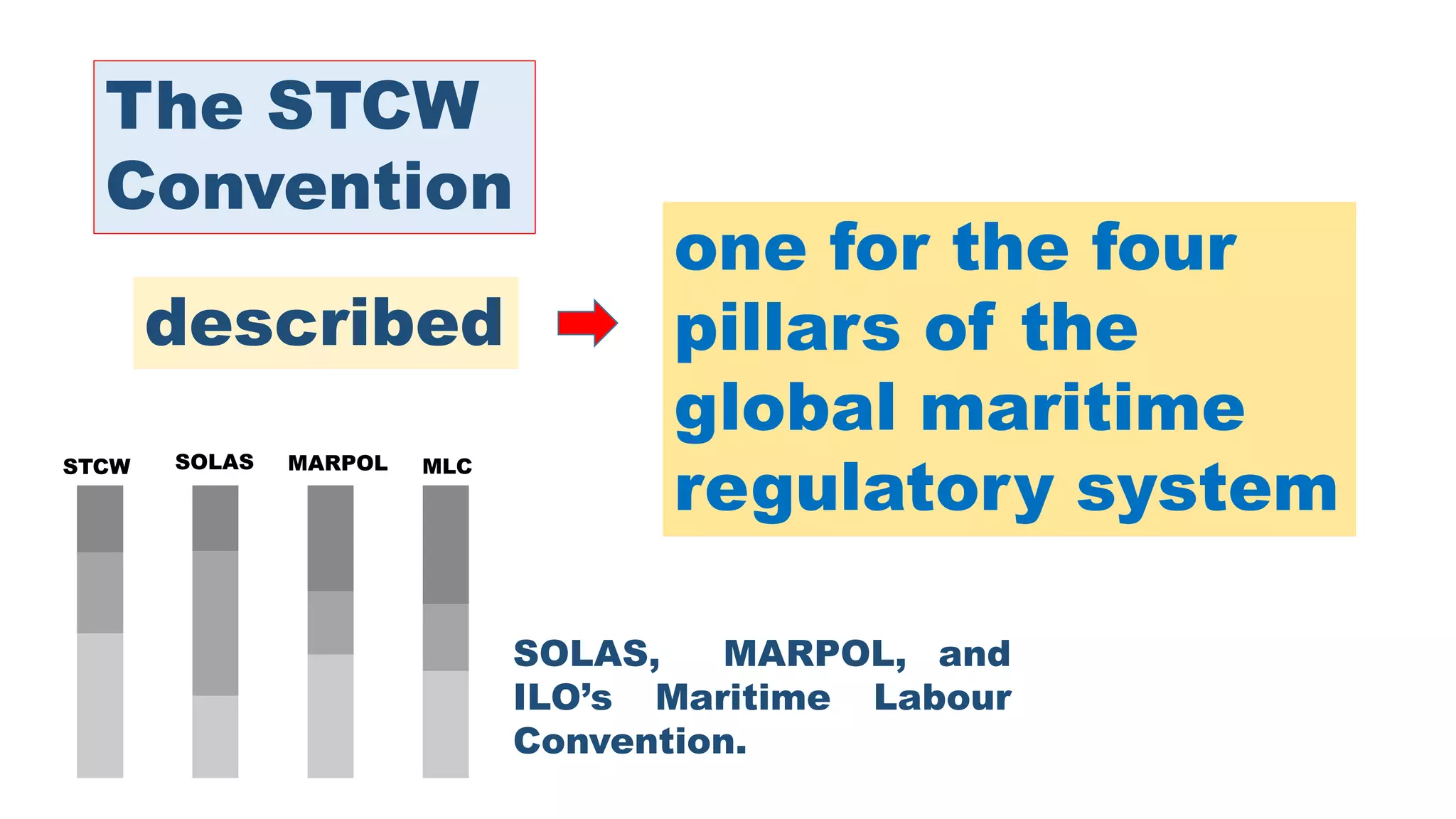
The STCW
Convention
described
one for the four
pillars of the
global maritime
regulatory system
SOLAS, MARPOL, and
ILO’s Maritime Labour
Convention.
STCW SOLAS MARPOL MLC
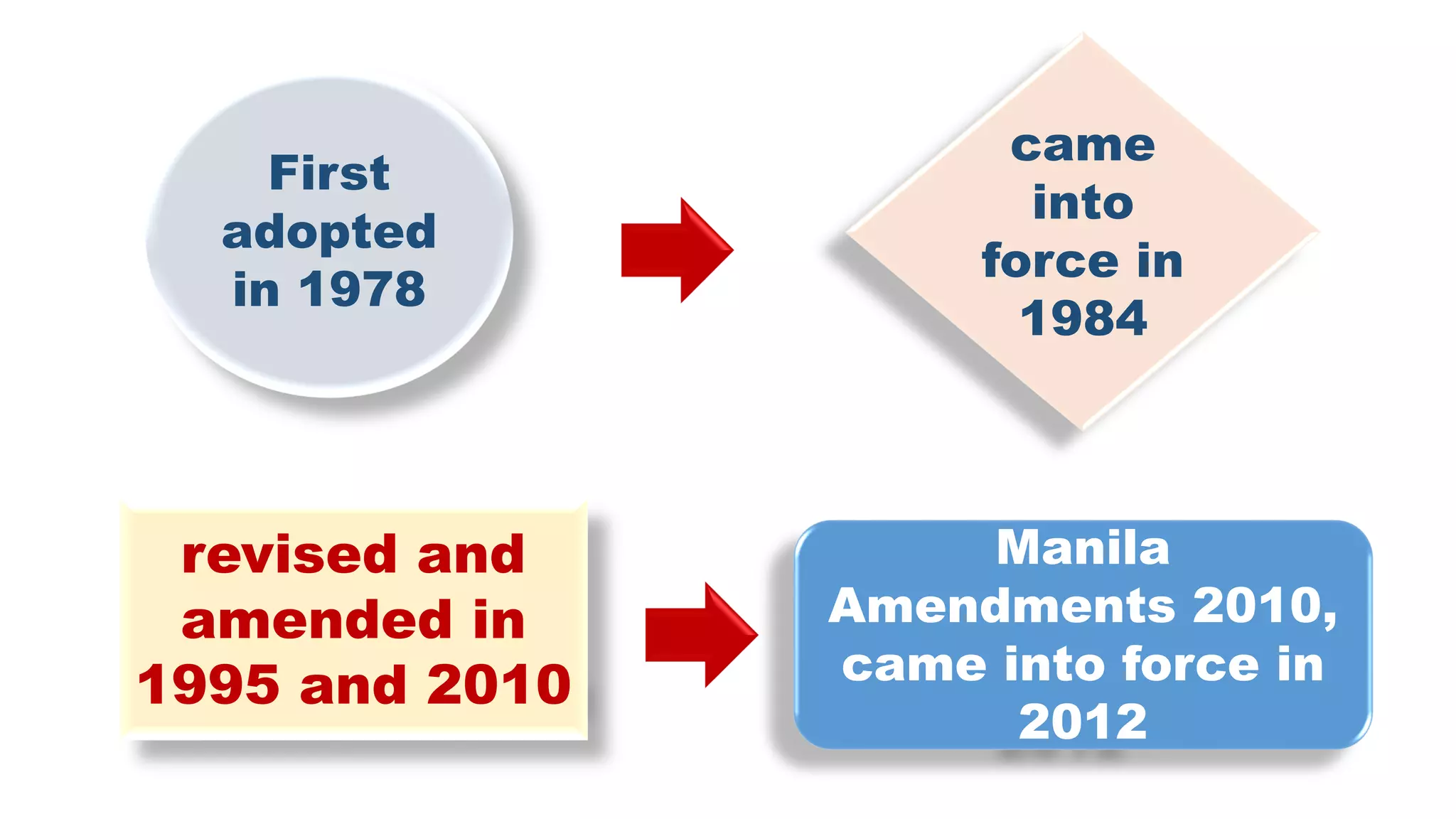
First
adopted
in 1978
came
into
force in
1984
revised and
amended in
1995 and 2010
Manila
Amendments 2010,
came into force in
2012
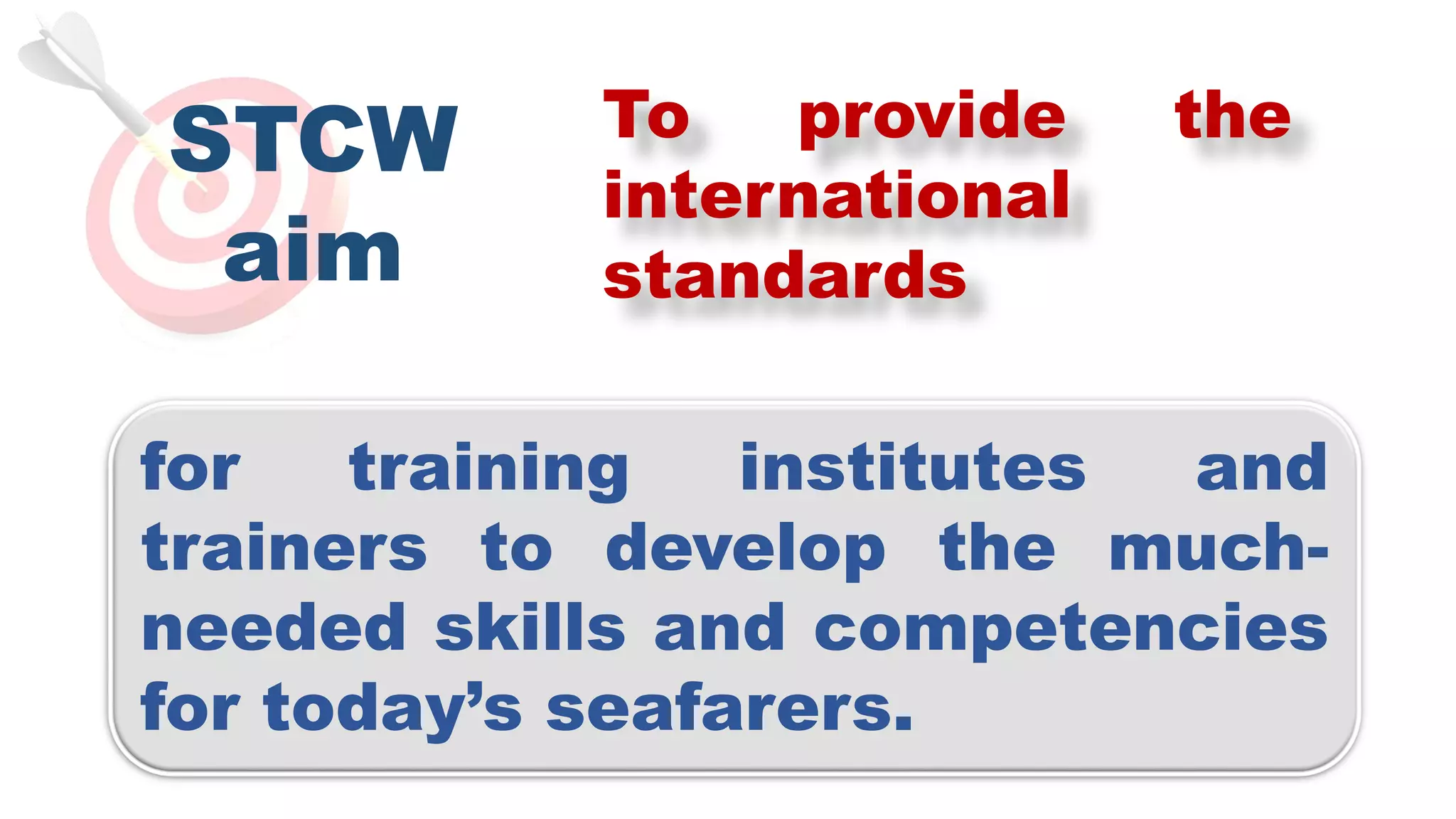
STCW
aim
To provide the
international
standards
for training institutes and
trainers to develop the much-
needed skills and competencies
for today’s seafarers.
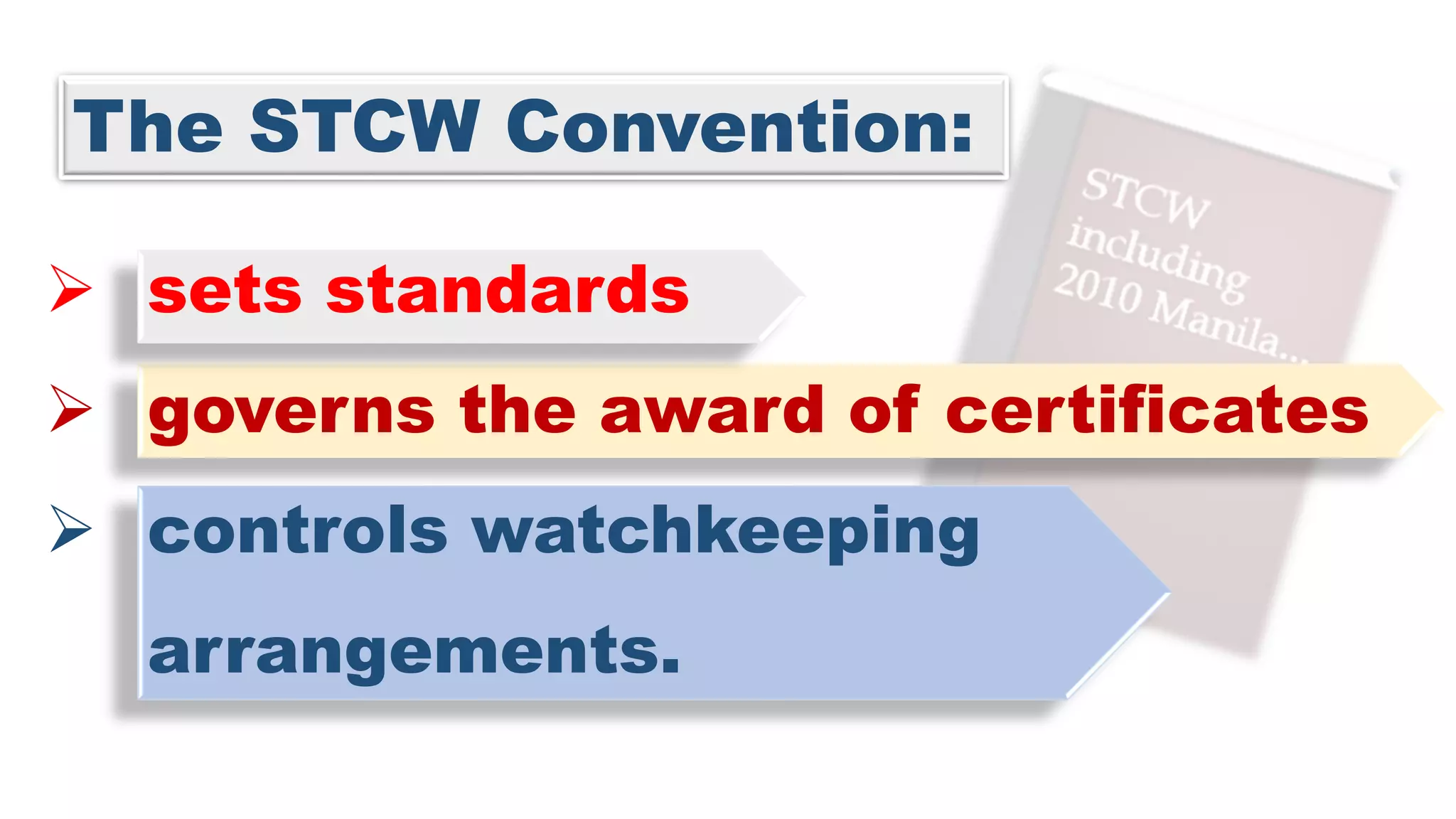
 sets standards
 governs the award of certificates
 controls watchkeeping
arrangements.
The STCW Convention:
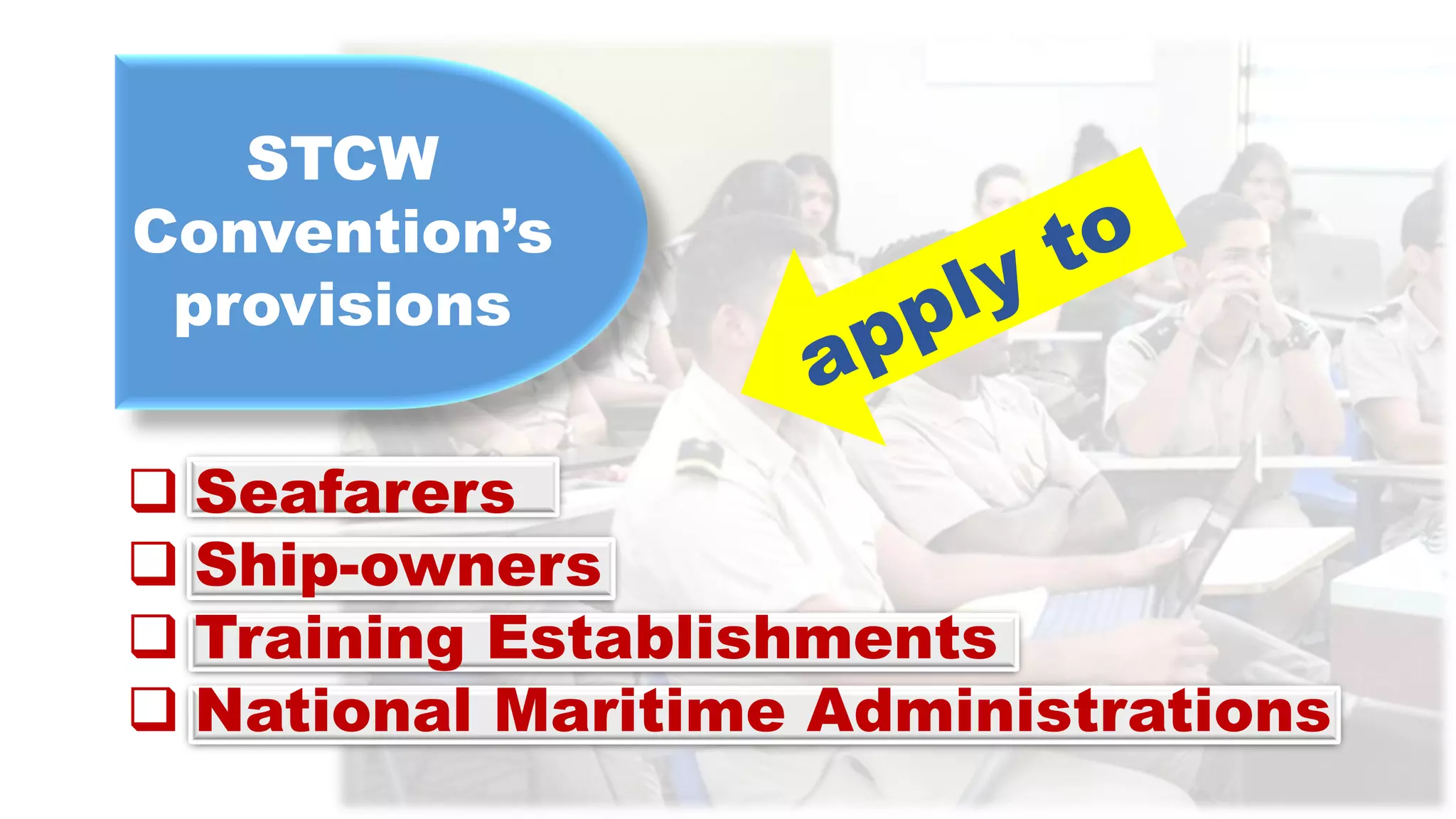
STCW
Convention’s
provisions
 Seafarers
 Ship-owners
 Training Establishments
 National Maritime Administrations
The 3 Sections of STCW Convention
Legal
responsibilities
a party has to
meet
Technical
details on how
the legal
responsibilities
in the articles
should be met
Specifies the
technical
details
contained in
the annex
The
Articles
The
Annex
The
Code
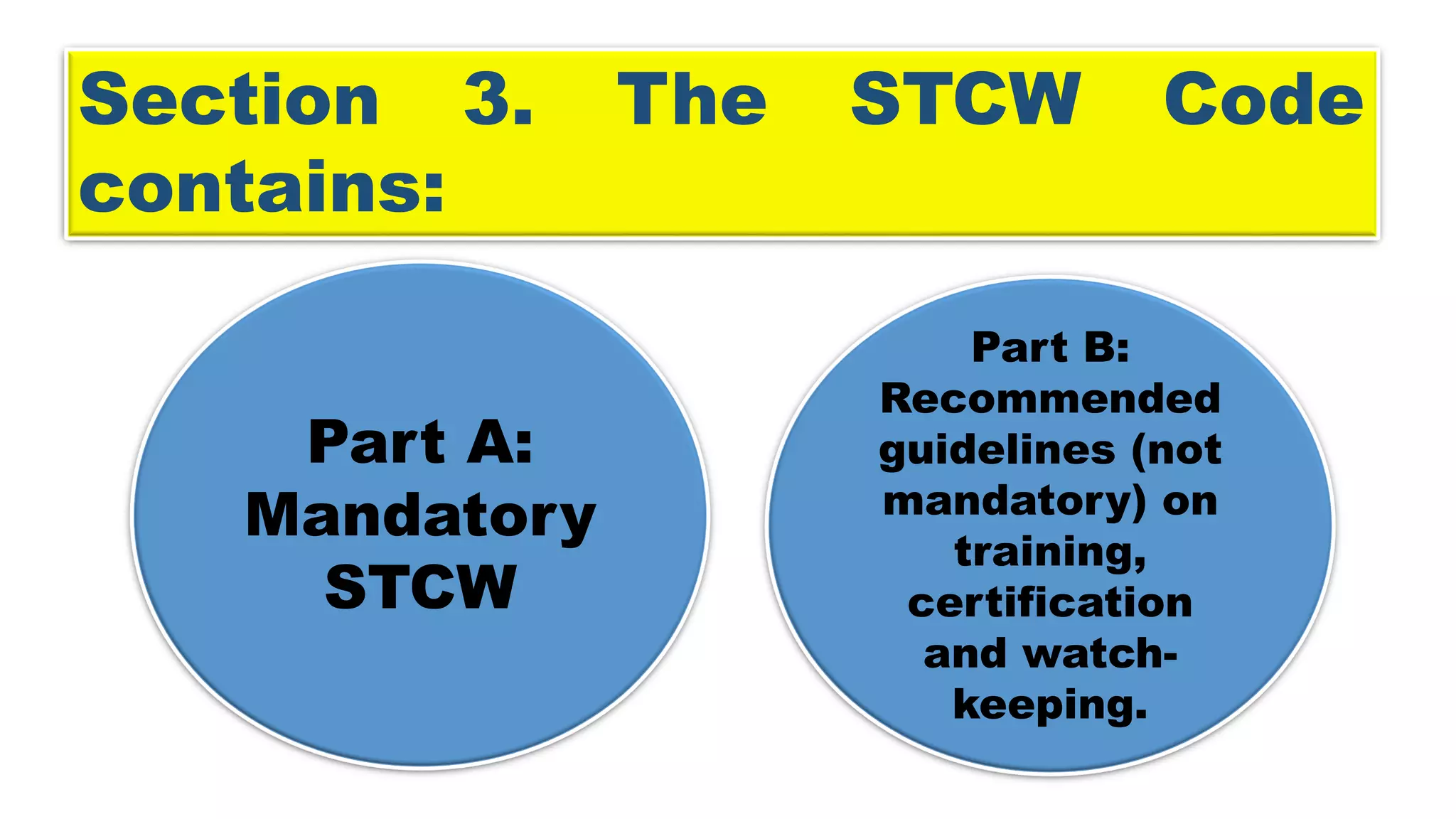
Section 3. The STCW Code
contains:
Part A:
Mandatory
STCW
Part B:
Recommended
guidelines (not
mandatory) on
training,
certification
and watch-
keeping.
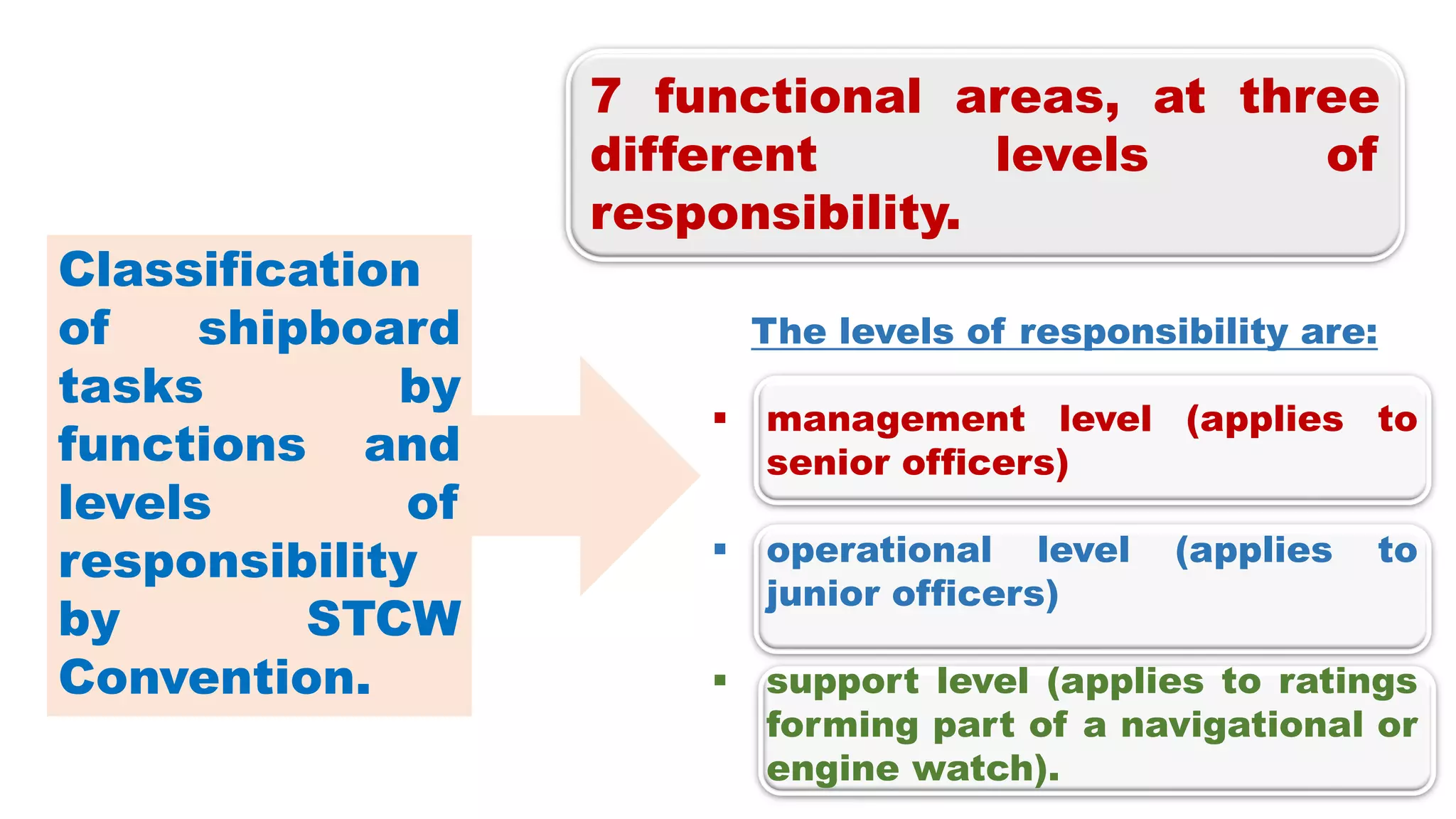
Classification
of shipboard
tasks by
functions and
levels of
responsibility
by STCW
Convention.
7 functional areas, at three
different levels of
responsibility.
The levels of responsibility are:
 management level (applies to
senior officers)
 operational level (applies to
junior officers)
 support level (applies to ratings
forming part of a navigational or
engine watch).
The following table lists the different functions and
levels of responsibility at which the functions can
be carried out.
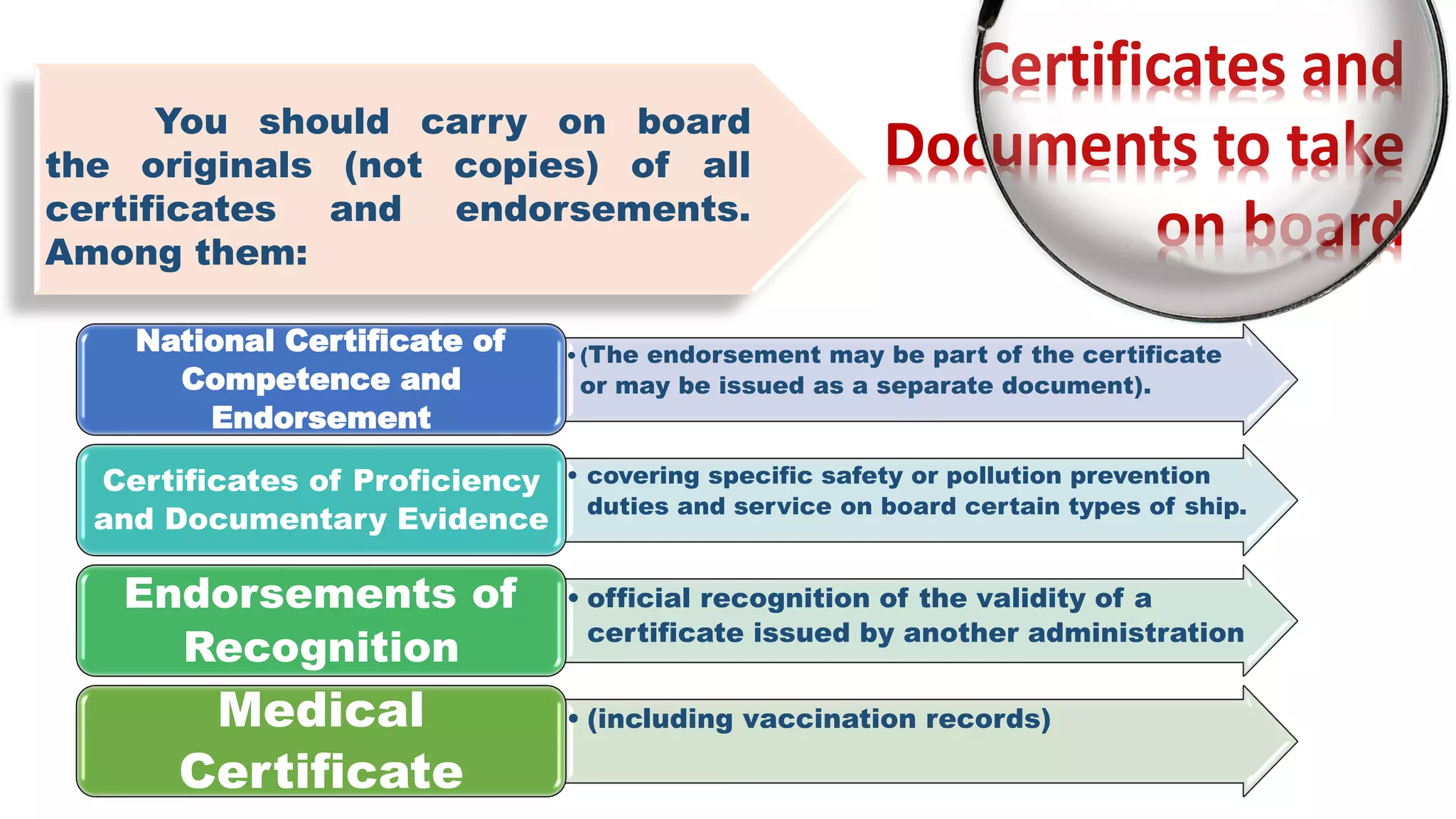
Certificates and
Documents to take
on board
You should carry on board
the originals (not copies) of all
certificates and endorsements.
Among them:
•(The endorsement may be part of the certificate
or may be issued as a separate document).
National Certificate of
Competence and
Endorsement
• covering specific safety or pollution prevention
duties and service on board certain types of ship.
Certificates of Proficiency
and Documentary Evidence
• official recognition of the validity of a
certificate issued by another administration
Endorsements of
Recognition
• (including vaccination records)Medical
Certificate
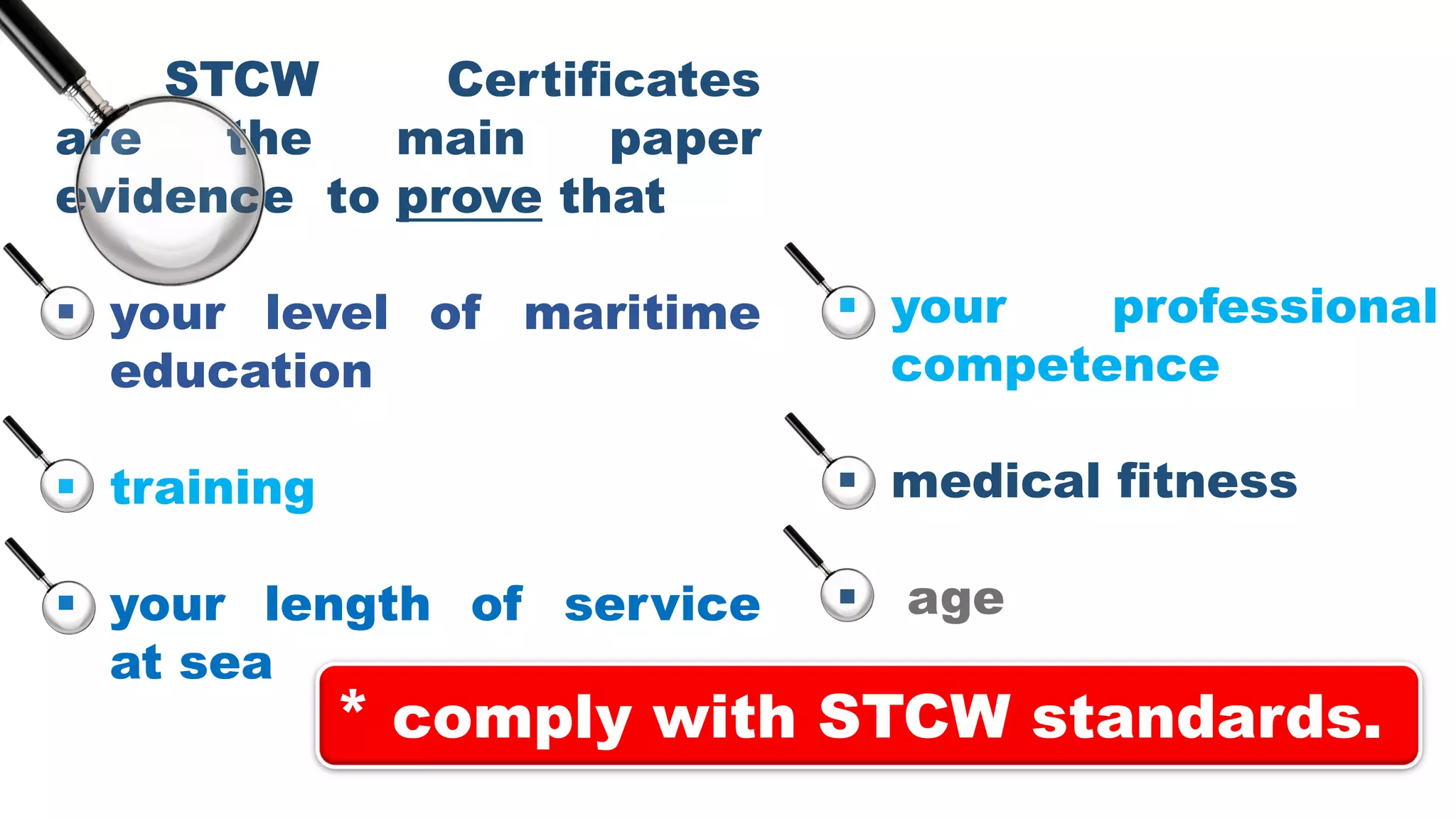
STCW Certificates
are the main paper
evidence to prove that
 your level of maritime
education
 training
 your length of service
at sea
 your professional
competence
 medical fitness
 age
* comply with STCW standards.
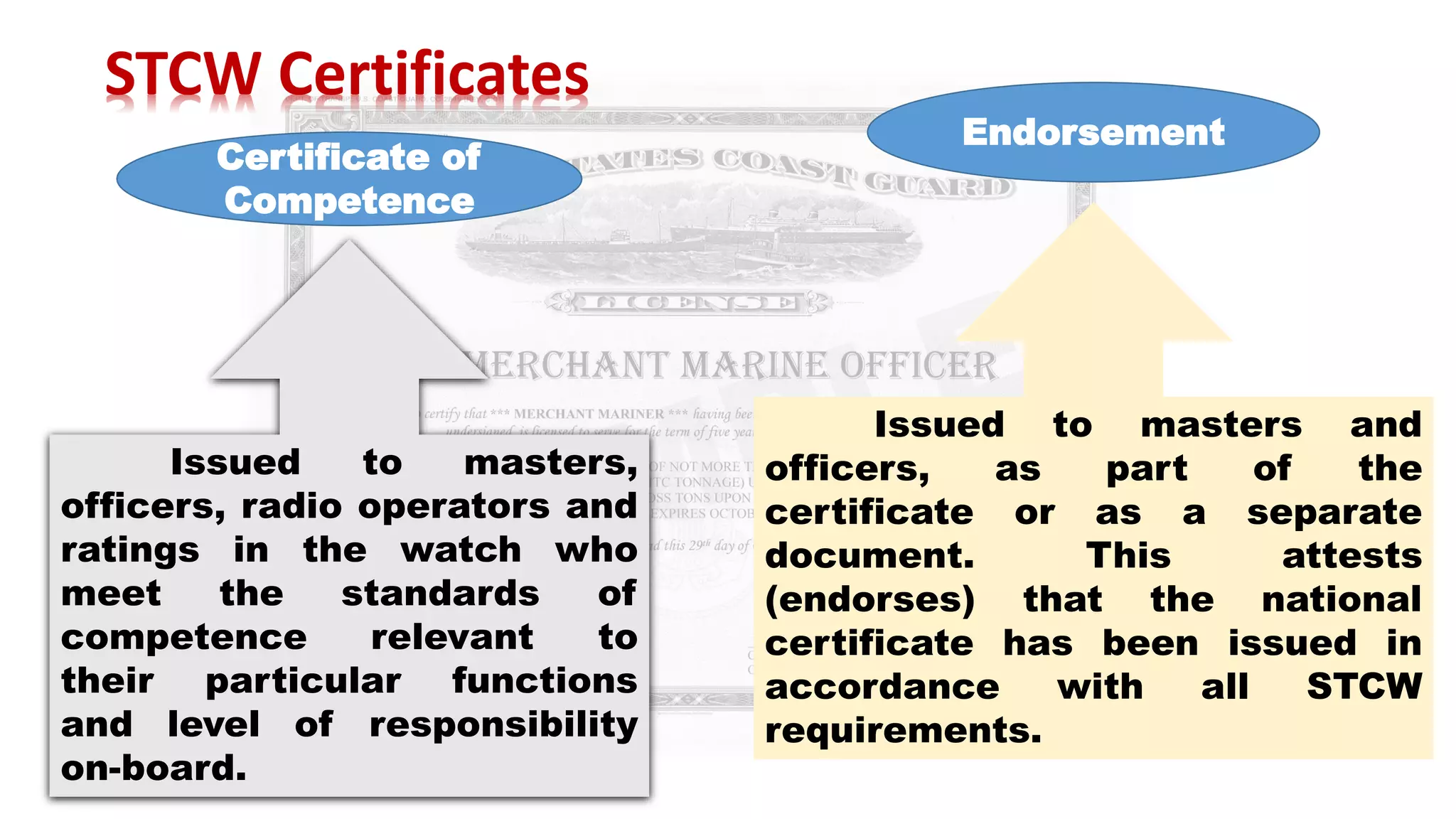
STCW Certificates
Certificate of
Competence
Endorsement
Issued to masters,
officers, radio operators and
ratings in the watch who
meet the standards of
competence relevant to
their particular functions
and level of responsibility
on-board.
Issued to masters and
officers, as part of the
certificate or as a separate
document. This attests
(endorses) that the national
certificate has been issued in
accordance with all STCW
requirements.
Endorsement
of Recognition Certificate of
Proficiency
Other
Documentary
Evidence
This endorsement
certificate is issued by
an administration as an
official recognition of
the validity of a
certificate issued by
another administration.
If you hold a certificate
from country ‘x’ , but you serve on a
ship in country ‘y’ , you need to
apply to the maritime administration
of country ‘y’ for an authorization to
serve on ships under its flag.
They certify that
seafarers meet
standards of competence
in specific functions
related to safety, care of
persons, or cargo.
They include certificates
for personnel serving on certain
types of ship (tankers, and
passenger ships) and for those
assigned with safety, security and
pollution prevention duties.
Documents issued
by the shipowner or
master of the vessel to
attest that the seafarer
has participated in a
safety drill or has
completed some type of
training (for example
familiarization training).
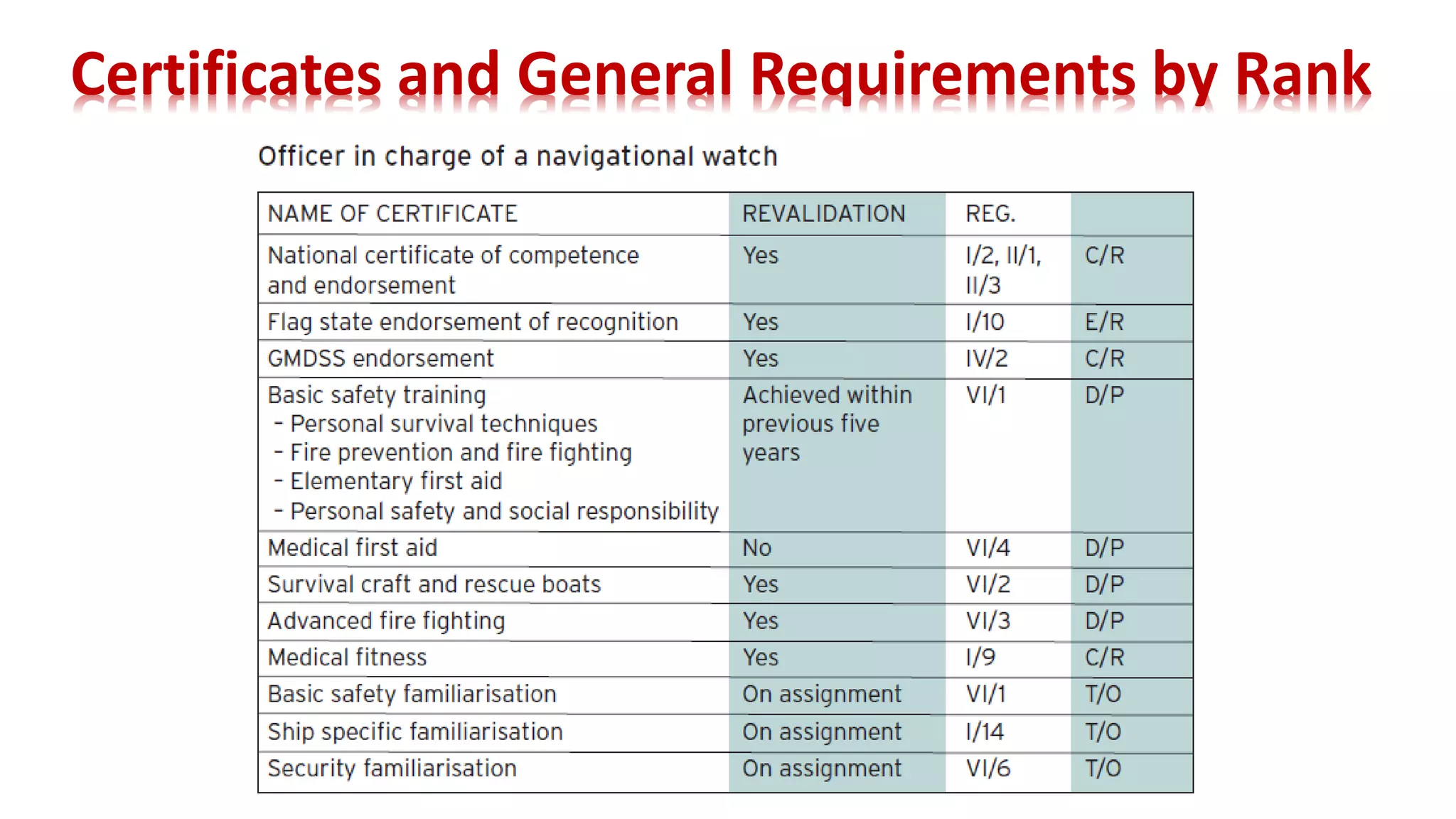
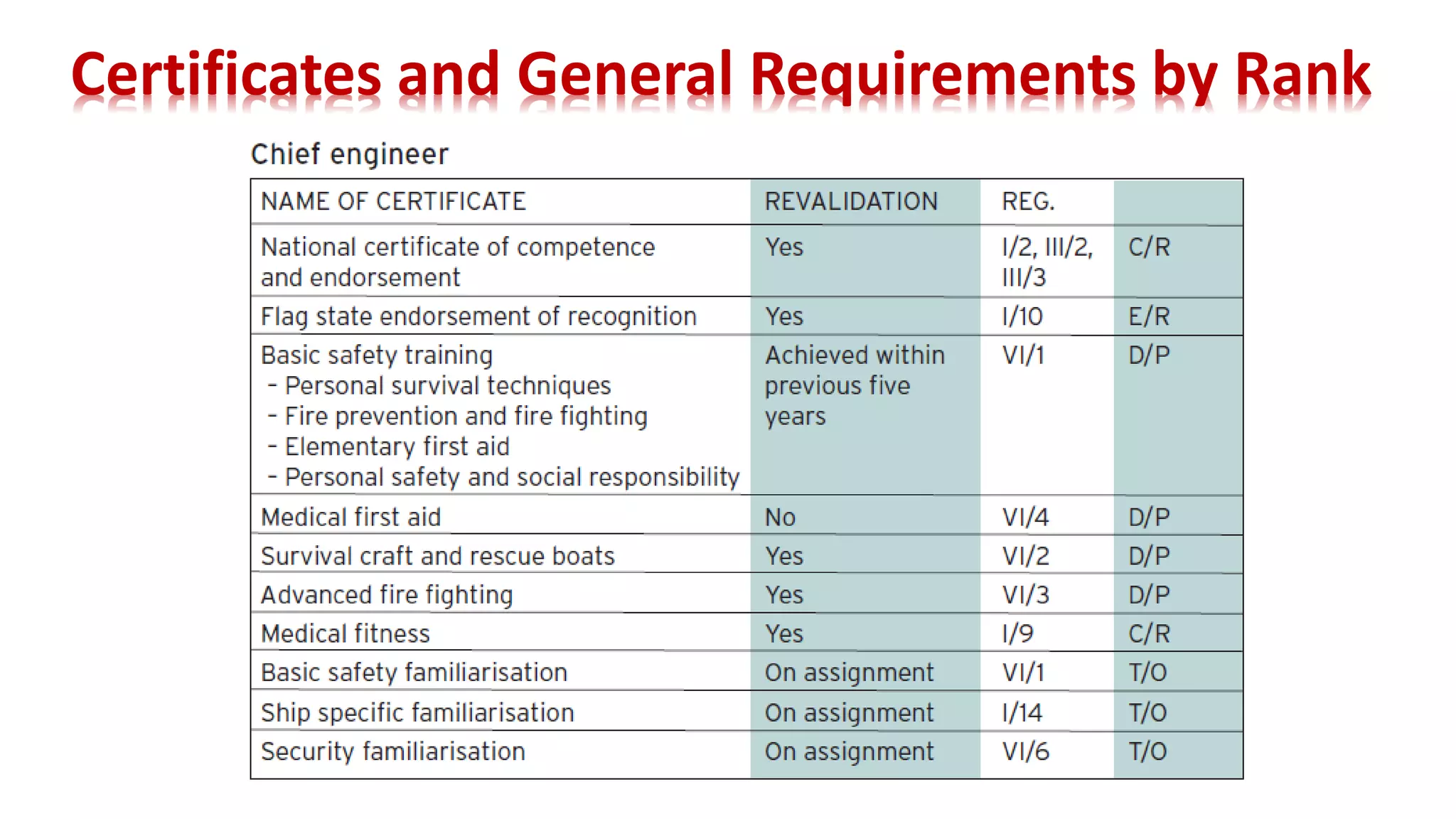
Certificates and General Requirements by Rank
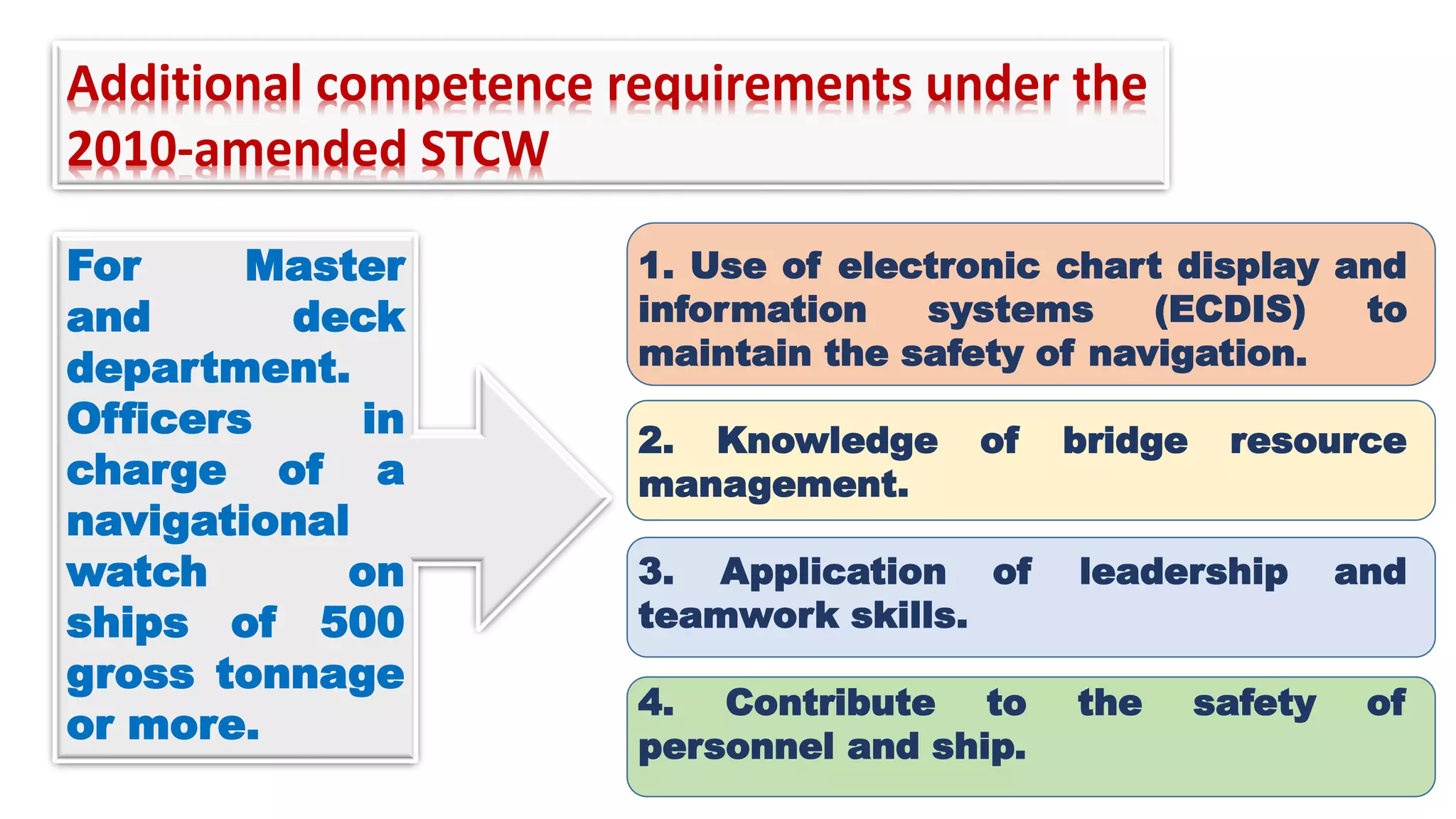
Additional competence requirements under the
2010-amended STCW
For Master
and deck
department.
Officers in
charge of a
navigational
watch on
ships of 500
gross tonnage
or more.
1. Use of electronic chart display and
information systems (ECDIS) to
maintain the safety of navigation.
2. Knowledge of bridge resource
management.
3. Application of leadership and
teamwork skills.
4. Contribute to the safety of
personnel and ship.
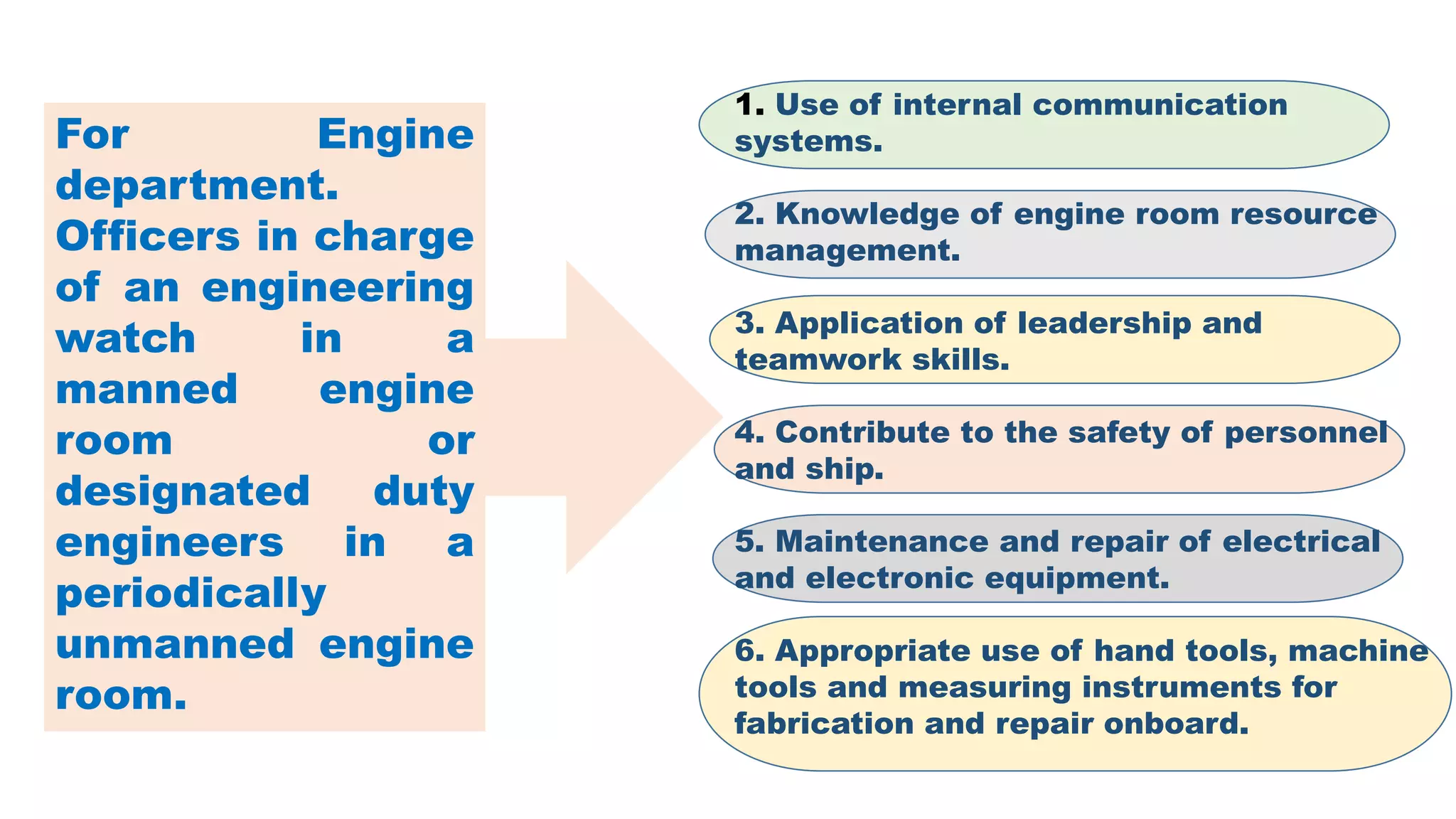
For Engine
department.
Officers in charge
of an engineering
watch in a
manned engine
room or
designated duty
engineers in a
periodically
unmanned engine
room.
1. Use of internal communication
systems.
2. Knowledge of engine room resource
management.
3. Application of leadership and
teamwork skills.
4. Contribute to the safety of personnel
and ship.
5. Maintenance and repair of electrical
and electronic equipment.
6. Appropriate use of hand tools, machine
tools and measuring instruments for
fabrication and repair onboard.
Under the STCW Convention, all officers in charge of a watch
(navigational or engineering) must have a good command of spoken and
written English.
 Senior officers with functions at a managerial level must also speak
and write English, since this is a requirement at the previous level of
responsibility.
 Ratings forming part of a navigational watch are required to be able to
comply with helm orders issued in English.
 Crew members assisting passengers during emergency situations
should be able to communicate safety-related issues in English or in the
language spoken by the passengers and other personnel on board.
 In these days of multi-national and multilingual crews, the importance
of sharing a common language cannot be underestimated.
International Transport Workers’ Federation. (2017). STCW A Guide for Seafarers.
Taking into account the 2010 Manila amendments. Document on line pdf. Retrieved
from:
References

Stcw a guide for seafarers

  • 1.
    Universidad Marítima delCaribe Language Coordination English VII Operations Edited by Cesar Rivas
  • 2.
    The STCW Convention described one forthe four pillars of the global maritime regulatory system SOLAS, MARPOL, and ILO’s Maritime Labour Convention. STCW SOLAS MARPOL MLC
  • 3.
    First adopted in 1978 came into force in 1984 revisedand amended in 1995 and 2010 Manila Amendments 2010, came into force in 2012
  • 4.
    STCW aim To provide the international standards fortraining institutes and trainers to develop the much- needed skills and competencies for today’s seafarers.
  • 5.
     sets standards governs the award of certificates  controls watchkeeping arrangements. The STCW Convention:
  • 6.
    STCW Convention’s provisions  Seafarers  Ship-owners Training Establishments  National Maritime Administrations
  • 7.
    The 3 Sectionsof STCW Convention Legal responsibilities a party has to meet Technical details on how the legal responsibilities in the articles should be met Specifies the technical details contained in the annex The Articles The Annex The Code
  • 8.
    Section 3. TheSTCW Code contains: Part A: Mandatory STCW Part B: Recommended guidelines (not mandatory) on training, certification and watch- keeping.
  • 9.
    Classification of shipboard tasks by functionsand levels of responsibility by STCW Convention. 7 functional areas, at three different levels of responsibility. The levels of responsibility are:  management level (applies to senior officers)  operational level (applies to junior officers)  support level (applies to ratings forming part of a navigational or engine watch).
  • 10.
    The following tablelists the different functions and levels of responsibility at which the functions can be carried out.
  • 11.
    Certificates and Documents totake on board You should carry on board the originals (not copies) of all certificates and endorsements. Among them: •(The endorsement may be part of the certificate or may be issued as a separate document). National Certificate of Competence and Endorsement • covering specific safety or pollution prevention duties and service on board certain types of ship. Certificates of Proficiency and Documentary Evidence • official recognition of the validity of a certificate issued by another administration Endorsements of Recognition • (including vaccination records)Medical Certificate
  • 12.
    STCW Certificates are themain paper evidence to prove that  your level of maritime education  training  your length of service at sea  your professional competence  medical fitness  age * comply with STCW standards.
  • 13.
    STCW Certificates Certificate of Competence Endorsement Issuedto masters, officers, radio operators and ratings in the watch who meet the standards of competence relevant to their particular functions and level of responsibility on-board. Issued to masters and officers, as part of the certificate or as a separate document. This attests (endorses) that the national certificate has been issued in accordance with all STCW requirements.
  • 14.
    Endorsement of Recognition Certificateof Proficiency Other Documentary Evidence This endorsement certificate is issued by an administration as an official recognition of the validity of a certificate issued by another administration. If you hold a certificate from country ‘x’ , but you serve on a ship in country ‘y’ , you need to apply to the maritime administration of country ‘y’ for an authorization to serve on ships under its flag. They certify that seafarers meet standards of competence in specific functions related to safety, care of persons, or cargo. They include certificates for personnel serving on certain types of ship (tankers, and passenger ships) and for those assigned with safety, security and pollution prevention duties. Documents issued by the shipowner or master of the vessel to attest that the seafarer has participated in a safety drill or has completed some type of training (for example familiarization training).
  • 15.
    Certificates and GeneralRequirements by Rank
  • 16.
    Certificates and GeneralRequirements by Rank
  • 17.
    Certificates and GeneralRequirements by Rank
  • 18.
    Certificates and GeneralRequirements by Rank
  • 19.
    Certificates and GeneralRequirements by Rank
  • 20.
    Certificates and GeneralRequirements by Rank
  • 21.
    Additional competence requirementsunder the 2010-amended STCW For Master and deck department. Officers in charge of a navigational watch on ships of 500 gross tonnage or more. 1. Use of electronic chart display and information systems (ECDIS) to maintain the safety of navigation. 2. Knowledge of bridge resource management. 3. Application of leadership and teamwork skills. 4. Contribute to the safety of personnel and ship.
  • 22.
    For Engine department. Officers incharge of an engineering watch in a manned engine room or designated duty engineers in a periodically unmanned engine room. 1. Use of internal communication systems. 2. Knowledge of engine room resource management. 3. Application of leadership and teamwork skills. 4. Contribute to the safety of personnel and ship. 5. Maintenance and repair of electrical and electronic equipment. 6. Appropriate use of hand tools, machine tools and measuring instruments for fabrication and repair onboard.
  • 23.
    Under the STCWConvention, all officers in charge of a watch (navigational or engineering) must have a good command of spoken and written English.  Senior officers with functions at a managerial level must also speak and write English, since this is a requirement at the previous level of responsibility.  Ratings forming part of a navigational watch are required to be able to comply with helm orders issued in English.  Crew members assisting passengers during emergency situations should be able to communicate safety-related issues in English or in the language spoken by the passengers and other personnel on board.  In these days of multi-national and multilingual crews, the importance of sharing a common language cannot be underestimated.
  • 24.
    International Transport Workers’Federation. (2017). STCW A Guide for Seafarers. Taking into account the 2010 Manila amendments. Document on line pdf. Retrieved from: References