




TRADE
BARRIERS
Zuki Patel
M.Pharm Sem-1 (PMRA)
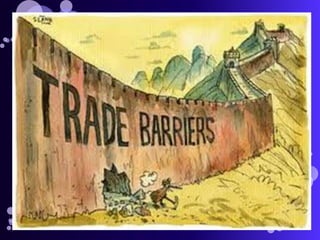
A barrier to trade is government imposed restraint on
the flow of international goods or services.
They arise from the rules and regulations governing trade
either from home country or host country or intermediary.
They are man-made obstacles to the free movements of goods
between different countries and impose artificial restrictions
on trading activities between countries.
A physical trade barries is a natural barrier like mountains,
rainforest, deserts.
OBJECTIVES
To protect Domestic Industries from foreign goods.
To promote new industries and research and
development activities by providing a home market for
domestic industries.
To maintain favourable balance of payment.
To mobilise additional revenue by imposing heavy
duties on imports. This also restricts conspicuous
consumption within country.
To encourage domestic production in the domestic
market and thereby make the country strong and
efficient
Types of Trade Barriers
They are classified as
1. Tariff Barriers
2. Non-tariff Barriers
A country may use both the types of barriers in order to
restrict the entry of foreign goods.
TARIFF BARRIERS
A Tariff barrier is a levy collected on goods when
they enter a domestic tariff area through customs.
It refers to the duties imposed on internationally
traded commodities when they cross national
boundaries and may be in the form of heavy taxes or
custom duties on imports, so as to discourage their entry
into the home country for marketing purposes.
TARIFF BARRIERS
Tariffs enhance the price of the imported goods,
thereby restricting their sales as well as their import.
Governments impose tariffs only on imports and not on
exports as they are interested in export promotion
The aim of a tariff is thus to raise the prices of
imported goods in domestic markets, reduce their
demand and thereby discourage their imports.
Types of TARIFF BARRIERS
Export duty : an export duty is levied by the country of
origin on a commodity designated for use in other
countries. The majority of finished goods do not attract
export duty. Such duities are normally imposed on the
primary products inorder to conserve them for domestic
industries. In india, export duty is levied on oilseeds,
coffee and onions, etc.
Types of TARIFF BARRIERS
Import duty : an import duty is a tax imposed on a
commodity originating in another country by the
country for which the product is designated. The
purpose of heavy import duties is to earn revenue, to
make imports costly and to provide protection to
domestic industries.
Types of TARIFF BARRIERS
Specific duty : a specific duty is a flat sum collected on
physical unit of the commodity imported. Here, the rate
of the duty is fixed and is collected on each unit
imported. For example, rs 800 on each tv set or washing
machine or rs 3000 per metric ton on cold rolled iron
coils.
Types of TARIFF BARRIERS
Protective tariff : it aims at giving protection to home
industries by restricting or eliminating competition.
Protective tariffs are usually high so as to reduce
imports
Anti-dumping duty : dumping is the commercial
practice of selling goods in foreign markets at a price
below their normal cost or even below their marginal
cost so as to capture foreign markets.
Types of TARIFF BARRIERS
Single column tariff : under this system, tariff rates are
fixed for various commodities and the same rates are
made applicable to imports from all other countries.
Double column tariff : under this sysytem, two rates of
duty are fixed on all or some commodities. The lower
rate is made applicable to a friendly country or to a
country with which the importing country has a
bilateral trade agreement. The higher rate is applicable
to all other countries.
Types of TARIFF BARRIERS
Triple column tariff : here three different rates of duties
are fixed. They are general tariff, international tariff
and preferential tariff. The first two categories have
minimum variance but the preferential tariff is
substantially lower than the general tariff and is
applicable to friendly countries where there is a
bilateral relationship.
Non-TARIFF BARRIERS
A Non-Tariff Barrier is a form of restrictive trade
where barriers to trade are set up and take a form other
than a tariff.
Non-Tariff Barriers include quotas, embargoes,
sanctions, levies and other restrictions and are
frequently used by large and developed economies.
Non-Tariff Barriers are another way to control the
amount of trade that it conducts with another country.
Types of Non-TARIFF BARRIERS
Licenses
Countries may use licenses to limit imported goods to
specific businesses. If a business is granted a trade
license, then it permits it to import goods that otherwise
are restricted for trade in the country.
Types of Non-TARIFF BARRIERS
Quotas
Countries typically use quotas for the importing and
exporting of goods and services. In nontariff barrier
procedures, countries agree on specified limits of goods
and services that are permitted for importation to a
country, typically without restrictions, up to a specified
limit. Quotas can also be set for specific time frames.
Additionally, quotas are also often used in
international trade license agreements.
Types of Non-TARIFF BARRIERS
Embargoes
a blockade or political agreement that limits a foreign
country's ability to export or import.
Sanctions
Countries impose sanctions on other countries to limit
their trade activity. Sanctions can include increased
administrative actions and additional customs and
trade procedures that slow or limit a country’s ability
to trade.
REFERENCES
Library of Economics and Liberty
Investopedia
Trade barriers-zuki
Trade barriers-zuki

Trade barriers-zuki

  • 1.
  • 3.
    A barrier totrade is government imposed restraint on the flow of international goods or services. They arise from the rules and regulations governing trade either from home country or host country or intermediary. They are man-made obstacles to the free movements of goods between different countries and impose artificial restrictions on trading activities between countries. A physical trade barries is a natural barrier like mountains, rainforest, deserts.
  • 4.
    OBJECTIVES To protect DomesticIndustries from foreign goods. To promote new industries and research and development activities by providing a home market for domestic industries. To maintain favourable balance of payment. To mobilise additional revenue by imposing heavy duties on imports. This also restricts conspicuous consumption within country. To encourage domestic production in the domestic market and thereby make the country strong and efficient
  • 5.
    Types of TradeBarriers They are classified as 1. Tariff Barriers 2. Non-tariff Barriers A country may use both the types of barriers in order to restrict the entry of foreign goods.
  • 6.
    TARIFF BARRIERS A Tariffbarrier is a levy collected on goods when they enter a domestic tariff area through customs. It refers to the duties imposed on internationally traded commodities when they cross national boundaries and may be in the form of heavy taxes or custom duties on imports, so as to discourage their entry into the home country for marketing purposes.
  • 7.
    TARIFF BARRIERS Tariffs enhancethe price of the imported goods, thereby restricting their sales as well as their import. Governments impose tariffs only on imports and not on exports as they are interested in export promotion The aim of a tariff is thus to raise the prices of imported goods in domestic markets, reduce their demand and thereby discourage their imports.
  • 8.
    Types of TARIFFBARRIERS Export duty : an export duty is levied by the country of origin on a commodity designated for use in other countries. The majority of finished goods do not attract export duty. Such duities are normally imposed on the primary products inorder to conserve them for domestic industries. In india, export duty is levied on oilseeds, coffee and onions, etc.
  • 9.
    Types of TARIFFBARRIERS Import duty : an import duty is a tax imposed on a commodity originating in another country by the country for which the product is designated. The purpose of heavy import duties is to earn revenue, to make imports costly and to provide protection to domestic industries.
  • 10.
    Types of TARIFFBARRIERS Specific duty : a specific duty is a flat sum collected on physical unit of the commodity imported. Here, the rate of the duty is fixed and is collected on each unit imported. For example, rs 800 on each tv set or washing machine or rs 3000 per metric ton on cold rolled iron coils.
  • 11.
    Types of TARIFFBARRIERS Protective tariff : it aims at giving protection to home industries by restricting or eliminating competition. Protective tariffs are usually high so as to reduce imports Anti-dumping duty : dumping is the commercial practice of selling goods in foreign markets at a price below their normal cost or even below their marginal cost so as to capture foreign markets.
  • 12.
    Types of TARIFFBARRIERS Single column tariff : under this system, tariff rates are fixed for various commodities and the same rates are made applicable to imports from all other countries. Double column tariff : under this sysytem, two rates of duty are fixed on all or some commodities. The lower rate is made applicable to a friendly country or to a country with which the importing country has a bilateral trade agreement. The higher rate is applicable to all other countries.
  • 13.
    Types of TARIFFBARRIERS Triple column tariff : here three different rates of duties are fixed. They are general tariff, international tariff and preferential tariff. The first two categories have minimum variance but the preferential tariff is substantially lower than the general tariff and is applicable to friendly countries where there is a bilateral relationship.
  • 14.
    Non-TARIFF BARRIERS A Non-TariffBarrier is a form of restrictive trade where barriers to trade are set up and take a form other than a tariff. Non-Tariff Barriers include quotas, embargoes, sanctions, levies and other restrictions and are frequently used by large and developed economies. Non-Tariff Barriers are another way to control the amount of trade that it conducts with another country.
  • 15.
    Types of Non-TARIFFBARRIERS Licenses Countries may use licenses to limit imported goods to specific businesses. If a business is granted a trade license, then it permits it to import goods that otherwise are restricted for trade in the country.
  • 16.
    Types of Non-TARIFFBARRIERS Quotas Countries typically use quotas for the importing and exporting of goods and services. In nontariff barrier procedures, countries agree on specified limits of goods and services that are permitted for importation to a country, typically without restrictions, up to a specified limit. Quotas can also be set for specific time frames. Additionally, quotas are also often used in international trade license agreements.
  • 17.
    Types of Non-TARIFFBARRIERS Embargoes a blockade or political agreement that limits a foreign country's ability to export or import. Sanctions Countries impose sanctions on other countries to limit their trade activity. Sanctions can include increased administrative actions and additional customs and trade procedures that slow or limit a country’s ability to trade.
  • 18.
    REFERENCES Library of Economicsand Liberty Investopedia