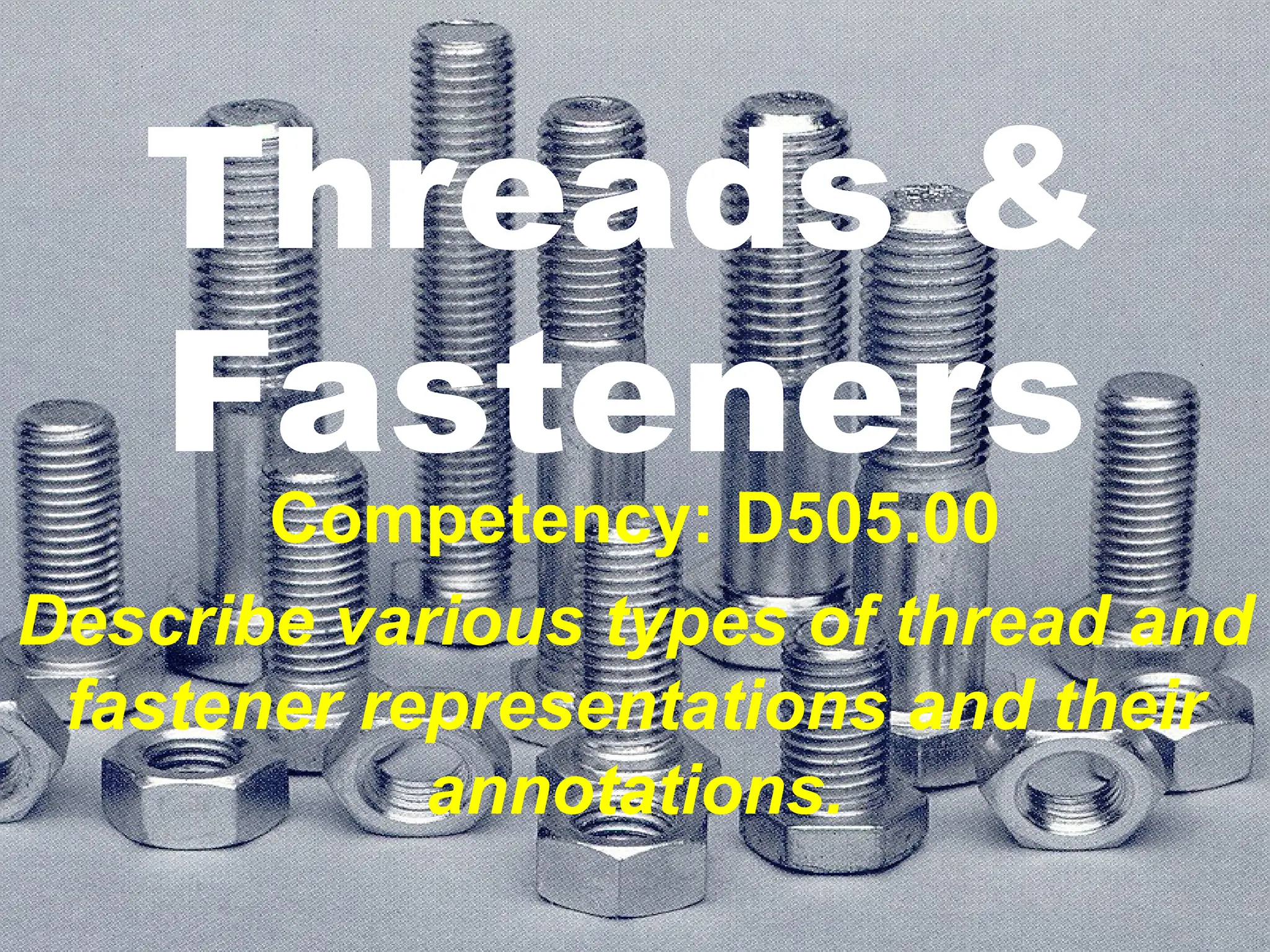
Threads &
Fasteners
Competency: D505.00
Describe various types of thread and
fastener representations and their
annotations.
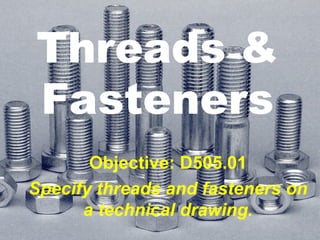
Threads &
Fasteners
Objective: D505.01
Specify threads and fasteners on
a technical drawing.
Basic Applications of Threads
How are threads used?
1.
1.Hold parts together
Hold parts together
2.
2.Adjust parts
Adjust parts
3.
3.Transmit power
Transmit power
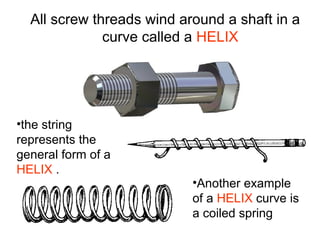
All screw threads wind around a shaft in a
curve called a HELIX
•the string
represents the
general form of a
HELIX .
•Another example
of a HELIX curve is
a coiled spring
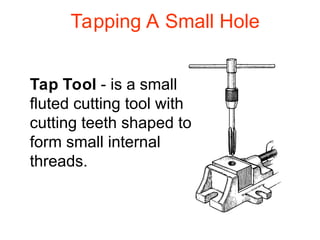
Tapping A Small Hole
Tap Tool - is a small
fluted cutting tool with
cutting teeth shaped to
form small internal
threads.
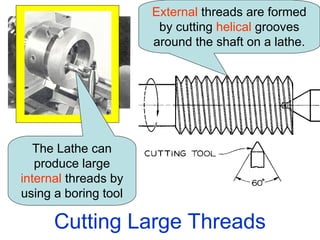
Cutting Large Threads
External threads are formed
by cutting helical grooves
around the shaft on a lathe.
The Lathe can
produce large
internal threads by
using a boring tool
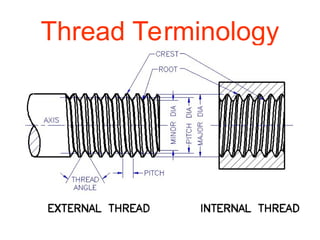
Thread Terminology
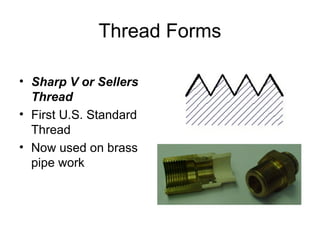
Thread Forms
• Sharp V or Sellers
Thread
• First U.S. Standard
Thread
• Now used on brass
pipe work
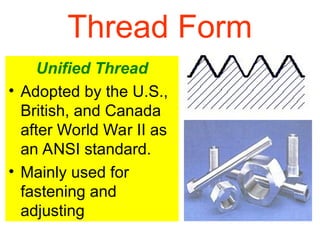
Thread Form
Unified Thread
• Adopted by the U.S.,
British, and Canada
after World War II as
an ANSI standard.
• Mainly used for
fastening and
adjusting
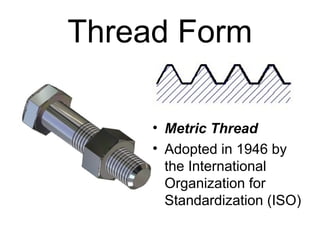
Thread Form
• Metric Thread
• Adopted in 1946 by
the International
Organization for
Standardization (ISO)
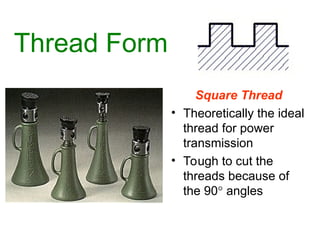
Thread Form
Square Thread
• Theoretically the ideal
thread for power
transmission
• Tough to cut the
threads because of
the 90° angles
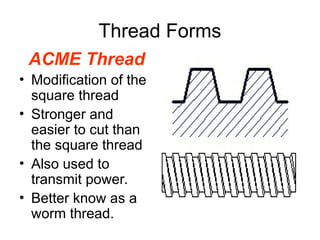
Thread Forms
ACME Thread
• Modification of the
square thread
• Stronger and
easier to cut than
the square thread
• Also used to
transmit power.
• Better know as a
worm thread.
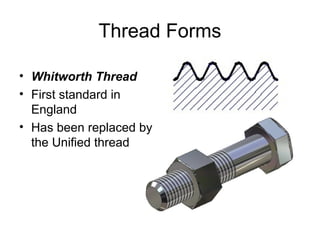
Thread Forms
• Whitworth Thread
• First standard in
England
• Has been replaced by
the Unified thread
Thread Forms
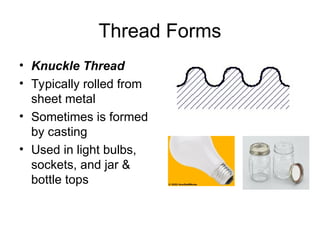
• Knuckle Thread
• Typically rolled from
sheet metal
• Sometimes is formed
by casting
• Used in light bulbs,
sockets, and jar &
bottle tops
Thread Forms
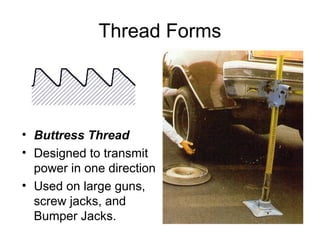
• Buttress Thread
• Designed to transmit
power in one direction
• Used on large guns,
screw jacks, and
Bumper Jacks.
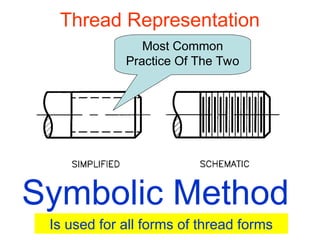
Thread Representation
Symbolic Method
Most Common
Practice Of The Two
Is used for all forms of thread forms
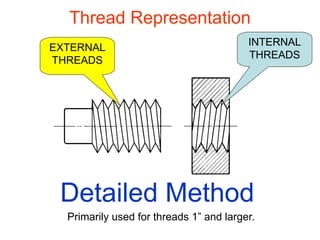
Thread Representation
EXTERNAL
THREADS
INTERNAL
THREADS
Detailed Method
Primarily used for threads 1” and larger.
Conventional Practices
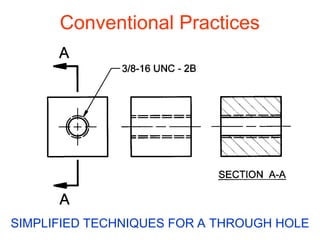
SIMPLIFIED TECHNIQUES FOR A THROUGH HOLE
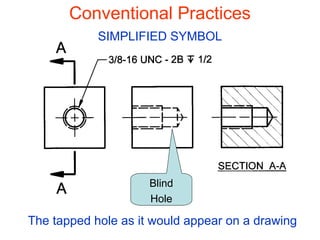
The tapped hole as it would appear on a drawing
Conventional Practices
SIMPLIFIED SYMBOL
Blind
Hole
Conventional Practices
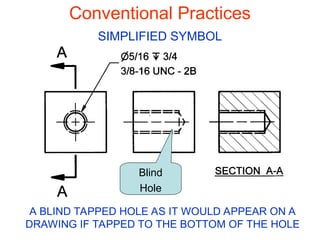
SIMPLIFIED SYMBOL
A BLIND TAPPED HOLE AS IT WOULD APPEAR ON A
DRAWING IF TAPPED TO THE BOTTOM OF THE HOLE
Blind
Hole
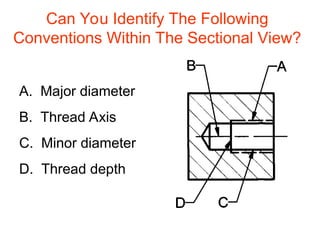
Can You Identify The Following
Conventions Within The Sectional View?
A. Major diameter
B. Thread Axis
C. Minor diameter
D. Thread depth
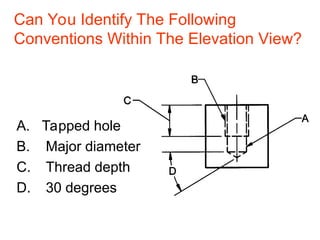
Can You Identify The Following
Conventions Within The Elevation View?
A. Tapped hole
B. Major diameter
C. Thread depth
D. 30 degrees
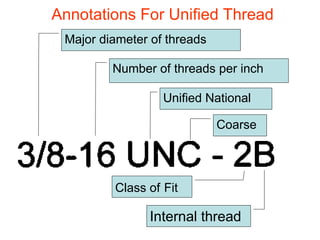
Annotations For Unified Thread
Major diameter of threads
Number of threads per inch
Unified National
Coarse
Class of Fit
Internal thread
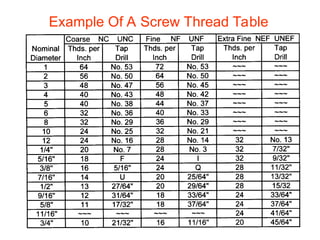
Example Of A Screw Thread Table
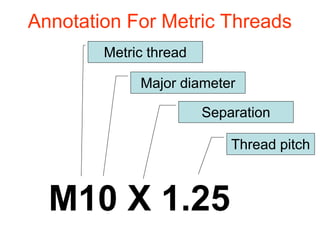
Annotation For Metric Threads
M10 X 1.25
Metric thread
Major diameter
Separation
Thread pitch
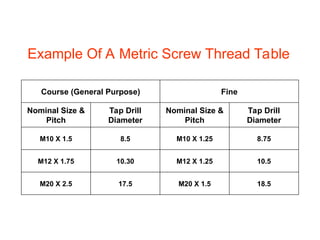
Course (General Purpose) Fine
Nominal Size &
Pitch
Tap Drill
Diameter
Nominal Size &
Pitch
Tap Drill
Diameter
M10 X 1.5 8.5 M10 X 1.25 8.75
M12 X 1.75 10.30 M12 X 1.25 10.5
M20 X 2.5 17.5 M20 X 1.5 18.5
Example Of A Metric Screw Thread Table
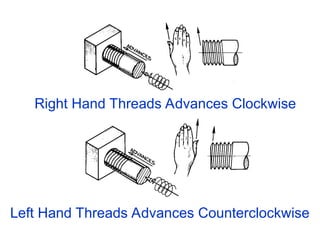
Left Hand Threads Advances Counterclockwise
Right Hand Threads Advances Clockwise
Other Types Of Threaded
Fasteners
Fasteners
 Bolt
Bolt &
& Nut
Nut
 Cap Screws
Cap Screws
 Machine Screws
Machine Screws
 Set Screws
Set Screws
 Wood Screws
Wood Screws
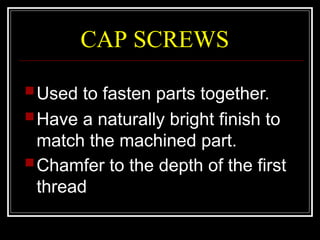
CAP SCREWS
Used to fasten parts together.
Have a naturally bright finish to
match the machined part.
Chamfer to the depth of the first
thread
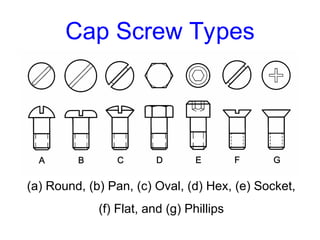
Cap Screw Types
(a) Round, (b) Pan, (c) Oval, (d) Hex, (e) Socket,
(f) Flat, and (g) Phillips
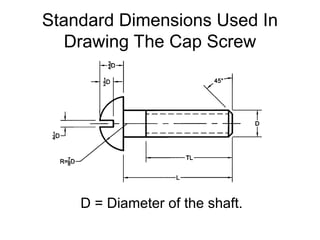
Standard Dimensions Used In
Drawing The Cap Screw
D = Diameter of the shaft.
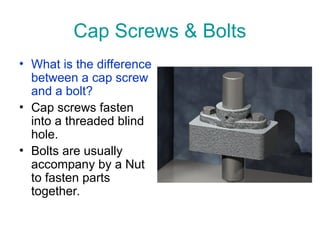
Cap Screws & Bolts
• What is the difference
between a cap screw
and a bolt?
• Cap screws fasten
into a threaded blind
hole.
• Bolts are usually
accompany by a Nut
to fasten parts
together.
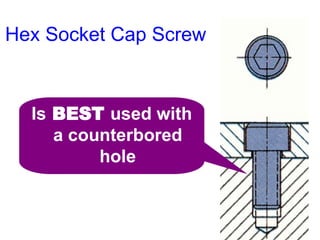
Hex Socket Cap Screw
Is BEST used with
a counterbored
hole
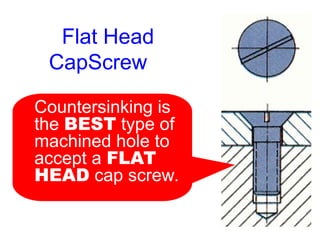
Flat Head
CapScrew
Countersinking is
the BEST type of
machined hole to
accept a FLAT
HEAD cap screw.
Set Screws
• There are generally two
types: square-head and
headless.
• Because of safety issues
the headless setscrew
would be best for rotating
parts.
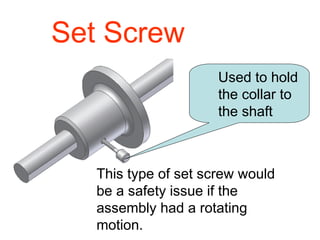
Set Screw
Used to hold
the collar to
the shaft
This type of set screw would
be a safety issue if the
assembly had a rotating
motion.
Fasteners For Wood
• Wood Screws – create their own thread
when you drive them into soft woods
such as pine and spruce.
– Cone shaped shafts for easy entry into
the wood.
– Hard woods, such as maple or oak,
may require drilling a pilot hole.
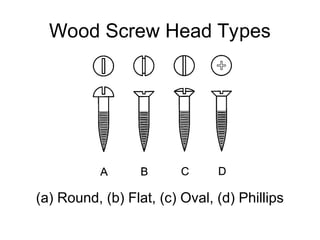
– Wood screws have flat, round, or oval
heads with slotted or Phillips head
configurations.
Wood Screw Head Types
(a) Round, (b) Flat, (c) Oval, (d) Phillips
Non-Threaded Fasteners
Keys & Keyways
Keys & Keyways
Rivets
Rivets
Cotter Pins
Cotter Pins
Keys
Keys
Are used to prevent relative
movement between, wheels,
pulleys, gears, cranks, and
similar parts to a shaft.
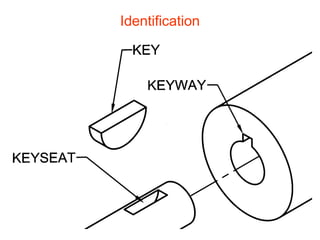
Identification
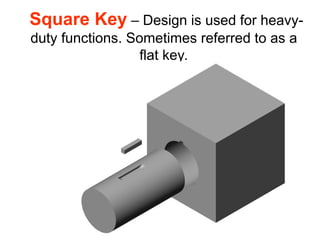
Square Key – Design is used for heavy-
duty functions. Sometimes referred to as a
flat key.
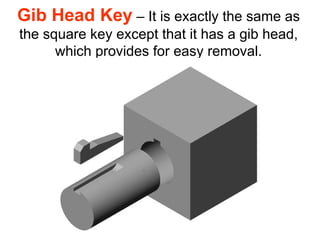
Gib Head Key – It is exactly the same as
the square key except that it has a gib head,
which provides for easy removal.
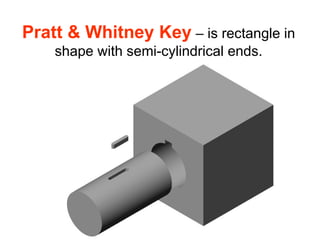
Pratt & Whitney Key – is rectangle in
shape with semi-cylindrical ends.
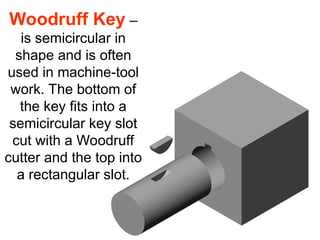
Woodruff Key –
is semicircular in
shape and is often
used in machine-tool
work. The bottom of
the key fits into a
semicircular key slot
cut with a Woodruff
cutter and the top into
a rectangular slot.
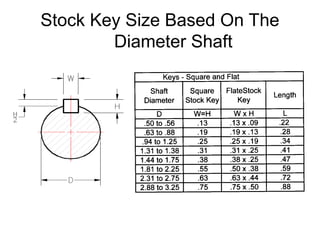
Stock Key Size Based On The
Diameter Shaft
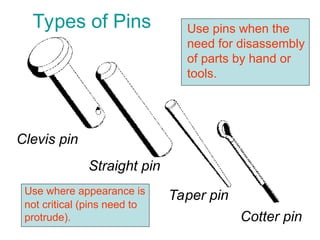
Types of Pins
Clevis pin
Straight pin
Taper pin
Cotter pin
Use pins when the
need for disassembly
of parts by hand or
tools.
Use where appearance is
not critical (pins need to
protrude).
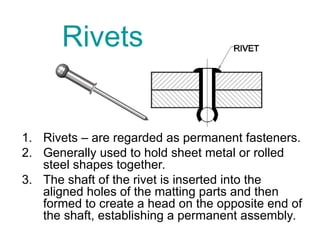
1. Rivets – are regarded as permanent fasteners.
2. Generally used to hold sheet metal or rolled
steel shapes together.
3. The shaft of the rivet is inserted into the
aligned holes of the matting parts and then
formed to create a head on the opposite end of
the shaft, establishing a permanent assembly.
Rivets

Threads and Fasteners.ppt

  • 1.
    Threads & Fasteners Competency: D505.00 Describevarious types of thread and fastener representations and their annotations.
  • 2.
    Threads & Fasteners Objective: D505.01 Specifythreads and fasteners on a technical drawing.
  • 3.
    Basic Applications ofThreads Basic Applications of Threads How are threads used? How are threads used? 1. 1.Hold parts together Hold parts together 2. 2.Adjust parts Adjust parts 3. 3.Transmit power Transmit power
  • 4.
    All screw threadswind around a shaft in a curve called a HELIX •the string represents the general form of a HELIX . •Another example of a HELIX curve is a coiled spring
  • 5.
    Tapping A SmallHole Tap Tool - is a small fluted cutting tool with cutting teeth shaped to form small internal threads.
  • 6.
    Cutting Large Threads Externalthreads are formed by cutting helical grooves around the shaft on a lathe. The Lathe can produce large internal threads by using a boring tool
  • 7.
  • 8.
    Thread Forms • SharpV or Sellers Thread • First U.S. Standard Thread • Now used on brass pipe work
  • 9.
    Thread Form Unified Thread •Adopted by the U.S., British, and Canada after World War II as an ANSI standard. • Mainly used for fastening and adjusting
  • 10.
    Thread Form • MetricThread • Adopted in 1946 by the International Organization for Standardization (ISO)
  • 11.
    Thread Form Square Thread •Theoretically the ideal thread for power transmission • Tough to cut the threads because of the 90° angles
  • 12.
    Thread Forms ACME Thread •Modification of the square thread • Stronger and easier to cut than the square thread • Also used to transmit power. • Better know as a worm thread.
  • 13.
    Thread Forms • WhitworthThread • First standard in England • Has been replaced by the Unified thread
  • 14.
    Thread Forms • KnuckleThread • Typically rolled from sheet metal • Sometimes is formed by casting • Used in light bulbs, sockets, and jar & bottle tops
  • 15.
    Thread Forms • ButtressThread • Designed to transmit power in one direction • Used on large guns, screw jacks, and Bumper Jacks.
  • 16.
    Thread Representation Symbolic Method MostCommon Practice Of The Two Is used for all forms of thread forms
  • 17.
  • 18.
  • 19.
    The tapped holeas it would appear on a drawing Conventional Practices SIMPLIFIED SYMBOL Blind Hole
  • 20.
    Conventional Practices SIMPLIFIED SYMBOL ABLIND TAPPED HOLE AS IT WOULD APPEAR ON A DRAWING IF TAPPED TO THE BOTTOM OF THE HOLE Blind Hole
  • 21.
    Can You IdentifyThe Following Conventions Within The Sectional View? A. Major diameter B. Thread Axis C. Minor diameter D. Thread depth
  • 22.
    Can You IdentifyThe Following Conventions Within The Elevation View? A. Tapped hole B. Major diameter C. Thread depth D. 30 degrees
  • 23.
    Annotations For UnifiedThread Major diameter of threads Number of threads per inch Unified National Coarse Class of Fit Internal thread
  • 24.
    Example Of AScrew Thread Table
  • 25.
    Annotation For MetricThreads M10 X 1.25 Metric thread Major diameter Separation Thread pitch
  • 26.
    Course (General Purpose)Fine Nominal Size & Pitch Tap Drill Diameter Nominal Size & Pitch Tap Drill Diameter M10 X 1.5 8.5 M10 X 1.25 8.75 M12 X 1.75 10.30 M12 X 1.25 10.5 M20 X 2.5 17.5 M20 X 1.5 18.5 Example Of A Metric Screw Thread Table
  • 27.
    Left Hand ThreadsAdvances Counterclockwise Right Hand Threads Advances Clockwise
  • 28.
    Other Types OfThreaded Other Types Of Threaded Fasteners Fasteners  Bolt Bolt & & Nut Nut  Cap Screws Cap Screws  Machine Screws Machine Screws  Set Screws Set Screws  Wood Screws Wood Screws
  • 29.
    CAP SCREWS Used tofasten parts together. Have a naturally bright finish to match the machined part. Chamfer to the depth of the first thread
  • 30.
    Cap Screw Types (a)Round, (b) Pan, (c) Oval, (d) Hex, (e) Socket, (f) Flat, and (g) Phillips
  • 31.
    Standard Dimensions UsedIn Drawing The Cap Screw D = Diameter of the shaft.
  • 32.
    Cap Screws &Bolts • What is the difference between a cap screw and a bolt? • Cap screws fasten into a threaded blind hole. • Bolts are usually accompany by a Nut to fasten parts together.
  • 33.
    Hex Socket CapScrew Is BEST used with a counterbored hole
  • 34.
    Flat Head CapScrew Countersinking is theBEST type of machined hole to accept a FLAT HEAD cap screw.
  • 35.
    Set Screws • Thereare generally two types: square-head and headless. • Because of safety issues the headless setscrew would be best for rotating parts.
  • 36.
    Set Screw Used tohold the collar to the shaft This type of set screw would be a safety issue if the assembly had a rotating motion.
  • 37.
    Fasteners For Wood •Wood Screws – create their own thread when you drive them into soft woods such as pine and spruce. – Cone shaped shafts for easy entry into the wood. – Hard woods, such as maple or oak, may require drilling a pilot hole. – Wood screws have flat, round, or oval heads with slotted or Phillips head configurations.
  • 38.
    Wood Screw HeadTypes (a) Round, (b) Flat, (c) Oval, (d) Phillips
  • 39.
    Non-Threaded Fasteners Non-Threaded Fasteners Keys& Keyways Keys & Keyways Rivets Rivets Cotter Pins Cotter Pins
  • 40.
    Keys Keys Are used toprevent relative Are used to prevent relative movement between, wheels, movement between, wheels, pulleys, gears, cranks, and pulleys, gears, cranks, and similar parts to a shaft. similar parts to a shaft.
  • 41.
  • 42.
    Square Key –Design is used for heavy- duty functions. Sometimes referred to as a flat key.
  • 43.
    Gib Head Key– It is exactly the same as the square key except that it has a gib head, which provides for easy removal.
  • 44.
    Pratt & WhitneyKey – is rectangle in shape with semi-cylindrical ends.
  • 45.
    Woodruff Key – issemicircular in shape and is often used in machine-tool work. The bottom of the key fits into a semicircular key slot cut with a Woodruff cutter and the top into a rectangular slot.
  • 46.
    Stock Key SizeBased On The Diameter Shaft
  • 47.
    Types of Pins Clevispin Straight pin Taper pin Cotter pin Use pins when the need for disassembly of parts by hand or tools. Use where appearance is not critical (pins need to protrude).
  • 48.
    1. Rivets –are regarded as permanent fasteners. 2. Generally used to hold sheet metal or rolled steel shapes together. 3. The shaft of the rivet is inserted into the aligned holes of the matting parts and then formed to create a head on the opposite end of the shaft, establishing a permanent assembly. Rivets