Thread Cutting by Hand (Taps and Dies)
Chapter 5
TOPICS
Introduction
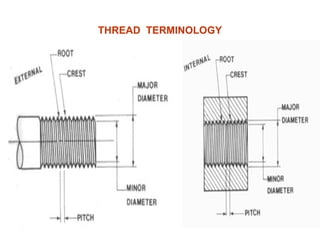
Thread terminology
Features of Hand Taps
Cutting internal threads
Cutting external threads
Introduction
• Screwed thread/fasteners occupy the most
prominent place among the removable
fasteners.
In general, screwed fasteners are used:-
• to hold parts together,
• to adjust parts with reference to each
other, /AS MEASURING INSTRUMENT/and
• to transmit power./LEAD SCREW ON LATHE/
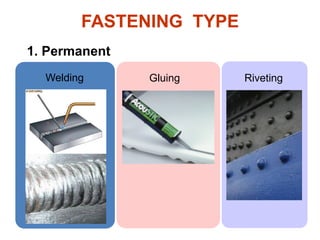
FASTENING TYPE
1. Permanent
Welding Gluing Riveting
FASTENING TYPE
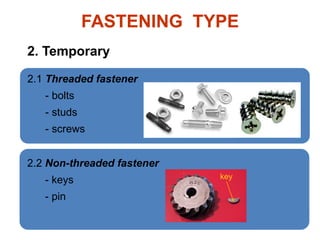
2.1 Threaded fastener
- bolts
- studs
- screws
2. Temporary
2.2 Non-threaded fastener
- keys
- pin
key
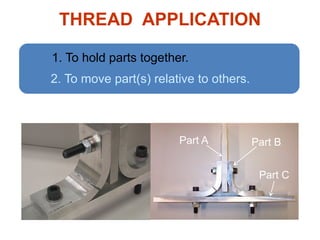
THREAD APPLICATION
1. To hold parts together.
2. To move part(s) relative to others.
Part A Part B
Part C
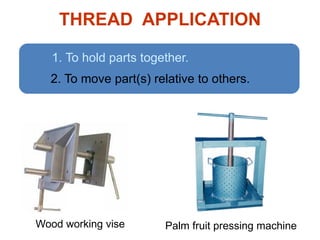
THREAD APPLICATION
1. To hold parts together.
2. To move part(s) relative to others.
Wood working vise Palm fruit pressing machine
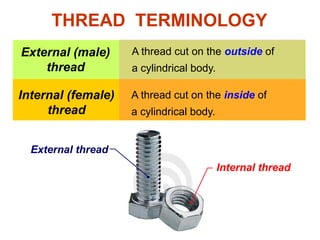
External (male)
thread
Internal (female)
thread
THREAD TERMINOLOGY
A thread cut on the outside of
a cylindrical body.
A thread cut on the inside of
a cylindrical body.
Internal thread
External thread
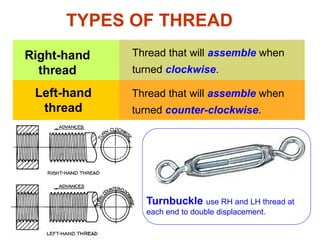
Right-hand
thread
Thread that will assemble when
turned clockwise.
Left-hand
thread
Thread that will assemble when
turned counter-clockwise.
TYPES OF THREAD
Turnbuckle use RH and LH thread at
each end to double displacement.
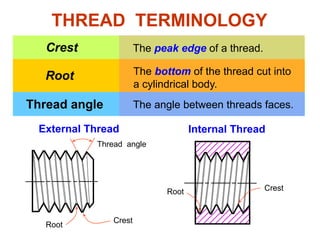
Crest
Root
Thread angle
THREAD TERMINOLOGY
The peak edge of a thread.
The bottom of the thread cut into
a cylindrical body.
The angle between threads faces.
Internal Thread
External Thread
Crest
Root
Thread angle
Crest
Root
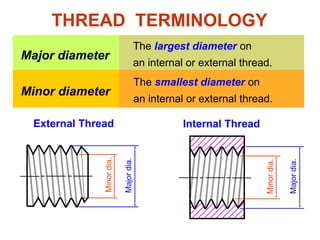
Major diameter
The largest diameter on
an internal or external thread.
Minor diameter
The smallest diameter on
an internal or external thread.
Internal Thread
External Thread
Minor
dia.
Major
dia.
THREAD TERMINOLOGY
Minor
dia.
Major
dia.
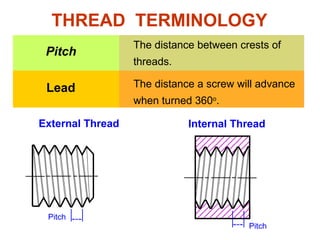
Pitch
The distance between crests of
threads.
Lead The distance a screw will advance
when turned 360o
.
THREAD TERMINOLOGY
Internal Thread
External Thread
Pitch
Pitch
THREAD TERMINOLOGY
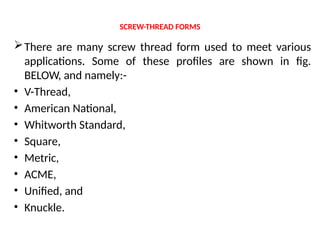
SCREW-THREAD FORMS
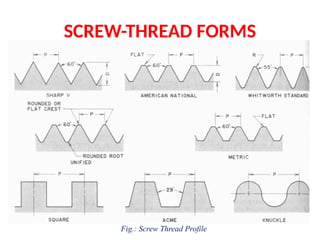
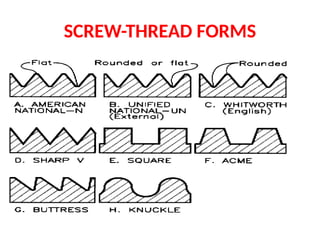
There are many screw thread form used to meet various
applications. Some of these profiles are shown in fig.
BELOW, and namely:-
• V-Thread,
• American National,
• Whitworth Standard,
• Square,
• Metric,
• ACME,
• Unified, and
• Knuckle.
SCREW-THREAD FORMS
Fig.: Screw Thread Profile
SCREW-THREAD FORMS
THREAD SPECIFICATION
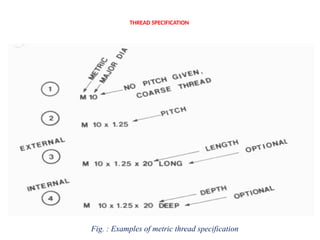
• Metric (ISO) threads are specified in a different
manner. They always start with the letter M to
indicate that this is a metric thread conforming to
the standards by the ISO.
• The next number is the major diameter in
millimeter. Mostly these are integers, but in smaller
sizes they may bear place decimal such as 1.6 or
2.5.
• The diameter is usually followed by an “x” and
another number that is the pitch of the thread in
millimeters. Since coarse threads are most
common, the may be omitted for coarse threads.
THREAD SPECIFICATION
Fig. : Examples of metric thread specification
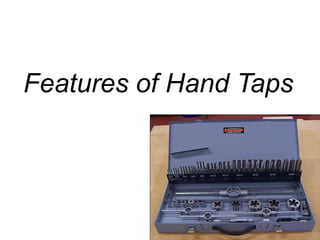
Features of Hand Taps
24-20
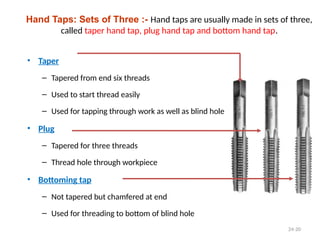
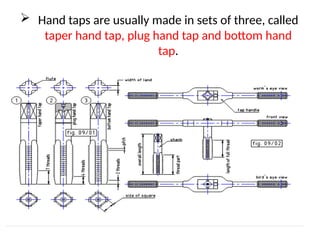
Hand Taps: Sets of Three :- Hand taps are usually made in sets of three,
called taper hand tap, plug hand tap and bottom hand tap.
• Taper
– Tapered from end six threads
– Used to start thread easily
– Used for tapping through work as well as blind hole
• Plug
– Tapered for three threads
– Thread hole through workpiece
• Bottoming tap
– Not tapered but chamfered at end
– Used for threading to bottom of blind hole
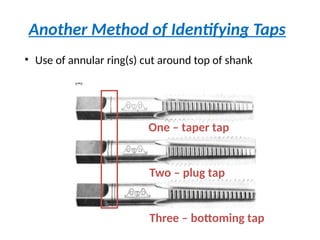
Another Method of Identifying Taps
• Use of annular ring(s) cut around top of shank
One – taper tap
Two – plug tap
Three – bottoming tap
 Hand taps are usually made in sets of three, called
taper hand tap, plug hand tap and bottom hand
tap.
Cutting external threads
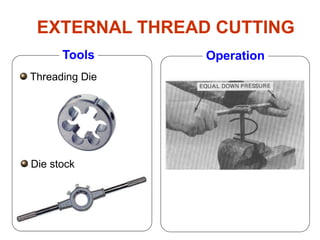
EXTERNAL THREAD CUTTING
Tools Operation
Threading Die
Die stock
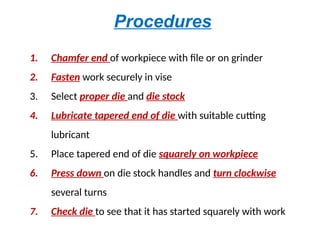
1. Chamfer end of workpiece with file or on grinder
2. Fasten work securely in vise
3. Select proper die and die stock
4. Lubricate tapered end of die with suitable cutting
lubricant
5. Place tapered end of die squarely on workpiece
6. Press down on die stock handles and turn clockwise
several turns
7. Check die to see that it has started squarely with work
Procedures
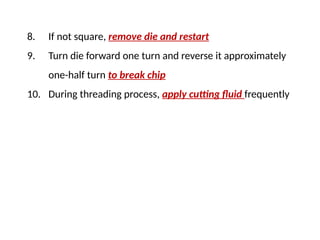
8. If not square, remove die and restart
9. Turn die forward one turn and reverse it approximately
one-half turn to break chip
10. During threading process, apply cutting fluid frequently
Cutting internal threads
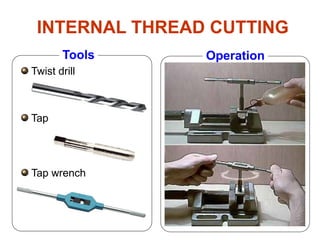
Twist drill
Tools
Tap
Tap wrench
Operation
INTERNAL THREAD CUTTING
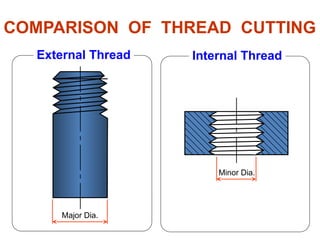
COMPARISON OF THREAD CUTTING
External Thread Internal Thread
Major Dia.
Minor Dia.
TAP DRILL SIZES FOR METRIC TAPS
• Before a tap is used, the hole must be drilled to the
correct tap drill size. This is the drill size that would
leave the proper amount of material in the hole for
a tap to cut a thread.
• When a chart is not available, the tap drill size for
the ISO (International Standards Organisation)
thread can be found easily by applying this simple
formular:-
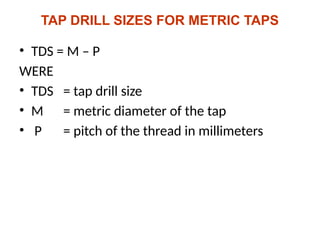
TAP DRILL SIZES FOR METRIC TAPS
• TDS = M – P
WERE
• TDS = tap drill size
• M = metric diameter of the tap
• P = pitch of the thread in millimeters
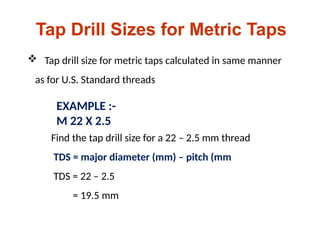
Tap Drill Sizes for Metric Taps
 Tap drill size for metric taps calculated in same manner
as for U.S. Standard threads
EXAMPLE :-
M 22 X 2.5
Find the tap drill size for a 22 – 2.5 mm thread
TDS = major diameter (mm) – pitch (mm
TDS = 22 – 2.5
= 19.5 mm
1. Select correct taps and tap wrench for job
2. Apply suitable cutting fluid to the tap
• No fluid required for tapping brass or cast iron
3. Place tap in hole as vertically as possible; press
downward on wrench, applying equal pressure on both
handles; turn clockwise (for right-hand thread) for two
turns
4. Remove tap wrench and check tap for squareness
• Check two positions at 90º to each other
Procedures
4. If tap not entered squarely, remove from hole and
restart it by applying pressure in direction from which
tap leans
5. When tap properly started, feed it into hole by turning
tap wrench
6. Turn tap clockwise one-quarter turn, and turn it
backward about ½ turn to break the chip (must turn
with steady motion)
SAFETY DURING THREAD
CUTTING
 Chips produced by hand threading are sharp and should be
cleaned by using a brush or piece of cloth.
 Do not use compressed air to remove the metal chips.
 Newly-cut external threads are very sharp. Again use a
brush or cloth to clean them.
 Wash your hands after using cutting fluids or oils.
 Be sure the die is clamped firmly in the die stock. If not, it
can fall from the holder and cause injury.
 An extra care should be taken in dealing with broken taps.

Unt5 5 THREAD CUTTING the best ever.pptx

  • 1.
    Thread Cutting byHand (Taps and Dies) Chapter 5
  • 2.
    TOPICS Introduction Thread terminology Features ofHand Taps Cutting internal threads Cutting external threads
  • 3.
    Introduction • Screwed thread/fastenersoccupy the most prominent place among the removable fasteners. In general, screwed fasteners are used:- • to hold parts together, • to adjust parts with reference to each other, /AS MEASURING INSTRUMENT/and • to transmit power./LEAD SCREW ON LATHE/
  • 4.
  • 5.
    FASTENING TYPE 2.1 Threadedfastener - bolts - studs - screws 2. Temporary 2.2 Non-threaded fastener - keys - pin key
  • 6.
    THREAD APPLICATION 1. Tohold parts together. 2. To move part(s) relative to others. Part A Part B Part C
  • 7.
    THREAD APPLICATION 1. Tohold parts together. 2. To move part(s) relative to others. Wood working vise Palm fruit pressing machine
  • 8.
    External (male) thread Internal (female) thread THREADTERMINOLOGY A thread cut on the outside of a cylindrical body. A thread cut on the inside of a cylindrical body. Internal thread External thread
  • 9.
    Right-hand thread Thread that willassemble when turned clockwise. Left-hand thread Thread that will assemble when turned counter-clockwise. TYPES OF THREAD Turnbuckle use RH and LH thread at each end to double displacement.
  • 10.
    Crest Root Thread angle THREAD TERMINOLOGY Thepeak edge of a thread. The bottom of the thread cut into a cylindrical body. The angle between threads faces. Internal Thread External Thread Crest Root Thread angle Crest Root
  • 11.
    Major diameter The largestdiameter on an internal or external thread. Minor diameter The smallest diameter on an internal or external thread. Internal Thread External Thread Minor dia. Major dia. THREAD TERMINOLOGY Minor dia. Major dia.
  • 12.
    Pitch The distance betweencrests of threads. Lead The distance a screw will advance when turned 360o . THREAD TERMINOLOGY Internal Thread External Thread Pitch Pitch
  • 13.
  • 14.
    SCREW-THREAD FORMS There aremany screw thread form used to meet various applications. Some of these profiles are shown in fig. BELOW, and namely:- • V-Thread, • American National, • Whitworth Standard, • Square, • Metric, • ACME, • Unified, and • Knuckle.
  • 15.
  • 16.
  • 17.
    THREAD SPECIFICATION • Metric(ISO) threads are specified in a different manner. They always start with the letter M to indicate that this is a metric thread conforming to the standards by the ISO. • The next number is the major diameter in millimeter. Mostly these are integers, but in smaller sizes they may bear place decimal such as 1.6 or 2.5. • The diameter is usually followed by an “x” and another number that is the pitch of the thread in millimeters. Since coarse threads are most common, the may be omitted for coarse threads.
  • 18.
    THREAD SPECIFICATION Fig. :Examples of metric thread specification
  • 19.
  • 20.
    24-20 Hand Taps: Setsof Three :- Hand taps are usually made in sets of three, called taper hand tap, plug hand tap and bottom hand tap. • Taper – Tapered from end six threads – Used to start thread easily – Used for tapping through work as well as blind hole • Plug – Tapered for three threads – Thread hole through workpiece • Bottoming tap – Not tapered but chamfered at end – Used for threading to bottom of blind hole
  • 21.
    Another Method ofIdentifying Taps • Use of annular ring(s) cut around top of shank One – taper tap Two – plug tap Three – bottoming tap
  • 22.
     Hand tapsare usually made in sets of three, called taper hand tap, plug hand tap and bottom hand tap.
  • 23.
  • 24.
    EXTERNAL THREAD CUTTING ToolsOperation Threading Die Die stock
  • 25.
    1. Chamfer endof workpiece with file or on grinder 2. Fasten work securely in vise 3. Select proper die and die stock 4. Lubricate tapered end of die with suitable cutting lubricant 5. Place tapered end of die squarely on workpiece 6. Press down on die stock handles and turn clockwise several turns 7. Check die to see that it has started squarely with work Procedures
  • 26.
    8. If notsquare, remove die and restart 9. Turn die forward one turn and reverse it approximately one-half turn to break chip 10. During threading process, apply cutting fluid frequently
  • 27.
  • 28.
  • 29.
    COMPARISON OF THREADCUTTING External Thread Internal Thread Major Dia. Minor Dia.
  • 30.
    TAP DRILL SIZESFOR METRIC TAPS • Before a tap is used, the hole must be drilled to the correct tap drill size. This is the drill size that would leave the proper amount of material in the hole for a tap to cut a thread. • When a chart is not available, the tap drill size for the ISO (International Standards Organisation) thread can be found easily by applying this simple formular:-
  • 31.
    TAP DRILL SIZESFOR METRIC TAPS • TDS = M – P WERE • TDS = tap drill size • M = metric diameter of the tap • P = pitch of the thread in millimeters
  • 32.
    Tap Drill Sizesfor Metric Taps  Tap drill size for metric taps calculated in same manner as for U.S. Standard threads EXAMPLE :- M 22 X 2.5 Find the tap drill size for a 22 – 2.5 mm thread TDS = major diameter (mm) – pitch (mm TDS = 22 – 2.5 = 19.5 mm
  • 33.
    1. Select correcttaps and tap wrench for job 2. Apply suitable cutting fluid to the tap • No fluid required for tapping brass or cast iron 3. Place tap in hole as vertically as possible; press downward on wrench, applying equal pressure on both handles; turn clockwise (for right-hand thread) for two turns 4. Remove tap wrench and check tap for squareness • Check two positions at 90º to each other Procedures
  • 34.
    4. If tapnot entered squarely, remove from hole and restart it by applying pressure in direction from which tap leans 5. When tap properly started, feed it into hole by turning tap wrench 6. Turn tap clockwise one-quarter turn, and turn it backward about ½ turn to break the chip (must turn with steady motion)
  • 35.
    SAFETY DURING THREAD CUTTING Chips produced by hand threading are sharp and should be cleaned by using a brush or piece of cloth.  Do not use compressed air to remove the metal chips.  Newly-cut external threads are very sharp. Again use a brush or cloth to clean them.  Wash your hands after using cutting fluids or oils.  Be sure the die is clamped firmly in the die stock. If not, it can fall from the holder and cause injury.  An extra care should be taken in dealing with broken taps.