4. Tangible Interfaces
Main Source Kenneth P. Fishkin, A Taxonomy for and Analysis of Tangible Interfaces. Journal of Personal and Ubiquitous Computing,   8   (5), September 2004, 347-358.
Basics CHI 1997, Hiroshi Ishii & Brett Ullmer: “Tangible User Interfaces” (TUIs) =  user interfaces that “augment the real physical world by coupling digital information to everyday physical objects and environments”. Later refined: No distinction between input and output (Ullmer & Ishii, 2001) Related terms: graspable, embodied, manipulative, haptic
Definitions hap-tic  1. relating to or based on the sense of touch  2. characterized by a predilection for the sense of touch <a haptic person>  tac-tile  1. perceptible by touch: TANGIBLE  2. of or relating to the sense of touch  tan-gi-ble  1.a : capable of being perceived especially by the sense of touch: PALPABLE  Source: Merriam-Webster
Example of a Tangible Interface 1 Hug over a distance Source: M ü ller et al., 2005
Already Commercialized: Hug Shirt! Shirts with sensors and actuators Works by cell phones Java software BlueTooth Participatory design Taxonomy of hugs Bodystorming (people hugging for a long time   ) Source: http://www.cutecircuit.com/now/projects/wearables/fr-hugs/
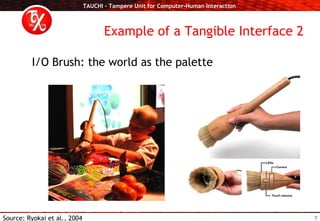
Example of a Tangible Interface 2 I/O Brush: the world as the palette Source: Ryokai et al., 2004
Development of the I/O Brush Source: Ryokai et al., 2005 Robust design Pressure sensing Orientation sensing Smudging support Paint history Paint palette
Sample Art Work Source: Ryokai et al., 2005
Fishkin’s Framework Some  input event  occurs. This input event is typically a physical manipulation performed by a user with their hands on some “everyday physical object”, such as tilting, shaking, squeezing, pushing, or most often moving.  A computer system  senses  this input event, and alters its state. The system provides feedback. This  output event  is via a change in the physical nature of some object – it alters its display surface, grows, shrinks, makes a sound, gives haptic feedback, etc.
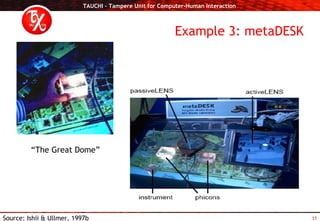
Example 3: metaDESK Source: Ishii & Ullmer, 1997b “ The Great Dome”
Typical Components Source: Ishii & Ullmer, 1997b
Great Dome: Input and Output Input: rotation and translation Input object: indicative of a building Output: altered display of the workspace Output object: augmented desktop
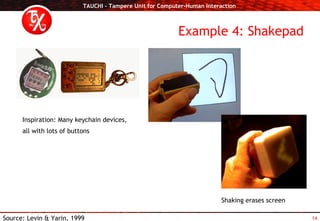
Example 4: Shakepad Source: Levin & Yarin, 1999 Inspiration: Many keychain devices, all with lots of buttons Shaking erases screen
Shakepad: Input and Output Input: shake Input object: “non-everyday” object Output: clear the screen Output object: same as input object
Example 5: ToonTown Shared audio system Location on tray controls volume Source: Singer et al., 1999
ToonTown: Input and Output Input: change of position Input objects: two representative objects Output: audio changes
Example 6: Photo Cubes Source: Want et al., 1999
Photo Cubes: Input and Output Input: spatial motion with orientation Input objects: one everyday object Output: altered display Output objects: non-everyday object
What About These? Wellner, 1993: Digital Desktop Ishii, 1995: Tangible Bricks
Sorting Out the Design Space Taxonomy: “orderly classification of plants and animals according to their presumed natural relationships” (Merriam-Webster) Taxonomy of Tangible User Interfaces Two-dimensional Embodiment Metaphor The higher an interface is in both dimensions, the more tangible it is
Embodiment Reflects how closely output is tied to input Does the user have the illusion of the system state being “inside” the object that is manipulated? Fishkin proposes a four-level scale Full Nearby Environmental Distant
Full Embodiment The output device  is  the input device Analogy: clay sculpting Examples: Rekimoto, 1996: Tilting interface
Gummi Source: Schwesig et al., 2004 Commercial version by Sony: http:// www.sony.net / Fun / SonyDesign /2003/ Gummi /
Platybus Amoeba As users approach the Platypus Amoeba they see a strange glowing creature. A translucent white blob with two glowing eyes, the Platy looks like the helpless baby of an alien creature. Platypus Amoeba emits small noises and a faint glow until a hand is moved over the soft skin and Platy gives a pleasant coo. Petting Platy has made it happy. What will more petting do? Perhaps you excite Platy and are rewarded with a display of colors or maybe it is displeased and truculent. Platy's reactions give you information as you use petting to interface with Platy and understand how Platy wants to be petted. Source:  Churi & Lin, 2003
Nearby Embodiment The output takes place  near  the input object First examples in HCI: light pen Examples: Bricks Great Dome (metaDESK) Photo Cube
Environmental Embodiment The output is  around  the user, often in audio “ Non-graspable” interfaces Examples: ToonTown
Distant Embodiment The output is  “over there” On another screen In another room … Examples: Doll’s Head Source: Hinckley, 1994
Applications May Span Several Levels Platypus Amoeba Makes sounds    Environmental Responds to patting    Full PingPongPlus Environmental and Nearby (Ishii et al., 1999)
Metaphor “ figure of speech in which a word or phrase literally denoting one kind of object or idea is used in place of another to suggest a likeness or analogy between them” (Merriam-Webster) “ drown in money” Can use a variety of attributes: shape, size, color, weight, smell, texture, … Here: Is the system effect of a user action analogous to the real-world effect of similar actions? Fishkin proposes two sub-dimensions: Shape of object    “metaphor of noun” Motion of object    “metaphor of verb”
No Metaphor Analogy: command-line interface Examples: The BitBall Programmable Beads Source: http://web.media.mit.edu/~mres/papers/chi-98/digital-manip.html
eTextiles Source: http://www.cs.colorado.edu/~buechley/projects/LED_clothing/tank.html
Noun Metaphor Object looks like the real thing Actions are at most weakly related to real-world actions Examples: Navigational blocks Tagged objects Source for Blocks: http://dmg.caup.washington.edu/xmlSiteEngine/browsers/static/project3.html
Tagged Objects Source: Want et al., 1999
Verb Metaphor Object acts like the real thing Shape of object irrelevant Example: Shakepad
Noun and Verb Metaphor Object looks and acts like the real thing – but they are still different Analogy: Desktop metaphor (to some extent) Examples ToonTown Urp Source for Urps: http://tangible.media.mit.edu/projects/urbansim/
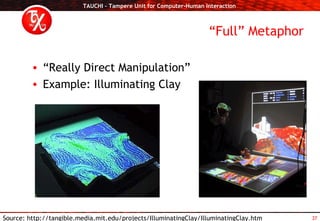
“Full” Metaphor “Really Direct Manipulation” Example: Illuminating Clay Source: http://tangible.media.mit.edu/projects/IlluminatingClay/IlluminatingClay.htm
Applications May Span Several Levels Example: Barney Peek-A-Boo: full metaphor Singing: noun metaphor
Let’s Try  It! 1 2 3 4 5 6 7 8 9 10 11 12 13 14 Names: None Verb Noun and verb Full Full Noun Metaphor Nearby Environment Distant Embodiment

Tangible Interfaces

  • 1.
  • 2.
    Main Source KennethP. Fishkin, A Taxonomy for and Analysis of Tangible Interfaces. Journal of Personal and Ubiquitous Computing, 8 (5), September 2004, 347-358.
  • 3.
    Basics CHI 1997,Hiroshi Ishii & Brett Ullmer: “Tangible User Interfaces” (TUIs) = user interfaces that “augment the real physical world by coupling digital information to everyday physical objects and environments”. Later refined: No distinction between input and output (Ullmer & Ishii, 2001) Related terms: graspable, embodied, manipulative, haptic
  • 4.
    Definitions hap-tic 1. relating to or based on the sense of touch 2. characterized by a predilection for the sense of touch <a haptic person> tac-tile 1. perceptible by touch: TANGIBLE 2. of or relating to the sense of touch tan-gi-ble 1.a : capable of being perceived especially by the sense of touch: PALPABLE Source: Merriam-Webster
  • 5.
    Example of aTangible Interface 1 Hug over a distance Source: M ü ller et al., 2005
  • 6.
    Already Commercialized: HugShirt! Shirts with sensors and actuators Works by cell phones Java software BlueTooth Participatory design Taxonomy of hugs Bodystorming (people hugging for a long time  ) Source: http://www.cutecircuit.com/now/projects/wearables/fr-hugs/
  • 7.
    Example of aTangible Interface 2 I/O Brush: the world as the palette Source: Ryokai et al., 2004
  • 8.
    Development of theI/O Brush Source: Ryokai et al., 2005 Robust design Pressure sensing Orientation sensing Smudging support Paint history Paint palette
  • 9.
    Sample Art WorkSource: Ryokai et al., 2005
  • 10.
    Fishkin’s Framework Some input event occurs. This input event is typically a physical manipulation performed by a user with their hands on some “everyday physical object”, such as tilting, shaking, squeezing, pushing, or most often moving. A computer system senses this input event, and alters its state. The system provides feedback. This output event is via a change in the physical nature of some object – it alters its display surface, grows, shrinks, makes a sound, gives haptic feedback, etc.
  • 11.
    Example 3: metaDESKSource: Ishii & Ullmer, 1997b “ The Great Dome”
  • 12.
    Typical Components Source:Ishii & Ullmer, 1997b
  • 13.
    Great Dome: Inputand Output Input: rotation and translation Input object: indicative of a building Output: altered display of the workspace Output object: augmented desktop
  • 14.
    Example 4: ShakepadSource: Levin & Yarin, 1999 Inspiration: Many keychain devices, all with lots of buttons Shaking erases screen
  • 15.
    Shakepad: Input andOutput Input: shake Input object: “non-everyday” object Output: clear the screen Output object: same as input object
  • 16.
    Example 5: ToonTownShared audio system Location on tray controls volume Source: Singer et al., 1999
  • 17.
    ToonTown: Input andOutput Input: change of position Input objects: two representative objects Output: audio changes
  • 18.
    Example 6: PhotoCubes Source: Want et al., 1999
  • 19.
    Photo Cubes: Inputand Output Input: spatial motion with orientation Input objects: one everyday object Output: altered display Output objects: non-everyday object
  • 20.
    What About These?Wellner, 1993: Digital Desktop Ishii, 1995: Tangible Bricks
  • 21.
    Sorting Out theDesign Space Taxonomy: “orderly classification of plants and animals according to their presumed natural relationships” (Merriam-Webster) Taxonomy of Tangible User Interfaces Two-dimensional Embodiment Metaphor The higher an interface is in both dimensions, the more tangible it is
  • 22.
    Embodiment Reflects howclosely output is tied to input Does the user have the illusion of the system state being “inside” the object that is manipulated? Fishkin proposes a four-level scale Full Nearby Environmental Distant
  • 23.
    Full Embodiment Theoutput device is the input device Analogy: clay sculpting Examples: Rekimoto, 1996: Tilting interface
  • 24.
    Gummi Source: Schwesiget al., 2004 Commercial version by Sony: http:// www.sony.net / Fun / SonyDesign /2003/ Gummi /
  • 25.
    Platybus Amoeba Asusers approach the Platypus Amoeba they see a strange glowing creature. A translucent white blob with two glowing eyes, the Platy looks like the helpless baby of an alien creature. Platypus Amoeba emits small noises and a faint glow until a hand is moved over the soft skin and Platy gives a pleasant coo. Petting Platy has made it happy. What will more petting do? Perhaps you excite Platy and are rewarded with a display of colors or maybe it is displeased and truculent. Platy's reactions give you information as you use petting to interface with Platy and understand how Platy wants to be petted. Source: Churi & Lin, 2003
  • 26.
    Nearby Embodiment Theoutput takes place near the input object First examples in HCI: light pen Examples: Bricks Great Dome (metaDESK) Photo Cube
  • 27.
    Environmental Embodiment Theoutput is around the user, often in audio “ Non-graspable” interfaces Examples: ToonTown
  • 28.
    Distant Embodiment Theoutput is “over there” On another screen In another room … Examples: Doll’s Head Source: Hinckley, 1994
  • 29.
    Applications May SpanSeveral Levels Platypus Amoeba Makes sounds  Environmental Responds to patting  Full PingPongPlus Environmental and Nearby (Ishii et al., 1999)
  • 30.
    Metaphor “ figureof speech in which a word or phrase literally denoting one kind of object or idea is used in place of another to suggest a likeness or analogy between them” (Merriam-Webster) “ drown in money” Can use a variety of attributes: shape, size, color, weight, smell, texture, … Here: Is the system effect of a user action analogous to the real-world effect of similar actions? Fishkin proposes two sub-dimensions: Shape of object  “metaphor of noun” Motion of object  “metaphor of verb”
  • 31.
    No Metaphor Analogy:command-line interface Examples: The BitBall Programmable Beads Source: http://web.media.mit.edu/~mres/papers/chi-98/digital-manip.html
  • 32.
  • 33.
    Noun Metaphor Objectlooks like the real thing Actions are at most weakly related to real-world actions Examples: Navigational blocks Tagged objects Source for Blocks: http://dmg.caup.washington.edu/xmlSiteEngine/browsers/static/project3.html
  • 34.
    Tagged Objects Source:Want et al., 1999
  • 35.
    Verb Metaphor Objectacts like the real thing Shape of object irrelevant Example: Shakepad
  • 36.
    Noun and VerbMetaphor Object looks and acts like the real thing – but they are still different Analogy: Desktop metaphor (to some extent) Examples ToonTown Urp Source for Urps: http://tangible.media.mit.edu/projects/urbansim/
  • 37.
    “Full” Metaphor “ReallyDirect Manipulation” Example: Illuminating Clay Source: http://tangible.media.mit.edu/projects/IlluminatingClay/IlluminatingClay.htm
  • 38.
    Applications May SpanSeveral Levels Example: Barney Peek-A-Boo: full metaphor Singing: noun metaphor
  • 39.
    Let’s Try It! 1 2 3 4 5 6 7 8 9 10 11 12 13 14 Names: None Verb Noun and verb Full Full Noun Metaphor Nearby Environment Distant Embodiment