Taming Snakemake
1/27/14
Why Make?


What are Make's advantages (over Perl and shell scripts)?


Make forces you to think about file transformation in terms of inputs and outputs, recipes and rules. In Perl you are forced to think at the level of
variables, conditionals, and loops. In Shell you are forced to think like a caveman.



Unfortunately, bioinformatics is still largely about files and their suffixes. Make has a very powerful syntax based almost entirely around file suffixes.



Make knows what's been made and what hasn't. Make can be interrupted and restarted safely, and without overwriting finished work.



Make knows what's changed and what hasn't. If an input is newer than an output, it will attempt to rebuild the output.



Make allows you to add new input files without worrying about overwriting old ones.



Make is well supported. There are 1333 Make questions on SO alone.



When people see a Makefile, they immediately know how to run it.



Make does not force you to wrap shell statements in quotes.



Make is a DSL. It will attempt to validate your syntax.



Make is ancient, ubiquitous, and reliable.



Make can parallelize with --jobs.



Make recipes encourage reuse.

https://share.chop.edu/pages/viewpage.action?pageId=138478819
Make review

http://github.research.chop.edu/BiG/err_chip_seq/blob/master/Makefile
Pipelines and Workflows
Other pipelines
Ruffus

Queue

GKNO
Why Snakemake?
 Addresses Makefile weaknesses without
throwing out the good stuff
 Difficult to implement control flow
 No cluster support
 Inflexible wildcards
 Too much reliance on sentinal files
 No reporting mechanism

Johannes Köster
Syntax
Make
Variables

Targets

Rules

Snakemake
Utilities
 Logs - wire them up manually

 Cluster support pretty decent
source /nas/is1/leipzig/martin/variome-env/bin/activate
snakemake --directory /nas/is1/leipzig/martin/snake-env --snakefile /nas/is1/leipzig/martin/snake-env/Snakefile -c qsub -j
16
source /mnt/isilon/cbmi/variome/leipzig/martin/respublica-env/bin/activate
snakemake --directory /mnt/isilon/cbmi/variome/leipzig/martin/snake-env --snakefile /mnt/isilon/cbmi/variome/leipzig/martin/snake-env/Snakefile -c qsub -j
16

 Cores/jobs/resources
Useful stuff
 dry-runs
 keep-going
 touch
 version changes
 workflow diagrams
Python legal
Client websites with Jekyll
 Jekyll is a templating engine for blogs that
accepts Markdown
 Layouts use the Liquid markup

http://mitomap.org/martin-rnaseq/
A workflow that reports itself
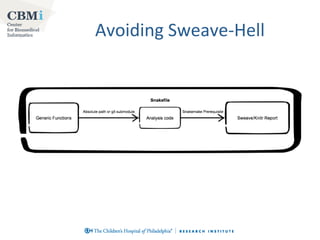
Avoiding Sweave-Hell
The bad way
Cache-ing chunks?
Avoiding Sweave-Hell
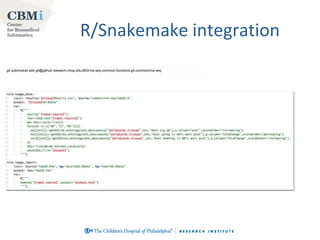
R/Snakemake integration
git submodule add git@github.research.chop.edu:BiG/rna-seq-common-functions.git common/rna-seq
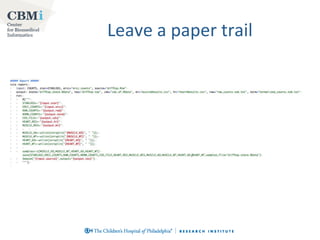
Leave a paper trail
Reproducible Checklist
 repository github.research.chop.edu
 workflow of some kind from beginning to end
 website at mybic.chop.edu
Ties that bind

Taming Snakemake

  • 1.
  • 2.
    Why Make?  What areMake's advantages (over Perl and shell scripts)?  Make forces you to think about file transformation in terms of inputs and outputs, recipes and rules. In Perl you are forced to think at the level of variables, conditionals, and loops. In Shell you are forced to think like a caveman.  Unfortunately, bioinformatics is still largely about files and their suffixes. Make has a very powerful syntax based almost entirely around file suffixes.  Make knows what's been made and what hasn't. Make can be interrupted and restarted safely, and without overwriting finished work.  Make knows what's changed and what hasn't. If an input is newer than an output, it will attempt to rebuild the output.  Make allows you to add new input files without worrying about overwriting old ones.  Make is well supported. There are 1333 Make questions on SO alone.  When people see a Makefile, they immediately know how to run it.  Make does not force you to wrap shell statements in quotes.  Make is a DSL. It will attempt to validate your syntax.  Make is ancient, ubiquitous, and reliable.  Make can parallelize with --jobs.  Make recipes encourage reuse. https://share.chop.edu/pages/viewpage.action?pageId=138478819
  • 3.
  • 4.
  • 5.
  • 6.
    Why Snakemake?  AddressesMakefile weaknesses without throwing out the good stuff  Difficult to implement control flow  No cluster support  Inflexible wildcards  Too much reliance on sentinal files  No reporting mechanism Johannes Köster
  • 7.
  • 8.
    Utilities  Logs -wire them up manually  Cluster support pretty decent source /nas/is1/leipzig/martin/variome-env/bin/activate snakemake --directory /nas/is1/leipzig/martin/snake-env --snakefile /nas/is1/leipzig/martin/snake-env/Snakefile -c qsub -j 16 source /mnt/isilon/cbmi/variome/leipzig/martin/respublica-env/bin/activate snakemake --directory /mnt/isilon/cbmi/variome/leipzig/martin/snake-env --snakefile /mnt/isilon/cbmi/variome/leipzig/martin/snake-env/Snakefile -c qsub -j 16  Cores/jobs/resources
  • 9.
    Useful stuff  dry-runs keep-going  touch  version changes  workflow diagrams
  • 10.
  • 11.
    Client websites withJekyll  Jekyll is a templating engine for blogs that accepts Markdown  Layouts use the Liquid markup http://mitomap.org/martin-rnaseq/
  • 12.
    A workflow thatreports itself
  • 13.
  • 14.
  • 15.
  • 16.
  • 17.
  • 18.
    R/Snakemake integration git submoduleadd git@github.research.chop.edu:BiG/rna-seq-common-functions.git common/rna-seq
  • 19.
  • 20.
    Reproducible Checklist  repositorygithub.research.chop.edu  workflow of some kind from beginning to end  website at mybic.chop.edu
  • 21.