 Simple past
 Past continuous

Past perfect

Past perfect continuous
Usamos el pasado simple para expresar que una acción
comenzó y terminó en un tiempo específico en el pasado.
Puede ser usado con una duración la cual comenzó y se
finalizó en el pasado: durante dos años, una semana,
cuatro días etc.


Form: SUBJECT+ VERB + ED OR IRREGULAR VERBS
 I saw “toy story” the last
 weekend.
I lived in Guanajuato for 6
 months.
He studied English for 1 year
He didn’t sleep the last night.
 I didn’t undestand this topic.
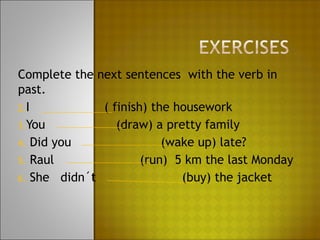
Complete the next sentences with the verb in
past.
2.I           ( finish) the housework
3.You            (draw) a pretty family
4. Did you                (wake up) late?
5. Raul               (run) 5 km the last Monday
6. She didn´t                (buy) the jacket
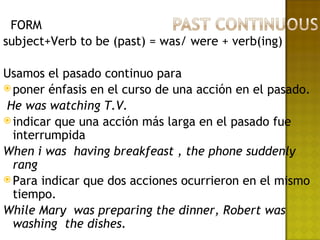
FORM
subject+Verb to be (past) = was/ were + verb(ing)

Usamos el pasado continuo para
 poner énfasis en el curso de una acción en el pasado.

He was watching T.V.
 indicar que una acción más larga en el pasado fue
  interrumpida
When i was having breakfeast , the phone suddenly
  rang
 Para indicar que dos acciones ocurrieron en el mismo
  tiempo.
While Mary was preparing the dinner, Robert was
  washing the dishes.
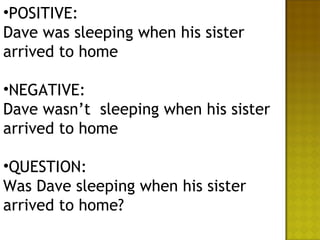
•POSITIVE:
Dave was sleeping when his sister
arrived to home

•NEGATIVE:
Dave wasn’t sleeping when his sister
arrived to home

•QUESTION:
Was Dave sleeping when his sister
arrived to home?
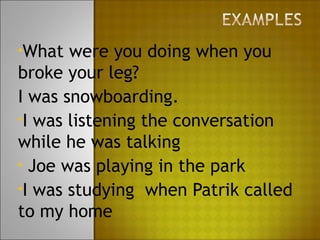
•What  were you doing when you
broke your leg?
I was snowboarding.
•I was listening the conversation
while he was talking
• Joe was playing in the park
•I was studying when Patrik called
to my home
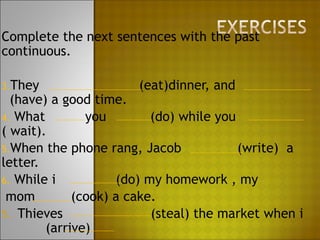
Complete the next sentences with the past
continuous.

3.They                 (eat)dinner, and
  (have) a good time.
4. What        you        (do) while you
( wait).
5.When the phone rang, Jacob             (write) a
letter.
6. While i          (do) my homework , my
 mom         (cook) a cake.
5. Thieves                (steal) the market when i
        (arrive)
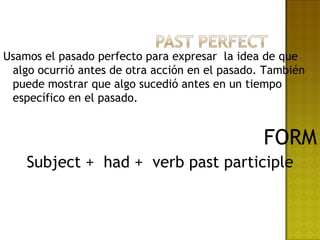
Usamos el pasado perfecto para expresar la idea de que
 algo ocurrió antes de otra acción en el pasado. También
 puede mostrar que algo sucedió antes en un tiempo
 específico en el pasado.


                                                FORM
    Subject + had + verb past participle
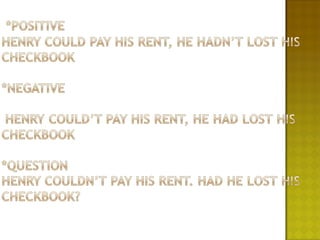
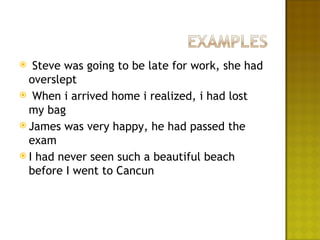
  Steve was going to be late for work, she had
  overslept
 When i arrived home i realized, i had lost
  my bag
 James was very happy, he had passed the
  exam
 I had never seen such a beautiful beach
  before I went to Cancun
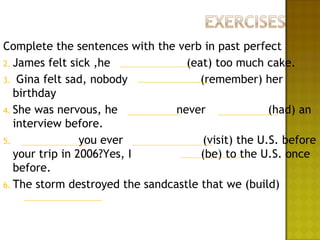
Complete the sentences with the verb in past perfect
2. James felt sick ,he             (eat) too much cake.
3. Gina felt sad, nobody              (remember) her
   birthday
4. She was nervous, he           never               (had) an
   interview before.
5.               you ever              (visit) the U.S. before
   your trip in 2006?Yes, I           (be) to the U.S. once
   before.
6. The storm destroyed the sandcastle that we (build)
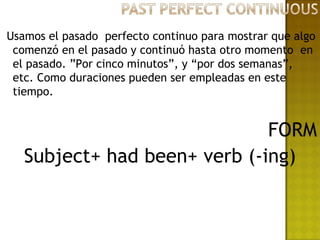
Usamos el pasado perfecto continuo para mostrar que algo
 comenzó en el pasado y continuó hasta otro momento en
 el pasado. ”Por cinco minutos”, y “por dos semanas”,
 etc. Como duraciones pueden ser empleadas en este
 tiempo.


                              FORM
   Subject+ had been+ verb (-ing)
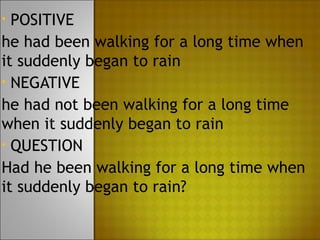
• POSITIVE
he had been walking for a long time when
it suddenly began to rain
• NEGATIVE

he had not been walking for a long time
when it suddenly began to rain
• QUESTION

Had he been walking for a long time when
it suddenly began to rain?
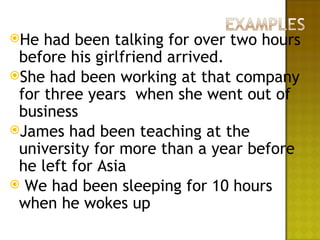
He  had been talking for over two hours
 before his girlfriend arrived.
She had been working at that company
 for three years when she went out of
 business
James had been teaching at the
 university for more than a year before
 he left for Asia
 We had been sleeping for 10 hours
 when he wokes up
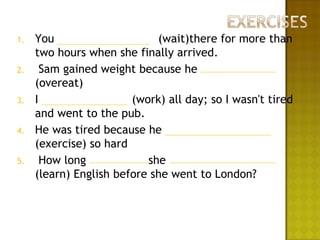
1.   You                     (wait)there for more than
     two hours when she finally arrived.
2.     Sam gained weight because he
     (overeat)
3.   I                  (work) all day; so I wasn't tired
     and went to the pub.
4.   He was tired because he
     (exercise) so hard
5.     How long            she
     (learn) English before she went to London?
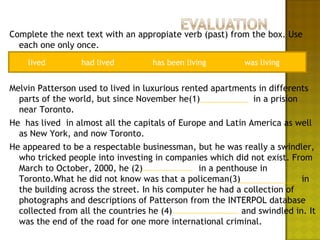
Complete the next text with an appropiate verb (past) from the box. Use
  each one only once.
    lived         had lived         has been living        was living


Melvin Patterson used to lived in luxurious rented apartments in differents
  parts of the world, but since November he(1)               in a prision
  near Toronto.
He has lived in almost all the capitals of Europe and Latin America as well
  as New York, and now Toronto.
He appeared to be a respectable businessman, but he was really a swindler,
  who tricked people into investing in companies which did not exist. From
  March to October, 2000, he (2)                in a penthouse in
  Toronto.What he did not know was that a policeman(3)                    in
  the building across the street. In his computer he had a collection of
  photographs and descriptions of Patterson from the INTERPOL database
  collected from all the countries he (4)                 and swindled in. It
  was the end of the road for one more international criminal.
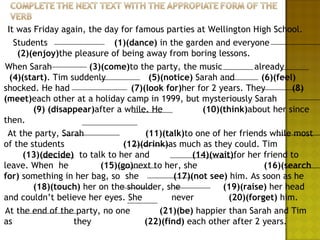
It was Friday again, the day for famous parties at Wellington High School.
   Students                  (1)(dance) in the garden and everyone
    (2)(enjoy)the pleasure of being away from boring lessons.
When Sarah             (3)(come)to the party, the music           already
  (4)(start). Tim suddenly             (5)(notice) Sarah and        (6)(feel)
shocked. He had                   (7)(look for)her for 2 years. They        (8)
(meet)each other at a holiday camp in 1999, but mysteriously Sarah
        (9) (disappear)after a while. He             (10)(think)about her since
then.
 At the party, Sarah                  (11)(talk)to one of her friends while most
of the students                 (12)(drink)as much as they could. Tim
     (13)(decide) to talk to her and               (14)(wait)for her friend to
leave. When he            (15)(go)next to her, she                   (16)(search
for) something in her bag, so she             (17)(not see) him. As soon as he
        (18)(touch) her on the shoulder, she              (19)(raise) her head
and couldn’t believe her eyes. She           never          (20)(forget) him.
At the end of the party, no one           (21)(be) happier than Sarah and Tim
as                 they               (22)(find) each other after 2 years.
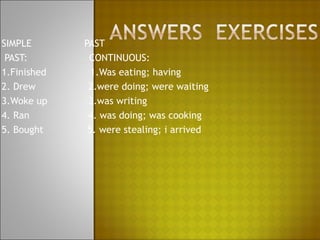
SIMPLE       PAST
 PAST:        CONTINUOUS:
1.Finished     1.Was eating; having
2. Drew       2.were doing; were waiting
3.Woke up     3.was writing
4. Ran        4. was doing; was cooking
5. Bought     5. were stealing; i arrived
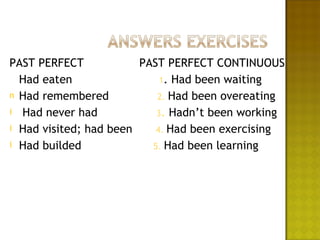
PAST PERFECT            PAST PERFECT CONTINUOUS
  Had eaten                 1. Had been waiting
n Had remembered           2. Had been overeating
i Had never had            3. Hadn’t been working
i Had visited; had been    4. Had been exercising
i Had builded             5. Had been learning
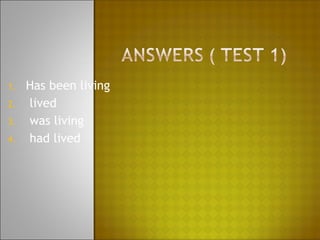
1.   Has been living
2.   lived
3.   was living
4.   had lived
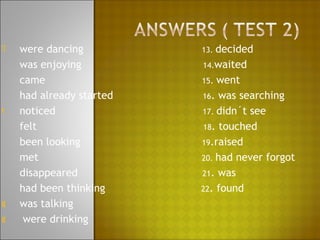
è   were dancing          13. decided
    was enjoying          14.waited
    came                  15. went
    had already started   16. was searching
t   noticed               17. didn´t see
    felt                  18. touched
    been looking          19.raised
    met                   20. had never forgot
    disappeared           21. was
    had been thinking     22. found
g   was talking
g    were drinking
BIBLIOGRAFÍA
• Guzmán García Patricia
•Michaca Abeja Abigail

• Rodea Anaya Arlette

•Ugarte Reséndiz Diana

Course on line about english

  • 1.
     Simple past Past continuous Past perfect Past perfect continuous
  • 2.
    Usamos el pasadosimple para expresar que una acción comenzó y terminó en un tiempo específico en el pasado. Puede ser usado con una duración la cual comenzó y se finalizó en el pasado: durante dos años, una semana, cuatro días etc. Form: SUBJECT+ VERB + ED OR IRREGULAR VERBS
  • 4.
     I saw“toy story” the last weekend. I lived in Guanajuato for 6 months. He studied English for 1 year He didn’t sleep the last night.  I didn’t undestand this topic.
  • 5.
    Complete the nextsentences with the verb in past. 2.I ( finish) the housework 3.You (draw) a pretty family 4. Did you (wake up) late? 5. Raul (run) 5 km the last Monday 6. She didn´t (buy) the jacket
  • 6.
    FORM subject+Verb to be(past) = was/ were + verb(ing) Usamos el pasado continuo para  poner énfasis en el curso de una acción en el pasado. He was watching T.V.  indicar que una acción más larga en el pasado fue interrumpida When i was having breakfeast , the phone suddenly rang  Para indicar que dos acciones ocurrieron en el mismo tiempo. While Mary was preparing the dinner, Robert was washing the dishes.
  • 7.
    •POSITIVE: Dave was sleepingwhen his sister arrived to home •NEGATIVE: Dave wasn’t sleeping when his sister arrived to home •QUESTION: Was Dave sleeping when his sister arrived to home?
  • 8.
    •What wereyou doing when you broke your leg? I was snowboarding. •I was listening the conversation while he was talking • Joe was playing in the park •I was studying when Patrik called to my home
  • 9.
    Complete the nextsentences with the past continuous. 3.They (eat)dinner, and (have) a good time. 4. What you (do) while you ( wait). 5.When the phone rang, Jacob (write) a letter. 6. While i (do) my homework , my mom (cook) a cake. 5. Thieves (steal) the market when i (arrive)
  • 10.
    Usamos el pasadoperfecto para expresar la idea de que algo ocurrió antes de otra acción en el pasado. También puede mostrar que algo sucedió antes en un tiempo específico en el pasado. FORM Subject + had + verb past participle
  • 12.
     Stevewas going to be late for work, she had overslept  When i arrived home i realized, i had lost my bag  James was very happy, he had passed the exam  I had never seen such a beautiful beach before I went to Cancun
  • 13.
    Complete the sentenceswith the verb in past perfect 2. James felt sick ,he (eat) too much cake. 3. Gina felt sad, nobody (remember) her birthday 4. She was nervous, he never (had) an interview before. 5. you ever (visit) the U.S. before your trip in 2006?Yes, I (be) to the U.S. once before. 6. The storm destroyed the sandcastle that we (build)
  • 14.
    Usamos el pasadoperfecto continuo para mostrar que algo comenzó en el pasado y continuó hasta otro momento en el pasado. ”Por cinco minutos”, y “por dos semanas”, etc. Como duraciones pueden ser empleadas en este tiempo. FORM Subject+ had been+ verb (-ing)
  • 15.
    • POSITIVE he hadbeen walking for a long time when it suddenly began to rain • NEGATIVE he had not been walking for a long time when it suddenly began to rain • QUESTION Had he been walking for a long time when it suddenly began to rain?
  • 16.
    He hadbeen talking for over two hours before his girlfriend arrived. She had been working at that company for three years when she went out of business James had been teaching at the university for more than a year before he left for Asia  We had been sleeping for 10 hours when he wokes up
  • 17.
    1. You (wait)there for more than two hours when she finally arrived. 2. Sam gained weight because he (overeat) 3. I (work) all day; so I wasn't tired and went to the pub. 4. He was tired because he (exercise) so hard 5. How long she (learn) English before she went to London?
  • 18.
    Complete the nexttext with an appropiate verb (past) from the box. Use each one only once. lived had lived has been living was living Melvin Patterson used to lived in luxurious rented apartments in differents parts of the world, but since November he(1) in a prision near Toronto. He has lived in almost all the capitals of Europe and Latin America as well as New York, and now Toronto. He appeared to be a respectable businessman, but he was really a swindler, who tricked people into investing in companies which did not exist. From March to October, 2000, he (2) in a penthouse in Toronto.What he did not know was that a policeman(3) in the building across the street. In his computer he had a collection of photographs and descriptions of Patterson from the INTERPOL database collected from all the countries he (4) and swindled in. It was the end of the road for one more international criminal.
  • 19.
    It was Fridayagain, the day for famous parties at Wellington High School. Students (1)(dance) in the garden and everyone (2)(enjoy)the pleasure of being away from boring lessons. When Sarah (3)(come)to the party, the music already (4)(start). Tim suddenly (5)(notice) Sarah and (6)(feel) shocked. He had (7)(look for)her for 2 years. They (8) (meet)each other at a holiday camp in 1999, but mysteriously Sarah (9) (disappear)after a while. He (10)(think)about her since then. At the party, Sarah (11)(talk)to one of her friends while most of the students (12)(drink)as much as they could. Tim (13)(decide) to talk to her and (14)(wait)for her friend to leave. When he (15)(go)next to her, she (16)(search for) something in her bag, so she (17)(not see) him. As soon as he (18)(touch) her on the shoulder, she (19)(raise) her head and couldn’t believe her eyes. She never (20)(forget) him. At the end of the party, no one (21)(be) happier than Sarah and Tim as they (22)(find) each other after 2 years.
  • 20.
    SIMPLE PAST PAST: CONTINUOUS: 1.Finished 1.Was eating; having 2. Drew 2.were doing; were waiting 3.Woke up 3.was writing 4. Ran 4. was doing; was cooking 5. Bought 5. were stealing; i arrived
  • 21.
    PAST PERFECT PAST PERFECT CONTINUOUS Had eaten 1. Had been waiting n Had remembered 2. Had been overeating i Had never had 3. Hadn’t been working i Had visited; had been 4. Had been exercising i Had builded 5. Had been learning
  • 22.
    1. Has been living 2. lived 3. was living 4. had lived
  • 23.
    è were dancing 13. decided was enjoying 14.waited came 15. went had already started 16. was searching t noticed 17. didn´t see felt 18. touched been looking 19.raised met 20. had never forgot disappeared 21. was had been thinking 22. found g was talking g were drinking
  • 24.
  • 25.
    • Guzmán GarcíaPatricia •Michaca Abeja Abigail • Rodea Anaya Arlette •Ugarte Reséndiz Diana