NITK Codechef Campus Chapter

COMPETITVE PROGRAMMING LECTURE SERIES
TALK 1
TOPICS : STL & IMPLEMENTATION

By : R Anirudh
Main Building
February 8th 2014
Slide 1
STANDARD TEMPLATE LIBRARY

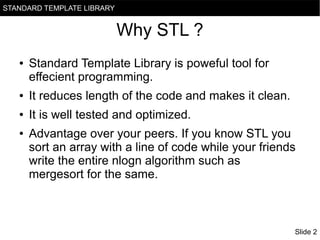
Why STL ?
●

Standard Template Library is poweful tool for
effecient programming.

●

It reduces length of the code and makes it clean.

●

It is well tested and optimized.

●

Advantage over your peers. If you know STL you
sort an array with a line of code while your friends
write the entire nlogn algorithm such as
mergesort for the same.

Slide 2
STANDARD TEMPLATE LIBRARY

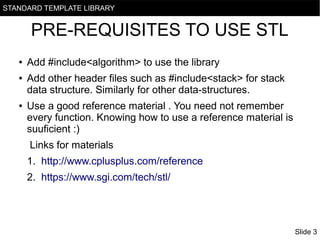
PRE-REQUISITES TO USE STL
●
●

●

Add #include<algorithm> to use the library
Add other header files such as #include<stack> for stack
data structure. Similarly for other data-structures.
Use a good reference material . You need not remember
every function. Knowing how to use a reference material is
suuficient :)
Links for materials
1. http://www.cplusplus.com/reference
2. https://www.sgi.com/tech/stl/

Slide 3
STANDARD TEMPLATE LIBRARY

USE OF STL IN ALGORITHMS

Slide 4
STANDARD TEMPLATE LIBRARY

Terminology in STL
●

A range is any sequence of objects that can be
accessed through iterators or pointers, such as an array
or an instance of some of the STL containers.
Syntax :STL_FUNC(begin iterator,end iterator)

●

Assume an array called 'arr' with 'n' elements for the
entire lecture.
*Iterator and pointer may be used interchangbly

Slide 5
STANDARD TEMPLATE LIBRARY

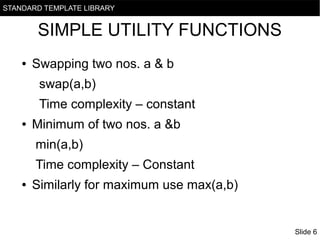
SIMPLE UTILITY FUNCTIONS
●

Swapping two nos. a & b
swap(a,b)
Time complexity – constant

●

Minimum of two nos. a &b
min(a,b)
Time complexity – Constant

●

Similarly for maximum use max(a,b)

Slide 6
STANDARD TEMPLATE LIBRARY

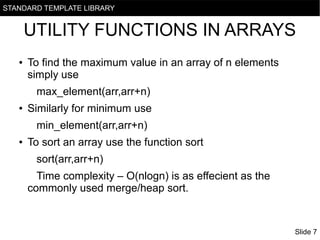
UTILITY FUNCTIONS IN ARRAYS
●

To find the maximum value in an array of n elements
simply use
max_element(arr,arr+n)

●

Similarly for minimum use
min_element(arr,arr+n)

●

To sort an array use the function sort
sort(arr,arr+n)
Time complexity – O(nlogn) is as effecient as the
commonly used merge/heap sort.

Slide 7
STANDARD TEMPLATE LIBRARY

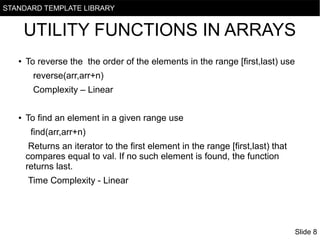
UTILITY FUNCTIONS IN ARRAYS
●

To reverse the the order of the elements in the range [first,last) use
reverse(arr,arr+n)
Complexity – Linear

●

To find an element in a given range use
find(arr,arr+n)
Returns an iterator to the first element in the range [first,last) that
compares equal to val. If no such element is found, the function
returns last.
Time Complexity - Linear

Slide 8
STANDARD TEMPLATE LIBRARY

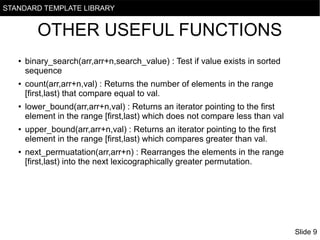
OTHER USEFUL FUNCTIONS
●

●

●

●

●

binary_search(arr,arr+n,search_value) : Test if value exists in sorted
sequence
count(arr,arr+n,val) : Returns the number of elements in the range
[first,last) that compare equal to val.
lower_bound(arr,arr+n,val) : Returns an iterator pointing to the first
element in the range [first,last) which does not compare less than val
upper_bound(arr,arr+n,val) : Returns an iterator pointing to the first
element in the range [first,last) which compares greater than val.
next_permuatation(arr,arr+n) : Rearranges the elements in the range
[first,last) into the next lexicographically greater permutation.

Slide 9
STANDARD TEMPLATE LIBRARY

STL and Data-Structures

Slide 10
STANDARD TEMPLATE LIBRARY

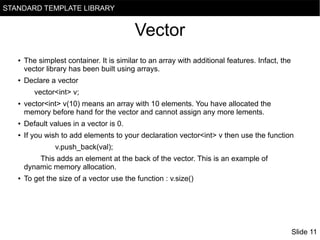
Vector
●

●

The simplest container. It is similar to an array with additional features. Infact, the
vector library has been built using arrays.
Declare a vector
vector<int> v;

●

vector<int> v(10) means an array with 10 elements. You have allocated the
memory before hand for the vector and cannot assign any more lements.

●

Default values in a vector is 0.

●

If you wish to add elements to your declaration vector<int> v then use the function
v.push_back(val);
This adds an element at the back of the vector. This is an example of
dynamic memory allocation.

●

To get the size of a vector use the function : v.size()

Slide 11
STANDARD TEMPLATE LIBRARY

Vector
●

●

To check if a vector is empty use function v.empty() which returns true/false depending on the
content of the vector
Suppose you want to resize your vector declared as vector<int> v(10) to 15 elements use
v.resize(15) . The resize() function makes vector contain the required number of elements. If
you require less elements than vector already contain, the last ones will be deleted.

●

To clear a vector use v.clear()

●

To initialize a vector from another vector there are two ways
vector<int> v1;
vector<int> v2 = v1;
vector<int> v3(v1);
int arr[]={1,2,3};
vector<int> v(arr,arr+sizeof(arr)/sizeof(int));

Slide 12
STANDARD TEMPLATE LIBRARY

Vector
●

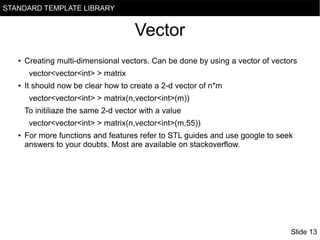
Creating multi-dimensional vectors. Can be done by using a vector of vectors
vector<vector<int> > matrix

●

It should now be clear how to create a 2-d vector of n*m
vector<vector<int> > matrix(n,vector<int>(m))
To initiliaze the same 2-d vector with a value
vector<vector<int> > matrix(n,vector<int>(m,55))

●

For more functions and features refer to STL guides and use google to seek
answers to your doubts. Most are available on stackoverflow.

Slide 13
STANDARD TEMPLATE LIBRARY

Pairs
●

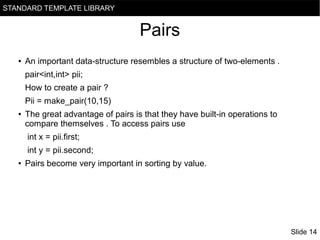
An important data-structure resembles a structure of two-elements .
pair<int,int> pii;
How to create a pair ?
Pii = make_pair(10,15)

●

The great advantage of pairs is that they have built-in operations to
compare themselves . To access pairs use
int x = pii.first;
int y = pii.second;

●

Pairs become very important in sorting by value.

Slide 14
STANDARD TEMPLATE LIBRARY

Strings
●

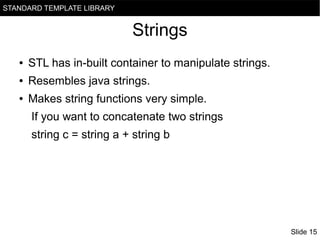
STL has in-built container to manipulate strings.

●

Resembles java strings.

●

Makes string functions very simple.
If you want to concatenate two strings
string c = string a + string b

Slide 15
STANDARD TEMPLATE LIBRARY

Sets
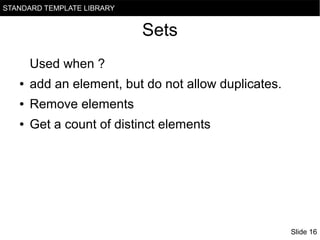
Used when ?
●

add an element, but do not allow duplicates.

●

Remove elements

●

Get a count of distinct elements

Slide 16
STANDARD TEMPLATE LIBRARY

Sets
Implementaion
set<int> s;
for(int i = 1; i <= 100; i++) {
s.insert(i); // Insert 100 elements, [1..100]
}
s.insert(5);

// Doesn't do anything. Duplicate !!

s.erase(6); // Removes 6th element

Slide 17
STANDARD TEMPLATE LIBRARY

Maps
●

Maps contain pairs<key,value>

●

Map ensures that at most one pair with specific key exists

map<string, int> M;
M["Top"] = 1;
M["Coder"] = 2;
M["SRM"] = 10;

int x = M["Top"] + M["Coder"];

Slide 18
STANDARD TEMPLATE LIBRARY

Maps
●

Iterating through a map.
map<int,string> m;
m[1]=”Ajith”;
m[2]=”Kumar”;
map<int,string>::iterator it;
for(it=m.begin();it!=m.end();it++)
{
if(it->second==''ajith”)
cout<<”Here's our superstar”;
}

Slide 19
STANDARD TEMPLATE LIBRARY

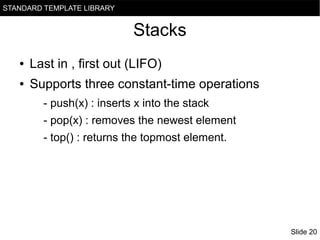
Stacks
●

Last in , first out (LIFO)

●

Supports three constant-time operations
- push(x) : inserts x into the stack
- pop(x) : removes the newest element
- top() : returns the topmost element.

Slide 20
STANDARD TEMPLATE LIBRARY

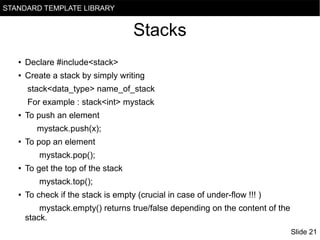
Stacks
●

Declare #include<stack>

●

Create a stack by simply writing
stack<data_type> name_of_stack
For example : stack<int> mystack

●

To push an element
mystack.push(x);

●

To pop an element
mystack.pop();

●

To get the top of the stack
mystack.top();

●

To check if the stack is empty (crucial in case of under-flow !!! )
mystack.empty() returns true/false depending on the content of the
stack.
Slide 21
STANDARD TEMPLATE LIBRARY

Problems on Stacks
●

●

http://codeforces.com/problemset/problem/344
/D
http://www.codechef.com/problems/BEX

Slide 22
STANDARD TEMPLATE LIBRARY

Problems on Stacks
●

http://codeforces.com/problemset/problem/344
/D

●

http://www.codechef.com/problems/BEX

●

http://www.spoj.com/problems/STPAR/

Slide 23
STANDARD TEMPLATE LIBRARY

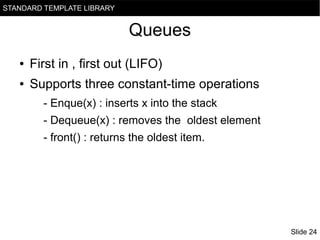
Queues
●

First in , first out (LIFO)

●

Supports three constant-time operations
- Enque(x) : inserts x into the stack
- Dequeue(x) : removes the oldest element
- front() : returns the oldest item.

Slide 24
STANDARD TEMPLATE LIBRARY

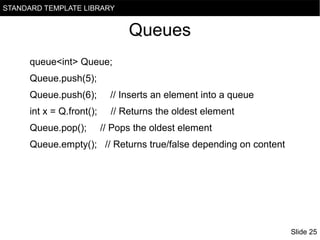
Queues
queue<int> Queue;
Queue.push(5);
Queue.push(6);

// Inserts an element into a queue

int x = Q.front();

// Returns the oldest element

Queue.pop();

// Pops the oldest element

Queue.empty(); // Returns true/false depending on content

Slide 25
STANDARD TEMPLATE LIBRARY

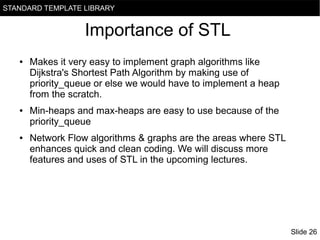
Importance of STL
●

●

●

Makes it very easy to implement graph algorithms like
Dijkstra's Shortest Path Algorithm by making use of
priority_queue or else we would have to implement a heap
from the scratch.
Min-heaps and max-heaps are easy to use because of the
priority_queue
Network Flow algorithms & graphs are the areas where STL
enhances quick and clean coding. We will discuss more
features and uses of STL in the upcoming lectures.

Slide 26
STANDARD TEMPLATE LIBRARY

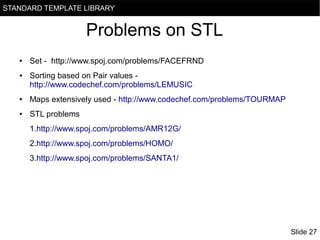
Problems on STL
●

●

Set - http://www.spoj.com/problems/FACEFRND
Sorting based on Pair values http://www.codechef.com/problems/LEMUSIC

●

Maps extensively used - http://www.codechef.com/problems/TOURMAP

●

STL problems
1.http://www.spoj.com/problems/AMR12G/
2.http://www.spoj.com/problems/HOMO/
3.http://www.spoj.com/problems/SANTA1/

Slide 27
STANDARD TEMPLATE LIBRARY

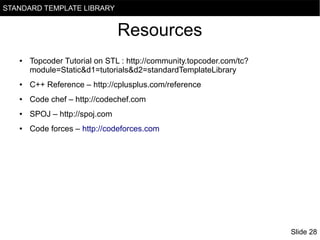
Resources
●

Topcoder Tutorial on STL : http://community.topcoder.com/tc?
module=Static&d1=tutorials&d2=standardTemplateLibrary

●

C++ Reference – http://cplusplus.com/reference

●

Code chef – http://codechef.com

●

SPOJ – http://spoj.com

●

Code forces – http://codeforces.com

Slide 28
STANDARD TEMPLATE LIBRARY

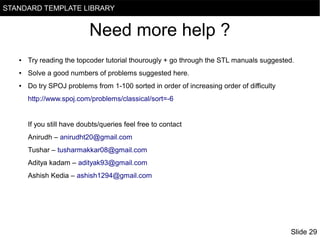
Need more help ?
●

Try reading the topcoder tutorial thourougly + go through the STL manuals suggested.

●

Solve a good numbers of problems suggested here.

●

Do try SPOJ problems from 1-100 sorted in order of increasing order of difficulty
http://www.spoj.com/problems/classical/sort=-6

If you still have doubts/queries feel free to contact
Anirudh – anirudht20@gmail.com
Tushar – tusharmakkar08@gmail.com
Aditya kadam – adityak93@gmail.com
Ashish Kedia – ashish1294@gmail.com

Slide 29

Talk on Standard Template Library

  • 1.
    NITK Codechef CampusChapter COMPETITVE PROGRAMMING LECTURE SERIES TALK 1 TOPICS : STL & IMPLEMENTATION By : R Anirudh Main Building February 8th 2014 Slide 1
  • 2.
    STANDARD TEMPLATE LIBRARY WhySTL ? ● Standard Template Library is poweful tool for effecient programming. ● It reduces length of the code and makes it clean. ● It is well tested and optimized. ● Advantage over your peers. If you know STL you sort an array with a line of code while your friends write the entire nlogn algorithm such as mergesort for the same. Slide 2
  • 3.
    STANDARD TEMPLATE LIBRARY PRE-REQUISITESTO USE STL ● ● ● Add #include<algorithm> to use the library Add other header files such as #include<stack> for stack data structure. Similarly for other data-structures. Use a good reference material . You need not remember every function. Knowing how to use a reference material is suuficient :) Links for materials 1. http://www.cplusplus.com/reference 2. https://www.sgi.com/tech/stl/ Slide 3
  • 4.
    STANDARD TEMPLATE LIBRARY USEOF STL IN ALGORITHMS Slide 4
  • 5.
    STANDARD TEMPLATE LIBRARY Terminologyin STL ● A range is any sequence of objects that can be accessed through iterators or pointers, such as an array or an instance of some of the STL containers. Syntax :STL_FUNC(begin iterator,end iterator) ● Assume an array called 'arr' with 'n' elements for the entire lecture. *Iterator and pointer may be used interchangbly Slide 5
  • 6.
    STANDARD TEMPLATE LIBRARY SIMPLEUTILITY FUNCTIONS ● Swapping two nos. a & b swap(a,b) Time complexity – constant ● Minimum of two nos. a &b min(a,b) Time complexity – Constant ● Similarly for maximum use max(a,b) Slide 6
  • 7.
    STANDARD TEMPLATE LIBRARY UTILITYFUNCTIONS IN ARRAYS ● To find the maximum value in an array of n elements simply use max_element(arr,arr+n) ● Similarly for minimum use min_element(arr,arr+n) ● To sort an array use the function sort sort(arr,arr+n) Time complexity – O(nlogn) is as effecient as the commonly used merge/heap sort. Slide 7
  • 8.
    STANDARD TEMPLATE LIBRARY UTILITYFUNCTIONS IN ARRAYS ● To reverse the the order of the elements in the range [first,last) use reverse(arr,arr+n) Complexity – Linear ● To find an element in a given range use find(arr,arr+n) Returns an iterator to the first element in the range [first,last) that compares equal to val. If no such element is found, the function returns last. Time Complexity - Linear Slide 8
  • 9.
    STANDARD TEMPLATE LIBRARY OTHERUSEFUL FUNCTIONS ● ● ● ● ● binary_search(arr,arr+n,search_value) : Test if value exists in sorted sequence count(arr,arr+n,val) : Returns the number of elements in the range [first,last) that compare equal to val. lower_bound(arr,arr+n,val) : Returns an iterator pointing to the first element in the range [first,last) which does not compare less than val upper_bound(arr,arr+n,val) : Returns an iterator pointing to the first element in the range [first,last) which compares greater than val. next_permuatation(arr,arr+n) : Rearranges the elements in the range [first,last) into the next lexicographically greater permutation. Slide 9
  • 10.
    STANDARD TEMPLATE LIBRARY STLand Data-Structures Slide 10
  • 11.
    STANDARD TEMPLATE LIBRARY Vector ● ● Thesimplest container. It is similar to an array with additional features. Infact, the vector library has been built using arrays. Declare a vector vector<int> v; ● vector<int> v(10) means an array with 10 elements. You have allocated the memory before hand for the vector and cannot assign any more lements. ● Default values in a vector is 0. ● If you wish to add elements to your declaration vector<int> v then use the function v.push_back(val); This adds an element at the back of the vector. This is an example of dynamic memory allocation. ● To get the size of a vector use the function : v.size() Slide 11
  • 12.
    STANDARD TEMPLATE LIBRARY Vector ● ● Tocheck if a vector is empty use function v.empty() which returns true/false depending on the content of the vector Suppose you want to resize your vector declared as vector<int> v(10) to 15 elements use v.resize(15) . The resize() function makes vector contain the required number of elements. If you require less elements than vector already contain, the last ones will be deleted. ● To clear a vector use v.clear() ● To initialize a vector from another vector there are two ways vector<int> v1; vector<int> v2 = v1; vector<int> v3(v1); int arr[]={1,2,3}; vector<int> v(arr,arr+sizeof(arr)/sizeof(int)); Slide 12
  • 13.
    STANDARD TEMPLATE LIBRARY Vector ● Creatingmulti-dimensional vectors. Can be done by using a vector of vectors vector<vector<int> > matrix ● It should now be clear how to create a 2-d vector of n*m vector<vector<int> > matrix(n,vector<int>(m)) To initiliaze the same 2-d vector with a value vector<vector<int> > matrix(n,vector<int>(m,55)) ● For more functions and features refer to STL guides and use google to seek answers to your doubts. Most are available on stackoverflow. Slide 13
  • 14.
    STANDARD TEMPLATE LIBRARY Pairs ● Animportant data-structure resembles a structure of two-elements . pair<int,int> pii; How to create a pair ? Pii = make_pair(10,15) ● The great advantage of pairs is that they have built-in operations to compare themselves . To access pairs use int x = pii.first; int y = pii.second; ● Pairs become very important in sorting by value. Slide 14
  • 15.
    STANDARD TEMPLATE LIBRARY Strings ● STLhas in-built container to manipulate strings. ● Resembles java strings. ● Makes string functions very simple. If you want to concatenate two strings string c = string a + string b Slide 15
  • 16.
    STANDARD TEMPLATE LIBRARY Sets Usedwhen ? ● add an element, but do not allow duplicates. ● Remove elements ● Get a count of distinct elements Slide 16
  • 17.
    STANDARD TEMPLATE LIBRARY Sets Implementaion set<int>s; for(int i = 1; i <= 100; i++) { s.insert(i); // Insert 100 elements, [1..100] } s.insert(5); // Doesn't do anything. Duplicate !! s.erase(6); // Removes 6th element Slide 17
  • 18.
    STANDARD TEMPLATE LIBRARY Maps ● Mapscontain pairs<key,value> ● Map ensures that at most one pair with specific key exists map<string, int> M; M["Top"] = 1; M["Coder"] = 2; M["SRM"] = 10; int x = M["Top"] + M["Coder"]; Slide 18
  • 19.
    STANDARD TEMPLATE LIBRARY Maps ● Iteratingthrough a map. map<int,string> m; m[1]=”Ajith”; m[2]=”Kumar”; map<int,string>::iterator it; for(it=m.begin();it!=m.end();it++) { if(it->second==''ajith”) cout<<”Here's our superstar”; } Slide 19
  • 20.
    STANDARD TEMPLATE LIBRARY Stacks ● Lastin , first out (LIFO) ● Supports three constant-time operations - push(x) : inserts x into the stack - pop(x) : removes the newest element - top() : returns the topmost element. Slide 20
  • 21.
    STANDARD TEMPLATE LIBRARY Stacks ● Declare#include<stack> ● Create a stack by simply writing stack<data_type> name_of_stack For example : stack<int> mystack ● To push an element mystack.push(x); ● To pop an element mystack.pop(); ● To get the top of the stack mystack.top(); ● To check if the stack is empty (crucial in case of under-flow !!! ) mystack.empty() returns true/false depending on the content of the stack. Slide 21
  • 22.
    STANDARD TEMPLATE LIBRARY Problemson Stacks ● ● http://codeforces.com/problemset/problem/344 /D http://www.codechef.com/problems/BEX Slide 22
  • 23.
    STANDARD TEMPLATE LIBRARY Problemson Stacks ● http://codeforces.com/problemset/problem/344 /D ● http://www.codechef.com/problems/BEX ● http://www.spoj.com/problems/STPAR/ Slide 23
  • 24.
    STANDARD TEMPLATE LIBRARY Queues ● Firstin , first out (LIFO) ● Supports three constant-time operations - Enque(x) : inserts x into the stack - Dequeue(x) : removes the oldest element - front() : returns the oldest item. Slide 24
  • 25.
    STANDARD TEMPLATE LIBRARY Queues queue<int>Queue; Queue.push(5); Queue.push(6); // Inserts an element into a queue int x = Q.front(); // Returns the oldest element Queue.pop(); // Pops the oldest element Queue.empty(); // Returns true/false depending on content Slide 25
  • 26.
    STANDARD TEMPLATE LIBRARY Importanceof STL ● ● ● Makes it very easy to implement graph algorithms like Dijkstra's Shortest Path Algorithm by making use of priority_queue or else we would have to implement a heap from the scratch. Min-heaps and max-heaps are easy to use because of the priority_queue Network Flow algorithms & graphs are the areas where STL enhances quick and clean coding. We will discuss more features and uses of STL in the upcoming lectures. Slide 26
  • 27.
    STANDARD TEMPLATE LIBRARY Problemson STL ● ● Set - http://www.spoj.com/problems/FACEFRND Sorting based on Pair values http://www.codechef.com/problems/LEMUSIC ● Maps extensively used - http://www.codechef.com/problems/TOURMAP ● STL problems 1.http://www.spoj.com/problems/AMR12G/ 2.http://www.spoj.com/problems/HOMO/ 3.http://www.spoj.com/problems/SANTA1/ Slide 27
  • 28.
    STANDARD TEMPLATE LIBRARY Resources ● TopcoderTutorial on STL : http://community.topcoder.com/tc? module=Static&d1=tutorials&d2=standardTemplateLibrary ● C++ Reference – http://cplusplus.com/reference ● Code chef – http://codechef.com ● SPOJ – http://spoj.com ● Code forces – http://codeforces.com Slide 28
  • 29.
    STANDARD TEMPLATE LIBRARY Needmore help ? ● Try reading the topcoder tutorial thourougly + go through the STL manuals suggested. ● Solve a good numbers of problems suggested here. ● Do try SPOJ problems from 1-100 sorted in order of increasing order of difficulty http://www.spoj.com/problems/classical/sort=-6 If you still have doubts/queries feel free to contact Anirudh – anirudht20@gmail.com Tushar – tusharmakkar08@gmail.com Aditya kadam – adityak93@gmail.com Ashish Kedia – ashish1294@gmail.com Slide 29