STANDARD
TEMPLATE LIBRARY
K.Thamizhselvi
Asst. Prof. of Computer Science,
Bon Secours College for Women, Thanjavur.
Standard Template Library
• The collection o generic classes and functions
is called the Standard Template Library (STL).
• STL components are defined in the
namespace std. to inform the compiler to use
standard C++ library.
• Directive
using namespace std;
Benefits of STL
• Using STL we can save time and effort
• Leads to high quality programs
• Well- written and well-tested components are
defined in STL.
Components of STL
Three key components
Containers
Algorithms
Iterators
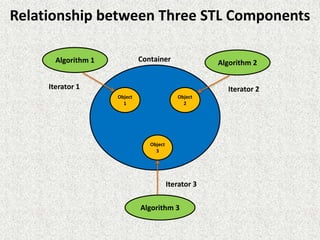
Relationship between Three STL Components
Object
1
Object
2
Object
3
Algorithm 3
Algorithm 1 Algorithm 2
Iterator 1 Iterator 2
Iterator 3
Container
These 3 components work in conjunction with one another to provide
support to a variety of programming solutions.
Algorithms employ iterators to perform operations stored in
containers.
• A container is an object that actually stores data. It is a way data is
organized in memory. Containers are implemented by template
classes.
• An algorithm is a procedure that is used to process the data
contained in the containers. They are implemented by template
functions.
• An iterator is an object that points to an element in a container. It
connect algorithms with containers and play a key role in
manipulation of data stored in the containers.
CONTAINERS
• Containers are the objects that hold data of
same type.
• Each container class defines a set of functions
that can be used to manipulate its contents.
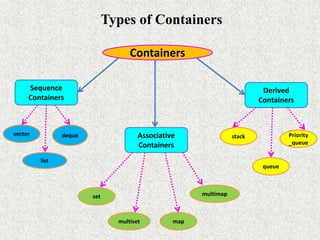
Types of Containers
Containers
Sequence
Containers
Derived
Containers
Associative
Containers
deque
list
vector
mapmultiset
multimapset
queue
stack Priority
_queue
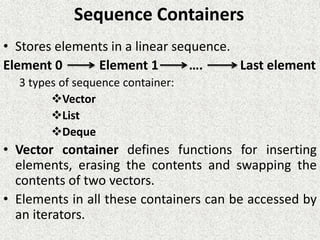
Sequence Containers
• Stores elements in a linear sequence.
Element 0 Element 1 …. Last element
3 types of sequence container:
Vector
List
Deque
• Vector container defines functions for inserting
elements, erasing the contents and swapping the
contents of two vectors.
• Elements in all these containers can be accessed by
an iterators.
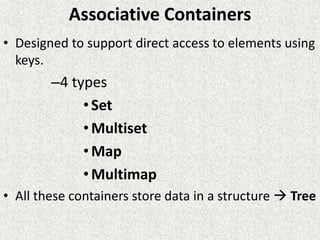
Associative Containers
• Designed to support direct access to elements using
keys.
–4 types
•Set
•Multiset
•Map
•Multimap
• All these containers store data in a structure  Tree
• Set & Multiset can store no. of items and provide
operations for manipulating them using the
values as the keys.
• Mutiset allows duplicate items
• Set does not allows.
• Map & Multimap are used to store pair of items,
one is key and another is value.
• Map allows only one key to store.
• Multimap permits multiple keys.
DERIVED CONTAINERS
• 3 Types:
–Stack
–Queue
–Priority_queue
• These are also called container adaptors.
• It does not support iterators.
• It cannot be used for data manipulation.
• To implement deleting and inserting pop() &
push() operations are used.
ALGORITHMS
• Used to work with two different types of
containers at the same time.
• STL Algorithms are standalone template
function.
• <algorithm> must be included to access the
STL algorithm.
• STL provides more than 60 algorithms to
support complex operations.
ITERATORS
• Used to access containers elements.
• The process of traversing from one element to
another  iterating .
• Types:
 Input
 Output
 Forward
 Bidirectional
 Random
• Input & Output iterators support the least
functions and they can be used only to
traverse in a container.
• The forward supports all operations of input &
output and also retains its position in
containers.
• A bidirectional iterator while support all
forward iterator operations, provide the ability
to move in the backward direction.
• A random access iterator combine the
functionality of bidirectional iterators with an
ability to jump to an arbitrary location.

Standard template library

  • 1.
    STANDARD TEMPLATE LIBRARY K.Thamizhselvi Asst. Prof.of Computer Science, Bon Secours College for Women, Thanjavur.
  • 2.
    Standard Template Library •The collection o generic classes and functions is called the Standard Template Library (STL). • STL components are defined in the namespace std. to inform the compiler to use standard C++ library. • Directive using namespace std;
  • 3.
    Benefits of STL •Using STL we can save time and effort • Leads to high quality programs • Well- written and well-tested components are defined in STL.
  • 4.
    Components of STL Threekey components Containers Algorithms Iterators
  • 5.
    Relationship between ThreeSTL Components Object 1 Object 2 Object 3 Algorithm 3 Algorithm 1 Algorithm 2 Iterator 1 Iterator 2 Iterator 3 Container
  • 6.
    These 3 componentswork in conjunction with one another to provide support to a variety of programming solutions. Algorithms employ iterators to perform operations stored in containers. • A container is an object that actually stores data. It is a way data is organized in memory. Containers are implemented by template classes. • An algorithm is a procedure that is used to process the data contained in the containers. They are implemented by template functions. • An iterator is an object that points to an element in a container. It connect algorithms with containers and play a key role in manipulation of data stored in the containers.
  • 7.
    CONTAINERS • Containers arethe objects that hold data of same type. • Each container class defines a set of functions that can be used to manipulate its contents.
  • 8.
  • 9.
    Sequence Containers • Storeselements in a linear sequence. Element 0 Element 1 …. Last element 3 types of sequence container: Vector List Deque • Vector container defines functions for inserting elements, erasing the contents and swapping the contents of two vectors. • Elements in all these containers can be accessed by an iterators.
  • 10.
    Associative Containers • Designedto support direct access to elements using keys. –4 types •Set •Multiset •Map •Multimap • All these containers store data in a structure  Tree
  • 11.
    • Set &Multiset can store no. of items and provide operations for manipulating them using the values as the keys. • Mutiset allows duplicate items • Set does not allows. • Map & Multimap are used to store pair of items, one is key and another is value. • Map allows only one key to store. • Multimap permits multiple keys.
  • 12.
    DERIVED CONTAINERS • 3Types: –Stack –Queue –Priority_queue • These are also called container adaptors. • It does not support iterators. • It cannot be used for data manipulation. • To implement deleting and inserting pop() & push() operations are used.
  • 13.
    ALGORITHMS • Used towork with two different types of containers at the same time. • STL Algorithms are standalone template function. • <algorithm> must be included to access the STL algorithm. • STL provides more than 60 algorithms to support complex operations.
  • 14.
    ITERATORS • Used toaccess containers elements. • The process of traversing from one element to another  iterating . • Types:  Input  Output  Forward  Bidirectional  Random
  • 15.
    • Input &Output iterators support the least functions and they can be used only to traverse in a container. • The forward supports all operations of input & output and also retains its position in containers. • A bidirectional iterator while support all forward iterator operations, provide the ability to move in the backward direction. • A random access iterator combine the functionality of bidirectional iterators with an ability to jump to an arbitrary location.