MUKESH PATEL SCHOOL OF TECHNOLOGY MANAGEMENT & ENGINEERING, SHIRPUR
Day-2
19th February 2023
Data Structures- Using STL in C++
1
Instructor
Piyush Kumar Soni
Assistant Professor,
Information Technology Department
Workshop on
Data Structures &
Algorithms
MUKESH PATEL SCHOOL OF TECHNOLOGY MANAGEMENT & ENGINEERING, SHIRPUR
Contents
2
• Template Functions and Classes
• C++ Standard Template Library (STL)
• Iterators
• Algorithms
• Containers
• vectors
• list
• queue
• stack
• Functions
MUKESH PATEL SCHOOL OF TECHNOLOGY MANAGEMENT & ENGINEERING, SHIRPUR
Template Functions and Classes
3
• A template is a simple yet very powerful tool in C++. The idea is to pass data
type as a parameter so that we don’t need to write the same code for different
data types.
• Eg., we may need to sort() for different data types. Rather than writing and
maintaining multiple codes, we can write one sort() and pass data type as a
parameter.
• Keywords to support templates: ‘template’ and ‘typename’. The second
keyword can always be replaced by the keyword ‘class’.
• Templates are expanded at compile time.
• This is like macros. The difference is, that the compiler does type checking
before template expansion. The idea is simple, source code contains only
function/class, but compiled code may contain multiple copies of the same
function/class.
MUKESH PATEL SCHOOL OF TECHNOLOGY MANAGEMENT & ENGINEERING, SHIRPUR
Template Functions
4
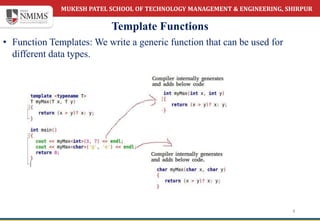
• Function Templates: We write a generic function that can be used for
different data types.
MUKESH PATEL SCHOOL OF TECHNOLOGY MANAGEMENT & ENGINEERING, SHIRPUR
Template Classes
5
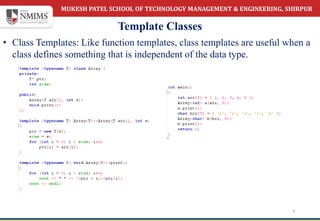
• Class Templates: Like function templates, class templates are useful when a
class defines something that is independent of the data type.
MUKESH PATEL SCHOOL OF TECHNOLOGY MANAGEMENT & ENGINEERING, SHIRPUR
Standard Template Library (STL)
6
• The Standard Template Library (STL) is a set of C++ template classes to
provide common programming data structures and functions.
• It is a generalized library and so, its components are parameterized.
• The key benefits of the STL is that it provides a way to write generic,
reusable code that can be applied to different data types.
• Key components of the STL include
• Iterators
• Algorithms
• Containers
• Functions
MUKESH PATEL SCHOOL OF TECHNOLOGY MANAGEMENT & ENGINEERING, SHIRPUR
Iterators
7
• As the name suggests, iterators are used for working on a sequence of
values.
• Iterators are used to point at the memory addresses of STL containers.
• They reduce the complexity and execution time of the program.
• Operations:-
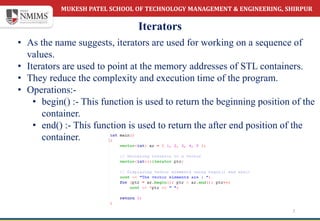
• begin() :- This function is used to return the beginning position of the
container.
• end() :- This function is used to return the after end position of the
container.
MUKESH PATEL SCHOOL OF TECHNOLOGY MANAGEMENT & ENGINEERING, SHIRPUR
Iterators
8
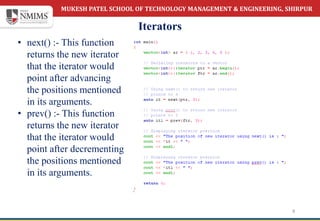
• next() :- This function
returns the new iterator
that the iterator would
point after advancing
the positions mentioned
in its arguments.
• prev() :- This function
returns the new iterator
that the iterator would
point after decrementing
the positions mentioned
in its arguments.
MUKESH PATEL SCHOOL OF TECHNOLOGY MANAGEMENT & ENGINEERING, SHIRPUR
Iterators
9
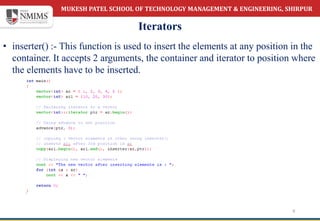
• inserter() :- This function is used to insert the elements at any position in the
container. It accepts 2 arguments, the container and iterator to position where
the elements have to be inserted.
MUKESH PATEL SCHOOL OF TECHNOLOGY MANAGEMENT & ENGINEERING, SHIRPUR
Algorithms
10
• The header algorithm defines a collection of functions specially designed to
be used on a range of elements.
• They act on containers and provide means for various operations for the
contents of the containers.
• Examples:
• Sort
• Reverse
• Max
MUKESH PATEL SCHOOL OF TECHNOLOGY MANAGEMENT & ENGINEERING, SHIRPUR
Sort
11
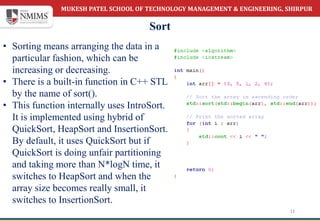
• Sorting means arranging the data in a
particular fashion, which can be
increasing or decreasing.
• There is a built-in function in C++ STL
by the name of sort().
• This function internally uses IntroSort.
It is implemented using hybrid of
QuickSort, HeapSort and InsertionSort.
By default, it uses QuickSort but if
QuickSort is doing unfair partitioning
and taking more than N*logN time, it
switches to HeapSort and when the
array size becomes really small, it
switches to InsertionSort.
MUKESH PATEL SCHOOL OF TECHNOLOGY MANAGEMENT & ENGINEERING, SHIRPUR
Reverse and Max
12
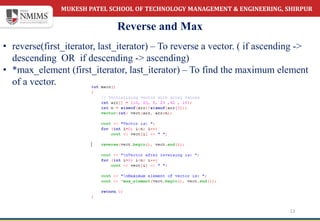
• reverse(first_iterator, last_iterator) – To reverse a vector. ( if ascending ->
descending OR if descending -> ascending)
• *max_element (first_iterator, last_iterator) – To find the maximum element
of a vector.
MUKESH PATEL SCHOOL OF TECHNOLOGY MANAGEMENT & ENGINEERING, SHIRPUR
Containers
13
• A container is a holder object that stores a collection of other objects (its
elements). They are implemented as class templates, which allows great
flexibility in the types supported as elements.
• The container manages the storage space for its elements and provides
member functions to access them, either directly or through iterators
(reference objects with similar properties to pointers).
• Following is the list of containers available with STL:
• vector
• list
• deque
• arrays
• forward_list
• queue
• priority_queue
• stack
MUKESH PATEL SCHOOL OF TECHNOLOGY MANAGEMENT & ENGINEERING, SHIRPUR
Vector
14
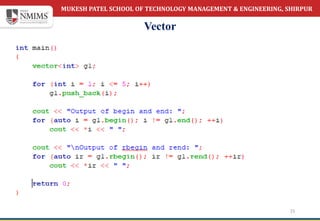
• Vectors are the same as dynamic arrays with the ability to resize itself
automatically when an element is inserted or deleted, with their storage being
handled automatically by the container.
• Vector elements are placed in contiguous storage so that they can be accessed
and traversed using iterators.
• Funtions:
• begin() – Returns an iterator pointing to the first element in the vector
• end() – Returns an iterator pointing to the theoretical element that follows the last
element in the vector
• rbegin() – Returns a reverse iterator pointing to the last element in the vector (reverse
beginning). It moves from last to first element
• rend() – Returns a reverse iterator pointing to the theoretical element preceding the first
element in the vector (considered as reverse end)
MUKESH PATEL SCHOOL OF TECHNOLOGY MANAGEMENT & ENGINEERING, SHIRPUR
Vector
15
MUKESH PATEL SCHOOL OF TECHNOLOGY MANAGEMENT & ENGINEERING, SHIRPUR
Vector
16
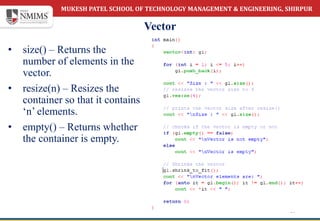
• size() – Returns the
number of elements in the
vector.
• resize(n) – Resizes the
container so that it contains
‘n’ elements.
• empty() – Returns whether
the container is empty.
MUKESH PATEL SCHOOL OF TECHNOLOGY MANAGEMENT & ENGINEERING, SHIRPUR
Stack
17
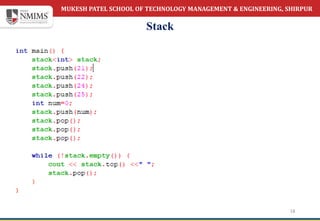
• Stacks are a type of container adaptors with LIFO(Last In First Out) type of
working, where a new element is added at one end (top) and an element is
removed from that end only.
• The functions associated with stack are:
• empty() – Returns whether the stack is empty
• size() – Returns the size of the stack
• top() – Returns a reference to the top most element of the stack
• push(g) – Adds the element ‘g’ at the top of the stack
• pop() – Deletes the most recent entered element of the stack
MUKESH PATEL SCHOOL OF TECHNOLOGY MANAGEMENT & ENGINEERING, SHIRPUR
Stack
18
MUKESH PATEL SCHOOL OF TECHNOLOGY MANAGEMENT & ENGINEERING, SHIRPUR
Queue
19
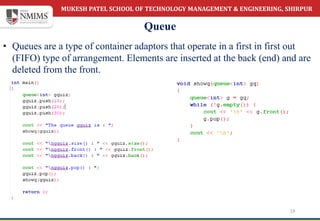
• Queues are a type of container adaptors that operate in a first in first out
(FIFO) type of arrangement. Elements are inserted at the back (end) and are
deleted from the front.
MUKESH PATEL SCHOOL OF TECHNOLOGY MANAGEMENT & ENGINEERING, SHIRPUR
Problem-Statement-1
20
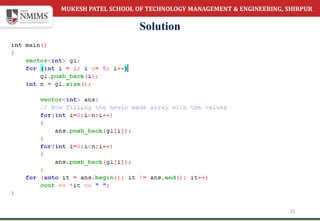
• Concatenation of Array:
• Given an integer array nums of length n, you want to create an array ans of
length 2n where ans[i] == nums[i] and ans[i + n] == nums[i] for 0 <= i < n
(0-indexed).
• Specifically, ans is the concatenation of two nums arrays.
• Return the array ans.
• Example:
Input: nums = [1,2,1]
Output: [1,2,1,1,2,1]
Explanation: The array ans is formed as follows:
- ans = [nums[0],nums[1],nums[2],nums[0],nums[1],nums[2]]
- ans = [1,2,1,1,2,1]
MUKESH PATEL SCHOOL OF TECHNOLOGY MANAGEMENT & ENGINEERING, SHIRPUR
Solution
21
MUKESH PATEL SCHOOL OF TECHNOLOGY MANAGEMENT & ENGINEERING, SHIRPUR
Problem-Statement-2
22
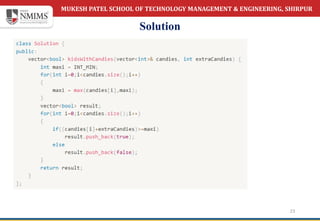
• Kids With the Greatest Number of Candies:
• There are `n` kids with candies. You are given an integer array `candies`,
where each `candies[i]` represents the number of candies the `ith` kid has,
and an integer `extraCandies`, denoting the number of extra candies that you
have.
• Return a boolean array result of length n, where result[i] is true if, after
giving the ith kid all the extraCandies , they will have the greatest number of
candies among all the kids, or false otherwise.
• Note that multiple kids can have the greatest number of candies.
MUKESH PATEL SCHOOL OF TECHNOLOGY MANAGEMENT & ENGINEERING, SHIRPUR
Solution
23
MUKESH PATEL SCHOOL OF TECHNOLOGY MANAGEMENT & ENGINEERING, SHIRPUR
Problem-Statement-3
24
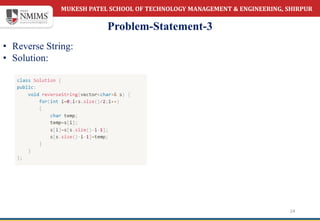
• Reverse String:
• Solution:
MUKESH PATEL SCHOOL OF TECHNOLOGY MANAGEMENT & ENGINEERING, SHIRPUR
Problem-Statement-4
25
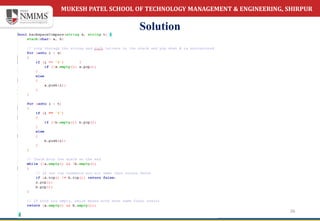
• Backspace String Compare:
• Given two strings s and t, return true if they are equal when both are typed
into empty text editors. '#' means a backspace character.
• Note that after backspacing an empty text, the text will continue empty.
• Example 1:
Input: s = "ab#c", t = "ad#c"
Output: true
Explanation: Both s and t become "ac".
• Example 2:
Input: s = "ab##", t = "c#d#"
Output: true
Explanation: Both s and t become "".
MUKESH PATEL SCHOOL OF TECHNOLOGY MANAGEMENT & ENGINEERING, SHIRPUR
Solution
26
MUKESH PATEL SCHOOL OF TECHNOLOGY MANAGEMENT & ENGINEERING, SHIRPUR
Problem-Statement-5
27
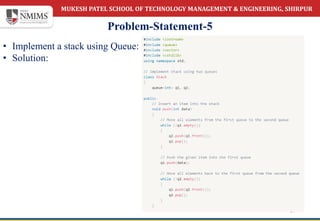
• Implement a stack using Queue:
• Solution:
MUKESH PATEL SCHOOL OF TECHNOLOGY MANAGEMENT & ENGINEERING, SHIRPUR
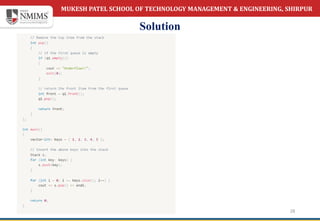
Solution
28
MUKESH PATEL SCHOOL OF TECHNOLOGY MANAGEMENT & ENGINEERING, SHIRPUR
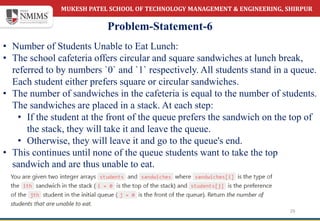
Problem-Statement-6
29
• Number of Students Unable to Eat Lunch:
• The school cafeteria offers circular and square sandwiches at lunch break,
referred to by numbers `0` and `1` respectively. All students stand in a queue.
Each student either prefers square or circular sandwiches.
• The number of sandwiches in the cafeteria is equal to the number of students.
The sandwiches are placed in a stack. At each step:
• If the student at the front of the queue prefers the sandwich on the top of
the stack, they will take it and leave the queue.
• Otherwise, they will leave it and go to the queue's end.
• This continues until none of the queue students want to take the top
sandwich and are thus unable to eat.
MUKESH PATEL SCHOOL OF TECHNOLOGY MANAGEMENT & ENGINEERING, SHIRPUR
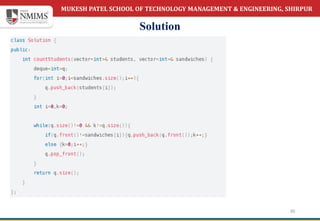
Solution
30
MUKESH PATEL SCHOOL OF TECHNOLOGY MANAGEMENT & ENGINEERING, SHIRPUR
Thank You…!!!
31

DSA-Day-2-PS.pptx

  • 1.
    MUKESH PATEL SCHOOLOF TECHNOLOGY MANAGEMENT & ENGINEERING, SHIRPUR Day-2 19th February 2023 Data Structures- Using STL in C++ 1 Instructor Piyush Kumar Soni Assistant Professor, Information Technology Department Workshop on Data Structures & Algorithms
  • 2.
    MUKESH PATEL SCHOOLOF TECHNOLOGY MANAGEMENT & ENGINEERING, SHIRPUR Contents 2 • Template Functions and Classes • C++ Standard Template Library (STL) • Iterators • Algorithms • Containers • vectors • list • queue • stack • Functions
  • 3.
    MUKESH PATEL SCHOOLOF TECHNOLOGY MANAGEMENT & ENGINEERING, SHIRPUR Template Functions and Classes 3 • A template is a simple yet very powerful tool in C++. The idea is to pass data type as a parameter so that we don’t need to write the same code for different data types. • Eg., we may need to sort() for different data types. Rather than writing and maintaining multiple codes, we can write one sort() and pass data type as a parameter. • Keywords to support templates: ‘template’ and ‘typename’. The second keyword can always be replaced by the keyword ‘class’. • Templates are expanded at compile time. • This is like macros. The difference is, that the compiler does type checking before template expansion. The idea is simple, source code contains only function/class, but compiled code may contain multiple copies of the same function/class.
  • 4.
    MUKESH PATEL SCHOOLOF TECHNOLOGY MANAGEMENT & ENGINEERING, SHIRPUR Template Functions 4 • Function Templates: We write a generic function that can be used for different data types.
  • 5.
    MUKESH PATEL SCHOOLOF TECHNOLOGY MANAGEMENT & ENGINEERING, SHIRPUR Template Classes 5 • Class Templates: Like function templates, class templates are useful when a class defines something that is independent of the data type.
  • 6.
    MUKESH PATEL SCHOOLOF TECHNOLOGY MANAGEMENT & ENGINEERING, SHIRPUR Standard Template Library (STL) 6 • The Standard Template Library (STL) is a set of C++ template classes to provide common programming data structures and functions. • It is a generalized library and so, its components are parameterized. • The key benefits of the STL is that it provides a way to write generic, reusable code that can be applied to different data types. • Key components of the STL include • Iterators • Algorithms • Containers • Functions
  • 7.
    MUKESH PATEL SCHOOLOF TECHNOLOGY MANAGEMENT & ENGINEERING, SHIRPUR Iterators 7 • As the name suggests, iterators are used for working on a sequence of values. • Iterators are used to point at the memory addresses of STL containers. • They reduce the complexity and execution time of the program. • Operations:- • begin() :- This function is used to return the beginning position of the container. • end() :- This function is used to return the after end position of the container.
  • 8.
    MUKESH PATEL SCHOOLOF TECHNOLOGY MANAGEMENT & ENGINEERING, SHIRPUR Iterators 8 • next() :- This function returns the new iterator that the iterator would point after advancing the positions mentioned in its arguments. • prev() :- This function returns the new iterator that the iterator would point after decrementing the positions mentioned in its arguments.
  • 9.
    MUKESH PATEL SCHOOLOF TECHNOLOGY MANAGEMENT & ENGINEERING, SHIRPUR Iterators 9 • inserter() :- This function is used to insert the elements at any position in the container. It accepts 2 arguments, the container and iterator to position where the elements have to be inserted.
  • 10.
    MUKESH PATEL SCHOOLOF TECHNOLOGY MANAGEMENT & ENGINEERING, SHIRPUR Algorithms 10 • The header algorithm defines a collection of functions specially designed to be used on a range of elements. • They act on containers and provide means for various operations for the contents of the containers. • Examples: • Sort • Reverse • Max
  • 11.
    MUKESH PATEL SCHOOLOF TECHNOLOGY MANAGEMENT & ENGINEERING, SHIRPUR Sort 11 • Sorting means arranging the data in a particular fashion, which can be increasing or decreasing. • There is a built-in function in C++ STL by the name of sort(). • This function internally uses IntroSort. It is implemented using hybrid of QuickSort, HeapSort and InsertionSort. By default, it uses QuickSort but if QuickSort is doing unfair partitioning and taking more than N*logN time, it switches to HeapSort and when the array size becomes really small, it switches to InsertionSort.
  • 12.
    MUKESH PATEL SCHOOLOF TECHNOLOGY MANAGEMENT & ENGINEERING, SHIRPUR Reverse and Max 12 • reverse(first_iterator, last_iterator) – To reverse a vector. ( if ascending -> descending OR if descending -> ascending) • *max_element (first_iterator, last_iterator) – To find the maximum element of a vector.
  • 13.
    MUKESH PATEL SCHOOLOF TECHNOLOGY MANAGEMENT & ENGINEERING, SHIRPUR Containers 13 • A container is a holder object that stores a collection of other objects (its elements). They are implemented as class templates, which allows great flexibility in the types supported as elements. • The container manages the storage space for its elements and provides member functions to access them, either directly or through iterators (reference objects with similar properties to pointers). • Following is the list of containers available with STL: • vector • list • deque • arrays • forward_list • queue • priority_queue • stack
  • 14.
    MUKESH PATEL SCHOOLOF TECHNOLOGY MANAGEMENT & ENGINEERING, SHIRPUR Vector 14 • Vectors are the same as dynamic arrays with the ability to resize itself automatically when an element is inserted or deleted, with their storage being handled automatically by the container. • Vector elements are placed in contiguous storage so that they can be accessed and traversed using iterators. • Funtions: • begin() – Returns an iterator pointing to the first element in the vector • end() – Returns an iterator pointing to the theoretical element that follows the last element in the vector • rbegin() – Returns a reverse iterator pointing to the last element in the vector (reverse beginning). It moves from last to first element • rend() – Returns a reverse iterator pointing to the theoretical element preceding the first element in the vector (considered as reverse end)
  • 15.
    MUKESH PATEL SCHOOLOF TECHNOLOGY MANAGEMENT & ENGINEERING, SHIRPUR Vector 15
  • 16.
    MUKESH PATEL SCHOOLOF TECHNOLOGY MANAGEMENT & ENGINEERING, SHIRPUR Vector 16 • size() – Returns the number of elements in the vector. • resize(n) – Resizes the container so that it contains ‘n’ elements. • empty() – Returns whether the container is empty.
  • 17.
    MUKESH PATEL SCHOOLOF TECHNOLOGY MANAGEMENT & ENGINEERING, SHIRPUR Stack 17 • Stacks are a type of container adaptors with LIFO(Last In First Out) type of working, where a new element is added at one end (top) and an element is removed from that end only. • The functions associated with stack are: • empty() – Returns whether the stack is empty • size() – Returns the size of the stack • top() – Returns a reference to the top most element of the stack • push(g) – Adds the element ‘g’ at the top of the stack • pop() – Deletes the most recent entered element of the stack
  • 18.
    MUKESH PATEL SCHOOLOF TECHNOLOGY MANAGEMENT & ENGINEERING, SHIRPUR Stack 18
  • 19.
    MUKESH PATEL SCHOOLOF TECHNOLOGY MANAGEMENT & ENGINEERING, SHIRPUR Queue 19 • Queues are a type of container adaptors that operate in a first in first out (FIFO) type of arrangement. Elements are inserted at the back (end) and are deleted from the front.
  • 20.
    MUKESH PATEL SCHOOLOF TECHNOLOGY MANAGEMENT & ENGINEERING, SHIRPUR Problem-Statement-1 20 • Concatenation of Array: • Given an integer array nums of length n, you want to create an array ans of length 2n where ans[i] == nums[i] and ans[i + n] == nums[i] for 0 <= i < n (0-indexed). • Specifically, ans is the concatenation of two nums arrays. • Return the array ans. • Example: Input: nums = [1,2,1] Output: [1,2,1,1,2,1] Explanation: The array ans is formed as follows: - ans = [nums[0],nums[1],nums[2],nums[0],nums[1],nums[2]] - ans = [1,2,1,1,2,1]
  • 21.
    MUKESH PATEL SCHOOLOF TECHNOLOGY MANAGEMENT & ENGINEERING, SHIRPUR Solution 21
  • 22.
    MUKESH PATEL SCHOOLOF TECHNOLOGY MANAGEMENT & ENGINEERING, SHIRPUR Problem-Statement-2 22 • Kids With the Greatest Number of Candies: • There are `n` kids with candies. You are given an integer array `candies`, where each `candies[i]` represents the number of candies the `ith` kid has, and an integer `extraCandies`, denoting the number of extra candies that you have. • Return a boolean array result of length n, where result[i] is true if, after giving the ith kid all the extraCandies , they will have the greatest number of candies among all the kids, or false otherwise. • Note that multiple kids can have the greatest number of candies.
  • 23.
    MUKESH PATEL SCHOOLOF TECHNOLOGY MANAGEMENT & ENGINEERING, SHIRPUR Solution 23
  • 24.
    MUKESH PATEL SCHOOLOF TECHNOLOGY MANAGEMENT & ENGINEERING, SHIRPUR Problem-Statement-3 24 • Reverse String: • Solution:
  • 25.
    MUKESH PATEL SCHOOLOF TECHNOLOGY MANAGEMENT & ENGINEERING, SHIRPUR Problem-Statement-4 25 • Backspace String Compare: • Given two strings s and t, return true if they are equal when both are typed into empty text editors. '#' means a backspace character. • Note that after backspacing an empty text, the text will continue empty. • Example 1: Input: s = "ab#c", t = "ad#c" Output: true Explanation: Both s and t become "ac". • Example 2: Input: s = "ab##", t = "c#d#" Output: true Explanation: Both s and t become "".
  • 26.
    MUKESH PATEL SCHOOLOF TECHNOLOGY MANAGEMENT & ENGINEERING, SHIRPUR Solution 26
  • 27.
    MUKESH PATEL SCHOOLOF TECHNOLOGY MANAGEMENT & ENGINEERING, SHIRPUR Problem-Statement-5 27 • Implement a stack using Queue: • Solution:
  • 28.
    MUKESH PATEL SCHOOLOF TECHNOLOGY MANAGEMENT & ENGINEERING, SHIRPUR Solution 28
  • 29.
    MUKESH PATEL SCHOOLOF TECHNOLOGY MANAGEMENT & ENGINEERING, SHIRPUR Problem-Statement-6 29 • Number of Students Unable to Eat Lunch: • The school cafeteria offers circular and square sandwiches at lunch break, referred to by numbers `0` and `1` respectively. All students stand in a queue. Each student either prefers square or circular sandwiches. • The number of sandwiches in the cafeteria is equal to the number of students. The sandwiches are placed in a stack. At each step: • If the student at the front of the queue prefers the sandwich on the top of the stack, they will take it and leave the queue. • Otherwise, they will leave it and go to the queue's end. • This continues until none of the queue students want to take the top sandwich and are thus unable to eat.
  • 30.
    MUKESH PATEL SCHOOLOF TECHNOLOGY MANAGEMENT & ENGINEERING, SHIRPUR Solution 30
  • 31.
    MUKESH PATEL SCHOOLOF TECHNOLOGY MANAGEMENT & ENGINEERING, SHIRPUR Thank You…!!! 31

Editor's Notes

  • #4 Why study Data Structure and algorithm together?