1A Concise and Practical Introduction to Programming Algorithms in Java © 2009 Frank Nielsen
Frank NIELSEN
nielsen@lix.polytechnique.fr
A Concise and
Practical
Introduction to
Programming
Algorithms in Java
Chapter 7: Linked lists
2A Concise and Practical Introduction to Programming Algorithms in Java © 2009 Frank Nielsen
Agenda
● Cells and linked lists
● Basic static functions on lists
● Recursive static functions on lists
● Hashing: Resolving collisions
● Summary of search method
(with respect to time complexity)
3A Concise and Practical Introduction to Programming Algorithms in Java © 2009 Frank Nielsen
Summary of Lecture 7
Searching:
● Sequential search (linear time) / arbitrary arrays
● Dichotomic search (logarithmic time) / ordered arrays
Sorting:
● Selection sort (quadratic time)
● Quicksort (recursive, in-place, O(n log n) exp. time)
Hashing
Methods work on arrays...
...weak to fully dynamic datasets
4A Concise and Practical Introduction to Programming Algorithms in Java © 2009 Frank Nielsen
Memory management in Java:
AUTOMATIC
● Working memory space for functions (stack):
PASS-BY-VALUE
● Global memory for storing arrays and objects:
Allocate with new
● Do not free allocated objects, Java does it for you!
GARBAGE COLLECTOR
(GC for short)
http://en.wikipedia.org/wiki/Java_(programming_language)
5A Concise and Practical Introduction to Programming Algorithms in Java © 2009 Frank Nielsen
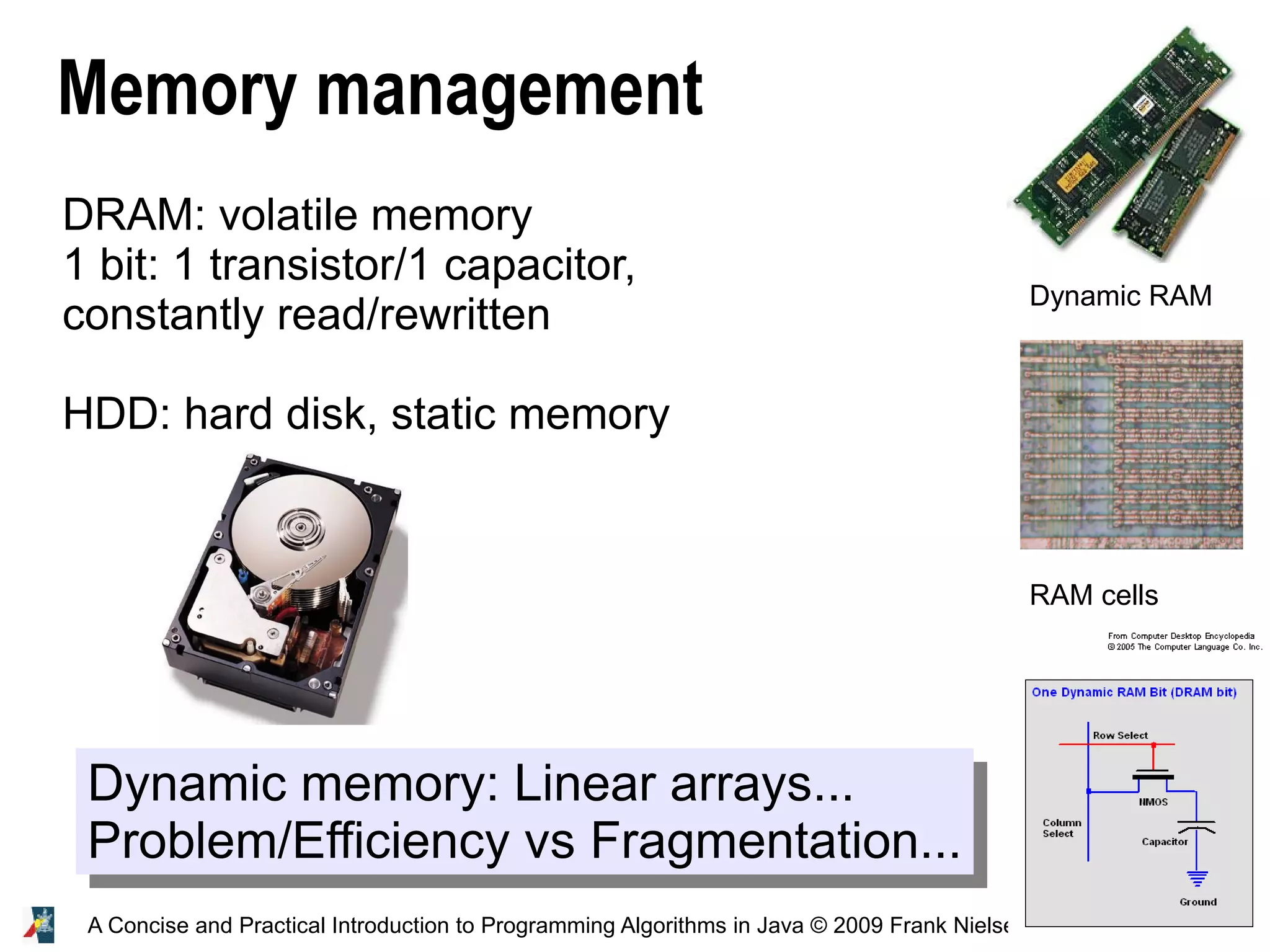
Memory management
Dynamic memory: Linear arrays...
Problem/Efficiency vs Fragmentation...
Dynamic RAM
RAM cells
DRAM: volatile memory
1 bit: 1 transistor/1 capacitor,
constantly read/rewritten
HDD: hard disk, static memory
6A Concise and Practical Introduction to Programming Algorithms in Java © 2009 Frank Nielsen
Visualizing memory
A representation
class Toto
{
double x;
String name;
Toto(double xx, String info)
{this.x=xx;
// For mutable object do this.name=new Object(info);
this.name=info;}
};
class VisualizingMemory
{
public static void Display(Toto obj)
{
System.out.println(obj.x+":"+obj.name);
}
public static void main(String[] args)
{
int i;
Toto var=new Toto(5,"Favorite prime!");
double [] arrayx=new double[10];
Display(var);
}
}
HeapFunctions
local variables
stack execution
pass-by-value
(non-persistent)
arrays
objects
persistent
int i (4 bytes)
main
Double [ ] array
Toto var
Object Toto
x
name
array[9]
...
array[1]
array[0]
Display
(pass by reference)
7A Concise and Practical Introduction to Programming Algorithms in Java © 2009 Frank Nielsen
Garbage collector (GC)
You do not have to explicitly free the memory
Java does it automatically on your behalf
No destructor:
● for objects
● for arrays
Objects no longer referred to are automatically collected
Objects no longer needed can be explicitly “forgotten”
obj=null;
array=null;
8A Concise and Practical Introduction to Programming Algorithms in Java © 2009 Frank Nielsen
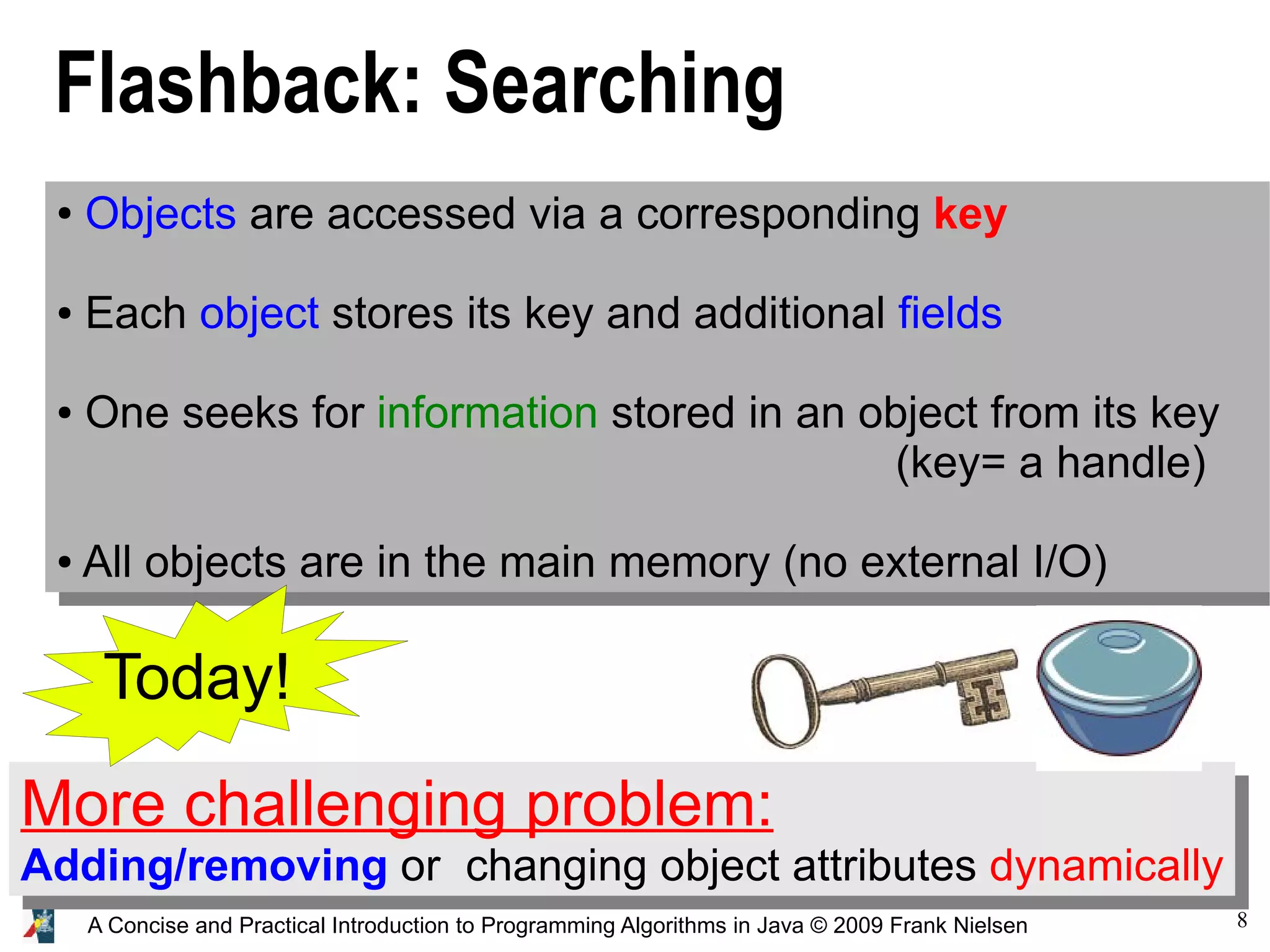
Flashback: Searching
● Objects are accessed via a corresponding key
● Each object stores its key and additional fields
● One seeks for information stored in an object from its key
(key= a handle)
● All objects are in the main memory (no external I/O)
More challenging problem:
Adding/removing or changing object attributes dynamically
Today!
9A Concise and Practical Introduction to Programming Algorithms in Java © 2009 Frank Nielsen
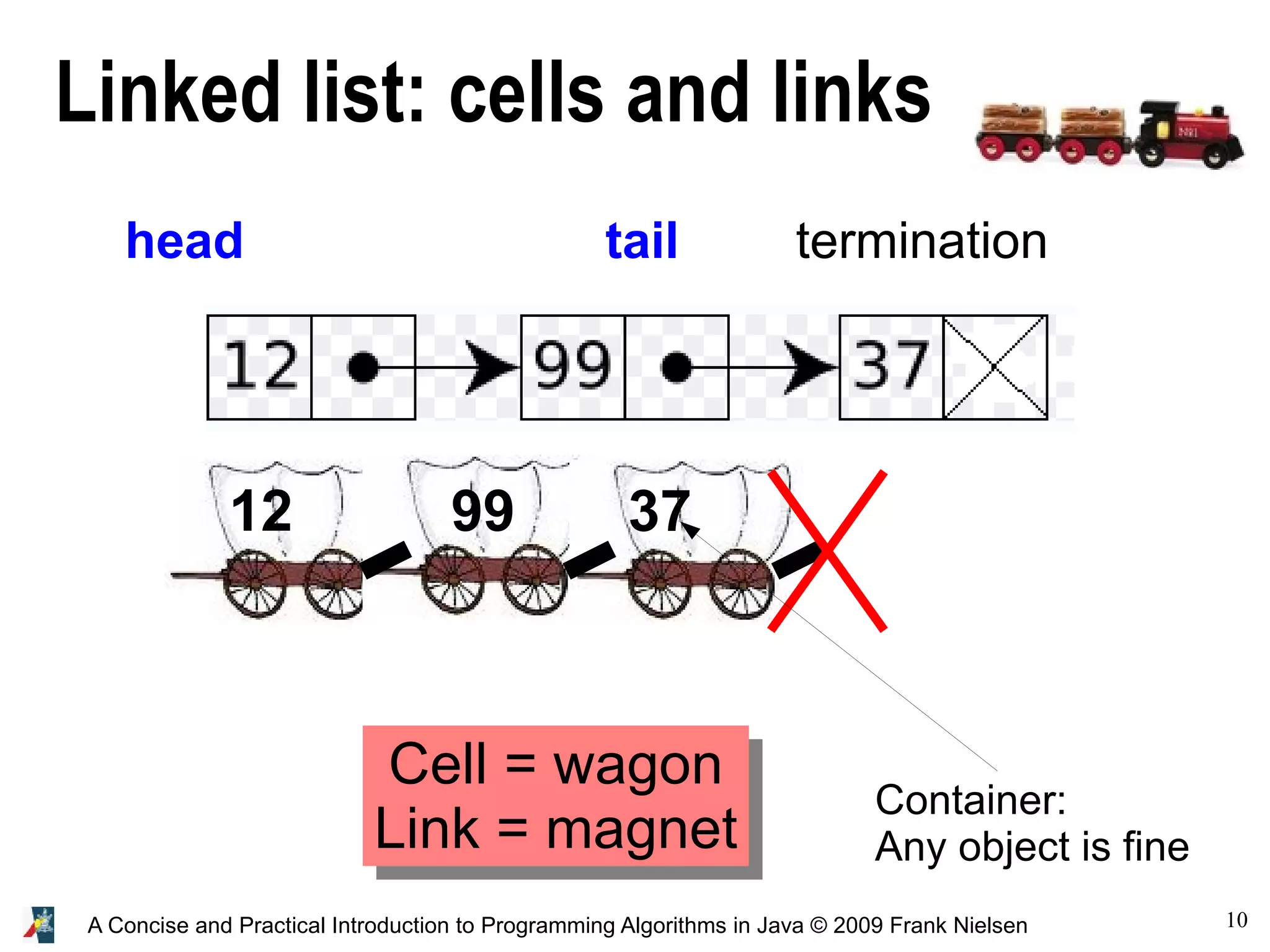
Linked list: cells and links
● Sequence is made of cells
● Each cell stores an object (cell=container)
● Each cell link to the following one
(=refer to, =point to)
● The last cell links to nothing (undefined)
● To add an element, create a new cell that...
...points to the first one (=head)
● Garbage collector takes care of cells not pointed by others
10A Concise and Practical Introduction to Programming Algorithms in Java © 2009 Frank Nielsen
Linked list: cells and links
Cell = wagon
Link = magnet
12 99 37
head tail termination
Container:
Any object is fine
11A Concise and Practical Introduction to Programming Algorithms in Java © 2009 Frank Nielsen
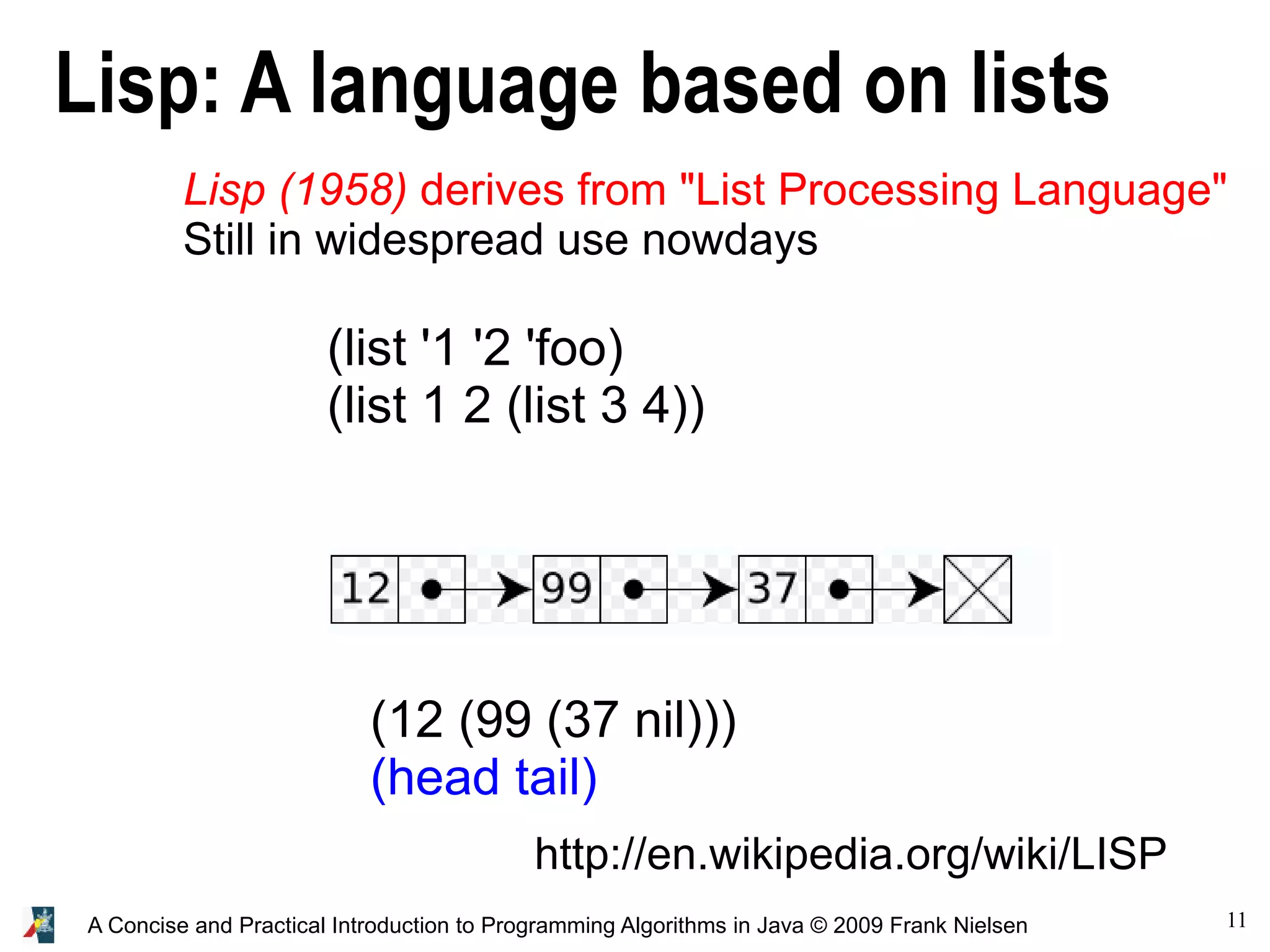
Lisp: A language based on lists
http://en.wikipedia.org/wiki/LISP
(list '1 '2 'foo)
(list 1 2 (list 3 4))
(12 (99 (37 nil)))
(head tail)
Lisp (1958) derives from "List Processing Language"
Still in widespread use nowdays
12A Concise and Practical Introduction to Programming Algorithms in Java © 2009 Frank Nielsen
Advantages of linked lists
● Store and represent a set of objects
● But we do not know beforehand how many...
● Add/remove dynamically to the set elements
Arrays: Memory compact data-structure for static sets
Linked lists: Efficient data-structure for dynamic sets
but use references to point to successors
(reference= 4 bytes)
13A Concise and Practical Introduction to Programming Algorithms in Java © 2009 Frank Nielsen
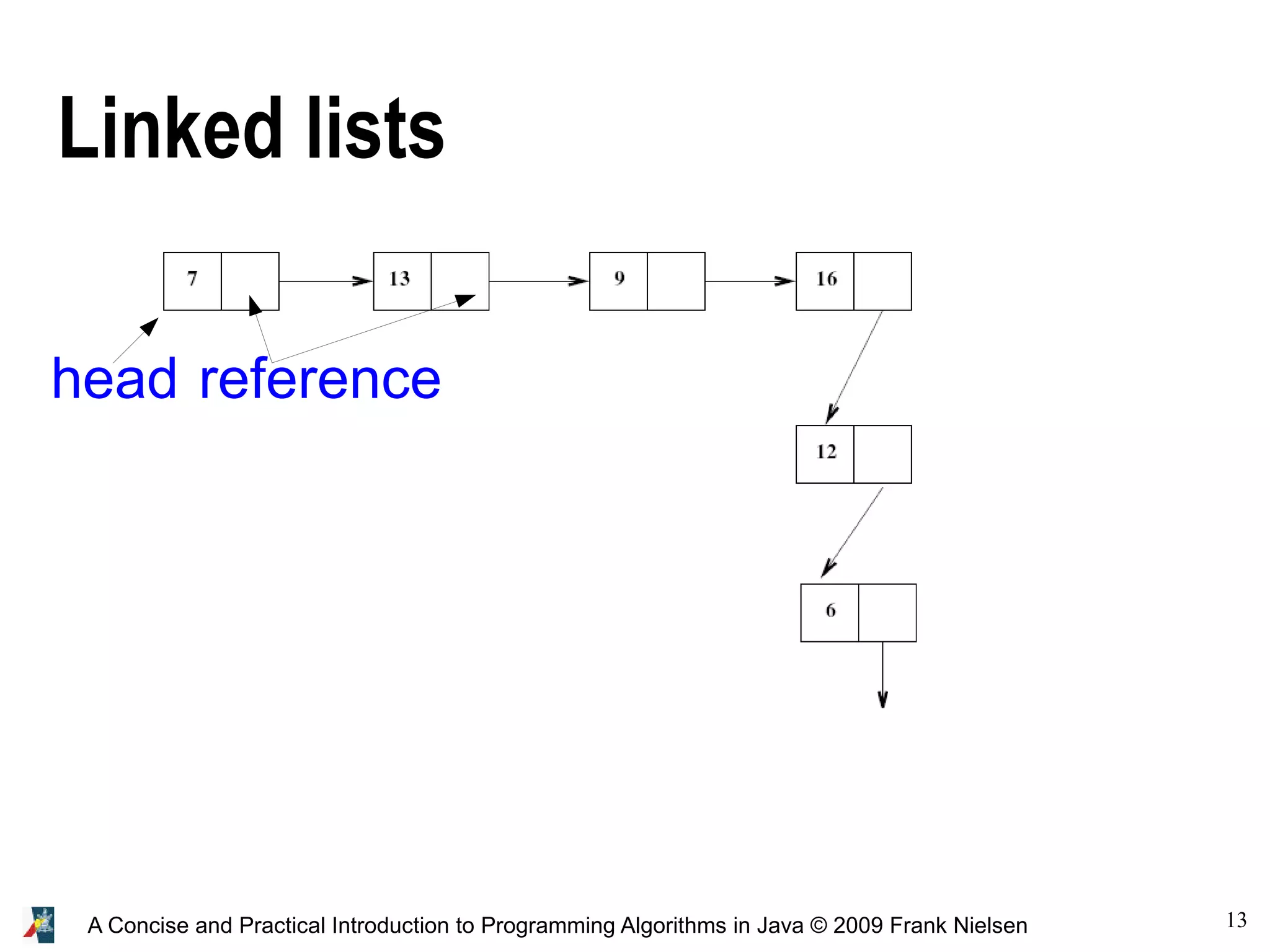
Linked lists
head reference
14A Concise and Practical Introduction to Programming Algorithms in Java © 2009 Frank Nielsen
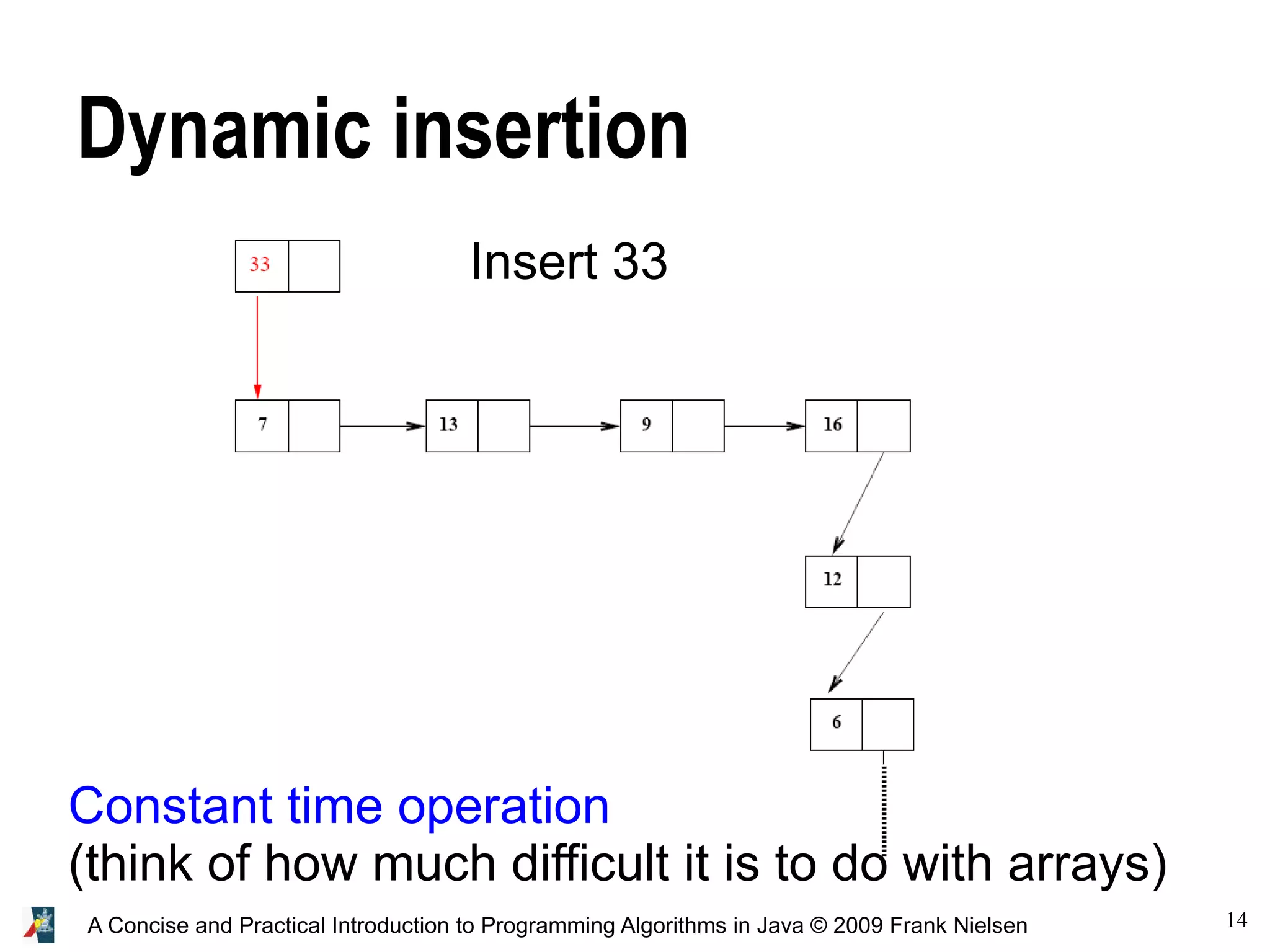
Dynamic insertion
Insert 33
Constant time operation
(think of how much difficult it is to do with arrays)
15A Concise and Practical Introduction to Programming Algorithms in Java © 2009 Frank Nielsen
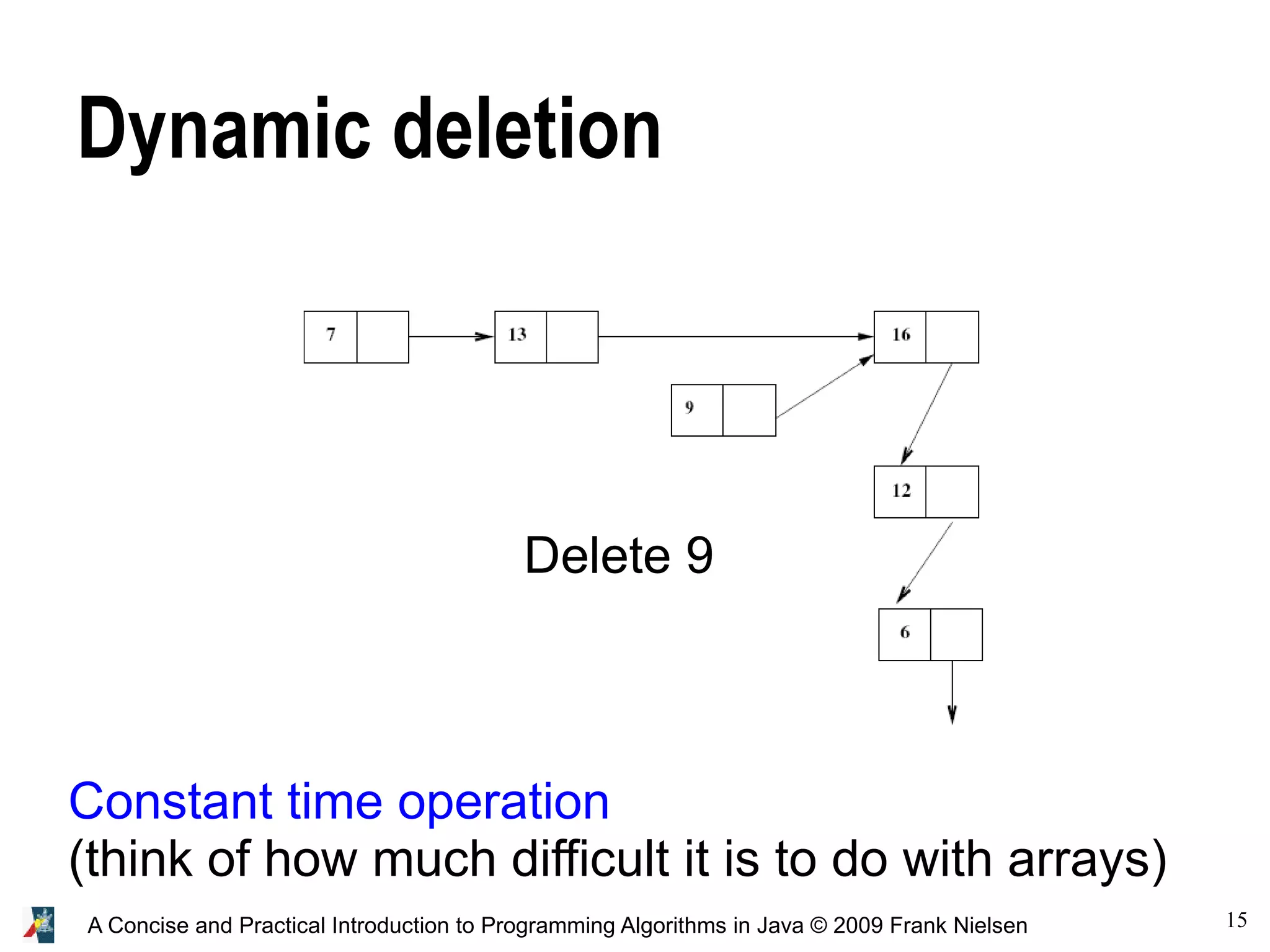
Dynamic deletion
Delete 9
Constant time operation
(think of how much difficult it is to do with arrays)
16A Concise and Practical Introduction to Programming Algorithms in Java © 2009 Frank Nielsen
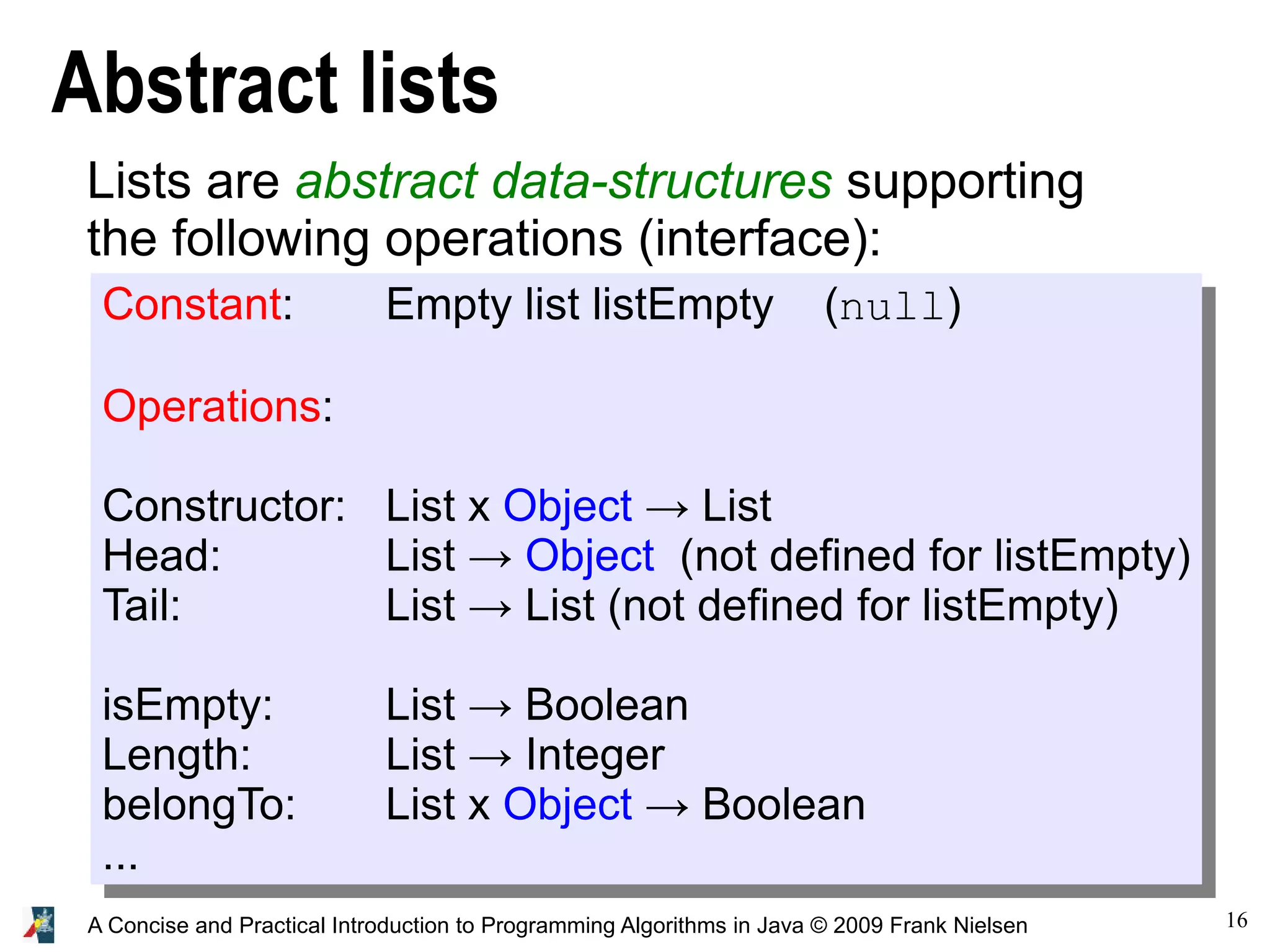
Abstract lists
Lists are abstract data-structures supporting
the following operations (interface):
Constant: Empty list listEmpty (null)
Operations:
Constructor: List x Object → List
Head: List → Object (not defined for listEmpty)
Tail: List → List (not defined for listEmpty)
isEmpty: List → Boolean
Length: List → Integer
belongTo: List x Object → Boolean
...
17A Concise and Practical Introduction to Programming Algorithms in Java © 2009 Frank Nielsen
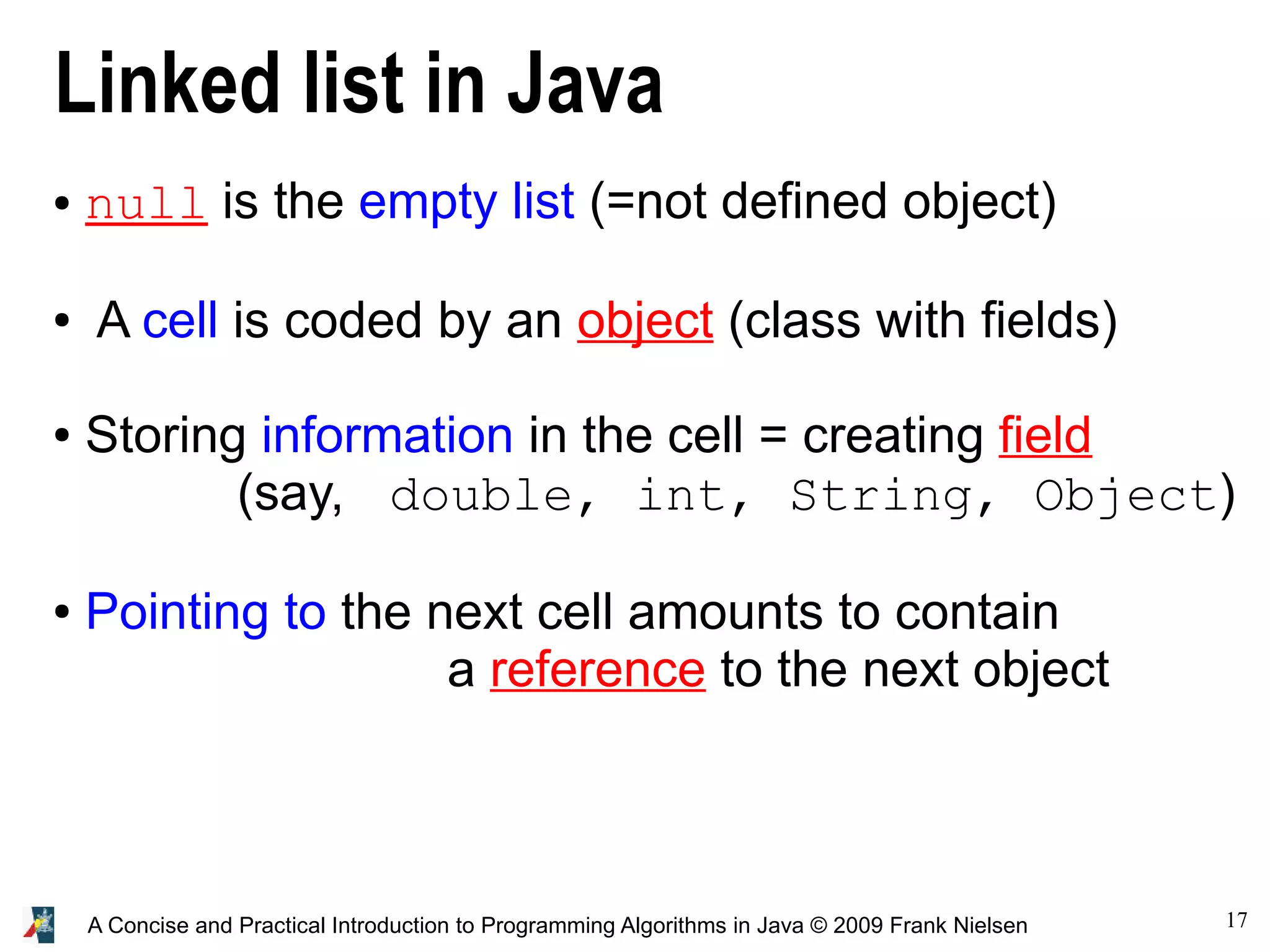
Linked list in Java
● null is the empty list (=not defined object)
● A cell is coded by an object (class with fields)
● Storing information in the cell = creating field
(say, double, int, String, Object)
● Pointing to the next cell amounts to contain
a reference to the next object
18A Concise and Practical Introduction to Programming Algorithms in Java © 2009 Frank Nielsen
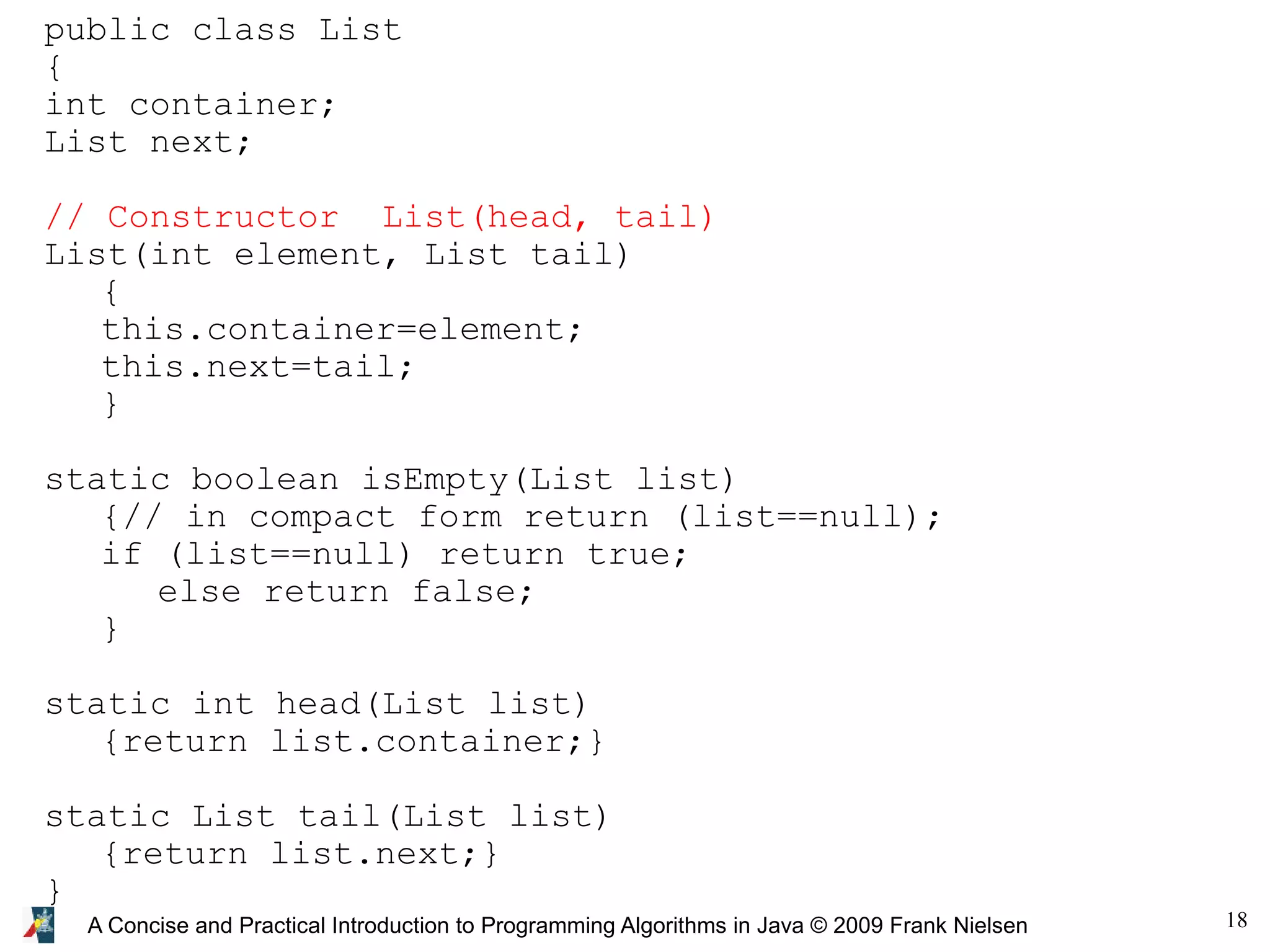
public class List
{
int container;
List next;
// Constructor List(head, tail)
List(int element, List tail)
{
this.container=element;
this.next=tail;
}
static boolean isEmpty(List list)
{// in compact form return (list==null);
if (list==null) return true;
else return false;
}
static int head(List list)
{return list.container;}
static List tail(List list)
{return list.next;}
}
19A Concise and Practical Introduction to Programming Algorithms in Java © 2009 Frank Nielsen
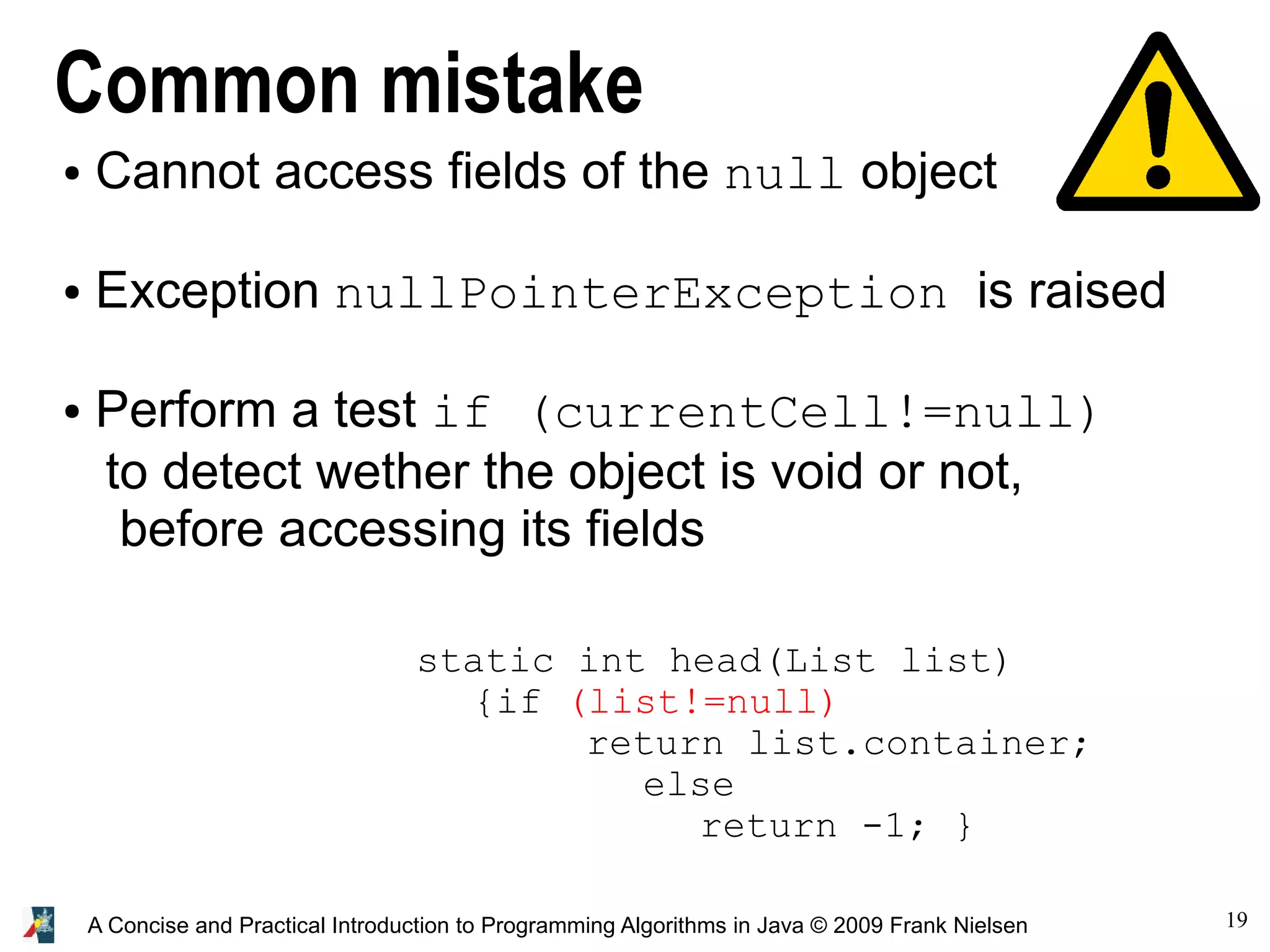
Common mistake
● Cannot access fields of the null object
● Exception nullPointerException is raised
● Perform a test if (currentCell!=null)
to detect wether the object is void or not,
before accessing its fields
static int head(List list)
{if (list!=null)
return list.container;
else
return -1; }
20A Concise and Practical Introduction to Programming Algorithms in Java © 2009 Frank Nielsen
public class List
{...}
class ListJava{
public static void main (String[] args)
{
List myList=new List(23,null);
}
} MemoryFunction stack
MyList (4 bytes)
Reference
main
23 null
List object
Container (int)
Reference to list
21A Concise and Practical Introduction to Programming Algorithms in Java © 2009 Frank Nielsen
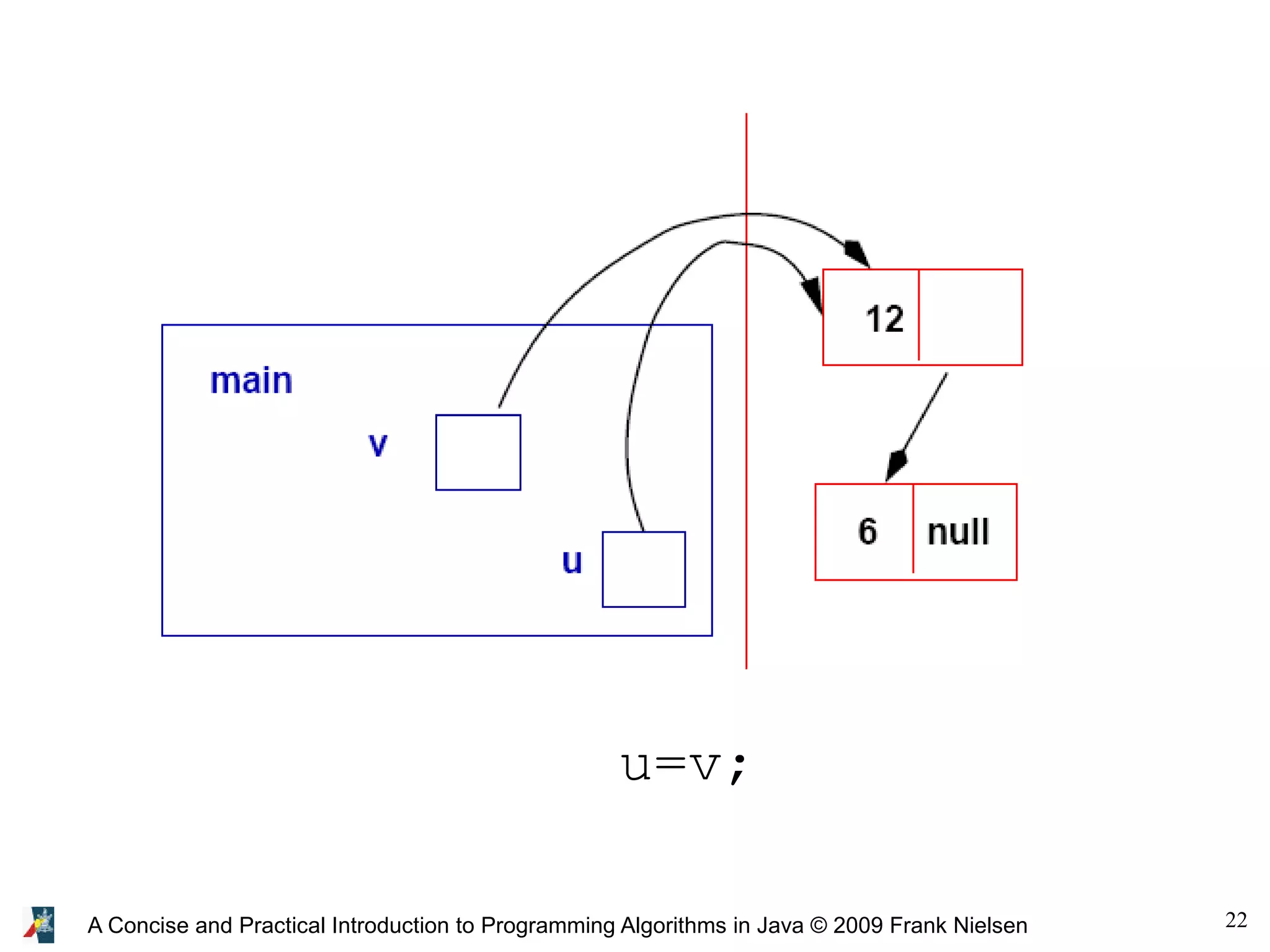
class ListJava{
public static void main (String[] args)
{
List u=new List(6,null);
List v=new List(12,u);
}
}
22A Concise and Practical Introduction to Programming Algorithms in Java © 2009 Frank Nielsen
u=v;
23A Concise and Practical Introduction to Programming Algorithms in Java © 2009 Frank Nielsen
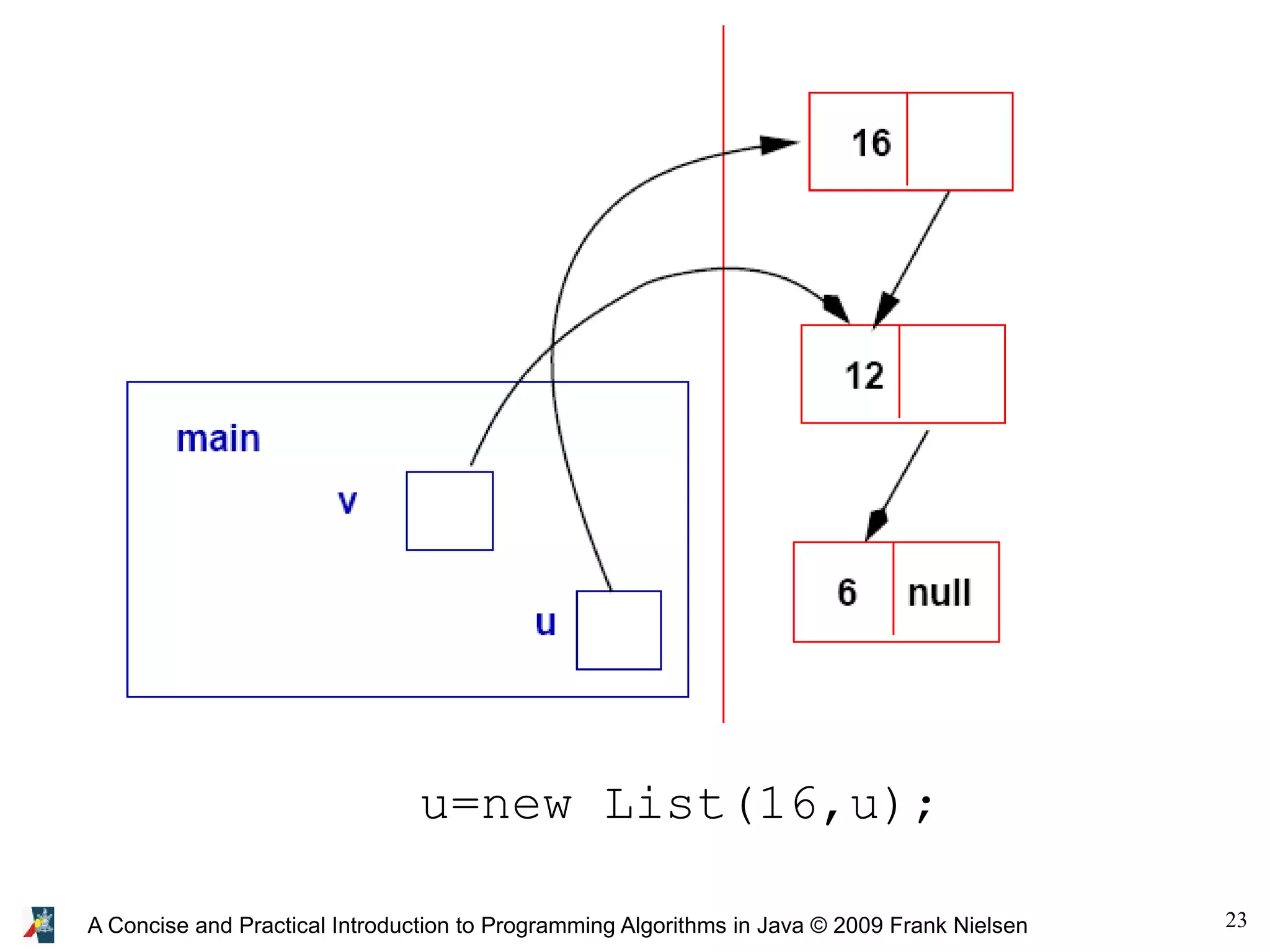
u=new List(16,u);
24A Concise and Practical Introduction to Programming Algorithms in Java © 2009 Frank Nielsen
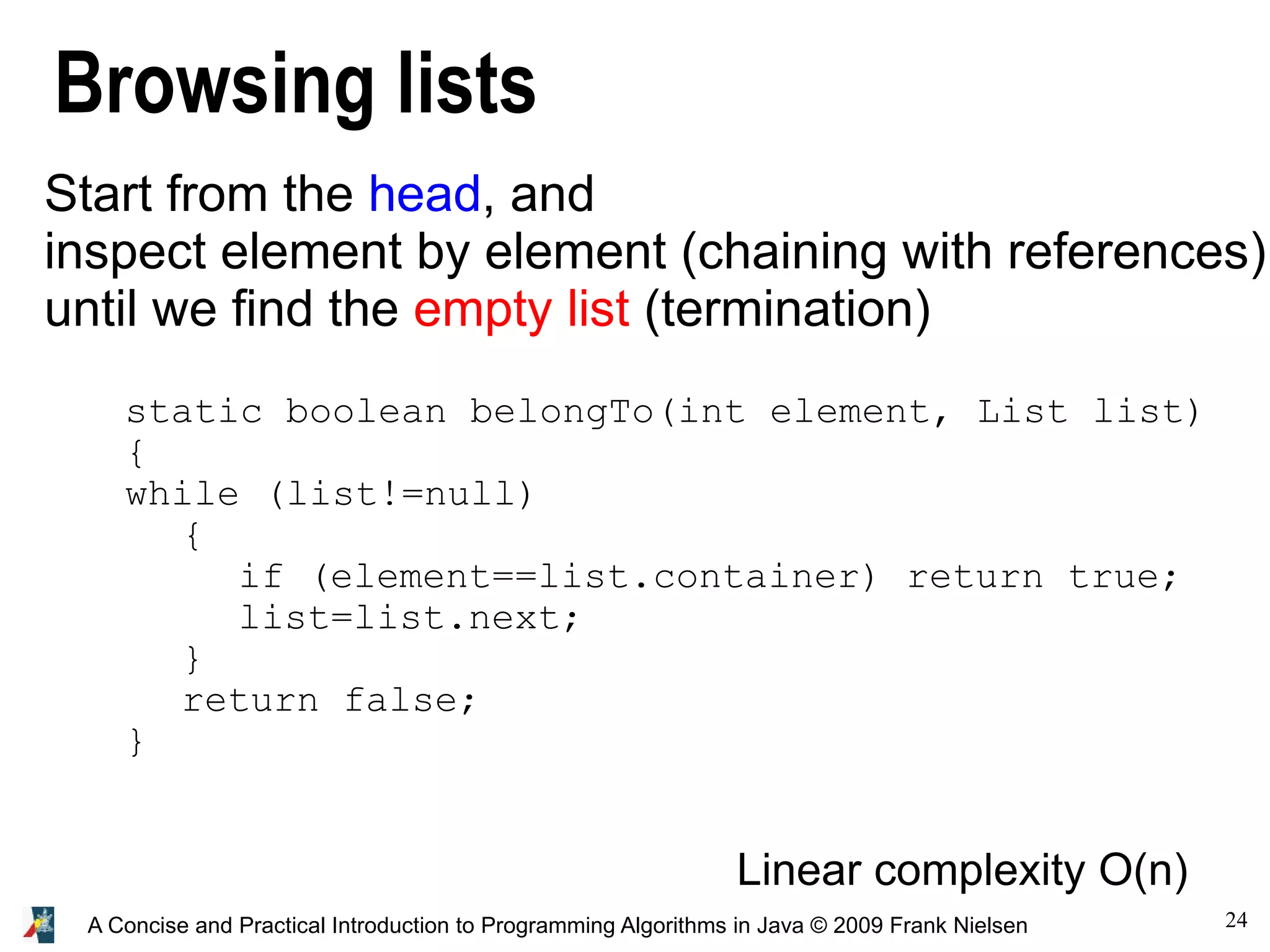
Browsing lists
Start from the head, and
inspect element by element (chaining with references)
until we find the empty list (termination)
Linear complexity O(n)
static boolean belongTo(int element, List list)
{
while (list!=null)
{
if (element==list.container) return true;
list=list.next;
}
return false;
}
25A Concise and Practical Introduction to Programming Algorithms in Java © 2009 Frank Nielsen
class ListJava{
public static void main (String[] args)
{
List u=new List(6,null);
u=new List(16,u);
u=new List(32,u);
u=new List(25,u);
System.out.println(List.belongTo(6,u));
System.out.println(List.belongTo(17,u));
}
}
List: Linear search complexity O(n)
static boolean belongTo(int element, List list)
{
while (list!=null)
{
if (element==list.container) return true;
list=list.next;
}
return false;
}
==
equals
26A Concise and Practical Introduction to Programming Algorithms in Java © 2009 Frank Nielsen
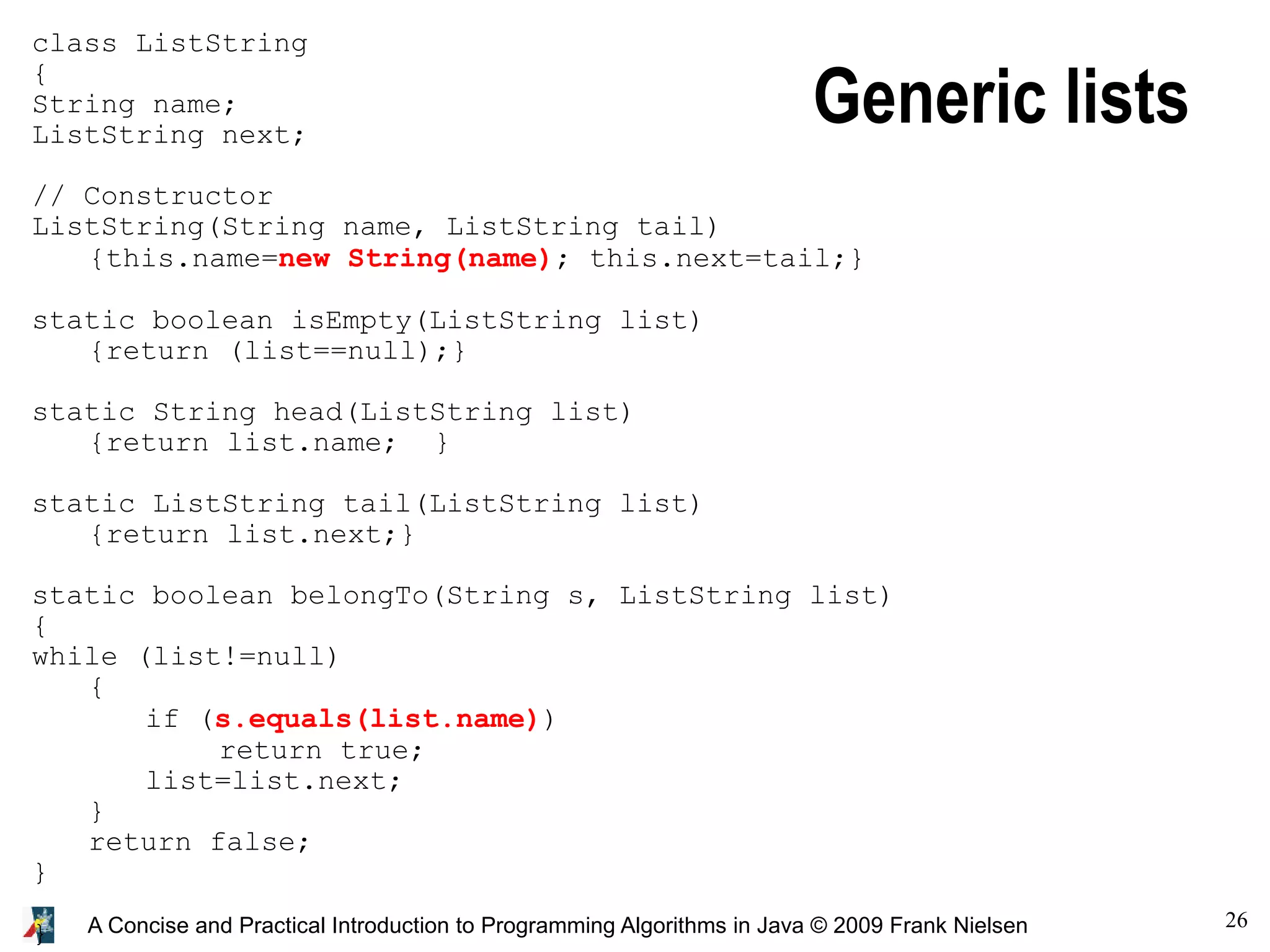
class ListString
{
String name;
ListString next;
// Constructor
ListString(String name, ListString tail)
{this.name=new String(name); this.next=tail;}
static boolean isEmpty(ListString list)
{return (list==null);}
static String head(ListString list)
{return list.name; }
static ListString tail(ListString list)
{return list.next;}
static boolean belongTo(String s, ListString list)
{
while (list!=null)
{
if (s.equals(list.name))
return true;
list=list.next;
}
return false;
}
}
Generic lists
27A Concise and Practical Introduction to Programming Algorithms in Java © 2009 Frank Nielsen
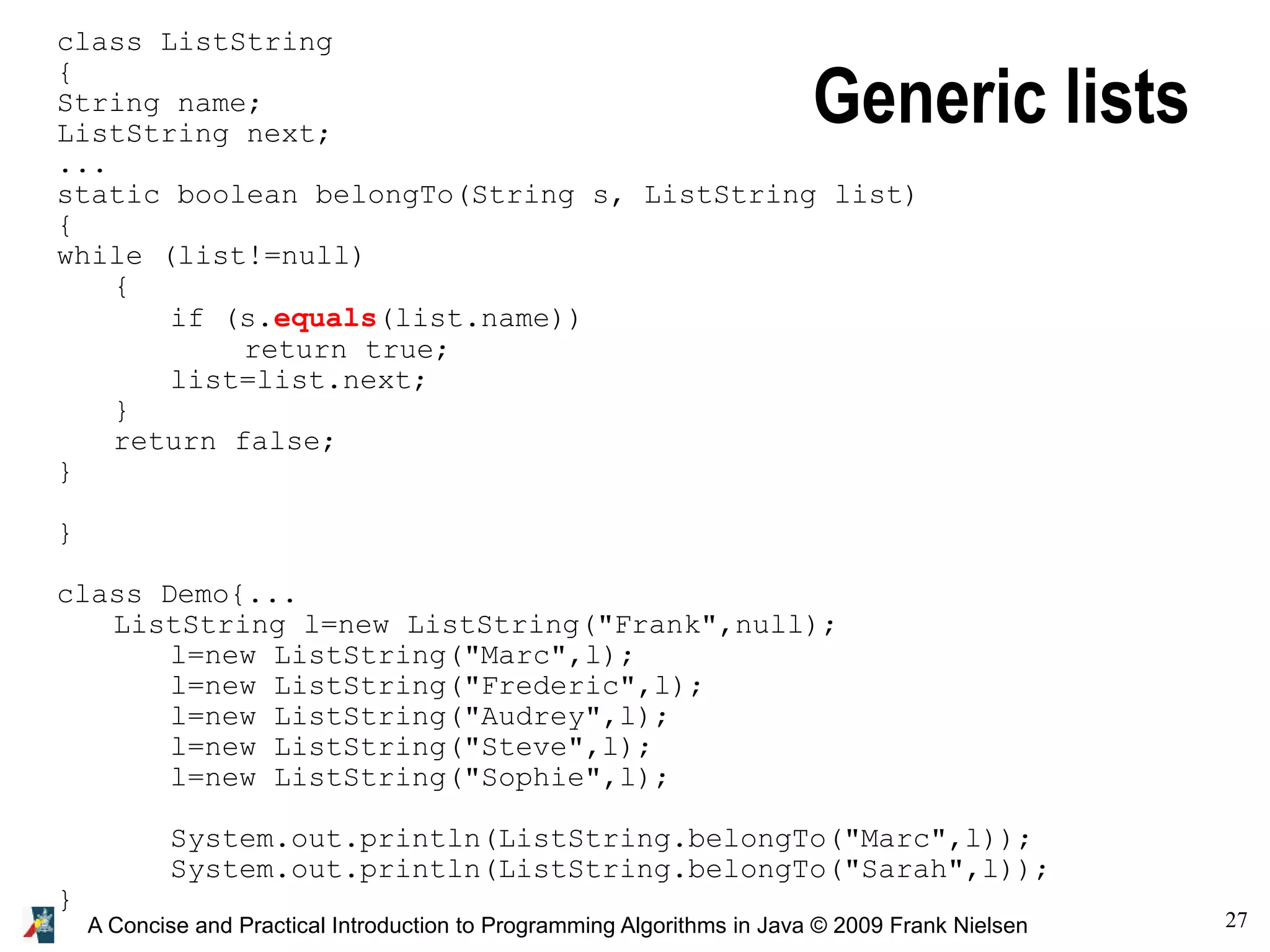
class ListString
{
String name;
ListString next;
...
static boolean belongTo(String s, ListString list)
{
while (list!=null)
{
if (s.equals(list.name))
return true;
list=list.next;
}
return false;
}
}
class Demo{...
ListString l=new ListString("Frank",null);
l=new ListString("Marc",l);
l=new ListString("Frederic",l);
l=new ListString("Audrey",l);
l=new ListString("Steve",l);
l=new ListString("Sophie",l);
System.out.println(ListString.belongTo("Marc",l));
System.out.println(ListString.belongTo("Sarah",l));
}
Generic lists
28A Concise and Practical Introduction to Programming Algorithms in Java © 2009 Frank Nielsen
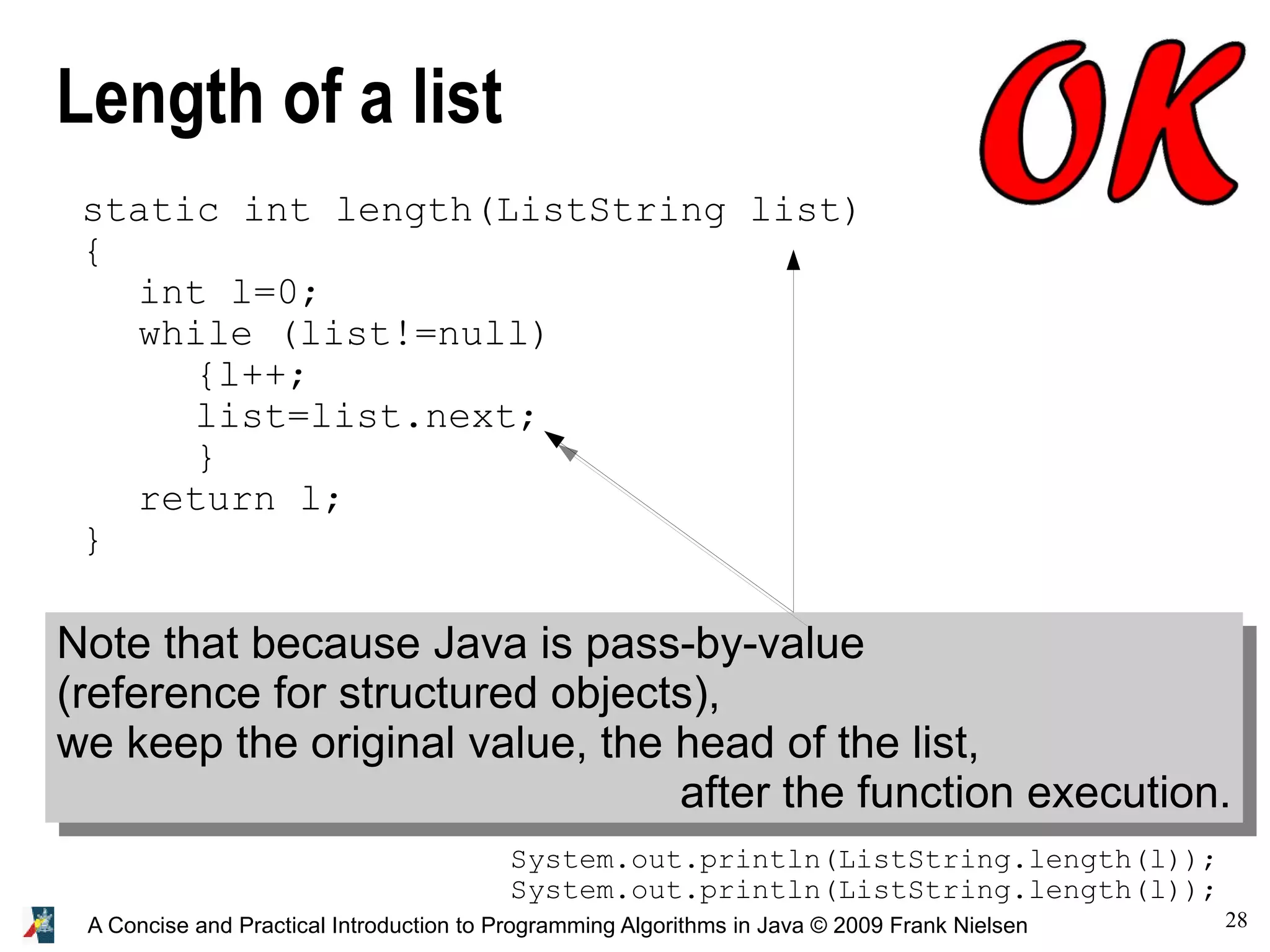
Length of a list
static int length(ListString list)
{
int l=0;
while (list!=null)
{l++;
list=list.next;
}
return l;
}
Note that because Java is pass-by-value
(reference for structured objects),
we keep the original value, the head of the list,
after the function execution.
System.out.println(ListString.length(l));
29A Concise and Practical Introduction to Programming Algorithms in Java © 2009 Frank Nielsen
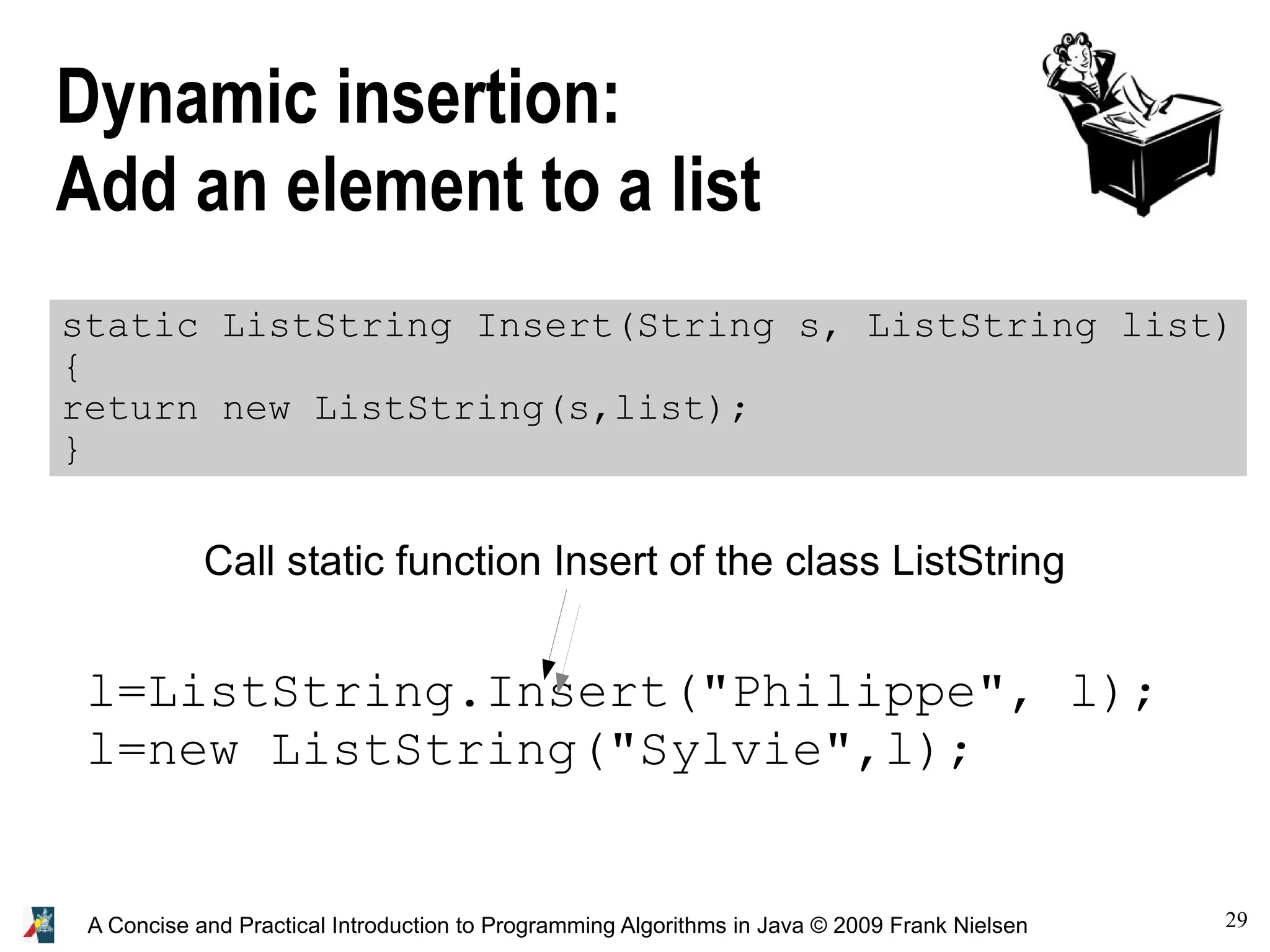
Dynamic insertion:
Add an element to a list
static ListString Insert(String s, ListString list)
{
return new ListString(s,list);
}
l=ListString.Insert("Philippe", l);
l=new ListString("Sylvie",l);
Call static function Insert of the class ListString
30A Concise and Practical Introduction to Programming Algorithms in Java © 2009 Frank Nielsen
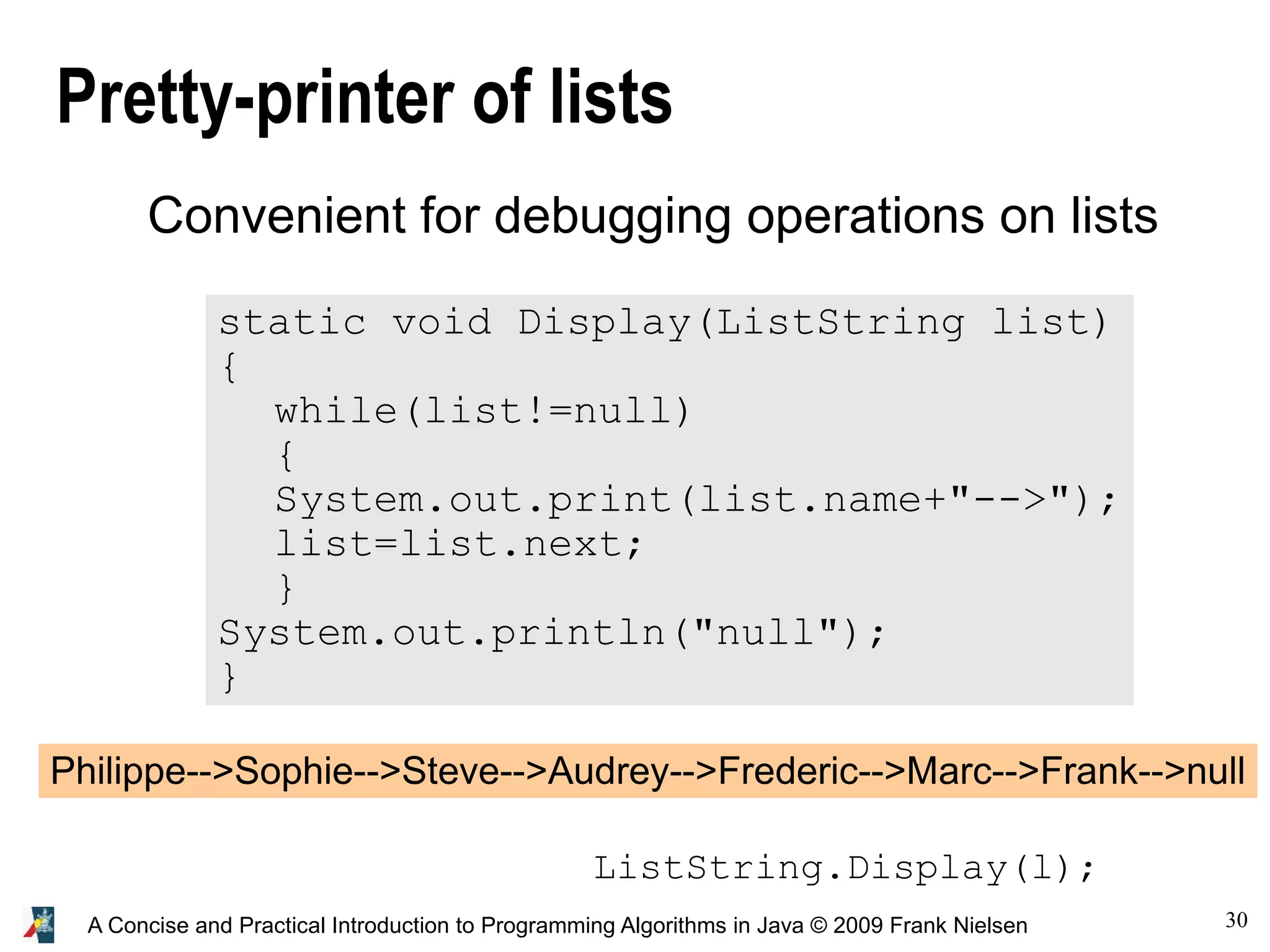
Pretty-printer of lists
Convenient for debugging operations on lists
Philippe-->Sophie-->Steve-->Audrey-->Frederic-->Marc-->Frank-->null
static void Display(ListString list)
{
while(list!=null)
{
System.out.print(list.name+"-->");
list=list.next;
}
System.out.println("null");
}
ListString.Display(l);
31A Concise and Practical Introduction to Programming Algorithms in Java © 2009 Frank Nielsen
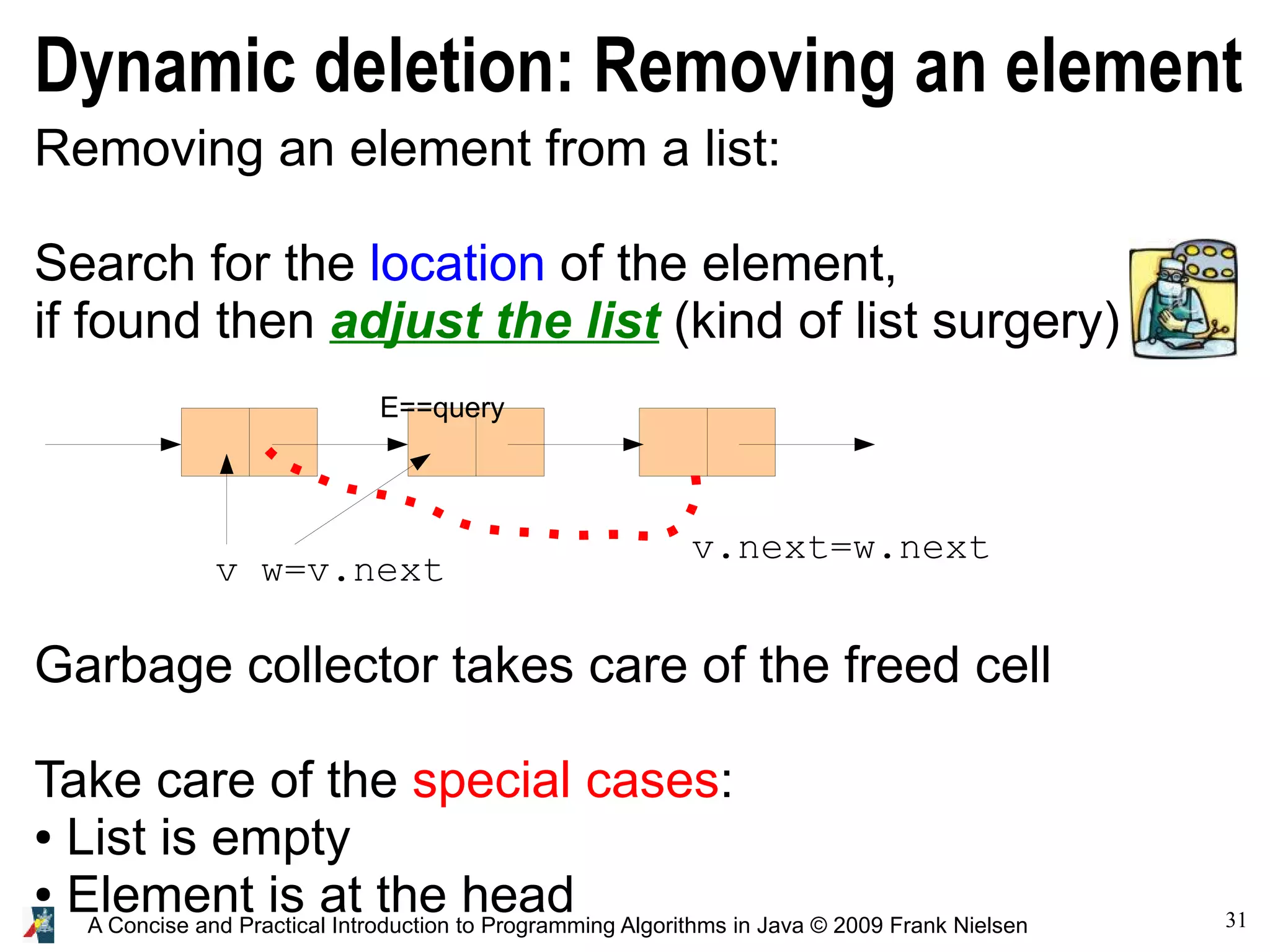
Dynamic deletion: Removing an element
Removing an element from a list:
Search for the location of the element,
if found then adjust the list (kind of list surgery)
Garbage collector takes care of the freed cell
Take care of the special cases:
● List is empty
● Element is at the head
v w=v.next
E==query
v.next=w.next
32A Concise and Practical Introduction to Programming Algorithms in Java © 2009 Frank Nielsen
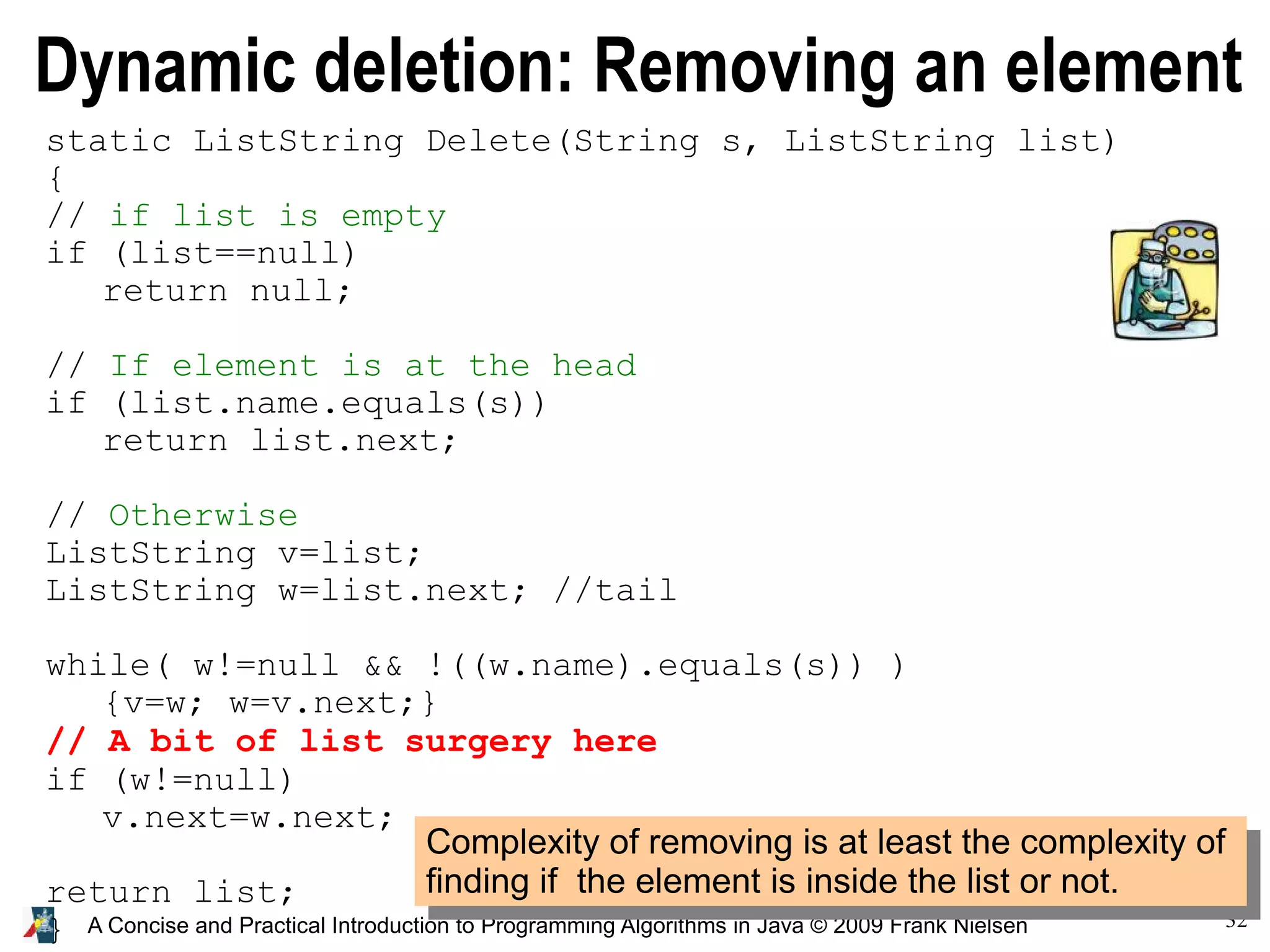
Dynamic deletion: Removing an element
Complexity of removing is at least the complexity of
finding if the element is inside the list or not.
static ListString Delete(String s, ListString list)
{
// if list is empty
if (list==null)
return null;
// If element is at the head
if (list.name.equals(s))
return list.next;
// Otherwise
ListString v=list;
ListString w=list.next; //tail
while( w!=null && !((w.name).equals(s)) )
{v=w; w=v.next;}
// A bit of list surgery here
if (w!=null)
v.next=w.next;
return list;
}
33A Concise and Practical Introduction to Programming Algorithms in Java © 2009 Frank Nielsen
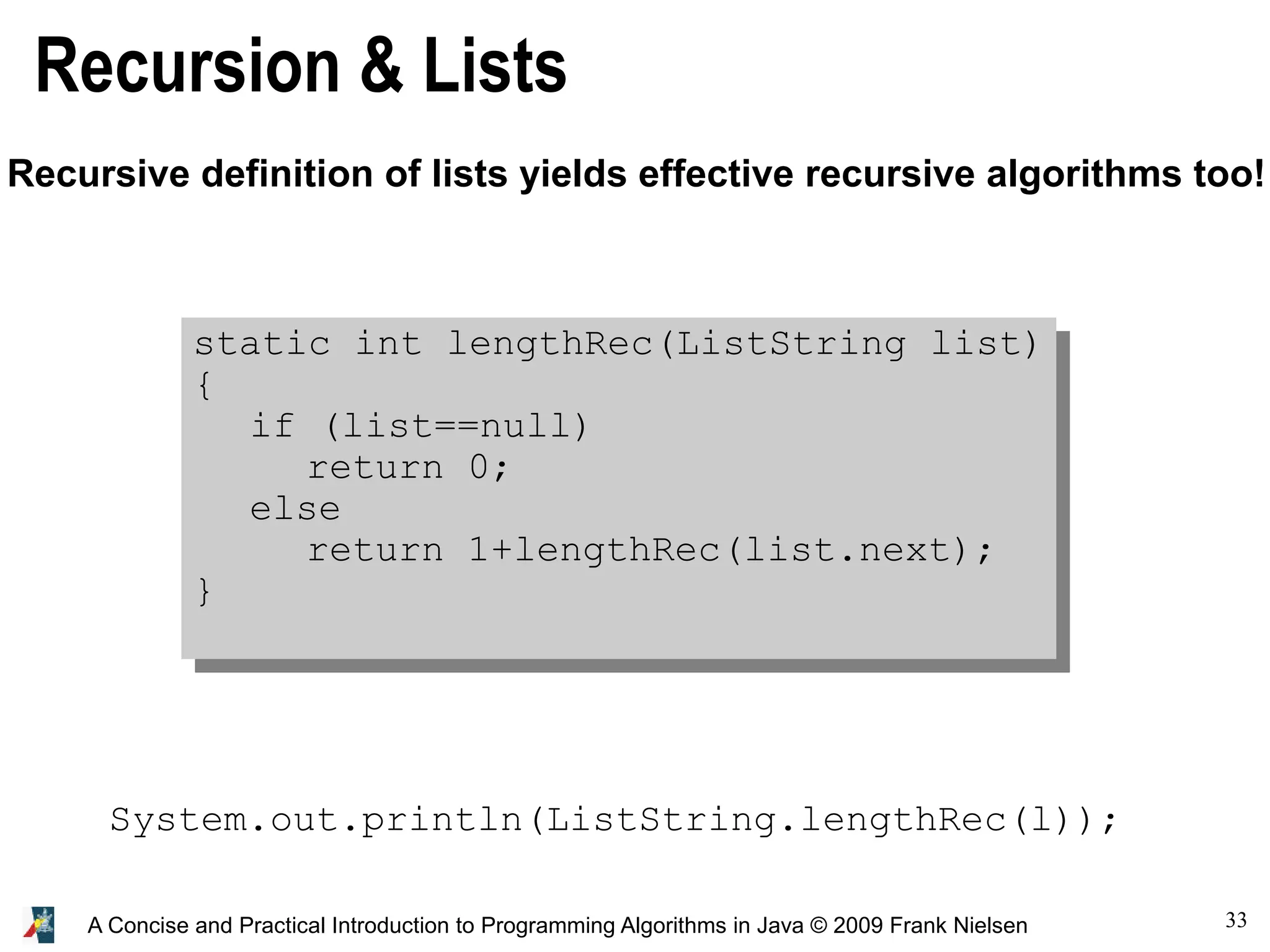
Recursion & Lists
Recursive definition of lists yields effective recursive algorithms too!
static int lengthRec(ListString list)
{
if (list==null)
return 0;
else
return 1+lengthRec(list.next);
}
System.out.println(ListString.lengthRec(l));
34A Concise and Practical Introduction to Programming Algorithms in Java © 2009 Frank Nielsen
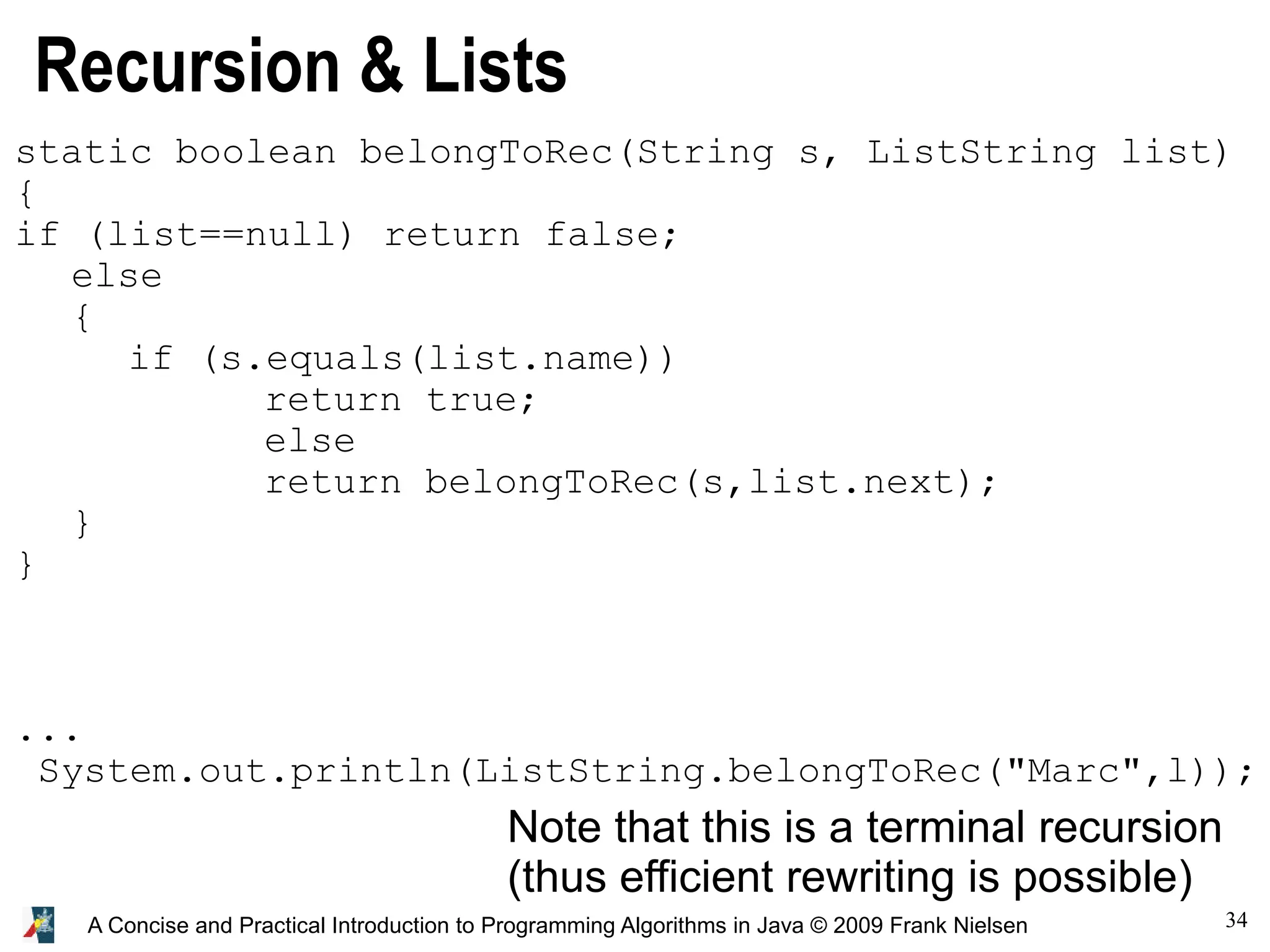
Recursion & Lists
static boolean belongToRec(String s, ListString list)
{
if (list==null) return false;
else
{
if (s.equals(list.name))
return true;
else
return belongToRec(s,list.next);
}
}
...
System.out.println(ListString.belongToRec("Marc",l));
Note that this is a terminal recursion
(thus efficient rewriting is possible)
35A Concise and Practical Introduction to Programming Algorithms in Java © 2009 Frank Nielsen
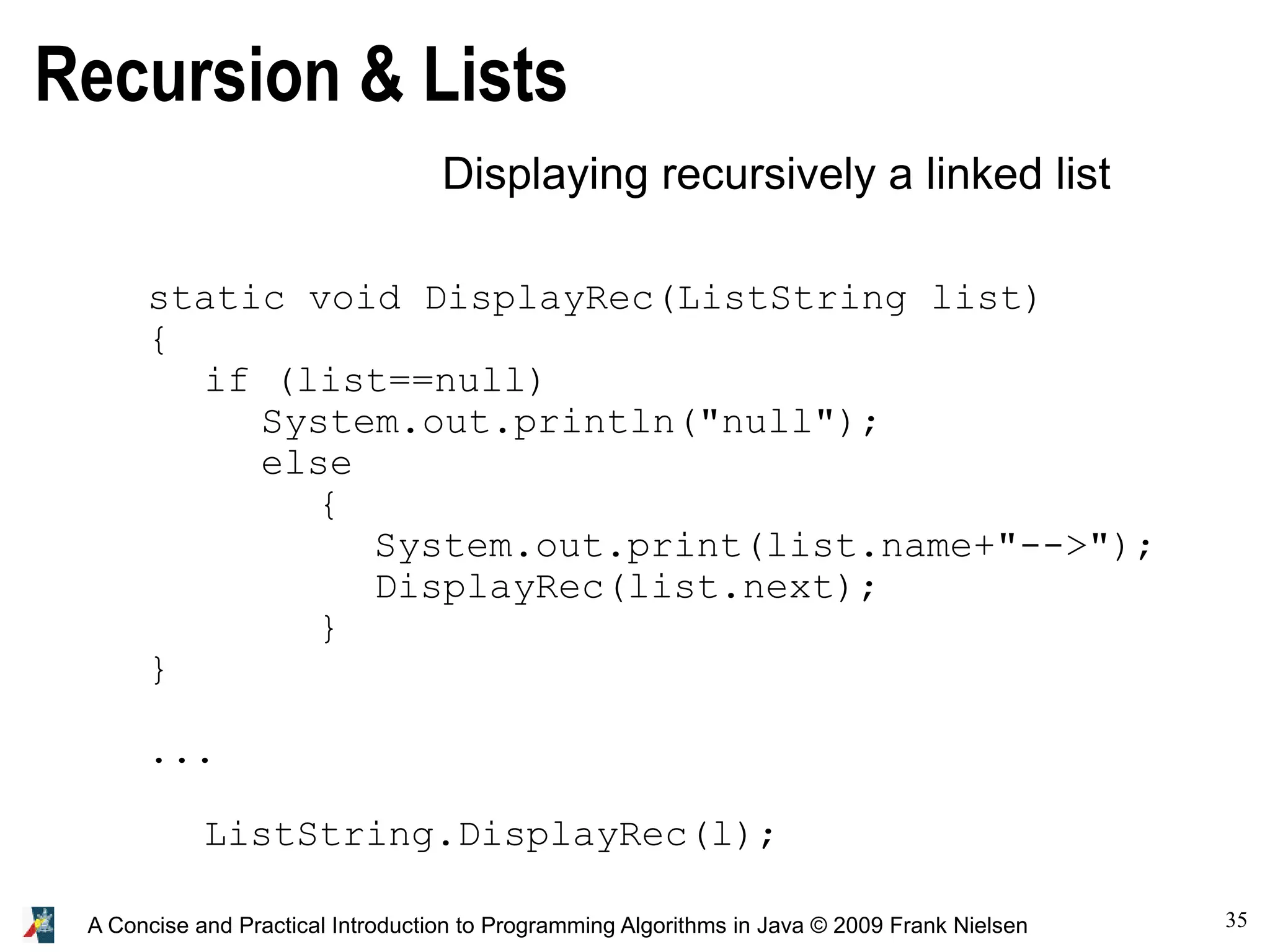
Recursion & Lists
static void DisplayRec(ListString list)
{
if (list==null)
System.out.println("null");
else
{
System.out.print(list.name+"-->");
DisplayRec(list.next);
}
}
...
ListString.DisplayRec(l);
Displaying recursively a linked list
36A Concise and Practical Introduction to Programming Algorithms in Java © 2009 Frank Nielsen
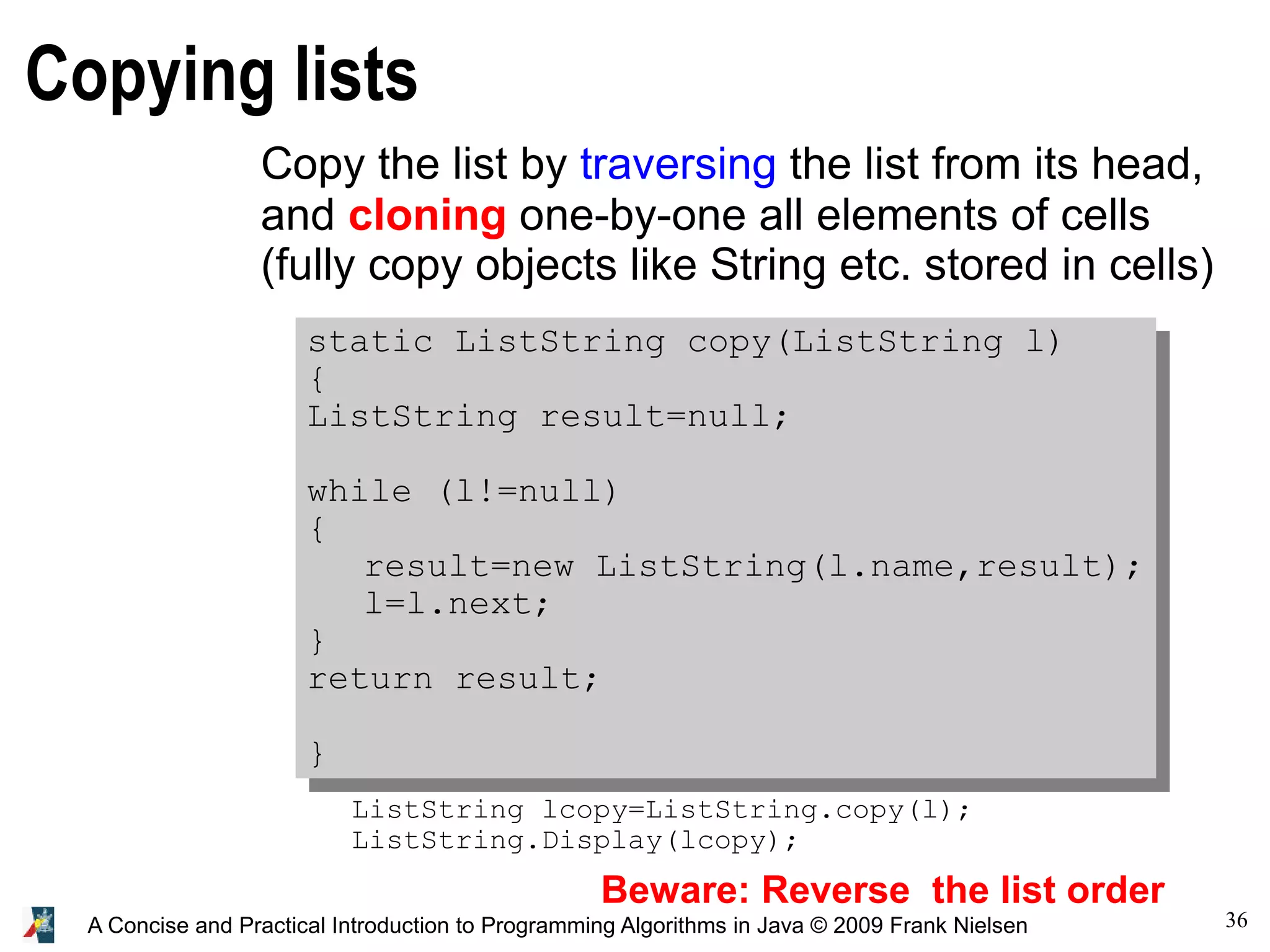
Copying lists
Copy the list by traversing the list from its head,
and cloning one-by-one all elements of cells
(fully copy objects like String etc. stored in cells)
static ListString copy(ListString l)
{
ListString result=null;
while (l!=null)
{
result=new ListString(l.name,result);
l=l.next;
}
return result;
}
ListString lcopy=ListString.copy(l);
ListString.Display(lcopy);
Beware: Reverse the list order
37A Concise and Practical Introduction to Programming Algorithms in Java © 2009 Frank Nielsen
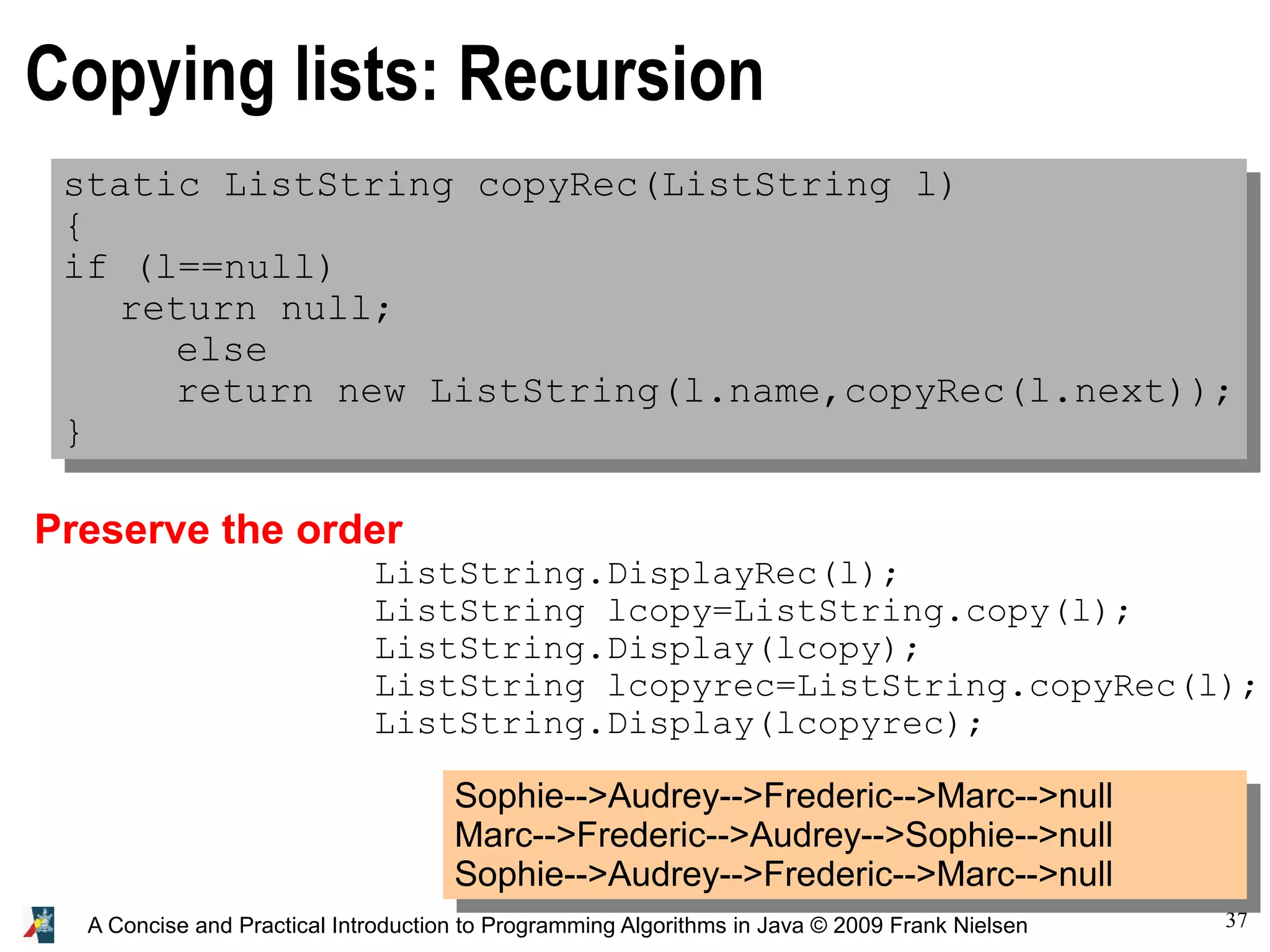
Copying lists: Recursion
static ListString copyRec(ListString l)
{
if (l==null)
return null;
else
return new ListString(l.name,copyRec(l.next));
}
ListString.DisplayRec(l);
ListString lcopy=ListString.copy(l);
ListString.Display(lcopy);
ListString lcopyrec=ListString.copyRec(l);
ListString.Display(lcopyrec);
Preserve the order
Sophie-->Audrey-->Frederic-->Marc-->null
Marc-->Frederic-->Audrey-->Sophie-->null
Sophie-->Audrey-->Frederic-->Marc-->null
38A Concise and Practical Introduction to Programming Algorithms in Java © 2009 Frank Nielsen
Building linked lists from arrays
static ListString Build(String [] array)
{
ListString result=null;
// To ensure that head is the first array element
// decrement: from largest to smallest index
for(int i=array.length-1;i>=0;i--)
result=new ListString(array[i],result);
return result;
}
String [] colors={"green", "red", "blue", "purple", "orange", "yellow"};
ListString lColors=ListString.Build(colors);
ListString.Display(lColors);
green-->red-->blue-->purple-->orange-->yellow-->null
39A Concise and Practical Introduction to Programming Algorithms in Java © 2009 Frank Nielsen
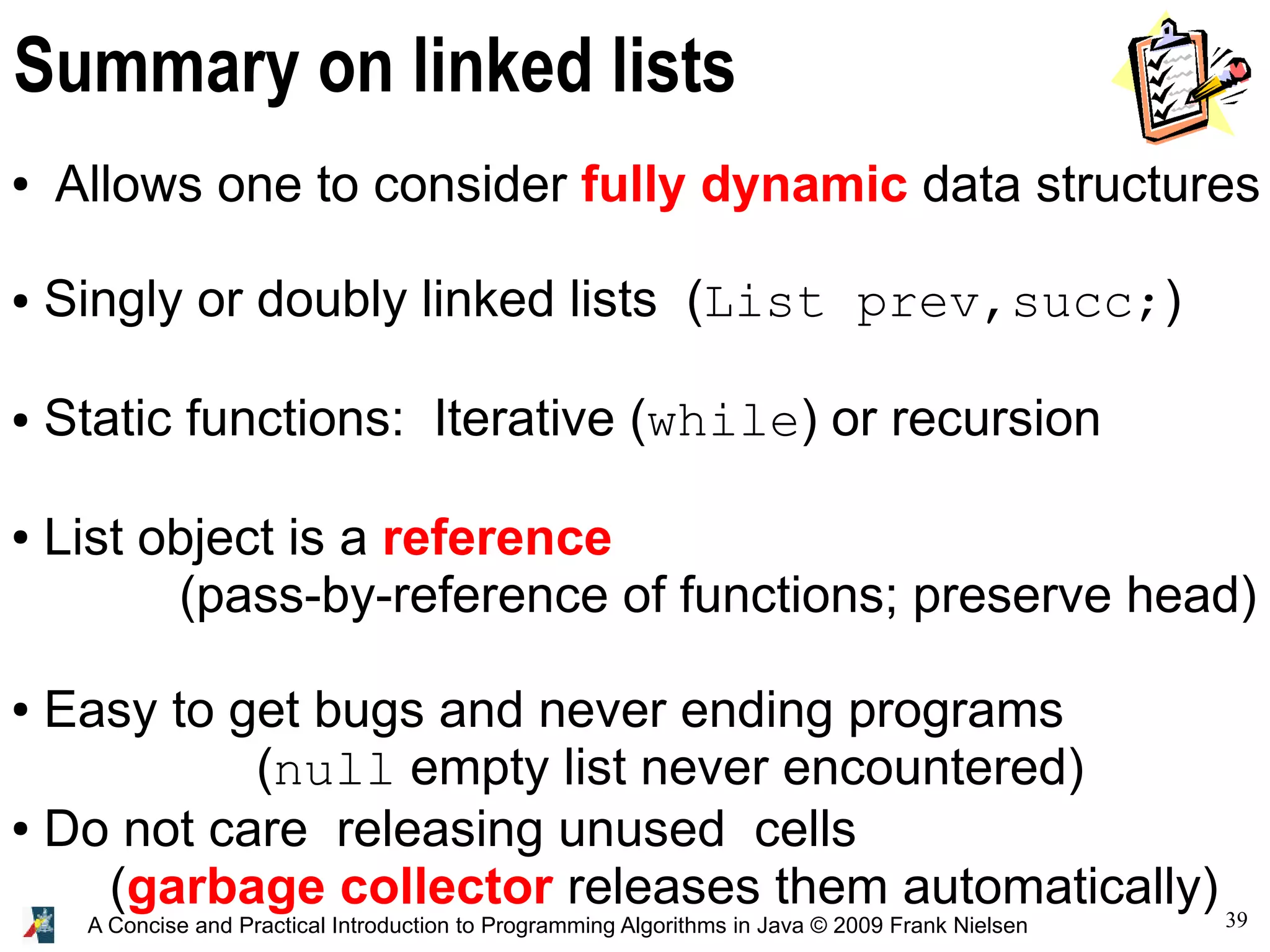
Summary on linked lists
● Allows one to consider fully dynamic data structures
● Singly or doubly linked lists (List prev,succ;)
● Static functions: Iterative (while) or recursion
● List object is a reference
(pass-by-reference of functions; preserve head)
● Easy to get bugs and never ending programs
(null empty list never encountered)
● Do not care releasing unused cells
(garbage collector releases them automatically)
40A Concise and Practical Introduction to Programming Algorithms in Java © 2009 Frank Nielsen
Hashing: A fundamental technique
● Store object x in array position h(x) (int)
● Major problem occurs if two objects x and y
are stored on the same cell: Collision.
Key issues in hashing:
● Finding good hashing functions that minimize collisions,
● Adopting a good search policy in case of collisions
int i;
array[i]
Object Obj=new Object();
int i;
i=h(Obj);// hashing function
array[i]
41A Concise and Practical Introduction to Programming Algorithms in Java © 2009 Frank Nielsen
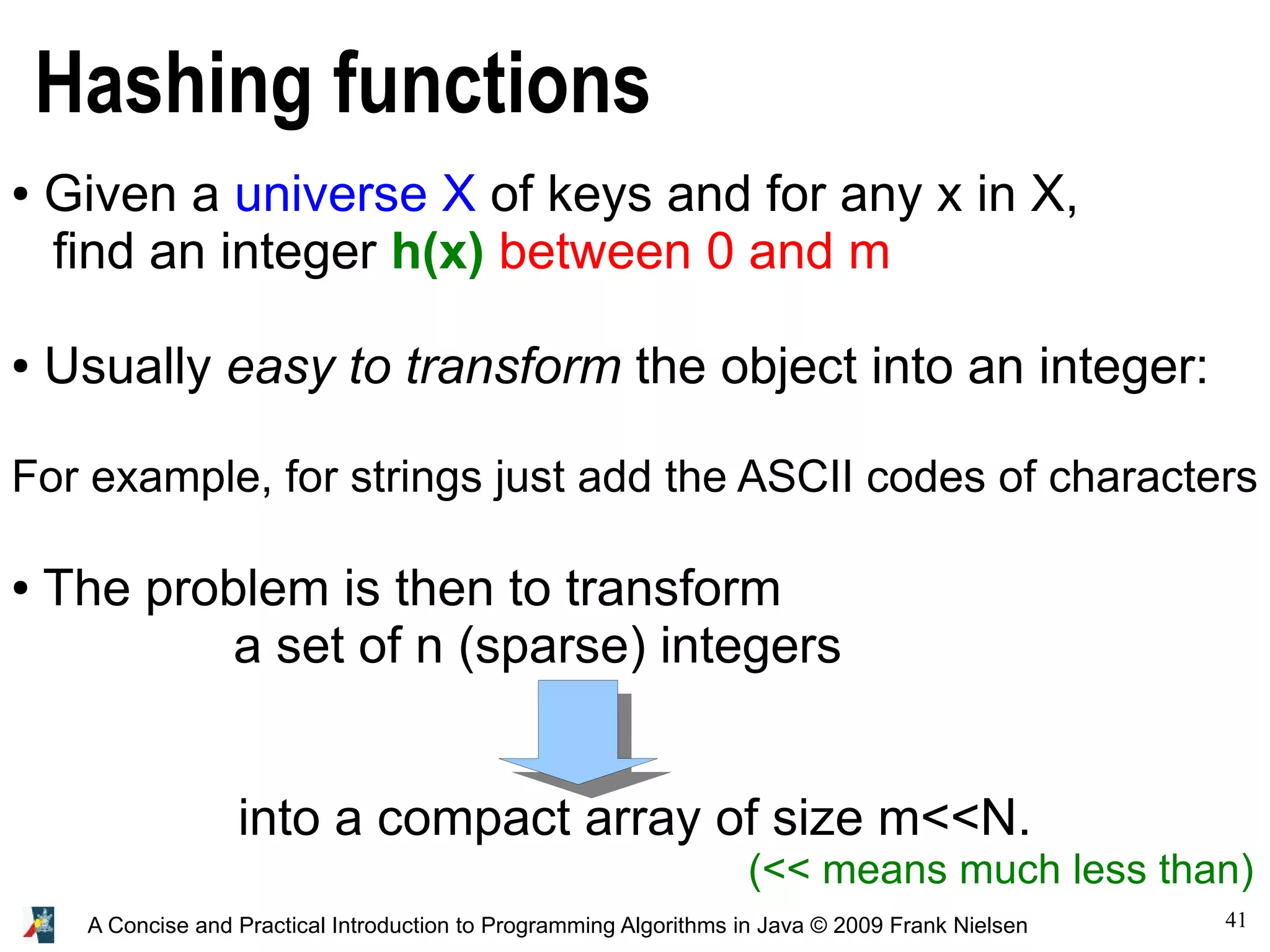
Hashing functions
● Given a universe X of keys and for any x in X,
find an integer h(x) between 0 and m
● Usually easy to transform the object into an integer:
For example, for strings just add the ASCII codes of characters
● The problem is then to transform
a set of n (sparse) integers
into a compact array of size m<<N.
(<< means much less than)
42A Concise and Practical Introduction to Programming Algorithms in Java © 2009 Frank Nielsen
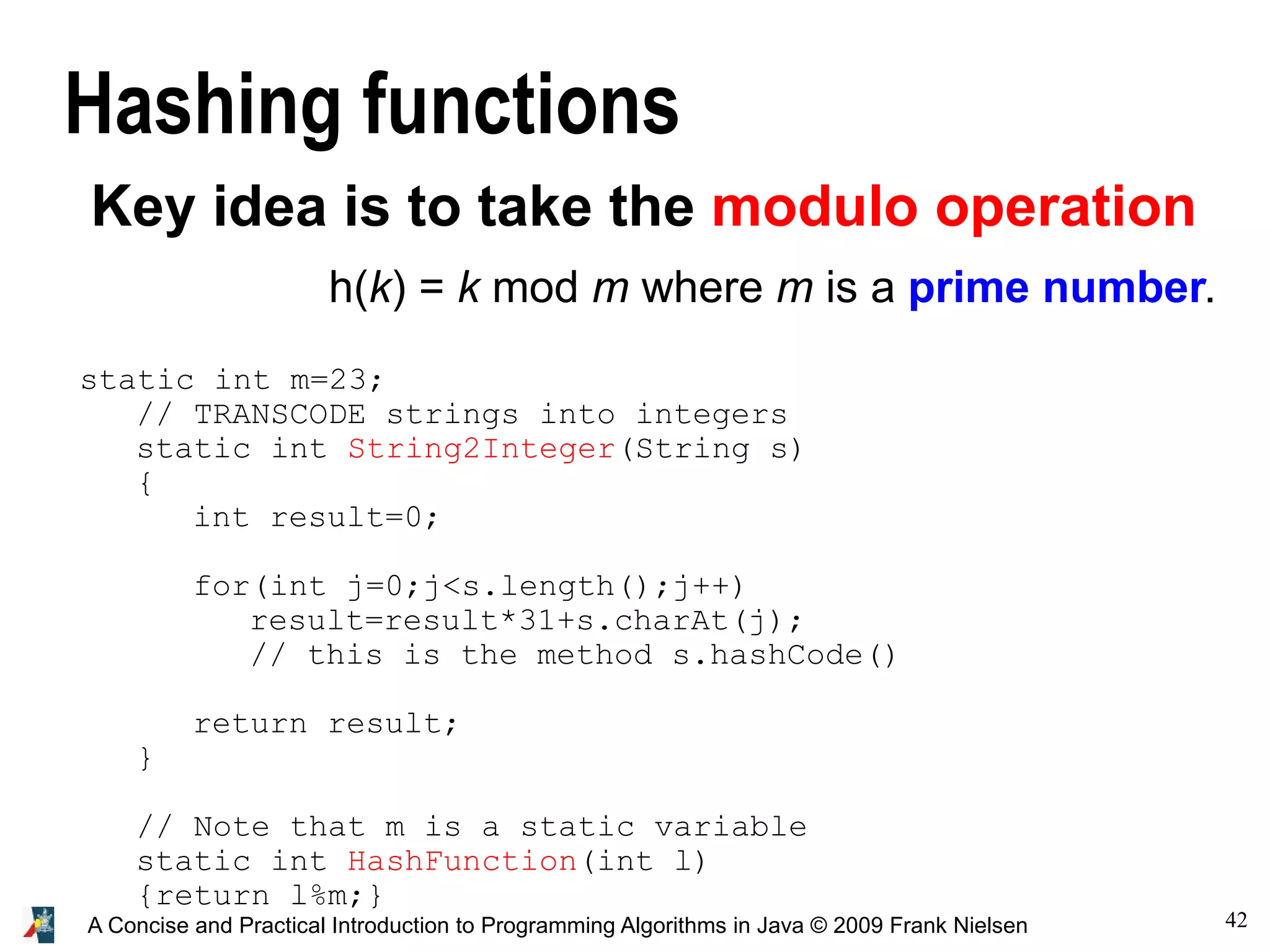
Hashing functions
Key idea is to take the modulo operation
h(k) = k mod m where m is a prime number.
static int m=23;
// TRANSCODE strings into integers
static int String2Integer(String s)
{
int result=0;
for(int j=0;j<s.length();j++)
result=result*31+s.charAt(j);
// this is the method s.hashCode()
return result;
}
// Note that m is a static variable
static int HashFunction(int l)
{return l%m;}
43A Concise and Practical Introduction to Programming Algorithms in Java © 2009 Frank Nielsen
public static void main (String[] args)
{
String [] animals={"cat","dog","parrot","horse","fish",
"shark","pelican","tortoise", "whale", "lion",
"flamingo", "cow", "snake", "spider", "bee", "peacock",
"elephant", "butterfly"};
int i;
String [] HashTable=new String[m];
for(i=0;i<m;i++)
HashTable[i]=new String("-->");
for(i=0;i<animals.length;i++)
{int pos=HashFunction(String2Integer(animals[i]));
HashTable[pos]+=(" "+animals[i]);
}
for(i=0;i<m;i++)
System.out.println("Position "+i+"t"+HashTable[i]);
}
44A Concise and Practical Introduction to Programming Algorithms in Java © 2009 Frank Nielsen
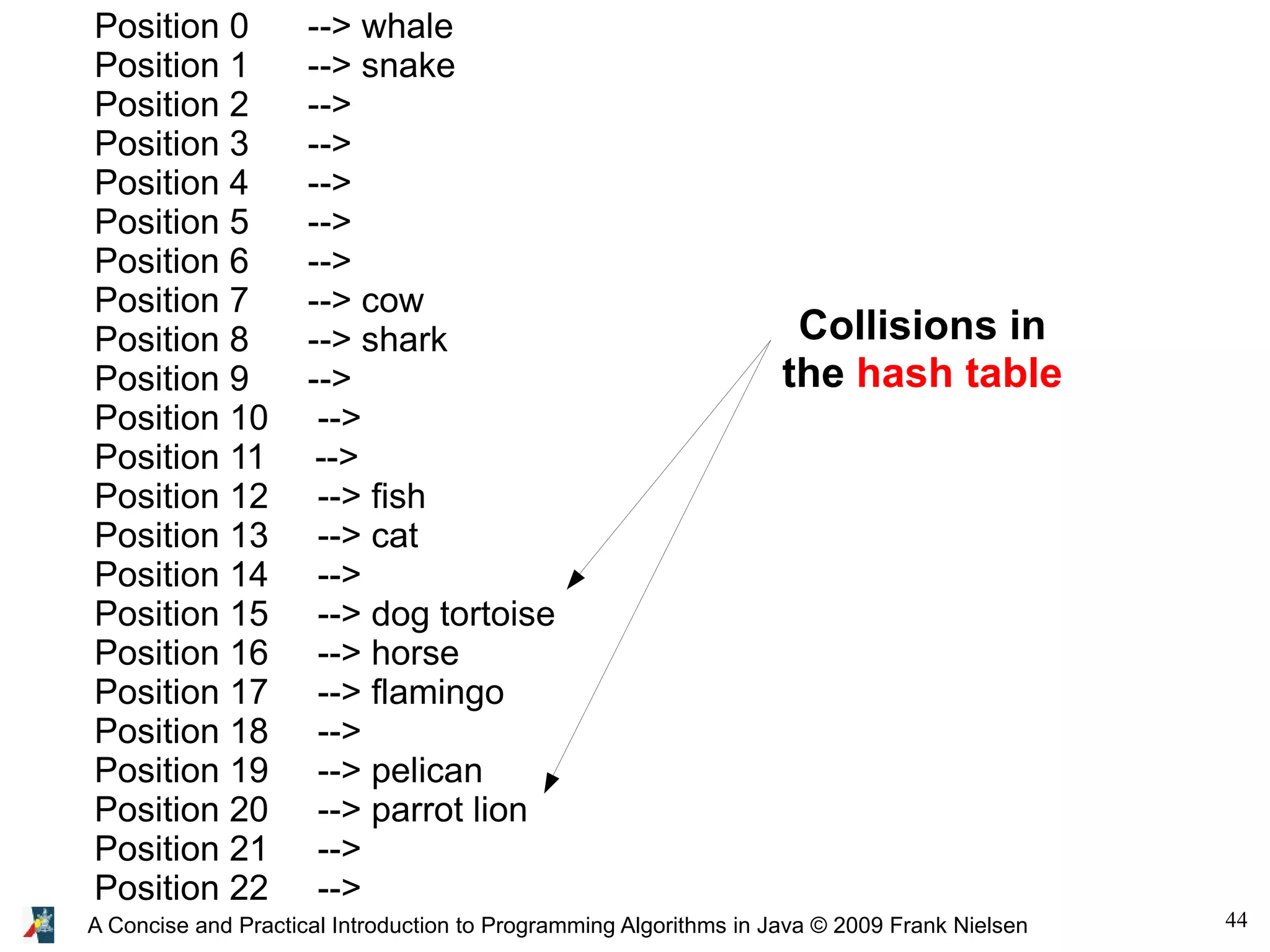
Position 0 --> whale
Position 1 --> snake
Position 2 -->
Position 3 -->
Position 4 -->
Position 5 -->
Position 6 -->
Position 7 --> cow
Position 8 --> shark
Position 9 -->
Position 10 -->
Position 11 -->
Position 12 --> fish
Position 13 --> cat
Position 14 -->
Position 15 --> dog tortoise
Position 16 --> horse
Position 17 --> flamingo
Position 18 -->
Position 19 --> pelican
Position 20 --> parrot lion
Position 21 -->
Position 22 -->
Collisions in
the hash table
45A Concise and Practical Introduction to Programming Algorithms in Java © 2009 Frank Nielsen
Hashing: Solving collision
Open address methodology
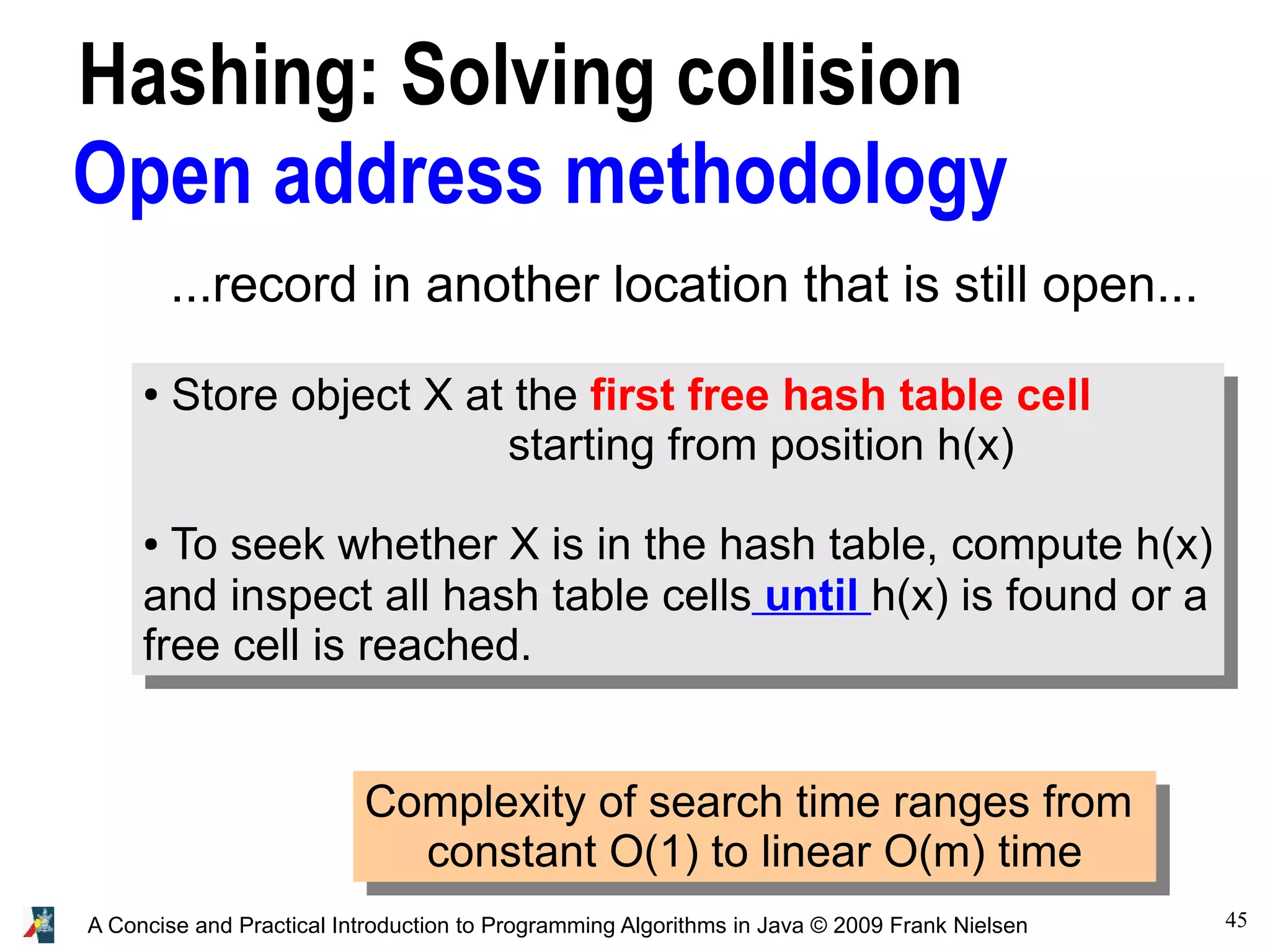
● Store object X at the first free hash table cell
starting from position h(x)
● To seek whether X is in the hash table, compute h(x)
and inspect all hash table cells until h(x) is found or a
free cell is reached.
Complexity of search time ranges from
constant O(1) to linear O(m) time
...record in another location that is still open...
46A Concise and Practical Introduction to Programming Algorithms in Java © 2009 Frank Nielsen
Position 0 whale
Position 1 snake
Position 2 bee
Position 3 spider
Position 4 butterfly
Position 5 null
Position 6 null
Position 7 cow
Position 8 shark
Position 9 null
Position 10 null
Position 11 null
Position 12 fish
Position 13 cat
Position 14 peacock
Position 15 dog
Position 16 horse
Position 17 tortoise
Position 18 flamingo
Position 19 pelican
Position 20 parrot
Position 21 lion
Position 22 elephant
String [] HashTable=new String[m];
// By default HashTable[i]=null
for(i=0;i<animals.length;i++)
{
int s2int=String2Integer(animals[i]);
int pos=HashFunction(s2int);
while (HashTable[pos]!=null)
pos=(pos+1)%m;
HashTable[pos]=new String(animals[i]);
}
47A Concise and Practical Introduction to Programming Algorithms in Java © 2009 Frank Nielsen
Hashing: Solving collision
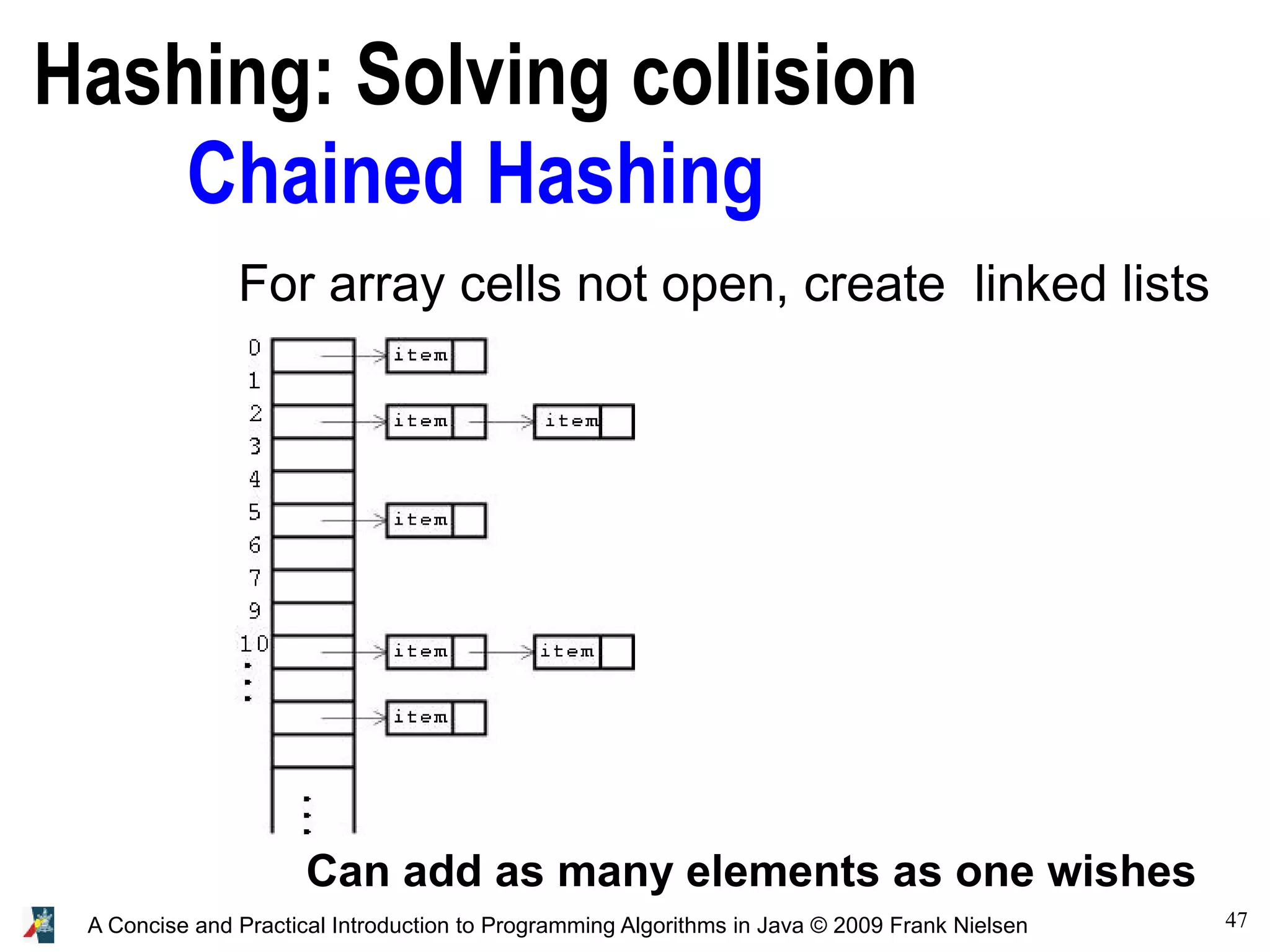
Chained Hashing
For array cells not open, create linked lists
Can add as many elements as one wishes
48A Concise and Practical Introduction to Programming Algorithms in Java © 2009 Frank Nielsen
ListString [] HashTable=new ListString[m];
for(i=0;i<m;i++)
HashTable[i]=null;
for(i=0;i<animals.length;i++)
{
int s2int=String2Integer(animals[i]);
int pos=HashFunction(s2int);
HashTable[pos]=ListString.Insert(animals[i],HashTable[pos]);
}
for(i=0;i<m;i++)
ListString.Display(HashTable[i]);
49A Concise and Practical Introduction to Programming Algorithms in Java © 2009 Frank Nielsen
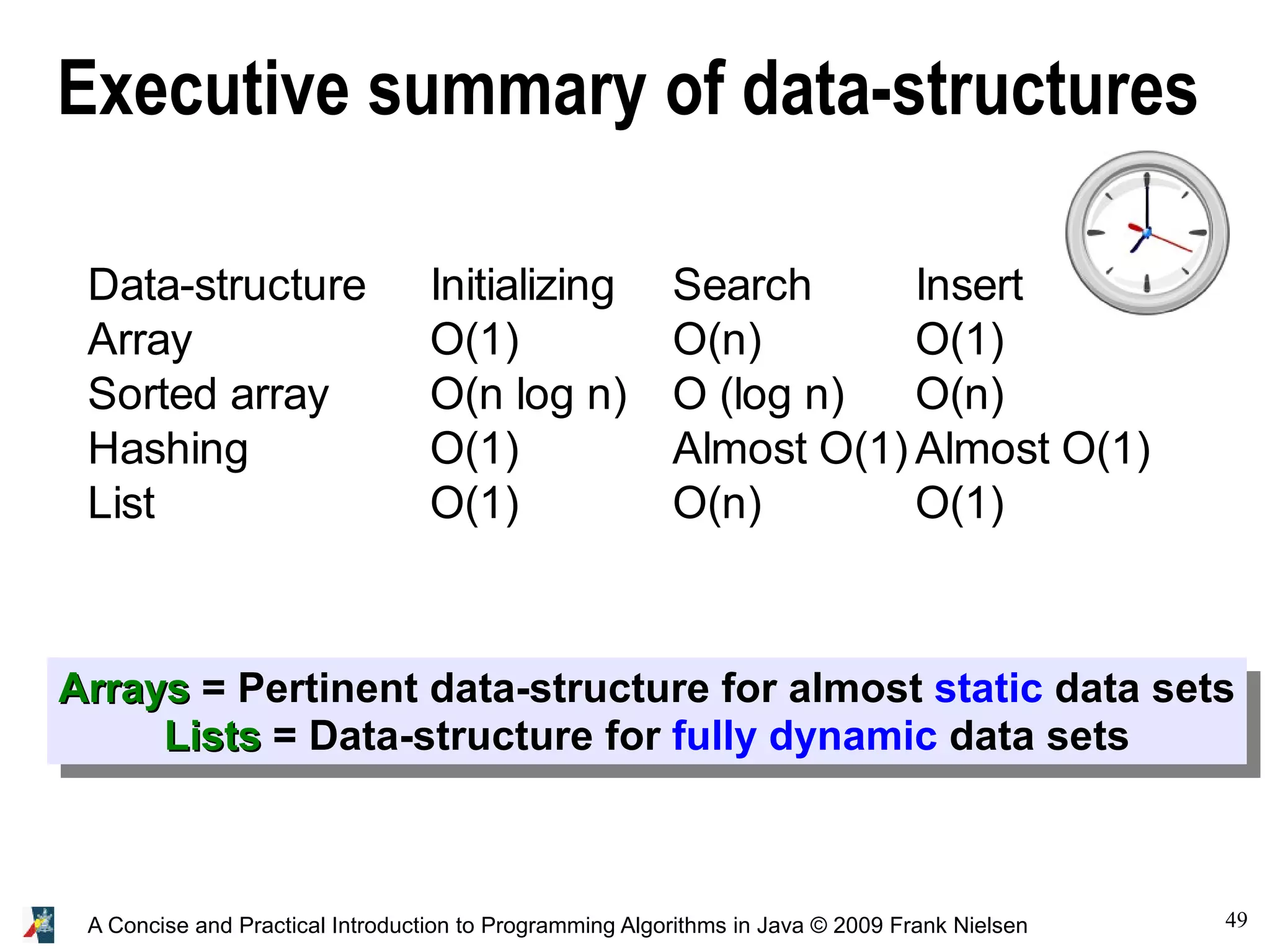
Executive summary of data-structures
Data-structure
O(1) O(n) O(1)
O(n)
O(1)
O(1) O(n) O(1)
Initializing Search Insert
Array
Sorted array O(n log n) O (log n)
Hashing Almost O(1) Almost O(1)
List
ArraysArrays = Pertinent data-structure for almost static data sets
ListsLists = Data-structure for fully dynamic data sets
50A Concise and Practical Introduction to Programming Algorithms in Java © 2009 Frank Nielsen
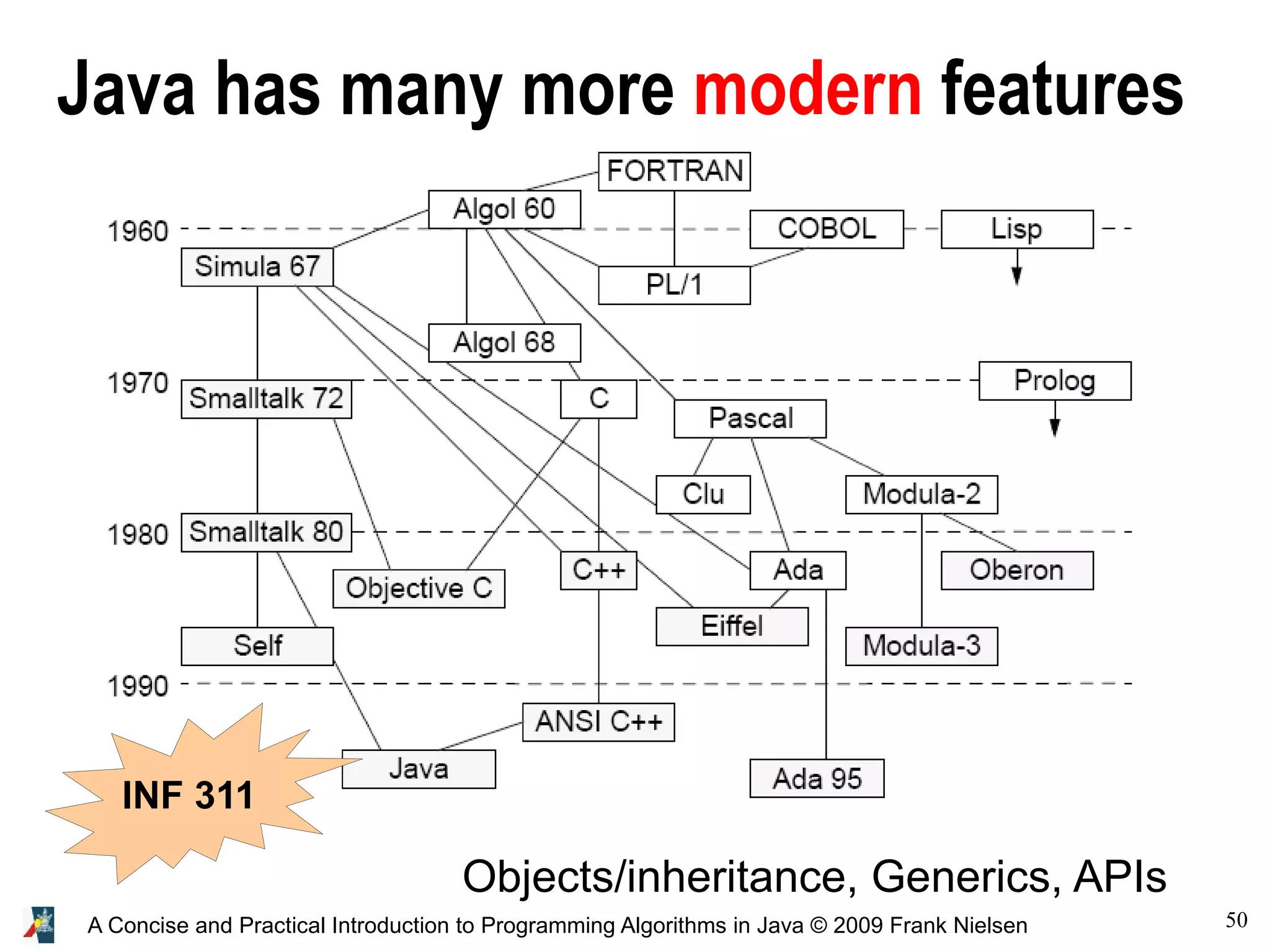
Java has many more modern features
Objects/inheritance, Generics, APIs
INF 311
51A Concise and Practical Introduction to Programming Algorithms in Java © 2009 Frank Nielsen
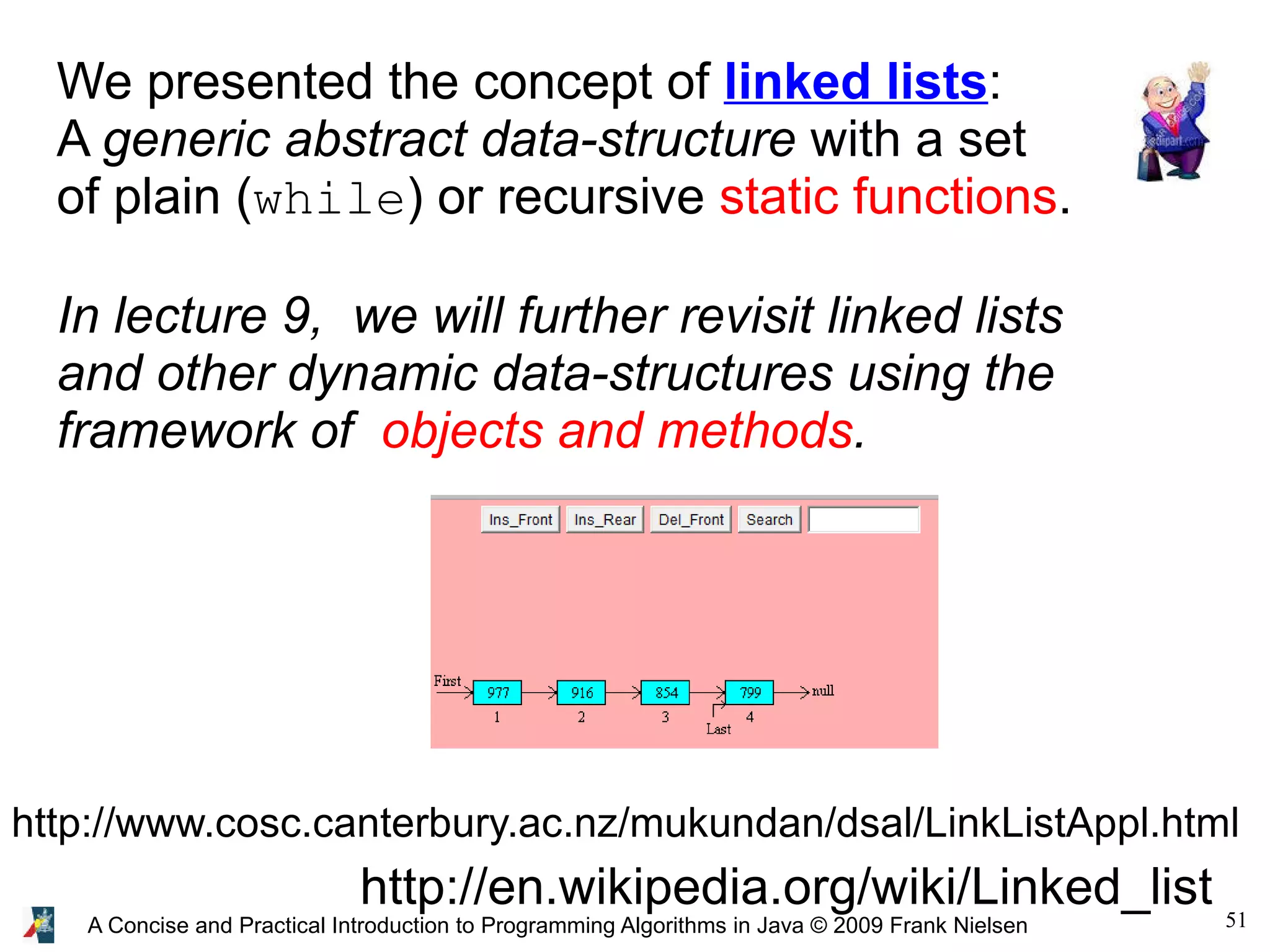
http://en.wikipedia.org/wiki/Linked_list
We presented the concept of linked lists:
A generic abstract data-structure with a set
of plain (while) or recursive static functions.
In lecture 9, we will further revisit linked lists
and other dynamic data-structures using the
framework of objects and methods.
http://www.cosc.canterbury.ac.nz/mukundan/dsal/LinkListAppl.html
52A Concise and Practical Introduction to Programming Algorithms in Java © 2009 Frank Nielsen

(chapter 7) A Concise and Practical Introduction to Programming Algorithms in Java

  • 1.
    1A Concise andPractical Introduction to Programming Algorithms in Java © 2009 Frank Nielsen Frank NIELSEN nielsen@lix.polytechnique.fr A Concise and Practical Introduction to Programming Algorithms in Java Chapter 7: Linked lists
  • 2.
    2A Concise andPractical Introduction to Programming Algorithms in Java © 2009 Frank Nielsen Agenda ● Cells and linked lists ● Basic static functions on lists ● Recursive static functions on lists ● Hashing: Resolving collisions ● Summary of search method (with respect to time complexity)
  • 3.
    3A Concise andPractical Introduction to Programming Algorithms in Java © 2009 Frank Nielsen Summary of Lecture 7 Searching: ● Sequential search (linear time) / arbitrary arrays ● Dichotomic search (logarithmic time) / ordered arrays Sorting: ● Selection sort (quadratic time) ● Quicksort (recursive, in-place, O(n log n) exp. time) Hashing Methods work on arrays... ...weak to fully dynamic datasets
  • 4.
    4A Concise andPractical Introduction to Programming Algorithms in Java © 2009 Frank Nielsen Memory management in Java: AUTOMATIC ● Working memory space for functions (stack): PASS-BY-VALUE ● Global memory for storing arrays and objects: Allocate with new ● Do not free allocated objects, Java does it for you! GARBAGE COLLECTOR (GC for short) http://en.wikipedia.org/wiki/Java_(programming_language)
  • 5.
    5A Concise andPractical Introduction to Programming Algorithms in Java © 2009 Frank Nielsen Memory management Dynamic memory: Linear arrays... Problem/Efficiency vs Fragmentation... Dynamic RAM RAM cells DRAM: volatile memory 1 bit: 1 transistor/1 capacitor, constantly read/rewritten HDD: hard disk, static memory
  • 6.
    6A Concise andPractical Introduction to Programming Algorithms in Java © 2009 Frank Nielsen Visualizing memory A representation class Toto { double x; String name; Toto(double xx, String info) {this.x=xx; // For mutable object do this.name=new Object(info); this.name=info;} }; class VisualizingMemory { public static void Display(Toto obj) { System.out.println(obj.x+":"+obj.name); } public static void main(String[] args) { int i; Toto var=new Toto(5,"Favorite prime!"); double [] arrayx=new double[10]; Display(var); } } HeapFunctions local variables stack execution pass-by-value (non-persistent) arrays objects persistent int i (4 bytes) main Double [ ] array Toto var Object Toto x name array[9] ... array[1] array[0] Display (pass by reference)
  • 7.
    7A Concise andPractical Introduction to Programming Algorithms in Java © 2009 Frank Nielsen Garbage collector (GC) You do not have to explicitly free the memory Java does it automatically on your behalf No destructor: ● for objects ● for arrays Objects no longer referred to are automatically collected Objects no longer needed can be explicitly “forgotten” obj=null; array=null;
  • 8.
    8A Concise andPractical Introduction to Programming Algorithms in Java © 2009 Frank Nielsen Flashback: Searching ● Objects are accessed via a corresponding key ● Each object stores its key and additional fields ● One seeks for information stored in an object from its key (key= a handle) ● All objects are in the main memory (no external I/O) More challenging problem: Adding/removing or changing object attributes dynamically Today!
  • 9.
    9A Concise andPractical Introduction to Programming Algorithms in Java © 2009 Frank Nielsen Linked list: cells and links ● Sequence is made of cells ● Each cell stores an object (cell=container) ● Each cell link to the following one (=refer to, =point to) ● The last cell links to nothing (undefined) ● To add an element, create a new cell that... ...points to the first one (=head) ● Garbage collector takes care of cells not pointed by others
  • 10.
    10A Concise andPractical Introduction to Programming Algorithms in Java © 2009 Frank Nielsen Linked list: cells and links Cell = wagon Link = magnet 12 99 37 head tail termination Container: Any object is fine
  • 11.
    11A Concise andPractical Introduction to Programming Algorithms in Java © 2009 Frank Nielsen Lisp: A language based on lists http://en.wikipedia.org/wiki/LISP (list '1 '2 'foo) (list 1 2 (list 3 4)) (12 (99 (37 nil))) (head tail) Lisp (1958) derives from "List Processing Language" Still in widespread use nowdays
  • 12.
    12A Concise andPractical Introduction to Programming Algorithms in Java © 2009 Frank Nielsen Advantages of linked lists ● Store and represent a set of objects ● But we do not know beforehand how many... ● Add/remove dynamically to the set elements Arrays: Memory compact data-structure for static sets Linked lists: Efficient data-structure for dynamic sets but use references to point to successors (reference= 4 bytes)
  • 13.
    13A Concise andPractical Introduction to Programming Algorithms in Java © 2009 Frank Nielsen Linked lists head reference
  • 14.
    14A Concise andPractical Introduction to Programming Algorithms in Java © 2009 Frank Nielsen Dynamic insertion Insert 33 Constant time operation (think of how much difficult it is to do with arrays)
  • 15.
    15A Concise andPractical Introduction to Programming Algorithms in Java © 2009 Frank Nielsen Dynamic deletion Delete 9 Constant time operation (think of how much difficult it is to do with arrays)
  • 16.
    16A Concise andPractical Introduction to Programming Algorithms in Java © 2009 Frank Nielsen Abstract lists Lists are abstract data-structures supporting the following operations (interface): Constant: Empty list listEmpty (null) Operations: Constructor: List x Object → List Head: List → Object (not defined for listEmpty) Tail: List → List (not defined for listEmpty) isEmpty: List → Boolean Length: List → Integer belongTo: List x Object → Boolean ...
  • 17.
    17A Concise andPractical Introduction to Programming Algorithms in Java © 2009 Frank Nielsen Linked list in Java ● null is the empty list (=not defined object) ● A cell is coded by an object (class with fields) ● Storing information in the cell = creating field (say, double, int, String, Object) ● Pointing to the next cell amounts to contain a reference to the next object
  • 18.
    18A Concise andPractical Introduction to Programming Algorithms in Java © 2009 Frank Nielsen public class List { int container; List next; // Constructor List(head, tail) List(int element, List tail) { this.container=element; this.next=tail; } static boolean isEmpty(List list) {// in compact form return (list==null); if (list==null) return true; else return false; } static int head(List list) {return list.container;} static List tail(List list) {return list.next;} }
  • 19.
    19A Concise andPractical Introduction to Programming Algorithms in Java © 2009 Frank Nielsen Common mistake ● Cannot access fields of the null object ● Exception nullPointerException is raised ● Perform a test if (currentCell!=null) to detect wether the object is void or not, before accessing its fields static int head(List list) {if (list!=null) return list.container; else return -1; }
  • 20.
    20A Concise andPractical Introduction to Programming Algorithms in Java © 2009 Frank Nielsen public class List {...} class ListJava{ public static void main (String[] args) { List myList=new List(23,null); } } MemoryFunction stack MyList (4 bytes) Reference main 23 null List object Container (int) Reference to list
  • 21.
    21A Concise andPractical Introduction to Programming Algorithms in Java © 2009 Frank Nielsen class ListJava{ public static void main (String[] args) { List u=new List(6,null); List v=new List(12,u); } }
  • 22.
    22A Concise andPractical Introduction to Programming Algorithms in Java © 2009 Frank Nielsen u=v;
  • 23.
    23A Concise andPractical Introduction to Programming Algorithms in Java © 2009 Frank Nielsen u=new List(16,u);
  • 24.
    24A Concise andPractical Introduction to Programming Algorithms in Java © 2009 Frank Nielsen Browsing lists Start from the head, and inspect element by element (chaining with references) until we find the empty list (termination) Linear complexity O(n) static boolean belongTo(int element, List list) { while (list!=null) { if (element==list.container) return true; list=list.next; } return false; }
  • 25.
    25A Concise andPractical Introduction to Programming Algorithms in Java © 2009 Frank Nielsen class ListJava{ public static void main (String[] args) { List u=new List(6,null); u=new List(16,u); u=new List(32,u); u=new List(25,u); System.out.println(List.belongTo(6,u)); System.out.println(List.belongTo(17,u)); } } List: Linear search complexity O(n) static boolean belongTo(int element, List list) { while (list!=null) { if (element==list.container) return true; list=list.next; } return false; } == equals
  • 26.
    26A Concise andPractical Introduction to Programming Algorithms in Java © 2009 Frank Nielsen class ListString { String name; ListString next; // Constructor ListString(String name, ListString tail) {this.name=new String(name); this.next=tail;} static boolean isEmpty(ListString list) {return (list==null);} static String head(ListString list) {return list.name; } static ListString tail(ListString list) {return list.next;} static boolean belongTo(String s, ListString list) { while (list!=null) { if (s.equals(list.name)) return true; list=list.next; } return false; } } Generic lists
  • 27.
    27A Concise andPractical Introduction to Programming Algorithms in Java © 2009 Frank Nielsen class ListString { String name; ListString next; ... static boolean belongTo(String s, ListString list) { while (list!=null) { if (s.equals(list.name)) return true; list=list.next; } return false; } } class Demo{... ListString l=new ListString("Frank",null); l=new ListString("Marc",l); l=new ListString("Frederic",l); l=new ListString("Audrey",l); l=new ListString("Steve",l); l=new ListString("Sophie",l); System.out.println(ListString.belongTo("Marc",l)); System.out.println(ListString.belongTo("Sarah",l)); } Generic lists
  • 28.
    28A Concise andPractical Introduction to Programming Algorithms in Java © 2009 Frank Nielsen Length of a list static int length(ListString list) { int l=0; while (list!=null) {l++; list=list.next; } return l; } Note that because Java is pass-by-value (reference for structured objects), we keep the original value, the head of the list, after the function execution. System.out.println(ListString.length(l)); System.out.println(ListString.length(l));
  • 29.
    29A Concise andPractical Introduction to Programming Algorithms in Java © 2009 Frank Nielsen Dynamic insertion: Add an element to a list static ListString Insert(String s, ListString list) { return new ListString(s,list); } l=ListString.Insert("Philippe", l); l=new ListString("Sylvie",l); Call static function Insert of the class ListString
  • 30.
    30A Concise andPractical Introduction to Programming Algorithms in Java © 2009 Frank Nielsen Pretty-printer of lists Convenient for debugging operations on lists Philippe-->Sophie-->Steve-->Audrey-->Frederic-->Marc-->Frank-->null static void Display(ListString list) { while(list!=null) { System.out.print(list.name+"-->"); list=list.next; } System.out.println("null"); } ListString.Display(l);
  • 31.
    31A Concise andPractical Introduction to Programming Algorithms in Java © 2009 Frank Nielsen Dynamic deletion: Removing an element Removing an element from a list: Search for the location of the element, if found then adjust the list (kind of list surgery) Garbage collector takes care of the freed cell Take care of the special cases: ● List is empty ● Element is at the head v w=v.next E==query v.next=w.next
  • 32.
    32A Concise andPractical Introduction to Programming Algorithms in Java © 2009 Frank Nielsen Dynamic deletion: Removing an element Complexity of removing is at least the complexity of finding if the element is inside the list or not. static ListString Delete(String s, ListString list) { // if list is empty if (list==null) return null; // If element is at the head if (list.name.equals(s)) return list.next; // Otherwise ListString v=list; ListString w=list.next; //tail while( w!=null && !((w.name).equals(s)) ) {v=w; w=v.next;} // A bit of list surgery here if (w!=null) v.next=w.next; return list; }
  • 33.
    33A Concise andPractical Introduction to Programming Algorithms in Java © 2009 Frank Nielsen Recursion & Lists Recursive definition of lists yields effective recursive algorithms too! static int lengthRec(ListString list) { if (list==null) return 0; else return 1+lengthRec(list.next); } System.out.println(ListString.lengthRec(l));
  • 34.
    34A Concise andPractical Introduction to Programming Algorithms in Java © 2009 Frank Nielsen Recursion & Lists static boolean belongToRec(String s, ListString list) { if (list==null) return false; else { if (s.equals(list.name)) return true; else return belongToRec(s,list.next); } } ... System.out.println(ListString.belongToRec("Marc",l)); Note that this is a terminal recursion (thus efficient rewriting is possible)
  • 35.
    35A Concise andPractical Introduction to Programming Algorithms in Java © 2009 Frank Nielsen Recursion & Lists static void DisplayRec(ListString list) { if (list==null) System.out.println("null"); else { System.out.print(list.name+"-->"); DisplayRec(list.next); } } ... ListString.DisplayRec(l); Displaying recursively a linked list
  • 36.
    36A Concise andPractical Introduction to Programming Algorithms in Java © 2009 Frank Nielsen Copying lists Copy the list by traversing the list from its head, and cloning one-by-one all elements of cells (fully copy objects like String etc. stored in cells) static ListString copy(ListString l) { ListString result=null; while (l!=null) { result=new ListString(l.name,result); l=l.next; } return result; } ListString lcopy=ListString.copy(l); ListString.Display(lcopy); Beware: Reverse the list order
  • 37.
    37A Concise andPractical Introduction to Programming Algorithms in Java © 2009 Frank Nielsen Copying lists: Recursion static ListString copyRec(ListString l) { if (l==null) return null; else return new ListString(l.name,copyRec(l.next)); } ListString.DisplayRec(l); ListString lcopy=ListString.copy(l); ListString.Display(lcopy); ListString lcopyrec=ListString.copyRec(l); ListString.Display(lcopyrec); Preserve the order Sophie-->Audrey-->Frederic-->Marc-->null Marc-->Frederic-->Audrey-->Sophie-->null Sophie-->Audrey-->Frederic-->Marc-->null
  • 38.
    38A Concise andPractical Introduction to Programming Algorithms in Java © 2009 Frank Nielsen Building linked lists from arrays static ListString Build(String [] array) { ListString result=null; // To ensure that head is the first array element // decrement: from largest to smallest index for(int i=array.length-1;i>=0;i--) result=new ListString(array[i],result); return result; } String [] colors={"green", "red", "blue", "purple", "orange", "yellow"}; ListString lColors=ListString.Build(colors); ListString.Display(lColors); green-->red-->blue-->purple-->orange-->yellow-->null
  • 39.
    39A Concise andPractical Introduction to Programming Algorithms in Java © 2009 Frank Nielsen Summary on linked lists ● Allows one to consider fully dynamic data structures ● Singly or doubly linked lists (List prev,succ;) ● Static functions: Iterative (while) or recursion ● List object is a reference (pass-by-reference of functions; preserve head) ● Easy to get bugs and never ending programs (null empty list never encountered) ● Do not care releasing unused cells (garbage collector releases them automatically)
  • 40.
    40A Concise andPractical Introduction to Programming Algorithms in Java © 2009 Frank Nielsen Hashing: A fundamental technique ● Store object x in array position h(x) (int) ● Major problem occurs if two objects x and y are stored on the same cell: Collision. Key issues in hashing: ● Finding good hashing functions that minimize collisions, ● Adopting a good search policy in case of collisions int i; array[i] Object Obj=new Object(); int i; i=h(Obj);// hashing function array[i]
  • 41.
    41A Concise andPractical Introduction to Programming Algorithms in Java © 2009 Frank Nielsen Hashing functions ● Given a universe X of keys and for any x in X, find an integer h(x) between 0 and m ● Usually easy to transform the object into an integer: For example, for strings just add the ASCII codes of characters ● The problem is then to transform a set of n (sparse) integers into a compact array of size m<<N. (<< means much less than)
  • 42.
    42A Concise andPractical Introduction to Programming Algorithms in Java © 2009 Frank Nielsen Hashing functions Key idea is to take the modulo operation h(k) = k mod m where m is a prime number. static int m=23; // TRANSCODE strings into integers static int String2Integer(String s) { int result=0; for(int j=0;j<s.length();j++) result=result*31+s.charAt(j); // this is the method s.hashCode() return result; } // Note that m is a static variable static int HashFunction(int l) {return l%m;}
  • 43.
    43A Concise andPractical Introduction to Programming Algorithms in Java © 2009 Frank Nielsen public static void main (String[] args) { String [] animals={"cat","dog","parrot","horse","fish", "shark","pelican","tortoise", "whale", "lion", "flamingo", "cow", "snake", "spider", "bee", "peacock", "elephant", "butterfly"}; int i; String [] HashTable=new String[m]; for(i=0;i<m;i++) HashTable[i]=new String("-->"); for(i=0;i<animals.length;i++) {int pos=HashFunction(String2Integer(animals[i])); HashTable[pos]+=(" "+animals[i]); } for(i=0;i<m;i++) System.out.println("Position "+i+"t"+HashTable[i]); }
  • 44.
    44A Concise andPractical Introduction to Programming Algorithms in Java © 2009 Frank Nielsen Position 0 --> whale Position 1 --> snake Position 2 --> Position 3 --> Position 4 --> Position 5 --> Position 6 --> Position 7 --> cow Position 8 --> shark Position 9 --> Position 10 --> Position 11 --> Position 12 --> fish Position 13 --> cat Position 14 --> Position 15 --> dog tortoise Position 16 --> horse Position 17 --> flamingo Position 18 --> Position 19 --> pelican Position 20 --> parrot lion Position 21 --> Position 22 --> Collisions in the hash table
  • 45.
    45A Concise andPractical Introduction to Programming Algorithms in Java © 2009 Frank Nielsen Hashing: Solving collision Open address methodology ● Store object X at the first free hash table cell starting from position h(x) ● To seek whether X is in the hash table, compute h(x) and inspect all hash table cells until h(x) is found or a free cell is reached. Complexity of search time ranges from constant O(1) to linear O(m) time ...record in another location that is still open...
  • 46.
    46A Concise andPractical Introduction to Programming Algorithms in Java © 2009 Frank Nielsen Position 0 whale Position 1 snake Position 2 bee Position 3 spider Position 4 butterfly Position 5 null Position 6 null Position 7 cow Position 8 shark Position 9 null Position 10 null Position 11 null Position 12 fish Position 13 cat Position 14 peacock Position 15 dog Position 16 horse Position 17 tortoise Position 18 flamingo Position 19 pelican Position 20 parrot Position 21 lion Position 22 elephant String [] HashTable=new String[m]; // By default HashTable[i]=null for(i=0;i<animals.length;i++) { int s2int=String2Integer(animals[i]); int pos=HashFunction(s2int); while (HashTable[pos]!=null) pos=(pos+1)%m; HashTable[pos]=new String(animals[i]); }
  • 47.
    47A Concise andPractical Introduction to Programming Algorithms in Java © 2009 Frank Nielsen Hashing: Solving collision Chained Hashing For array cells not open, create linked lists Can add as many elements as one wishes
  • 48.
    48A Concise andPractical Introduction to Programming Algorithms in Java © 2009 Frank Nielsen ListString [] HashTable=new ListString[m]; for(i=0;i<m;i++) HashTable[i]=null; for(i=0;i<animals.length;i++) { int s2int=String2Integer(animals[i]); int pos=HashFunction(s2int); HashTable[pos]=ListString.Insert(animals[i],HashTable[pos]); } for(i=0;i<m;i++) ListString.Display(HashTable[i]);
  • 49.
    49A Concise andPractical Introduction to Programming Algorithms in Java © 2009 Frank Nielsen Executive summary of data-structures Data-structure O(1) O(n) O(1) O(n) O(1) O(1) O(n) O(1) Initializing Search Insert Array Sorted array O(n log n) O (log n) Hashing Almost O(1) Almost O(1) List ArraysArrays = Pertinent data-structure for almost static data sets ListsLists = Data-structure for fully dynamic data sets
  • 50.
    50A Concise andPractical Introduction to Programming Algorithms in Java © 2009 Frank Nielsen Java has many more modern features Objects/inheritance, Generics, APIs INF 311
  • 51.
    51A Concise andPractical Introduction to Programming Algorithms in Java © 2009 Frank Nielsen http://en.wikipedia.org/wiki/Linked_list We presented the concept of linked lists: A generic abstract data-structure with a set of plain (while) or recursive static functions. In lecture 9, we will further revisit linked lists and other dynamic data-structures using the framework of objects and methods. http://www.cosc.canterbury.ac.nz/mukundan/dsal/LinkListAppl.html
  • 52.
    52A Concise andPractical Introduction to Programming Algorithms in Java © 2009 Frank Nielsen