Effective STL Notes

     UTTAM GANDHI,
  SOFTWARE DEVELOPER
Pre-requisites

—  C++
—  Data Structure
—  Templates
—  Smart Pointers
—  Constant Time, Logarithmic, Linear


Uttam Gandhi, Software Developer
http://www.linkedin.com/pub/uttam-gandhi/21/7aa/24   Content last revised on 1/4/13
Acknowledgments

—  This presentation is based on Scott Meyers well
   known book ‘Effective STL’


Uttam Gandhi, Software Developer
http://www.linkedin.com/pub/uttam-gandhi/21/7aa/24   Content last revised on 1/4/13
Why STL

—  Contains most useful algorithms and data structures
—  Established programming techniques, idioms and
    styles
—  Usually very-well tested
—  Usually highly optimized (might use optimizations
    that are not available to ordinary programmer)
—  Ref-- http://www.cs.helsinki.fi/u/tpkarkka/alglib/
    k06/lectures/stl_intro.html


Uttam Gandhi, Software Developer
http://www.linkedin.com/pub/uttam-gandhi/21/7aa/24   Content last revised on 1/4/13
STL Intro duction

—  STL consists of
    ¡  Containers

    ¡  Algorithms

    ¡  Iterators


Uttam Gandhi, Software Developer
http://www.linkedin.com/pub/uttam-gandhi/21/7aa/24   Content last revised on 1/4/13
Containers

—  Types of container
    ¡  Sequence containers
         ÷  vector
         ÷  list
         ÷  string
         ÷  deque
   ¡    Associative Containers
         ÷  set
         ÷  multiset
         ÷  map
         ÷  multimap
         ÷  unordered_map         (C++ 11)

Uttam Gandhi, Software Developer
http://www.linkedin.com/pub/uttam-gandhi/21/7aa/24   Content last revised on 1/4/13
Containers

—  Container type based on allocation
    ¡  Contiguous-memory containers
         ÷  Insertion  and deletion causes movement of elements
         ÷  vector, string, deque

   ¡    Node-based containers
         ÷  Insertion  and deletion changes pointers, not nodes
         ÷  list and all associative containers


Uttam Gandhi, Software Developer
http://www.linkedin.com/pub/uttam-gandhi/21/7aa/24   Content last revised on 1/4/13
How to choose your container

—  Insert element at an arbitrary position
—  Ordering of elements in the container
—  Category of iterators
—  Is it important to avoid movement of existing
    container elements when insertions or erasures take
    place?
—  Layout compatible with C
—  container uses reference counting


Uttam Gandhi, Software Developer
http://www.linkedin.com/pub/uttam-gandhi/21/7aa/24   Content last revised on 1/4/13
Containers do Copy

—  Containers make copies of object
    ¡  Storing

    ¡  Retrieving

    ¡  Insert/Delete causes movement of objects by copying

    ¡  Sorting algorithms

—  Copying is done using copy constructor and copy
    assignment operator
—  Copying should be efficient
—  Copying can lead to slicing


Uttam Gandhi, Software Developer
http://www.linkedin.com/pub/uttam-gandhi/21/7aa/24   Content last revised on 1/4/13
Making Copy Efficient

—  Use pointers
    ¡  Efficient, as bitwise copy will be made

    ¡  No slicing

    ¡  But possibility of memory leak

    ¡  Use smart pointers (self managed/shared/intrusive)

    ¡  Ref http://onlamp.com/pub/a/onlamp/2006/05/04/smart-
        pointers.html?page=5
—  Still STL containers are better than C data structure
    ¡  Widget w[maxNumWidgets];

    ¡  vector<widget> vw;

    ¡  vw.reserve(maxNumWidgets)

Uttam Gandhi, Software Developer
http://www.linkedin.com/pub/uttam-gandhi/21/7aa/24   Content last revised on 1/4/13
Use empty than size==0

—  Use empty, rather than checking size == 0
    ¡  For some list implementation, size takes linear time

    ¡  Why
           ¢  Splice  operation moves elements from one list to other without
               copying elements
           ¢  If, size operation has to be constant then every list operation
               should update size
           ¢  This means, splice operation will take linear time

           ¢  One of the two can be constant but not both

   ¡    empty() will always be constant


Uttam Gandhi, Software Developer
http://www.linkedin.com/pub/uttam-gandhi/21/7aa/24   Content last revised on 1/4/13
Prefer range member functions 1/3

—  vector<Widget> v1, v2;
   for ( vector<Widget>::const_iterator ci =
   v2.begin(); ci != v2.end(); ++ci)
   v1.push_back(*ci);
   ¡  lengthy code
   ¡  for loop

—  copy(v2.begin(), v2.end(), back_inserter(v1 ));
    ¡  For loop is inside copy implementation

—  v1 .insert(v1 .end(), v2.begin(),v2.end());
    ¡  Short code
    ¡  Clear to understand

Uttam Gandhi, Software Developer
http://www.linkedin.com/pub/uttam-gandhi/21/7aa/24   Content last revised on 1/4/13
Prefer range member functions 2/3

—  Efficiency Hits
    ¡  Inserting one element at a time, makes numValues calls of
        insert
         ÷  Range   function will make single insert call, so numValues-1 less
             calls
         ÷  Inlining could have saved, but its not guaranteed
         ÷  Range insert will always be efficient
   ¡    Inserting element will cause movement of elements by copying
         them
         ÷  Every  element will be shifted at least numValues times
         ÷  Shifting of primitive will require bitwise copy
         ÷  For user defined type, calls to assignment operator or copy
             constructor

Uttam Gandhi, Software Developer
http://www.linkedin.com/pub/uttam-gandhi/21/7aa/24   Content last revised on 1/4/13
Prefer range member functions 3/3

—  Efficiency Hits
    ¡  Inserting element in vector can cause reallocations
       ÷  In case of range insert, reallocation would be 1 at max
       ÷  inserting numValues new elements could result in new memory
           being allocated up to log2numValues
       ÷  inserting 1000 elements one at a time can result in 10 new
           allocations


Uttam Gandhi, Software Developer
http://www.linkedin.com/pub/uttam-gandhi/21/7aa/24   Content last revised on 1/4/13
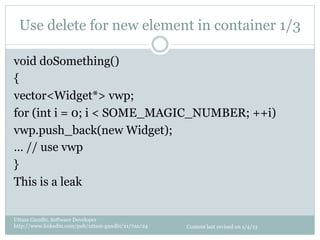
Use delete for new element in container 1/3

void doSomething()
{
vector<Widget*> vwp;
for (int i = 0; i < SOME_MAGIC_NUMBER; ++i)
vwp.push_back(new Widget);
… // use vwp
}
This is a leak

Uttam Gandhi, Software Developer
http://www.linkedin.com/pub/uttam-gandhi/21/7aa/24   Content last revised on 1/4/13
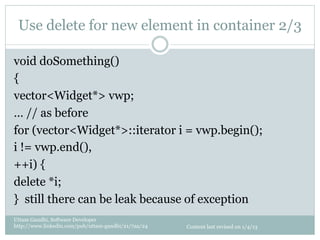
Use delete for new element in container 2/3

void doSomething()
{
vector<Widget*> vwp;
… // as before
for (vector<Widget*>::iterator i = vwp.begin();
i != vwp.end(),
++i) {
delete *i;
} still there can be leak because of exception
Uttam Gandhi, Software Developer
http://www.linkedin.com/pub/uttam-gandhi/21/7aa/24   Content last revised on 1/4/13
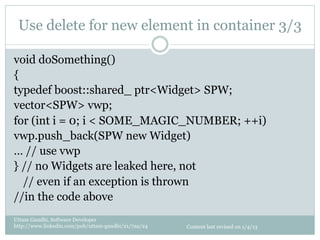
Use delete for new element in container 3/3

void doSomething()
{
typedef boost::shared_ ptr<Widget> SPW;
vector<SPW> vwp;
for (int i = 0; i < SOME_MAGIC_NUMBER; ++i)
vwp.push_back(SPW new Widget)
… // use vwp
} // no Widgets are leaked here, not
  // even if an exception is thrown
//in the code above
Uttam Gandhi, Software Developer
http://www.linkedin.com/pub/uttam-gandhi/21/7aa/24   Content last revised on 1/4/13
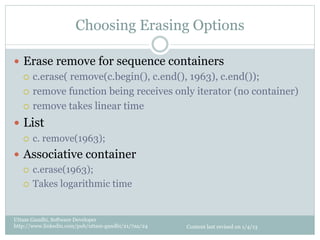
Choosing Erasing Options

—  Erase remove for sequence containers
    ¡  c.erase( remove(c.begin(), c.end(), 1963), c.end());

    ¡  remove function being receives only iterator (no container)

    ¡  remove takes linear time

—  List
   ¡    c. remove(1963);
—  Associative container
    ¡  c.erase(1963);

    ¡  Takes logarithmic time


Uttam Gandhi, Software Developer
http://www.linkedin.com/pub/uttam-gandhi/21/7aa/24   Content last revised on 1/4/13
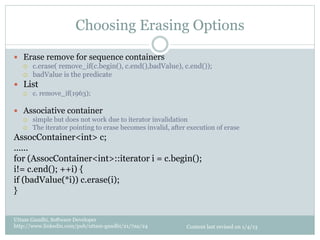
Choosing Erasing Options

—  Erase remove for sequence containers
    ¡  c.erase( remove_if(c.begin(), c.end(),badValue), c.end());
    ¡  badValue is the predicate

—  List
   ¡    c. remove_if(1963);

—  Associative container
   ¡    simple but does not work due to iterator invalidation
   ¡    The iterator pointing to erase becomes invalid, after execution of erase
AssocContainer<int> c;
......
for (AssocContainer<int>::iterator i = c.begin();
i!= c.end(); ++i) {
if (badValue(*i)) c.erase(i);
}


Uttam Gandhi, Software Developer
http://www.linkedin.com/pub/uttam-gandhi/21/7aa/24            Content last revised on 1/4/13
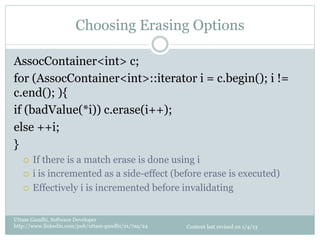
Choosing Erasing Options

AssocContainer<int> c;
for (AssocContainer<int>::iterator i = c.begin(); i !=
c.end(); ){
if (badValue(*i)) c.erase(i++);
else ++i;
}
   ¡  If there is a match erase is done using i
   ¡  i is incremented as a side-effect (before erase is executed)

   ¡  Effectively i is incremented before invalidating


Uttam Gandhi, Software Developer
http://www.linkedin.com/pub/uttam-gandhi/21/7aa/24   Content last revised on 1/4/13
Prefer vector and string

—  Dynamic Allocation
   ¡    Ensure delete is called for every new, else leak
   ¡    Ensure delete[] is called for array
   ¡    Ensure delete called only once
—  Vector and string advantages
   ¡    Manage own memory
   ¡    Offer useful member functions like size, iterators, erase
   ¡    Can be used with legacy C code using array and char*
—  Drawback
   ¡    string uses ref counting
   ¡    Causes overhead of concurrency control in multithreaded
         environment
   ¡    http://www.gotw.ca/publications/optimizations.htm
Uttam Gandhi, Software Developer
http://www.linkedin.com/pub/uttam-gandhi/21/7aa/24   Content last revised on 1/4/13
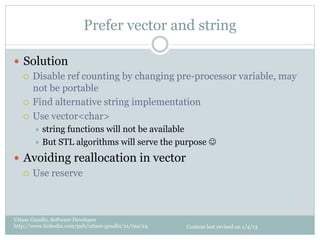
Prefer vector and string

—  Solution
    ¡  Disable ref counting by changing pre-processor variable, may
        not be portable
    ¡  Find alternative string implementation

    ¡  Use vector<char>
       ÷  stringfunctions will not be available
       ÷  But STL algorithms will serve the purpose J

—  Avoiding reallocation in vector
    ¡  Use reserve


Uttam Gandhi, Software Developer
http://www.linkedin.com/pub/uttam-gandhi/21/7aa/24   Content last revised on 1/4/13
Pass vector and string to legacy API

—  Vector
    ¡  void doSomething(const int* pInts, size_t numlnts);

    ¡  doSomething(&v[0], v.size());

    ¡  Frankly, if you're hanging out with people who tell you to use
        v.begin() instead of &v[0], you need to rethink your social
        circle.
    ¡  v can be modified but no new element should be added

    ¡  size_t fillArray(double *pArray, size_t arraySize);

    ¡  vector<double> vd(maxNumDoubles);

    ¡  vd.resize(fillArray(&vd[0], vd.size()));
    ¡  list<double> l(vd.begin(), vd.end());

Uttam Gandhi, Software Developer
http://www.linkedin.com/pub/uttam-gandhi/21/7aa/24   Content last revised on 1/4/13
Pass vector and string to legacy API

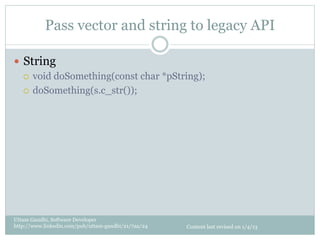
—  String
    ¡  void doSomething(const char *pString);

    ¡  doSomething(s.c_str());


Uttam Gandhi, Software Developer
http://www.linkedin.com/pub/uttam-gandhi/21/7aa/24   Content last revised on 1/4/13
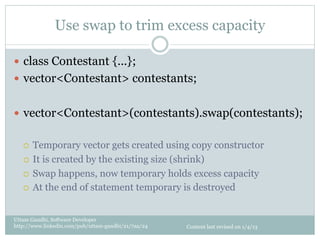
Use swap to trim excess capacity

—  class Contestant {...};
—  vector<Contestant> contestants;


—  vector<Contestant>(contestants).swap(contestants);


   ¡  Temporary vector gets created using copy constructor
   ¡  It is created by the existing size (shrink)

   ¡  Swap happens, now temporary holds excess capacity

   ¡  At the end of statement temporary is destroyed


Uttam Gandhi, Software Developer
http://www.linkedin.com/pub/uttam-gandhi/21/7aa/24   Content last revised on 1/4/13
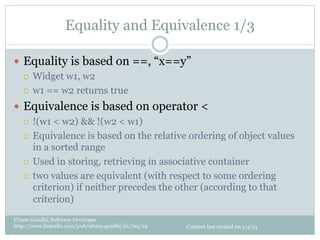
Equality and Equivalence 1/3

—  Equality is based on ==, “x==y”
    ¡  Widget w1, w2

    ¡  w1 == w2 returns true

—  Equivalence is based on operator <
    ¡  !(w1 < w2) && !(w2 < w1)

    ¡  Equivalence is based on the relative ordering of object values
        in a sorted range
    ¡  Used in storing, retrieving in associative container

    ¡  two values are equivalent (with respect to some ordering
        criterion) if neither precedes the other (according to that
        criterion)
Uttam Gandhi, Software Developer
http://www.linkedin.com/pub/uttam-gandhi/21/7aa/24   Content last revised on 1/4/13
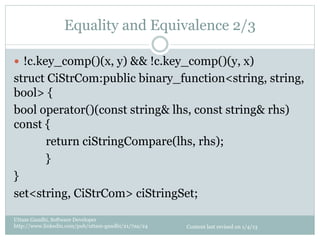
Equality and Equivalence 2/3

—  !c.key_comp()(x, y) && !c.key_comp()(y, x)
struct CiStrCom:public binary_function<string, string,
bool> {
bool operator()(const string& lhs, const string& rhs)
const {
      return ciStringCompare(lhs, rhs);
      }
}
set<string, CiStrCom> ciStringSet;

Uttam Gandhi, Software Developer
http://www.linkedin.com/pub/uttam-gandhi/21/7aa/24   Content last revised on 1/4/13
Equality and Equivalence 3/3

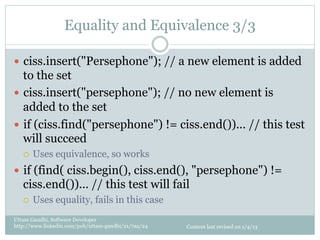
—  ciss.insert("Persephone"); // a new element is added
    to the set
—  ciss.insert("persephone"); // no new element is
    added to the set
—  if (ciss.find("persephone") != ciss.end())... // this test
    will succeed
   ¡    Uses equivalence, so works
—  if (find( ciss.begin(), ciss.end(), "persephone") !=
   ciss.end())... // this test will fail
   ¡    Uses equality, fails in this case
Uttam Gandhi, Software Developer
http://www.linkedin.com/pub/uttam-gandhi/21/7aa/24   Content last revised on 1/4/13
Overriding default comp function

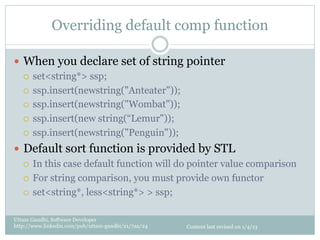
—  When you declare set of string pointer
    ¡  set<string*> ssp;

    ¡  ssp.insert(newstring("Anteater"));

    ¡  ssp.insert(newstring("Wombat"));

    ¡  ssp.insert(new string(“Lemur"));

    ¡  ssp.insert(newstring("Penguin"));

—  Default sort function is provided by STL
    ¡  In this case default function will do pointer value comparison

    ¡  For string comparison, you must provide own functor

    ¡  set<string*, less<string*> > ssp;


Uttam Gandhi, Software Developer
http://www.linkedin.com/pub/uttam-gandhi/21/7aa/24   Content last revised on 1/4/13
Functor for string dereference

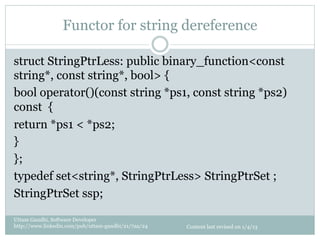
struct StringPtrLess: public binary_function<const
string*, const string*, bool> {
bool operator()(const string *ps1, const string *ps2)
const {
return *ps1 < *ps2;
}
};
typedef set<string*, StringPtrLess> StringPtrSet ;
StringPtrSet ssp;

Uttam Gandhi, Software Developer
http://www.linkedin.com/pub/uttam-gandhi/21/7aa/24   Content last revised on 1/4/13
Templatized functor for de-reference

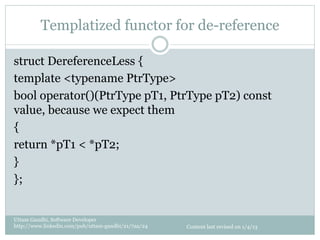
struct DereferenceLess {
template <typename PtrType>
bool operator()(PtrType pT1, PtrType pT2) const
value, because we expect them
{
return *pT1 < *pT2;
}
};


Uttam Gandhi, Software Developer
http://www.linkedin.com/pub/uttam-gandhi/21/7aa/24   Content last revised on 1/4/13
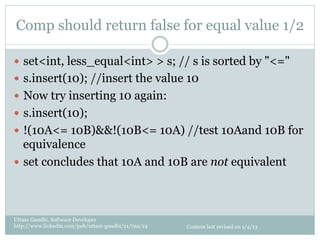
Comp should return false for equal value 1/2

—  set<int, less_equal<int> > s; // s is sorted by "<="
—  s.insert(10); //insert the value 10
—  Now try inserting 10 again:
—  s.insert(10);
—  !(10A<= 10B)&&!(10B<= 10A) //test 10Aand 10B for
    equivalence
—  set concludes that 10A and 10B are not equivalent


Uttam Gandhi, Software Developer
http://www.linkedin.com/pub/uttam-gandhi/21/7aa/24   Content last revised on 1/4/13
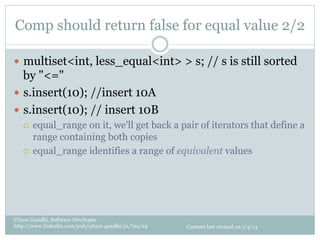
Comp should return false for equal value 2/2

—  multiset<int, less_equal<int> > s; // s is still sorted
    by "<="
—  s.insert(10); //insert 10A
—  s.insert(10); // insert 10B
   ¡  equal_range on it, we'll get back a pair of iterators that define a
       range containing both copies
   ¡  equal_range identifies a range of equivalent values


Uttam Gandhi, Software Developer
http://www.linkedin.com/pub/uttam-gandhi/21/7aa/24   Content last revised on 1/4/13
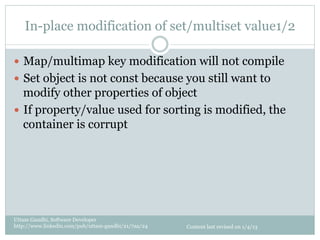
In-place modification of set/multiset value1/2

—  Map/multimap key modification will not compile
—  Set object is not const because you still want to
    modify other properties of object
—  If property/value used for sorting is modified, the
    container is corrupt


Uttam Gandhi, Software Developer
http://www.linkedin.com/pub/uttam-gandhi/21/7aa/24   Content last revised on 1/4/13
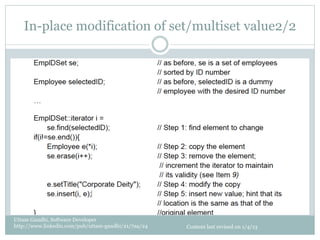
In-place modification of set/multiset value2/2


Uttam Gandhi, Software Developer
http://www.linkedin.com/pub/uttam-gandhi/21/7aa/24   Content last revised on 1/4/13
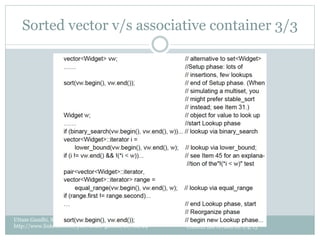
Sorted vector v/s associative container 1/3

—  Standard associative container
    ¡  Typically implemented as balanced binary trees

    ¡  optimized for mix of lookup, insertion and deletion

    ¡  No way to predict the next operation

—  Typical application usage of container
    ¡  Setup
         ÷  All   operation are insert/delete, hardly any lookup
   ¡    Lookup
         ÷  Almost    all operations are lookup
   ¡    Reorganize
         ÷  Modify,   insert/delete, sort
Uttam Gandhi, Software Developer
http://www.linkedin.com/pub/uttam-gandhi/21/7aa/24   Content last revised on 1/4/13
Sorted vector v/s associative container 2/3

—  For such usage, sorted vector can provide better
   performance
   ¡    Size
         ÷  Less size per element in vector, so storing takes less space
         ÷  Will lead to less page fault
         ÷  As vector offer better locality of reference
         ÷  Insertion/deletion can be costly, so not useful if application
             requires too many of these


Uttam Gandhi, Software Developer
http://www.linkedin.com/pub/uttam-gandhi/21/7aa/24   Content last revised on 1/4/13
Sorted vector v/s associative container 3/3


Uttam Gandhi, Software Developer
http://www.linkedin.com/pub/uttam-gandhi/21/7aa/24   Content last revised on 1/4/13
map::operator[] and map-insert 1/2

—  map::operator[]
    ¡  Provides add/update functionality

    ¡  Returns reference to value

    ¡  If object does not exists,
         ÷  creates default constructed object
         ÷  insert in map
         ÷  Destructor of temporary object
         ÷  Assignment

   ¡    If insert is called directly, 3 function calls are saved


Uttam Gandhi, Software Developer
http://www.linkedin.com/pub/uttam-gandhi/21/7aa/24   Content last revised on 1/4/13
map::operator[] and map-insert 2/2

—  Update
    ¡  m[k] = v;
         ÷  Requires   no object creation, deletion
   ¡    m.insert( IntWidgetMap::value_type(k, v)).first->second = v;
         ÷  Temporary     object of Widget is create, destroyed


Uttam Gandhi, Software Developer
http://www.linkedin.com/pub/uttam-gandhi/21/7aa/24     Content last revised on 1/4/13
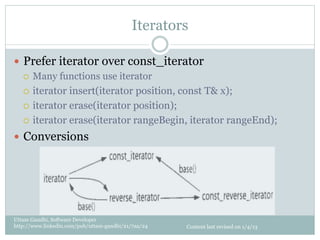
Iterators

—  Prefer iterator over const_iterator
    ¡  Many functions use iterator

    ¡  iterator insert(iterator position, const T& x);

    ¡  iterator erase(iterator position);

    ¡  iterator erase(iterator rangeBegin, iterator rangeEnd);

—  Conversions


Uttam Gandhi, Software Developer
http://www.linkedin.com/pub/uttam-gandhi/21/7aa/24   Content last revised on 1/4/13
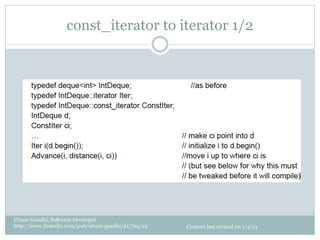
const_iterator to iterator 1/2


Uttam Gandhi, Software Developer
http://www.linkedin.com/pub/uttam-gandhi/21/7aa/24   Content last revised on 1/4/13
const_iterator to iterator 2/2

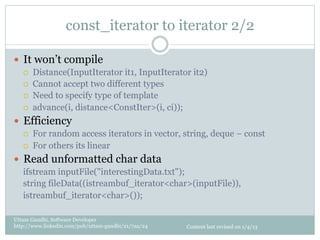
—  It won’t compile
   ¡    Distance(InputIterator it1, InputIterator it2)
   ¡    Cannot accept two different types
   ¡    Need to specify type of template
   ¡    advance(i, distance<ConstIter>(i, ci));
—  Efficiency
   ¡    For random access iterators in vector, string, deque – const
   ¡    For others its linear
—  Read unformatted char data
   ifstream inputFile("interestingData.txt");
   string fileData((istreambuf_iterator<char>(inputFile)),
   istreambuf_iterator<char>());

Uttam Gandhi, Software Developer
http://www.linkedin.com/pub/uttam-gandhi/21/7aa/24   Content last revised on 1/4/13
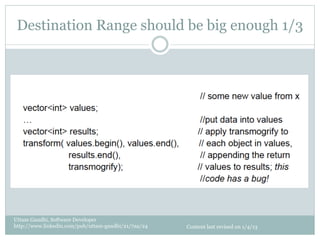
Destination Range should be big enough 1/3


Uttam Gandhi, Software Developer
http://www.linkedin.com/pub/uttam-gandhi/21/7aa/24   Content last revised on 1/4/13
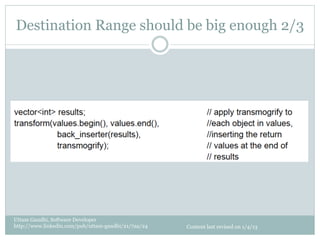
Destination Range should be big enough 2/3


Uttam Gandhi, Software Developer
http://www.linkedin.com/pub/uttam-gandhi/21/7aa/24   Content last revised on 1/4/13
Destination Range should be big enough 3/3

—  back_inserter, calls push_back
    ¡  Works with sequence container (vector, list, string deque)

—  front_inserter can also be used
    ¡  List, deque

—  Inserter
    ¡  Insert at specified position


Uttam Gandhi, Software Developer
http://www.linkedin.com/pub/uttam-gandhi/21/7aa/24   Content last revised on 1/4/13
Sorting Options 1/3

—  Applicable on sequence containers
    ¡  vector, deque, string, array

—  sort and stable_sort
    ¡  stable_sort maintains position of equivalent elements

—  partial_sort
    ¡  e.g. Get best 20 widgets sorted

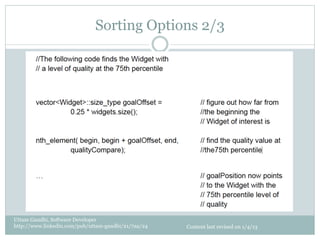
—  nth element
    ¡  e.g. Get best 20 widgets, in any order

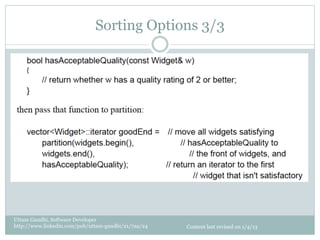
—  partition/stable_partition
    ¡  Partition on a criterion

Uttam Gandhi, Software Developer
http://www.linkedin.com/pub/uttam-gandhi/21/7aa/24   Content last revised on 1/4/13
Sorting Options 2/3


Uttam Gandhi, Software Developer
http://www.linkedin.com/pub/uttam-gandhi/21/7aa/24   Content last revised on 1/4/13
Sorting Options 3/3


Uttam Gandhi, Software Developer
http://www.linkedin.com/pub/uttam-gandhi/21/7aa/24   Content last revised on 1/4/13
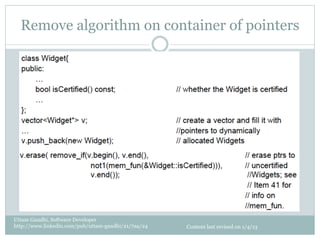
Remove algorithm on container of pointers


Uttam Gandhi, Software Developer
http://www.linkedin.com/pub/uttam-gandhi/21/7aa/24   Content last revised on 1/4/13
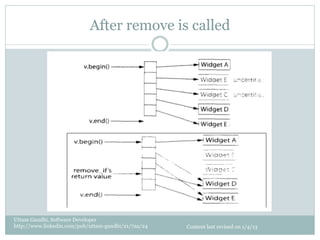
After remove is called


Uttam Gandhi, Software Developer
http://www.linkedin.com/pub/uttam-gandhi/21/7aa/24   Content last revised on 1/4/13
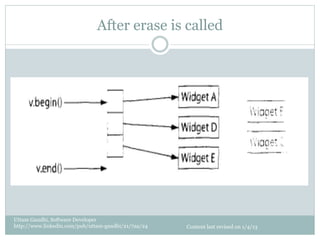
After erase is called


Uttam Gandhi, Software Developer
http://www.linkedin.com/pub/uttam-gandhi/21/7aa/24   Content last revised on 1/4/13
Algorithms expecting sorted ranges

—  binary search algorithms
   ¡    binary_search
   ¡    lower_bound
   ¡    upper_bound
   ¡    equal_range
—  Set Operations
   ¡    set_union
   ¡    set_intersection
   ¡    set_difference
   ¡    set_symmetric_difference
—  Mege Sorted Ranges
   ¡    merge
   ¡    implace_merge
—  Includes
   ¡    Check if range is present in other range
—  unique
—  unique_copy


Uttam Gandhi, Software Developer
http://www.linkedin.com/pub/uttam-gandhi/21/7aa/24   Content last revised on 1/4/13
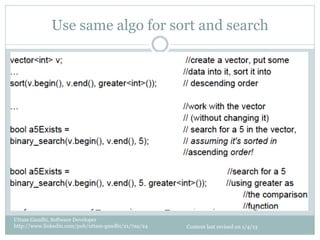
Use same algo for sort and search


Uttam Gandhi, Software Developer
http://www.linkedin.com/pub/uttam-gandhi/21/7aa/24   Content last revised on 1/4/13
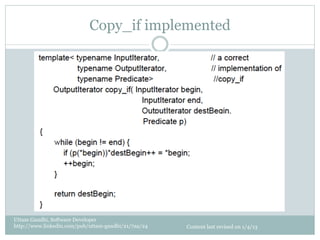
Copy_if implemented


Uttam Gandhi, Software Developer
http://www.linkedin.com/pub/uttam-gandhi/21/7aa/24   Content last revised on 1/4/13
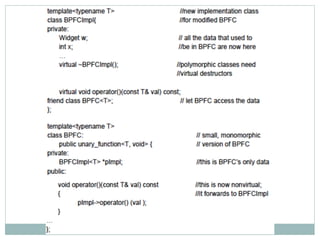
Function Objects

—  Passed by value
    ¡  Should be small

    ¡  Monomorphic (non-polymorphic)


Uttam Gandhi, Software Developer
http://www.linkedin.com/pub/uttam-gandhi/21/7aa/24   Content last revised on 1/4/13
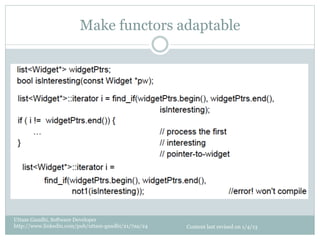
Make functors adaptable


Uttam Gandhi, Software Developer
http://www.linkedin.com/pub/uttam-gandhi/21/7aa/24   Content last revised on 1/4/13
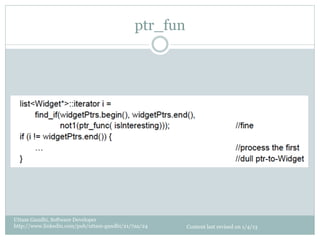
ptr_fun


Uttam Gandhi, Software Developer
http://www.linkedin.com/pub/uttam-gandhi/21/7aa/24     Content last revised on 1/4/13
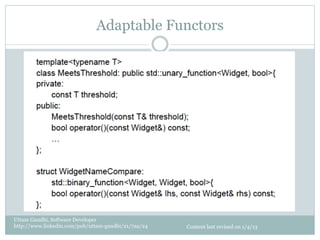
Adaptable Functors


Uttam Gandhi, Software Developer
http://www.linkedin.com/pub/uttam-gandhi/21/7aa/24   Content last revised on 1/4/13
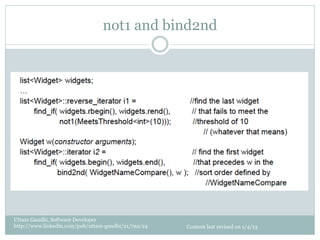
not1 and bind2nd


Uttam Gandhi, Software Developer
http://www.linkedin.com/pub/uttam-gandhi/21/7aa/24   Content last revised on 1/4/13
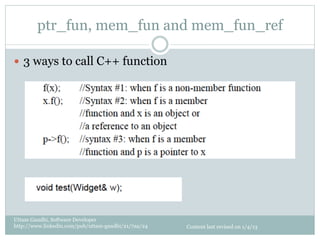
ptr_fun, mem_fun and mem_fun_ref

—  3 ways to call C++ function


Uttam Gandhi, Software Developer
http://www.linkedin.com/pub/uttam-gandhi/21/7aa/24   Content last revised on 1/4/13
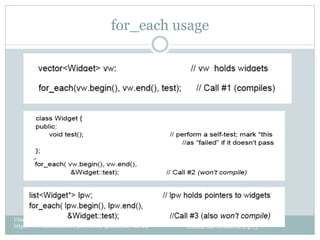
for_each usage


Uttam Gandhi, Software Developer
http://www.linkedin.com/pub/uttam-gandhi/21/7aa/24   Content last revised on 1/4/13
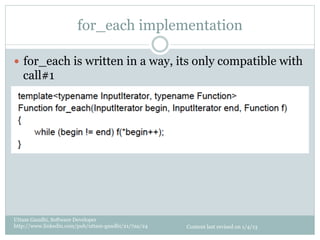
for_each implementation

—  for_each is written in a way, its only compatible with
   call#1


Uttam Gandhi, Software Developer
http://www.linkedin.com/pub/uttam-gandhi/21/7aa/24   Content last revised on 1/4/13
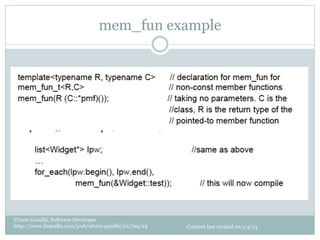
mem_fun example


Uttam Gandhi, Software Developer
http://www.linkedin.com/pub/uttam-gandhi/21/7aa/24   Content last revised on 1/4/13
Prefer algorithm to hand-written loop 1/2

—  Efficiency
    ¡  Algorithms are often more efficient than the loops
        programmers produce.
—  Correctness
    ¡  Writing loops is more subject to errors than is calling
        algorithms.
—  Maintainability
    ¡  Algorithm calls often yield code that is clearer and more
        straightforward than the corresponding explicit loops.


Uttam Gandhi, Software Developer
http://www.linkedin.com/pub/uttam-gandhi/21/7aa/24   Content last revised on 1/4/13
Prefer algorithm to hand-written loop 2/2

—  Efficiency
    ¡  Check of end() is done only once

    ¡  Call to begin, end are generally inlined inside for_each

    ¡  Have knowledge about internal implementation of container
         ÷  E.g.   using pointers for vector traversal
   ¡    Implementers use more sophisticated algo than avg c++
         programmer


Uttam Gandhi, Software Developer
http://www.linkedin.com/pub/uttam-gandhi/21/7aa/24   Content last revised on 1/4/13
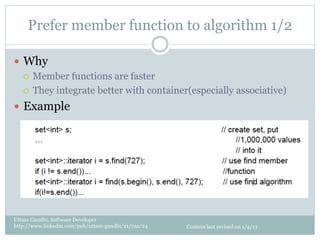
Prefer member function to algorithm 1/2

—  Why
    ¡  Member functions are faster

    ¡  They integrate better with container(especially associative)

—  Example


Uttam Gandhi, Software Developer
http://www.linkedin.com/pub/uttam-gandhi/21/7aa/24   Content last revised on 1/4/13
Prefer member function to algorithm 2/2

   ¡  Member find: About 40 (worst case) to about 20 (average case)
   ¡  Algorithm find: 1 ,000,000 (worst case) to 500,000 (average
       case)
—  Equivalence and eqality
    ¡  std::find uses equality, set::find uses equivalence

—  list functions
    ¡  remove, remove_if. unique, sort, merge, and reverse

    ¡  each std version copy objects

    ¡  list members do not copy objects

    ¡  remove_erase is needed if std version used, list::remove works
        directly
Uttam Gandhi, Software Developer
http://www.linkedin.com/pub/uttam-gandhi/21/7aa/24   Content last revised on 1/4/13
Search options 1/2

—  Logarithmic complexity
    ¡  binary_search

    ¡  lower_bound

    ¡  upper_bound

    ¡  equal_range

    ¡  Uses equivalence

—  Linear Search Complexity
    ¡  find

    ¡  count

    ¡  Use equality


Uttam Gandhi, Software Developer
http://www.linkedin.com/pub/uttam-gandhi/21/7aa/24   Content last revised on 1/4/13
Search options 2/2

—  find v/s count
    ¡  find stops at match of value

    ¡  count looks till end

    ¡  find is efficient for check of existence

—  binary_search
    ¡  Widget w; //value to search for

    ¡  if (binary_search(vw.begin(), vw.end(), w))

—  lower_bound
    ¡  Returns iterators to first match, if not found returns position,
        where the element should be inserted

Uttam Gandhi, Software Developer
http://www.linkedin.com/pub/uttam-gandhi/21/7aa/24   Content last revised on 1/4/13
equal_range

—  equal_range
    ¡  Returns pair of iterator pointing to first and last occurrence of
        match
    ¡  If not found, both iterator return same position, where the
        element should be inserted


Uttam Gandhi, Software Developer
http://www.linkedin.com/pub/uttam-gandhi/21/7aa/24   Content last revised on 1/4/13
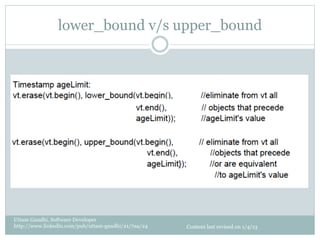
lower_bound v/s upper_bound


Uttam Gandhi, Software Developer
http://www.linkedin.com/pub/uttam-gandhi/21/7aa/24   Content last revised on 1/4/13
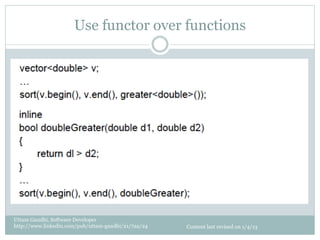
Use functor over functions


Uttam Gandhi, Software Developer
http://www.linkedin.com/pub/uttam-gandhi/21/7aa/24   Content last revised on 1/4/13
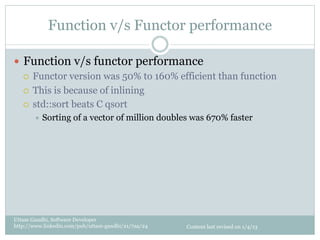
Function v/s Functor performance

—  Function v/s functor performance
    ¡  Functor version was 50% to 160% efficient than function

    ¡  This is because of inlining

    ¡  std::sort beats C qsort
       ÷  Sorting    of a vector of million doubles was 670% faster


Uttam Gandhi, Software Developer
http://www.linkedin.com/pub/uttam-gandhi/21/7aa/24   Content last revised on 1/4/13
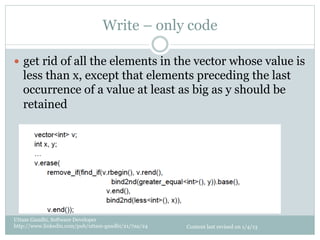
Write – only code

—  get rid of all the elements in the vector whose value is
   less than x, except that elements preceding the last
   occurrence of a value at least as big as y should be
   retained


Uttam Gandhi, Software Developer
http://www.linkedin.com/pub/uttam-gandhi/21/7aa/24   Content last revised on 1/4/13
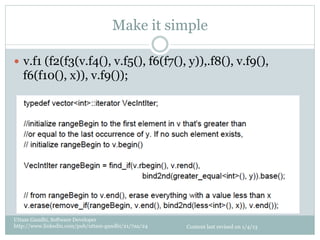
Make it simple

—  v.f1 (f2(f3(v.f4(), v.f5(), f6(f7(), y)),.f8(), v.f9(),
   f6(f10(), x)), v.f9());


Uttam Gandhi, Software Developer
http://www.linkedin.com/pub/uttam-gandhi/21/7aa/24   Content last revised on 1/4/13

Effective stl notes

  • 1.
    Effective STL Notes UTTAM GANDHI, SOFTWARE DEVELOPER
  • 2.
    Pre-requisites —  C++ —  DataStructure —  Templates —  Smart Pointers —  Constant Time, Logarithmic, Linear Uttam Gandhi, Software Developer http://www.linkedin.com/pub/uttam-gandhi/21/7aa/24 Content last revised on 1/4/13
  • 3.
    Acknowledgments —  This presentationis based on Scott Meyers well known book ‘Effective STL’ Uttam Gandhi, Software Developer http://www.linkedin.com/pub/uttam-gandhi/21/7aa/24 Content last revised on 1/4/13
  • 4.
    Why STL —  Containsmost useful algorithms and data structures —  Established programming techniques, idioms and styles —  Usually very-well tested —  Usually highly optimized (might use optimizations that are not available to ordinary programmer) —  Ref-- http://www.cs.helsinki.fi/u/tpkarkka/alglib/ k06/lectures/stl_intro.html Uttam Gandhi, Software Developer http://www.linkedin.com/pub/uttam-gandhi/21/7aa/24 Content last revised on 1/4/13
  • 5.
    STL Intro duction — STL consists of ¡  Containers ¡  Algorithms ¡  Iterators Uttam Gandhi, Software Developer http://www.linkedin.com/pub/uttam-gandhi/21/7aa/24 Content last revised on 1/4/13
  • 6.
    Containers —  Types ofcontainer ¡  Sequence containers ÷  vector ÷  list ÷  string ÷  deque ¡  Associative Containers ÷  set ÷  multiset ÷  map ÷  multimap ÷  unordered_map (C++ 11) Uttam Gandhi, Software Developer http://www.linkedin.com/pub/uttam-gandhi/21/7aa/24 Content last revised on 1/4/13
  • 7.
    Containers —  Container typebased on allocation ¡  Contiguous-memory containers ÷  Insertion and deletion causes movement of elements ÷  vector, string, deque ¡  Node-based containers ÷  Insertion and deletion changes pointers, not nodes ÷  list and all associative containers Uttam Gandhi, Software Developer http://www.linkedin.com/pub/uttam-gandhi/21/7aa/24 Content last revised on 1/4/13
  • 8.
    How to chooseyour container —  Insert element at an arbitrary position —  Ordering of elements in the container —  Category of iterators —  Is it important to avoid movement of existing container elements when insertions or erasures take place? —  Layout compatible with C —  container uses reference counting Uttam Gandhi, Software Developer http://www.linkedin.com/pub/uttam-gandhi/21/7aa/24 Content last revised on 1/4/13
  • 9.
    Containers do Copy — Containers make copies of object ¡  Storing ¡  Retrieving ¡  Insert/Delete causes movement of objects by copying ¡  Sorting algorithms —  Copying is done using copy constructor and copy assignment operator —  Copying should be efficient —  Copying can lead to slicing Uttam Gandhi, Software Developer http://www.linkedin.com/pub/uttam-gandhi/21/7aa/24 Content last revised on 1/4/13
  • 10.
    Making Copy Efficient — Use pointers ¡  Efficient, as bitwise copy will be made ¡  No slicing ¡  But possibility of memory leak ¡  Use smart pointers (self managed/shared/intrusive) ¡  Ref http://onlamp.com/pub/a/onlamp/2006/05/04/smart- pointers.html?page=5 —  Still STL containers are better than C data structure ¡  Widget w[maxNumWidgets]; ¡  vector<widget> vw; ¡  vw.reserve(maxNumWidgets) Uttam Gandhi, Software Developer http://www.linkedin.com/pub/uttam-gandhi/21/7aa/24 Content last revised on 1/4/13
  • 11.
    Use empty thansize==0 —  Use empty, rather than checking size == 0 ¡  For some list implementation, size takes linear time ¡  Why ¢  Splice operation moves elements from one list to other without copying elements ¢  If, size operation has to be constant then every list operation should update size ¢  This means, splice operation will take linear time ¢  One of the two can be constant but not both ¡  empty() will always be constant Uttam Gandhi, Software Developer http://www.linkedin.com/pub/uttam-gandhi/21/7aa/24 Content last revised on 1/4/13
  • 12.
    Prefer range memberfunctions 1/3 —  vector<Widget> v1, v2; for ( vector<Widget>::const_iterator ci = v2.begin(); ci != v2.end(); ++ci) v1.push_back(*ci); ¡  lengthy code ¡  for loop —  copy(v2.begin(), v2.end(), back_inserter(v1 )); ¡  For loop is inside copy implementation —  v1 .insert(v1 .end(), v2.begin(),v2.end()); ¡  Short code ¡  Clear to understand Uttam Gandhi, Software Developer http://www.linkedin.com/pub/uttam-gandhi/21/7aa/24 Content last revised on 1/4/13
  • 13.
    Prefer range memberfunctions 2/3 —  Efficiency Hits ¡  Inserting one element at a time, makes numValues calls of insert ÷  Range function will make single insert call, so numValues-1 less calls ÷  Inlining could have saved, but its not guaranteed ÷  Range insert will always be efficient ¡  Inserting element will cause movement of elements by copying them ÷  Every element will be shifted at least numValues times ÷  Shifting of primitive will require bitwise copy ÷  For user defined type, calls to assignment operator or copy constructor Uttam Gandhi, Software Developer http://www.linkedin.com/pub/uttam-gandhi/21/7aa/24 Content last revised on 1/4/13
  • 14.
    Prefer range memberfunctions 3/3 —  Efficiency Hits ¡  Inserting element in vector can cause reallocations ÷  In case of range insert, reallocation would be 1 at max ÷  inserting numValues new elements could result in new memory being allocated up to log2numValues ÷  inserting 1000 elements one at a time can result in 10 new allocations Uttam Gandhi, Software Developer http://www.linkedin.com/pub/uttam-gandhi/21/7aa/24 Content last revised on 1/4/13
  • 15.
    Use delete fornew element in container 1/3 void doSomething() { vector<Widget*> vwp; for (int i = 0; i < SOME_MAGIC_NUMBER; ++i) vwp.push_back(new Widget); … // use vwp } This is a leak Uttam Gandhi, Software Developer http://www.linkedin.com/pub/uttam-gandhi/21/7aa/24 Content last revised on 1/4/13
  • 16.
    Use delete fornew element in container 2/3 void doSomething() { vector<Widget*> vwp; … // as before for (vector<Widget*>::iterator i = vwp.begin(); i != vwp.end(), ++i) { delete *i; } still there can be leak because of exception Uttam Gandhi, Software Developer http://www.linkedin.com/pub/uttam-gandhi/21/7aa/24 Content last revised on 1/4/13
  • 17.
    Use delete fornew element in container 3/3 void doSomething() { typedef boost::shared_ ptr<Widget> SPW; vector<SPW> vwp; for (int i = 0; i < SOME_MAGIC_NUMBER; ++i) vwp.push_back(SPW new Widget) … // use vwp } // no Widgets are leaked here, not // even if an exception is thrown //in the code above Uttam Gandhi, Software Developer http://www.linkedin.com/pub/uttam-gandhi/21/7aa/24 Content last revised on 1/4/13
  • 18.
    Choosing Erasing Options — Erase remove for sequence containers ¡  c.erase( remove(c.begin(), c.end(), 1963), c.end()); ¡  remove function being receives only iterator (no container) ¡  remove takes linear time —  List ¡  c. remove(1963); —  Associative container ¡  c.erase(1963); ¡  Takes logarithmic time Uttam Gandhi, Software Developer http://www.linkedin.com/pub/uttam-gandhi/21/7aa/24 Content last revised on 1/4/13
  • 19.
    Choosing Erasing Options — Erase remove for sequence containers ¡  c.erase( remove_if(c.begin(), c.end(),badValue), c.end()); ¡  badValue is the predicate —  List ¡  c. remove_if(1963); —  Associative container ¡  simple but does not work due to iterator invalidation ¡  The iterator pointing to erase becomes invalid, after execution of erase AssocContainer<int> c; ...... for (AssocContainer<int>::iterator i = c.begin(); i!= c.end(); ++i) { if (badValue(*i)) c.erase(i); } Uttam Gandhi, Software Developer http://www.linkedin.com/pub/uttam-gandhi/21/7aa/24 Content last revised on 1/4/13
  • 20.
    Choosing Erasing Options AssocContainer<int>c; for (AssocContainer<int>::iterator i = c.begin(); i != c.end(); ){ if (badValue(*i)) c.erase(i++); else ++i; } ¡  If there is a match erase is done using i ¡  i is incremented as a side-effect (before erase is executed) ¡  Effectively i is incremented before invalidating Uttam Gandhi, Software Developer http://www.linkedin.com/pub/uttam-gandhi/21/7aa/24 Content last revised on 1/4/13
  • 21.
    Prefer vector andstring —  Dynamic Allocation ¡  Ensure delete is called for every new, else leak ¡  Ensure delete[] is called for array ¡  Ensure delete called only once —  Vector and string advantages ¡  Manage own memory ¡  Offer useful member functions like size, iterators, erase ¡  Can be used with legacy C code using array and char* —  Drawback ¡  string uses ref counting ¡  Causes overhead of concurrency control in multithreaded environment ¡  http://www.gotw.ca/publications/optimizations.htm Uttam Gandhi, Software Developer http://www.linkedin.com/pub/uttam-gandhi/21/7aa/24 Content last revised on 1/4/13
  • 22.
    Prefer vector andstring —  Solution ¡  Disable ref counting by changing pre-processor variable, may not be portable ¡  Find alternative string implementation ¡  Use vector<char> ÷  stringfunctions will not be available ÷  But STL algorithms will serve the purpose J —  Avoiding reallocation in vector ¡  Use reserve Uttam Gandhi, Software Developer http://www.linkedin.com/pub/uttam-gandhi/21/7aa/24 Content last revised on 1/4/13
  • 23.
    Pass vector andstring to legacy API —  Vector ¡  void doSomething(const int* pInts, size_t numlnts); ¡  doSomething(&v[0], v.size()); ¡  Frankly, if you're hanging out with people who tell you to use v.begin() instead of &v[0], you need to rethink your social circle. ¡  v can be modified but no new element should be added ¡  size_t fillArray(double *pArray, size_t arraySize); ¡  vector<double> vd(maxNumDoubles); ¡  vd.resize(fillArray(&vd[0], vd.size())); ¡  list<double> l(vd.begin(), vd.end()); Uttam Gandhi, Software Developer http://www.linkedin.com/pub/uttam-gandhi/21/7aa/24 Content last revised on 1/4/13
  • 24.
    Pass vector andstring to legacy API —  String ¡  void doSomething(const char *pString); ¡  doSomething(s.c_str()); Uttam Gandhi, Software Developer http://www.linkedin.com/pub/uttam-gandhi/21/7aa/24 Content last revised on 1/4/13
  • 25.
    Use swap totrim excess capacity —  class Contestant {...}; —  vector<Contestant> contestants; —  vector<Contestant>(contestants).swap(contestants); ¡  Temporary vector gets created using copy constructor ¡  It is created by the existing size (shrink) ¡  Swap happens, now temporary holds excess capacity ¡  At the end of statement temporary is destroyed Uttam Gandhi, Software Developer http://www.linkedin.com/pub/uttam-gandhi/21/7aa/24 Content last revised on 1/4/13
  • 26.
    Equality and Equivalence1/3 —  Equality is based on ==, “x==y” ¡  Widget w1, w2 ¡  w1 == w2 returns true —  Equivalence is based on operator < ¡  !(w1 < w2) && !(w2 < w1) ¡  Equivalence is based on the relative ordering of object values in a sorted range ¡  Used in storing, retrieving in associative container ¡  two values are equivalent (with respect to some ordering criterion) if neither precedes the other (according to that criterion) Uttam Gandhi, Software Developer http://www.linkedin.com/pub/uttam-gandhi/21/7aa/24 Content last revised on 1/4/13
  • 27.
    Equality and Equivalence2/3 —  !c.key_comp()(x, y) && !c.key_comp()(y, x) struct CiStrCom:public binary_function<string, string, bool> { bool operator()(const string& lhs, const string& rhs) const { return ciStringCompare(lhs, rhs); } } set<string, CiStrCom> ciStringSet; Uttam Gandhi, Software Developer http://www.linkedin.com/pub/uttam-gandhi/21/7aa/24 Content last revised on 1/4/13
  • 28.
    Equality and Equivalence3/3 —  ciss.insert("Persephone"); // a new element is added to the set —  ciss.insert("persephone"); // no new element is added to the set —  if (ciss.find("persephone") != ciss.end())... // this test will succeed ¡  Uses equivalence, so works —  if (find( ciss.begin(), ciss.end(), "persephone") != ciss.end())... // this test will fail ¡  Uses equality, fails in this case Uttam Gandhi, Software Developer http://www.linkedin.com/pub/uttam-gandhi/21/7aa/24 Content last revised on 1/4/13
  • 29.
    Overriding default compfunction —  When you declare set of string pointer ¡  set<string*> ssp; ¡  ssp.insert(newstring("Anteater")); ¡  ssp.insert(newstring("Wombat")); ¡  ssp.insert(new string(“Lemur")); ¡  ssp.insert(newstring("Penguin")); —  Default sort function is provided by STL ¡  In this case default function will do pointer value comparison ¡  For string comparison, you must provide own functor ¡  set<string*, less<string*> > ssp; Uttam Gandhi, Software Developer http://www.linkedin.com/pub/uttam-gandhi/21/7aa/24 Content last revised on 1/4/13
  • 30.
    Functor for stringdereference struct StringPtrLess: public binary_function<const string*, const string*, bool> { bool operator()(const string *ps1, const string *ps2) const { return *ps1 < *ps2; } }; typedef set<string*, StringPtrLess> StringPtrSet ; StringPtrSet ssp; Uttam Gandhi, Software Developer http://www.linkedin.com/pub/uttam-gandhi/21/7aa/24 Content last revised on 1/4/13
  • 31.
    Templatized functor forde-reference struct DereferenceLess { template <typename PtrType> bool operator()(PtrType pT1, PtrType pT2) const value, because we expect them { return *pT1 < *pT2; } }; Uttam Gandhi, Software Developer http://www.linkedin.com/pub/uttam-gandhi/21/7aa/24 Content last revised on 1/4/13
  • 32.
    Comp should returnfalse for equal value 1/2 —  set<int, less_equal<int> > s; // s is sorted by "<=" —  s.insert(10); //insert the value 10 —  Now try inserting 10 again: —  s.insert(10); —  !(10A<= 10B)&&!(10B<= 10A) //test 10Aand 10B for equivalence —  set concludes that 10A and 10B are not equivalent Uttam Gandhi, Software Developer http://www.linkedin.com/pub/uttam-gandhi/21/7aa/24 Content last revised on 1/4/13
  • 33.
    Comp should returnfalse for equal value 2/2 —  multiset<int, less_equal<int> > s; // s is still sorted by "<=" —  s.insert(10); //insert 10A —  s.insert(10); // insert 10B ¡  equal_range on it, we'll get back a pair of iterators that define a range containing both copies ¡  equal_range identifies a range of equivalent values Uttam Gandhi, Software Developer http://www.linkedin.com/pub/uttam-gandhi/21/7aa/24 Content last revised on 1/4/13
  • 34.
    In-place modification ofset/multiset value1/2 —  Map/multimap key modification will not compile —  Set object is not const because you still want to modify other properties of object —  If property/value used for sorting is modified, the container is corrupt Uttam Gandhi, Software Developer http://www.linkedin.com/pub/uttam-gandhi/21/7aa/24 Content last revised on 1/4/13
  • 35.
    In-place modification ofset/multiset value2/2 Uttam Gandhi, Software Developer http://www.linkedin.com/pub/uttam-gandhi/21/7aa/24 Content last revised on 1/4/13
  • 36.
    Sorted vector v/sassociative container 1/3 —  Standard associative container ¡  Typically implemented as balanced binary trees ¡  optimized for mix of lookup, insertion and deletion ¡  No way to predict the next operation —  Typical application usage of container ¡  Setup ÷  All operation are insert/delete, hardly any lookup ¡  Lookup ÷  Almost all operations are lookup ¡  Reorganize ÷  Modify, insert/delete, sort Uttam Gandhi, Software Developer http://www.linkedin.com/pub/uttam-gandhi/21/7aa/24 Content last revised on 1/4/13
  • 37.
    Sorted vector v/sassociative container 2/3 —  For such usage, sorted vector can provide better performance ¡  Size ÷  Less size per element in vector, so storing takes less space ÷  Will lead to less page fault ÷  As vector offer better locality of reference ÷  Insertion/deletion can be costly, so not useful if application requires too many of these Uttam Gandhi, Software Developer http://www.linkedin.com/pub/uttam-gandhi/21/7aa/24 Content last revised on 1/4/13
  • 38.
    Sorted vector v/sassociative container 3/3 Uttam Gandhi, Software Developer http://www.linkedin.com/pub/uttam-gandhi/21/7aa/24 Content last revised on 1/4/13
  • 39.
    map::operator[] and map-insert1/2 —  map::operator[] ¡  Provides add/update functionality ¡  Returns reference to value ¡  If object does not exists, ÷  creates default constructed object ÷  insert in map ÷  Destructor of temporary object ÷  Assignment ¡  If insert is called directly, 3 function calls are saved Uttam Gandhi, Software Developer http://www.linkedin.com/pub/uttam-gandhi/21/7aa/24 Content last revised on 1/4/13
  • 40.
    map::operator[] and map-insert2/2 —  Update ¡  m[k] = v; ÷  Requires no object creation, deletion ¡  m.insert( IntWidgetMap::value_type(k, v)).first->second = v; ÷  Temporary object of Widget is create, destroyed Uttam Gandhi, Software Developer http://www.linkedin.com/pub/uttam-gandhi/21/7aa/24 Content last revised on 1/4/13
  • 41.
    Iterators —  Prefer iteratorover const_iterator ¡  Many functions use iterator ¡  iterator insert(iterator position, const T& x); ¡  iterator erase(iterator position); ¡  iterator erase(iterator rangeBegin, iterator rangeEnd); —  Conversions Uttam Gandhi, Software Developer http://www.linkedin.com/pub/uttam-gandhi/21/7aa/24 Content last revised on 1/4/13
  • 42.
    const_iterator to iterator1/2 Uttam Gandhi, Software Developer http://www.linkedin.com/pub/uttam-gandhi/21/7aa/24 Content last revised on 1/4/13
  • 43.
    const_iterator to iterator2/2 —  It won’t compile ¡  Distance(InputIterator it1, InputIterator it2) ¡  Cannot accept two different types ¡  Need to specify type of template ¡  advance(i, distance<ConstIter>(i, ci)); —  Efficiency ¡  For random access iterators in vector, string, deque – const ¡  For others its linear —  Read unformatted char data ifstream inputFile("interestingData.txt"); string fileData((istreambuf_iterator<char>(inputFile)), istreambuf_iterator<char>()); Uttam Gandhi, Software Developer http://www.linkedin.com/pub/uttam-gandhi/21/7aa/24 Content last revised on 1/4/13
  • 44.
    Destination Range shouldbe big enough 1/3 Uttam Gandhi, Software Developer http://www.linkedin.com/pub/uttam-gandhi/21/7aa/24 Content last revised on 1/4/13
  • 45.
    Destination Range shouldbe big enough 2/3 Uttam Gandhi, Software Developer http://www.linkedin.com/pub/uttam-gandhi/21/7aa/24 Content last revised on 1/4/13
  • 46.
    Destination Range shouldbe big enough 3/3 —  back_inserter, calls push_back ¡  Works with sequence container (vector, list, string deque) —  front_inserter can also be used ¡  List, deque —  Inserter ¡  Insert at specified position Uttam Gandhi, Software Developer http://www.linkedin.com/pub/uttam-gandhi/21/7aa/24 Content last revised on 1/4/13
  • 47.
    Sorting Options 1/3 — Applicable on sequence containers ¡  vector, deque, string, array —  sort and stable_sort ¡  stable_sort maintains position of equivalent elements —  partial_sort ¡  e.g. Get best 20 widgets sorted —  nth element ¡  e.g. Get best 20 widgets, in any order —  partition/stable_partition ¡  Partition on a criterion Uttam Gandhi, Software Developer http://www.linkedin.com/pub/uttam-gandhi/21/7aa/24 Content last revised on 1/4/13
  • 48.
    Sorting Options 2/3 UttamGandhi, Software Developer http://www.linkedin.com/pub/uttam-gandhi/21/7aa/24 Content last revised on 1/4/13
  • 49.
    Sorting Options 3/3 UttamGandhi, Software Developer http://www.linkedin.com/pub/uttam-gandhi/21/7aa/24 Content last revised on 1/4/13
  • 50.
    Remove algorithm oncontainer of pointers Uttam Gandhi, Software Developer http://www.linkedin.com/pub/uttam-gandhi/21/7aa/24 Content last revised on 1/4/13
  • 51.
    After remove iscalled Uttam Gandhi, Software Developer http://www.linkedin.com/pub/uttam-gandhi/21/7aa/24 Content last revised on 1/4/13
  • 52.
    After erase iscalled Uttam Gandhi, Software Developer http://www.linkedin.com/pub/uttam-gandhi/21/7aa/24 Content last revised on 1/4/13
  • 53.
    Algorithms expecting sortedranges —  binary search algorithms ¡  binary_search ¡  lower_bound ¡  upper_bound ¡  equal_range —  Set Operations ¡  set_union ¡  set_intersection ¡  set_difference ¡  set_symmetric_difference —  Mege Sorted Ranges ¡  merge ¡  implace_merge —  Includes ¡  Check if range is present in other range —  unique —  unique_copy Uttam Gandhi, Software Developer http://www.linkedin.com/pub/uttam-gandhi/21/7aa/24 Content last revised on 1/4/13
  • 54.
    Use same algofor sort and search Uttam Gandhi, Software Developer http://www.linkedin.com/pub/uttam-gandhi/21/7aa/24 Content last revised on 1/4/13
  • 55.
    Copy_if implemented Uttam Gandhi,Software Developer http://www.linkedin.com/pub/uttam-gandhi/21/7aa/24 Content last revised on 1/4/13
  • 56.
    Function Objects —  Passedby value ¡  Should be small ¡  Monomorphic (non-polymorphic) Uttam Gandhi, Software Developer http://www.linkedin.com/pub/uttam-gandhi/21/7aa/24 Content last revised on 1/4/13
  • 58.
    Make functors adaptable UttamGandhi, Software Developer http://www.linkedin.com/pub/uttam-gandhi/21/7aa/24 Content last revised on 1/4/13
  • 59.
    ptr_fun Uttam Gandhi, SoftwareDeveloper http://www.linkedin.com/pub/uttam-gandhi/21/7aa/24 Content last revised on 1/4/13
  • 60.
    Adaptable Functors Uttam Gandhi,Software Developer http://www.linkedin.com/pub/uttam-gandhi/21/7aa/24 Content last revised on 1/4/13
  • 61.
    not1 and bind2nd UttamGandhi, Software Developer http://www.linkedin.com/pub/uttam-gandhi/21/7aa/24 Content last revised on 1/4/13
  • 62.
    ptr_fun, mem_fun andmem_fun_ref —  3 ways to call C++ function Uttam Gandhi, Software Developer http://www.linkedin.com/pub/uttam-gandhi/21/7aa/24 Content last revised on 1/4/13
  • 63.
    for_each usage Uttam Gandhi,Software Developer http://www.linkedin.com/pub/uttam-gandhi/21/7aa/24 Content last revised on 1/4/13
  • 64.
    for_each implementation —  for_eachis written in a way, its only compatible with call#1 Uttam Gandhi, Software Developer http://www.linkedin.com/pub/uttam-gandhi/21/7aa/24 Content last revised on 1/4/13
  • 65.
    mem_fun example Uttam Gandhi,Software Developer http://www.linkedin.com/pub/uttam-gandhi/21/7aa/24 Content last revised on 1/4/13
  • 66.
    Prefer algorithm tohand-written loop 1/2 —  Efficiency ¡  Algorithms are often more efficient than the loops programmers produce. —  Correctness ¡  Writing loops is more subject to errors than is calling algorithms. —  Maintainability ¡  Algorithm calls often yield code that is clearer and more straightforward than the corresponding explicit loops. Uttam Gandhi, Software Developer http://www.linkedin.com/pub/uttam-gandhi/21/7aa/24 Content last revised on 1/4/13
  • 67.
    Prefer algorithm tohand-written loop 2/2 —  Efficiency ¡  Check of end() is done only once ¡  Call to begin, end are generally inlined inside for_each ¡  Have knowledge about internal implementation of container ÷  E.g. using pointers for vector traversal ¡  Implementers use more sophisticated algo than avg c++ programmer Uttam Gandhi, Software Developer http://www.linkedin.com/pub/uttam-gandhi/21/7aa/24 Content last revised on 1/4/13
  • 68.
    Prefer member functionto algorithm 1/2 —  Why ¡  Member functions are faster ¡  They integrate better with container(especially associative) —  Example Uttam Gandhi, Software Developer http://www.linkedin.com/pub/uttam-gandhi/21/7aa/24 Content last revised on 1/4/13
  • 69.
    Prefer member functionto algorithm 2/2 ¡  Member find: About 40 (worst case) to about 20 (average case) ¡  Algorithm find: 1 ,000,000 (worst case) to 500,000 (average case) —  Equivalence and eqality ¡  std::find uses equality, set::find uses equivalence —  list functions ¡  remove, remove_if. unique, sort, merge, and reverse ¡  each std version copy objects ¡  list members do not copy objects ¡  remove_erase is needed if std version used, list::remove works directly Uttam Gandhi, Software Developer http://www.linkedin.com/pub/uttam-gandhi/21/7aa/24 Content last revised on 1/4/13
  • 70.
    Search options 1/2 — Logarithmic complexity ¡  binary_search ¡  lower_bound ¡  upper_bound ¡  equal_range ¡  Uses equivalence —  Linear Search Complexity ¡  find ¡  count ¡  Use equality Uttam Gandhi, Software Developer http://www.linkedin.com/pub/uttam-gandhi/21/7aa/24 Content last revised on 1/4/13
  • 71.
    Search options 2/2 — find v/s count ¡  find stops at match of value ¡  count looks till end ¡  find is efficient for check of existence —  binary_search ¡  Widget w; //value to search for ¡  if (binary_search(vw.begin(), vw.end(), w)) —  lower_bound ¡  Returns iterators to first match, if not found returns position, where the element should be inserted Uttam Gandhi, Software Developer http://www.linkedin.com/pub/uttam-gandhi/21/7aa/24 Content last revised on 1/4/13
  • 72.
    equal_range —  equal_range ¡  Returns pair of iterator pointing to first and last occurrence of match ¡  If not found, both iterator return same position, where the element should be inserted Uttam Gandhi, Software Developer http://www.linkedin.com/pub/uttam-gandhi/21/7aa/24 Content last revised on 1/4/13
  • 73.
    lower_bound v/s upper_bound UttamGandhi, Software Developer http://www.linkedin.com/pub/uttam-gandhi/21/7aa/24 Content last revised on 1/4/13
  • 74.
    Use functor overfunctions Uttam Gandhi, Software Developer http://www.linkedin.com/pub/uttam-gandhi/21/7aa/24 Content last revised on 1/4/13
  • 75.
    Function v/s Functorperformance —  Function v/s functor performance ¡  Functor version was 50% to 160% efficient than function ¡  This is because of inlining ¡  std::sort beats C qsort ÷  Sorting of a vector of million doubles was 670% faster Uttam Gandhi, Software Developer http://www.linkedin.com/pub/uttam-gandhi/21/7aa/24 Content last revised on 1/4/13
  • 76.
    Write – onlycode —  get rid of all the elements in the vector whose value is less than x, except that elements preceding the last occurrence of a value at least as big as y should be retained Uttam Gandhi, Software Developer http://www.linkedin.com/pub/uttam-gandhi/21/7aa/24 Content last revised on 1/4/13
  • 77.
    Make it simple — v.f1 (f2(f3(v.f4(), v.f5(), f6(f7(), y)),.f8(), v.f9(), f6(f10(), x)), v.f9()); Uttam Gandhi, Software Developer http://www.linkedin.com/pub/uttam-gandhi/21/7aa/24 Content last revised on 1/4/13