A. INTRODUCTION
• What is ?
• List of Games
• Compare with normal training session
B. PRACTICAL
Typical training session
1. Game
2. Corrective exercise (2)
3. Play game again with variation
4. Corrective exercise (2)
5. Play game again with another variation
Demonstrate 3 other games
6. Keeping possession 3v2
7. Leo Messi
8. with surprise attacks
C. SEMINAR
D. Q&A
Futbol a la medida del niño
“Football tailored to children”
FUN for children
www.thebeautifulgame.ie
3v3 with 4 wide goals
No “over-coaching” here!
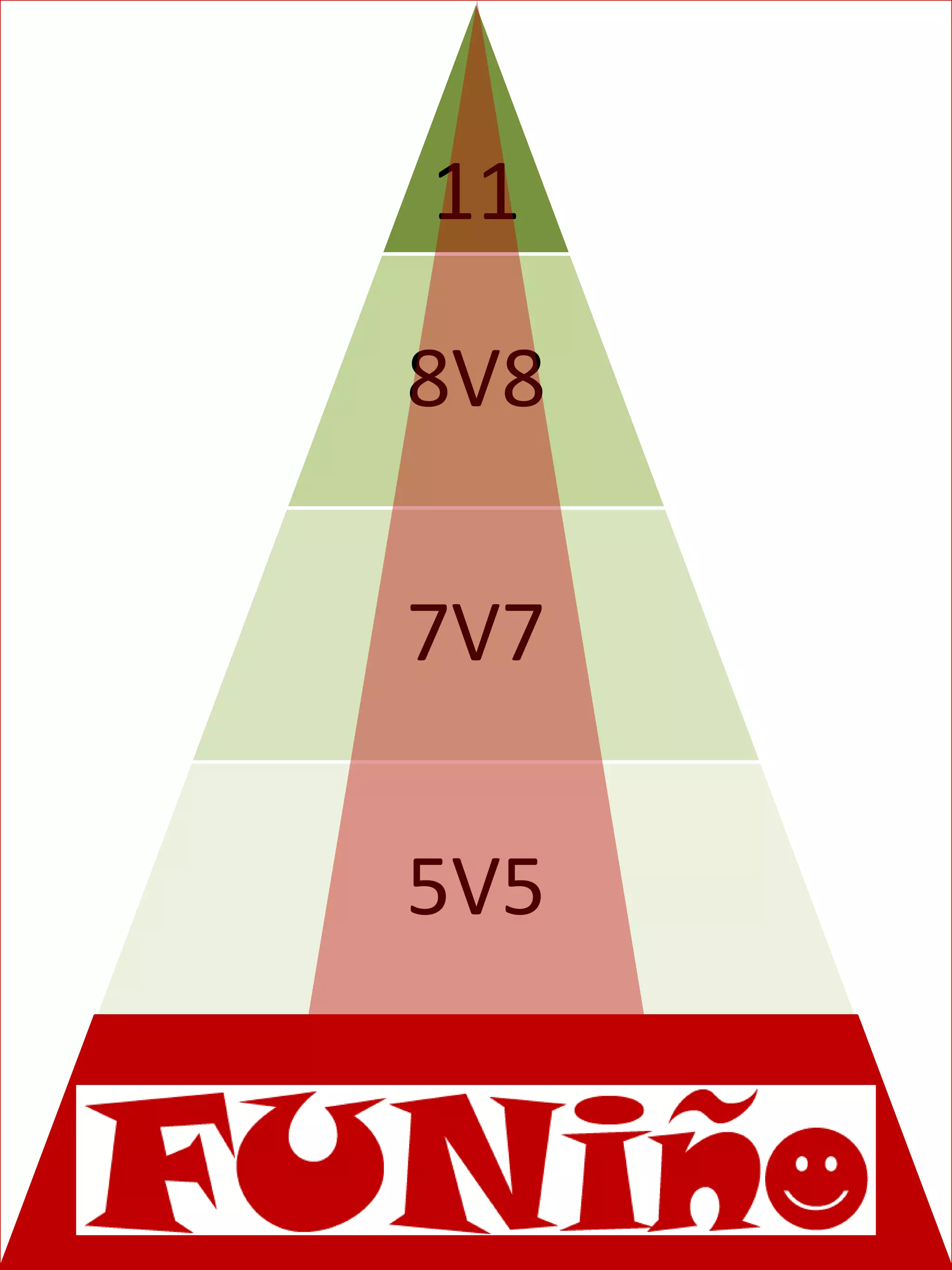
11
8V8
7V7
5V5
www.thebeautifulgame.ie
Children must fall in love with the game
What do young kids 7-9 years of age want most?
To have the ball
To dribble
To score goals
To show their skills
To be admired
To experience success!
= IGNITION
www.thebeautifulgame.ie
What do young kids 7-9 years of age
NOT want?
Lines
(drills)
Lectures
(instructions)
Laps
(warm ups and running)
= IGNITION
The Importance
of experiencing
success
as a motivational
factor in youth
football
Motivation in Youth Football
PRIMARY FACTORS SECONDARY FACTORS
THE GAME ITSELF OTHERS
Experiencing success Coach
Fun - enjoyment Parents
Improvement
Comraderie Other adults
Involvement Facilities
Self-expression
Experimentation
Independence
www.thebeautifulgame.ie
Standard Training Session
for Young Players
How much time?
• Listening to coach_______________?
• Standing in line _________________?
• Physical conditioning ____________?
• Playing the game________________?
WARM UP 10 mins
Physical training 15 mins
Drills 20 mins
Game 15 mins
No warm up or physical training, or drills!
1. Play one of the 32 games for 15 mins
- Discover any issues with players.
2. Use corrective games to fix issues.
(Players will be more motivated to fix problems
that affect their game result and performance).
3. Repeat game with a variation
- see if issues have been resolved.
4. Apply more corrective games
(or some multilateral games)
5. Repeat game with another variation
Training Session
Game Intelligence
Because we have odd numbers 3v3
Usually there is one less-defended goal
This means there is always a better option to be sought
In this way encourages
• Perception (peripheral vision vs tunnel vision)
• Understanding the game situation
• Decision-making
The Game is the Teacher
Fall in love with the Game
Street Football for 21st Century
Let the Children Play
more of the ball
more goals
more FUN!
Game Intelligence
Perception - Understanding
Decision-making – Execution
Football that starts in the head
and finishes with the feet
Player-centred
Kids come first
Age-appropriate
Guided Discovery
Game-oriented
Simplified games in training
To match age-appropriate competitions
Age-appropriate
Games + Training
www.thebeautifulgame.ie
The Four Stages of
Problem-Solving
in Football
What’s happening? - Observation - Extract critical information on the
game situation
Gather visual and time/space related information
What’s relevant? - Analysis – Draw on previous knowledge and
experience
Recognize the problem(s) , devise solutions/options
What’ should I do? – Assess options & Risk – Weigh up and choose the
best option
Select the appropriate solution
How do I do it? – Resolve the problem – Motor response
Execute the chosen solution successfully
PERCEPTION
UNDERSTANDING &
INTERPRETING
DECISION MAKING
EXECUTION
Player
Centred
Player-centred
Kids football is NOT about:
Dad’s (or Mums)
The Coach
The Club
The League
Or anyone else
It is about the rights and needs
of the young player!
www.thebeautifulgame.ie
COACH-CENTRED PLAYER-CENTRED
Players are “Empty
Vessels”
Players are full of
Potential
Coach is the font of
all knowledge
Players participate
in own learning
Dictator Style
All instructions
Engagement style
Guided Discovery
Conditioning
through drills
More interactive
learning/games
Controlling Empowering
Dehumanizing Motivating
If the enjoyment of the game is taken away
by adults who rant and rave on the touchline
and the grassroots game becomes, in effect, a
computer game controlled by dad’s, the
opportunity for young players to plant the
seeds of a lifelong love affair with the game
will be diminished.
Les Howie
www.thebeautifulgame.ie
“Education is not
the filling of a pail,
but
the lighting of a fire!”
W.B.Yeats
Age-Appropriate
…If we try to alter this natural
order, they will reach adulthood
prematurely but with neither
substance nor strength.”
Jean-Jacques Rousseau
“Nature decrees that children
should be children before they
become adults...
11
POETRY
SENTENCES
PROSE
VOCABULARY
ALPHABET
An Educational Model For Languages
COMPUTERS
ARCHITECTURE
ECONOMICS
MULTIPLY & DIVIDE
FORMULAS
ALGEBRA
TRIGONOMETRY
ADD & SUBTRACT
COUNTING
An Educational Model For Maths
FUNd’s
5-6
years
FUNiño
7-9
years
5v5 & 7v7
10-12
years
8v8
13
years
Topics
11v11
14+
years
3v3
4v4*
2v2
ABCs/Multilateral Games
Optimal Football
Development Model
-to develop
fully-rounded,
intelligent,
creative
players
for
The Modern Game
Game-Oriented
“The problem is, in
England, you teach
children to win the
game,
www.thebeautifulgame.ie
in Spain,
we teach
children
to play the game”
3 IS THE MAGIC NUMBER!
SHAPE
Triangle provides width and depth
ATTACK/POSSESSION
at least two options
DEFENCE
Press/Cover/Balance
WHY SMALL SIDED GAMES
• More touches of the ball
• Simpler decisions to make
• Better game-related fitness, short duration of
high-intensity vs laps
• More time with coach per player
• Easier to coach especially for parent coaches
• More opportunities to solve game problems
• More attacking opportunities (dribbling, shooting,
passing )
• More defending opportunities
• More shooting and more goals = more fun!
• No hiding place, players don’t get lost in these
games, improves competitiveness & healthy
aggression
• More opportunities for the full range of skills
• Encourages better shape and awareness of team-
mates
• Encourages faster play, fast transition from
defence to attack
More involvement, more success, more fun!
The Manchester United
4 v 4 Pilot Scheme
On Average 4v4 versus 8v8 had:
1. 135% more passes
2. 260% more Scoring Attempts
3. 500% more Goals Scored
4. 225% more 1v1 Encounters
5. 280% more Dribbling Skills
www.thebeautifulgame.ie
4V4
Wing play Swarming
Peripheral Vision Tunnel Vision
More time and space 25% more crowded
Triangular formation Rhomboid shape
No Fixed Positions Usually fixed positions
More Goals Less Goals
Greater participation Space to hide
Reading the game More rushed
Physical involvement Hiding place
More passing More long clearances
Just imagine how FUNiño
would compare to 7v7 with 25%
less players and 100% more
goals than 4v4 football!
1. 200% more passes?
2. 400% more Scoring Attempts?
3. 700% more Goals Scored?
4. 400% more 1v1 Encounters?
5. 500% more Dribbling Skills?
1. The Rules are the instructions
2. Let them dribble, don’t force passing
3. Start training sessions with a game
4. Limit the use of lines, lectures and laps
5. Use Guided Discovery rather than instruction
6. No need to warm up
7. No need for extra physical training
8. Size 4 ball
9. Use all the variations
10. Multiple Competitions, not one per season
11. Rolling Substitutions
12. Use multilateral activities in training
13. Allow 4v3 when a team falls behind by 3 goals
14. Reward exhibiting “The Beautiful Game”
The Game is the Teacher!
& TALENT
The whole competition lasts 75 minutes in which the official
FUNiño rules are applied.
Coaches give no instructions and generally choose equal
teams from their 16 player squad, which makes for a better
experience for everybody on the day.
A full-size pitch hosts 8 FUNiño games and 64 players at
the same time.
Teams play two matches of 3x10 minutes
(with 2.5 minutes of rest in between the periods).
Festival
Benefits
of
Funiño
recognizes that playing
is like breathing to children…
…necessary for their physical and
mental well-being!
Player Benefits:
Optimal pitch size and player numbers, 4 goals
out wide and simple rules means:
• Easy to understand and improve at
• Success = confidence and enjoyment
• More touches on the ball and goals
• More 1v1s and 2v1s
• Lots of dribbling, then lots of passing
Benefits of Funiño
• Establishes all the basic skills:
Controlling
Passing
Dribbling
Shooting
Tackling
• The player has plenty of opportunity to
- "be in love with the ball"
- improvise and to take risks
without fear of making mistakes
• All 3 players are vital and participate
• Wide goals = better peripheral vision
• Reduces swarming
• More time and space to think/decide
Benefits of Funiño
• Great variety is more interesting for all
• The positive environment of discovery
instead of instruction is much more
stimulating than traditional training and
games
• Smaller players make up for their size
through clever play
• Rolling substitutions and equal
playing time benefits everyone
• Frequent repetition of basic game
situations gives greater opportunity to
master them
Benefits of Funiño
• The two goals create options which
stimulates creativity and improvisation
• Develops support play and off-the-ball
play
• Learning takes place in a fully-integrated
holistic environment, just as in the game
itself. There is no isolation of technical,
tactical or physical elements
• Usually everyone scores a goal!
Benefits of Funiño
Some Benefits For Coaches
• FUNiño can be simple or complex
• New communication and training skills
• Modify the rules to suit players’ ability
• Endless variety
• The game is easier to analyze
• Player performance is easier to analyze
• Rolling substitutions = less stressful for all!
FUNdamentals - Learn to love
the game!
Fun for kids Plenty of goals
Plenty of action No specialization
Involvement Equal playing time
The Game is the Teacher!
www.thebeautifulgame.ie

FUNino: Horst Wein

  • 3.
    A. INTRODUCTION • Whatis ? • List of Games • Compare with normal training session B. PRACTICAL Typical training session 1. Game 2. Corrective exercise (2) 3. Play game again with variation 4. Corrective exercise (2) 5. Play game again with another variation Demonstrate 3 other games 6. Keeping possession 3v2 7. Leo Messi 8. with surprise attacks C. SEMINAR D. Q&A
  • 4.
    Futbol a lamedida del niño “Football tailored to children” FUN for children
  • 5.
  • 6.
  • 7.
  • 8.
    www.thebeautifulgame.ie Children must fallin love with the game What do young kids 7-9 years of age want most? To have the ball To dribble To score goals To show their skills To be admired To experience success! = IGNITION
  • 9.
    www.thebeautifulgame.ie What do youngkids 7-9 years of age NOT want? Lines (drills) Lectures (instructions) Laps (warm ups and running) = IGNITION
  • 10.
    The Importance of experiencing success asa motivational factor in youth football
  • 11.
    Motivation in YouthFootball PRIMARY FACTORS SECONDARY FACTORS THE GAME ITSELF OTHERS Experiencing success Coach Fun - enjoyment Parents Improvement Comraderie Other adults Involvement Facilities Self-expression Experimentation Independence
  • 12.
    www.thebeautifulgame.ie Standard Training Session forYoung Players How much time? • Listening to coach_______________? • Standing in line _________________? • Physical conditioning ____________? • Playing the game________________? WARM UP 10 mins Physical training 15 mins Drills 20 mins Game 15 mins
  • 13.
    No warm upor physical training, or drills! 1. Play one of the 32 games for 15 mins - Discover any issues with players. 2. Use corrective games to fix issues. (Players will be more motivated to fix problems that affect their game result and performance). 3. Repeat game with a variation - see if issues have been resolved. 4. Apply more corrective games (or some multilateral games) 5. Repeat game with another variation Training Session
  • 16.
    Game Intelligence Because wehave odd numbers 3v3 Usually there is one less-defended goal This means there is always a better option to be sought In this way encourages • Perception (peripheral vision vs tunnel vision) • Understanding the game situation • Decision-making
  • 17.
    The Game isthe Teacher Fall in love with the Game Street Football for 21st Century Let the Children Play more of the ball more goals more FUN!
  • 19.
    Game Intelligence Perception -Understanding Decision-making – Execution Football that starts in the head and finishes with the feet Player-centred Kids come first Age-appropriate Guided Discovery Game-oriented Simplified games in training To match age-appropriate competitions Age-appropriate Games + Training
  • 20.
  • 21.
    The Four Stagesof Problem-Solving in Football What’s happening? - Observation - Extract critical information on the game situation Gather visual and time/space related information What’s relevant? - Analysis – Draw on previous knowledge and experience Recognize the problem(s) , devise solutions/options What’ should I do? – Assess options & Risk – Weigh up and choose the best option Select the appropriate solution How do I do it? – Resolve the problem – Motor response Execute the chosen solution successfully PERCEPTION UNDERSTANDING & INTERPRETING DECISION MAKING EXECUTION
  • 22.
  • 23.
    Player-centred Kids football isNOT about: Dad’s (or Mums) The Coach The Club The League Or anyone else It is about the rights and needs of the young player!
  • 24.
    www.thebeautifulgame.ie COACH-CENTRED PLAYER-CENTRED Players are“Empty Vessels” Players are full of Potential Coach is the font of all knowledge Players participate in own learning Dictator Style All instructions Engagement style Guided Discovery Conditioning through drills More interactive learning/games Controlling Empowering Dehumanizing Motivating
  • 25.
    If the enjoymentof the game is taken away by adults who rant and rave on the touchline and the grassroots game becomes, in effect, a computer game controlled by dad’s, the opportunity for young players to plant the seeds of a lifelong love affair with the game will be diminished. Les Howie
  • 26.
    www.thebeautifulgame.ie “Education is not thefilling of a pail, but the lighting of a fire!” W.B.Yeats
  • 27.
  • 28.
    …If we tryto alter this natural order, they will reach adulthood prematurely but with neither substance nor strength.” Jean-Jacques Rousseau “Nature decrees that children should be children before they become adults...
  • 29.
  • 30.
  • 31.
  • 32.
    FUNd’s 5-6 years FUNiño 7-9 years 5v5 & 7v7 10-12 years 8v8 13 years Topics 11v11 14+ years 3v3 4v4* 2v2 ABCs/MultilateralGames Optimal Football Development Model -to develop fully-rounded, intelligent, creative players for The Modern Game
  • 33.
  • 34.
    “The problem is,in England, you teach children to win the game, www.thebeautifulgame.ie in Spain, we teach children to play the game”
  • 35.
    3 IS THEMAGIC NUMBER! SHAPE Triangle provides width and depth ATTACK/POSSESSION at least two options DEFENCE Press/Cover/Balance
  • 37.
    WHY SMALL SIDEDGAMES • More touches of the ball • Simpler decisions to make • Better game-related fitness, short duration of high-intensity vs laps • More time with coach per player • Easier to coach especially for parent coaches • More opportunities to solve game problems • More attacking opportunities (dribbling, shooting, passing ) • More defending opportunities • More shooting and more goals = more fun! • No hiding place, players don’t get lost in these games, improves competitiveness & healthy aggression • More opportunities for the full range of skills • Encourages better shape and awareness of team- mates • Encourages faster play, fast transition from defence to attack More involvement, more success, more fun!
  • 38.
    The Manchester United 4v 4 Pilot Scheme On Average 4v4 versus 8v8 had: 1. 135% more passes 2. 260% more Scoring Attempts 3. 500% more Goals Scored 4. 225% more 1v1 Encounters 5. 280% more Dribbling Skills www.thebeautifulgame.ie
  • 39.
    4V4 Wing play Swarming PeripheralVision Tunnel Vision More time and space 25% more crowded Triangular formation Rhomboid shape No Fixed Positions Usually fixed positions More Goals Less Goals Greater participation Space to hide Reading the game More rushed Physical involvement Hiding place More passing More long clearances
  • 40.
    Just imagine howFUNiño would compare to 7v7 with 25% less players and 100% more goals than 4v4 football! 1. 200% more passes? 2. 400% more Scoring Attempts? 3. 700% more Goals Scored? 4. 400% more 1v1 Encounters? 5. 500% more Dribbling Skills?
  • 41.
    1. The Rulesare the instructions 2. Let them dribble, don’t force passing 3. Start training sessions with a game 4. Limit the use of lines, lectures and laps 5. Use Guided Discovery rather than instruction 6. No need to warm up 7. No need for extra physical training 8. Size 4 ball 9. Use all the variations 10. Multiple Competitions, not one per season 11. Rolling Substitutions 12. Use multilateral activities in training 13. Allow 4v3 when a team falls behind by 3 goals 14. Reward exhibiting “The Beautiful Game” The Game is the Teacher! & TALENT
  • 42.
    The whole competitionlasts 75 minutes in which the official FUNiño rules are applied. Coaches give no instructions and generally choose equal teams from their 16 player squad, which makes for a better experience for everybody on the day. A full-size pitch hosts 8 FUNiño games and 64 players at the same time. Teams play two matches of 3x10 minutes (with 2.5 minutes of rest in between the periods). Festival
  • 43.
  • 44.
    recognizes that playing islike breathing to children… …necessary for their physical and mental well-being! Player Benefits: Optimal pitch size and player numbers, 4 goals out wide and simple rules means: • Easy to understand and improve at • Success = confidence and enjoyment • More touches on the ball and goals • More 1v1s and 2v1s • Lots of dribbling, then lots of passing Benefits of Funiño
  • 45.
    • Establishes allthe basic skills: Controlling Passing Dribbling Shooting Tackling • The player has plenty of opportunity to - "be in love with the ball" - improvise and to take risks without fear of making mistakes • All 3 players are vital and participate • Wide goals = better peripheral vision • Reduces swarming • More time and space to think/decide Benefits of Funiño
  • 46.
    • Great varietyis more interesting for all • The positive environment of discovery instead of instruction is much more stimulating than traditional training and games • Smaller players make up for their size through clever play • Rolling substitutions and equal playing time benefits everyone • Frequent repetition of basic game situations gives greater opportunity to master them Benefits of Funiño
  • 47.
    • The twogoals create options which stimulates creativity and improvisation • Develops support play and off-the-ball play • Learning takes place in a fully-integrated holistic environment, just as in the game itself. There is no isolation of technical, tactical or physical elements • Usually everyone scores a goal! Benefits of Funiño
  • 48.
    Some Benefits ForCoaches • FUNiño can be simple or complex • New communication and training skills • Modify the rules to suit players’ ability • Endless variety • The game is easier to analyze • Player performance is easier to analyze • Rolling substitutions = less stressful for all!
  • 49.
    FUNdamentals - Learnto love the game! Fun for kids Plenty of goals Plenty of action No specialization Involvement Equal playing time The Game is the Teacher! www.thebeautifulgame.ie