Ivan Kepčija, MA
ivan.kepcija@gmail.com
www.soccercurriculum.com
Presentation today
• Experiences
• Top football analysis
• Curriculum
• Methodology
• Periodization
• Exercises for development
• Coach competencies
Who am I?
Ivan Kepčija
• Coach since 2004
• Masters degree in Sport Science
– Research in sport psychology
• UEFA Pro candidate
• Collegiate and youth coach
• Dinamo Zagreb Youth Academy
• Croatian U19 National Team
• Legia Warszawa Sporting Director
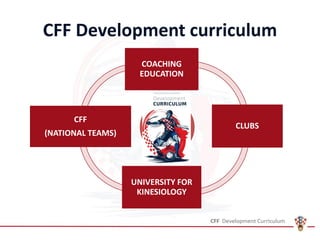
CFF Development curriculum
COACHING
EDUCATION
CLUBS
UNIVERSITY FOR
KINESIOLOGY
CFF
(NATIONAL TEAMS)
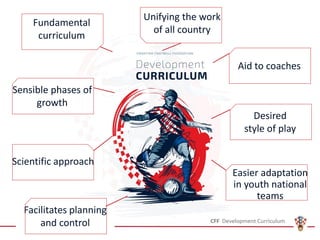
Fundamental
curriculum
Unifying the work
of all country
Easier adaptation
in youth national
teams
Scientific approach
Aid to coaches
Desired
style of play
Sensible phases of
growth
Facilitates planning
and control
Planning
Principles
Methodology
Periodization
Structure
U6 U19+
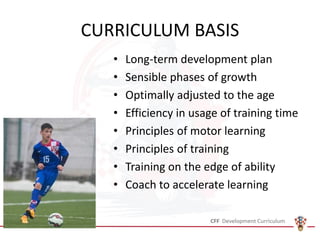
CURRICULUM BASIS
• Long-term development plan
• Sensible phases of growth
• Optimally adjusted to the age
• Efficiency in usage of training time
• Principles of motor learning
• Principles of training
• Training on the edge of ability
• Coach to accelerate learning
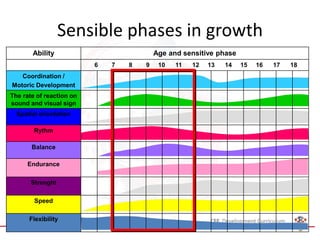
Ability Age and sensitive phase
6 7 8 9 10 11 12 13 14 15 16 17 18
Coordination /
Motoric Development
The rate of reaction on
sound and visual sign
Spatial orientation
Rythm
Balance
Endurance
Strenght
Speed
Flexibility
Sensible phases in growth
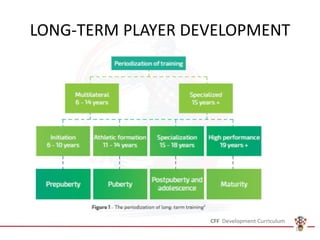
LONG-TERM PLAYER DEVELOPMENT
10
Biological vs chronological age!
#1 #2 #3
Height (in cm) 149 164 185
Weight (u kg) 39,8 49,8 71,6
Chronological age 14,4 13,5 14,4
Expected time of
accelerated growth
15,5 13,8 12,8
Biological minus
chronological age
-1,1 -0,3 +1,8
STYLE OF PLAY
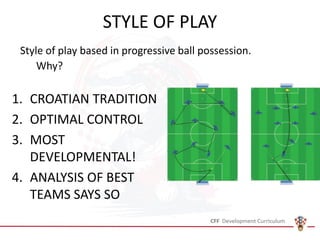
Style of play based in progressive ball possession.
Why?
1. CROATIAN TRADITION
2. OPTIMAL CONTROL
3. MOST
DEVELOPMENTAL!
4. ANALYSIS OF BEST
TEAMS SAYS SO
PROGRESSIVE BALL POSSESSION
Key characteristics:
1. Large number of successful passes
2. Large percentage of succesful forward passes
3. Small number of passes backwards
4. Large number of final 3rd and penalty box entries
5. Many players in the box finishing the attack
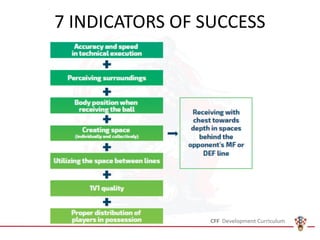
7 INDICATORS OF SUCCESS
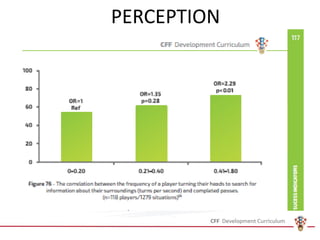
PERCEPTION
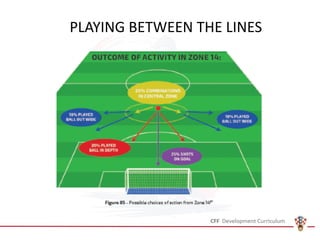
PLAYING BETWEEN THE LINES
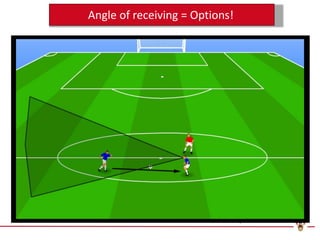
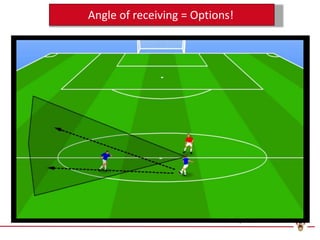
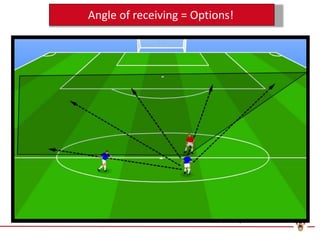
Angle of receiving = Options!
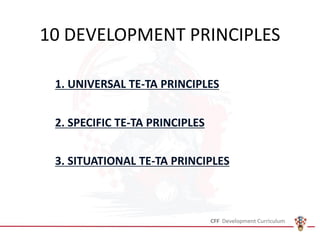
1. UNIVERSAL TE-TA PRINCIPLES
2. SPECIFIC TE-TA PRINCIPLES
3. SITUATIONAL TE-TA PRINCIPLES
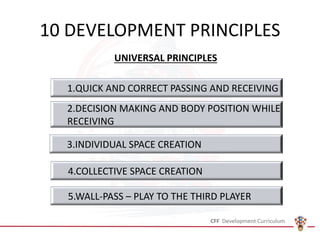
10 DEVELOPMENT PRINCIPLES
UNIVERSAL PRINCIPLES
1.QUICK AND CORRECT PASSING AND RECEIVING
2.DECISION MAKING AND BODY POSITION WHILE
RECEIVING
5.WALL-PASS – PLAY TO THE THIRD PLAYER
3.INDIVIDUAL SPACE CREATION
4.COLLECTIVE SPACE CREATION
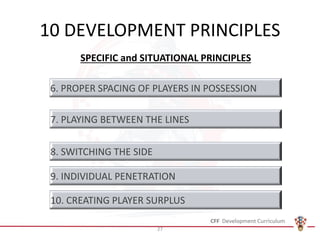
10 DEVELOPMENT PRINCIPLES
SPECIFIC and SITUATIONAL PRINCIPLES
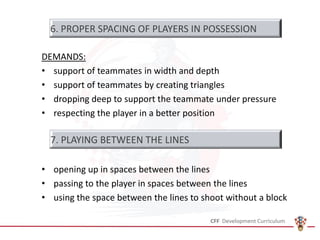
6. PROPER SPACING OF PLAYERS IN POSSESSION
7. PLAYING BETWEEN THE LINES
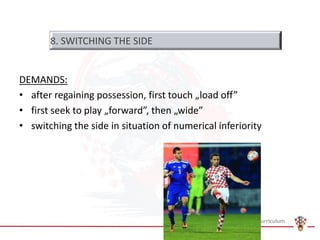
8. SWITCHING THE SIDE
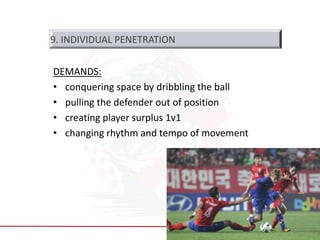
9. INDIVIDUAL PENETRATION
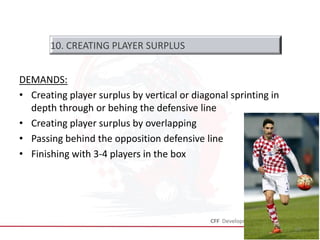
10. CREATING PLAYER SURPLUS
27
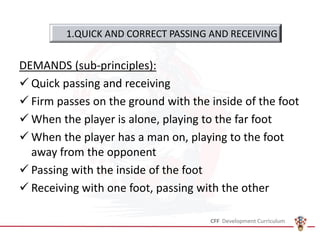
DEMANDS (sub-principles):
✓ Quick passing and receiving
✓ Firm passes on the ground with the inside of the foot
✓ When the player is alone, playing to the far foot
✓ When the player has a man on, playing to the foot
away from the opponent
✓ Passing with the inside of the foot
✓ Receiving with one foot, passing with the other
1.QUICK AND CORRECT PASSING AND RECEIVING
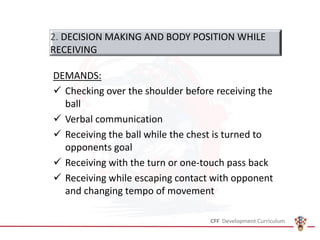
DEMANDS:
✓ Checking over the shoulder before receiving the
ball
✓ Verbal communication
✓ Receiving the ball while the chest is turned to
opponents goal
✓ Receiving with the turn or one-touch pass back
✓ Receiving while escaping contact with opponent
and changing tempo of movement
2. DECISION MAKING AND BODY POSITION WHILE
RECEIVING
DEMANDS:
✓ vertically – check-to – run-away or run-away-check to
✓ diagonally - check-to – away or check-away - to
✓ horizontally – checking-to – opening sideways or opening
sideways – checking to
✓ emptying the space
✓ crossing (or interchange) of positions
✓ rotation
3. INDIVIDUAL SPACE CREATION
4. COLLECTIVE SPACE CREATION
DEMANDS:
• Wall-pass
• Playing to the third player
• Composure under pressure
• Proper timing for opening up and decision-making
5. WALL-PASS – PLAY TO THE THIRD PLAYER
DEMANDS:
• support of teammates in width and depth
• support of teammates by creating triangles
• dropping deep to support the teammate under pressure
• respecting the player in a better position
• opening up in spaces between the lines
• passing to the player in spaces between the lines
• using the space between the lines to shoot without a block
6. PROPER SPACING OF PLAYERS IN POSSESSION
7. PLAYING BETWEEN THE LINES
DEMANDS:
• after regaining possession, first touch „load off”
• first seek to play „forward”, then „wide”
• switching the side in situation of numerical inferiority
8. SWITCHING THE SIDE
DEMANDS:
• conquering space by dribbling the ball
• pulling the defender out of position
• creating player surplus 1v1
• changing rhythm and tempo of movement
34
9. INDIVIDUAL PENETRATION
DEMANDS:
• Creating player surplus by vertical or diagonal sprinting in
depth through or behing the defensive line
• Creating player surplus by overlapping
• Passing behind the opposition defensive line
• Finishing with 3-4 players in the box
35
10. CREATING PLAYER SURPLUS
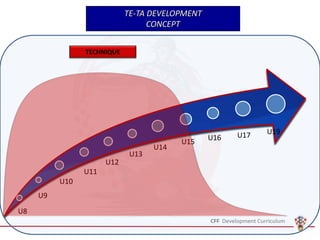
U8
U10
U11
U12
U9
U13
U14
U15 U16 U17 U19
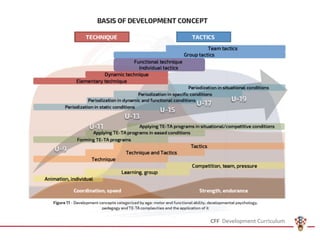
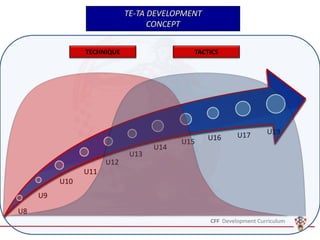
TECHNIQUE
TE-TA DEVELOPMENT
CONCEPT
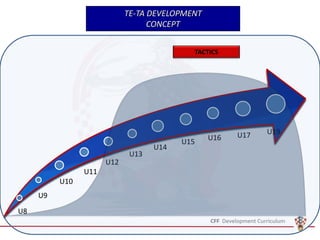
U8
U10
U11
U12
U9
U13
U14
U15 U16 U17 U19
TACTICS
TE-TA DEVELOPMENT
CONCEPT
U8
U10
U11
U12
U9
U13
U14
U15 U16 U17 U19
TECHNIQUE TACTICS
TE-TA DEVELOPMENT
CONCEPT
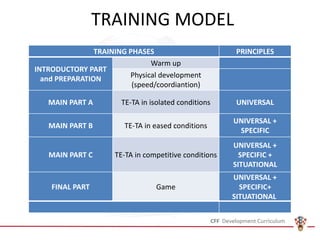
TRAINING MODEL
TRAINING PHASES PRINCIPLES
INTRODUCTORY PART
and PREPARATION
Warm up
Physical development
(speed/coordiantion)
MAIN PART A TE-TA in isolated conditions UNIVERSAL
MAIN PART B TE-TA in eased conditions
UNIVERSAL +
SPECIFIC
MAIN PART C TE-TA in competitive conditions
UNIVERSAL +
SPECIFIC +
SITUATIONAL
FINAL PART Game
UNIVERSAL +
SPECIFIC+
SITUATIONAL
TRAINING PHASES U-9 U-11 U-13 U-15 U-17 U-19 PRINCIPLES
INTRODUCTORY
PART and
PREPARATION
Warm up 5 5 10 10 10 10
Physical
development
(speed/coordian
tion)
20 20 15 15 15 15
MAIN PART A
TE-TA in isolated
conditions
20 20 25 25 20 20 UNIVERSAL
MAIN PART B
TE-TA in eased
conditions
10 10 15 15 15 15
UNIVERSAL +
SPECIFIC
MAIN PART C
TE-TA in
competitive
conditions
0 0 15 15 15 15
UNIVERSAL +
SPECIFIC +
SITUATIONAL
FINAL PART Game 20 20 10 10 15 15
TOTAL TRAINING MINUTES 75 75 90 90 90 90
TRAINING MODEL
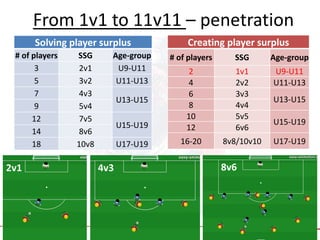
From 1v1 to 11v11 – penetration
2v1 4v3 8v6
Solving player surplus
# of players SSG Age-group
3 2v1 U9-U11
5 3v2 U11-U13
7 4v3
U13-U15
9 5v4
12 7v5
U15-U19
14 8v6
18 10v8 U17-U19
Creating player surplus
# of players SSG Age-group
2 1v1 U9-U11
4 2v2 U11-U13
6 3v3
U13-U15
8 4v4
10 5v5
U15-U19
12 6v6
16-20 8v8/10v10 U17-U19
44
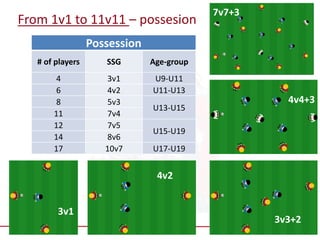
From 1v1 to 11v11 – possesion
Possession
# of players SSG Age-group
4 3v1 U9-U11
6 4v2 U11-U13
8 5v3
U13-U15
11 7v4
12 7v5
U15-U19
14 8v6
17 10v7 U17-U19
3v1
4v2
3v3+2
4v4+3
7v7+3
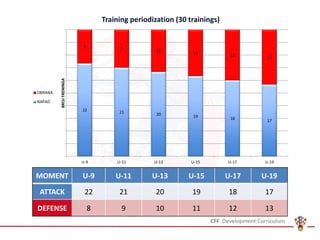
MOMENT U-9 U-11 U-13 U-15 U-17 U-19
ATTACK 22 21 20 19 18 17
DEFENSE 8 9 10 11 12 13
22 21 20 19 18 17
8 9 10 11 12 13
U-9 U-11 U-13 U-15 U-17 U-19
BROJTRENINGA
Training periodization (30 trainings)
OBRANA
NAPAD
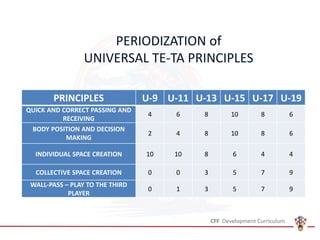
PRINCIPLES U-9 U-11 U-13 U-15 U-17 U-19
QUICK AND CORRECT PASSING AND
RECEIVING
4 6 8 10 8 6
BODY POSITION AND DECISION
MAKING
2 4 8 10 8 6
INDIVIDUAL SPACE CREATION 10 10 8 6 4 4
COLLECTIVE SPACE CREATION 0 0 3 5 7 9
WALL-PASS – PLAY TO THE THIRD
PLAYER
0 1 3 5 7 9
PERIODIZATION of
UNIVERSAL TE-TA PRINCIPLES
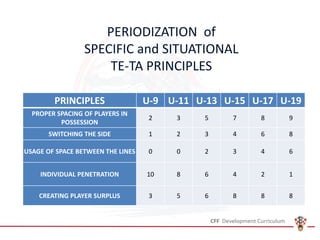
PRINCIPLES U-9 U-11 U-13 U-15 U-17 U-19
PROPER SPACING OF PLAYERS IN
POSSESSION
2 3 5 7 8 9
SWITCHING THE SIDE 1 2 3 4 6 8
USAGE OF SPACE BETWEEN THE LINES 0 0 2 3 4 6
INDIVIDUAL PENETRATION 10 8 6 4 2 1
CREATING PLAYER SURPLUS 3 5 6 8 8 8
PERIODIZATION of
SPECIFIC and SITUATIONAL
TE-TA PRINCIPLES
DEFENSIVE PRINCIPLES
SPECIFIC
SITUATIONAL
INDIVIDUAL DEFENSE
2-3-4 PLAYERS IN A HORIZONTAL RELATIONSHIP
2-3-4 PLAYERS IN VERTICAL RELATIONSHIPS
TEAM DEFENSE
ZONAL DEFENSE – LOW BLOCK
ZONAL PRESSING – MIDDLE BLOCK
PRESSING – HIGH PRESS
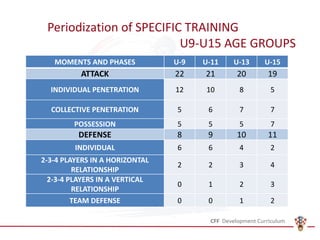
Periodization of SPECIFIC TRAINING
U9-U15 AGE GROUPS
MOMENTS AND PHASES U-9 U-11 U-13 U-15
ATTACK 22 21 20 19
INDIVIDUAL PENETRATION 12 10 8 5
COLLECTIVE PENETRATION 5 6 7 7
POSSESSION 5 5 5 7
DEFENSE 8 9 10 11
INDIVIDUAL 6 6 4 2
2-3-4 PLAYERS IN A HORIZONTAL
RELATIONSHIP
2 2 3 4
2-3-4 PLAYERS IN A VERTICAL
RELATIONSHIP
0 1 2 3
TEAM DEFENSE 0 0 1 2
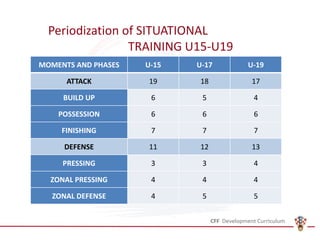
MOMENTS AND PHASES U-15 U-17 U-19
ATTACK 19 18 17
BUILD UP 6 5 4
POSSESSION 6 6 6
FINISHING 7 7 7
DEFENSE 11 12 13
PRESSING 3 3 4
ZONAL PRESSING 4 4 4
ZONAL DEFENSE 4 5 5
Periodization of SITUATIONAL
TRAINING U15-U19
Ivan Kepčija, MA
Ivan.kepcija@gmail.com

Ivan Kepcija - Croatian FF Development Program

  • 1.
  • 2.
    Presentation today • Experiences •Top football analysis • Curriculum • Methodology • Periodization • Exercises for development • Coach competencies
  • 3.
    Who am I? IvanKepčija • Coach since 2004 • Masters degree in Sport Science – Research in sport psychology • UEFA Pro candidate • Collegiate and youth coach • Dinamo Zagreb Youth Academy • Croatian U19 National Team • Legia Warszawa Sporting Director
  • 4.
  • 5.
    Fundamental curriculum Unifying the work ofall country Easier adaptation in youth national teams Scientific approach Aid to coaches Desired style of play Sensible phases of growth Facilitates planning and control
  • 6.
  • 8.
    CURRICULUM BASIS • Long-termdevelopment plan • Sensible phases of growth • Optimally adjusted to the age • Efficiency in usage of training time • Principles of motor learning • Principles of training • Training on the edge of ability • Coach to accelerate learning
  • 9.
    Ability Age andsensitive phase 6 7 8 9 10 11 12 13 14 15 16 17 18 Coordination / Motoric Development The rate of reaction on sound and visual sign Spatial orientation Rythm Balance Endurance Strenght Speed Flexibility Sensible phases in growth
  • 10.
  • 11.
    Biological vs chronologicalage! #1 #2 #3 Height (in cm) 149 164 185 Weight (u kg) 39,8 49,8 71,6 Chronological age 14,4 13,5 14,4 Expected time of accelerated growth 15,5 13,8 12,8 Biological minus chronological age -1,1 -0,3 +1,8
  • 15.
    STYLE OF PLAY Styleof play based in progressive ball possession. Why? 1. CROATIAN TRADITION 2. OPTIMAL CONTROL 3. MOST DEVELOPMENTAL! 4. ANALYSIS OF BEST TEAMS SAYS SO
  • 17.
    PROGRESSIVE BALL POSSESSION Keycharacteristics: 1. Large number of successful passes 2. Large percentage of succesful forward passes 3. Small number of passes backwards 4. Large number of final 3rd and penalty box entries 5. Many players in the box finishing the attack
  • 18.
  • 19.
  • 20.
  • 21.
  • 22.
  • 23.
  • 24.
  • 25.
    1. UNIVERSAL TE-TAPRINCIPLES 2. SPECIFIC TE-TA PRINCIPLES 3. SITUATIONAL TE-TA PRINCIPLES 10 DEVELOPMENT PRINCIPLES
  • 26.
    10 DEVELOPMENT PRINCIPLES UNIVERSALPRINCIPLES 1.QUICK AND CORRECT PASSING AND RECEIVING 2.DECISION MAKING AND BODY POSITION WHILE RECEIVING 5.WALL-PASS – PLAY TO THE THIRD PLAYER 3.INDIVIDUAL SPACE CREATION 4.COLLECTIVE SPACE CREATION
  • 27.
    10 DEVELOPMENT PRINCIPLES SPECIFICand SITUATIONAL PRINCIPLES 6. PROPER SPACING OF PLAYERS IN POSSESSION 7. PLAYING BETWEEN THE LINES 8. SWITCHING THE SIDE 9. INDIVIDUAL PENETRATION 10. CREATING PLAYER SURPLUS 27
  • 28.
    DEMANDS (sub-principles): ✓ Quickpassing and receiving ✓ Firm passes on the ground with the inside of the foot ✓ When the player is alone, playing to the far foot ✓ When the player has a man on, playing to the foot away from the opponent ✓ Passing with the inside of the foot ✓ Receiving with one foot, passing with the other 1.QUICK AND CORRECT PASSING AND RECEIVING
  • 29.
    DEMANDS: ✓ Checking overthe shoulder before receiving the ball ✓ Verbal communication ✓ Receiving the ball while the chest is turned to opponents goal ✓ Receiving with the turn or one-touch pass back ✓ Receiving while escaping contact with opponent and changing tempo of movement 2. DECISION MAKING AND BODY POSITION WHILE RECEIVING
  • 30.
    DEMANDS: ✓ vertically –check-to – run-away or run-away-check to ✓ diagonally - check-to – away or check-away - to ✓ horizontally – checking-to – opening sideways or opening sideways – checking to ✓ emptying the space ✓ crossing (or interchange) of positions ✓ rotation 3. INDIVIDUAL SPACE CREATION 4. COLLECTIVE SPACE CREATION
  • 31.
    DEMANDS: • Wall-pass • Playingto the third player • Composure under pressure • Proper timing for opening up and decision-making 5. WALL-PASS – PLAY TO THE THIRD PLAYER
  • 32.
    DEMANDS: • support ofteammates in width and depth • support of teammates by creating triangles • dropping deep to support the teammate under pressure • respecting the player in a better position • opening up in spaces between the lines • passing to the player in spaces between the lines • using the space between the lines to shoot without a block 6. PROPER SPACING OF PLAYERS IN POSSESSION 7. PLAYING BETWEEN THE LINES
  • 33.
    DEMANDS: • after regainingpossession, first touch „load off” • first seek to play „forward”, then „wide” • switching the side in situation of numerical inferiority 8. SWITCHING THE SIDE
  • 34.
    DEMANDS: • conquering spaceby dribbling the ball • pulling the defender out of position • creating player surplus 1v1 • changing rhythm and tempo of movement 34 9. INDIVIDUAL PENETRATION
  • 35.
    DEMANDS: • Creating playersurplus by vertical or diagonal sprinting in depth through or behing the defensive line • Creating player surplus by overlapping • Passing behind the opposition defensive line • Finishing with 3-4 players in the box 35 10. CREATING PLAYER SURPLUS
  • 37.
    U8 U10 U11 U12 U9 U13 U14 U15 U16 U17U19 TECHNIQUE TE-TA DEVELOPMENT CONCEPT
  • 38.
    U8 U10 U11 U12 U9 U13 U14 U15 U16 U17U19 TACTICS TE-TA DEVELOPMENT CONCEPT
  • 39.
    U8 U10 U11 U12 U9 U13 U14 U15 U16 U17U19 TECHNIQUE TACTICS TE-TA DEVELOPMENT CONCEPT
  • 41.
    TRAINING MODEL TRAINING PHASESPRINCIPLES INTRODUCTORY PART and PREPARATION Warm up Physical development (speed/coordiantion) MAIN PART A TE-TA in isolated conditions UNIVERSAL MAIN PART B TE-TA in eased conditions UNIVERSAL + SPECIFIC MAIN PART C TE-TA in competitive conditions UNIVERSAL + SPECIFIC + SITUATIONAL FINAL PART Game UNIVERSAL + SPECIFIC+ SITUATIONAL
  • 42.
    TRAINING PHASES U-9U-11 U-13 U-15 U-17 U-19 PRINCIPLES INTRODUCTORY PART and PREPARATION Warm up 5 5 10 10 10 10 Physical development (speed/coordian tion) 20 20 15 15 15 15 MAIN PART A TE-TA in isolated conditions 20 20 25 25 20 20 UNIVERSAL MAIN PART B TE-TA in eased conditions 10 10 15 15 15 15 UNIVERSAL + SPECIFIC MAIN PART C TE-TA in competitive conditions 0 0 15 15 15 15 UNIVERSAL + SPECIFIC + SITUATIONAL FINAL PART Game 20 20 10 10 15 15 TOTAL TRAINING MINUTES 75 75 90 90 90 90 TRAINING MODEL
  • 43.
    From 1v1 to11v11 – penetration 2v1 4v3 8v6 Solving player surplus # of players SSG Age-group 3 2v1 U9-U11 5 3v2 U11-U13 7 4v3 U13-U15 9 5v4 12 7v5 U15-U19 14 8v6 18 10v8 U17-U19 Creating player surplus # of players SSG Age-group 2 1v1 U9-U11 4 2v2 U11-U13 6 3v3 U13-U15 8 4v4 10 5v5 U15-U19 12 6v6 16-20 8v8/10v10 U17-U19
  • 44.
    44 From 1v1 to11v11 – possesion Possession # of players SSG Age-group 4 3v1 U9-U11 6 4v2 U11-U13 8 5v3 U13-U15 11 7v4 12 7v5 U15-U19 14 8v6 17 10v7 U17-U19 3v1 4v2 3v3+2 4v4+3 7v7+3
  • 46.
    MOMENT U-9 U-11U-13 U-15 U-17 U-19 ATTACK 22 21 20 19 18 17 DEFENSE 8 9 10 11 12 13 22 21 20 19 18 17 8 9 10 11 12 13 U-9 U-11 U-13 U-15 U-17 U-19 BROJTRENINGA Training periodization (30 trainings) OBRANA NAPAD
  • 47.
    PRINCIPLES U-9 U-11U-13 U-15 U-17 U-19 QUICK AND CORRECT PASSING AND RECEIVING 4 6 8 10 8 6 BODY POSITION AND DECISION MAKING 2 4 8 10 8 6 INDIVIDUAL SPACE CREATION 10 10 8 6 4 4 COLLECTIVE SPACE CREATION 0 0 3 5 7 9 WALL-PASS – PLAY TO THE THIRD PLAYER 0 1 3 5 7 9 PERIODIZATION of UNIVERSAL TE-TA PRINCIPLES
  • 48.
    PRINCIPLES U-9 U-11U-13 U-15 U-17 U-19 PROPER SPACING OF PLAYERS IN POSSESSION 2 3 5 7 8 9 SWITCHING THE SIDE 1 2 3 4 6 8 USAGE OF SPACE BETWEEN THE LINES 0 0 2 3 4 6 INDIVIDUAL PENETRATION 10 8 6 4 2 1 CREATING PLAYER SURPLUS 3 5 6 8 8 8 PERIODIZATION of SPECIFIC and SITUATIONAL TE-TA PRINCIPLES
  • 49.
    DEFENSIVE PRINCIPLES SPECIFIC SITUATIONAL INDIVIDUAL DEFENSE 2-3-4PLAYERS IN A HORIZONTAL RELATIONSHIP 2-3-4 PLAYERS IN VERTICAL RELATIONSHIPS TEAM DEFENSE ZONAL DEFENSE – LOW BLOCK ZONAL PRESSING – MIDDLE BLOCK PRESSING – HIGH PRESS
  • 50.
    Periodization of SPECIFICTRAINING U9-U15 AGE GROUPS MOMENTS AND PHASES U-9 U-11 U-13 U-15 ATTACK 22 21 20 19 INDIVIDUAL PENETRATION 12 10 8 5 COLLECTIVE PENETRATION 5 6 7 7 POSSESSION 5 5 5 7 DEFENSE 8 9 10 11 INDIVIDUAL 6 6 4 2 2-3-4 PLAYERS IN A HORIZONTAL RELATIONSHIP 2 2 3 4 2-3-4 PLAYERS IN A VERTICAL RELATIONSHIP 0 1 2 3 TEAM DEFENSE 0 0 1 2
  • 51.
    MOMENTS AND PHASESU-15 U-17 U-19 ATTACK 19 18 17 BUILD UP 6 5 4 POSSESSION 6 6 6 FINISHING 7 7 7 DEFENSE 11 12 13 PRESSING 3 3 4 ZONAL PRESSING 4 4 4 ZONAL DEFENSE 4 5 5 Periodization of SITUATIONAL TRAINING U15-U19
  • 52.