Apache Flink
retrospective, roadmap, and vision
A trip down memory lane
2
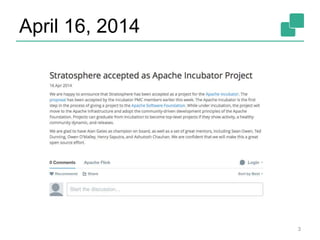
April 16, 2014
3
4
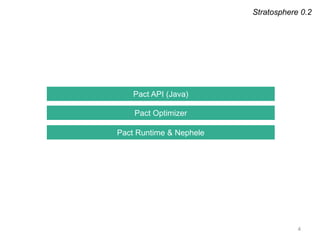
Pact Optimizer
Pact API (Java)
Pact Runtime & Nephele
Stratosphere 0.2
5
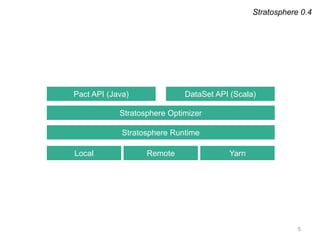
Stratosphere Optimizer
Pact API (Java)
Stratosphere Runtime
DataSet API (Scala)
Stratosphere 0.4
Local Remote Yarn
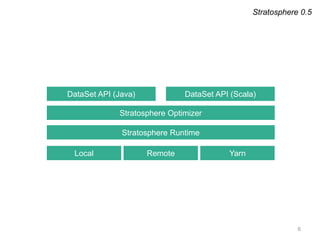
6
Stratosphere Optimizer
DataSet API (Java)
Stratosphere Runtime
DataSet API (Scala)
Stratosphere 0.5
Local Remote Yarn
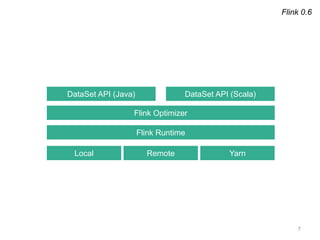
7
Flink Optimizer
DataSet API (Java)
Flink Runtime
DataSet API (Scala)
Flink 0.6
Local Remote Yarn
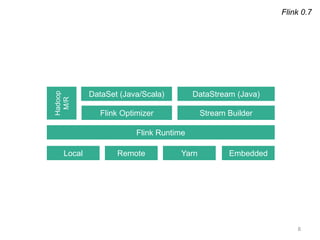
8
Flink Optimizer
DataSet (Java/Scala)
Flink Runtime
Flink 0.7
DataStream (Java)
Stream Builder
Hadoop
M/R
Local Remote Yarn Embedded
9
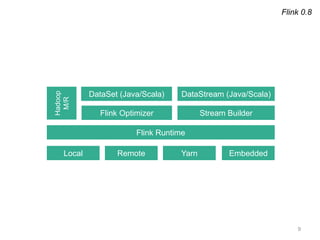
Flink Runtime
Flink 0.8
Flink Optimizer
DataSet (Java/Scala) DataStream (Java/Scala)
Stream Builder
Hadoop
M/R
Local Remote Yarn Embedded
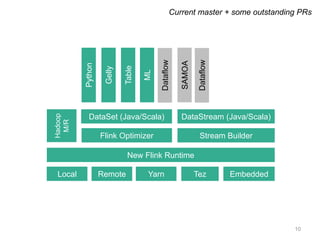
10
Python
Gelly
Table
ML
SAMOA
Current master + some outstanding PRs
Flink Optimizer
DataSet (Java/Scala) DataStream (Java/Scala)
Stream Builder
Hadoop
M/R
New Flink Runtime
Local Remote Yarn Tez Embedded
Dataflow
Dataflow
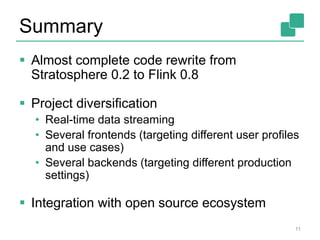
Summary
 Almost complete code rewrite from
Stratosphere 0.2 to Flink 0.8
 Project diversification
• Real-time data streaming
• Several frontends (targeting different user profiles
and use cases)
• Several backends (targeting different production
settings)
 Integration with open source ecosystem
11
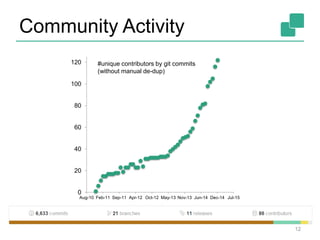
Community Activity
12
0
20
40
60
80
100
120
Aug-10 Feb-11 Sep-11 Apr-12 Oct-12 May-13 Nov-13 Jun-14 Dec-14 Jul-15
#unique contributors by git commits
(without manual de-dup)
Vision for Flink
13
What are we building?
14
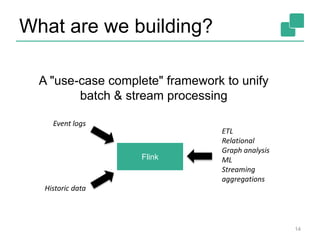
A "use-case complete" framework to unify
batch & stream processing
Flink
Event logs
Historic data
ETL
Relational
Graph analysis
ML
Streaming
aggregations
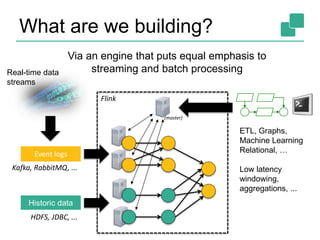
Flink
Historic data
Kafka, RabbitMQ, ...
HDFS, JDBC, ...
ETL, Graphs,
Machine Learning
Relational, …
Low latency
windowing,
aggregations, ...
Event logs
Via an engine that puts equal emphasis to
streaming and batch processingReal-time data
streams
What are we building?
(master)
16
Python
Gelly
Table
ML
SAMOAFlink Optimizer
DataSet (Java/Scala) DataStream (Java/Scala)
Stream Builder
Hadoop
M/R
Flink Runtime
Local Remote Yarn Tez Embedded
Dataflow
Dataflow
Focus this talk on stream
processing with Flink
Batch processing with Flink more well-
understood and with clear roadmap
Table
Life of data streams
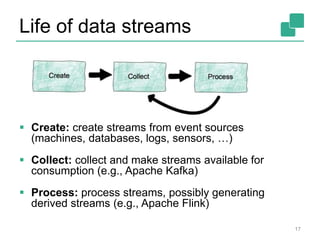
 Create: create streams from event sources
(machines, databases, logs, sensors, …)
 Collect: collect and make streams available for
consumption (e.g., Apache Kafka)
 Process: process streams, possibly generating
derived streams (e.g., Apache Flink)
17
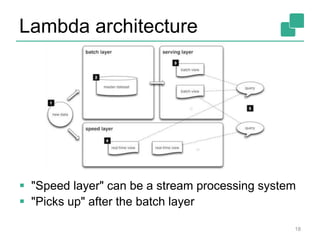
Lambda architecture
 "Speed layer" can be a stream processing system
 "Picks up" after the batch layer
18
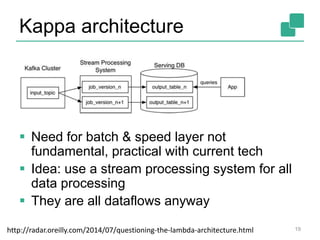
Kappa architecture
 Need for batch & speed layer not
fundamental, practical with current tech
 Idea: use a stream processing system for all
data processing
 They are all dataflows anyway
19http://radar.oreilly.com/2014/07/questioning-the-lambda-architecture.html
Data streaming with Flink
 Flink is building a proper stream
processing system
• that can execute both batch and stream jobs
natively
• batch-only jobs pass via different optimization
code path
 Flink is building libraries and DSLs on top
of both batch and streaming
• e.g., see recent Table API
20
Additions to Kappa
 Dataflow systems are good, but they are the
bottom-most layer
 In addition to a streaming dataflow system,
we need
• Different APIs (e.g., window definitions)
• Different optimization code paths
• Different management of local memory and disk
 Our approach: build these on top of a
common distributed streaming dataflow
system
21
Building blocks for streaming
 Pipelining
 Replay
 Operator state
 State backup
 High-level language(s)
 Integration with static sources
 High availability
22
See also:
• Stonebraker et al. "The 8 requirements of real-time stream processing."
• https://highlyscalable.wordpress.com/2013/08/20/in-stream-big-data-processing/
Building blocks for streaming
 Pipelining
• "Keep the data moving"
 Replay
• Tolerate machine failures
 Operator state
• For anything more interesting than filters
 State backup/restore
• App does not worry about duplicates
23
Pipelining
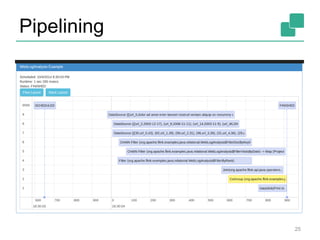
 Flink has always had pipelining
 Pipelined shuffles inspired by databases
(e.g., Impala) used for batch
 Later, DataStream API used the same
mechanism
24
Pipelining
25
Replay
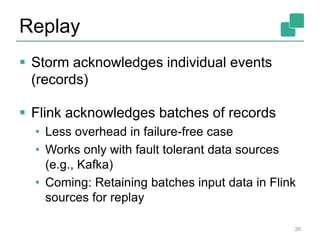
 Storm acknowledges individual events
(records)
 Flink acknowledges batches of records
• Less overhead in failure-free case
• Works only with fault tolerant data sources
(e.g., Kafka)
• Coming: Retaining batches input data in Flink
sources for replay
26
Operator state
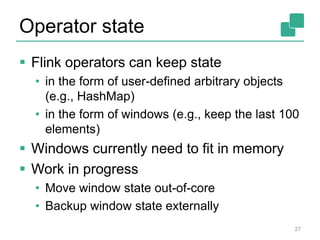
 Flink operators can keep state
• in the form of user-defined arbitrary objects
(e.g., HashMap)
• in the form of windows (e.g., keep the last 100
elements)
 Windows currently need to fit in memory
 Work in progress
• Move window state out-of-core
• Backup window state externally
27
State backup
28
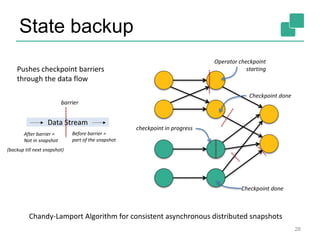
Chandy-Lamport Algorithm for consistent asynchronous distributed snapshots
Pushes checkpoint barriers
through the data flow
Operator checkpoint
starting
Checkpoint done
Data Stream
barrier
Before barrier =
part of the snapshot
After barrier =
Not in snapshot
Checkpoint done
checkpoint in progress
(backup till next snapshot)
Flink Streaming APIs
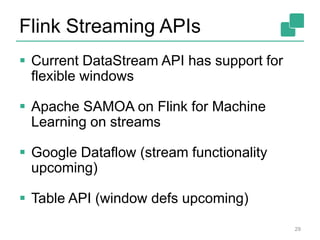
 Current DataStream API has support for
flexible windows
 Apache SAMOA on Flink for Machine
Learning on streams
 Google Dataflow (stream functionality
upcoming)
 Table API (window defs upcoming)
29
Integrating batch with
streaming
30
Batch + Streaming
 Making the switch from batch to streaming
easy will be key to boost streaming
adoption
 Applications will need to combine
streaming and static data sources
 Flink supports this through a new hybrid
runtime architecture
31
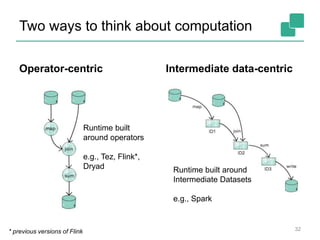
Two ways to think about computation
Operator-centric Intermediate data-centric
32
Runtime built around
Intermediate Datasets
e.g., Spark
Runtime built
around operators
e.g., Tez, Flink*,
Dryad
* previous versions of Flink
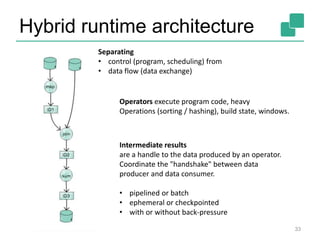
Hybrid runtime architecture
33
Separating
• control (program, scheduling) from
• data flow (data exchange)
Intermediate results
are a handle to the data produced by an operator.
Coordinate the "handshake" between data
producer and data consumer.
• pipelined or batch
• ephemeral or checkpointed
• with or without back-pressure
Operators execute program code, heavy
Operations (sorting / hashing), build state, windows.
flink.apache.org
@ApacheFlink

Flink history, roadmap and vision

  • 1.
  • 2.
    A trip downmemory lane 2
  • 3.
  • 4.
    4 Pact Optimizer Pact API(Java) Pact Runtime & Nephele Stratosphere 0.2
  • 5.
    5 Stratosphere Optimizer Pact API(Java) Stratosphere Runtime DataSet API (Scala) Stratosphere 0.4 Local Remote Yarn
  • 6.
    6 Stratosphere Optimizer DataSet API(Java) Stratosphere Runtime DataSet API (Scala) Stratosphere 0.5 Local Remote Yarn
  • 7.
    7 Flink Optimizer DataSet API(Java) Flink Runtime DataSet API (Scala) Flink 0.6 Local Remote Yarn
  • 8.
    8 Flink Optimizer DataSet (Java/Scala) FlinkRuntime Flink 0.7 DataStream (Java) Stream Builder Hadoop M/R Local Remote Yarn Embedded
  • 9.
    9 Flink Runtime Flink 0.8 FlinkOptimizer DataSet (Java/Scala) DataStream (Java/Scala) Stream Builder Hadoop M/R Local Remote Yarn Embedded
  • 10.
    10 Python Gelly Table ML SAMOA Current master +some outstanding PRs Flink Optimizer DataSet (Java/Scala) DataStream (Java/Scala) Stream Builder Hadoop M/R New Flink Runtime Local Remote Yarn Tez Embedded Dataflow Dataflow
  • 11.
    Summary  Almost completecode rewrite from Stratosphere 0.2 to Flink 0.8  Project diversification • Real-time data streaming • Several frontends (targeting different user profiles and use cases) • Several backends (targeting different production settings)  Integration with open source ecosystem 11
  • 12.
    Community Activity 12 0 20 40 60 80 100 120 Aug-10 Feb-11Sep-11 Apr-12 Oct-12 May-13 Nov-13 Jun-14 Dec-14 Jul-15 #unique contributors by git commits (without manual de-dup)
  • 13.
  • 14.
    What are webuilding? 14 A "use-case complete" framework to unify batch & stream processing Flink Event logs Historic data ETL Relational Graph analysis ML Streaming aggregations
  • 15.
    Flink Historic data Kafka, RabbitMQ,... HDFS, JDBC, ... ETL, Graphs, Machine Learning Relational, … Low latency windowing, aggregations, ... Event logs Via an engine that puts equal emphasis to streaming and batch processingReal-time data streams What are we building? (master)
  • 16.
    16 Python Gelly Table ML SAMOAFlink Optimizer DataSet (Java/Scala)DataStream (Java/Scala) Stream Builder Hadoop M/R Flink Runtime Local Remote Yarn Tez Embedded Dataflow Dataflow Focus this talk on stream processing with Flink Batch processing with Flink more well- understood and with clear roadmap Table
  • 17.
    Life of datastreams  Create: create streams from event sources (machines, databases, logs, sensors, …)  Collect: collect and make streams available for consumption (e.g., Apache Kafka)  Process: process streams, possibly generating derived streams (e.g., Apache Flink) 17
  • 18.
    Lambda architecture  "Speedlayer" can be a stream processing system  "Picks up" after the batch layer 18
  • 19.
    Kappa architecture  Needfor batch & speed layer not fundamental, practical with current tech  Idea: use a stream processing system for all data processing  They are all dataflows anyway 19http://radar.oreilly.com/2014/07/questioning-the-lambda-architecture.html
  • 20.
    Data streaming withFlink  Flink is building a proper stream processing system • that can execute both batch and stream jobs natively • batch-only jobs pass via different optimization code path  Flink is building libraries and DSLs on top of both batch and streaming • e.g., see recent Table API 20
  • 21.
    Additions to Kappa Dataflow systems are good, but they are the bottom-most layer  In addition to a streaming dataflow system, we need • Different APIs (e.g., window definitions) • Different optimization code paths • Different management of local memory and disk  Our approach: build these on top of a common distributed streaming dataflow system 21
  • 22.
    Building blocks forstreaming  Pipelining  Replay  Operator state  State backup  High-level language(s)  Integration with static sources  High availability 22 See also: • Stonebraker et al. "The 8 requirements of real-time stream processing." • https://highlyscalable.wordpress.com/2013/08/20/in-stream-big-data-processing/
  • 23.
    Building blocks forstreaming  Pipelining • "Keep the data moving"  Replay • Tolerate machine failures  Operator state • For anything more interesting than filters  State backup/restore • App does not worry about duplicates 23
  • 24.
    Pipelining  Flink hasalways had pipelining  Pipelined shuffles inspired by databases (e.g., Impala) used for batch  Later, DataStream API used the same mechanism 24
  • 25.
  • 26.
    Replay  Storm acknowledgesindividual events (records)  Flink acknowledges batches of records • Less overhead in failure-free case • Works only with fault tolerant data sources (e.g., Kafka) • Coming: Retaining batches input data in Flink sources for replay 26
  • 27.
    Operator state  Flinkoperators can keep state • in the form of user-defined arbitrary objects (e.g., HashMap) • in the form of windows (e.g., keep the last 100 elements)  Windows currently need to fit in memory  Work in progress • Move window state out-of-core • Backup window state externally 27
  • 28.
    State backup 28 Chandy-Lamport Algorithmfor consistent asynchronous distributed snapshots Pushes checkpoint barriers through the data flow Operator checkpoint starting Checkpoint done Data Stream barrier Before barrier = part of the snapshot After barrier = Not in snapshot Checkpoint done checkpoint in progress (backup till next snapshot)
  • 29.
    Flink Streaming APIs Current DataStream API has support for flexible windows  Apache SAMOA on Flink for Machine Learning on streams  Google Dataflow (stream functionality upcoming)  Table API (window defs upcoming) 29
  • 30.
  • 31.
    Batch + Streaming Making the switch from batch to streaming easy will be key to boost streaming adoption  Applications will need to combine streaming and static data sources  Flink supports this through a new hybrid runtime architecture 31
  • 32.
    Two ways tothink about computation Operator-centric Intermediate data-centric 32 Runtime built around Intermediate Datasets e.g., Spark Runtime built around operators e.g., Tez, Flink*, Dryad * previous versions of Flink
  • 33.
    Hybrid runtime architecture 33 Separating •control (program, scheduling) from • data flow (data exchange) Intermediate results are a handle to the data produced by an operator. Coordinate the "handshake" between data producer and data consumer. • pipelined or batch • ephemeral or checkpointed • with or without back-pressure Operators execute program code, heavy Operations (sorting / hashing), build state, windows.
  • 34.

Editor's Notes

  • #6 Iterations, Yarn support, Local execution, accummulators, web frontend, HBase, JDBC, Windows compatibility, mvn central,
  • #7 New Java API, distributed cache, iteration improvements, collection data sources and sinks, JDBC data sources and sinks, Hadoop I/O format, Avro support
  • #8 Robustness, netty, move to Apache
  • #9 Unification of Java and Scala APIs, logical keys/POJO support, MR compat, collections backend, blob service, mapr filesystem
  • #10 Extended filesystem support, DataStream Scala, streaming windows, mutable/immutable objects, lots of performance and stability, Kryo default serializer, HBase updated
  • #11 Akka rewrite, Tez mode, Python API, Gelly, Flinq, FlinkML. other systems
  • #12 Choice is good for both the users and the poor operations people. If I write a job I don't care if it runs on Flink or Tez