Taking it online Web accessibility for local government
Web accessibility Perceivable Operable Understandable Robust Web Content Accessibility Guidelines 2.0: http://www.w3.org/TR/WCAG20/
Web standards HTML is designed for universal access “ The power of the Web is in its universality. Access by everyone regardless of disability is an essential aspect.” - Tim Berners-Lee, inventor of the World Wide Web.
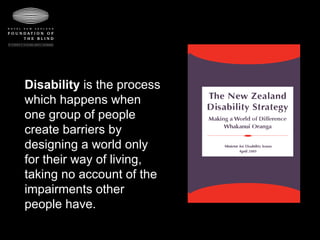
Disability  is the process which happens when one group of people create barriers by designing a world only for their way of living, taking no account of the impairments other people have.
Print   disability ( New Zealand  Copyright Act 1994) a person has a print disability if he or she—  (a) Is blind; or  (b) Suffers severe impairment of his or her sight; or  (c) Is unable to hold or manipulate books; or  (d) Is unable to focus or move his or her eyes; or  (e) Suffers a handicap with respect to visual perception.
The Web is not a  barrier  to people with disabilities, it is the  solution from Constructing a POUR website: http://www.webaim.org/articles/pour/
Access to information Participation in democracy Social and cultural inclusion Education opportunities including life-long learning Meaningful employment and business interactions
e-Government New Zealand Government Web Standards 2.0  http://webstandards.govt.nz/ Strong focus on accessibility Linked with cross-government Digital Strategy: http://www.digitalstrategy.govt.nz
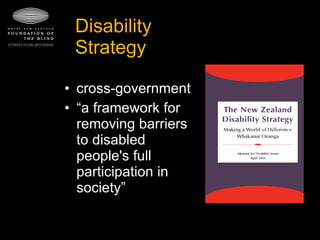
Disability Strategy cross-government “ a framework for removing barriers to disabled people's full participation in society”
UN Convention on the Rights of Persons with Disabilities …  States Parties shall take appropriate measures to ensure to persons with disabilities access, on an equal basis with others, … to information and communications, including information and communications technologies and systems …  From Article 9, Accessibility
Moira Clunie [email_address] Mike Lloyd [email_address]

Taking it online: Web accessibility for local government

  • 1.
    Taking it onlineWeb accessibility for local government
  • 2.
    Web accessibility PerceivableOperable Understandable Robust Web Content Accessibility Guidelines 2.0: http://www.w3.org/TR/WCAG20/
  • 3.
    Web standards HTMLis designed for universal access “ The power of the Web is in its universality. Access by everyone regardless of disability is an essential aspect.” - Tim Berners-Lee, inventor of the World Wide Web.
  • 4.
    Disability isthe process which happens when one group of people create barriers by designing a world only for their way of living, taking no account of the impairments other people have.
  • 5.
    Print disability ( New Zealand Copyright Act 1994) a person has a print disability if he or she— (a) Is blind; or (b) Suffers severe impairment of his or her sight; or (c) Is unable to hold or manipulate books; or (d) Is unable to focus or move his or her eyes; or (e) Suffers a handicap with respect to visual perception.
  • 6.
    The Web isnot a barrier to people with disabilities, it is the solution from Constructing a POUR website: http://www.webaim.org/articles/pour/
  • 7.
    Access to informationParticipation in democracy Social and cultural inclusion Education opportunities including life-long learning Meaningful employment and business interactions
  • 8.
    e-Government New ZealandGovernment Web Standards 2.0 http://webstandards.govt.nz/ Strong focus on accessibility Linked with cross-government Digital Strategy: http://www.digitalstrategy.govt.nz
  • 9.
    Disability Strategy cross-government“ a framework for removing barriers to disabled people's full participation in society”
  • 10.
    UN Convention onthe Rights of Persons with Disabilities … States Parties shall take appropriate measures to ensure to persons with disabilities access, on an equal basis with others, … to information and communications, including information and communications technologies and systems … From Article 9, Accessibility
  • 11.
    Moira Clunie [email_address]Mike Lloyd [email_address]