Advancing Internet Policy in the
Digital Age:
Best Practices
& Lessons Learned
Created by:
Jillian C. York
Electronic Frontier Foundation
Meet your trainer:
Jillian York, Electronic Frontier Foundation
jillian@eff.org
Working definition of Internet governance:
“Internet governance is the development
and application by Governments, the private
sector, and civil society, in their respective
roles, of shared principles, norms, rules,
decision-making procedures, and
programmes that shape the evolution and
use of the Internet.”
Source: WSIS
Internet Governance (IG)
What does IG cover?
• Internet infrastructure and standardisation
• Technical standards (e.g., IP, DNS)
• Safety/integrity (e.g., spam, security)
• Legal issues (e.g., privacy, copyright, cybercrime)
• Economic issues (e.g., taxation)
• Access issues
• Socio-cultural issues (e.g., free expression)
International Governance:
A Brief History
• Late 1960s: US develops DARPA, TCP/IP
• First regulation: Internet Engineering Task
Force (IETF)
• Mid-’90s: “DNS War” as private companies
get involved
• 1998: Establishment of ICANN to regulate
domains
• 2003: First World Summit on the
Information Society (WSIS) in Geneva
A Brief History, continued
• 2005: Second WSIS in Tunis brought
about conflict
• 2006: First Internet Governance Forum
(IGF) promoting multistakeholderism in
Internet governance
• Since 2006: Greater international
developments in IGF, ICANN, other for a
• 2013: “WSIS+10” in February 2013
ICANN:
Internet Corporation for Assigned Names and Numbers
What does it do?
• Coordinates the Internet protocol address
spaces (IPv4 and IPv6)
• Assigns address blocks to regional Internet
registries (e.g., .uk, .eg)
• Manages top-level domain name space (e.g.,
.com, .net)
ICANN, continued
• Non-profit, private org based in the United
States
• Open process of decision-making
IANA:
Internet Assigned Numbers Authority
• Subordinate to ICANN, contracted to the
US Department of Commerce
• In charge of numbers, IP addresses
The UN
• UN involvement: The IGF vs. the ITU
• Internet Governance Forum (IGF):
Multistakeholderism
• International Telecommunication Union
(ITU): Governments
Universal Declaration of Human
Rights
Article 19:
“Everyone has the right to freedom of opinion
and expression; this right includes freedom to
hold opinions without interference and to
seek, receive and impart information and
ideas through any media and regardless of
frontiers.”
International Covenant on Civil and
Political Rights (ICCPR)
Article 19
1. Everyone shall have the right to hold opinions without
interference
2. Everyone shall have the right to freedom of expression; this
right shall include freedom to seek, receive and impart
information and ideas of all kinds, regardless of frontiers,
either orally, in writing or in print, in the form of art, or
through any other media of his choice.
3. The exercise of the rights provided for in paragraph 2 of this
article carries with it special duties and responsibilities. It
may therefore be subject to certain restrictions, but these
shall only be such as are provided by law and are
necessary:
a) For the respect of the rights or reputations of others;
b) For the protection of national security or of public order (ordre
public) or of public health or morals.
Introduction to Content Control
Content Control
What types of content are commonly
controlled online?
• Political speech
• Obscene content
• Social issues, human rights information
• “Hate speech,” blasphemy
• Threats to national security
• Intellectual property
Technical Controls
Technical mechanisms of control:
• IP blocking
• DNS poisoning
• Keyword filtering
• URL blocking
• Deep packet inspection
• Attacks (DDoS, malware)
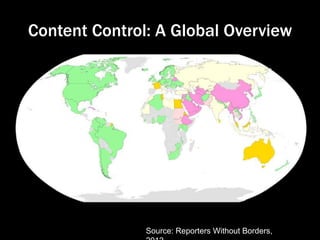
Content Control: A Global Overview
Source: Reporters Without Borders,
Qatar: Transparency in Censorship
Legal Controls
• Copyright-related restrictions
– Digital Millennium Copyright Act (DMCA)
– International treaties (e.g., ACTA, TPP)
– “Three-strikes” laws (e.g., HADOPI)
• Defamation, Libel, and Lese Majesty
– Criminal (e.g., Thailand)
– Civil (e.g., UK, Turkey)
– Blocking of websites (e.g., India, Palestine)
Legal Controls
• Obscenity, hate speech
– Dozens of countries place restrictions on certain
types of speech
– Some restrictions justified under ICCPR.
• Intermediary liability
– Intermediaries are often held responsible for the
content they host.
– Very few countries provide liability protections for
intermediaries
Regulation by companies
• Private companies have increasing power
over content
• Governments frequently enact pressure on
companies to restrict content or hand over
user data
Regulation by companies, cont‟d
• Companies are subject to laws in the
jurisdictions in which they work
• Privacy and speech laws vary widely by
jurisdiction, presenting challenges for
companies
• 2004: Shi Tao and Yahoo!
The quasi-public sphere: challenges
• Intermediaries have the right to restrict
speech and make their own regulations
• Many companies go beyond the First
Amendment (US) or Article 19 in
regulating speech
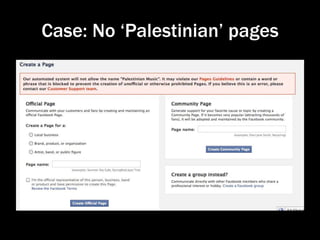
Case: No „Palestinian‟ pages
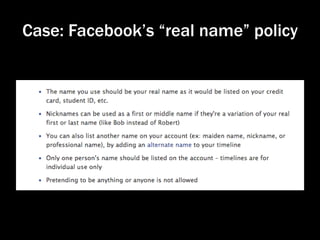
Case: Facebook‟s “real name” policy
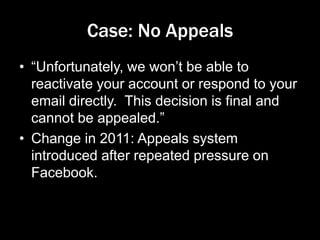
Case: No Appeals
• “Unfortunately, we won’t be able to
reactivate your account or respond to your
email directly. This decision is final and
cannot be appealed.”
• Change in 2011: Appeals system
introduced after repeated pressure on
Facebook.
What is being done to protect speech
on private platforms?
• Global Network Initiative
• Who Has Your Back?
• Individual advocacy
Global Network Initiative
• Founded in 2008
• Yahoo!, Google, Microsoft founding
members
• Multistakeholder
• Seeks to safeguard freedom of speech
and privacy against government
restrictions
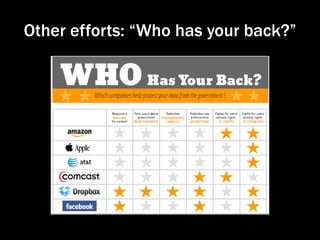
Other efforts: “Who has your back?”
Day 2:
User Rights & Safety
Domestic Internet Governance
• What are some principles for protecting
user rights?
• How does Palestine compare to the rest of
the world?
Your Security
• Review of risk assessment principles
What program should I use to:
• Email?
• Chat?
• Text message?
• Voice chat?
Your Site‟s Security
• Where should I host my site?
• How can I mirror my site?
• How do I backup my site?
• What else do I need to know?

International internet governance

  • 1.
    Advancing Internet Policyin the Digital Age: Best Practices & Lessons Learned Created by: Jillian C. York Electronic Frontier Foundation
  • 2.
    Meet your trainer: JillianYork, Electronic Frontier Foundation jillian@eff.org
  • 3.
    Working definition ofInternet governance: “Internet governance is the development and application by Governments, the private sector, and civil society, in their respective roles, of shared principles, norms, rules, decision-making procedures, and programmes that shape the evolution and use of the Internet.” Source: WSIS
  • 4.
    Internet Governance (IG) Whatdoes IG cover? • Internet infrastructure and standardisation • Technical standards (e.g., IP, DNS) • Safety/integrity (e.g., spam, security) • Legal issues (e.g., privacy, copyright, cybercrime) • Economic issues (e.g., taxation) • Access issues • Socio-cultural issues (e.g., free expression)
  • 5.
    International Governance: A BriefHistory • Late 1960s: US develops DARPA, TCP/IP • First regulation: Internet Engineering Task Force (IETF) • Mid-’90s: “DNS War” as private companies get involved • 1998: Establishment of ICANN to regulate domains • 2003: First World Summit on the Information Society (WSIS) in Geneva
  • 6.
    A Brief History,continued • 2005: Second WSIS in Tunis brought about conflict • 2006: First Internet Governance Forum (IGF) promoting multistakeholderism in Internet governance • Since 2006: Greater international developments in IGF, ICANN, other for a • 2013: “WSIS+10” in February 2013
  • 7.
    ICANN: Internet Corporation forAssigned Names and Numbers What does it do? • Coordinates the Internet protocol address spaces (IPv4 and IPv6) • Assigns address blocks to regional Internet registries (e.g., .uk, .eg) • Manages top-level domain name space (e.g., .com, .net)
  • 8.
    ICANN, continued • Non-profit,private org based in the United States • Open process of decision-making
  • 9.
    IANA: Internet Assigned NumbersAuthority • Subordinate to ICANN, contracted to the US Department of Commerce • In charge of numbers, IP addresses
  • 10.
    The UN • UNinvolvement: The IGF vs. the ITU • Internet Governance Forum (IGF): Multistakeholderism • International Telecommunication Union (ITU): Governments
  • 11.
    Universal Declaration ofHuman Rights Article 19: “Everyone has the right to freedom of opinion and expression; this right includes freedom to hold opinions without interference and to seek, receive and impart information and ideas through any media and regardless of frontiers.”
  • 12.
    International Covenant onCivil and Political Rights (ICCPR) Article 19 1. Everyone shall have the right to hold opinions without interference 2. Everyone shall have the right to freedom of expression; this right shall include freedom to seek, receive and impart information and ideas of all kinds, regardless of frontiers, either orally, in writing or in print, in the form of art, or through any other media of his choice. 3. The exercise of the rights provided for in paragraph 2 of this article carries with it special duties and responsibilities. It may therefore be subject to certain restrictions, but these shall only be such as are provided by law and are necessary: a) For the respect of the rights or reputations of others; b) For the protection of national security or of public order (ordre public) or of public health or morals.
  • 13.
  • 14.
    Content Control What typesof content are commonly controlled online? • Political speech • Obscene content • Social issues, human rights information • “Hate speech,” blasphemy • Threats to national security • Intellectual property
  • 15.
    Technical Controls Technical mechanismsof control: • IP blocking • DNS poisoning • Keyword filtering • URL blocking • Deep packet inspection • Attacks (DDoS, malware)
  • 16.
    Content Control: AGlobal Overview Source: Reporters Without Borders,
  • 17.
  • 18.
    Legal Controls • Copyright-relatedrestrictions – Digital Millennium Copyright Act (DMCA) – International treaties (e.g., ACTA, TPP) – “Three-strikes” laws (e.g., HADOPI) • Defamation, Libel, and Lese Majesty – Criminal (e.g., Thailand) – Civil (e.g., UK, Turkey) – Blocking of websites (e.g., India, Palestine)
  • 19.
    Legal Controls • Obscenity,hate speech – Dozens of countries place restrictions on certain types of speech – Some restrictions justified under ICCPR. • Intermediary liability – Intermediaries are often held responsible for the content they host. – Very few countries provide liability protections for intermediaries
  • 20.
    Regulation by companies •Private companies have increasing power over content • Governments frequently enact pressure on companies to restrict content or hand over user data
  • 21.
    Regulation by companies,cont‟d • Companies are subject to laws in the jurisdictions in which they work • Privacy and speech laws vary widely by jurisdiction, presenting challenges for companies • 2004: Shi Tao and Yahoo!
  • 22.
    The quasi-public sphere:challenges • Intermediaries have the right to restrict speech and make their own regulations • Many companies go beyond the First Amendment (US) or Article 19 in regulating speech
  • 23.
  • 24.
  • 25.
    Case: No Appeals •“Unfortunately, we won’t be able to reactivate your account or respond to your email directly. This decision is final and cannot be appealed.” • Change in 2011: Appeals system introduced after repeated pressure on Facebook.
  • 26.
    What is beingdone to protect speech on private platforms? • Global Network Initiative • Who Has Your Back? • Individual advocacy
  • 27.
    Global Network Initiative •Founded in 2008 • Yahoo!, Google, Microsoft founding members • Multistakeholder • Seeks to safeguard freedom of speech and privacy against government restrictions
  • 28.
    Other efforts: “Whohas your back?”
  • 29.
  • 30.
    Domestic Internet Governance •What are some principles for protecting user rights? • How does Palestine compare to the rest of the world?
  • 31.
    Your Security • Reviewof risk assessment principles What program should I use to: • Email? • Chat? • Text message? • Voice chat?
  • 32.
    Your Site‟s Security •Where should I host my site? • How can I mirror my site? • How do I backup my site? • What else do I need to know?