LOGO
INTERNET GOVERNANCE
AND THE FILTERING PROBLEM


            Presented by Tran Quang Minh Tan


               BarCampSaigon – RMIT University
                           December 11, 2011
About me


     tranquangminhtan@gmail.com
                                  2
Contents

     1         Internet Governance

         + Definition
         + Status

     2           Internet Filtering

         + Definition
         + Status
         + Problems

     3     Case Study and Discussion

         + Filtering Standard

     4              Conclusion

                                       3
As March 2011
Internet Population: 2.095b
About 30.2% of World Population
Source: InternetWorldStats.com


                                              4
                                 Source: opte.org
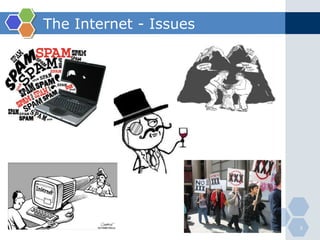
The Internet - Issues


                        5
Internet Governance - Definition
    “Internet governance is the development and
    application by Governments, the private sector and
    civil society, in their respective roles, of shared
    principles, norms, rules, decision-making procedures,
    and programs that shape the evolution and use of the
    Internet.” (source: wikipedia)

 The term Internet Governance is formally defined in
  June 2005 by a working group in World Summit on
  the Information Society (WSIS)


                                                            6
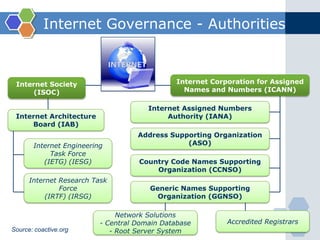
Internet Governance - Authorities


 Internet Society                              Internet Corporation for Assigned
     (ISOC)                                      Names and Numbers (ICANN)

                                       Internet Assigned Numbers
 Internet Architecture                      Authority (IANA)
     Board (IAB)
                                    Address Supporting Organization
       Internet Engineering                     (ASO)
            Task Force
          (IETG) (IESG)             Country Code Names Supporting
                                        Organization (CCNSO)
      Internet Research Task
               Force                   Generic Names Supporting
           (IRTF) (IRSG)                 Organization (GGNSO)

                               Network Solutions
                          - Central Domain Database         Accredited Registrars 7
Source: coactive.org         - Root Server System
Internet Governance - Authorities
 Internet Corporation for Assigned Names and Numbers
  (ICANN)
  ICANN was formed in 1998. ICANN is an acronym for the Internet
  Corporation for Assigned Names and Numbers, a global multi-
  stakeholder organization that was created and empowered through
  actions by the U.S. government and its Department of Commerce. It
  coordinates the Internet DNS, IP addresses and autonomous system
  numbers; which involves a continued management of these evolving
  systems and the protocols that underly them.

 The Internet Society
  The Internet Society (ISOC) is a nonprofit organization founded in
  1992 to provide leadership in Internet related standards, education
  and policy. They are dedicated to ensuring the open development,
  evolution and use of the Internet for the benefit of people throughout
  the world.


                                                                           8
Internet Governance - Principles

1. Human rights, democracy and rule of law

2. Multi-Stakeholder governance

3. Responsibilities of States

4. Empowerment of Internet Users

5. Global nature of the internet

6. Integrity of the Internet

7. Decentralized management

8. Open architecture

9. Network neutrality

10. Cultural and linguistic diversity

(Source: Council of Europe conference, Strasbourg, 18-19 April 2011)   9
Internet Governance - Framework
                    Source: nav6.org


                                       10
Internet Governance - Concerns
 Manage Internet Infrastructure
  + Physical Infrastructure
  + IP Addresses, Domain Names
 Define protocol and standard
  + IETF, W3C
 Promote Internet Access
  + Especially in developing country
 Security
  + Anonymity, Privacy
 Content Regulation
  + Child-abusing protection
  + Copyright, Pirate Software, Music
  + Filtering / Censoring


                                        11
Internet Filtering


                     12
Internet Filtering - Definition
 Internet filtering normally refers to the technical
  approaches to control access to information on the
  Internet.

 An Internet filter is hardware or software that restricts
  the information that is delivered over the Internet.
  Filters can greatly reduce the flow of harmful content
  onto your computer.

 Filters can be installed on the servers of an Internet
  Service Provider (ISP) or proxy service, as part of a
  local area network, or on individual computers. They
  can block access to websites, e-mail, chat, or other
  Internet-based communications based on category,
  site, or content.

                                                              13
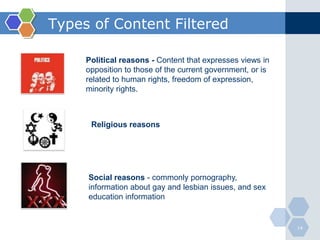
Types of Content Filtered

     Political reasons - Content that expresses views in
     opposition to those of the current government, or is
     related to human rights, freedom of expression,
     minority rights.


      Religious reasons


     Social reasons - commonly pornography,
     information about gay and lesbian issues, and sex
     education information


                                                            14
Internet Filtering - Implementation
How filtering is implemented
- Domain filtering
  eg. http://facebook.com
- IP Address filtering
  eg. 69.63.189.11

- URL filtering
  eg. http://www.facebook.com/ BarCampSaigon

- Keyword filtering
  eg. “Tiananmen” in China
- Ad-hoc filtering
  eg. Ebay Vietnam
                                               15
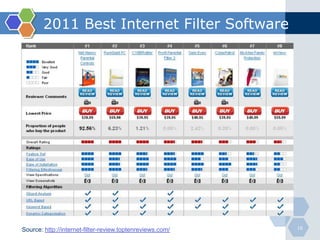
2011 Best Internet Filter Software


Source: http://internet-filter-review.toptenreviews.com/   16
Global Status - Political content


Political content: Content that expresses views in opposition to those of
the current government, or is related to human rights, freedom of
expression, minority rights, and religious movements.
                                                                            17
Source: http://map.opennet.net/filtering-pol.html
Global Status - Social content


Social content: Content related to sexuality, gambling, and illegal drugs and
alcohol, as well as other topics that may be socially sensitive or perceived as
offensive.
                                                                                  18
Source: http://map.opennet.net/filtering-soc.html
Global Status - Conflict & security


Conflict & security: Content related to armed conflicts, border disputes,
separatist movements, and militant groups.
                                                                            19
Source: http://map.opennet.net/filtering-consec.html
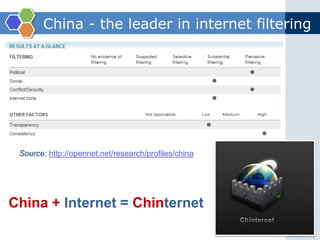
China - the leader in internet filtering


 Source: http://opennet.net/research/profiles/china


China + Internet = Chinternet
                                                      20
Internet Filtering – Problem
 Internet Performance
   Eg. In Australia from 2% - 75%
   (http://www.acma.gov.au/webwr/_assets/main/lib310554/
   isp-level_internet_content_filtering_trial-report.pdf)


 Ethic / Freedom of speech /
  Human Rights

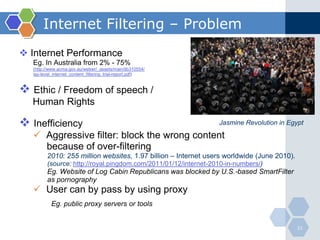
 Inefficiency                                                   Jasmine Revolution in Egypt

    Aggressive filter: block the wrong content
     because of over-filtering
         2010: 255 million websites, 1.97 billion – Internet users worldwide (June 2010).
         (source: http://royal.pingdom.com/2011/01/12/internet-2010-in-numbers/)
         Eg. Website of Log Cabin Republicans was blocked by U.S.-based SmartFilter
         as pornography
    User can by pass by using proxy
           Eg. public proxy servers or tools


                                                                                            21
Internet Filtering – Problem (cont.)
 Each country implement its own of filtering engine
             costly, ineffective
Eg. Australia: Based on the Government's budgeting of $44.5 million to implement the filtering
scheme, this means the policy will cost $90,000 per URL.
(source: http://www.smh.com.au/news/technology/web/2009/06/03/1243708489312.html)

 Global problems: criminal, virus, sexuality, gambling, and
illegal drugs and alcohol, security…


Should filtering implemented by
individual or as a global standard?                                                              22
Discussion – .XXX
Sexually-Explicit Website
Operated under ICM Registry
Brief history
   First proposed in 2000 (rejected)
   Resubmitted again in 2004 (rejected)
   Another time in 2007 (rejected)
   Finally approved in 2011
    a 10-years effort
ICM is expected to make over 200m / year
                            Source: Wikipedia


                                                23
Discussion – .XXX
Cyber Safety for Kids Act of 2006
  Raised by Senator Max Baucus and Mark
   Pryor
  Require website with explicit sexual content
   MUST operate under .xxx domain


    Should we consider .xxx domain
    as a standard for sexual filtering ?


                                                  24
Discussion - .XXX
IOMO: .XXX is not feasible for a filtering
 standard
   How to define sexual content ?
   How to enforce the standard globally ?
   Commercialized-motivation ?


                                              25
Discussion – ICANN Reform


                                 26
Source: http://www.icann.org
Conclusion
   There is a need for Internet Governance, but is not a simple
    subject.

 The Internet filtering is costly, ineffective now.

 There is a greater need for cooperation between various branches
    of government and law enforcement in and between countries.

 The trend: build up the standards by

     + An Independent Organization

     + By cooperation governments

 Our opinion:

    - Independent Organization (ICANN reform, ITU…)

    - And…


                                                                     27
References
 Local Nets: Filtering and the Internet Governance Problem,
  John Palfrey, (Chapter in Jack Balkin et al., The Global Flow of
  Information) September, 2005
 Wikipedia
 OpenNET Intialtive, website http://opennet.net
 CoActive.org/.NYC Project
 ICANN, website http://www.icann.org


                                                                     28
LOGO
       Q&A

Internet governance and the filtering problems

  • 1.
    LOGO INTERNET GOVERNANCE AND THEFILTERING PROBLEM Presented by Tran Quang Minh Tan BarCampSaigon – RMIT University December 11, 2011
  • 2.
    About me tranquangminhtan@gmail.com 2
  • 3.
    Contents 1 Internet Governance + Definition + Status 2 Internet Filtering + Definition + Status + Problems 3 Case Study and Discussion + Filtering Standard 4 Conclusion 3
  • 4.
    As March 2011 InternetPopulation: 2.095b About 30.2% of World Population Source: InternetWorldStats.com 4 Source: opte.org
  • 5.
  • 6.
    Internet Governance -Definition  “Internet governance is the development and application by Governments, the private sector and civil society, in their respective roles, of shared principles, norms, rules, decision-making procedures, and programs that shape the evolution and use of the Internet.” (source: wikipedia)  The term Internet Governance is formally defined in June 2005 by a working group in World Summit on the Information Society (WSIS) 6
  • 7.
    Internet Governance -Authorities Internet Society Internet Corporation for Assigned (ISOC) Names and Numbers (ICANN) Internet Assigned Numbers Internet Architecture Authority (IANA) Board (IAB) Address Supporting Organization Internet Engineering (ASO) Task Force (IETG) (IESG) Country Code Names Supporting Organization (CCNSO) Internet Research Task Force Generic Names Supporting (IRTF) (IRSG) Organization (GGNSO) Network Solutions - Central Domain Database Accredited Registrars 7 Source: coactive.org - Root Server System
  • 8.
    Internet Governance -Authorities  Internet Corporation for Assigned Names and Numbers (ICANN) ICANN was formed in 1998. ICANN is an acronym for the Internet Corporation for Assigned Names and Numbers, a global multi- stakeholder organization that was created and empowered through actions by the U.S. government and its Department of Commerce. It coordinates the Internet DNS, IP addresses and autonomous system numbers; which involves a continued management of these evolving systems and the protocols that underly them.  The Internet Society The Internet Society (ISOC) is a nonprofit organization founded in 1992 to provide leadership in Internet related standards, education and policy. They are dedicated to ensuring the open development, evolution and use of the Internet for the benefit of people throughout the world. 8
  • 9.
    Internet Governance -Principles 1. Human rights, democracy and rule of law 2. Multi-Stakeholder governance 3. Responsibilities of States 4. Empowerment of Internet Users 5. Global nature of the internet 6. Integrity of the Internet 7. Decentralized management 8. Open architecture 9. Network neutrality 10. Cultural and linguistic diversity (Source: Council of Europe conference, Strasbourg, 18-19 April 2011) 9
  • 10.
    Internet Governance -Framework Source: nav6.org 10
  • 11.
    Internet Governance -Concerns  Manage Internet Infrastructure + Physical Infrastructure + IP Addresses, Domain Names  Define protocol and standard + IETF, W3C  Promote Internet Access + Especially in developing country  Security + Anonymity, Privacy  Content Regulation + Child-abusing protection + Copyright, Pirate Software, Music + Filtering / Censoring 11
  • 12.
  • 13.
    Internet Filtering -Definition  Internet filtering normally refers to the technical approaches to control access to information on the Internet.  An Internet filter is hardware or software that restricts the information that is delivered over the Internet. Filters can greatly reduce the flow of harmful content onto your computer.  Filters can be installed on the servers of an Internet Service Provider (ISP) or proxy service, as part of a local area network, or on individual computers. They can block access to websites, e-mail, chat, or other Internet-based communications based on category, site, or content. 13
  • 14.
    Types of ContentFiltered Political reasons - Content that expresses views in opposition to those of the current government, or is related to human rights, freedom of expression, minority rights. Religious reasons Social reasons - commonly pornography, information about gay and lesbian issues, and sex education information 14
  • 15.
    Internet Filtering -Implementation How filtering is implemented - Domain filtering eg. http://facebook.com - IP Address filtering eg. 69.63.189.11 - URL filtering eg. http://www.facebook.com/ BarCampSaigon - Keyword filtering eg. “Tiananmen” in China - Ad-hoc filtering eg. Ebay Vietnam 15
  • 16.
    2011 Best InternetFilter Software Source: http://internet-filter-review.toptenreviews.com/ 16
  • 17.
    Global Status -Political content Political content: Content that expresses views in opposition to those of the current government, or is related to human rights, freedom of expression, minority rights, and religious movements. 17 Source: http://map.opennet.net/filtering-pol.html
  • 18.
    Global Status -Social content Social content: Content related to sexuality, gambling, and illegal drugs and alcohol, as well as other topics that may be socially sensitive or perceived as offensive. 18 Source: http://map.opennet.net/filtering-soc.html
  • 19.
    Global Status -Conflict & security Conflict & security: Content related to armed conflicts, border disputes, separatist movements, and militant groups. 19 Source: http://map.opennet.net/filtering-consec.html
  • 20.
    China - theleader in internet filtering Source: http://opennet.net/research/profiles/china China + Internet = Chinternet 20
  • 21.
    Internet Filtering –Problem  Internet Performance Eg. In Australia from 2% - 75% (http://www.acma.gov.au/webwr/_assets/main/lib310554/ isp-level_internet_content_filtering_trial-report.pdf)  Ethic / Freedom of speech / Human Rights  Inefficiency Jasmine Revolution in Egypt  Aggressive filter: block the wrong content because of over-filtering 2010: 255 million websites, 1.97 billion – Internet users worldwide (June 2010). (source: http://royal.pingdom.com/2011/01/12/internet-2010-in-numbers/) Eg. Website of Log Cabin Republicans was blocked by U.S.-based SmartFilter as pornography  User can by pass by using proxy Eg. public proxy servers or tools 21
  • 22.
    Internet Filtering –Problem (cont.)  Each country implement its own of filtering engine  costly, ineffective Eg. Australia: Based on the Government's budgeting of $44.5 million to implement the filtering scheme, this means the policy will cost $90,000 per URL. (source: http://www.smh.com.au/news/technology/web/2009/06/03/1243708489312.html)  Global problems: criminal, virus, sexuality, gambling, and illegal drugs and alcohol, security… Should filtering implemented by individual or as a global standard? 22
  • 23.
    Discussion – .XXX Sexually-ExplicitWebsite Operated under ICM Registry Brief history  First proposed in 2000 (rejected)  Resubmitted again in 2004 (rejected)  Another time in 2007 (rejected)  Finally approved in 2011   a 10-years effort ICM is expected to make over 200m / year Source: Wikipedia 23
  • 24.
    Discussion – .XXX CyberSafety for Kids Act of 2006  Raised by Senator Max Baucus and Mark Pryor  Require website with explicit sexual content MUST operate under .xxx domain Should we consider .xxx domain as a standard for sexual filtering ? 24
  • 25.
    Discussion - .XXX IOMO:.XXX is not feasible for a filtering standard  How to define sexual content ?  How to enforce the standard globally ?  Commercialized-motivation ? 25
  • 26.
    Discussion – ICANNReform 26 Source: http://www.icann.org
  • 27.
    Conclusion  There is a need for Internet Governance, but is not a simple subject.  The Internet filtering is costly, ineffective now.  There is a greater need for cooperation between various branches of government and law enforcement in and between countries.  The trend: build up the standards by + An Independent Organization + By cooperation governments  Our opinion: - Independent Organization (ICANN reform, ITU…) - And… 27
  • 28.
    References  Local Nets:Filtering and the Internet Governance Problem, John Palfrey, (Chapter in Jack Balkin et al., The Global Flow of Information) September, 2005  Wikipedia  OpenNET Intialtive, website http://opennet.net  CoActive.org/.NYC Project  ICANN, website http://www.icann.org 28
  • 29.
    LOGO Q&A

Editor's Notes

  • #5 Ask other to guess what is it ?- This is the visualized version of the internet.say something about the importance of the internet (some story of my life, how i get addicted to the internet)+ internet acts as an important and reliable information sourcesay something about the structure of the internet+ structured, complicated, and successful model+Internet is hierarchy structured. The complexity of the internet (click)The internet is growing fast.400% compared with ten years ago The internet gives us many benefits but also create us a lot of issues etheir
  • #6 Identify the problemNot mentioning about virus, scam or identification theft.The question is who should be responsible for these issues, who will fix it, who will make the decisions. local authority or global organization Thinking about internet as a big organization, multi-international organization. need some kind of governance. who is doing it ? Who is making the decision ?
  • #7 This is a general definition but I think it covers most aspect for internet governance.It covers almost every roles in the public from government to individual.
  • #8 http://www.coactivate.org/projects/campaign-for.nyc/global-internet-governanceThis is not a complete picture, but somehow presents the current stateExplain each authority
  • #10 Source: Council of Europe conference, Strasbourg, 18-19 April 2011It’s only a draft versionHighlight multi-stakeholder governance
  • #12 To be more detail what is concerned in Internet GovernanceInternet Filtering
  • #13 Internet is growing very fastMore than 2,095m users, 30.2 %In Vietnam: 1/3
  • #21 China has the world's biggest online population: more than 380m users.More than sixty Internet regulations. The size of the Internet police is rumored at more than 30,000 have to submit identity cards and photos of themselves, as well as meeting regulators before their sites could be registered.The escalation of the government's effort to neutralize critical online opinion comes after a series of large anti-Japanese, anti-pollution, anti-corruption protests, and ethnic riots, many of which were organized or publicized using instant messaging services, chat rooms, and text messages.- How about VietNam? Give some websites that blocked… (danluan.org, facebook, )- The governmental authorities not only block website content but also monitor the Internet access of individuals.
  • #23 Source: http://www.smh.com.au/news/technology/web/2009/06/03/1243708489312.html
  • #24 Discussion that filtering is necessary. I would like to come to an agreement between us that “Filtering is necessary” Public common need
  • #25 There is also a bill in US …I’m going to be a supporter for this ruleDo a SWOTStrength: easy to implement, global standardWeakness: filter just does not workOpportunity: use the money to do something elseThreat: the law will changeWhat do you think ?
  • #26 Actually .xxx is a starter step for gTLD domain, such as .ipad .apple .nyc .hcmc180k for registration and 20k for renew
  • #27 To extend more further about the topic ….Behind the domain story, there is also another issue with current situation of internet governance. ICANN is too effected by US-Government, there are many complains and criticized by other countries and organization. For example the .gov and .mil domain is exclusive for U.S Governance
  • #28 International Telecommunications Union (ITU)