USERUSERMaking Accessibility Easy
SCOPE OF THE PROBLEM
Developing websites that provide Accessibility to individuals with disabilities is not only
the law - it is the moral thing to do, both socially and economically. According to the US
Census Bureau, there are currently over 56.7 million adults living with a disability in the
United States. An additional study conducted by the PEW Internet Project found that
54% of adults with disabilities use the Internet, many of whom find e-commerce and
online transactions extremely challenging or unfeasible to complete at all.
So, why is Accessibility so difficult? What does it mean for an organization to make its
website accessible? In addition to the various specifications within the Web Content
Accessibility Guidelines (WCAG), which goes into great detail to describe technically
and philosophically what needs to be done, organizations tend to find that
incorporating Accessibility requires significant changes - not only to their technical
implementation but also to their user experience, graphic design, and overall
implementation process. All of these changes can impact the cost and time to market,
depending on how an organization responds to these requirements.
Currently, there is no reasonable-cost solution for Accessibility. Even with the advent of
newer and more cost effective Agile Development Approaches and well trained
WWW.USER1ST.COM | Of
CORPORATE:
WEB ACCESSIBILITY OVERVIEW
USERUSERMaking Accessibility Easy
engineers; Accessibility efforts need to fit within an existing development infrastructure,
thereby making them costly and complicated to incorporate into a solution
development lifecycle. Because of these issues, organizations can expend vast
resources trying to make their websites accessible, yet often still fall short of achieving
fully accessible content.
USER1ST SOLUTION OVERVIEW
User1st, founded in 2012 and officially launched in 2014, is committed to helping
individuals with disabilities obtain equal access to the Internet. Our product, Accessibility
Suite, is a web-based platform that provides a quick-deploy, software as a service
based solution. User1st has developed a revolutionary approach to detecting,
correcting, and providing Accessibility to a site’s end users based on the
recommendations of the WCAG. Already implemented in Banks, Airlines, Government
Agencies and Universities, User1st is offering a new approach to save time and money
while achieving a higher standard of Accessibility across more sites than ever before.
THE USER1ST DIFFERENCE
The most distinctive aspect of User1st is that it streamlines the requirement for
Accessibility by allowing web applications and website owners to achieve Accessibility
without modifying their codebase or fundamentally impacting their user experience.
This is achieved through a new approach to Accessibility for websites. Instead of re-
engineering the entire site, User1st has a meta-data driven approach called the “User1st
Accessibility Skin.” The User1st Accessibility skin is a set of pre-defined metadata that
describes the site’s various elements that could impact Accessibility. The Accessibility
Skin is configured using our patent pending User1st Code-Fix editor. The Code Fix
Editor doesn’t require new code to be written; instead all configurations in the code fixer
are completed via a step-by- step wizard. The User1st code fixer works by mapping the
site’s logical sections or inner elements (e.g. site header, footer, gallery or field, image,
button) and then providing "macro-rules" to those elements (e.g.,
"this is a header section" or "provide the images in this location with
an alternative text driven from the header of the section"). Accessibility Skins
combined with a disability profile selection allow the User1st Front End to provide the
accessible accommodation requested by the user.
WWW.USER1ST.COM | Of
USERUSERMaking Accessibility Easy
Accessibility Skins are not directly initiated by end-users. They are exposed to users via
the Use1st Accessibility Menu in the form of Disability Profiles. A disability profile is a
functional description of what accommodation is being requested by the end user
without needing to identify their disability which would create privacy concerns.
WEB ACCESSIBILITY LEGISLATION
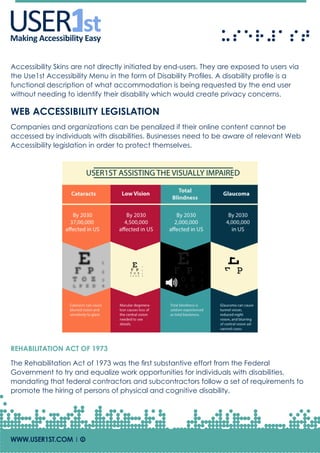
Companies and organizations can be penalized if their online content cannot be
accessed by individuals with disabilities. Businesses need to be aware of relevant Web
Accessibility legislation in order to protect themselves.
REHABILITATION ACT OF 1973
The Rehabilitation Act of 1973 was the first substantive effort from the Federal
Government to try and equalize work opportunities for individuals with disabilities,
mandating that federal contractors and subcontractors follow a set of requirements to
promote the hiring of persons of physical and cognitive disability.
WWW.USER1ST.COM | Of
USERUSERMaking Accessibility Easy
A number of Sections of the Rehabilitation Act are directly impacted by the need for
accessible online content.
SOME THEM INCLUDE:
SECTION 503:
Prohibits discrimination by federal contractors and subcontractors against
persons with disabilities. It does so by requiring contractors to take a proactive
approach to recruiting, employing, training, and promoting qualified individuals with
disabilities.
SECTION 504:
Requires that individuals with disabilities have equal access to programs and services
provided by recipients of federal funding
SECTION 508:
States that all federal agencies, institutions and public accommodations must provide
comparable access to information to disabled individuals as it does for non-disabled
individuals.
AMERICANS WITH DISABILITIES ACT
Passed in 1990, the Americans with Disabilities Act (ADA) is a landmark decision by
the federal government that prohibits discrimination and ensures equal opportunity for
persons with disabilities in employment. It applies to state and local government
services, public accommodations, commercial and transportation facilities.
TITLE II AND III OF THE ADA:
The U.S. Department of Justice recently revised Title II requirements for State and Local
Government and Title II requirements for places of Public Accommodation. One such
revision focuses on “Effective Communication.”
Public and private entities must provide effective communication channels for individuals
with disabilities in the form of auxiliary aids, including, among others, screen reader
software, magnification software, and accessible electronic and information technology.
WWW.USER1ST.COM | Of
USERUSERMaking Accessibility Easy
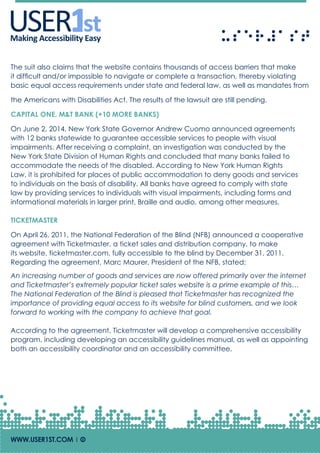
RELEVANT WEB ACCESSIBILITY NEWS AND ISSUES
A number of web accessibility cases have gone to court to date - the precedent
has been set. Examples of for-profit/corporate businesses being taken to court over
inaccessible websites are abundant. As the below samples will show, whether it be
retail, financial services, entertainment, lodging, or other industries, a lack of web
accessibility leaves companies liable to legal action.
A NUMBER OF NOTABLE CASES AND NEWS REGARDING CORPORATE ENTITIES INCLUDE:
REEBOK
On October 14, 2015, Jose Del-Orden, a bind citizen of New York, filed a class action
lawsuit against Reebok. The suit claims that Reebok.com, Reebok’s website, denies blind
individuals equal access to goods and services.
WWW.USER1ST.COM | Of
USERUSERMaking Accessibility Easy
WWW.USER1ST.COM | Of
The suit also claims that the website contains thousands of access barriers that make
it difficult and/or impossible to navigate or complete a transaction, thereby violating
basic equal access requirements under state and federal law, as well as mandates from
the Americans with Disabilities Act. The results of the lawsuit are still pending.
CAPITAL ONE, M&T BANK (+10 MORE BANKS)
On June 2, 2014, New York State Governor Andrew Cuomo announced agreements
with 12 banks statewide to guarantee accessible services to people with visual
impairments. After receiving a complaint, an investigation was conducted by the
New York State Division of Human Rights and concluded that many banks failed to
accommodate the needs of the disabled. According to New York Human Rights
Law, it is prohibited for places of public accommodation to deny goods and services
to individuals on the basis of disability. All banks have agreed to comply with state
law by providing services to individuals with visual impairments, including forms and
informational materials in larger print, Braille and audio, among other measures.
TICKETMASTER
On April 26, 2011, the National Federation of the Blind (NFB) announced a cooperative
agreement with Ticketmaster, a ticket sales and distribution company, to make
its website, ticketmaster.com, fully accessible to the blind by December 31, 2011.
Regarding the agreement, Marc Maurer, President of the NFB, stated:
An increasing number of goods and services are now offered primarily over the internet
and Ticketmaster’s extremely popular ticket sales website is a prime example of this…
The National Federation of the Blind is pleased that Ticketmaster has recognized the
importance of providing equal access to its website for blind customers, and we look
forward to working with the company to achieve that goal.
According to the agreement, Ticketmaster will develop a comprehensive accessibility
program, including developing an accessibility guidelines manual, as well as appointing
both an accessibility coordinator and an accessibility committee.
USERUSERMaking Accessibility Easy
NATIONAL BASKETBALL ASSOCIATION
On November 6, 2015, a lawsuit was issued against the National Basketball Association
(NBA) on the grounds that its website did not accommodate users who are blind or
visually impaired. The suit, which was filed as discrimination under the Americans with
Disabilities Act, specifies that the NBA’s website did not function with screen readers, the
primary method by which a blind person may independently use the Internet.
The results of the lawsuit are still pending.
WEBSITE ACCESSIBILITY THE EMERGING LITIGATION THREAT OF
2016 FOR US COMPANIES
American companies and government agencies need to ensure that their websites are
accessible for all, including people with disabilities, or risk falling victim to a growing
wave of class action litigation under the Americans with Disabilities Act.
For US companies and their lawyers, the compliance issues associated with designing
and maintaining an online presence are about to get a lot more complicated. Failing
to ensure that their websites are fully accessible for people visual, hearing and manual
dexterity impairments has seen an exploding number of businesses slapped with
discrimination lawsuits under landmark civil rights legislation for people with disabilities.
LEGAL AMBIGUITY
The legislation in question, Title III of the Americans with Disabilities Act, demands
that no individual be discriminated against on the basis of disability from enjoying
and benefiting from 'the goods, services, facilities, privileges, advantages or
accommodations of any place of public accommodation by any person/s who owns,
leases (or leases to) a place of public accommodation.' Many have argued
that websites are beyond the scope of the ADA and the definition of a 'place of
public accommodation'. However, the growing number of lawsuits lodged against
companies with inaccessible web platforms implies the opposite. While accessibility
class actions have met with mixed results in court, an important 2008 test case brought
against Target Corp by the National Federation of the Blind resulted in a $6m settlement.
WWW.USER1ST.COM | Of
USERUSERMaking Accessibility Easy
CHANGING TIMES
Drafted in 1990, the ADA makes no specific reference to websites. However, there is
growing support for the argument that compliance with the ADA needs to match the
realities of living with a disability in the digital age. 'Now that the Internet plays such
a critical role in the personal and professional lives of Americans, excluding disabled
persons from access to covered entities that use it as their principal means of reaching
the public would defeat the purpose of this important civil rights legislation,' wrote
one federal judge in Vermont, who refused to throw out a class action lawsuit against
online digital library Scribd Inc.
MANAGING THE RISK
To help mitigate the emerging risk of ADA litigation, companies must ensure that their
websites are compatible with the assistive technologies that people with visual and
hearing impairments or difficulties with manual dexterity use to navigate internet spaces.
This could include ensuring compatibility with screen readers, voice-control software and
manual keyboard navigation. However, the US Department of Justice is not expected to
issue formal guidance on website compliance with Title III of the ADA until 2018.
SOURCES: Corporate Counsel; JD Supra; National Law Review
WWW.USER1ST.COM | Of

User1st - Corporate Overview (1)

  • 1.
    USERUSERMaking Accessibility Easy SCOPEOF THE PROBLEM Developing websites that provide Accessibility to individuals with disabilities is not only the law - it is the moral thing to do, both socially and economically. According to the US Census Bureau, there are currently over 56.7 million adults living with a disability in the United States. An additional study conducted by the PEW Internet Project found that 54% of adults with disabilities use the Internet, many of whom find e-commerce and online transactions extremely challenging or unfeasible to complete at all. So, why is Accessibility so difficult? What does it mean for an organization to make its website accessible? In addition to the various specifications within the Web Content Accessibility Guidelines (WCAG), which goes into great detail to describe technically and philosophically what needs to be done, organizations tend to find that incorporating Accessibility requires significant changes - not only to their technical implementation but also to their user experience, graphic design, and overall implementation process. All of these changes can impact the cost and time to market, depending on how an organization responds to these requirements. Currently, there is no reasonable-cost solution for Accessibility. Even with the advent of newer and more cost effective Agile Development Approaches and well trained WWW.USER1ST.COM | Of CORPORATE: WEB ACCESSIBILITY OVERVIEW
  • 2.
    USERUSERMaking Accessibility Easy engineers;Accessibility efforts need to fit within an existing development infrastructure, thereby making them costly and complicated to incorporate into a solution development lifecycle. Because of these issues, organizations can expend vast resources trying to make their websites accessible, yet often still fall short of achieving fully accessible content. USER1ST SOLUTION OVERVIEW User1st, founded in 2012 and officially launched in 2014, is committed to helping individuals with disabilities obtain equal access to the Internet. Our product, Accessibility Suite, is a web-based platform that provides a quick-deploy, software as a service based solution. User1st has developed a revolutionary approach to detecting, correcting, and providing Accessibility to a site’s end users based on the recommendations of the WCAG. Already implemented in Banks, Airlines, Government Agencies and Universities, User1st is offering a new approach to save time and money while achieving a higher standard of Accessibility across more sites than ever before. THE USER1ST DIFFERENCE The most distinctive aspect of User1st is that it streamlines the requirement for Accessibility by allowing web applications and website owners to achieve Accessibility without modifying their codebase or fundamentally impacting their user experience. This is achieved through a new approach to Accessibility for websites. Instead of re- engineering the entire site, User1st has a meta-data driven approach called the “User1st Accessibility Skin.” The User1st Accessibility skin is a set of pre-defined metadata that describes the site’s various elements that could impact Accessibility. The Accessibility Skin is configured using our patent pending User1st Code-Fix editor. The Code Fix Editor doesn’t require new code to be written; instead all configurations in the code fixer are completed via a step-by- step wizard. The User1st code fixer works by mapping the site’s logical sections or inner elements (e.g. site header, footer, gallery or field, image, button) and then providing "macro-rules" to those elements (e.g., "this is a header section" or "provide the images in this location with an alternative text driven from the header of the section"). Accessibility Skins combined with a disability profile selection allow the User1st Front End to provide the accessible accommodation requested by the user. WWW.USER1ST.COM | Of
  • 3.
    USERUSERMaking Accessibility Easy AccessibilitySkins are not directly initiated by end-users. They are exposed to users via the Use1st Accessibility Menu in the form of Disability Profiles. A disability profile is a functional description of what accommodation is being requested by the end user without needing to identify their disability which would create privacy concerns. WEB ACCESSIBILITY LEGISLATION Companies and organizations can be penalized if their online content cannot be accessed by individuals with disabilities. Businesses need to be aware of relevant Web Accessibility legislation in order to protect themselves. REHABILITATION ACT OF 1973 The Rehabilitation Act of 1973 was the first substantive effort from the Federal Government to try and equalize work opportunities for individuals with disabilities, mandating that federal contractors and subcontractors follow a set of requirements to promote the hiring of persons of physical and cognitive disability. WWW.USER1ST.COM | Of
  • 4.
    USERUSERMaking Accessibility Easy Anumber of Sections of the Rehabilitation Act are directly impacted by the need for accessible online content. SOME THEM INCLUDE: SECTION 503: Prohibits discrimination by federal contractors and subcontractors against persons with disabilities. It does so by requiring contractors to take a proactive approach to recruiting, employing, training, and promoting qualified individuals with disabilities. SECTION 504: Requires that individuals with disabilities have equal access to programs and services provided by recipients of federal funding SECTION 508: States that all federal agencies, institutions and public accommodations must provide comparable access to information to disabled individuals as it does for non-disabled individuals. AMERICANS WITH DISABILITIES ACT Passed in 1990, the Americans with Disabilities Act (ADA) is a landmark decision by the federal government that prohibits discrimination and ensures equal opportunity for persons with disabilities in employment. It applies to state and local government services, public accommodations, commercial and transportation facilities. TITLE II AND III OF THE ADA: The U.S. Department of Justice recently revised Title II requirements for State and Local Government and Title II requirements for places of Public Accommodation. One such revision focuses on “Effective Communication.” Public and private entities must provide effective communication channels for individuals with disabilities in the form of auxiliary aids, including, among others, screen reader software, magnification software, and accessible electronic and information technology. WWW.USER1ST.COM | Of
  • 5.
    USERUSERMaking Accessibility Easy RELEVANTWEB ACCESSIBILITY NEWS AND ISSUES A number of web accessibility cases have gone to court to date - the precedent has been set. Examples of for-profit/corporate businesses being taken to court over inaccessible websites are abundant. As the below samples will show, whether it be retail, financial services, entertainment, lodging, or other industries, a lack of web accessibility leaves companies liable to legal action. A NUMBER OF NOTABLE CASES AND NEWS REGARDING CORPORATE ENTITIES INCLUDE: REEBOK On October 14, 2015, Jose Del-Orden, a bind citizen of New York, filed a class action lawsuit against Reebok. The suit claims that Reebok.com, Reebok’s website, denies blind individuals equal access to goods and services. WWW.USER1ST.COM | Of
  • 6.
    USERUSERMaking Accessibility Easy WWW.USER1ST.COM| Of The suit also claims that the website contains thousands of access barriers that make it difficult and/or impossible to navigate or complete a transaction, thereby violating basic equal access requirements under state and federal law, as well as mandates from the Americans with Disabilities Act. The results of the lawsuit are still pending. CAPITAL ONE, M&T BANK (+10 MORE BANKS) On June 2, 2014, New York State Governor Andrew Cuomo announced agreements with 12 banks statewide to guarantee accessible services to people with visual impairments. After receiving a complaint, an investigation was conducted by the New York State Division of Human Rights and concluded that many banks failed to accommodate the needs of the disabled. According to New York Human Rights Law, it is prohibited for places of public accommodation to deny goods and services to individuals on the basis of disability. All banks have agreed to comply with state law by providing services to individuals with visual impairments, including forms and informational materials in larger print, Braille and audio, among other measures. TICKETMASTER On April 26, 2011, the National Federation of the Blind (NFB) announced a cooperative agreement with Ticketmaster, a ticket sales and distribution company, to make its website, ticketmaster.com, fully accessible to the blind by December 31, 2011. Regarding the agreement, Marc Maurer, President of the NFB, stated: An increasing number of goods and services are now offered primarily over the internet and Ticketmaster’s extremely popular ticket sales website is a prime example of this… The National Federation of the Blind is pleased that Ticketmaster has recognized the importance of providing equal access to its website for blind customers, and we look forward to working with the company to achieve that goal. According to the agreement, Ticketmaster will develop a comprehensive accessibility program, including developing an accessibility guidelines manual, as well as appointing both an accessibility coordinator and an accessibility committee.
  • 7.
    USERUSERMaking Accessibility Easy NATIONALBASKETBALL ASSOCIATION On November 6, 2015, a lawsuit was issued against the National Basketball Association (NBA) on the grounds that its website did not accommodate users who are blind or visually impaired. The suit, which was filed as discrimination under the Americans with Disabilities Act, specifies that the NBA’s website did not function with screen readers, the primary method by which a blind person may independently use the Internet. The results of the lawsuit are still pending. WEBSITE ACCESSIBILITY THE EMERGING LITIGATION THREAT OF 2016 FOR US COMPANIES American companies and government agencies need to ensure that their websites are accessible for all, including people with disabilities, or risk falling victim to a growing wave of class action litigation under the Americans with Disabilities Act. For US companies and their lawyers, the compliance issues associated with designing and maintaining an online presence are about to get a lot more complicated. Failing to ensure that their websites are fully accessible for people visual, hearing and manual dexterity impairments has seen an exploding number of businesses slapped with discrimination lawsuits under landmark civil rights legislation for people with disabilities. LEGAL AMBIGUITY The legislation in question, Title III of the Americans with Disabilities Act, demands that no individual be discriminated against on the basis of disability from enjoying and benefiting from 'the goods, services, facilities, privileges, advantages or accommodations of any place of public accommodation by any person/s who owns, leases (or leases to) a place of public accommodation.' Many have argued that websites are beyond the scope of the ADA and the definition of a 'place of public accommodation'. However, the growing number of lawsuits lodged against companies with inaccessible web platforms implies the opposite. While accessibility class actions have met with mixed results in court, an important 2008 test case brought against Target Corp by the National Federation of the Blind resulted in a $6m settlement. WWW.USER1ST.COM | Of
  • 8.
    USERUSERMaking Accessibility Easy CHANGINGTIMES Drafted in 1990, the ADA makes no specific reference to websites. However, there is growing support for the argument that compliance with the ADA needs to match the realities of living with a disability in the digital age. 'Now that the Internet plays such a critical role in the personal and professional lives of Americans, excluding disabled persons from access to covered entities that use it as their principal means of reaching the public would defeat the purpose of this important civil rights legislation,' wrote one federal judge in Vermont, who refused to throw out a class action lawsuit against online digital library Scribd Inc. MANAGING THE RISK To help mitigate the emerging risk of ADA litigation, companies must ensure that their websites are compatible with the assistive technologies that people with visual and hearing impairments or difficulties with manual dexterity use to navigate internet spaces. This could include ensuring compatibility with screen readers, voice-control software and manual keyboard navigation. However, the US Department of Justice is not expected to issue formal guidance on website compliance with Title III of the ADA until 2018. SOURCES: Corporate Counsel; JD Supra; National Law Review WWW.USER1ST.COM | Of