Table Tennis
Objectives:
At the end of the lesson, students must be able to:
1. Identify the basic fundamental skills of table
tennis;
2. Differentiate the proper grips of holding the
racket; and
3. Understand the rules and regulation of the
sport.
• Table tennis, also known as
ping-pong, is a popular
indoor sport played with
small paddles and a
lightweight ball on a table
with a net dividing the
Brief History
• The earliest version of the
game was played on a table
using rackets and balls that
were often made from cigar
box lids and wine corks.
Brief History
• This sport was first invented in
Victorian England in 1880.
• Table tennis is an adaptation of
another popular game, known
as lawn tennis.
Brief History
• Table tennis, also known as
ping-pong and whiff-whaff, is a
racket sport derived from tennis
but distinguished by its playing
surface being atop a stationary
table, rather than the court on
which players stand.
Table Tennis
• The object is to hit the ball so
that it goes over the net and
bounces on the opponent's
half of the table in such a way
that the opponent cannot
reach it or return it correctly.
Table Tennis
Basic Fundamental Skills
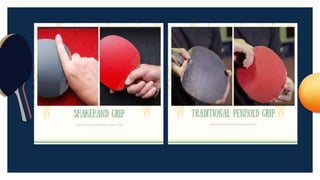
1. Grip: The grip is the most important aspect of
table tennis. The most common grips are shakehand
grip and penhold grip.
Shakehand: Placing your index finger on the rubber
back of the ping pong paddle.
Penhold: Grips the paddle in a similar way to how
you would hold a pen when writing, by curling the
ring and fourth finger back.
Basic Fundamental Skills
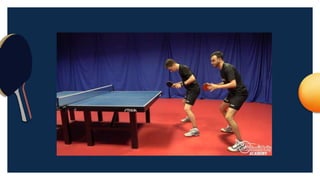
2. Stance: A good stance will help
you maintain your balance and allow
you to move quickly in any direction.
You should stand with your feet
shoulder-width apart and knees
slightly bent.
Basic Fundamental Skills
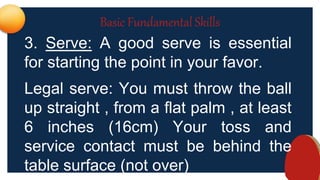
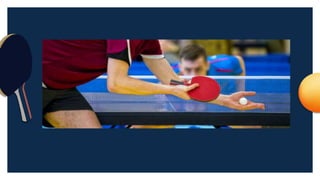
3. Serve: A good serve is essential
for starting the point in your favor.
Legal serve: You must throw the ball
up straight , from a flat palm , at least
6 inches (16cm) Your toss and
service contact must be behind the
table surface (not over)
Basic Fundamental Skills
There are several basic and important moves
in table tennis that you should master to
improve your game:
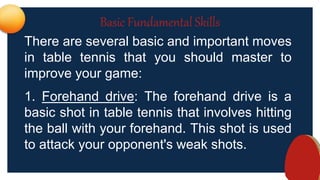
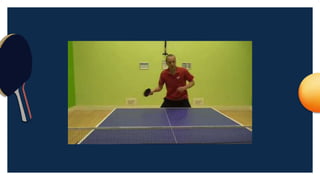
1. Forehand drive: The forehand drive is a
basic shot in table tennis that involves hitting
the ball with your forehand. This shot is used
to attack your opponent's weak shots.
Basic Fundamental Skills
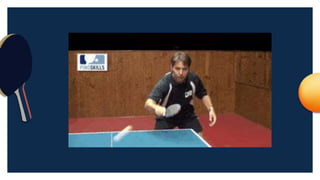
2. Backhand drive: The backhand drive is
similar to the forehand drive but is executed
with your backhand. It is an important shot to
have as it allows you to defend against your
opponent's attacks.
Basic Fundamental Skills
3. Smash: The smash is a powerful attacking
shot that is used to return a high ball with a
lot of force. It is an important shot to have in
your arsenal as it allows you to win points
quickly.
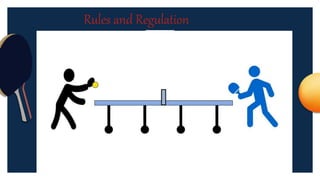
Rules and Regulation
Assessment
1. Where was this sport first invented?
2. A racket sport derived from tennis but distinguished by its
playing surface being atop a _____________.
3. It is a powerful attacking shot that is used to return a high
ball with a lot of force.
4. The earliest version of the game was played on a table
using rackets and balls that were often made from
____________.
5. The game is played to how many points?
Assessment
1. Victorian England
2.Stationary Table
3.Smash
4.Cigar Box Lid and Wine Corks
5.11 points

TABLE TENNIS.pptx

  • 1.
  • 2.
    Objectives: At the endof the lesson, students must be able to: 1. Identify the basic fundamental skills of table tennis; 2. Differentiate the proper grips of holding the racket; and 3. Understand the rules and regulation of the sport.
  • 3.
    • Table tennis,also known as ping-pong, is a popular indoor sport played with small paddles and a lightweight ball on a table with a net dividing the Brief History
  • 4.
    • The earliestversion of the game was played on a table using rackets and balls that were often made from cigar box lids and wine corks. Brief History
  • 5.
    • This sportwas first invented in Victorian England in 1880. • Table tennis is an adaptation of another popular game, known as lawn tennis. Brief History
  • 6.
    • Table tennis,also known as ping-pong and whiff-whaff, is a racket sport derived from tennis but distinguished by its playing surface being atop a stationary table, rather than the court on which players stand. Table Tennis
  • 7.
    • The objectis to hit the ball so that it goes over the net and bounces on the opponent's half of the table in such a way that the opponent cannot reach it or return it correctly. Table Tennis
  • 9.
    Basic Fundamental Skills 1.Grip: The grip is the most important aspect of table tennis. The most common grips are shakehand grip and penhold grip. Shakehand: Placing your index finger on the rubber back of the ping pong paddle. Penhold: Grips the paddle in a similar way to how you would hold a pen when writing, by curling the ring and fourth finger back.
  • 11.
    Basic Fundamental Skills 2.Stance: A good stance will help you maintain your balance and allow you to move quickly in any direction. You should stand with your feet shoulder-width apart and knees slightly bent.
  • 13.
    Basic Fundamental Skills 3.Serve: A good serve is essential for starting the point in your favor. Legal serve: You must throw the ball up straight , from a flat palm , at least 6 inches (16cm) Your toss and service contact must be behind the table surface (not over)
  • 15.
    Basic Fundamental Skills Thereare several basic and important moves in table tennis that you should master to improve your game: 1. Forehand drive: The forehand drive is a basic shot in table tennis that involves hitting the ball with your forehand. This shot is used to attack your opponent's weak shots.
  • 17.
    Basic Fundamental Skills 2.Backhand drive: The backhand drive is similar to the forehand drive but is executed with your backhand. It is an important shot to have as it allows you to defend against your opponent's attacks.
  • 19.
    Basic Fundamental Skills 3.Smash: The smash is a powerful attacking shot that is used to return a high ball with a lot of force. It is an important shot to have in your arsenal as it allows you to win points quickly.
  • 20.
  • 21.
    Assessment 1. Where wasthis sport first invented? 2. A racket sport derived from tennis but distinguished by its playing surface being atop a _____________. 3. It is a powerful attacking shot that is used to return a high ball with a lot of force. 4. The earliest version of the game was played on a table using rackets and balls that were often made from ____________. 5. The game is played to how many points?
  • 22.
    Assessment 1. Victorian England 2.StationaryTable 3.Smash 4.Cigar Box Lid and Wine Corks 5.11 points

Editor's Notes

  • #4 The name ping pong comes from “peng,” the sound of the wooden ball being struck, and “pon,” an onomatopoeia for a high-pitched bounce. Ping pong was originally known as Gossima or Whiff-Whaff in English.The name “Gossima” was derived from the French phrase “le jeu de gossima”, which means “play of delight”. Ping-Pong: The Table Tennis Game You Know and Love. 
  • #5 The name ping pong comes from “peng,” the sound of the wooden ball being struck, and “pon,” an onomatopoeia for a high-pitched bounce. Ping pong was originally known as Gossima or Whiff-Whaff in English.The name “Gossima” was derived from the French phrase “le jeu de gossima”, which means “play of delight”. Ping-Pong: The Table Tennis Game You Know and Love. 
  • #6 Therefore, table tennis was created as a way of continuing to play lawn tennis but inside during the colder winter months.
  • #12 The main footwork pattern that you'll use in a table tennis match is the side to side footwork pattern.
  • #14 The main footwork pattern that you'll use in a table tennis match is the side to side footwork pattern.
  • #16 The main footwork pattern that you'll use in a table tennis match is the side to side footwork pattern.
  • #18 The main footwork pattern that you'll use in a table tennis match is the side to side footwork pattern.
  • #20 The main footwork pattern that you'll use in a table tennis match is the side to side footwork pattern.
  • #22 The main footwork pattern that you'll use in a table tennis match is the side to side footwork pattern.
  • #23 The main footwork pattern that you'll use in a table tennis match is the side to side footwork pattern.