Table TennisCris Guillen
Den Karl Flores
Sydne Mhay Galigao
Marnie Grace Dagasgas
Emelou Dumas
Stella Caturla
Topic Outline
• Overview
• Historical Background
• Equipment
• Gameplay
• Rules and Scoring
• Double Game
Table Tennis
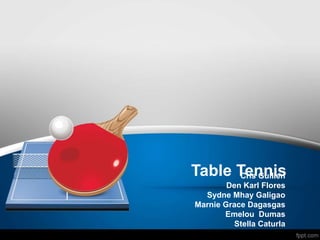
• Table tennis, also known as ping pong, is a
sport in which two or four players (dual) hit a
lightweight ball back and forth across a table
using a small paddle.
• The game takes place on a hard table divided
by a net. Except for the initial serve, the rules
are generally as follows: players must allow a
ball played toward them to bounce one time on
their side of the table, and must return it so t
that it bounces on the opposite side at least
once.
• The game takes place on a hard table
divided by a net. Except for the initial
serve, the rules are generally as follows:
• Players must allow a ball played toward
them to bounce one time on their side of
the table, and must return it so t that it
bounces on the opposite side at least
once.
• Table tennis is governed by the worldwide
organization the International Table Tennis
Federation (ITTF), founded in 1926. ITTF
currently includes 220 member
associations.
• The table tennis official rules are specified
in the ITTF handbook.
• Table tennis has been an Olympic sport
since 1988.
History
• The sport originated in Victorian England,
where it was played among the upper-
class as an after-dinner parlour Game.
• The game were developed by British
military officers in India in around 1860s or
1870s, who brought it back with them.
• A row of books stood up along the center of
the table as a net, two more books served as
rackets and were used to continuously hit a
golf-ball.
Equipments
• Ping-Pong Ball
• Table
• Paddle/racket
Ping-Pong Ball
• The international rules specify that the
game is played with a sphere having a
mass of 2.7 grams and a diameter of 40
millimeters.
• The rules say that the ball shall bounce up
24–26 cm when dropped from a height of
30.5 cm onto a standard steel block
thereby having a coefficient of restitution
(bounce) of 0.89 to 0.92.
• The ball is made of celluloid plastic as of
2015, colored white or orange, with a
matte finish. The choice of ball color is
made according to the table color and its
surroundings.
Table
• The table is 2.74 m long, 1.525 m wide,
and 76 cm high with any continuous
material so long as the table yields a
uniform bounce of about 23 cm when a
standard ball is dropped onto it from a
height of 30 cm
• The table or playing surface is uniformly
dark colored and matte, divided into two
halves by a net at 15.25 cm in height.
Paddle/racket
• Players are equipped with a laminated
wooden racket covered with rubber on one
or two sides depending on the grip of the
player.
• The ITTF uses the term “racket", though
“bat” is common in Britain, and “paddle” in
the U.S. and Canada.
• According to the ITTF regulations, at least
85% of the blade by thickness shall be of
natural wood.
• The average size of the blade is about 17
centimeters long and 15 centimeters wide.
• Although the official restrictions only focus
on the flatness and rigidness of the blade
itself, these dimensions are optimal for
most play styles.
Gameplay
• According to ITTF rule 2.13.1, the first
service is decided by lot, normally a coin
toss. It is also common for one player (or
the umpire/scorer) to hide the ball in one
or the other hand, usually hidden under
the table, allowing the other player to
guess which hand the ball is in.
Starting
LET
• A Let is a rally of which the result is not scored,
and is called in the following circumstances:
• The ball touches the net in service, provided
the service is otherwise correct or the ball is
obstructed by the player on the receiving side.
Obstruction means a player touches the ball
when it is above or traveling towards the
playing surface, not having touched the
player’s court since last being struck by the
player.
• When the player on the receiving side is
not ready and the service is delivered.
• Player’s failure to make a service or a
return or to comply with the Laws is due to
a disturbance outside the control of the
player.
• Play is interrupted by the umpire or
assistant umpire.
• A let is also called if the ball hits the
server’s side of the table if the ball does
not pass further than the edge. If the ball
hits the table edge and hits the net, it is
called a foul serve.
Rules of the Game
• If the ball touches the table surface, it is
declared in
• If it touches the side of the table, it is
declared out
• A player is not allowed to strike the ball in
volley, unless the opponent's ball leaves
the table and I strike the ball in volley
behind the table, in which case the point
would be given to me.
Service
• The initial order of serving is decided by
lot. Service changes every 2 points,
except during periods of extra play where
it changes each time. Service must adhere
to the following rules :
• The ball rests freely on the open palm of
the hand.
• The hand holding the ball must be above
the level of the table.
• The ball should be projected upwards (at
least 16 cm)
• The ball should be struck when it is falling
and behind the table.
• The ball should first bounce in one's court,
then in the opponent's court.
• Service can be diagonal and also in a
straight line in singles
• Service can be replayed when :
• The ball touches the net or its supporting
posts before touching the opponent's court
(''let'' service)
• The ball touches the net then is struck in
volley by the opponent without it touching
his court.
• The receiver was not ready at the time of
service.
Scoring
• A player scores a point when his opponent
commits one of the following errors:
• He isn't able to return the ball.
• He returns the ball outside the opposite
side of the table.
• He lets the ball bounce more than once in
his own court before returning it.
• He touches the ball several times
successively.
• He strikes the ball in volley (without it
bouncing on the table) above his side of
the table.
• He moves the table during play.
• He touches the net or a post.
• His free hand touches the table.
• He makes a bad service.
Adding up Points
• The winner of a match is the one who wins
the first THREE or FOUR games.
(according to the competition)
• A game consists of 11 points.
• There must be a gap of at least two points
between opponents.
• If the score is 10-10, the game goes in to
extra play until one of the players has
gained a lead of 2 points.
• The point goes to the player who
successfully ends a rally
• The score of the server is always
announced first.
Double Game
• In addition to games between individual
players, pairs may also play table tennis.
Singles and doubles are both played in
international competition, including the
Olympic Games since 1988 and the
Commonwealth Games since 2002.
• In 2005, the ITTF announced that doubles
table tennis only was featured as a part of
team events in the 2008 Olympics.
• In doubles, all the rules of single play are
applied except for the following:
• A line painted along the long axis of the table
to create doubles courts bisects the table.
This line’s only purpose is to facilitate the
doubles service rule, which is that service
must originate from the right hand “box” in
such a way that the first bounce of the serve
bounces once in said right hand box and then
must bounce at least once in the opponent
side’s right hand box (far left box for server),
or the receiving pair score a point
Order of play, serving and
receiving
• 1.
• Players must hit the ball in turn. For
example, if A is paired with B, X is paired
with Y, A is the server and X is the
receiver.
• The order of play shall be A→X→B→Y.
The rally proceeds this way until one side
fails to make a legal return and the other
side scores.
• 2.
• At each change of service, the previous
receiver shall become the server and the
partner of the previous server shall
become the receiver. For example, if the
previous order of play is A→X→B→Y, the
order becomes X→B→Y→A after the
change of service
• In the second or the latter games of a
match, the game begins in reverse order
of play. For example, if the order of play is
A→X→B→Y at beginning of the first
game, the order begins with X→A→Y→B
or Y→B→X→A in the second game
depending on either X or Y being chosen
as the first server of the game.
• That means the first receiver of the game
is the player who served to the first server
of the game in the preceding game. In
each game of a doubles match, the pair
having the right to serve first shall choose
which of them will do so. The receiving
pair, however, can only choose in the first
game of the match.
• 4.
• When a pair reaches 5 points in the final
game, the pairs must switch ends of the table
and change the receiver to reverse the order
of play. For example, when the last order of
play before a pair score 5 points in the final
game is A→X→B→Y, the order after change
shall be A→Y→B→X if A still has the second
serve. Otherwise, X is the next server and the
order becomes X→A→Y→B.
Expedite system
• If a game is unfinished after 10 minutes’
play and fewer than 18 points have been
scored, the expedite system is initiated.
• Under the expedite system, the server
must win the point before the opponent
makes 13 consecutive returns or the point
goes to the opponent
• The system can also be initiated at any
time at the request of both players or
pairs. Once introduced, the expedite
system remains in force until the end of
the match. A rule to shorten the time of a
match, it is mainly seen in defensive
players’ games.
• Video Pre.: How to Play Table Tennis

Pingpong

  • 1.
    Table TennisCris Guillen DenKarl Flores Sydne Mhay Galigao Marnie Grace Dagasgas Emelou Dumas Stella Caturla
  • 2.
    Topic Outline • Overview •Historical Background • Equipment • Gameplay • Rules and Scoring • Double Game
  • 3.
    Table Tennis • Tabletennis, also known as ping pong, is a sport in which two or four players (dual) hit a lightweight ball back and forth across a table using a small paddle. • The game takes place on a hard table divided by a net. Except for the initial serve, the rules are generally as follows: players must allow a ball played toward them to bounce one time on their side of the table, and must return it so t that it bounces on the opposite side at least once.
  • 4.
    • The gametakes place on a hard table divided by a net. Except for the initial serve, the rules are generally as follows: • Players must allow a ball played toward them to bounce one time on their side of the table, and must return it so t that it bounces on the opposite side at least once.
  • 5.
    • Table tennisis governed by the worldwide organization the International Table Tennis Federation (ITTF), founded in 1926. ITTF currently includes 220 member associations. • The table tennis official rules are specified in the ITTF handbook. • Table tennis has been an Olympic sport since 1988.
  • 6.
    History • The sportoriginated in Victorian England, where it was played among the upper- class as an after-dinner parlour Game. • The game were developed by British military officers in India in around 1860s or 1870s, who brought it back with them. • A row of books stood up along the center of the table as a net, two more books served as rackets and were used to continuously hit a golf-ball.
  • 7.
    Equipments • Ping-Pong Ball •Table • Paddle/racket
  • 8.
    Ping-Pong Ball • Theinternational rules specify that the game is played with a sphere having a mass of 2.7 grams and a diameter of 40 millimeters. • The rules say that the ball shall bounce up 24–26 cm when dropped from a height of 30.5 cm onto a standard steel block thereby having a coefficient of restitution (bounce) of 0.89 to 0.92.
  • 9.
    • The ballis made of celluloid plastic as of 2015, colored white or orange, with a matte finish. The choice of ball color is made according to the table color and its surroundings.
  • 10.
    Table • The tableis 2.74 m long, 1.525 m wide, and 76 cm high with any continuous material so long as the table yields a uniform bounce of about 23 cm when a standard ball is dropped onto it from a height of 30 cm • The table or playing surface is uniformly dark colored and matte, divided into two halves by a net at 15.25 cm in height.
  • 11.
    Paddle/racket • Players areequipped with a laminated wooden racket covered with rubber on one or two sides depending on the grip of the player. • The ITTF uses the term “racket", though “bat” is common in Britain, and “paddle” in the U.S. and Canada.
  • 12.
    • According tothe ITTF regulations, at least 85% of the blade by thickness shall be of natural wood. • The average size of the blade is about 17 centimeters long and 15 centimeters wide. • Although the official restrictions only focus on the flatness and rigidness of the blade itself, these dimensions are optimal for most play styles.
  • 13.
    Gameplay • According toITTF rule 2.13.1, the first service is decided by lot, normally a coin toss. It is also common for one player (or the umpire/scorer) to hide the ball in one or the other hand, usually hidden under the table, allowing the other player to guess which hand the ball is in. Starting
  • 14.
    LET • A Letis a rally of which the result is not scored, and is called in the following circumstances: • The ball touches the net in service, provided the service is otherwise correct or the ball is obstructed by the player on the receiving side. Obstruction means a player touches the ball when it is above or traveling towards the playing surface, not having touched the player’s court since last being struck by the player.
  • 15.
    • When theplayer on the receiving side is not ready and the service is delivered. • Player’s failure to make a service or a return or to comply with the Laws is due to a disturbance outside the control of the player. • Play is interrupted by the umpire or assistant umpire.
  • 16.
    • A letis also called if the ball hits the server’s side of the table if the ball does not pass further than the edge. If the ball hits the table edge and hits the net, it is called a foul serve.
  • 17.
    Rules of theGame • If the ball touches the table surface, it is declared in • If it touches the side of the table, it is declared out • A player is not allowed to strike the ball in volley, unless the opponent's ball leaves the table and I strike the ball in volley behind the table, in which case the point would be given to me.
  • 18.
    Service • The initialorder of serving is decided by lot. Service changes every 2 points, except during periods of extra play where it changes each time. Service must adhere to the following rules : • The ball rests freely on the open palm of the hand. • The hand holding the ball must be above the level of the table.
  • 19.
    • The ballshould be projected upwards (at least 16 cm) • The ball should be struck when it is falling and behind the table. • The ball should first bounce in one's court, then in the opponent's court. • Service can be diagonal and also in a straight line in singles
  • 20.
    • Service canbe replayed when : • The ball touches the net or its supporting posts before touching the opponent's court (''let'' service) • The ball touches the net then is struck in volley by the opponent without it touching his court. • The receiver was not ready at the time of service.
  • 21.
    Scoring • A playerscores a point when his opponent commits one of the following errors: • He isn't able to return the ball. • He returns the ball outside the opposite side of the table. • He lets the ball bounce more than once in his own court before returning it. • He touches the ball several times successively.
  • 22.
    • He strikesthe ball in volley (without it bouncing on the table) above his side of the table. • He moves the table during play. • He touches the net or a post. • His free hand touches the table. • He makes a bad service.
  • 23.
    Adding up Points •The winner of a match is the one who wins the first THREE or FOUR games. (according to the competition) • A game consists of 11 points. • There must be a gap of at least two points between opponents. • If the score is 10-10, the game goes in to extra play until one of the players has gained a lead of 2 points.
  • 24.
    • The pointgoes to the player who successfully ends a rally • The score of the server is always announced first.
  • 25.
    Double Game • Inaddition to games between individual players, pairs may also play table tennis. Singles and doubles are both played in international competition, including the Olympic Games since 1988 and the Commonwealth Games since 2002. • In 2005, the ITTF announced that doubles table tennis only was featured as a part of team events in the 2008 Olympics.
  • 26.
    • In doubles,all the rules of single play are applied except for the following:
  • 27.
    • A linepainted along the long axis of the table to create doubles courts bisects the table. This line’s only purpose is to facilitate the doubles service rule, which is that service must originate from the right hand “box” in such a way that the first bounce of the serve bounces once in said right hand box and then must bounce at least once in the opponent side’s right hand box (far left box for server), or the receiving pair score a point
  • 28.
    Order of play,serving and receiving • 1. • Players must hit the ball in turn. For example, if A is paired with B, X is paired with Y, A is the server and X is the receiver. • The order of play shall be A→X→B→Y. The rally proceeds this way until one side fails to make a legal return and the other side scores.
  • 29.
    • 2. • Ateach change of service, the previous receiver shall become the server and the partner of the previous server shall become the receiver. For example, if the previous order of play is A→X→B→Y, the order becomes X→B→Y→A after the change of service
  • 30.
    • In thesecond or the latter games of a match, the game begins in reverse order of play. For example, if the order of play is A→X→B→Y at beginning of the first game, the order begins with X→A→Y→B or Y→B→X→A in the second game depending on either X or Y being chosen as the first server of the game.
  • 31.
    • That meansthe first receiver of the game is the player who served to the first server of the game in the preceding game. In each game of a doubles match, the pair having the right to serve first shall choose which of them will do so. The receiving pair, however, can only choose in the first game of the match.
  • 32.
    • 4. • Whena pair reaches 5 points in the final game, the pairs must switch ends of the table and change the receiver to reverse the order of play. For example, when the last order of play before a pair score 5 points in the final game is A→X→B→Y, the order after change shall be A→Y→B→X if A still has the second serve. Otherwise, X is the next server and the order becomes X→A→Y→B.
  • 33.
    Expedite system • Ifa game is unfinished after 10 minutes’ play and fewer than 18 points have been scored, the expedite system is initiated. • Under the expedite system, the server must win the point before the opponent makes 13 consecutive returns or the point goes to the opponent
  • 34.
    • The systemcan also be initiated at any time at the request of both players or pairs. Once introduced, the expedite system remains in force until the end of the match. A rule to shorten the time of a match, it is mainly seen in defensive players’ games. • Video Pre.: How to Play Table Tennis