Short Activity !!!
"PingPong Simpson Samson"
All the Students must participate!
The facilitator will call out either "Simpson" or
"Samson," and participants must respond with a
specific action:
"Simpson": Mimic a forehand stroke (swing with their
dominant hand as if hitting the ball).
"Samson": Mimic a backhand stroke (swing with their
non-dominant hand).
If someone does the wrong action or hesitates, they’re
out for the round or can do a silly challenge to rejoin
the game (sing/dance)
Learning Objectives
At theend of the lesson Student’s will,
• Recall the origin and history of Table Tennis and its
evolution into the sport it is today;
• Explain how different types of shots are executed
and the situations in which each shot is most
effective;
• Demonstrate the correct technique for executing
basic shots, such as the forehand drive and
backhand block, during practice;
• Design a fitness training program that includes
exercises to enhance key fitness components.
Learnings
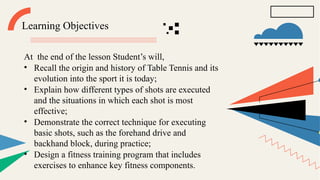
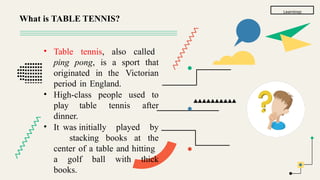
• Table tennis,also called
ping pong, is a sport that
originated in the Victorian
period in England.
• High-class people used to
play table tennis after
dinner.
• It was initially played by
stacking books at the
center of a table and hitting
a golf ball with thick
books.
What is TABLE TENNIS?
11.
Learnings
BIG IDEA
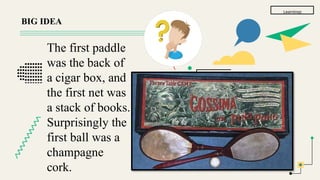
The firstpaddle
was the back of
a cigar box, and
the first net was
a stack of books.
Surprisingly the
first ball was a
champagne
cork.
Learnings
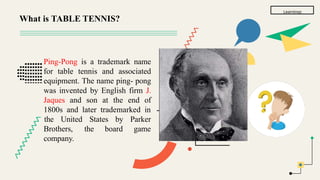
Ping-Pong is atrademark name
for table tennis and associated
equipment. The name ping- pong
was invented by English firm J.
Jaques and son at the end of
1800s and later trademarked in
the United States by Parker
game
Brothers, the board
company.
What is TABLE TENNIS?
14.
Learnings
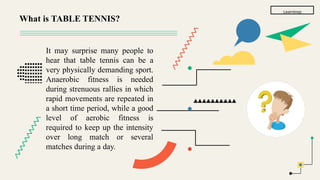
It may surprisemany people to
hear that table tennis can be a
very physically demanding sport.
Anaerobic fitness is needed
during strenuous rallies in which
rapid movements are repeated in
a short time period, while a good
level of aerobic fitness is
required to keep up the intensity
over long match or several
matches during a day.
What is TABLE TENNIS?
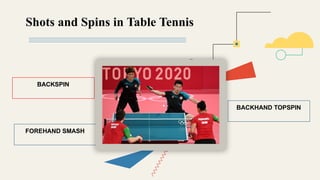
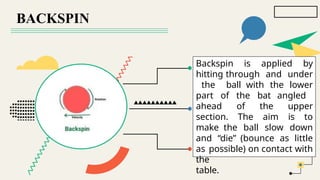
BACKSPIN
Backspin is appliedby
hitting through and under
the ball with the lower
part of the bat angled
ahead of the upper
section. The aim is to
make the ball slow down
and “die” (bounce as little
as possible) on contact with
the
table.
17.
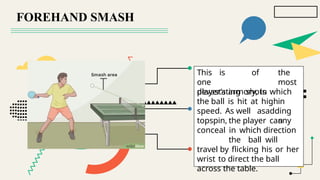
FOREHAND SMASH
This is
one
devastating
ofthe
most
shots
in
any
player’s armory, in which
the ball is hit at high
speed. As well asadding
topspin, the player can
conceal in which direction
the ball will
travel by flicking his or her
wrist to direct the ball
across the table.
18.
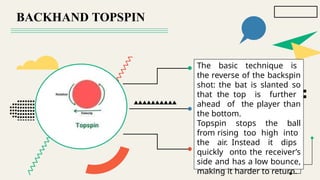
BACKHAND TOPSPIN
The basictechnique is
the reverse of the backspin
shot: the bat is slanted so
that the top is further
ahead of the player than
the bottom.
Topspin stops the ball
from rising too high into
the air. Instead it dips
quickly onto the receiver’s
side and has a low bounce,
making it harder to return.
19.
FITNESS COMPONENTS INTABLE TENNIS
1. Speed and quickness are the most
important.
2. Agility is one of the factor for
successful performance.
3. Hand-eye coordination
4. Balance and coordination
5. Reaction time
6. Flexibility
7. Analytic an tactical ability
20.
FITNESS COMPONENTS INTABLE TENNIS
8. Skill and technique
9. Motivation and self confidence
10. Coping with pressure situations
11. Aerobic endurance
12. Strength and power
13. Body size and composition
21.
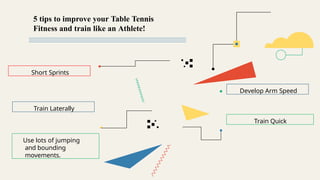
Short Sprints
5 tipsto improve your Table Tennis
Fitness and train like an Athlete!
Use lots of jumping
and bounding
movements.
Train Laterally
Train Quick
Develop Arm Speed
22.
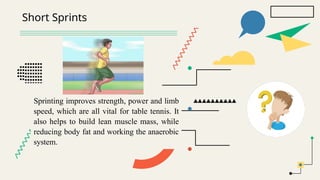
Short Sprints
Sprinting improvesstrength, power and limb
speed, which are all vital for table tennis. It
also helps to build lean muscle mass, while
reducing body fat and working the anaerobic
system.
23.
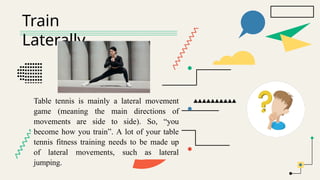
Train
Laterally
Table tennis ismainly a lateral movement
game (meaning the main directions of
movements are side to side). So, “you
become how you train”. A lot of your table
tennis fitness training needs to be made up
of lateral movements, such as lateral
jumping.
24.
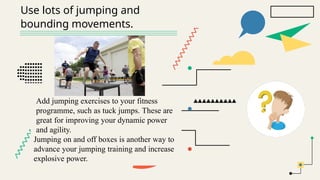
Use lots ofjumping and
bounding movements.
Add jumping exercises to your fitness
programme, such as tuck jumps. These are
great for improving your dynamic power
and agility.
Jumping on and off boxes is another way to
advance your jumping training and increase
explosive power.
25.
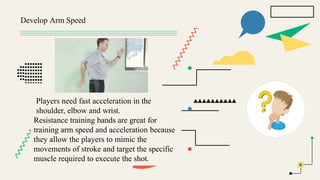
Develop Arm Speed
Playersneed fast acceleration in the
shoulder, elbow and wrist.
Resistance training bands are great for
training arm speed and acceleration because
they allow the players to mimic the
movements of stroke and target the specific
muscle required to execute the shot.
26.
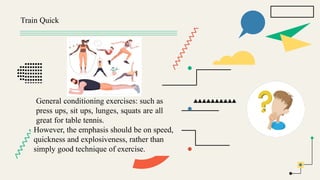
Train Quick
General conditioningexercises: such as
press ups, sit ups, lunges, squats are all
great for table tennis.
However, the emphasis should be on speed,
quickness and explosiveness, rather than
simply good technique of exercise.
27.
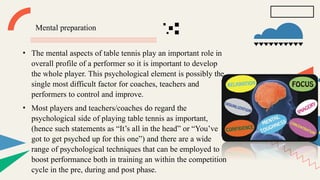
Mental preparation
• Themental aspects of table tennis play an important role in
overall profile of a performer so it is important to develop
the whole player. This psychological element is possibly the
single most difficult factor for coaches, teachers and
performers to control and improve.
• Most players and teachers/coaches do regard the
psychological side of playing table tennis as important,
(hence such statements as “It’s all in the head” or “You’ve
got to get psyched up for this one”) and there are a wide
range of psychological techniques that can be employed to
boost performance both in training an within the competition
cycle in the pre, during and post phase.
28.
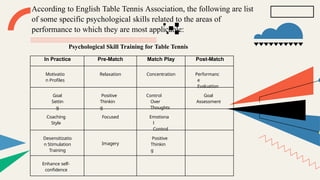
According to EnglishTable Tennis Association, the following are list
of some specific psychological skills related to the areas of
performance to which they are most applicable:
In Practice Pre-Match Match Play Post-Match
Motivatio
n Profiles
Relaxation Concentration Performanc
e
Evaluation
Goal
Settin
g
Positive
Thinkin
g
Control
Over
Thoughts
Goal
Assessment
Coaching
Style
Focused Emotiona
l
Control
Desensitizatio
n Stimulation
Training
Imagery
Positive
Thinkin
g
Enhance self-
confidence
Psychological Skill Training for Table Tennis
29.
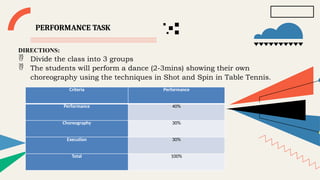
PERFORMANCE TASK
DIRECTIONS:
Dividethe class into 3 groups
The students will perform a dance (2-3mins) showing their own
choreography using the techniques in Shot and Spin in Table Tennis.
Criteria Performance
Performance 40%
Choreography 30%
Execution 30%
Total 100%
30.
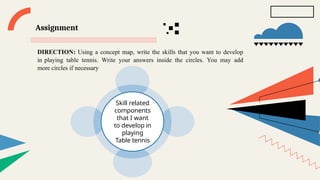
DIRECTION: Using aconcept map, write the skills that you want to develop
in playing table tennis. Write your answers inside the circles. You may add
more circles if necessary
Skill related
components
that I want
to develop in
playing
Table tennis
Assignment