Table Tennis
PE & HEALTH
Group 2
TableTennis
Table tennis, also known as
ping-pong, is a sport in which
two or four players hit a
lightweight ball, called the
ping-pong ball, back and forth
across a table using small solid
rackets. The game takes place
on a hard table divided by a
net.
History of
Table Tennis
The game was
invented in England in
the early 20th century
(1901-1940) and was
originally called ping-
pong.
In 1920s, the game
continued to be
played in England and
in many countries.
In 1926, International
Table Tennis
Federation was
founded led by
representatives of
England, Germany,
and Hungary.
In 1926, first world
championship were
held in London.
1950s- Asia emerged
as breeding grounds
of champions
History of
Table Tennis
1970s-a period in
which Cold War
tensions between
China and the United
States were eased
1971 - first event held
in Beijing paved the
way for U.S. Pres.
Richard Nixon’s
historic visit to China
the following year.
In 1980, the first
World Cup was held.
1988 - table tennis
became an olympic
sport
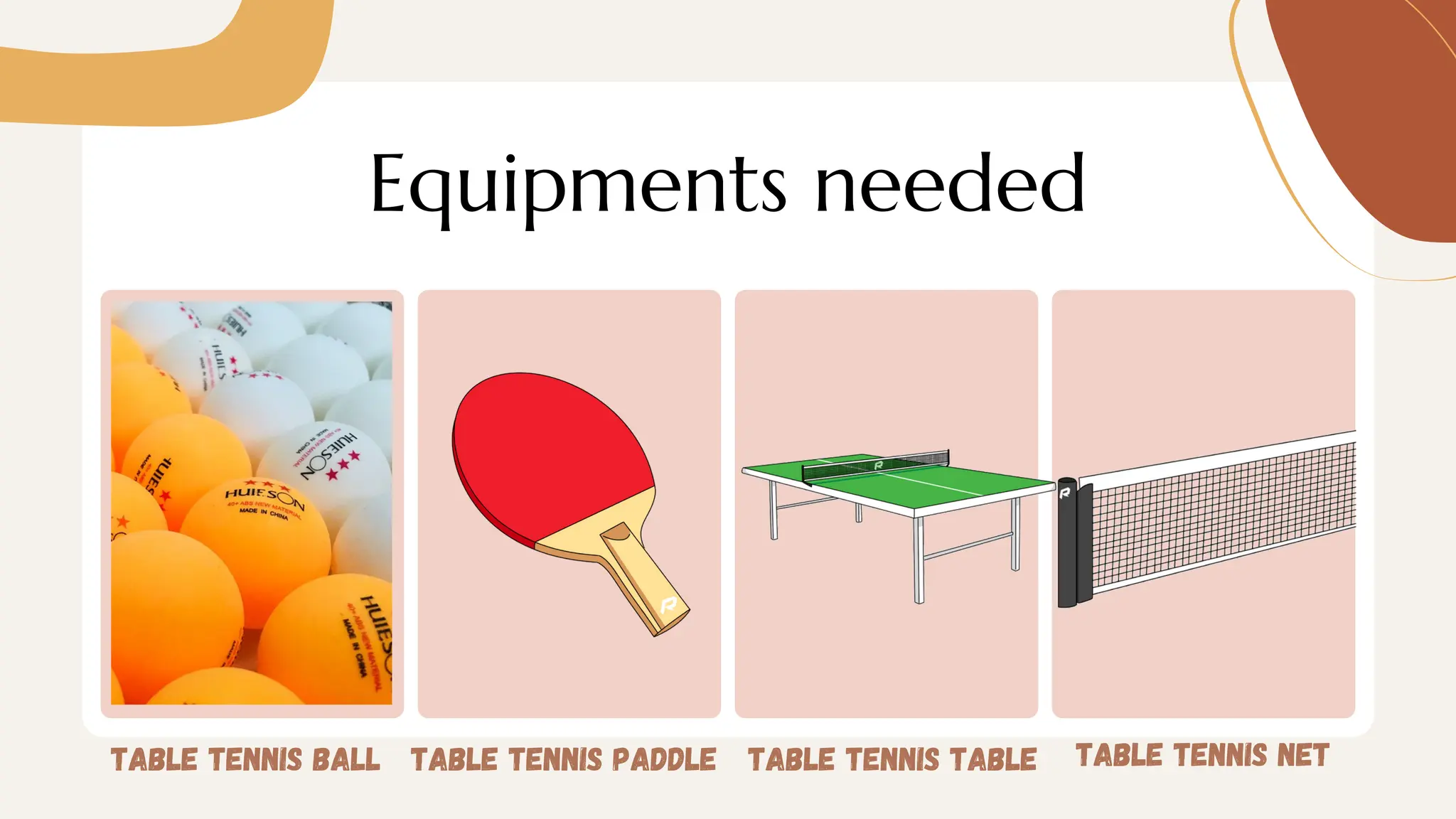
Equipments needed
table tennis ball table tennis paddle table tennis table table tennis net
Technical and Tactical skills
in Table Tennis
Technical
Skills
GRIP
1.
4. STROKES
3. serving
2. STANCE & Footwork
GRIP
1.
Holding the racket determines how you play the game.
2 basic grips recommended:
Orthodox or Shakehand grip - This kind of grip is used by most professional
and recreational players. The basic position is to hold the paddle-like when
you are shaking somebody’s hand.
a.
b. Penhold grip - Penhold is very powerful in performing the forehand spin. It is
most common for Asian players to play ping pong with this type of grip. This
is similar to holding a pen between the thumb and forefinger.
2. stance and footwork
Proper stance and footwork in serving or receiving are just as important as
learning table tennis itself. It is any sport skill that requires a constantly alert
player.
types of stance:
Stance in serving - face slightly to the right side with feet well apart and the
left foot forward. Position about 1 1/2 to 2 ft directly behind the center line of
own court.
Stance in receiving - Position about 2 to 2 1/2 ft directly at the back of the
center line of own court. Feet well apart, knees slightly bent, and body
inclined forward in ready position.
a.
b.
2. stance and footwork
Forehand stroke - both left foot and shoulder should point approx. toward
the table.
Backhand stroke - both right foot and shoulder should point approx. toward
the table.
a.
b.
3. serving
Types of serving:
Topspin serve - with either a forehand or backhand stroke, the ball is put
into play by projecting it upward from the flat free hand.
Backspin serve - the ball is struck with a downward , forward motion of the
racket. The racket face is facing upward from the tabletop and net.
a.
b.
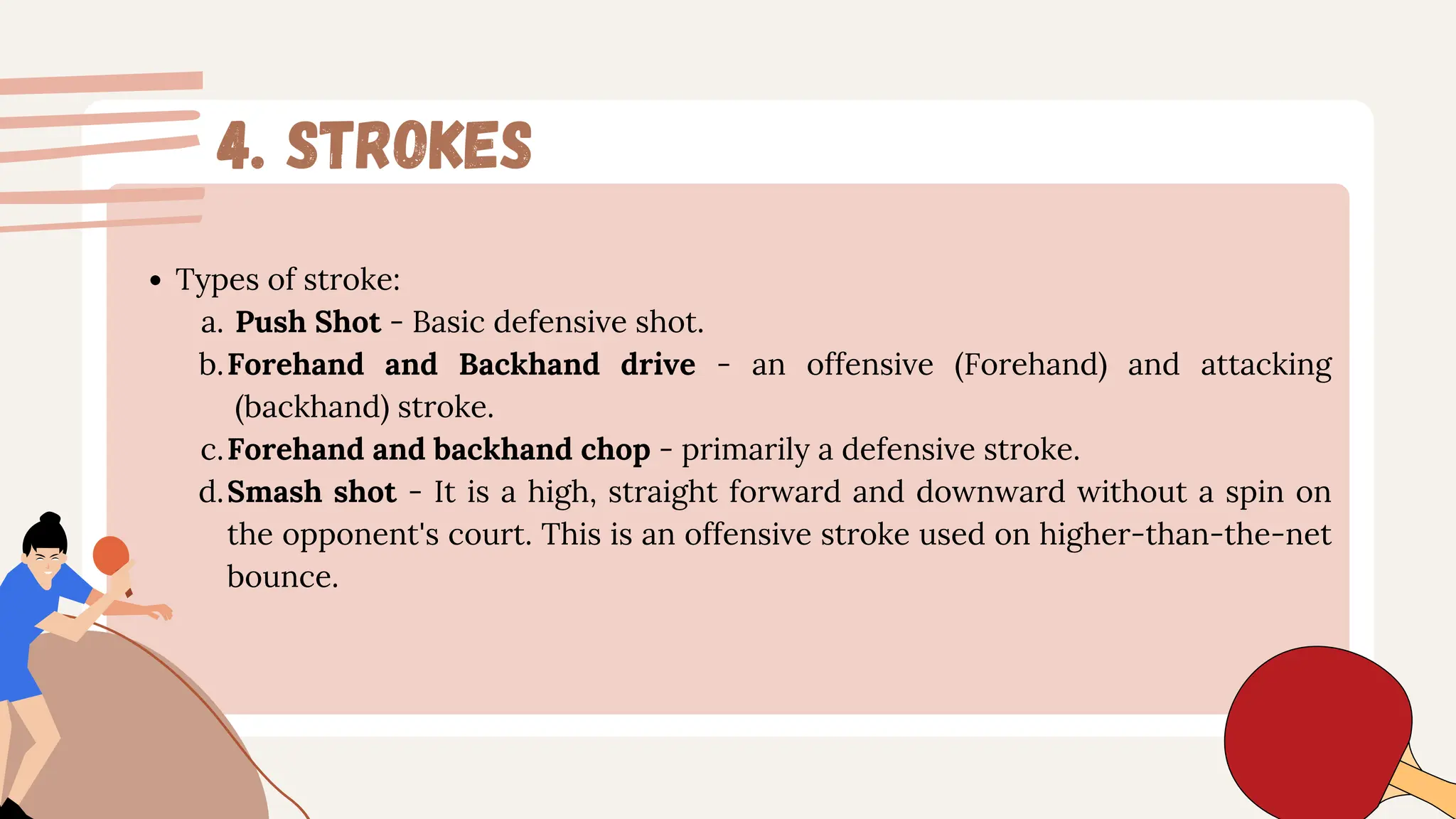
4. strokes
Types of stroke:
Push Shot - Basic defensive shot.
Forehand and Backhand drive - an offensive (Forehand) and attacking
(backhand) stroke.
Forehand and backhand chop - primarily a defensive stroke.
Smash shot - It is a high, straight forward and downward without a spin on
the opponent's court. This is an offensive stroke used on higher-than-the-net
bounce.
a.
b.
c.
d.
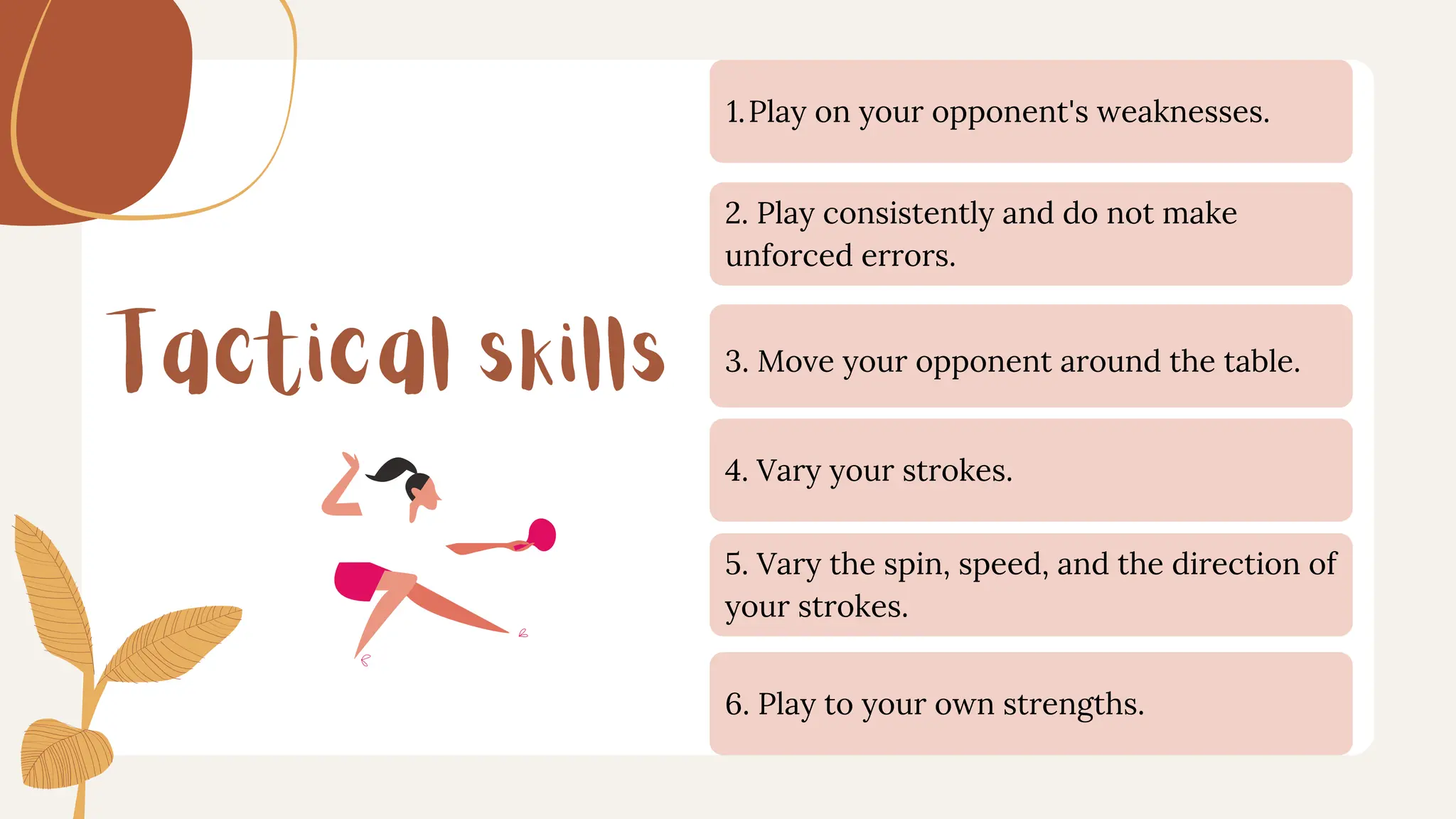
Tactical skills
Play on your opponent's weaknesses.
1.
2. Play consistently and do not make
unforced errors.
3. Move your opponent around the table.
4. Vary your strokes.
5. Vary the spin, speed, and the direction of
your strokes.
6. Play to your own strengths.
table tennis rules
Games are played to 11 points.
Alternate serves every 2 points.
Toss the ball straight up when serving.
The serve can land anywhere in singles.
Doubles serves must go right court to right court.
A serve that touches the net on the way over is a "LET".
Alternate hitting in a doubles rally.
1.
2.
3.
4.
5.
6.
7.
8. Volleys are not allowed.
9. If your hit bounces back over the net by itself, it is your point.
10. Touching the ball with your paddle hand is allowed.
11. You may not touch the table with your non-paddle hand.
12. An "edge" ball bouncing off the horizontal table top surface is good
13. Honor system applies to disagreements.
Table tennis officials
Referees - They uphold the laws of the game on the field of play.
Umpires or judges - They use voice and hand signals to control the
game and communicate the score to the players. These sports now
have the use of video technology to assist them. Points are then
awarded accordingly.
Time-keepers - they are vital in Sport where time is stopped and
started frequently.
Starters - They control the beginning of a race. These officials
monitor false starts and penalize those who break the rules.
1.
2.
3.
4.

594672sidjjdjdhdhdjd419-Table-tennis-ppt.pdf

  • 1.
    Table Tennis PE &HEALTH Group 2
  • 2.
    TableTennis Table tennis, alsoknown as ping-pong, is a sport in which two or four players hit a lightweight ball, called the ping-pong ball, back and forth across a table using small solid rackets. The game takes place on a hard table divided by a net.
  • 3.
    History of Table Tennis Thegame was invented in England in the early 20th century (1901-1940) and was originally called ping- pong. In 1920s, the game continued to be played in England and in many countries. In 1926, International Table Tennis Federation was founded led by representatives of England, Germany, and Hungary. In 1926, first world championship were held in London. 1950s- Asia emerged as breeding grounds of champions
  • 4.
    History of Table Tennis 1970s-aperiod in which Cold War tensions between China and the United States were eased 1971 - first event held in Beijing paved the way for U.S. Pres. Richard Nixon’s historic visit to China the following year. In 1980, the first World Cup was held. 1988 - table tennis became an olympic sport
  • 5.
    Equipments needed table tennisball table tennis paddle table tennis table table tennis net
  • 6.
    Technical and Tacticalskills in Table Tennis
  • 7.
  • 8.
    GRIP 1. Holding the racketdetermines how you play the game. 2 basic grips recommended: Orthodox or Shakehand grip - This kind of grip is used by most professional and recreational players. The basic position is to hold the paddle-like when you are shaking somebody’s hand. a. b. Penhold grip - Penhold is very powerful in performing the forehand spin. It is most common for Asian players to play ping pong with this type of grip. This is similar to holding a pen between the thumb and forefinger.
  • 9.
    2. stance andfootwork Proper stance and footwork in serving or receiving are just as important as learning table tennis itself. It is any sport skill that requires a constantly alert player. types of stance: Stance in serving - face slightly to the right side with feet well apart and the left foot forward. Position about 1 1/2 to 2 ft directly behind the center line of own court. Stance in receiving - Position about 2 to 2 1/2 ft directly at the back of the center line of own court. Feet well apart, knees slightly bent, and body inclined forward in ready position. a. b.
  • 10.
    2. stance andfootwork Forehand stroke - both left foot and shoulder should point approx. toward the table. Backhand stroke - both right foot and shoulder should point approx. toward the table. a. b.
  • 11.
    3. serving Types ofserving: Topspin serve - with either a forehand or backhand stroke, the ball is put into play by projecting it upward from the flat free hand. Backspin serve - the ball is struck with a downward , forward motion of the racket. The racket face is facing upward from the tabletop and net. a. b.
  • 12.
    4. strokes Types ofstroke: Push Shot - Basic defensive shot. Forehand and Backhand drive - an offensive (Forehand) and attacking (backhand) stroke. Forehand and backhand chop - primarily a defensive stroke. Smash shot - It is a high, straight forward and downward without a spin on the opponent's court. This is an offensive stroke used on higher-than-the-net bounce. a. b. c. d.
  • 13.
    Tactical skills Play onyour opponent's weaknesses. 1. 2. Play consistently and do not make unforced errors. 3. Move your opponent around the table. 4. Vary your strokes. 5. Vary the spin, speed, and the direction of your strokes. 6. Play to your own strengths.
  • 14.
  • 15.
    Games are playedto 11 points. Alternate serves every 2 points. Toss the ball straight up when serving. The serve can land anywhere in singles. Doubles serves must go right court to right court. A serve that touches the net on the way over is a "LET". Alternate hitting in a doubles rally. 1. 2. 3. 4. 5. 6. 7.
  • 16.
    8. Volleys arenot allowed. 9. If your hit bounces back over the net by itself, it is your point. 10. Touching the ball with your paddle hand is allowed. 11. You may not touch the table with your non-paddle hand. 12. An "edge" ball bouncing off the horizontal table top surface is good 13. Honor system applies to disagreements.
  • 17.
    Table tennis officials Referees- They uphold the laws of the game on the field of play. Umpires or judges - They use voice and hand signals to control the game and communicate the score to the players. These sports now have the use of video technology to assist them. Points are then awarded accordingly. Time-keepers - they are vital in Sport where time is stopped and started frequently. Starters - They control the beginning of a race. These officials monitor false starts and penalize those who break the rules. 1. 2. 3. 4.