ta
History of Table Tennis
The game of table tennis probably descended from
the game of "Royal Tennis" (also known as Real
Tennis or Court Tennis), which was played in the
medieval era. In the 1990’s, Englishman James Gibb
is credited with bringing hollow celluloid balls back to
England from the USA, although some other sources
claim they were plastic balls. Previously most balls
were solid rubber or cork, often covered in material.
Some sources also credit Gibb with inventing the
name "ping pong", which was supposed to have
been derived from the sound of the ball bouncing off
the drum battledores (paddles), each of which had a
different sound.
Equipments
O Ball - 2.7 gram, 40 mm diameter
O Table - c 2.74 m (9 ft.) long, 1.52 m (5 ft.)
  wide, and 76 cm (30 inch) high with a
  Masonite (a type of hardboard) or similarly
  manufactured timber, layered with a
  smooth, low-friction coating. The table
  surface is divided into two halves by a
  15.25 cm (6 inch) high net.
Equipments
O Racket - The average size of the blade is
  about 6.5 inches (16.5 cm) long and
  6 inches (15 cm) wide wooden blade
  covered with rubber on one or two sides.
O Net - usually made of a dark-colored
  mesh, which is clearly visible against a
  white or an orange ball.
Rules and Regulation
O Starting a game
According to ITTF rule 2.13.1, the first service is
decided by lot normally a coin toss. It is also common
for one player (or the umpire/scorer) to hide the ball
in one or the other hand (usually hidden under the
table), allowing the other player to guess which hand
the ball is in. The correct or incorrect guess gives the
"winner" the option to choose to serve, receive, or to
choose which side of the table to use. (A common but
non-sanctioned method is for the players to play the
ball back and forth four times and then play out the
point. This is commonly referred to as "play to serve"
or "rally to serve".)
Service and return
O In game play, the player serving the ball commences a play. The
  server first stands with the ball held on the open palm of the
  hand not carrying the racket, called the freehand, and tosses the
  ball directly upward without spin, In casual games, many players
  do not toss the ball upward; however, this is technically illegal
  and can give the serving player an unfair advantage.
O The ball must remain behind the end line and above the upper
  surface of the table, known as the playing surface, at all times
  during the service. The server cannot use his body or clothing to
  obstruct sight of the ball; the opponent and the umpire must
  have a clear view of the ball at all times. If the umpire is doubtful
  of the legality of a service they may first interrupt play and give a
  warning to the server.
O If the service is "good", then the receiver must make a "good"
  return by hitting the ball back before it bounces a second time on
  receiver's side of the table so that the ball passes the net and
  touches the opponent's court, either directly or after touching the
  net assembly
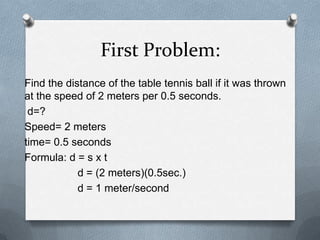
First Problem:
Find the distance of the table tennis ball if it was thrown
at the speed of 2 meters per 0.5 seconds.
 d=?
Speed= 2 meters
time= 0.5 seconds
Formula: d = s x t
            d = (2 meters)(0.5sec.)
            d = 1 meter/second
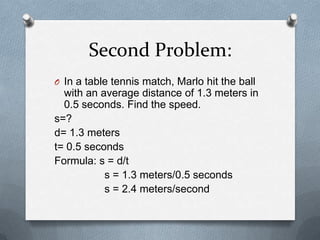
Second Problem:
O In a table tennis match, Marlo hit the ball
  with an average distance of 1.3 meters in
  0.5 seconds. Find the speed.
s=?
d= 1.3 meters
t= 0.5 seconds
Formula: s = d/t
           s = 1.3 meters/0.5 seconds
           s = 2.4 meters/second
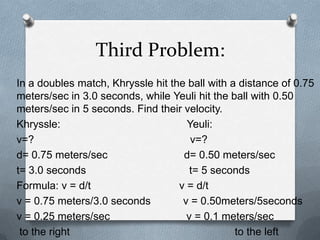
Third Problem:
In a doubles match, Khryssle hit the ball with a distance of 0.75
meters/sec in 3.0 seconds, while Yeuli hit the ball with 0.50
meters/sec in 5 seconds. Find their velocity.
Khryssle:                            Yeuli:
v=?                                   v=?
d= 0.75 meters/sec                  d= 0.50 meters/sec
t= 3.0 seconds                        t= 5 seconds
Formula: v = d/t                   v = d/t
v = 0.75 meters/3.0 seconds         v = 0.50meters/5seconds
v = 0.25 meters/sec                  v = 0.1 meters/sec
 to the right                                   to the left

Table tennis

  • 1.
  • 2.
    History of TableTennis The game of table tennis probably descended from the game of "Royal Tennis" (also known as Real Tennis or Court Tennis), which was played in the medieval era. In the 1990’s, Englishman James Gibb is credited with bringing hollow celluloid balls back to England from the USA, although some other sources claim they were plastic balls. Previously most balls were solid rubber or cork, often covered in material. Some sources also credit Gibb with inventing the name "ping pong", which was supposed to have been derived from the sound of the ball bouncing off the drum battledores (paddles), each of which had a different sound.
  • 3.
    Equipments O Ball -2.7 gram, 40 mm diameter O Table - c 2.74 m (9 ft.) long, 1.52 m (5 ft.) wide, and 76 cm (30 inch) high with a Masonite (a type of hardboard) or similarly manufactured timber, layered with a smooth, low-friction coating. The table surface is divided into two halves by a 15.25 cm (6 inch) high net.
  • 4.
    Equipments O Racket -The average size of the blade is about 6.5 inches (16.5 cm) long and 6 inches (15 cm) wide wooden blade covered with rubber on one or two sides. O Net - usually made of a dark-colored mesh, which is clearly visible against a white or an orange ball.
  • 5.
  • 6.
    O Starting agame According to ITTF rule 2.13.1, the first service is decided by lot normally a coin toss. It is also common for one player (or the umpire/scorer) to hide the ball in one or the other hand (usually hidden under the table), allowing the other player to guess which hand the ball is in. The correct or incorrect guess gives the "winner" the option to choose to serve, receive, or to choose which side of the table to use. (A common but non-sanctioned method is for the players to play the ball back and forth four times and then play out the point. This is commonly referred to as "play to serve" or "rally to serve".)
  • 7.
    Service and return OIn game play, the player serving the ball commences a play. The server first stands with the ball held on the open palm of the hand not carrying the racket, called the freehand, and tosses the ball directly upward without spin, In casual games, many players do not toss the ball upward; however, this is technically illegal and can give the serving player an unfair advantage. O The ball must remain behind the end line and above the upper surface of the table, known as the playing surface, at all times during the service. The server cannot use his body or clothing to obstruct sight of the ball; the opponent and the umpire must have a clear view of the ball at all times. If the umpire is doubtful of the legality of a service they may first interrupt play and give a warning to the server. O If the service is "good", then the receiver must make a "good" return by hitting the ball back before it bounces a second time on receiver's side of the table so that the ball passes the net and touches the opponent's court, either directly or after touching the net assembly
  • 9.
    First Problem: Find thedistance of the table tennis ball if it was thrown at the speed of 2 meters per 0.5 seconds. d=? Speed= 2 meters time= 0.5 seconds Formula: d = s x t d = (2 meters)(0.5sec.) d = 1 meter/second
  • 10.
    Second Problem: O Ina table tennis match, Marlo hit the ball with an average distance of 1.3 meters in 0.5 seconds. Find the speed. s=? d= 1.3 meters t= 0.5 seconds Formula: s = d/t s = 1.3 meters/0.5 seconds s = 2.4 meters/second
  • 11.
    Third Problem: In adoubles match, Khryssle hit the ball with a distance of 0.75 meters/sec in 3.0 seconds, while Yeuli hit the ball with 0.50 meters/sec in 5 seconds. Find their velocity. Khryssle: Yeuli: v=? v=? d= 0.75 meters/sec d= 0.50 meters/sec t= 3.0 seconds t= 5 seconds Formula: v = d/t v = d/t v = 0.75 meters/3.0 seconds v = 0.50meters/5seconds v = 0.25 meters/sec v = 0.1 meters/sec to the right to the left