Tennis
Group Members
 Choo Jan Meng
 Keng Shen Kai
 Ng Chen San
 Sia Shi Min
 Tan Hong Wee
 Tee Yeh Hun
 Teh Rong Jiunn
History
&
Background
It’s a game of sport not only testing your
Hard Work, Discipline, Intelligence but is
also testing your Determination.
What is Tennis?
 Tennis
 A racquet sport that can be played individually
against a single opponent or between two teams of
two players each.
 Each player uses a racquet that is strung with cord to
strike a hollow rubber ball covered with felt over or
around a net and into the opponent's court.
 Objective :
 To play the ball in such a way that the opponent is
not able to play a good return.
 The opponent who is unable to return the ball will not
gain a point, while the opposite opponent will.
History of Tennis
 An Englishman, Major Walter C. Wingfield
 invented lawn tennis (1873) & first played it at a garden
party in Wales.
 Sports historians all agree that Wingfield deserves much of
the credit for the development of modern tennis
 Called "Sphairistiké“(ball playing) by its inventor, the
early game was played on an hourglass-shaped court,
widest at the baselines and narrowest at the net.
 Court tennis
 Known as royal tennis.
 Originated in France during the Middle Ages and
became a favourite of British royalty, including Henry VIII.
 The progression from court tennis:
• Used an unresilient sheepskin ball filled with sawdust, sand, or
wool, to lawn tennis depended upon invention of a ball that
would bounce.
 Tennis spread to the United States by way of
Bermuda.
 While vacationing there, Mary Ewing Outerbridge of New
York was introduced (1874) to the game by a friend of
Wingfield.
 She returned to the United States with a net, balls, and
rackets, and with the help of her brother, set up a tennis
court in Staten Island, N.Y.
Equipment
of
tennis
Type of tennis racquet
a)Power or game improvement racquets
 Super oversize head
 Lightweight and longer
 designed for players with shorter &slower swings
 wants more power from racquet
b)Tweener racquets
 smaller head size
 heavier weight compare to power racquets
 offer medium- high power
 For players that seek for enhanced
maneuverability
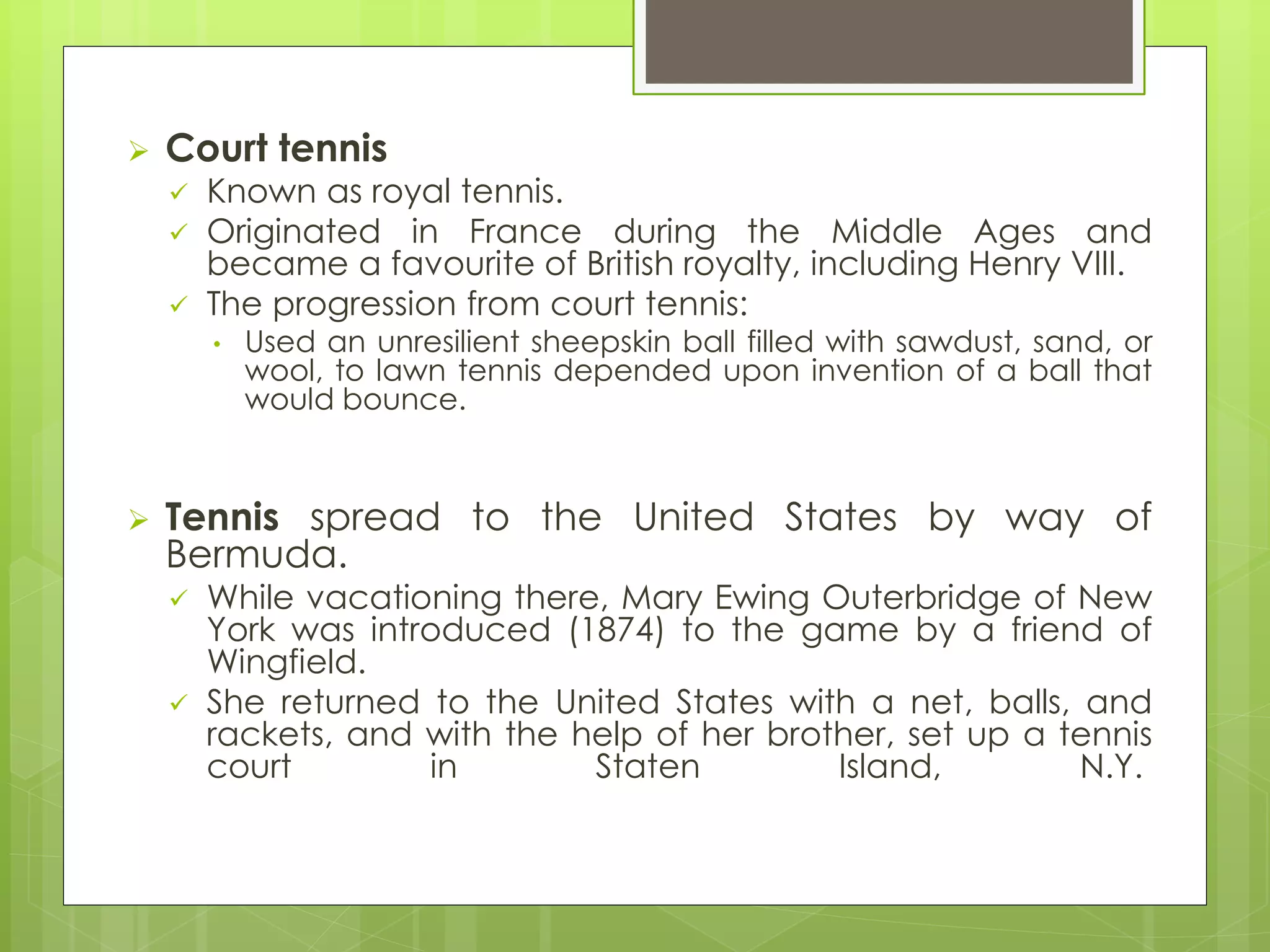
c)Control or players’ racquets
 have the smallest head size
 heaviest among three type of racquets
 for players that like to provide own power
 better control of the racquets
Type of tennis balls
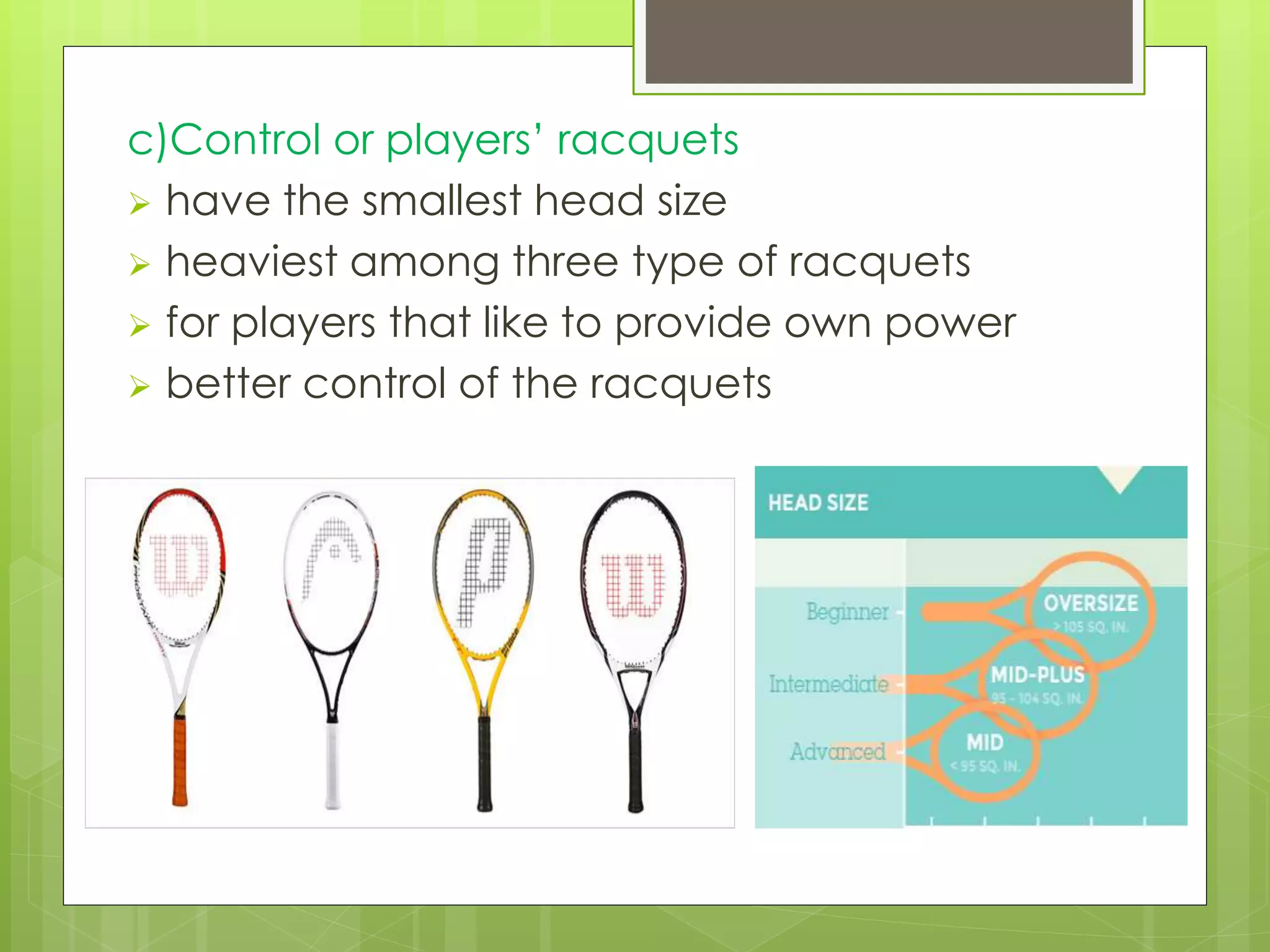
 a)Recreational tennis ball
 typical tennis ball
 no specification on any type of court
 as practice ball or ball machine
 not allow in match play for many leagues
 b)Fast-speed tennis ball
 ball is slightly harder
 for slower court
 sufficient for almost all league match play
c) Slow-speed tennis ball
 larger in size
 for faster court
What do a String Dampener do?
 dampen string vibrations,
 not frame vibrations;
 in dampening string vibrations
 change the sound of the impact,
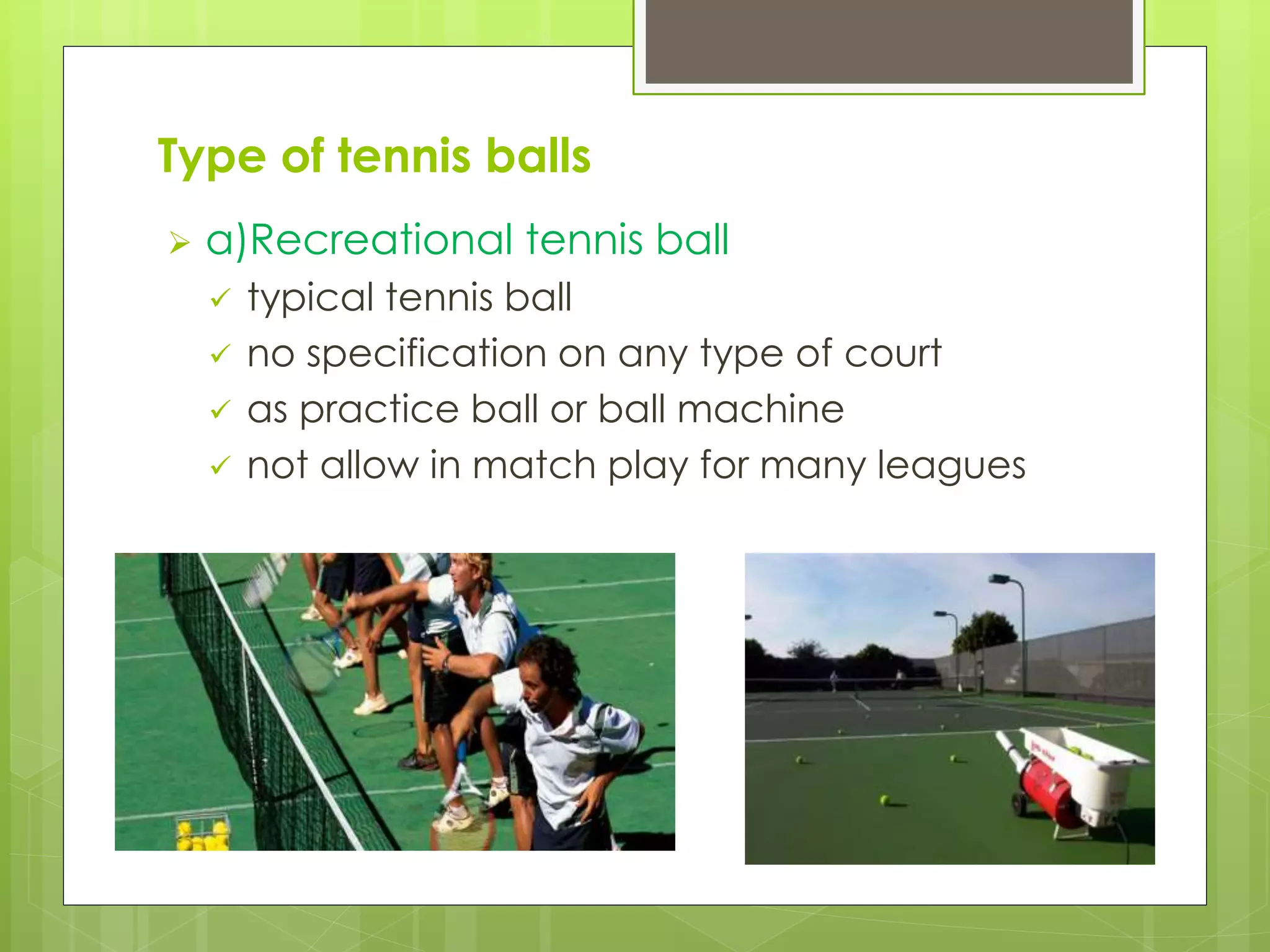
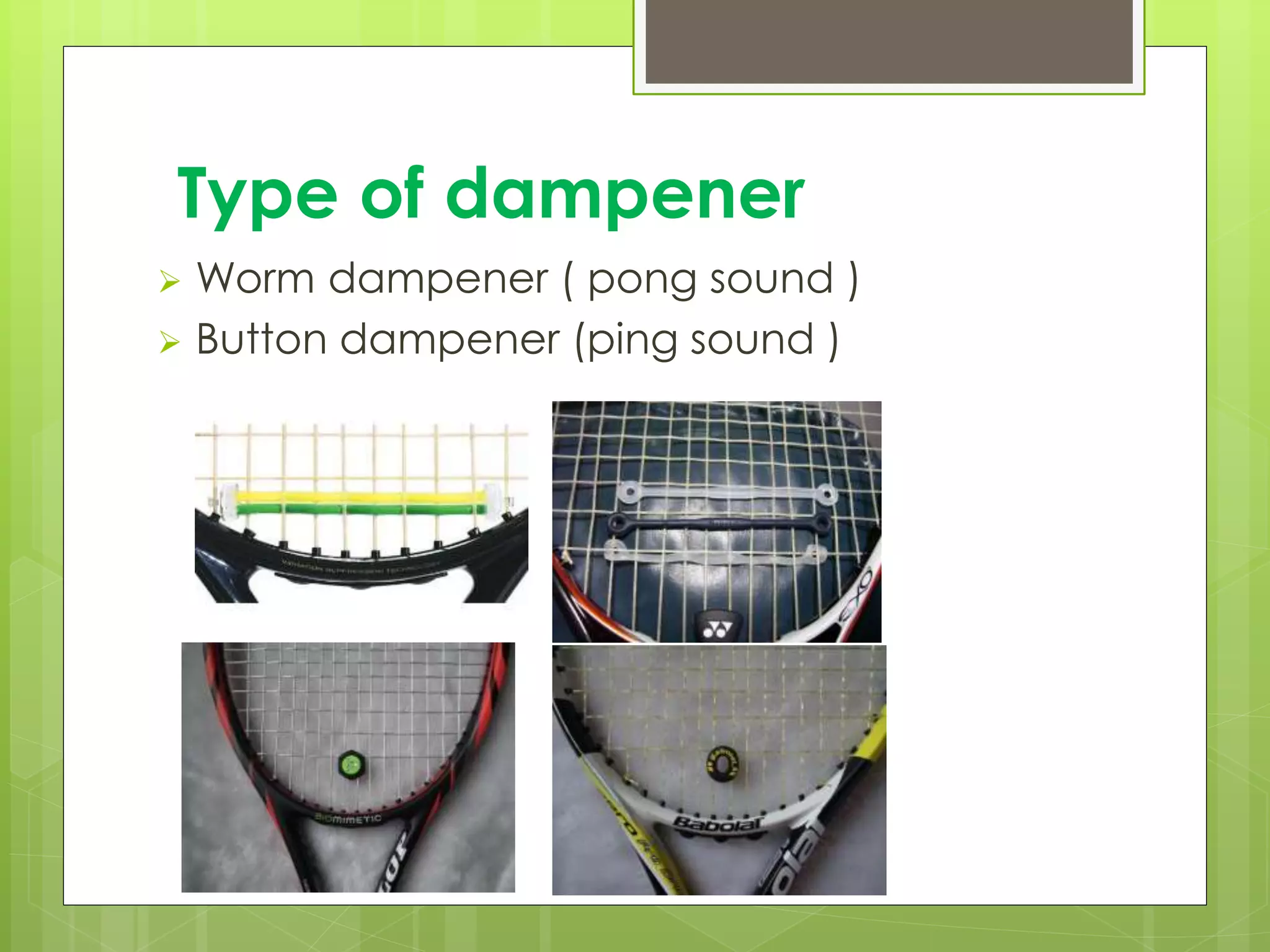
Type of dampener
 Worm dampener ( pong sound )
 Button dampener (ping sound )
Rules
&
regulation
The Size of Tennis Court
By International Tennis Federation (ITF)
Types of Tennis Court
Clay Type Surface
 Made of crushed stone and
brick.
 The surface slows down the
ball and produce a high
bounce.
 Good for baseline player.
 Cheaper to construct but cost
more for maintain.
Hard Type Surface
 Made of asphalt, arcylic or
synthetic rubber and resin.
 Faster than clay type surface
but slower than grass.
 Good for big serve and hitter.
 Cheapest to maintain.
 Used in majority of
tournaments.
Grass Type Surface
 The most popular courts
but almost extinct due to
expensive maintainance.
 Bounces depends on the
healthiness of the grass
(fast ball, low bounce).
 Good for serve and volley
player.
Standard Scoring System
(Game, Set, Match)
 Zero point = Love
 First point = 15
 Second point =30
 Third point = 40
 Fourth point = Game
 If each player score: 40:40
= Deuce
 If one player score
another point after
Deuce = advantage
 If the same player score
one more point = Game
Sets:
The first to win 6 games (must win by margin of 2 games).
There are 3 sets and 5 sets (depends on the match).
If games are tied 6:6 then continue with tie-breaker.
Tie-breaker:
First to win 7 points (score have to win by margin of 2
points, 7:5)
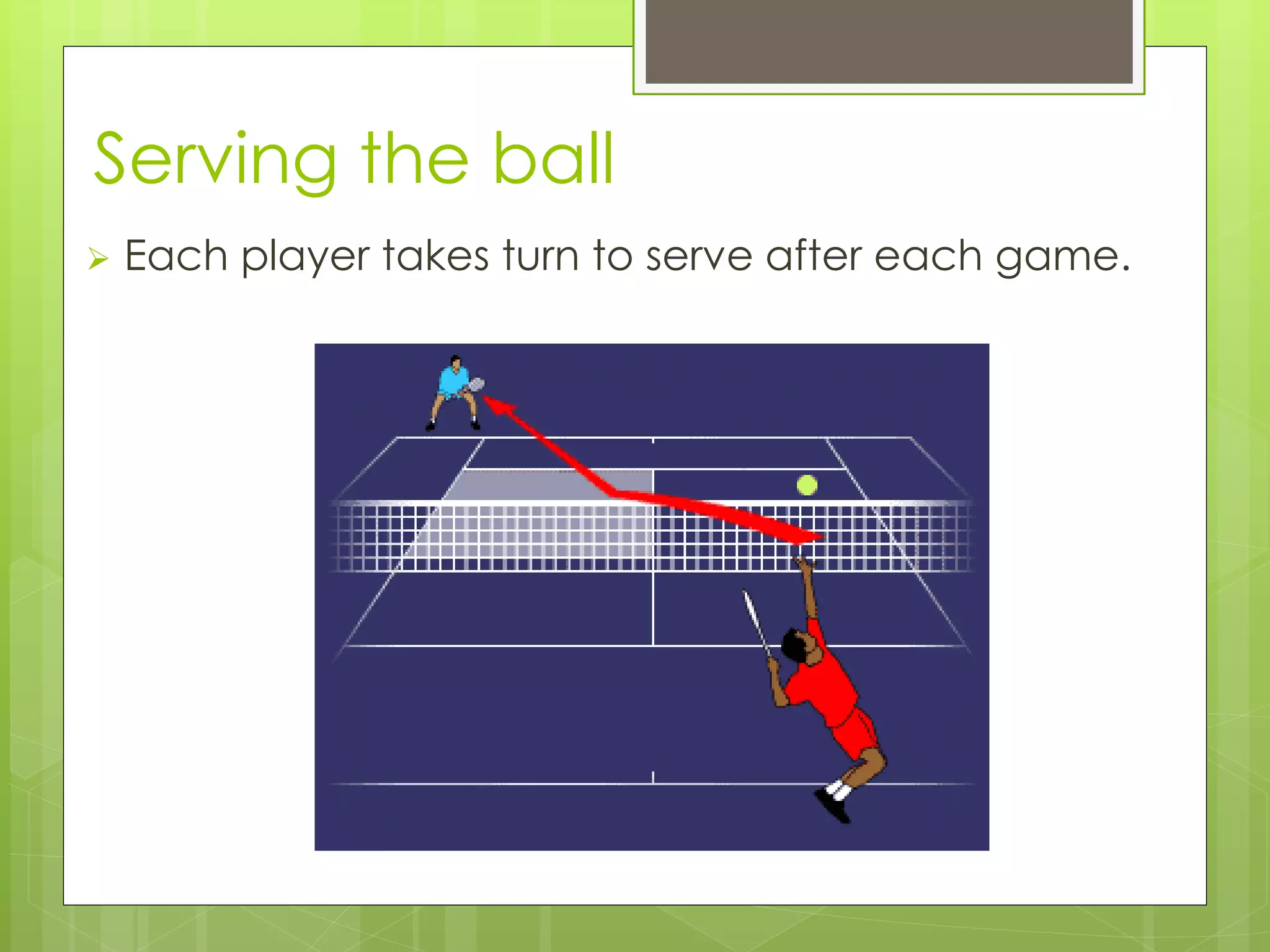
Serving the ball
 Each player takes turn to serve after each game.
Rules in Tennis
 Coin Toss
 Determine the first serve by which side of player.
 When Players change ends (double):
 Players change ends at end of 1st, 3rd and every
subsequent alternate game of each set.
 End of each set if the total of games are not even.
 Player losses point:
 two consecutive serve fault, bounces twice, outside
correct court, before bounce, hit permanent fixture
and touches ball more than once.
Tournament
a) The Grand Slam Tournaments
 Also called Majors - the four most important annual tennis
events.
 Offer the most ranking points, prize money, public and
media attention.
 The greatest strength and size of field; & greater number of
"best of" sets for men.
 Consists of the following tournaments :
(each tournament is played over a period of two weeks)
 Australian Open - mid January (played on hard courts)
 French Open - May/June (played in clay)
 Wimbledon - June/July (played on grass)
 US Open - August/September (played on hard courts)
 “Grand Slam” term originally refers to :
 The achievement of winning all four major championships in a
single calendar year.
 A Career Grand Slam = Winning all four majors at any point
during the course of a career.
b) ATP World Tour
 ATP World Tour Masters 1000, ATP World Tour
500 series, ATP World Tour 250 series and ATP
Challenger Tour.
 ATP World Tour Finals
 Played on indoor hard courts.
 Held annually in November at the O2 Arena in
London, United Kingdom.
 The season-ending championships of the
Association of Tennis Professionals (ATP) World
Tour, featuring the top eight singles players and
doubles teams of the ATP Rankings.
c) WTA Tournament
 Premier Mandatory, International
tournaments, WTA 125k Series
 Year-ending championships
(WTA Tour Championships)
 Generally considered to be the fifth most
prestigious event on the women's tour after the
four Grand Slam tournaments.
 Has the largest prize money and ranking points
after the Grand Slams.
 Since 2003, eight singles players divided into
two round robin groups, and four doubles
teams.
Tennis
Players
Female players
 Caroline Wozniacki
 Born 11 July 1990
 Danish professional tennis player
 Former World No. 1 on the WTA Tour
(held 67 weeks)
 The first woman from a
Scandinavian country to hold the
top ranking position and 20th
overall.
 Wozniacki's playing style centers on:
 “The defensive aspects of tennis with her anticipation, movement,
agility, footwork and defense all first-rate and key parts of her game.“
 Her two-handed backhand - best weapons - capable of turning
defense -> offense, most notably the backhand down-the-line.
 Her defensive playing style has her contemporaries label her a counter-
puncher.
Female players
 Caroline Wozniacki
 2005–2007: Junior success and WTA
debut
 2008: First WTA Tour title
 2009: First Grand Slam Final
( Top 5 ranking )
 2010: New world No. 1
 2011: Year-end No. 1 for the second
year in a row
 2012: Beginning of singles decline
 2013: Continued struggles with form
 2014: Resurgence and second Grand
Slam final
 2015: Back in the top 5 .
Male players
 Nikolay Davydenko
 Retired Russian tennis player.
 Achieved a career-high singles ranking of
World No. 3 in November 2006.
 Best result in a Grand Slam tournament:
- semi-finals, accomplished on four
occasions(twice each at the French
Open & the U.S. Open, losing to Roger
Federer in all but one of them).
 His biggest achievement :
 winning the 2009 ATP World Tour
Finals
 won three ATP Masters Series.
Male players
 Nikolay Davydenko
 In mid-October 2014,Davydenko retired
from competitions .
 Employs an offensive baseline game, using
deep and penetrating groundstrokes on
both wings(technically efficient on both
forehand & backhand).
 His tremendous footspeed and anticipation
enables him to hit the ball early which
catches opponents out of position and
allows him to dictate the play
 Davydenko's main weaknesses:
 his volleys - not consistent as his groundstrokes, though he
does have one of the best swinging volleys on tour.
 His occasional inability to close out matches.
Interesting Video
THE END &
Thank You

Tennis presentation slide FINAL

  • 1.
  • 2.
    Group Members  ChooJan Meng  Keng Shen Kai  Ng Chen San  Sia Shi Min  Tan Hong Wee  Tee Yeh Hun  Teh Rong Jiunn
  • 3.
  • 4.
    It’s a gameof sport not only testing your Hard Work, Discipline, Intelligence but is also testing your Determination.
  • 5.
    What is Tennis? Tennis  A racquet sport that can be played individually against a single opponent or between two teams of two players each.  Each player uses a racquet that is strung with cord to strike a hollow rubber ball covered with felt over or around a net and into the opponent's court.  Objective :  To play the ball in such a way that the opponent is not able to play a good return.  The opponent who is unable to return the ball will not gain a point, while the opposite opponent will.
  • 6.
    History of Tennis An Englishman, Major Walter C. Wingfield  invented lawn tennis (1873) & first played it at a garden party in Wales.  Sports historians all agree that Wingfield deserves much of the credit for the development of modern tennis  Called "Sphairistiké“(ball playing) by its inventor, the early game was played on an hourglass-shaped court, widest at the baselines and narrowest at the net.
  • 7.
     Court tennis Known as royal tennis.  Originated in France during the Middle Ages and became a favourite of British royalty, including Henry VIII.  The progression from court tennis: • Used an unresilient sheepskin ball filled with sawdust, sand, or wool, to lawn tennis depended upon invention of a ball that would bounce.  Tennis spread to the United States by way of Bermuda.  While vacationing there, Mary Ewing Outerbridge of New York was introduced (1874) to the game by a friend of Wingfield.  She returned to the United States with a net, balls, and rackets, and with the help of her brother, set up a tennis court in Staten Island, N.Y.
  • 8.
  • 9.
    Type of tennisracquet a)Power or game improvement racquets  Super oversize head  Lightweight and longer  designed for players with shorter &slower swings  wants more power from racquet b)Tweener racquets  smaller head size  heavier weight compare to power racquets  offer medium- high power  For players that seek for enhanced maneuverability
  • 10.
    c)Control or players’racquets  have the smallest head size  heaviest among three type of racquets  for players that like to provide own power  better control of the racquets
  • 11.
    Type of tennisballs  a)Recreational tennis ball  typical tennis ball  no specification on any type of court  as practice ball or ball machine  not allow in match play for many leagues
  • 12.
     b)Fast-speed tennisball  ball is slightly harder  for slower court  sufficient for almost all league match play c) Slow-speed tennis ball  larger in size  for faster court
  • 13.
    What do aString Dampener do?  dampen string vibrations,  not frame vibrations;  in dampening string vibrations  change the sound of the impact,
  • 14.
    Type of dampener Worm dampener ( pong sound )  Button dampener (ping sound )
  • 15.
  • 16.
    The Size ofTennis Court
  • 17.
    By International TennisFederation (ITF) Types of Tennis Court
  • 18.
    Clay Type Surface Made of crushed stone and brick.  The surface slows down the ball and produce a high bounce.  Good for baseline player.  Cheaper to construct but cost more for maintain.
  • 19.
    Hard Type Surface Made of asphalt, arcylic or synthetic rubber and resin.  Faster than clay type surface but slower than grass.  Good for big serve and hitter.  Cheapest to maintain.  Used in majority of tournaments.
  • 20.
    Grass Type Surface The most popular courts but almost extinct due to expensive maintainance.  Bounces depends on the healthiness of the grass (fast ball, low bounce).  Good for serve and volley player.
  • 21.
    Standard Scoring System (Game,Set, Match)  Zero point = Love  First point = 15  Second point =30  Third point = 40  Fourth point = Game  If each player score: 40:40 = Deuce  If one player score another point after Deuce = advantage  If the same player score one more point = Game Sets: The first to win 6 games (must win by margin of 2 games). There are 3 sets and 5 sets (depends on the match). If games are tied 6:6 then continue with tie-breaker. Tie-breaker: First to win 7 points (score have to win by margin of 2 points, 7:5)
  • 22.
    Serving the ball Each player takes turn to serve after each game.
  • 23.
    Rules in Tennis Coin Toss  Determine the first serve by which side of player.  When Players change ends (double):  Players change ends at end of 1st, 3rd and every subsequent alternate game of each set.  End of each set if the total of games are not even.  Player losses point:  two consecutive serve fault, bounces twice, outside correct court, before bounce, hit permanent fixture and touches ball more than once.
  • 24.
  • 25.
    a) The GrandSlam Tournaments  Also called Majors - the four most important annual tennis events.  Offer the most ranking points, prize money, public and media attention.  The greatest strength and size of field; & greater number of "best of" sets for men.  Consists of the following tournaments : (each tournament is played over a period of two weeks)  Australian Open - mid January (played on hard courts)  French Open - May/June (played in clay)  Wimbledon - June/July (played on grass)  US Open - August/September (played on hard courts)  “Grand Slam” term originally refers to :  The achievement of winning all four major championships in a single calendar year.  A Career Grand Slam = Winning all four majors at any point during the course of a career.
  • 26.
    b) ATP WorldTour  ATP World Tour Masters 1000, ATP World Tour 500 series, ATP World Tour 250 series and ATP Challenger Tour.  ATP World Tour Finals  Played on indoor hard courts.  Held annually in November at the O2 Arena in London, United Kingdom.  The season-ending championships of the Association of Tennis Professionals (ATP) World Tour, featuring the top eight singles players and doubles teams of the ATP Rankings.
  • 27.
    c) WTA Tournament Premier Mandatory, International tournaments, WTA 125k Series  Year-ending championships (WTA Tour Championships)  Generally considered to be the fifth most prestigious event on the women's tour after the four Grand Slam tournaments.  Has the largest prize money and ranking points after the Grand Slams.  Since 2003, eight singles players divided into two round robin groups, and four doubles teams.
  • 28.
  • 29.
    Female players  CarolineWozniacki  Born 11 July 1990  Danish professional tennis player  Former World No. 1 on the WTA Tour (held 67 weeks)  The first woman from a Scandinavian country to hold the top ranking position and 20th overall.  Wozniacki's playing style centers on:  “The defensive aspects of tennis with her anticipation, movement, agility, footwork and defense all first-rate and key parts of her game.“  Her two-handed backhand - best weapons - capable of turning defense -> offense, most notably the backhand down-the-line.  Her defensive playing style has her contemporaries label her a counter- puncher.
  • 30.
    Female players  CarolineWozniacki  2005–2007: Junior success and WTA debut  2008: First WTA Tour title  2009: First Grand Slam Final ( Top 5 ranking )  2010: New world No. 1  2011: Year-end No. 1 for the second year in a row  2012: Beginning of singles decline  2013: Continued struggles with form  2014: Resurgence and second Grand Slam final  2015: Back in the top 5 .
  • 31.
    Male players  NikolayDavydenko  Retired Russian tennis player.  Achieved a career-high singles ranking of World No. 3 in November 2006.  Best result in a Grand Slam tournament: - semi-finals, accomplished on four occasions(twice each at the French Open & the U.S. Open, losing to Roger Federer in all but one of them).  His biggest achievement :  winning the 2009 ATP World Tour Finals  won three ATP Masters Series.
  • 32.
    Male players  NikolayDavydenko  In mid-October 2014,Davydenko retired from competitions .  Employs an offensive baseline game, using deep and penetrating groundstrokes on both wings(technically efficient on both forehand & backhand).  His tremendous footspeed and anticipation enables him to hit the ball early which catches opponents out of position and allows him to dictate the play  Davydenko's main weaknesses:  his volleys - not consistent as his groundstrokes, though he does have one of the best swinging volleys on tour.  His occasional inability to close out matches.
  • 33.
  • 34.