MASITAH ABD. WAHID (AP050093)  HAZNI ABD. GHANI (AP050065)  HAYAZI MOHD YASIN (AP050372)  1 SPH SESSION 2005/2006 LECTURER : CIK SARIMAH ISMAIL http://tangkapgambar.blogspot.com /
INTRODUCTION By study of history, it helps us to identify the traditions of our nation’s customs, and a knowledge of the evolution of food and beverage service that would not only assist in discerning the trends that hare led to present-day standards but produce a sense of pride in an employee in being part of an ancient and honorable calling. There are several different types of service in Malaysia. Most forms of service originated  in the private homes is different. It’s depend of community. The four traditional forms of our service discussed in this chapter are Malay, Chinese, Indian and Western. In addition to the table setting, we including about silverware, napkin, glassware and place setting. We would like to say special thanks to Cik Sarimah Bt. Ismail, En Rizal B. Mohd Said and Pn. Erna above encouragement us to made this manual possible. We also would like to say special thanks to our course mate SPH section 1, who helped us in revision of the book.
TABLE SETTING PREPARING THE TABLE The first opening duty is to check your station to see that the  general area is presentable to setup for service.  Setup enough tables to accommodate the reservations and  the average number of persons without reservations who are  expected.  Using a clean cloth or sponge in a solution of milk  detergent and warm water, thoroughly wash the tables before you  set them.  Check the seats, dusting off crumbs and cleaning sticky  area.
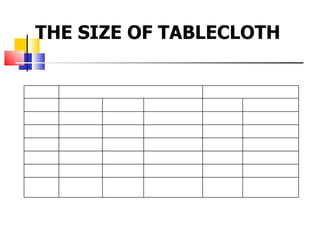
THE SIZE OF TABLECLOTH SEAT TABLE SIZE TABLE CLOTH 2 Square 2’6” 75 cm 54” x 54” 135cm x 135cm 4 Square 3’ 1 m 60” x 60” 150cm x 150cm 4 Round 3’ 1 m 60” x 60” 150cm x 150cm 8 Round 5’ 1.5 m 84” x 84” 210cm x 210cm 4 Rectangular 2 ½’ x 4 ½’ 75 cm x 135 cm 54” x 78” 135cm x 200cm 6 Rectangular 3’ x 6’ 90 cm x 180 cm 60” x 96” 150cm x 245cm Buffet 4’ x 10’ 120 cm x 300 cm 72” x 144” 180cm x 365cm
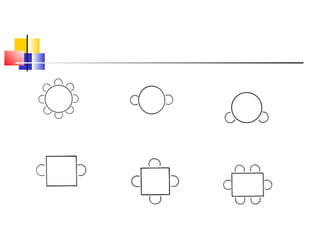
CHAIR PLACEMENT AROUND TABLES OF VARIOUS SHAPES Round tables Round deuce in center of room Round deuce against a wall Center of room or window view Square deuce in center of room or against a wall square rectangular
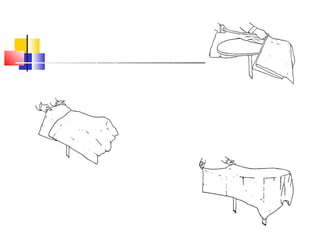
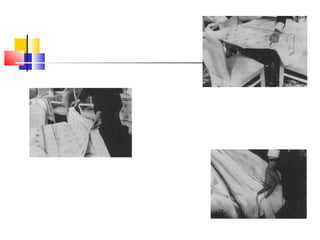
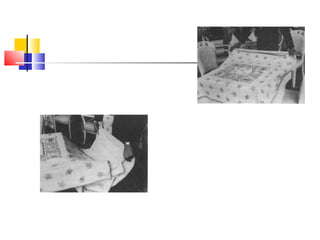
Lift the tablecloth and throw the bottom free single fold over the far edge of the table. Judge the amount of overlap necessary from the creases running across the tablecloth and parallel to the waiter. Release the inverted fold held between the thumb and first finger, and draw the first single fold, held between the first and second finger, slowly towards you. Shake the cloth gently as you draw it towards you and this will allow it to unfold more easily. Ensure the corners of the tablecloth cover the legs of the table PLACING THE CLOTH ON THE TABLE
CHANGING THE TABLECLOTH Drop the top edge over the edge of the table Bring the bottom edge up to table height Grasp the second edge
Step back from the table holding all three edge, just before releasing the top edge After dropping the top edge, bring your hands together, keeping all crumbs inside the folds of the tablecloth
CUTLERIES AND CROCKERY These items add considerably to the good looks of a restaurant as seen by a  customer immediately he enters it, and its quality must be in accordance with the  class of restaurant. A single plate as used for serving a nouvelle cuisine meal cost  as much and a cut-glass goblet is equally expensive, so waiting-staff should take  reasonable care in handling them so as to avoid breakages and damages. According to dictionary  cutlery  means  spoons, forks  and  knives  that we use for  eating food. There’s so many types of cutlery and different shapes for different kind of  uses. Not only fork, spoon and knives including in cutlery but also the things that use for  serving such as crumber, cake server and serving fork.  Crockery  is  cups, dishes  and  plates . Or the other name we call it, table ware.  There are such different plates for serving types of foods. For cups, it’s a lot of  different within meals. It is made in several qualities with bone china and porcelain  being reckoned as the best, it can be colored, plan or decorated, elegant to look at, yet  functional and easy to option future stocks. It may be necessary one size and shape  serve several purposes. Crockery also not specific to plate and cups but also things that  we use to serve the guest such as serving dish cover and serving tray.
Plates and bowls: 1. Service plates 2. Main course plates 3. Breakfast plates 4. Soup plates 5. Plates or bowls for cereal 6. Bread and butter plates Cup and Linear: 1. Coffee unit 2. Soup bowl and linear 3. Egg cup and saucer 4. Demitasse unit TYPES OF CROCKERY
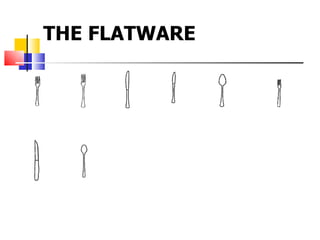
THE FLATWARE Appetizer forks Entree forks Entrée knives Bread and butter knives Soup spoons Steak knives Teaspoons Cocktail forks Knives: 1. Main course 2. Fish knives 3. Fruit knives Forks: 1. Main course fork  or dinner forks 2. Dessert forks 3. Salad forks Spoon: 1. Table spoon 2. Cereal spoon 3. Coffee spoon 4. Demitasse spoon
How flatware dirty or clean- is handle by the service staff can effect its cleanliness.  Most operations provide a separate vessel with a special chemical in it for soaking  soiled flatware so that food particles do not stick to the flatware or between the  tines of forks. Egg residue can be especially difficult to remove once it has hardened. If the flatware requires daily supplemental care there are various methods that can  be employed. There are two specialized cleaning machines for flatware. 1.  A tumbler washer , which is used with a special soap for the cleaning and polishing of already clean flatware after every use. 2.  A burnishing machine , essentially a revolving drum lined with rubber and filled with metal pellets, which is used for deep polishing on an occasional basis. Lacking mechanical assistance, the serves are obliged to complete the cleaning of \ the flatware by hand.
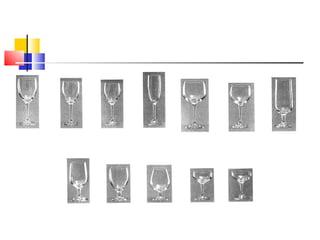
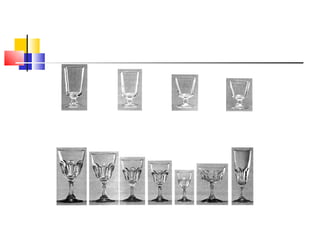
THE GLASSES Glasses vary in size and style depending on the preference of  management. However the well-know types of glasses are important for  the waiter or waitress to recognize. Whiskey Jigger or Shot Glass . A very small glass with a capacity of 1½ ounces. Highball Glass . A medium-tall, straight-sided glass holding between 5 and 8 ounces. Collins Glass . A tall, straight-sided, frosted glass holding about 10 to 12 ounces. Old Fashioned Glass . A low, squat glass holding about 6 ounces. Cocktail Glass . A 4 ounce, funnel-shaped, stemmed glass. Sour Glass . A 4 ounce, slender, tulip-shaped glass with a short stem. Brandy Glass . An 8 ounce, balloon-shaped glass with a short stem. Cordial Glass . A slender, stemmed, tulip-shaped holding about 1 ounce. *Normally there is 3 types of glasses setting on the table. The 3 main glasses are  goblet  (10 ½ oz),  tall wine  (8 ½ oz) and  tall wine  (6 ½ oz).
Goblet  Tall Wine  Tall Wine  Flute 10 ½ oz  8 ½ oz  6 ½ oz  5 ¾ oz Grand Ballon  Ballon Wine   Pilsner 13 oz Wine  8 ½ oz  12 oz All purpose  Banquet  Brandy  Champagne  Champagne Goblet  Goblet 11 oz  10 ½ oz  12 oz  8 ½ oz  4 ½ oz TYPES OF GLASSWARE
Footed Hi Ball  Footed Hi Ball  Footed Rocks  Footed Rocks 10 oz  8 oz  7 oz  6 ½ oz Goblet  Wine  Wine  Sherry  Cordial Champagne  Flute 10 ½ oz  8 ½ oz  5 ½ oz  3 ¾ oz  1 ½ oz  6 ½ oz  5 ½ oz
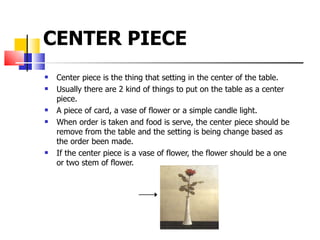
CENTER PIECE Center piece is the thing that setting in the center of the table. Usually there are 2 kind of things to put on the table as a center piece. A piece of card, a vase of flower or a simple candle light. When order is taken and food is serve, the center piece should be remove from the table and the setting is being change based as the order been made. If the center piece is a vase of flower, the flower should be a one or two stem of flower. Sample of center piece
Flatware for place setting must be immaculate and polished. Once these basics are covered, the rest is detail.  Immaculate and polished flatware excludes that with the following: Fingerprints Water stains Bits of food particles The Rules  to remember when  holding flatware : Always handle flatware its waist not at the top, which will go into the guest’s mount, nor at the bottom, where fingerprints will show. Always use a cloth napkin or clean cloth when handling flatware to avoid getting fingerprints on it. Use a clean lint-free cloth napkin to wipe down wet flatware to prevent water marks. Only water makes them, only water removes them. When resetting or replacing flatware at a table with guests present, carry the flatware in cloth pouch or folded envelope atop a salad plate, remove the flatware from the pouch and place it for the guest’s use. Place pieces of flatware parallel to each other, and perpendicular to the edge of the table. PREPARING FLATWARE FOR THE DINING ROOM
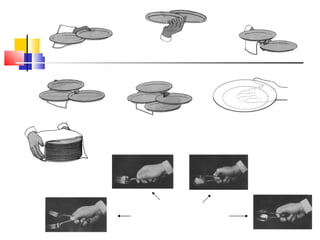
Use of serving spoon and fork View from below Placing a cold plate on table Carrying number of plate
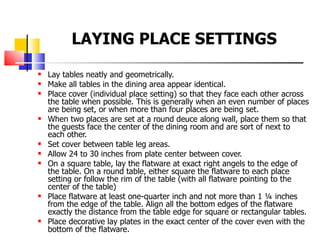
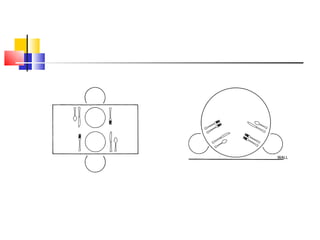
LAYING PLACE SETTINGS Lay tables neatly and geometrically. Make all tables in the dining area appear identical. Place cover (individual place setting) so that they face each other across the table when possible. This is generally when an even number of places are being set, or when more than four places are being set. When two places are set at a round deuce along wall, place them so that the guests face the center of the dining room and are sort of next to each other. Set cover between table leg areas. Allow 24 to 30 inches from plate center between cover. On a square table, lay the flatware at exact right angels to the edge of the table. On a round table, either square the flatware to each place setting or follow the rim of the table (with all flatware pointing to the center of the table) Place flatware at least one-quarter inch and not more than 1 ¼ inches from the edge of the table. Align all the bottom edges of the flatware exactly the distance from the table edge for square or rectangular tables. Place decorative lay plates in the exact center of the cover even with the bottom of the flatware.
Flatware alignment on a table Flatware alignment at a round deuce along a wall
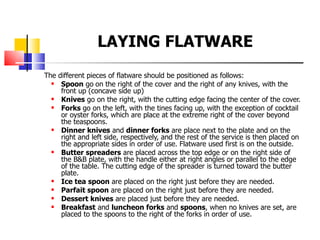
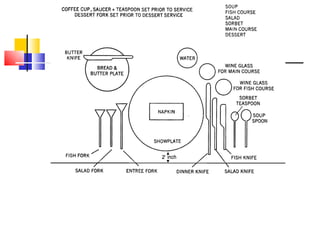
LAYING FLATWARE The different pieces of flatware should be positioned as follows: Spoon  go   on the right of the cover and the right of any knives, with the front up (concave side up) Knives  go on the right, with the cutting edge facing the center of the cover. Forks  go on the left, with the tines facing up, with the exception of cocktail or oyster forks, which are place at the extreme right of the cover beyond the teaspoons. Dinner knives  and  dinner forks  are place next to the plate and on the right and left side, respectively, and the rest of the service is then placed on the appropriate sides in order of use. Flatware used first is on the outside. Butter spreaders  are placed across the top edge or on the right side of the B&B plate, with the handle either at right angles or parallel to the edge of the table. The cutting edge of the spreader is turned toward the butter plate. Ice tea spoon  are placed on the right just before they are needed. Parfait spoon  are placed on the right just before they are needed. Dessert knives  are placed just before they are needed. Breakfast  and  luncheon forks  and  spoons , when no knives are set, are placed to the spoons to the right of the forks in order of use.
- Utensil should be about ½ inch away from the plate or each other. - They should also be lined up evenly from their bottom. - Dinner plate should be placed approximately 2 inches from the table’s edge. - Napkin are commonly placed on the plate, to the left of the forks or inside of a drinking glass. - When using candles as the sole source of light they must be placed symmetrically upon the table and their  flames should not be at eyelevel.
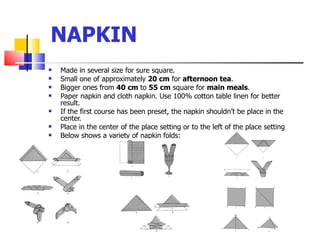
NAPKIN Made in several size for sure square. Small one of approximately  20 cm  for  afternoon tea . Bigger ones from  40   cm  to  55   cm  square for  main meals . Paper napkin and cloth napkin. Use 100% cotton table linen for better result. If the first course has been preset, the napkin shouldn’t be place in the center.  Place in the center of the place setting or to the left of the place setting Below shows a variety of napkin folds:
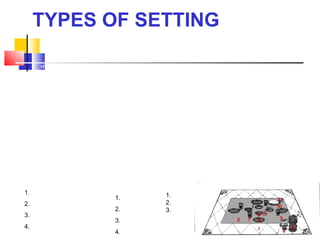
TYPES OF SETTING MALAY Normally, Malay table setting is use a white cloth what they call it ‘kain saprah’ for linear the  dinner on the floor or on the table. They use hand when eat. That’s why there usually put a bowl full of water to wash hand before eat. The food is serving in bowl or plate and put it in the center of table. The rice is serving in a plate and for the additional, the rice is put in a big bowl. The plate is going in front of the guest and the glasses go on the left of the guest. The food is self service. Usually, there are 4 or 5 people eat together. To take additional food, the guest usually use left hand to take the food. It’s because the right hand had been use to eaten.  Usually coffee and dessert is serving. Mengkuang mat White cloth (kain saprah) Wash hand place Liquid soap Napkin Rice plate Glass Food plate Food spoon Serve plate Rice
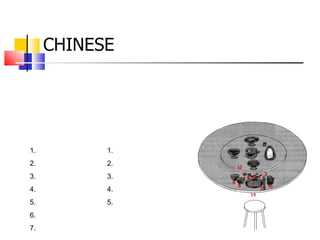
CHINESE Usually, the Chinese use chopstick to eat. Variety of food is usually following the types of serve and usually there are 5 or more variety of food. The host usually serves the food to the guest. Usually the food is put on the table that can be swing. It’s because to easy the guest to take the food. Usually dessert and Chinese tea is serving. 15 cm plate Chopstick Chopstick cover Eat spoon Soup spoon Chili plate Ketchup plate Rice bowl Soup bowl Tea glass Round table Swing table
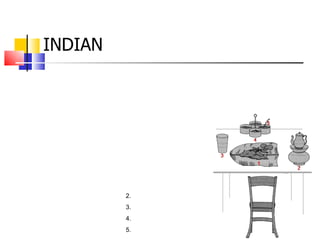
INDIAN Usually, there use hand to eat because of that, the place to wash hand is ready. They use bananas leaf. The rice is serve on the bananas leaf and the food is serve beside the rice on the same bananas leaf. The additional food is put in the 4 container that stick together. The dessert also serve in the glass container or stainless steel but not on the bananas leaf. Usually they serve a glass of cow milk or yogurt (lasi) for drink.  1.  Banana leaf Wash hand place Glass Food container stick together Food spoon
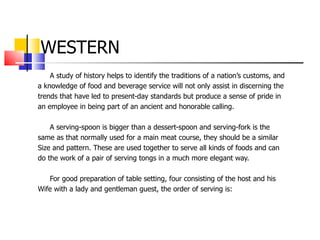
WESTERN A study of history helps to identify the traditions of a nation’s customs, and  a knowledge of food and beverage service will not only assist in discerning the  trends that have led to present-day standards but produce a sense of pride in  an employee in being part of an ancient and honorable calling. A serving-spoon is bigger than a dessert-spoon and serving-fork is the  same as that normally used for a main meat course, they should be a similar  Size and pattern. These are used together to serve all kinds of foods and can  do the work of a pair of serving tongs in a much more elegant way.  For good preparation of table setting, four consisting of the host and his  Wife with a lady and gentleman guest, the order of serving is:
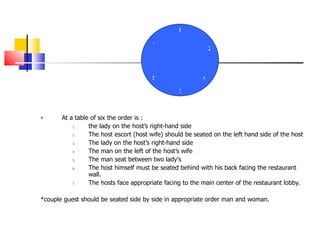
At a table of six the order is : the lady on the host’s right-hand side The host escort (host wife) should be seated on the left hand side of the host The lady on the host’s right-hand side The man on the left of the host’s wife The man seat between two lady's The host himself must be seated behind with his back facing the restaurant wall. The hosts face appropriate facing to the main center of the restaurant lobby.  *couple guest should be seated side by side in appropriate order man and woman. host lady man lady man Host’s wife 6 4 2 3 5 1
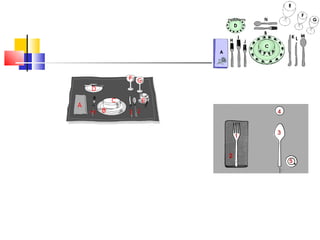
Breakfast and Lunch Snack set Dinner A.  Napkin B.  Service Plate C.  Soup Bowl D.  Butter Plate/Butter  Knife or Salad Plate E.  Water Glass F.  White Wine G.  Red Wine     H.  Fish Fork I.   Dinner Fork J.   Salad Fork K.   Service Knife L.   Fish Knife M.   Soup Spoon N.  Dessert Fork/Spoon   A Napkin B Luncheon Plate C Cereal Bowl D Bread and Butter Plate E Cup and Saucer with spoon F Water Glass G Juice Glass H Fork I Knife J Teaspoon 1. Fork 2. Napkin 3. Spoon 4. Glass 5. Cup
CONCLUSION The conclusion, the presentation of food is very important because it elicits the initial  consumer reaction to its acceptance or rejection, we eat first with our eyes, then with the nose  and finally with our mouth. First impression win over hearts and it is imperative to have a well laid-out table setting. the  table is on display from the moment the guest arrive. It clearly conveys the thought that has  gone into planning and shows the invited guests that they are well cared for. The history of table setting reminds us of the names of well-known about performance  community.
PREFERENCES http://www.finedinings.com/planning_an_elegant_fine_dining_.htm   http://www.cruisereviews.com/Celebrity/Millennium43.htm   Axler B and Litrides c. (1990).  Food And Beverage Service , Kanada: Wiley  Bill Hansen. (1995).  Off-Premise Catering Management , New York: Wiley  H. L. Cracknell, (1989).  Mastering Restaurant Service,  London: Macmillan Sondra J. Dahmer, (1988).  The Waiter And Waitress Training Manual , USA: Van Nostrand  Reinhold Wallace L. Rande (1996).  Introduction To Professional Foodservice , Kanada: Wiley Aishah. Hamzah (2002).  Teknologi Dan Perkhidmatan Katering , Kuala Lumpur: Dewan    Bahasa dan Pustaka