PRINCIPLES IN
DINING ROOM
OPERATIONS
PRINCIPLES IN DINING ROOM
OPERATIONS
Preparing the dining room is one of the major
activities that spell success in any food service
activity.
ROOM ARRANGEMENT
The arrangement of tables is an important factor
that contributes to the success of any occasion or
function. It is extremely important to create an
environment suitable for the purpose of the
occasion.
• When planning the arrangement of a room, you must include the following room
layout considerations:
1. Size or square footage of the room area.
2. Aisle space required for service personnel to go around while serving the food.
3. Service areas or wait stations, including the soiled dish area.
4. Placement of the beverage stations, coffee stations, and portable bar
5. Number of seats per table
6. Shapes and size of table
7. Total number of guest
8. Type of menu served
9. Activity and flow of the guest
10. Fire and safety codes and the emergency exits
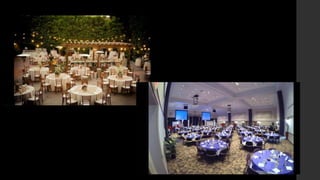
• Banquet style is generally used to describe room
setups for meal functions. Here are some things to
remember:
1. Use round tables(66-72 inches in round)
2. Sit eight to ten guests per table
3. Tables are usually ten feet apart from center to
center.
Some dining rooms have partitions to separate areas.
These partitions can bne mechanically folded to one
side similar to an accordion.
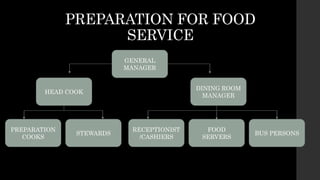
PREPARATION FOR FOOD
SERVICE
GENERAL
MANAGER
HEAD COOK
DINING ROOM
MANAGER
STEWARDS
PREPARATION
COOKS
RECEPTIONIST
/CASHIERS
FOOD
SERVERS
BUS PERSONS
MISE-EN-PLACE PREPARATIONS
Mise- en-place is a French word which means
“everything in place” in `food and even in beverage
service, this refers to all the basic preparations in dining
the dining or service area before the set-up and food
service are undertaken. Here are the basic activities
that should be considered.
1. Pick up and cleaning of equipment and supplies
a. Have a list of items to be picked up and to be installed
at service station to make sure nothing is left out.
b. Bring the requested items in a trolley or bus pan.
Follow the guidelines as follows:
•Chinawares must be piled up by tens to
avoid accidental breakage.
•Glasswares must be placed in a glassware
rack or utility.
•Flatwares must be placed in flatware rack.
c. Check for damages and remove them.
Damaged ones should be listed in the
breakages and losses report.
2. Wiping and polishing service wares
a.Prepare clean and dry cloth for wiping.
b.Dry cutleries and china wares using
clean, dry cloth. Once moist use another
wiping cloth.
3. Preparing the service station and
stocking the sideboard
To facilitate the flow of service, it is best to place a
service cabinet or sideboard per area or station in the
dining/ function area. Items placed on the sideboard
must be checked daily for cleanliness and condition.
a. Thoroughly clean the side board/cabinet with sanitizer
and make sure it is completely dry and free of any foul
odor.
b. The person in-charge shall prepare par stock of items
to be stocked in the service station. A par stock refers to
the volume of utility items/ other stocks needed to
sustain an efficient service.
a.Before the start of the operations, the
captain waiter shall check the
completeness of par stock.
b.Supplies should be properly classified
and arranged. Place them in their
appropriate location at the service
station.
DINING ROOM EQUIPMENT
• The ability to set up a beautiful dining table is
very important consideration in many food
service establishments. The needed dining
equipment is based on the menu, type of service,
location for the event and special needs of clients
or customers. These include equipment for
serving the food and for dining.
• These equipment are classified as dinnerwares,
flatwares beveragewares and linens.
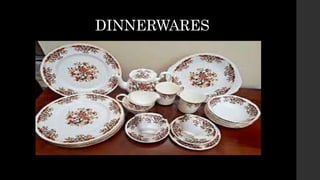
DINNERWARES
1. Platters are oval shaped dishes with widths ranging from 8-
10 inches of either china, ceramics, glasss or plastic.
2. Soup tureens are round or oval-shaped hollow container
made either of china or ceramics.
3. Tea/ coffee pot is used for serving tea or coffee
4. Sugar bowl and creamer are used for serving sugar and milk.
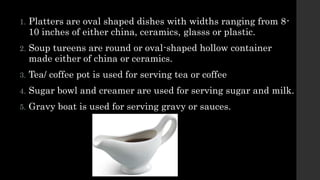
5. Gravy boat is used for serving gravy or sauces.
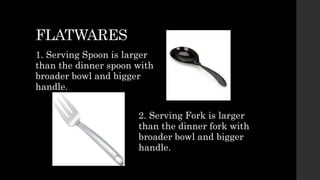
FLATWARES
1. Serving Spoon is larger
than the dinner spoon with
broader bowl and bigger
handle.
2. Serving Fork is larger
than the dinner fork with
broader bowl and bigger
handle.
3. Pie server has a wide, flat, and
elongated shape with short handle.
4. Soup ladle has a long handle with
small, rounded, deep, bowl.
5. Gravy ladle has a long handle with
small, rounded, hollow bowl.
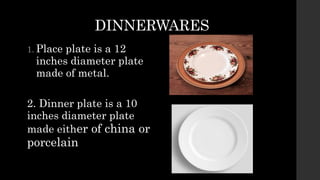
DINNERWARES
1. Place plate is a 12
inches diameter plate
made of metal.
2. Dinner plate is a 10
inches diameter plate
made either of china or
porcelain
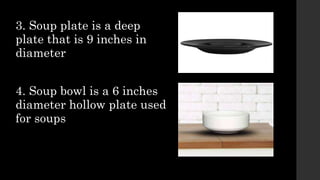
3. Soup plate is a deep
plate that is 9 inches in
diameter
4. Soup bowl is a 6 inches
diameter hollow plate used
for soups
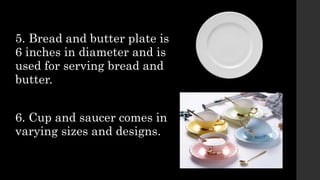
5. Bread and butter plate is
6 inches in diameter and is
used for serving bread and
butter.
6. Cup and saucer comes in
varying sizes and designs.
FLATWARES
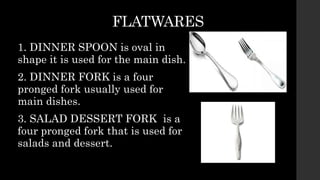
1. DINNER SPOON is oval in
shape it is used for the main dish.
2. DINNER FORK is a four
pronged fork usually used for
main dishes.
3. SALAD DESSERT FORK is a
four pronged fork that is used for
salads and dessert.
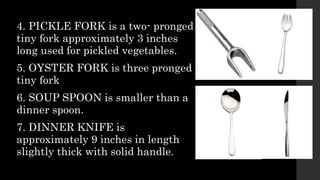
4. PICKLE FORK is a two- pronged
tiny fork approximately 3 inches
long used for pickled vegetables.
5. OYSTER FORK is three pronged
tiny fork
6. SOUP SPOON is smaller than a
dinner spoon.
7. DINNER KNIFE is
approximately 9 inches in length
slightly thick with solid handle.
BEVERAGE WARE
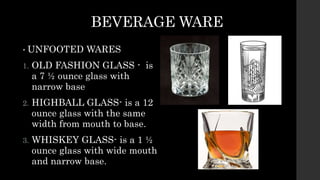
• UNFOOTED WARES
1. OLD FASHION GLASS - is
a 7 ½ ounce glass with
narrow base
2. HIGHBALL GLASS- is a 12
ounce glass with the same
width from mouth to base.
3. WHISKEY GLASS- is a 1 ½
ounce glass with wide mouth
and narrow base.
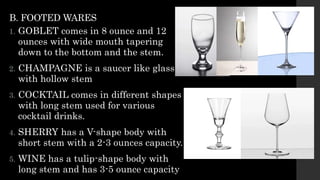
B. FOOTED WARES
1. GOBLET comes in 8 ounce and 12
ounces with wide mouth tapering
down to the bottom and the stem.
2. CHAMPAGNE is a saucer like glass
with hollow stem
3. COCKTAIL comes in different shapes
with long stem used for various
cocktail drinks.
4. SHERRY has a V-shape body with
short stem with a 2-3 ounces capacity.
5. WINE has a tulip-shape body with
long stem and has 3-5 ounce capacity
LINENS USED FOR DINING
1. TABLE CLOTH comes in varying sizes and shapes
depending on the table. It can be made of cotton, domask,
ramie, linen or synthetic.
2. SILENCE CLOTH is a thick cloth used as padding
underneath the table cloth.
3. TOP CLOTH OR TABLE RUNNERS are smaller cloth
placed on the top table
4. PLACEMATS measures approximately 18-24 inches and
used as individual covers.
5. NAPKINS comes in varying sizes and materials used as
protection of clothes from getting soiled.
LESSON 3 PRINCIPLES IN DINING ROOM OPERATION.pptx

LESSON 3 PRINCIPLES IN DINING ROOM OPERATION.pptx

  • 1.
  • 2.
    PRINCIPLES IN DININGROOM OPERATIONS Preparing the dining room is one of the major activities that spell success in any food service activity. ROOM ARRANGEMENT The arrangement of tables is an important factor that contributes to the success of any occasion or function. It is extremely important to create an environment suitable for the purpose of the occasion.
  • 3.
    • When planningthe arrangement of a room, you must include the following room layout considerations: 1. Size or square footage of the room area. 2. Aisle space required for service personnel to go around while serving the food. 3. Service areas or wait stations, including the soiled dish area. 4. Placement of the beverage stations, coffee stations, and portable bar 5. Number of seats per table 6. Shapes and size of table 7. Total number of guest 8. Type of menu served 9. Activity and flow of the guest 10. Fire and safety codes and the emergency exits
  • 4.
    • Banquet styleis generally used to describe room setups for meal functions. Here are some things to remember: 1. Use round tables(66-72 inches in round) 2. Sit eight to ten guests per table 3. Tables are usually ten feet apart from center to center. Some dining rooms have partitions to separate areas. These partitions can bne mechanically folded to one side similar to an accordion.
  • 6.
    PREPARATION FOR FOOD SERVICE GENERAL MANAGER HEADCOOK DINING ROOM MANAGER STEWARDS PREPARATION COOKS RECEPTIONIST /CASHIERS FOOD SERVERS BUS PERSONS
  • 7.
    MISE-EN-PLACE PREPARATIONS Mise- en-placeis a French word which means “everything in place” in `food and even in beverage service, this refers to all the basic preparations in dining the dining or service area before the set-up and food service are undertaken. Here are the basic activities that should be considered. 1. Pick up and cleaning of equipment and supplies a. Have a list of items to be picked up and to be installed at service station to make sure nothing is left out. b. Bring the requested items in a trolley or bus pan. Follow the guidelines as follows:
  • 8.
    •Chinawares must bepiled up by tens to avoid accidental breakage. •Glasswares must be placed in a glassware rack or utility. •Flatwares must be placed in flatware rack. c. Check for damages and remove them. Damaged ones should be listed in the breakages and losses report.
  • 9.
    2. Wiping andpolishing service wares a.Prepare clean and dry cloth for wiping. b.Dry cutleries and china wares using clean, dry cloth. Once moist use another wiping cloth. 3. Preparing the service station and stocking the sideboard
  • 10.
    To facilitate theflow of service, it is best to place a service cabinet or sideboard per area or station in the dining/ function area. Items placed on the sideboard must be checked daily for cleanliness and condition. a. Thoroughly clean the side board/cabinet with sanitizer and make sure it is completely dry and free of any foul odor. b. The person in-charge shall prepare par stock of items to be stocked in the service station. A par stock refers to the volume of utility items/ other stocks needed to sustain an efficient service.
  • 11.
    a.Before the startof the operations, the captain waiter shall check the completeness of par stock. b.Supplies should be properly classified and arranged. Place them in their appropriate location at the service station.
  • 12.
    DINING ROOM EQUIPMENT •The ability to set up a beautiful dining table is very important consideration in many food service establishments. The needed dining equipment is based on the menu, type of service, location for the event and special needs of clients or customers. These include equipment for serving the food and for dining. • These equipment are classified as dinnerwares, flatwares beveragewares and linens.
  • 13.
  • 14.
    1. Platters areoval shaped dishes with widths ranging from 8- 10 inches of either china, ceramics, glasss or plastic. 2. Soup tureens are round or oval-shaped hollow container made either of china or ceramics. 3. Tea/ coffee pot is used for serving tea or coffee 4. Sugar bowl and creamer are used for serving sugar and milk. 5. Gravy boat is used for serving gravy or sauces.
  • 15.
    FLATWARES 1. Serving Spoonis larger than the dinner spoon with broader bowl and bigger handle. 2. Serving Fork is larger than the dinner fork with broader bowl and bigger handle.
  • 16.
    3. Pie serverhas a wide, flat, and elongated shape with short handle. 4. Soup ladle has a long handle with small, rounded, deep, bowl. 5. Gravy ladle has a long handle with small, rounded, hollow bowl.
  • 17.
    DINNERWARES 1. Place plateis a 12 inches diameter plate made of metal. 2. Dinner plate is a 10 inches diameter plate made either of china or porcelain
  • 18.
    3. Soup plateis a deep plate that is 9 inches in diameter 4. Soup bowl is a 6 inches diameter hollow plate used for soups
  • 19.
    5. Bread andbutter plate is 6 inches in diameter and is used for serving bread and butter. 6. Cup and saucer comes in varying sizes and designs.
  • 20.
    FLATWARES 1. DINNER SPOONis oval in shape it is used for the main dish. 2. DINNER FORK is a four pronged fork usually used for main dishes. 3. SALAD DESSERT FORK is a four pronged fork that is used for salads and dessert.
  • 21.
    4. PICKLE FORKis a two- pronged tiny fork approximately 3 inches long used for pickled vegetables. 5. OYSTER FORK is three pronged tiny fork 6. SOUP SPOON is smaller than a dinner spoon. 7. DINNER KNIFE is approximately 9 inches in length slightly thick with solid handle.
  • 22.
    BEVERAGE WARE • UNFOOTEDWARES 1. OLD FASHION GLASS - is a 7 ½ ounce glass with narrow base 2. HIGHBALL GLASS- is a 12 ounce glass with the same width from mouth to base. 3. WHISKEY GLASS- is a 1 ½ ounce glass with wide mouth and narrow base.
  • 23.
    B. FOOTED WARES 1.GOBLET comes in 8 ounce and 12 ounces with wide mouth tapering down to the bottom and the stem. 2. CHAMPAGNE is a saucer like glass with hollow stem 3. COCKTAIL comes in different shapes with long stem used for various cocktail drinks. 4. SHERRY has a V-shape body with short stem with a 2-3 ounces capacity. 5. WINE has a tulip-shape body with long stem and has 3-5 ounce capacity
  • 24.
    LINENS USED FORDINING 1. TABLE CLOTH comes in varying sizes and shapes depending on the table. It can be made of cotton, domask, ramie, linen or synthetic. 2. SILENCE CLOTH is a thick cloth used as padding underneath the table cloth. 3. TOP CLOTH OR TABLE RUNNERS are smaller cloth placed on the top table 4. PLACEMATS measures approximately 18-24 inches and used as individual covers. 5. NAPKINS comes in varying sizes and materials used as protection of clothes from getting soiled.