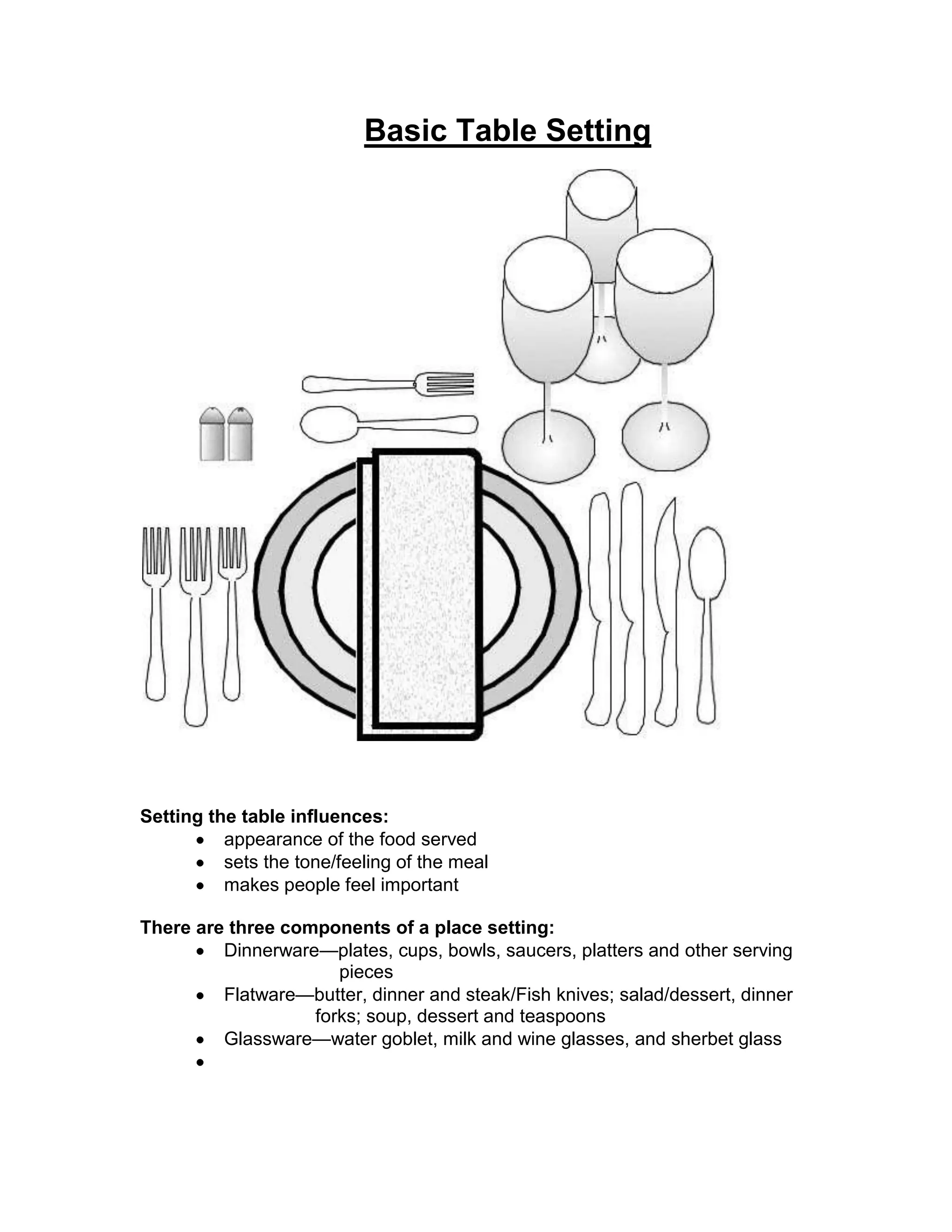
Basic Table Setting


Setting the table influences:
          appearance of the food served
          sets the tone/feeling of the meal
          makes people feel important

There are three components of a place setting:
         Dinnerware—plates, cups, bowls, saucers, platters and other serving
                      pieces
         Flatware—butter, dinner and steak/Fish knives; salad/dessert, dinner
                   forks; soup, dessert and teaspoons
         Glassware—water goblet, milk and wine glasses, and sherbet glass
Cover - arrangement of a place setting for one person; dinner plate is generally
in the middle of the cover. Allow 20 -24 inches of space for each cover.

Set the table with what is needed for the meal. Flatware is arranged in the
order it is used, starting at the outside and working toward the center.

There are 6 rules in proper dinnerware placement:
      1. Allow 20-24” for each place setting with the plate in the middle.
      2. The rule of thumb: the plate should be 1” from the table edge (use
         thumb).
      3. Bread/butter plate—top left, above the salad plate.
      4. Salad plate—lower left, above the napkin.
      5. Soup bowl—on plate or separate.
      6. Cup/saucer—separate or glassware.

There are differences in flatware:
      1. Soup spoon—larger than teaspoon
      2. Salad/dessert fork—smaller than dinner fork
      3. Butter knife—shape and size smaller than dinner knife

There are 4 rules in proper flatware placement:
      1. Also a rule of thumb—place items 1 to 1 1/2 ” from the table edge so
         that handles are lined up and the utensils are even with the plate.
      2. Forks—to the left of the plate; dessert fork is sometimes placed above
         the center of the plate
      Knives, spoons—to the right of the plate; dessert spoon is sometimes
      placed above the center of the plate
      3. Arrange flatware in order of use, from outside toward plate—(salad fork
         at the left of the dinner fork if the salad is the first course, otherwise, to
         the right of the dinner fork if the salad is served with dinner)
      4. Forks—tines up
      Knives—sharp cutting edge toward plate
          Spoons—bowls up
          Butter knife—on bread/butter plate

There are rules of glassware placement:
      1. Water goblet at the tip of the knife blade.
      2. Other beverage glasses at right of goblet and slightly forward in a
         diagonal. NOTE: cup and saucer—lower right.
      3. If glassware contents are cold, serve with saucer to catch moisture
         condensation.

Placement of the napkin:
     1. Left of the forks
     2. Center of the dinner plate or cover
     3. In the water goblet
The napkin is placed so that when it is removed, it will not disturb any of
the flatware!

Etiquette

Table etiquette - courtesy shown by good manners at meals. Table manners
reflect part of your personality to others; makes eating a pleasant experience for
everyone, most rules of etiquette involve common sense and consideration of
other people.

Common Rules of Etiquette:
       Sit down from the left side of your chair
       Assist with passing of foods when appropriate; pass to the right
       Use flatware from the outside in
       Napkin
              place on lap before starting to eat; cover your mouth and nose if
              you must cough or sneeze
              leave on your chair if leaving the table and returning during a
              meal
              leave to the left of the plate when finished with the meal
       When eating with a small group wait until everyone is served before
       eating
       Follow actions of host/hostess as a guide when dining in someone’s
       home
       Avoid talking with food in your mouth; chew with your mouth closed
       Cut food into pieces as you eat; cut into small bite-size pieces; but
       meat one bite at a time
       Sit up straight; avoid leaning on elbows while eating
       Place spoon on soup plate rather than the bowl/cup when finished
       eating
       Place the knife and fork on the plate with the handles parallel to the
       edge of the table when finished eating
       Break one piece of bread/roll and butter one piece at a time
       Place butter on your own plate before buttering your bread/roll

Summary:
       If you apply basic principles of setting the table, table service and manners
you can create a pleasant atmosphere so that your relationships and appearance
of food are enhanced. Good manners show respect for others.
       Besides eating, these things should also be taking place at the table:
           Communication via conversation
           Relationship development
           Values development (I care enough to spend time with you)
           Exchange of ideas
Basic table setting

Basic table setting

  • 1.
    Basic Table Setting Settingthe table influences: appearance of the food served sets the tone/feeling of the meal makes people feel important There are three components of a place setting: Dinnerware—plates, cups, bowls, saucers, platters and other serving pieces Flatware—butter, dinner and steak/Fish knives; salad/dessert, dinner forks; soup, dessert and teaspoons Glassware—water goblet, milk and wine glasses, and sherbet glass
  • 2.
    Cover - arrangementof a place setting for one person; dinner plate is generally in the middle of the cover. Allow 20 -24 inches of space for each cover. Set the table with what is needed for the meal. Flatware is arranged in the order it is used, starting at the outside and working toward the center. There are 6 rules in proper dinnerware placement: 1. Allow 20-24” for each place setting with the plate in the middle. 2. The rule of thumb: the plate should be 1” from the table edge (use thumb). 3. Bread/butter plate—top left, above the salad plate. 4. Salad plate—lower left, above the napkin. 5. Soup bowl—on plate or separate. 6. Cup/saucer—separate or glassware. There are differences in flatware: 1. Soup spoon—larger than teaspoon 2. Salad/dessert fork—smaller than dinner fork 3. Butter knife—shape and size smaller than dinner knife There are 4 rules in proper flatware placement: 1. Also a rule of thumb—place items 1 to 1 1/2 ” from the table edge so that handles are lined up and the utensils are even with the plate. 2. Forks—to the left of the plate; dessert fork is sometimes placed above the center of the plate Knives, spoons—to the right of the plate; dessert spoon is sometimes placed above the center of the plate 3. Arrange flatware in order of use, from outside toward plate—(salad fork at the left of the dinner fork if the salad is the first course, otherwise, to the right of the dinner fork if the salad is served with dinner) 4. Forks—tines up Knives—sharp cutting edge toward plate Spoons—bowls up Butter knife—on bread/butter plate There are rules of glassware placement: 1. Water goblet at the tip of the knife blade. 2. Other beverage glasses at right of goblet and slightly forward in a diagonal. NOTE: cup and saucer—lower right. 3. If glassware contents are cold, serve with saucer to catch moisture condensation. Placement of the napkin: 1. Left of the forks 2. Center of the dinner plate or cover 3. In the water goblet
  • 3.
    The napkin isplaced so that when it is removed, it will not disturb any of the flatware! Etiquette Table etiquette - courtesy shown by good manners at meals. Table manners reflect part of your personality to others; makes eating a pleasant experience for everyone, most rules of etiquette involve common sense and consideration of other people. Common Rules of Etiquette: Sit down from the left side of your chair Assist with passing of foods when appropriate; pass to the right Use flatware from the outside in Napkin place on lap before starting to eat; cover your mouth and nose if you must cough or sneeze leave on your chair if leaving the table and returning during a meal leave to the left of the plate when finished with the meal When eating with a small group wait until everyone is served before eating Follow actions of host/hostess as a guide when dining in someone’s home Avoid talking with food in your mouth; chew with your mouth closed Cut food into pieces as you eat; cut into small bite-size pieces; but meat one bite at a time Sit up straight; avoid leaning on elbows while eating Place spoon on soup plate rather than the bowl/cup when finished eating Place the knife and fork on the plate with the handles parallel to the edge of the table when finished eating Break one piece of bread/roll and butter one piece at a time Place butter on your own plate before buttering your bread/roll Summary: If you apply basic principles of setting the table, table service and manners you can create a pleasant atmosphere so that your relationships and appearance of food are enhanced. Good manners show respect for others. Besides eating, these things should also be taking place at the table: Communication via conversation Relationship development Values development (I care enough to spend time with you) Exchange of ideas