CHAPTER 6
THE SERVICE
SEQUENCE
(MISE EN PLACE)
By: Mumtazul Ilyani
Mise En Place
 There are several things to be done
ahead of time to ensure the best
service for the guest.
 This organization and completion of
duties ahead of time is “mise en
place.”
 (A French term translated “put into place”)
Why is Mise En Place Important?
 The amount of work and the long hours
of the f&b business make this “mise en
place” even more important.
 E.g. am shift gets everything ready for pm shift
and vice versa.
 Mise en place allows the use of
teamwork which is essential to
maintain energy levels throughout the
day and night and to help avoid
overtime pay.
Examples of Mise En Place
 Maitre d’ or Manager
 Check Reservation Book
 Discuss Cover Count and Flow of Service
with Chef
 Layout and Explain Floor Plan to
Waitstaff
 Adjust temperature, lighting and music
Examples of Mise En Place
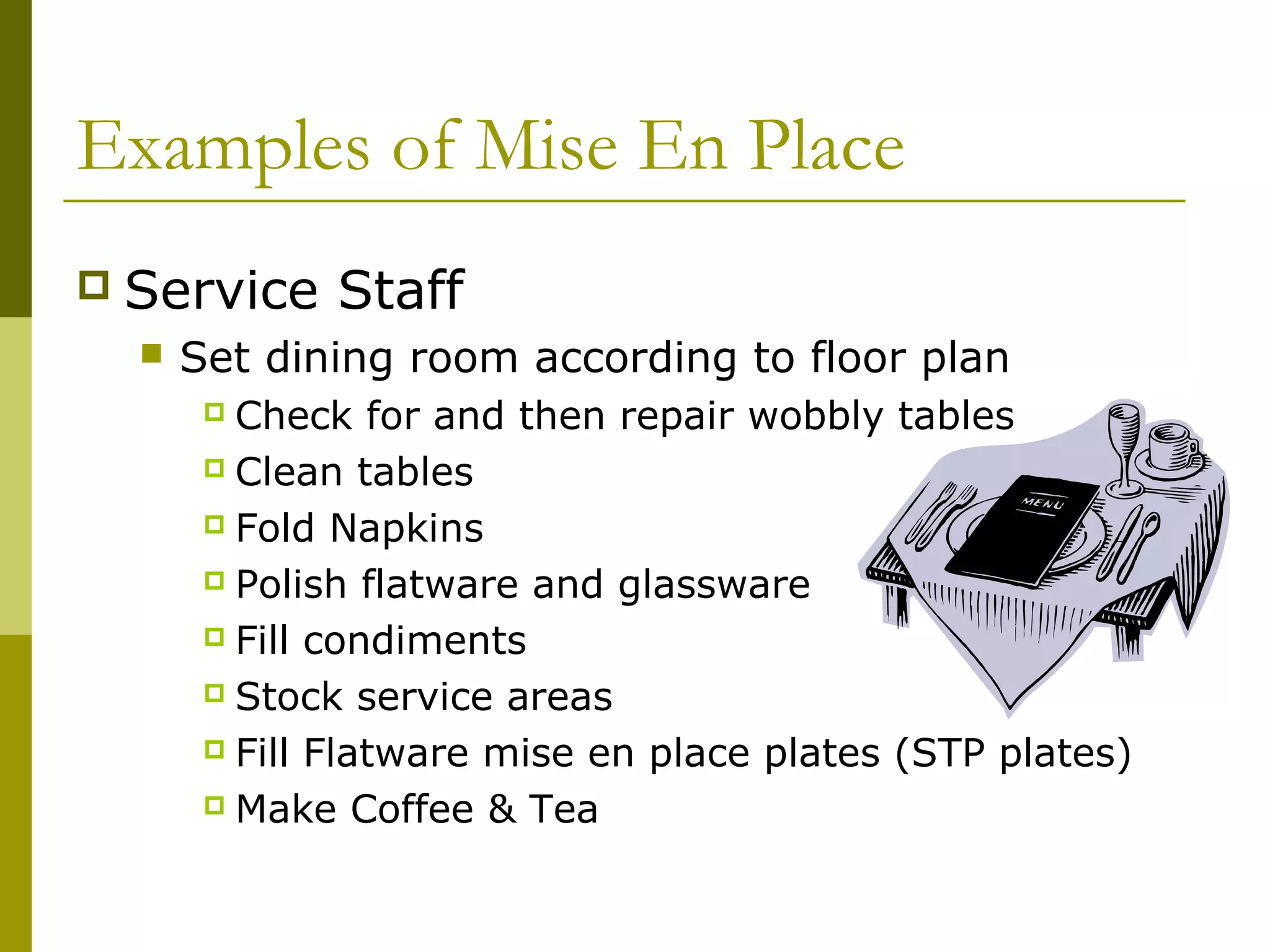
 Service Staff
 Set dining room according to floor plan
 Check for and then repair wobbly tables
 Clean tables
 Fold Napkins
 Polish flatware and glassware
 Fill condiments
 Stock service areas
 Fill Flatware mise en place plates (STP plates)
 Make Coffee & Tea
Mise En Place for the
SideBoard/SideStation
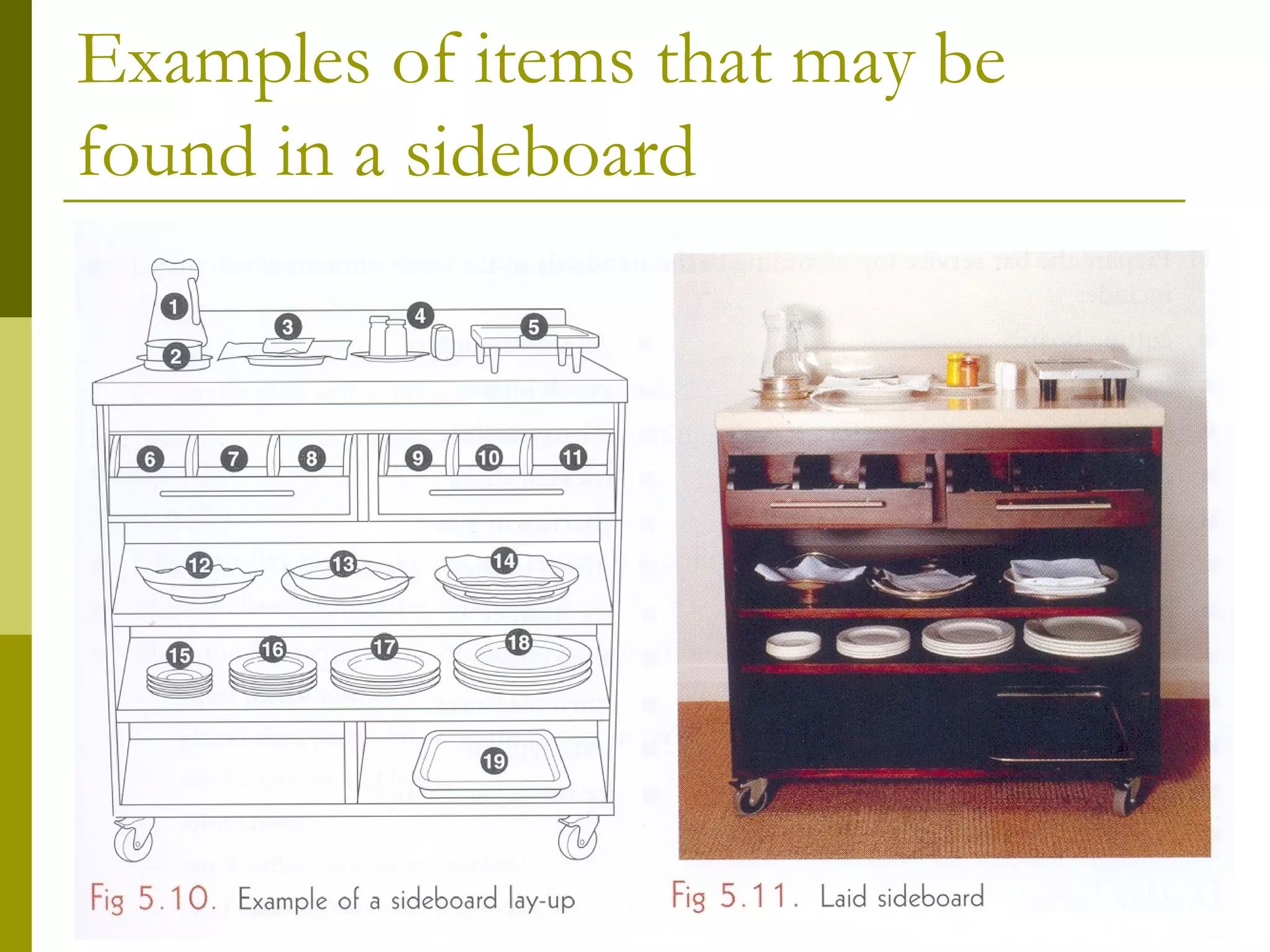
 The sideboard is of minimum size and portable so
that it may be easily moved if necessary. The
material used in the make-up of the sideboard
should blend with the rest of the décor. The top of
a sideboard should be of a heat resistant material
that can be easily washed down. The actual lay-up
of a sideboard depends on its construction – the
number of shelves and drawers for tableware, and
other miscellaneous items, and secondly on the
type of menu and service offered.
 Before laying anything in the sideboard, ensure
that it is cleaned thoroughly, polished and laid with
cloth.
Examples of items that may be
found in a sideboard
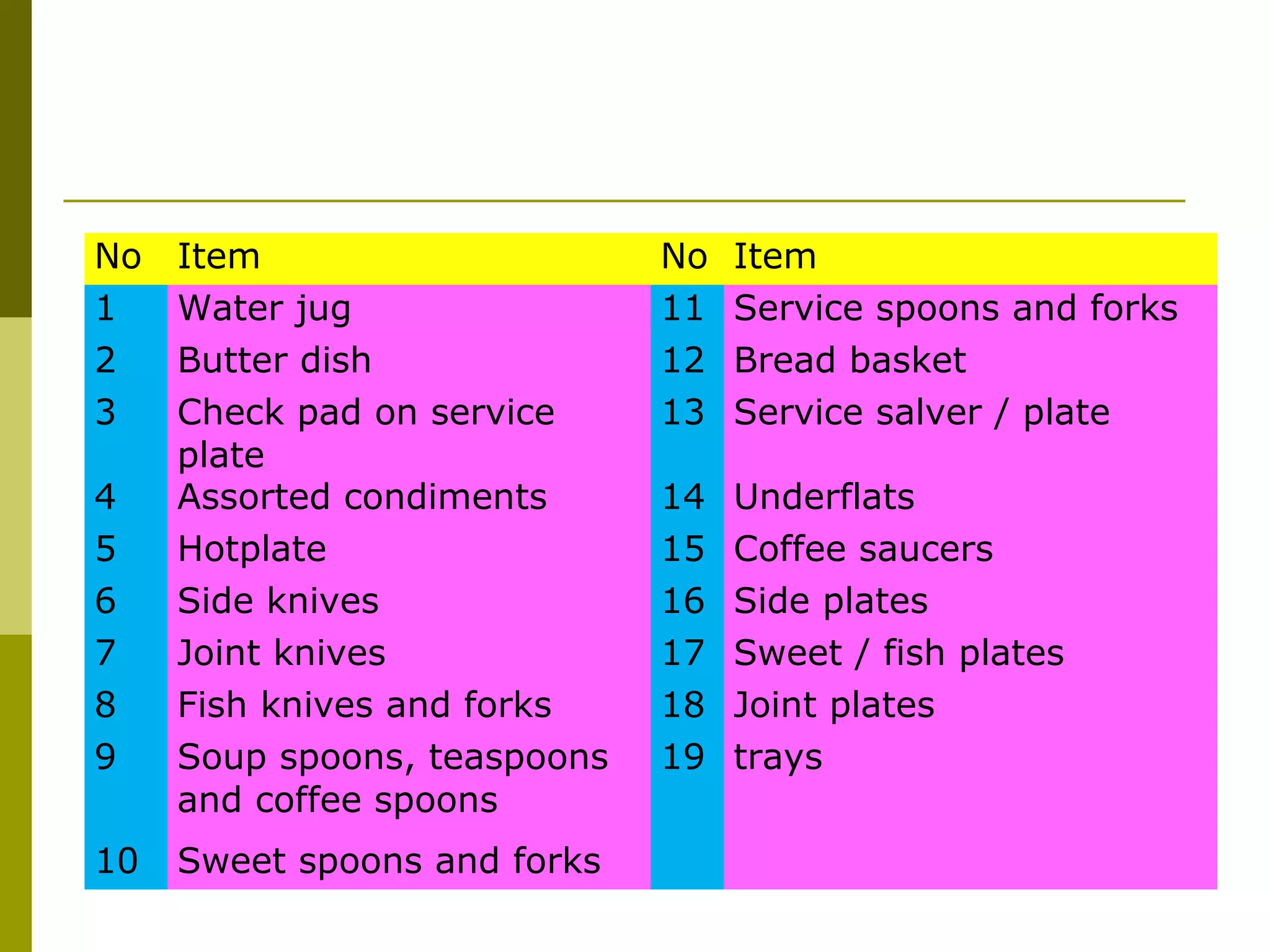
No Item No Item
1 Water jug 11 Service spoons and forks
2 Butter dish 12 Bread basket
3 Check pad on service
plate
13 Service salver / plate
4 Assorted condiments 14 Underflats
5 Hotplate 15 Coffee saucers
6 Side knives 16 Side plates
7 Joint knives 17 Sweet / fish plates
8 Fish knives and forks 18 Joint plates
9 Soup spoons, teaspoons
and coffee spoons
19 trays
10 Sweet spoons and forks
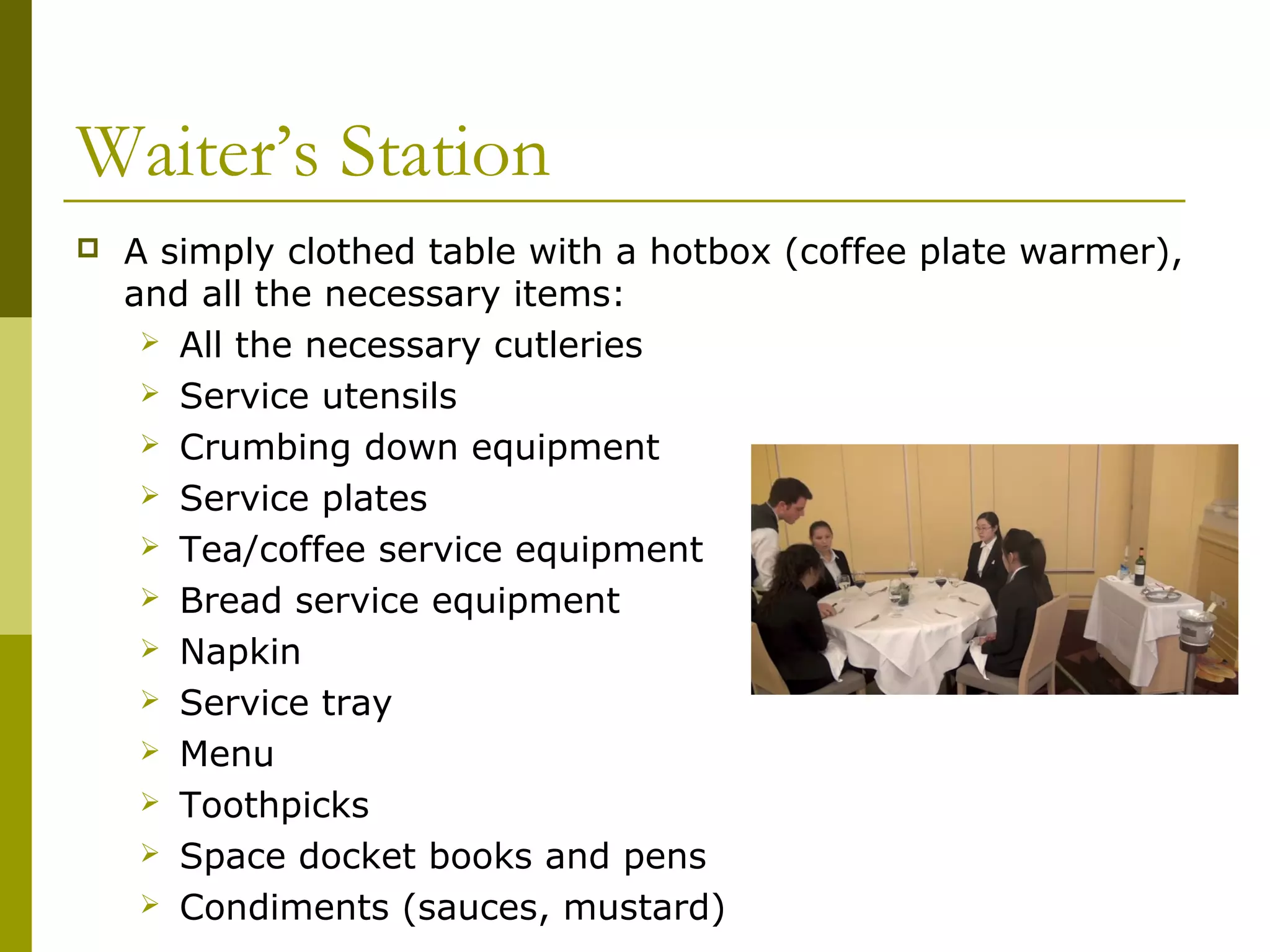
Waiter’s Station
 A simply clothed table with a hotbox (coffee plate warmer),
and all the necessary items:
 All the necessary cutleries
 Service utensils
 Crumbing down equipment
 Service plates
 Tea/coffee service equipment
 Bread service equipment
 Napkin
 Service tray
 Menu
 Toothpicks
 Space docket books and pens
 Condiments (sauces, mustard)
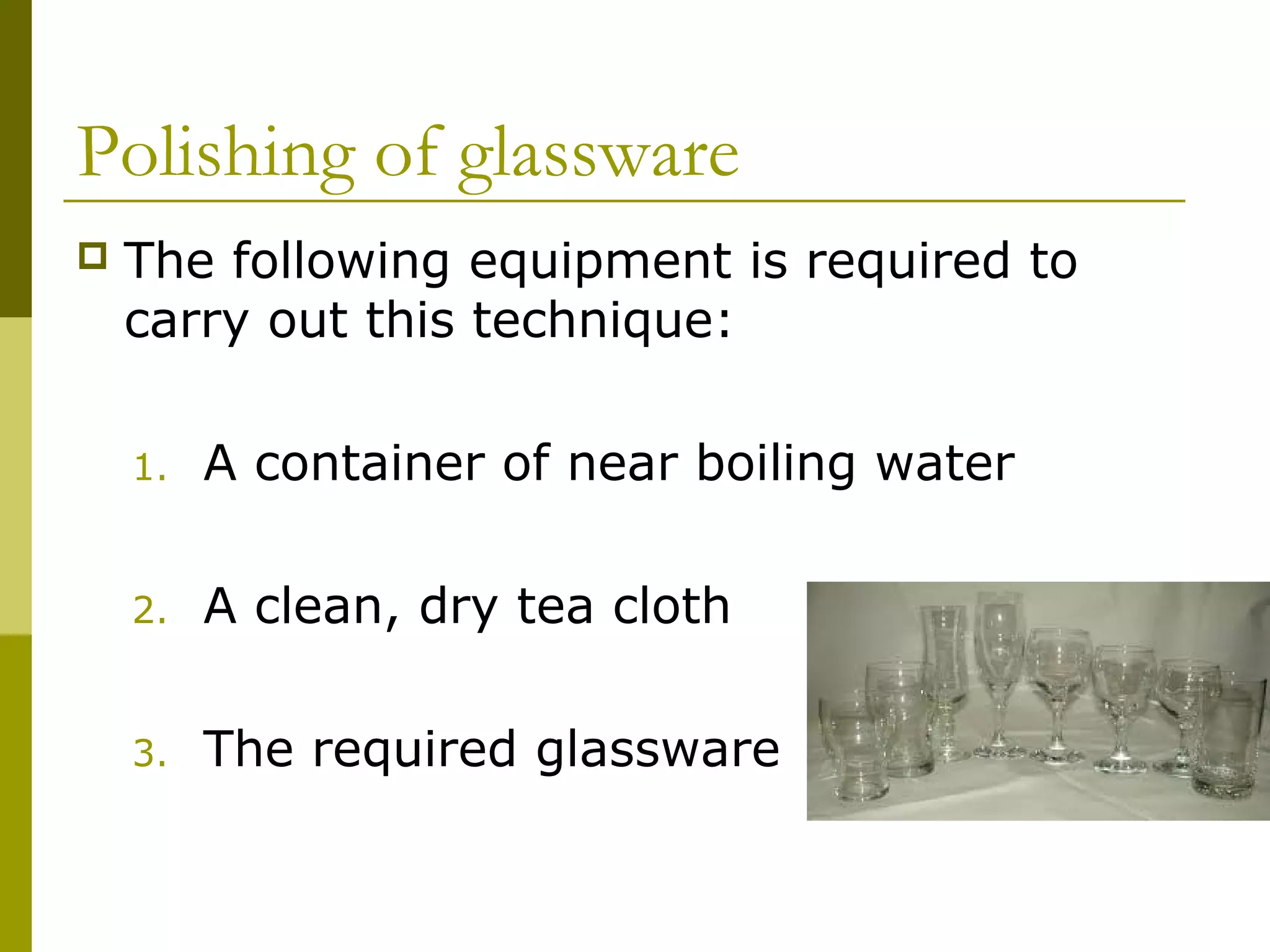
Polishing of glassware
 The following equipment is required to
carry out this technique:
1. A container of near boiling water
2. A clean, dry tea cloth
3. The required glassware
1. Hold the goblet over the steam from the
boiling water so that the steam enters the bowl
of the glass.
2. Rotate the goblet to allow the steam to
circulate fully within the bowl of the glass and
then hold the base of the glass over the
steam.
3. Now hold the base of the goblet in the clean,
dry teacloth.
4. Place the other hand underneath the teacloth
in readiness to polish the bowl of the glass.
5. Place the thumb of the polishing hand inside
the bowl of the glass and the fingers on the
outside, holding the bowl of the goblet gently
but firmly. Rotate the goblet with the hand
holding the base of the glass.
6. When fully polished, hold the goblet up to the
light to check that it is clean.
7. Ensure that the base of the glass is also clean.
Steps of polishing glassware
VIDEO
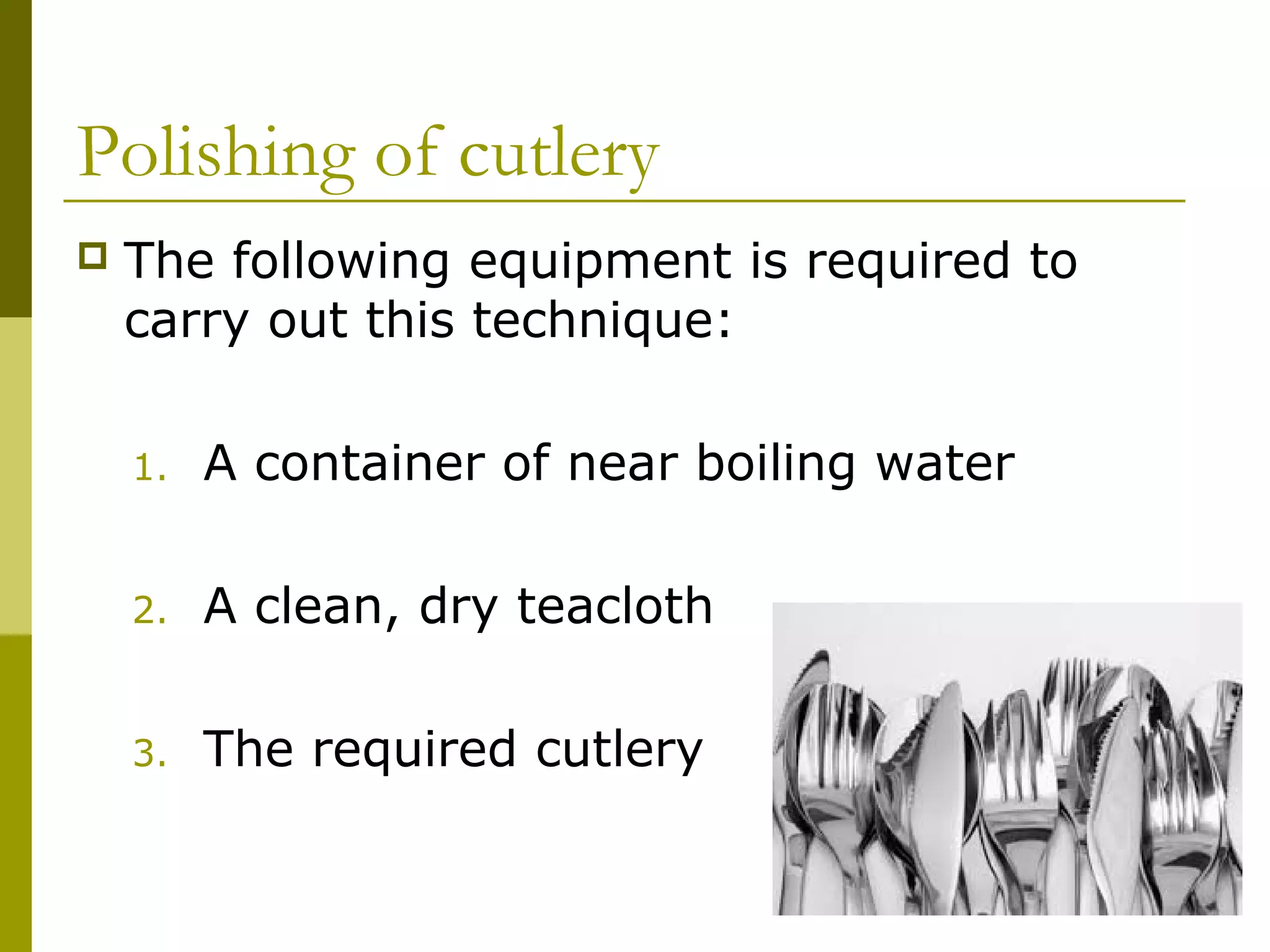
Polishing of cutlery
 The following equipment is required to
carry out this technique:
1. A container of near boiling water
2. A clean, dry teacloth
3. The required cutlery
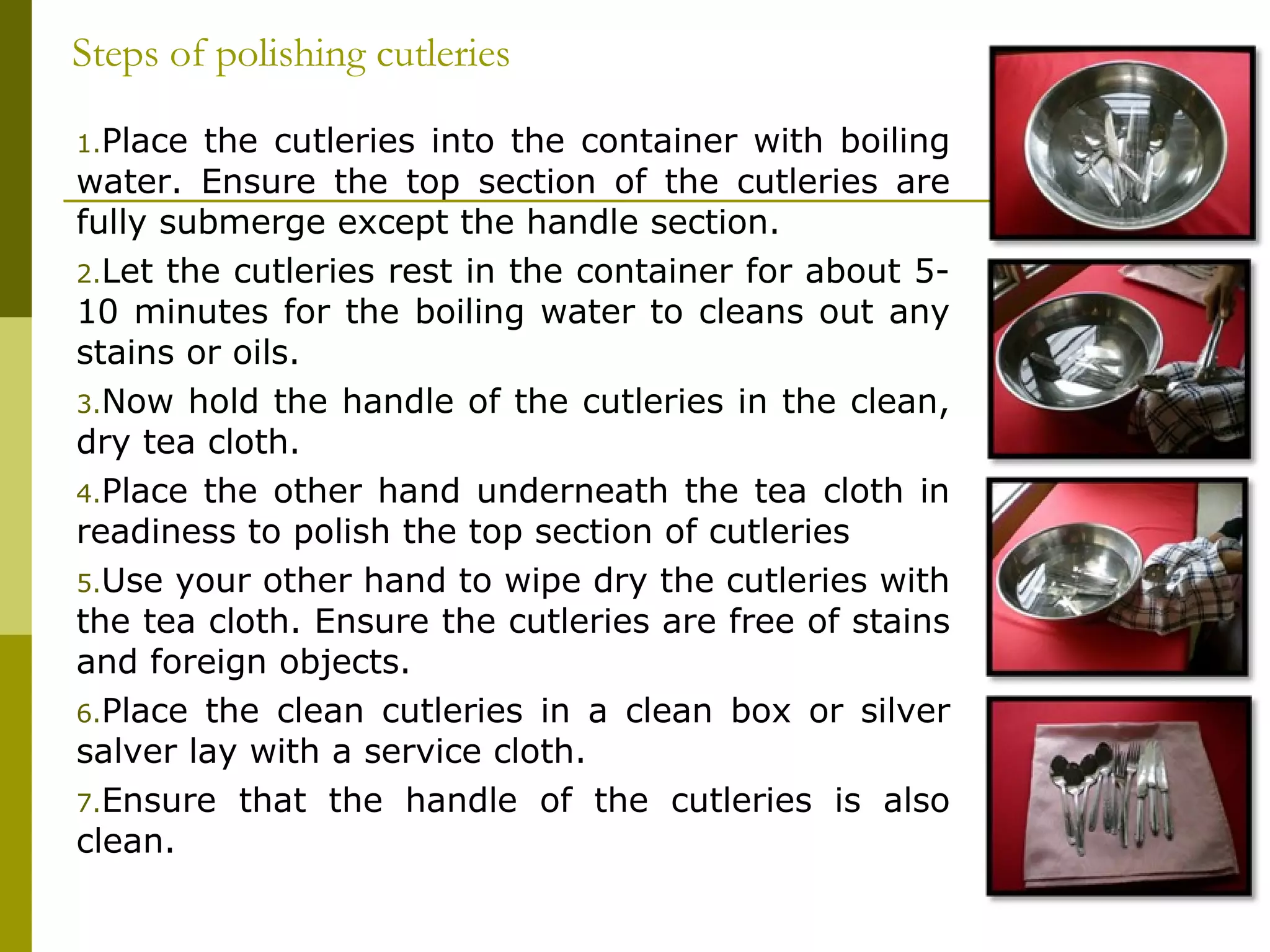
1.Place the cutleries into the container with boiling
water. Ensure the top section of the cutleries are
fully submerge except the handle section.
2.Let the cutleries rest in the container for about 5-
10 minutes for the boiling water to cleans out any
stains or oils.
3.Now hold the handle of the cutleries in the clean,
dry tea cloth.
4.Place the other hand underneath the tea cloth in
readiness to polish the top section of cutleries
5.Use your other hand to wipe dry the cutleries with
the tea cloth. Ensure the cutleries are free of stains
and foreign objects.
6.Place the clean cutleries in a clean box or silver
salver lay with a service cloth.
7.Ensure that the handle of the cutleries is also
clean.
Steps of polishing cutleries
VIDEO
Steps of polishing chinaware
1. Put boiling/hot water in the water pitcher.
2. Pour some hot water on the plate/bowl.
3. Pour the water back in the water pitcher.
4. Wipe the plate/bowl until dry.
VIDEO
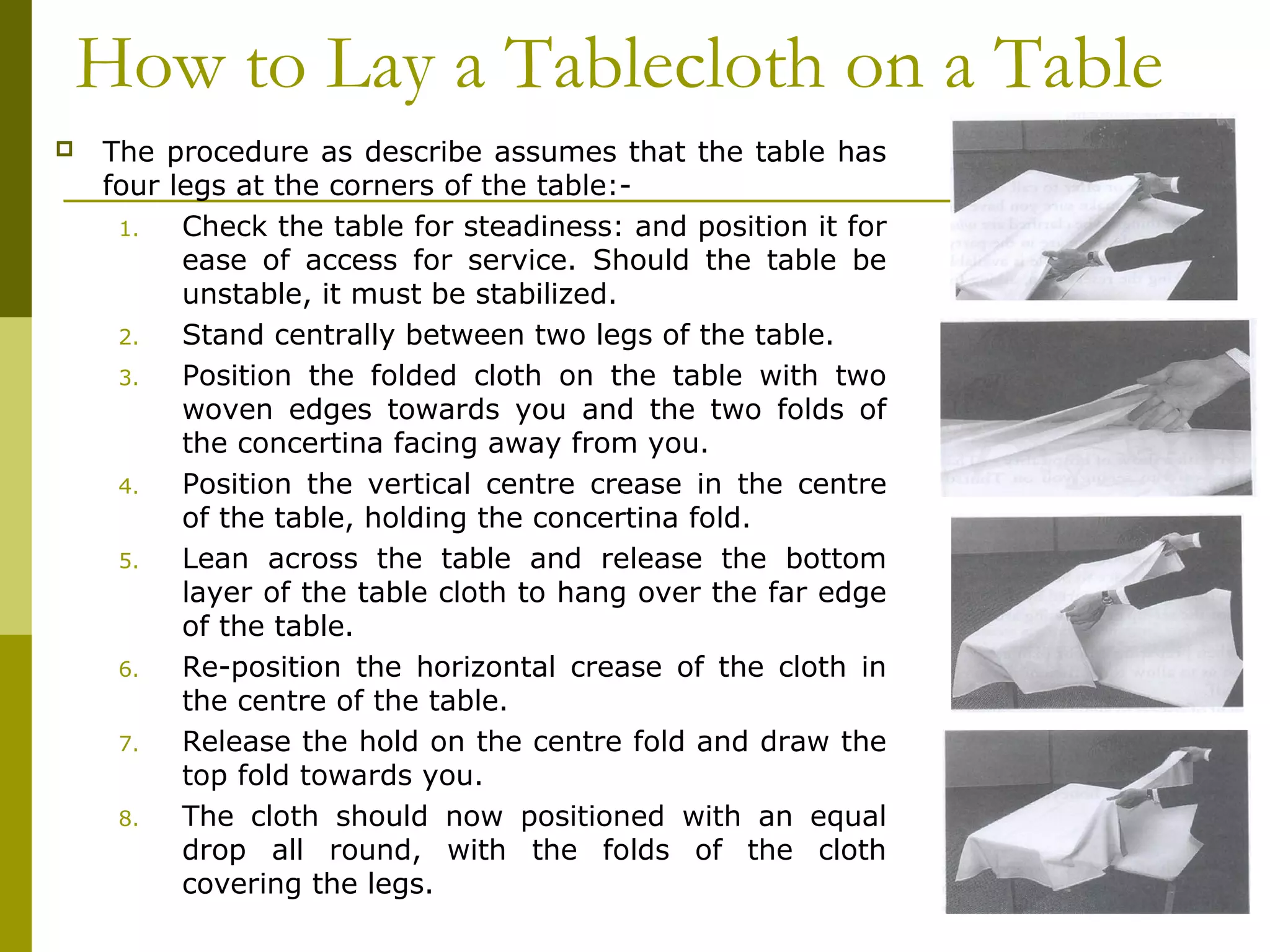
How to Lay a Tablecloth on a Table
 The procedure as describe assumes that the table has
four legs at the corners of the table:-
1. Check the table for steadiness: and position it for
ease of access for service. Should the table be
unstable, it must be stabilized.
2. Stand centrally between two legs of the table.
3. Position the folded cloth on the table with two
woven edges towards you and the two folds of
the concertina facing away from you.
4. Position the vertical centre crease in the centre
of the table, holding the concertina fold.
5. Lean across the table and release the bottom
layer of the table cloth to hang over the far edge
of the table.
6. Re-position the horizontal crease of the cloth in
the centre of the table.
7. Release the hold on the centre fold and draw the
top fold towards you.
8. The cloth should now positioned with an equal
drop all round, with the folds of the cloth
covering the legs.
VIDEO
How to Change a Tablecloth During
Service
 Cloths often have to be changed during food service,
when guests are present at other tables and new
covers are to be laid, or when there has been serious
spillage.
 The procedure is as follows:-
1. Remove any articles remaining on the table to the
sideboard.
2. Stand centrally between the two legs of the table.
3. Holding the concertina fold, position the vertical
centre crease of the clean cloth in the centre of
the table.
4. Lean across the table and allow the bottom layer
of the clean cloth to hang over the far edge of the
soiled cloth.
5. Take the soiled cloth in both hands, holding it
between the little and ring (fourth) fingers.
6. Concertina the soiled cloth towards you while
opening the clean cloth above it.
7. Fold the soiled cloth and remove it discreetly.
VIDEO
How to Lay a Cover
 Definition of covers:-
 total number of guests concerned
 denotes all the necessary cutlery, flatware,
crockery , glassware and linen necessary to lay
a certain type of place setting for a specific
meal
Two basic covers for the table
setting
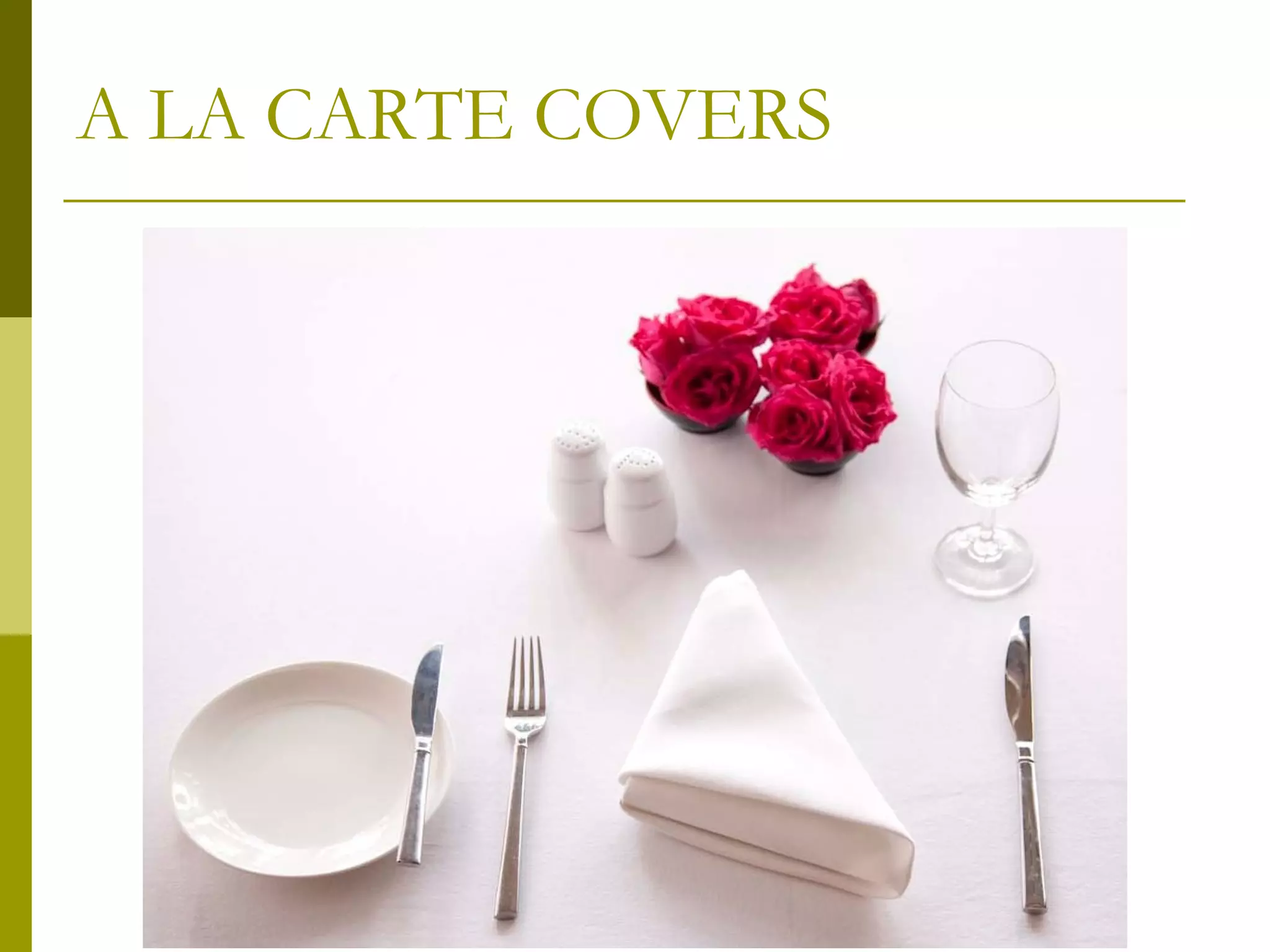
A LA CARTE TABLE D'HOTE
Fish Plate (or show plate)
Fish Knife (or dinner knife)
Fish Fork (or dinner fork)
Side plate
Side knife
Napkin
Water Goblet
Note:
The reason for the fish knife and fork cover
is that traditionally the a la carte cover was
meant for the first course, which was a hors
d’oeuvres, in the classical menu sequence.
The current standard for a table knife and
fork was due to the fact that eating habits
have changed.
Some establishments have also used a
decorative cover/show plate as part of their a
la carte setting.
Dinner knife
Dinner fork
Fish knife
Fish fork
Soup spoon
Dessert spoon
Dessert fork
Side plate
Side knife
Napkin
Water Goblet
Note:
Table d’hote settings are
based on the principle that
the tableware for the whole
meal is laid before the first
course is served.
A LA CARTE COVERS
TABLE D’HOTE COVER
 These two sets of covers are
traditional; however covers will
differ from establishment to
establishment.
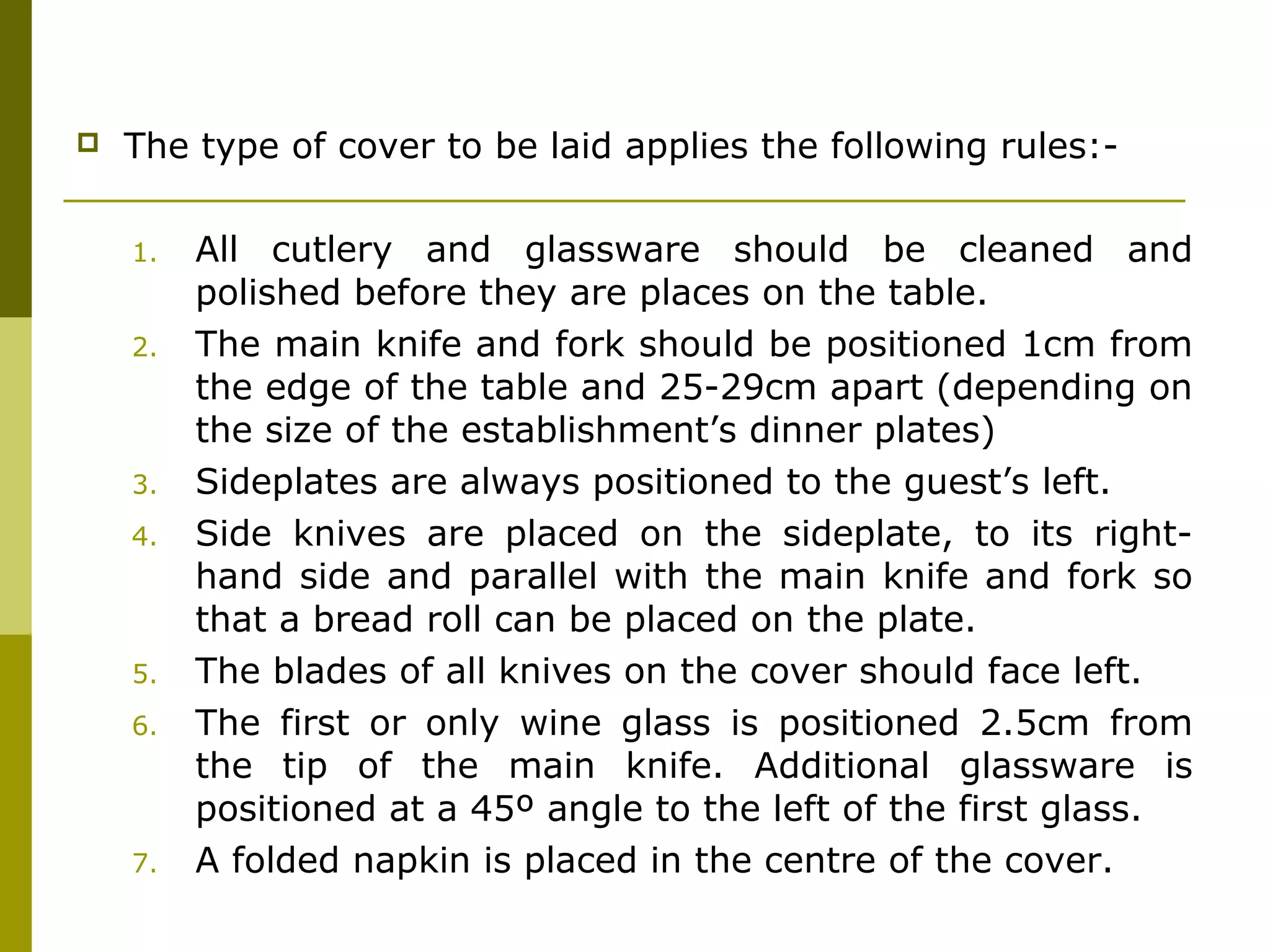
 After the above covers have been
laid, complete the table setting
with the addition of the following
items:-
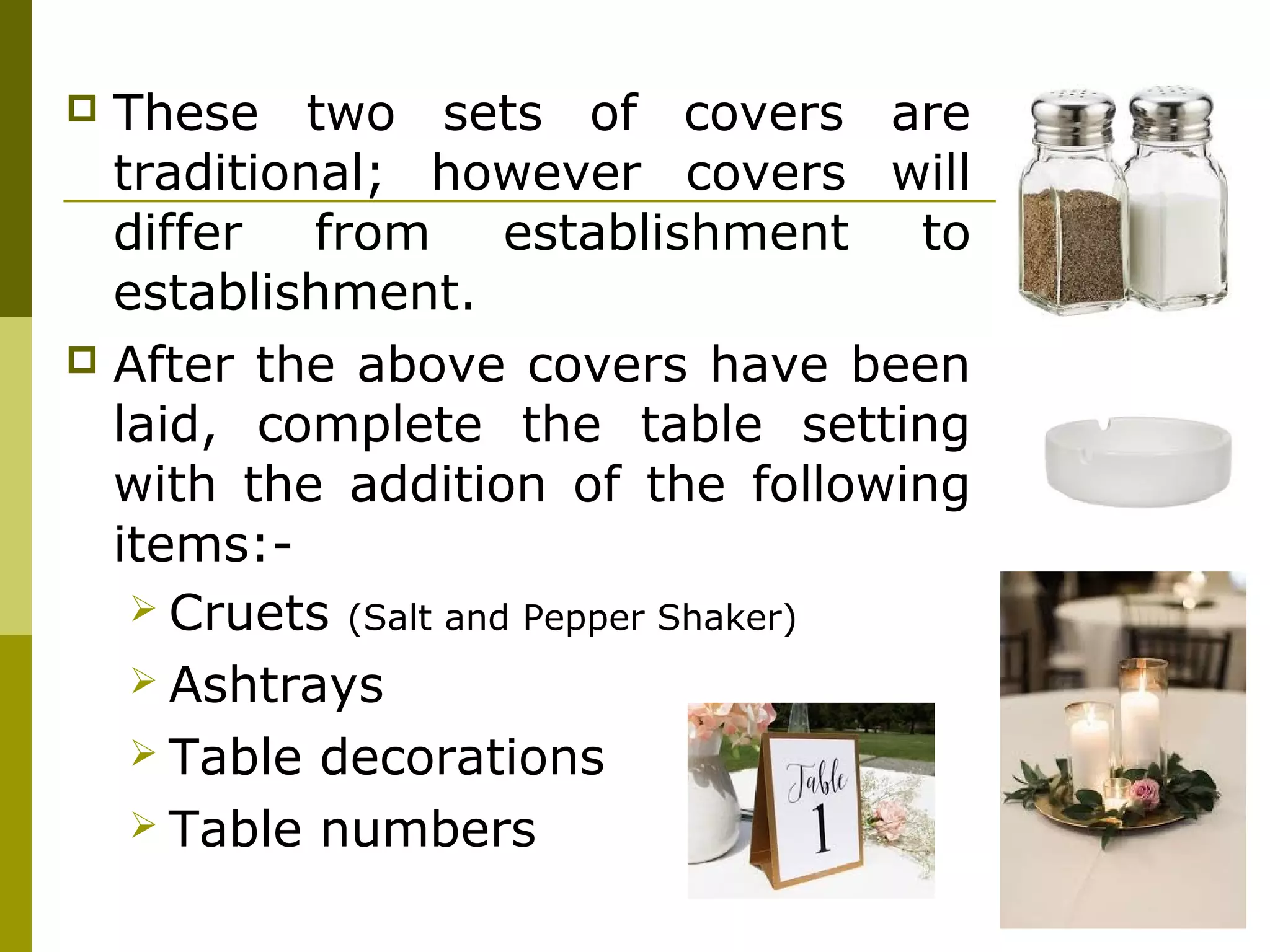
 Cruets (Salt and Pepper Shaker)
 Ashtrays
 Table decorations
 Table numbers
 The type of cover to be laid applies the following rules:-
1. All cutlery and glassware should be cleaned and
polished before they are places on the table.
2. The main knife and fork should be positioned 1cm from
the edge of the table and 25-29cm apart (depending on
the size of the establishment’s dinner plates)
3. Sideplates are always positioned to the guest’s left.
4. Side knives are placed on the sideplate, to its right-
hand side and parallel with the main knife and fork so
that a bread roll can be placed on the plate.
5. The blades of all knives on the cover should face left.
6. The first or only wine glass is positioned 2.5cm from
the tip of the main knife. Additional glassware is
positioned at a 45º angle to the left of the first glass.
7. A folded napkin is placed in the centre of the cover.
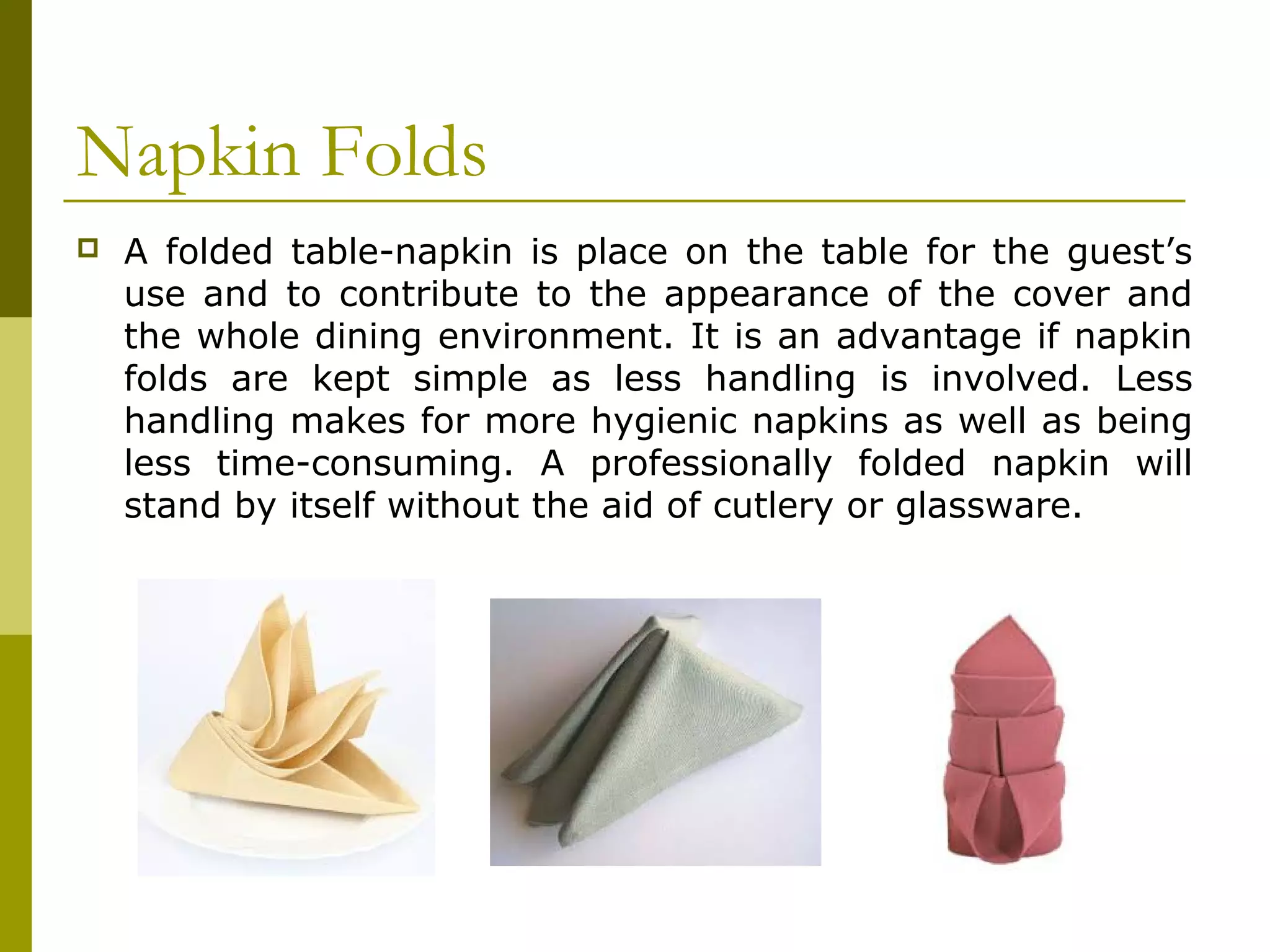
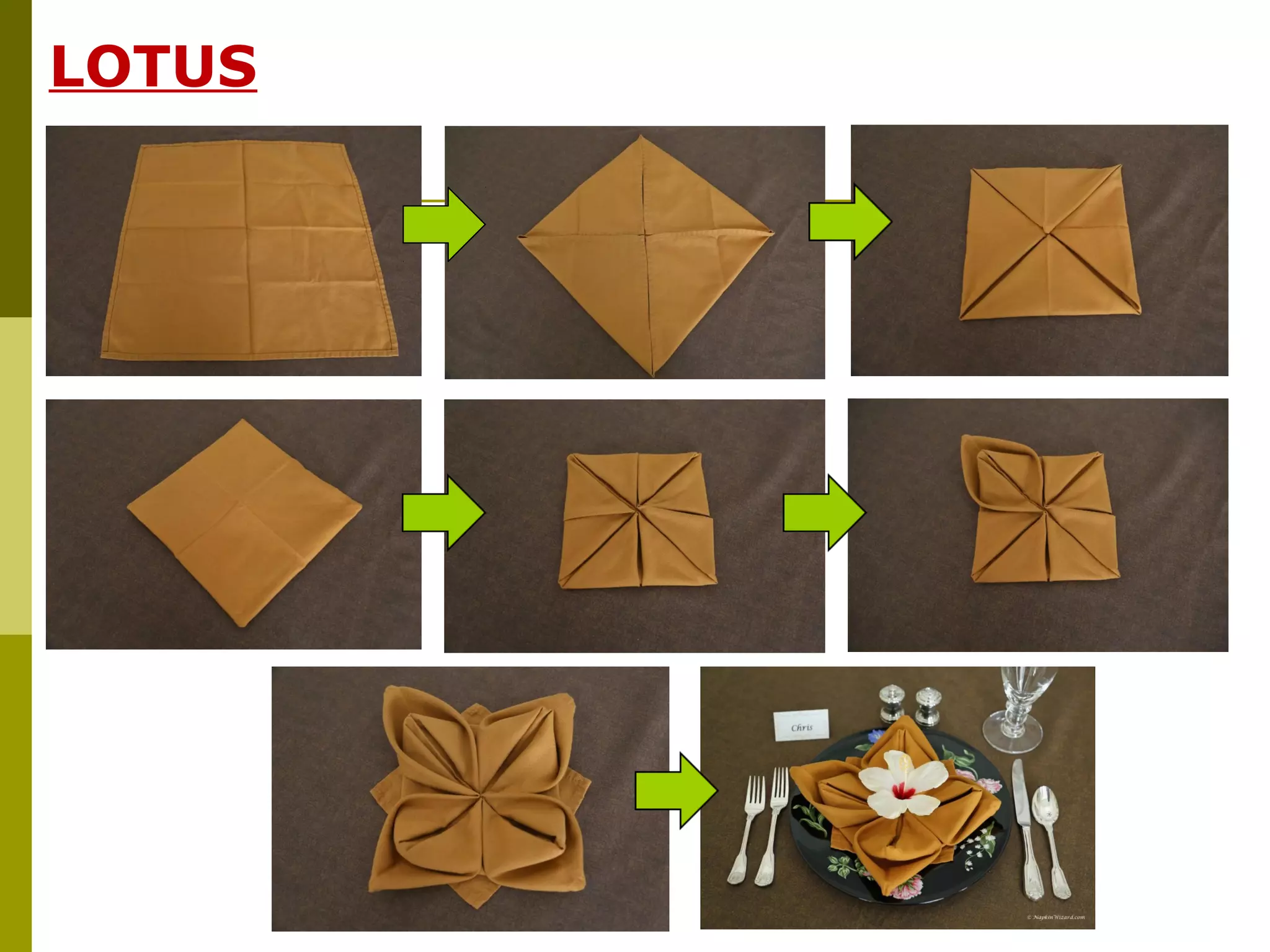
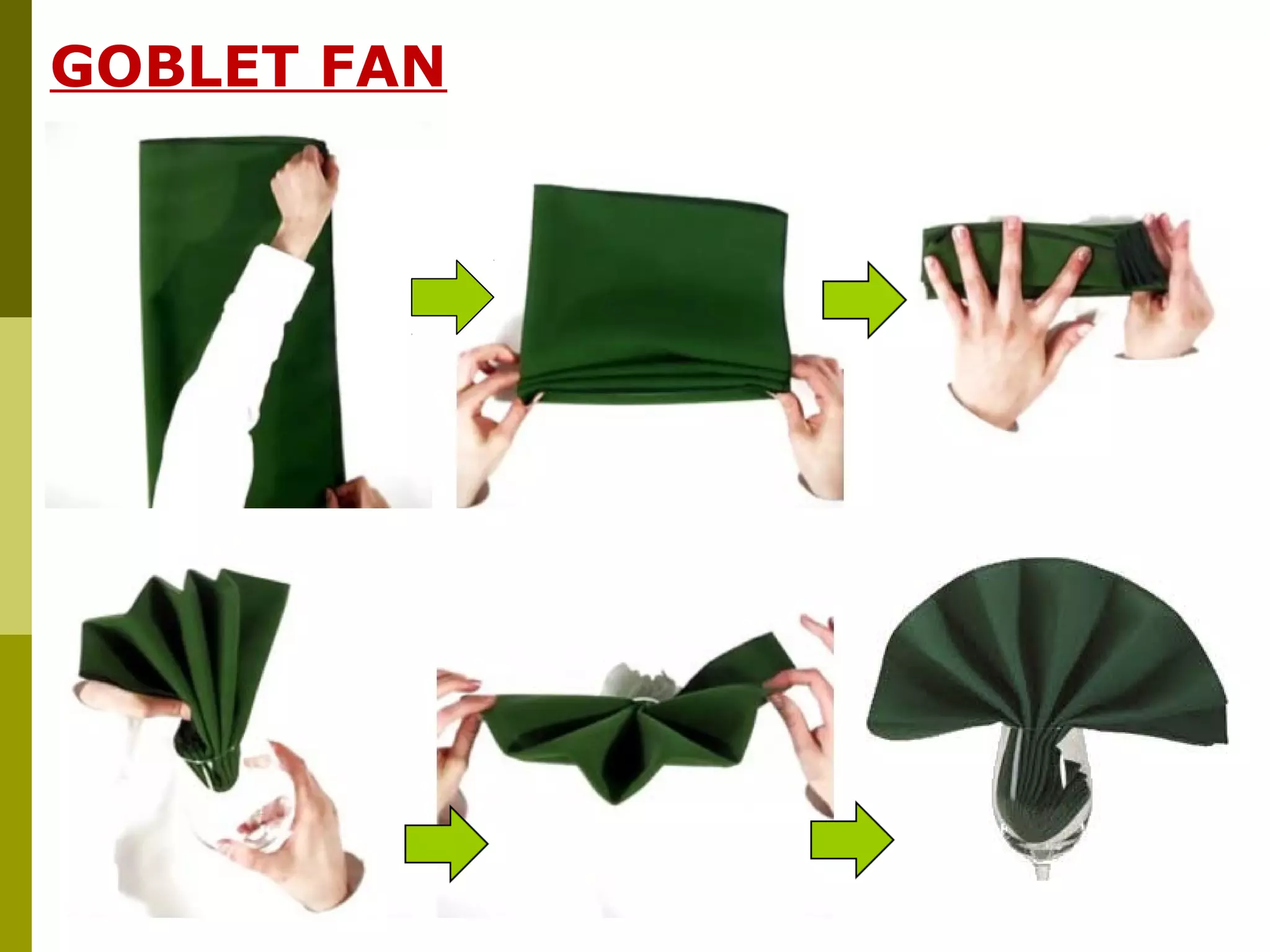
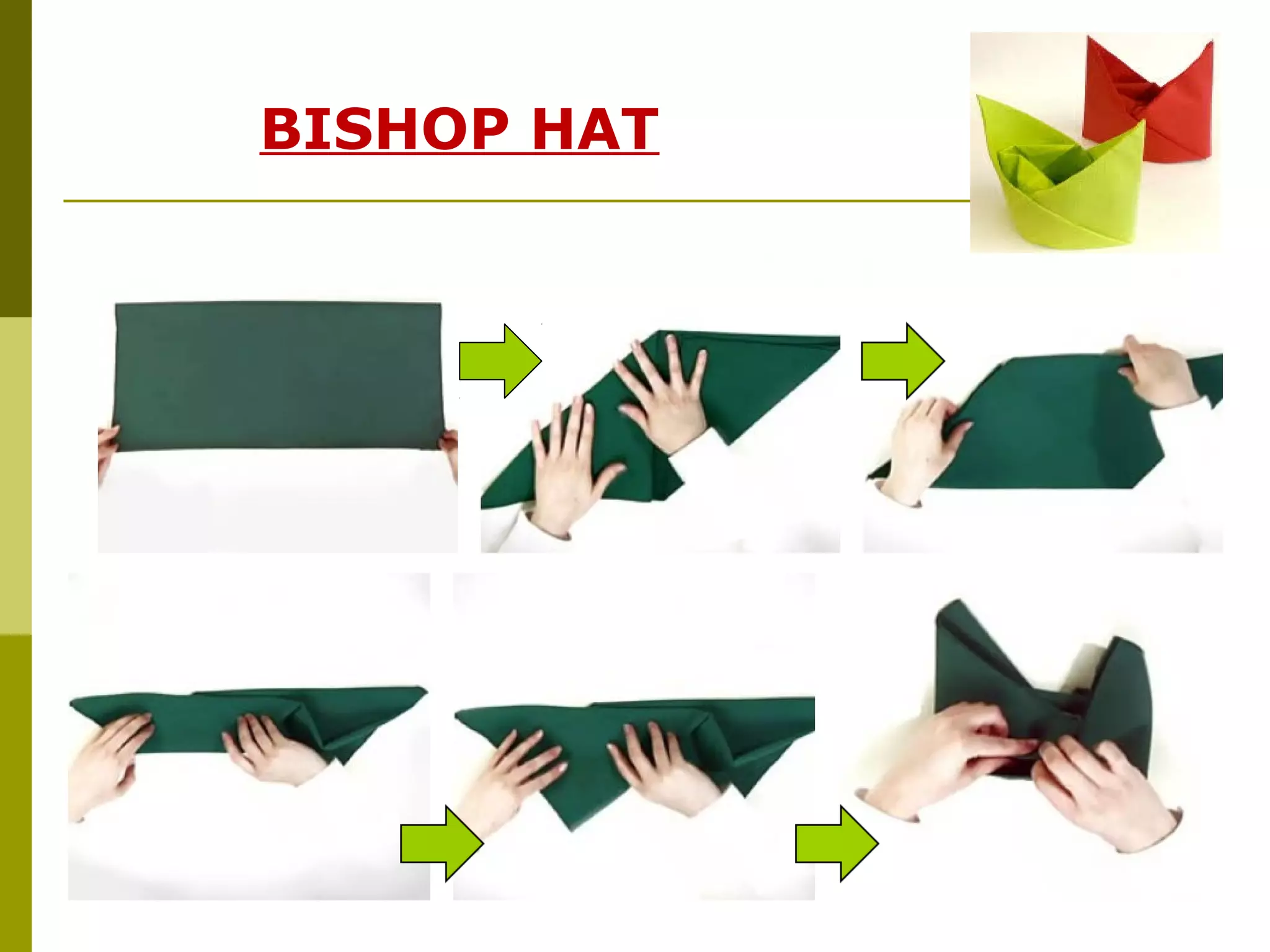
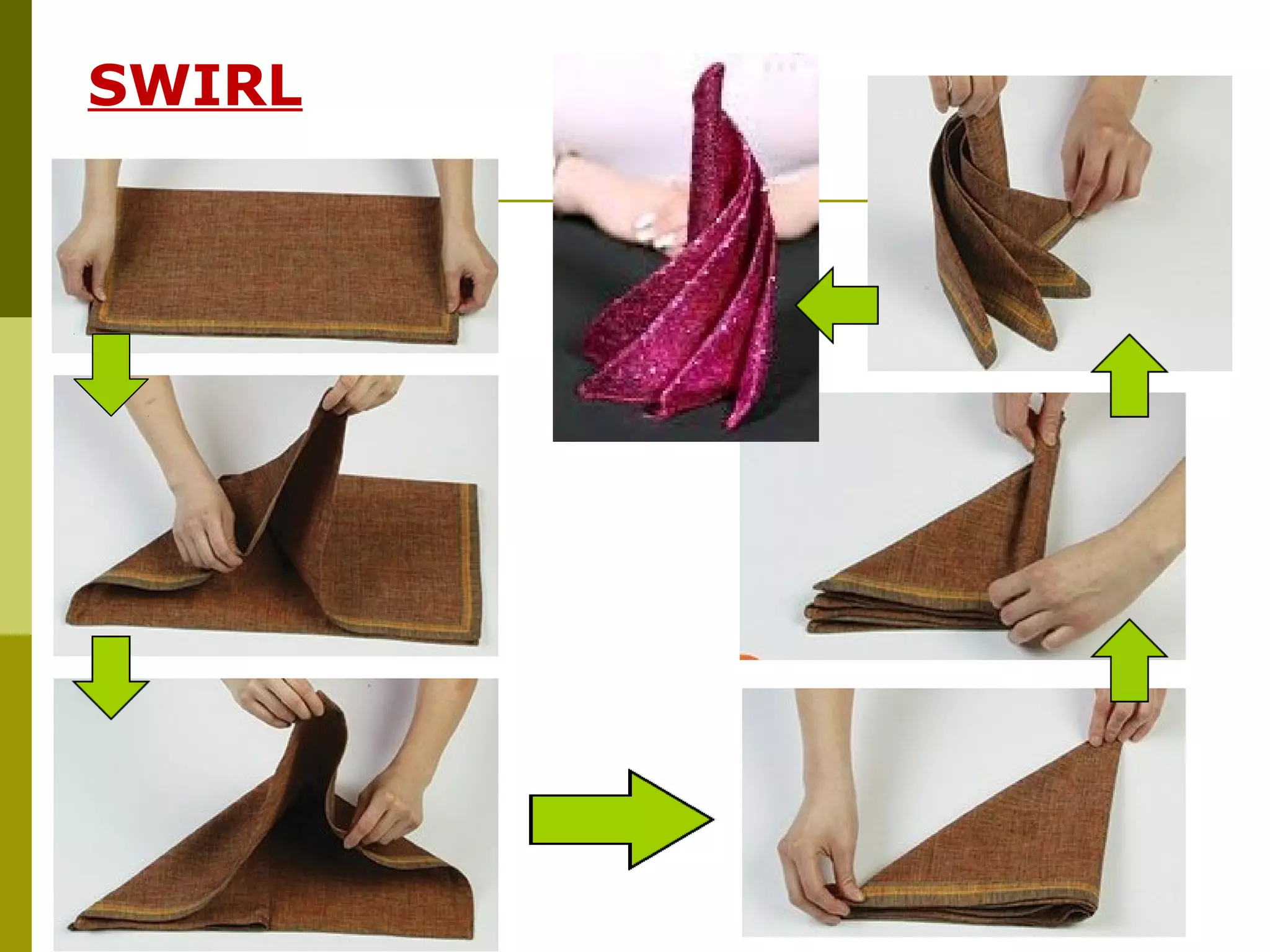
Napkin Folds
 A folded table-napkin is place on the table for the guest’s
use and to contribute to the appearance of the cover and
the whole dining environment. It is an advantage if napkin
folds are kept simple as less handling is involved. Less
handling makes for more hygienic napkins as well as being
less time-consuming. A professionally folded napkin will
stand by itself without the aid of cutlery or glassware.
BIRD OF PARADISE
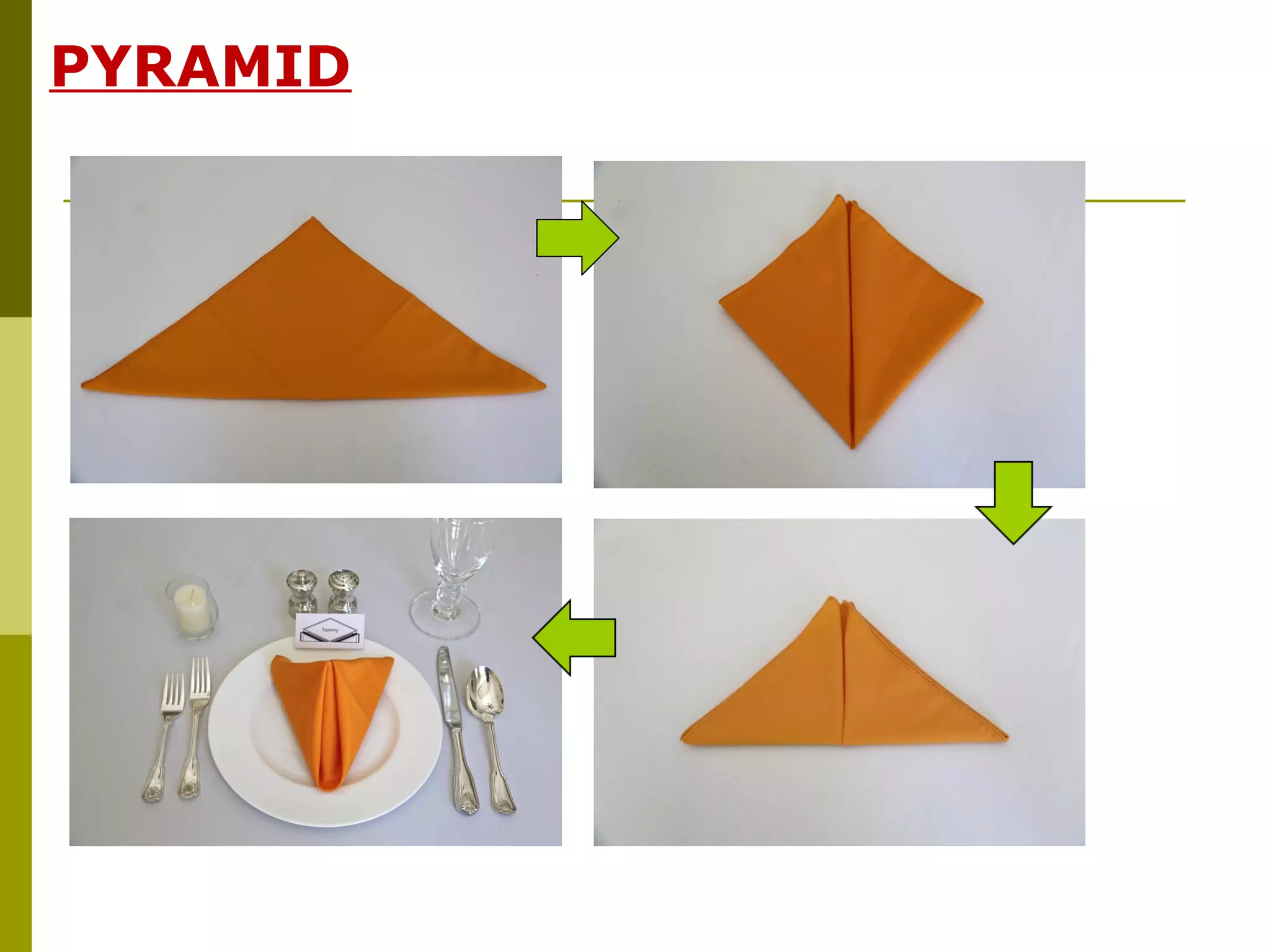
PYRAMID
CROWN
ATRIUM LILY
LOTUS
CANDLE
GOBLET FAN
BISHOP HAT
ROSEBUD
WATERFALL PLEAT
SWIRL

THE FOOD SERVICE SEQUENCE (MISE EN PLACE)

  • 1.
    CHAPTER 6 THE SERVICE SEQUENCE (MISEEN PLACE) By: Mumtazul Ilyani
  • 2.
    Mise En Place There are several things to be done ahead of time to ensure the best service for the guest.  This organization and completion of duties ahead of time is “mise en place.”  (A French term translated “put into place”)
  • 3.
    Why is MiseEn Place Important?  The amount of work and the long hours of the f&b business make this “mise en place” even more important.  E.g. am shift gets everything ready for pm shift and vice versa.  Mise en place allows the use of teamwork which is essential to maintain energy levels throughout the day and night and to help avoid overtime pay.
  • 4.
    Examples of MiseEn Place  Maitre d’ or Manager  Check Reservation Book  Discuss Cover Count and Flow of Service with Chef  Layout and Explain Floor Plan to Waitstaff  Adjust temperature, lighting and music
  • 5.
    Examples of MiseEn Place  Service Staff  Set dining room according to floor plan  Check for and then repair wobbly tables  Clean tables  Fold Napkins  Polish flatware and glassware  Fill condiments  Stock service areas  Fill Flatware mise en place plates (STP plates)  Make Coffee & Tea
  • 6.
    Mise En Placefor the SideBoard/SideStation  The sideboard is of minimum size and portable so that it may be easily moved if necessary. The material used in the make-up of the sideboard should blend with the rest of the décor. The top of a sideboard should be of a heat resistant material that can be easily washed down. The actual lay-up of a sideboard depends on its construction – the number of shelves and drawers for tableware, and other miscellaneous items, and secondly on the type of menu and service offered.  Before laying anything in the sideboard, ensure that it is cleaned thoroughly, polished and laid with cloth.
  • 7.
    Examples of itemsthat may be found in a sideboard
  • 8.
    No Item NoItem 1 Water jug 11 Service spoons and forks 2 Butter dish 12 Bread basket 3 Check pad on service plate 13 Service salver / plate 4 Assorted condiments 14 Underflats 5 Hotplate 15 Coffee saucers 6 Side knives 16 Side plates 7 Joint knives 17 Sweet / fish plates 8 Fish knives and forks 18 Joint plates 9 Soup spoons, teaspoons and coffee spoons 19 trays 10 Sweet spoons and forks
  • 9.
    Waiter’s Station  Asimply clothed table with a hotbox (coffee plate warmer), and all the necessary items:  All the necessary cutleries  Service utensils  Crumbing down equipment  Service plates  Tea/coffee service equipment  Bread service equipment  Napkin  Service tray  Menu  Toothpicks  Space docket books and pens  Condiments (sauces, mustard)
  • 10.
    Polishing of glassware The following equipment is required to carry out this technique: 1. A container of near boiling water 2. A clean, dry tea cloth 3. The required glassware
  • 11.
    1. Hold thegoblet over the steam from the boiling water so that the steam enters the bowl of the glass. 2. Rotate the goblet to allow the steam to circulate fully within the bowl of the glass and then hold the base of the glass over the steam. 3. Now hold the base of the goblet in the clean, dry teacloth. 4. Place the other hand underneath the teacloth in readiness to polish the bowl of the glass. 5. Place the thumb of the polishing hand inside the bowl of the glass and the fingers on the outside, holding the bowl of the goblet gently but firmly. Rotate the goblet with the hand holding the base of the glass. 6. When fully polished, hold the goblet up to the light to check that it is clean. 7. Ensure that the base of the glass is also clean. Steps of polishing glassware
  • 12.
  • 13.
    Polishing of cutlery The following equipment is required to carry out this technique: 1. A container of near boiling water 2. A clean, dry teacloth 3. The required cutlery
  • 14.
    1.Place the cutleriesinto the container with boiling water. Ensure the top section of the cutleries are fully submerge except the handle section. 2.Let the cutleries rest in the container for about 5- 10 minutes for the boiling water to cleans out any stains or oils. 3.Now hold the handle of the cutleries in the clean, dry tea cloth. 4.Place the other hand underneath the tea cloth in readiness to polish the top section of cutleries 5.Use your other hand to wipe dry the cutleries with the tea cloth. Ensure the cutleries are free of stains and foreign objects. 6.Place the clean cutleries in a clean box or silver salver lay with a service cloth. 7.Ensure that the handle of the cutleries is also clean. Steps of polishing cutleries
  • 15.
  • 16.
    Steps of polishingchinaware 1. Put boiling/hot water in the water pitcher. 2. Pour some hot water on the plate/bowl. 3. Pour the water back in the water pitcher. 4. Wipe the plate/bowl until dry.
  • 17.
  • 18.
    How to Laya Tablecloth on a Table  The procedure as describe assumes that the table has four legs at the corners of the table:- 1. Check the table for steadiness: and position it for ease of access for service. Should the table be unstable, it must be stabilized. 2. Stand centrally between two legs of the table. 3. Position the folded cloth on the table with two woven edges towards you and the two folds of the concertina facing away from you. 4. Position the vertical centre crease in the centre of the table, holding the concertina fold. 5. Lean across the table and release the bottom layer of the table cloth to hang over the far edge of the table. 6. Re-position the horizontal crease of the cloth in the centre of the table. 7. Release the hold on the centre fold and draw the top fold towards you. 8. The cloth should now positioned with an equal drop all round, with the folds of the cloth covering the legs.
  • 19.
  • 20.
    How to Changea Tablecloth During Service  Cloths often have to be changed during food service, when guests are present at other tables and new covers are to be laid, or when there has been serious spillage.  The procedure is as follows:- 1. Remove any articles remaining on the table to the sideboard. 2. Stand centrally between the two legs of the table. 3. Holding the concertina fold, position the vertical centre crease of the clean cloth in the centre of the table. 4. Lean across the table and allow the bottom layer of the clean cloth to hang over the far edge of the soiled cloth. 5. Take the soiled cloth in both hands, holding it between the little and ring (fourth) fingers. 6. Concertina the soiled cloth towards you while opening the clean cloth above it. 7. Fold the soiled cloth and remove it discreetly.
  • 21.
  • 22.
    How to Laya Cover  Definition of covers:-  total number of guests concerned  denotes all the necessary cutlery, flatware, crockery , glassware and linen necessary to lay a certain type of place setting for a specific meal
  • 23.
    Two basic coversfor the table setting A LA CARTE TABLE D'HOTE Fish Plate (or show plate) Fish Knife (or dinner knife) Fish Fork (or dinner fork) Side plate Side knife Napkin Water Goblet Note: The reason for the fish knife and fork cover is that traditionally the a la carte cover was meant for the first course, which was a hors d’oeuvres, in the classical menu sequence. The current standard for a table knife and fork was due to the fact that eating habits have changed. Some establishments have also used a decorative cover/show plate as part of their a la carte setting. Dinner knife Dinner fork Fish knife Fish fork Soup spoon Dessert spoon Dessert fork Side plate Side knife Napkin Water Goblet Note: Table d’hote settings are based on the principle that the tableware for the whole meal is laid before the first course is served.
  • 24.
    A LA CARTECOVERS
  • 25.
  • 26.
     These twosets of covers are traditional; however covers will differ from establishment to establishment.  After the above covers have been laid, complete the table setting with the addition of the following items:-  Cruets (Salt and Pepper Shaker)  Ashtrays  Table decorations  Table numbers
  • 27.
     The typeof cover to be laid applies the following rules:- 1. All cutlery and glassware should be cleaned and polished before they are places on the table. 2. The main knife and fork should be positioned 1cm from the edge of the table and 25-29cm apart (depending on the size of the establishment’s dinner plates) 3. Sideplates are always positioned to the guest’s left. 4. Side knives are placed on the sideplate, to its right- hand side and parallel with the main knife and fork so that a bread roll can be placed on the plate. 5. The blades of all knives on the cover should face left. 6. The first or only wine glass is positioned 2.5cm from the tip of the main knife. Additional glassware is positioned at a 45º angle to the left of the first glass. 7. A folded napkin is placed in the centre of the cover.
  • 28.
    Napkin Folds  Afolded table-napkin is place on the table for the guest’s use and to contribute to the appearance of the cover and the whole dining environment. It is an advantage if napkin folds are kept simple as less handling is involved. Less handling makes for more hygienic napkins as well as being less time-consuming. A professionally folded napkin will stand by itself without the aid of cutlery or glassware.
  • 29.
  • 30.
  • 31.
  • 32.
  • 33.
  • 34.
  • 35.
  • 36.
  • 37.
  • 38.
  • 39.