Members:
Merry Joy A.
Longos
John Leo B.
Campos
Qualities of
Efficient Food
Service
Personnel
LESSON 3 :
Success in a food service establishment
depends on the job performance of the food service
personnel .
* People working in a food service establishment
should possess the following qualifications.
1. He is physically fit and have a good posture.
2. He is well-groomed.
3. He can communicate intelligibly with the clientele and
other members of the establishment , orally or in writing.
4. He has a pleasing personality . He is :
-interested -friendly
-loyal -capable
-honest -reliable
-courteous -personable
Common Function of a Food Service Operation
1. Purchasing – it is a management function
unless a purchasing agent is assigned for that
purpose.
2. Reserving, Issuing, and Storing – in large
establishments workers are assigned to
perform each of the three functions.
3. Preparation – it is the production of all food
items included in the menu.
4. Service – it is a function that included all
activities that relate to the selling of food
items.
5. Sanitation – it is a function that includes the
care of the physical plant, equipment and
utensil, maintenance, and ware washing.
Lesson 4 :
Quality Control
Quality Control in any food service covers
all its operation, such as purchasing, issuing,
receiving , menu planning, production, sales, and
service.
Quantifying Recipes
A recipe has two major parts, namely ; the ingredients
and the procedures of preparing the products. The
basic recipe is used at home , while the quantity
recipe is used in a large gathering and service
establishment .
A basic recipe can be converted to a quantity recipe
by:
1. Selecting and evaluating a basic recipe as to the
adaptability to the operation;
2. The quantity of the original recipe should first be
prepared before increasing the ingredients of a
recipe;
3. Transposing the measuring of ingredients into
weights;
4. Checking the tools and equipment to be used to
ensure accuracy;
5. Start quantifying the recipe with 25 serving then
increased the quantity gradually;
6. Supervising the preparation of the converted recipe;
7. Evaluating the finished product using original
standards; and / or
8. Standardizing the yield or number of serving
according to the plan in which it is cooked instead a
definite number of serving .
Ways of Producing Quality Foods
1. Using a standard recipe- having a standardized
recipe eliminates waste of time, money and
effort on the part of the production staff.
2. Working with highly qualified personnel – skills
in job assignment help much in the production
of quality food.
3. Adequate facilities and equipments these
contribute to the efficiency of the production
staff.
4. Practice of safety and cleanliness – This
contributes to the good quality of the product.
Lesson 5 :
Dining Room Preparation
-Dining Room Preparation
- is the proper arrangements of dining tables. Setting the
tables properly makes meals more appealing, satisfying,
and enjoyable to dinner .
Table Appointments
Table Appointments are the complements used for
dining.
Include:
 Dinnerware
 silverware or flatware
 glassware or beverage
ware
 hallow-ware
 linens
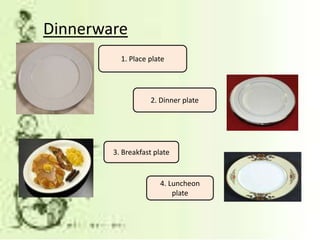
Dinnerware
1. Place plate
2. Dinner plate
3. Breakfast plate
4. Luncheon
plate
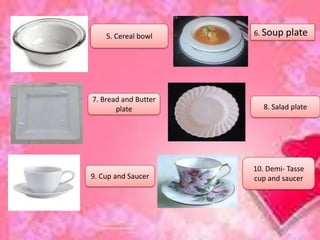
5. Cereal bowl 6. Soup plate
7. Bread and Butter
plate 8. Salad plate
9. Cup and Saucer
10. Demi- Tasse
cup and saucer
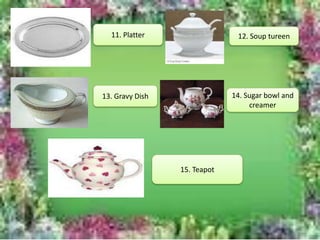
11. Platter 12. Soup tureen
13. Gravy Dish 14. Sugar bowl and
creamer
15. Teapot
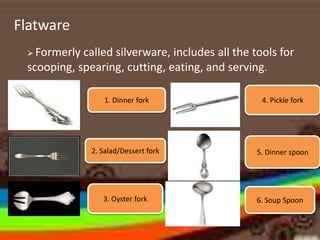
Flatware
 Formerly called silverware, includes all the tools for
scooping, spearing, cutting, eating, and serving.
1. Dinner fork
2. Salad/Dessert fork
3. Oyster fork
4. Pickle fork
5. Dinner spoon
6. Soup Spoon
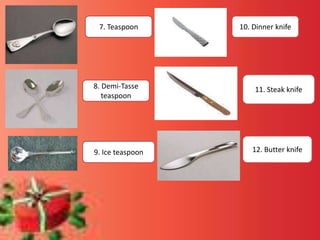
7. Teaspoon
8. Demi-Tasse
teaspoon
9. Ice teaspoon
10. Dinner knife
11. Steak knife
12. Butter knife
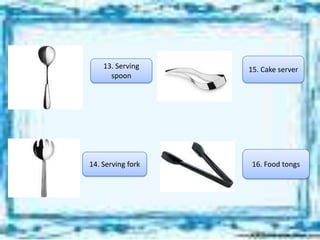
13. Serving
spoon
14. Serving fork
15. Cake server
16. Food tongs
Halloware
 includes pieces used for
serving and such decoration
objects as trays, pitchers,
beverage pots, vases , and so
forth, regardless of the
mateerial which they are
composed.
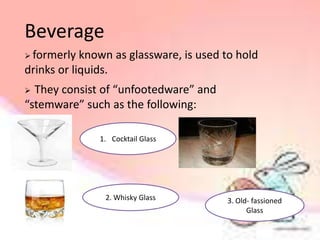
Beverage
 formerly known as glassware, is used to hold
drinks or liquids.
 They consist of “unfootedware” and
“stemware” such as the following:
1. Cocktail Glass
2. Whisky Glass 3. Old- fassioned
Glass
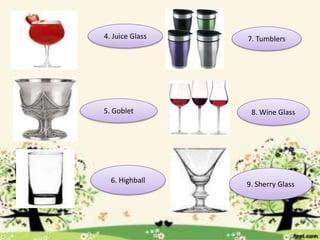
4. Juice Glass
5. Goblet
6. Highball
7. Tumblers
8. Wine Glass
9. Sherry Glass
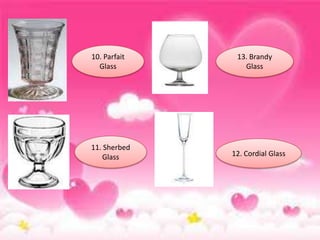
10. Parfait
Glass
11. Sherbed
Glass 12. Cordial Glass
13. Brandy
Glass
Linens
 include table coverings and napkins of all
types, regardless of fiber.
Modern clothes – are available in a wide variety
of fibers, colors, and designs.
•Types:
1. Table cloth 5. top cloth
2. silence cloth 6. Dinner napkin
3. runners 7. Luncheon/Breakfast napkin
4. place mat 8.Tea napkin
9. Cocktail napkin
Linens Used in Table Setting
1. Tablecloth
 a material used to cover the entire surface of the table plus a
few inches overhang , 1. to 16”for sit-down meals, and florr
length for buffet service.
2. Silence cloth
 a heavy, pdlike material used underneath the table cloth.
3. Runners
 are long, narrow strips of cloth used to bare tables without
underliners.
4. Top cloth
 are small pieces of material placed on top of tablecloths.
5. Place mats
 table coverings.
6. Napkin
 vary in size and type of material depending on the use.
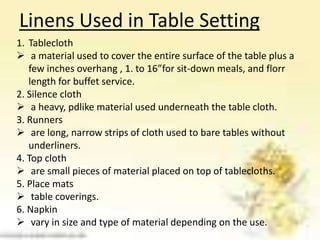
 Table Covers
 Runners
 Top Cloth
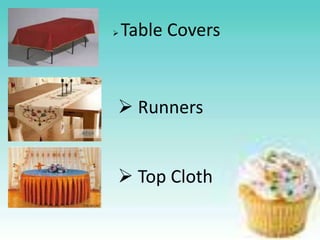
 Table Napkin
 Place mats
Table Setting
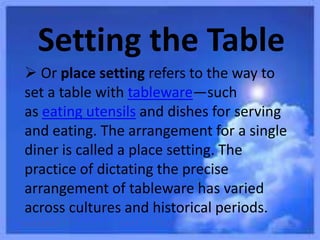
Setting the Table
 Or place setting refers to the way to
set a table with tableware—such
as eating utensils and dishes for serving
and eating. The arrangement for a single
diner is called a place setting. The
practice of dictating the precise
arrangement of tableware has varied
across cultures and historical periods.
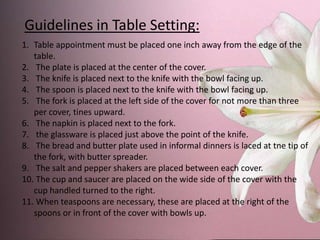
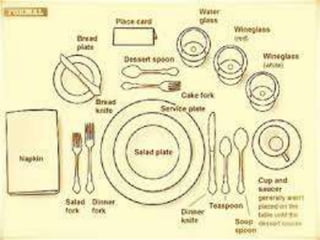
Guidelines in Table Setting:
1. Table appointment must be placed one inch away from the edge of the
table.
2. The plate is placed at the center of the cover.
3. The knife is placed next to the knife with the bowl facing up.
4. The spoon is placed next to the knife with the bowl facing up.
5. The fork is placed at the left side of the cover for not more than three
per cover, tines upward.
6. The napkin is placed next to the fork.
7. the glassware is placed just above the point of the knife.
8. The bread and butter plate used in informal dinners is laced at tne tip of
the fork, with butter spreader.
9. The salt and pepper shakers are placed between each cover.
10. The cup and saucer are placed on the wide side of the cover with the
cup handled turned to the right.
11. When teaspoons are necessary, these are placed at the right of the
spoons or in front of the cover with bowls up.
The
End
The
End

Dining preparation & Table Setting

  • 2.
  • 3.
  • 4.
    Success in afood service establishment depends on the job performance of the food service personnel . * People working in a food service establishment should possess the following qualifications. 1. He is physically fit and have a good posture. 2. He is well-groomed. 3. He can communicate intelligibly with the clientele and other members of the establishment , orally or in writing. 4. He has a pleasing personality . He is : -interested -friendly -loyal -capable -honest -reliable -courteous -personable
  • 5.
    Common Function ofa Food Service Operation 1. Purchasing – it is a management function unless a purchasing agent is assigned for that purpose. 2. Reserving, Issuing, and Storing – in large establishments workers are assigned to perform each of the three functions. 3. Preparation – it is the production of all food items included in the menu. 4. Service – it is a function that included all activities that relate to the selling of food items. 5. Sanitation – it is a function that includes the care of the physical plant, equipment and utensil, maintenance, and ware washing.
  • 6.
  • 7.
    Quality Control inany food service covers all its operation, such as purchasing, issuing, receiving , menu planning, production, sales, and service. Quantifying Recipes A recipe has two major parts, namely ; the ingredients and the procedures of preparing the products. The basic recipe is used at home , while the quantity recipe is used in a large gathering and service establishment . A basic recipe can be converted to a quantity recipe by: 1. Selecting and evaluating a basic recipe as to the adaptability to the operation; 2. The quantity of the original recipe should first be prepared before increasing the ingredients of a recipe;
  • 8.
    3. Transposing themeasuring of ingredients into weights; 4. Checking the tools and equipment to be used to ensure accuracy; 5. Start quantifying the recipe with 25 serving then increased the quantity gradually; 6. Supervising the preparation of the converted recipe; 7. Evaluating the finished product using original standards; and / or 8. Standardizing the yield or number of serving according to the plan in which it is cooked instead a definite number of serving .
  • 9.
    Ways of ProducingQuality Foods 1. Using a standard recipe- having a standardized recipe eliminates waste of time, money and effort on the part of the production staff. 2. Working with highly qualified personnel – skills in job assignment help much in the production of quality food. 3. Adequate facilities and equipments these contribute to the efficiency of the production staff. 4. Practice of safety and cleanliness – This contributes to the good quality of the product.
  • 10.
    Lesson 5 : DiningRoom Preparation
  • 11.
    -Dining Room Preparation -is the proper arrangements of dining tables. Setting the tables properly makes meals more appealing, satisfying, and enjoyable to dinner . Table Appointments Table Appointments are the complements used for dining. Include:  Dinnerware  silverware or flatware  glassware or beverage ware  hallow-ware  linens
  • 12.
    Dinnerware 1. Place plate 2.Dinner plate 3. Breakfast plate 4. Luncheon plate
  • 13.
    5. Cereal bowl6. Soup plate 7. Bread and Butter plate 8. Salad plate 9. Cup and Saucer 10. Demi- Tasse cup and saucer
  • 14.
    11. Platter 12.Soup tureen 13. Gravy Dish 14. Sugar bowl and creamer 15. Teapot
  • 15.
    Flatware  Formerly calledsilverware, includes all the tools for scooping, spearing, cutting, eating, and serving. 1. Dinner fork 2. Salad/Dessert fork 3. Oyster fork 4. Pickle fork 5. Dinner spoon 6. Soup Spoon
  • 16.
    7. Teaspoon 8. Demi-Tasse teaspoon 9.Ice teaspoon 10. Dinner knife 11. Steak knife 12. Butter knife
  • 17.
    13. Serving spoon 14. Servingfork 15. Cake server 16. Food tongs
  • 18.
    Halloware  includes piecesused for serving and such decoration objects as trays, pitchers, beverage pots, vases , and so forth, regardless of the mateerial which they are composed.
  • 19.
    Beverage  formerly knownas glassware, is used to hold drinks or liquids.  They consist of “unfootedware” and “stemware” such as the following: 1. Cocktail Glass 2. Whisky Glass 3. Old- fassioned Glass
  • 20.
    4. Juice Glass 5.Goblet 6. Highball 7. Tumblers 8. Wine Glass 9. Sherry Glass
  • 21.
    10. Parfait Glass 11. Sherbed Glass12. Cordial Glass 13. Brandy Glass
  • 22.
    Linens  include tablecoverings and napkins of all types, regardless of fiber. Modern clothes – are available in a wide variety of fibers, colors, and designs. •Types: 1. Table cloth 5. top cloth 2. silence cloth 6. Dinner napkin 3. runners 7. Luncheon/Breakfast napkin 4. place mat 8.Tea napkin 9. Cocktail napkin
  • 23.
    Linens Used inTable Setting 1. Tablecloth  a material used to cover the entire surface of the table plus a few inches overhang , 1. to 16”for sit-down meals, and florr length for buffet service. 2. Silence cloth  a heavy, pdlike material used underneath the table cloth. 3. Runners  are long, narrow strips of cloth used to bare tables without underliners. 4. Top cloth  are small pieces of material placed on top of tablecloths. 5. Place mats  table coverings. 6. Napkin  vary in size and type of material depending on the use.
  • 24.
     Table Covers Runners  Top Cloth
  • 25.
  • 26.
  • 27.
    Setting the Table Or place setting refers to the way to set a table with tableware—such as eating utensils and dishes for serving and eating. The arrangement for a single diner is called a place setting. The practice of dictating the precise arrangement of tableware has varied across cultures and historical periods.
  • 28.
    Guidelines in TableSetting: 1. Table appointment must be placed one inch away from the edge of the table. 2. The plate is placed at the center of the cover. 3. The knife is placed next to the knife with the bowl facing up. 4. The spoon is placed next to the knife with the bowl facing up. 5. The fork is placed at the left side of the cover for not more than three per cover, tines upward. 6. The napkin is placed next to the fork. 7. the glassware is placed just above the point of the knife. 8. The bread and butter plate used in informal dinners is laced at tne tip of the fork, with butter spreader. 9. The salt and pepper shakers are placed between each cover. 10. The cup and saucer are placed on the wide side of the cover with the cup handled turned to the right. 11. When teaspoons are necessary, these are placed at the right of the spoons or in front of the cover with bowls up.
  • 30.