5 th  National Symposium on Biosafety:   A Rational Basis for Biocontainment Biosafety in Microbiological and Biomedical Laboratories 3 rd  Edition JY Richmond & RW McKinney  (eds.)
BMBL  Introduction 1941 - Meyer and Eddie 74 lab associated brucellosis infections in US 1949 - Sulkin and Pike   222 viral infections (21 fatal) Only 27% related to known accidents
BMBL  Introduction 1951,1965, 1976 - Sulkin and Pike Surveys for lab-associated infections More than 5,000 labs Cumulative total of 3,921cases cited Most commonly reported:  Hepatitis   Brucellosis Tuberculosis   Tularemia Typhoid Venzuelan Equine Encephalitis
BMBL  Introduction 1951,1965, 1976 - Sulkin and Pike   (cont.) Surveys for lab-associated infections Fewer than 20% associated with known accidents Exposure to infectious aerosols plausible (but unconfirmed) for >80% of reported cases
Principles of Biosafety Introduction Biosafety Levels 1-3 Guidelines to describe combinations of: Laboratory Practices and Techniques Standard Practices Special Practices Safety Equipment  (Primary Barriers) Laboratory Facilities  (Secondary Barriers)
Principles of Biosafety  Introduction Biosafety Levels 1-3 Provide Increasing levels of personnel and environmental protection Guidelines for working safely in microbiological and biomedical laboratories
Lab Practices and Techniques  Introduction Knowledgeable supervisor  Personnel Aware of potential hazards Proficient in practices/techniques Biosafety manual specific to lab
Safety Equipment  (Primary Barriers) - Introduction Biosafety cabinets (BSCs)  [BSL-2/3] Personal protective clothing  Gloves Gowns  Pipetting Devices  Safety centrifuge cups and rotors Eye and face protection Respiratory protection  [BSL-3]
Biosafety Level 1 Introduction Suitable for work involving well-characterized agents not known to cause disease in healthy adult humans and of minimal potential hazard to laboratory personnel and the environment.
Biosafety Level 1  Introduction Examples: Bacillus subtilis Naegleria gruberi Infectious canine hepatitis virus E. coli
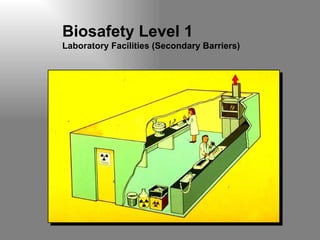
Biosafety Level 1  Laboratory Facilities (Secondary Barriers)
Biosafety Level 1  Laboratory Facilities (Secondary Barriers) Sink for handwashing Work surfaces easily cleaned Bench tops Sturdy furniture Windows fitted with flyscreens

T6

  • 1.
    5 th National Symposium on Biosafety: A Rational Basis for Biocontainment Biosafety in Microbiological and Biomedical Laboratories 3 rd Edition JY Richmond & RW McKinney (eds.)
  • 2.
    BMBL Introduction1941 - Meyer and Eddie 74 lab associated brucellosis infections in US 1949 - Sulkin and Pike 222 viral infections (21 fatal) Only 27% related to known accidents
  • 3.
    BMBL Introduction1951,1965, 1976 - Sulkin and Pike Surveys for lab-associated infections More than 5,000 labs Cumulative total of 3,921cases cited Most commonly reported: Hepatitis  Brucellosis Tuberculosis  Tularemia Typhoid Venzuelan Equine Encephalitis
  • 4.
    BMBL Introduction1951,1965, 1976 - Sulkin and Pike (cont.) Surveys for lab-associated infections Fewer than 20% associated with known accidents Exposure to infectious aerosols plausible (but unconfirmed) for >80% of reported cases
  • 5.
    Principles of BiosafetyIntroduction Biosafety Levels 1-3 Guidelines to describe combinations of: Laboratory Practices and Techniques Standard Practices Special Practices Safety Equipment (Primary Barriers) Laboratory Facilities (Secondary Barriers)
  • 6.
    Principles of Biosafety Introduction Biosafety Levels 1-3 Provide Increasing levels of personnel and environmental protection Guidelines for working safely in microbiological and biomedical laboratories
  • 7.
    Lab Practices andTechniques Introduction Knowledgeable supervisor Personnel Aware of potential hazards Proficient in practices/techniques Biosafety manual specific to lab
  • 8.
    Safety Equipment (Primary Barriers) - Introduction Biosafety cabinets (BSCs) [BSL-2/3] Personal protective clothing Gloves Gowns Pipetting Devices Safety centrifuge cups and rotors Eye and face protection Respiratory protection [BSL-3]
  • 9.
    Biosafety Level 1Introduction Suitable for work involving well-characterized agents not known to cause disease in healthy adult humans and of minimal potential hazard to laboratory personnel and the environment.
  • 10.
    Biosafety Level 1 Introduction Examples: Bacillus subtilis Naegleria gruberi Infectious canine hepatitis virus E. coli
  • 11.
    Biosafety Level 1 Laboratory Facilities (Secondary Barriers)
  • 12.
    Biosafety Level 1 Laboratory Facilities (Secondary Barriers) Sink for handwashing Work surfaces easily cleaned Bench tops Sturdy furniture Windows fitted with flyscreens