MindCanvas: Reimagining online research Rashmi Sinha Uzanto www.uzanto.com www.themindcanvas.com
Duct-tape research! (in the trenches - Information Architecture Redesign of eBay.com)
Background to IA redesign eBay.com has grown in organic fashion – inconsistent, fractured user experience Separate design / usability efforts for parts of eBay first effort to focus on user experience for entire site Basic eBay facts World’s largest online marketplace (79 million in US) Types of users Buyers & sellers New & experienced Individuals & corporations Different countries & cultures
Challenges  New IA would need to Serve diverse user group varying goals / mental models Be future-oriented, allow for change & growth Changes needed to be evolutionary not revolutionary accommodate users familiar with current site Senior management at eBay needed proof Is there need for such drastic restructuring? Research to be completed in 6 weeks!
Goals of research Research has multiple goals Need successful design, not just good design Serves user Satisfies business goals  Is accepted by management 3-stage research method Stages: Exploration    Understanding    Verification Stages complement & build upon each other Mix of qualitative & quantitative methods  Qualitative:  rich, open-ended understanding of users / domain Quantitative:  recommendations grounded in data (help make case to management)
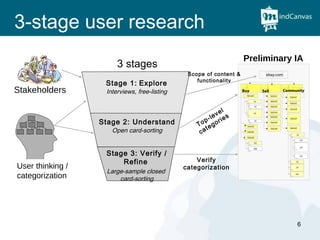
3-stage user research  Stage 1:   Explore Interviews, free-listing Stage 3:  Verify / Refine   Large-sample closed  card-sorting 3 stages Stakeholders User thinking / categorization Preliminary IA Stage 2: Understand Open card-sorting Verify categorization Top-level categories Scope of content & functionality ebay.com Community Buy Sell Sub cat1 SubCat2 SubCat3 xx SubCat1 Subcat4 Subcat3 Subcat2 xx xx xxx SubCat3 SubCat5 SubCat4 SubCat6 SubCat4 xx xxx xx xxx xxx xxx SubCat4 SubCat5 SubCat1 SubCat2 xxx xx xx
Stage 1: Explore domain with Freelisting Goals Explore domain in open-ended fashion, map scope. Generate list of current & “Horizon Tasks” (planned for future) Method Interviews & Freelisting With eBay users, stakeholders & designers  Freelisting tasks (eBay is about tasks!) What are all the tasks users can do on eBay.com List an item, Pay for it What else will users be able to do on eBay.com 2-5 years that they can’t do today? Results: List of 100 representative tasks (25 Horizon)
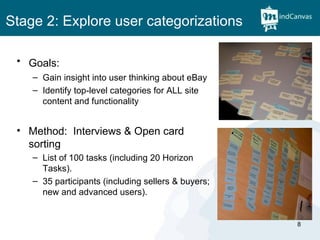
Stage 2: Explore user categorizations  Goals:   Gain insight into user thinking about eBay Identify top-level categories for ALL site content and functionality Method:  Interviews & Open card sorting  List of 100 tasks (including 20 Horizon Tasks). 35 participants (including sellers & buyers; new and advanced users).
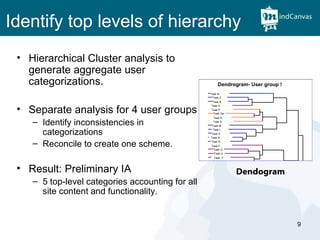
Identify top levels of hierarchy Hierarchical Cluster analysis to generate aggregate user categorizations. Separate analysis for 4 user groups  Identify inconsistencies in categorizations Reconcile to create one scheme. Result: Preliminary IA 5 top-level categories accounting for all site content and functionality. Dendogram
Stage 3: Verify & refine scheme Goals: Verify 5-category scheme covers all of eBay. What tasks/concepts don’t fit? Where do users expect this info? Input from larger, more diverse set of users. Establish method for future verification of IA. and to generalize scheme to international eBays. Method: closed card sorting  Large sample (~ 1,000)  representing all eBay user types. Study conducted using online survey.  Participants categorized tasks into one of categories (or selected  Other  if it didn’t belong) Result Site-map showing the structure for all main parts of the eBay.com
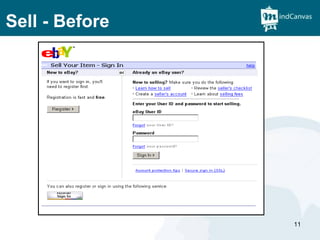
Sell - Before
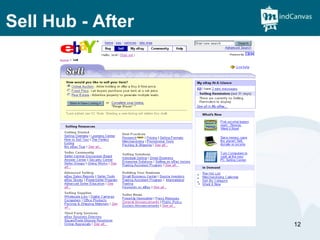
Sell Hub - After
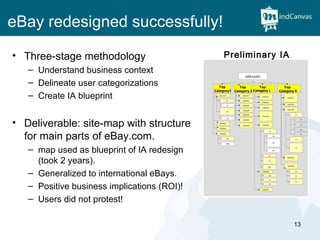
eBay redesigned successfully! Three-stage methodology Understand business context  Delineate user categorizations Create IA blueprint Deliverable: site-map with structure for main parts of eBay.com.  map used as blueprint of IA redesign (took 2 years). Generalized to international eBays. Positive business implications (ROI)! Users did not protest! site.com Top Category  3 Top Category1 Top Category 2 Top Category 4 SubCat1 Sub cat1 SubCat2 xx SubCat3 xx xx SubCat2 SubCat3 SubCat5 xx xx xx xx SubCat1 Subcat4 Subcat3 Subcat2 xx xx xxx SubCat3 SubCat5 SubCat4 SubCat6 SubCat4 xxx xx xx xxx xx xxx xxx xxx SubCat7 SubCat4 SubCat5 SubCat6 SubCat1 SubCat2 xx xx xxx xx xxx xx xx SubCat4 xx Preliminary IA
Duct-tape research! There has to be a better way - fast, cheap (relatively) & online…
Why we built MindCanvas Qualitative research is great, takes a lot of time Online tools suck, get used anyway (users not engaged) Business stakeholders respond to quantitative analysis & large sample sizes Deliverables do not cater to designers  Research findings remain locked up with analyst
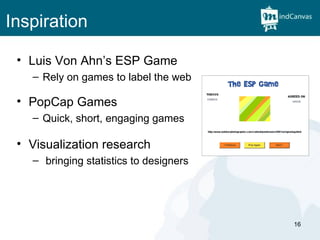
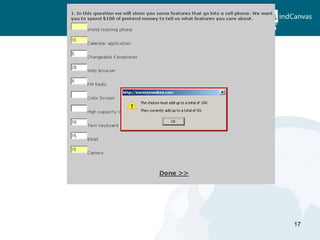
Inspiration Luis Von Ahn’s ESP Game Rely on games to label the web PopCap Games Quick, short, engaging games Visualization research bringing statistics to designers
 
back to the future! MindCanvas interpretation
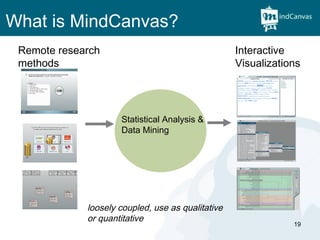
What is MindCanvas? Remote research methods Statistical Analysis & Data Mining  Interactive Visualizations loosely coupled, use as qualitative or quantitative
Game-like elicitation methods Surveys do not engage people. Games are fun! People engage in complex tasks willingly Do game-like methods work better? MindCanvas has game-like elements (its not a game) Interactive, visual, screen build up, fun For both qualitative & quantitative Remote moderated for qualitative Remote unmoderated for quantitative
Rich interactive visualizations Large datasets need statistical analysis & data mining Visualizations-to-go Self-contained files - embedded into PowerPoint, emailed, shared Interactive visualizations with slides & knobs! Easy to share with team Visualization posters Designers want printouts to hang on walls, and scribble on
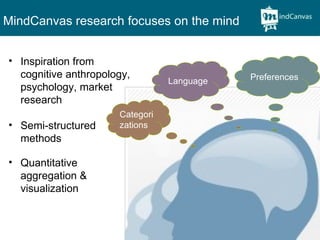
MindCanvas research focuses on the mind Inspiration from cognitive anthropology, psychology, market research Semi-structured methods Quantitative aggregation & visualization Categorizations Preferences Language
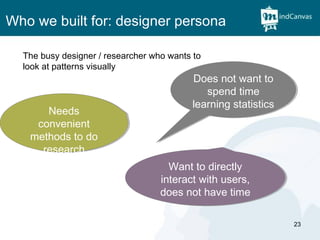
Who we built for: designer persona Needs convenient methods to do research Does not want to spend time learning statistics The busy designer / researcher who wants to look at patterns visually Want to directly interact with users, does not have time
Who we built for: participant persona “ This was the most fun I have had in a while!” “ It is very easy to complete the task. In fact, I had fun doing this.” The not-tech savvy person who occasionally takes surveys “ I think there are too many cards. But it was kind of  fun.”
Where MindCanvas could help Product Development:  Finding the  right  feature-set for the  right  users (or personas) Information Architecture:  Understanding how people think for information design. Early visual design validation:  Understanding what people think & feel about a design when its just an image.
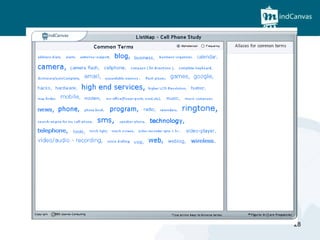
MindCanvas in product development Initial understanding of domain What’s important to people? What words do they use? Method:  Freelisting Deliverable:  ListMap Prioritizing features / outcomes users care about Method:  Divide-the-dollar Deliverable:  WeightMap ClusterBrowser
MindCanvas in Information Architecture How do people think about a domain? Method:  OpenSort Deliverable Dendogram SimilarityBrowser VocabularyBrowser 1,  2 Is your information architecture effective? Is one scheme more effective than another? Method:  TreeSort Deliverable: ClusterBrowser
 
Questions? MindCanvas team is… Delhi Kapil Mohan Kamalmeet Singh Debasish Biswas Sunil Gupta Amit Ranjan Mountain View Jon Boutelle Rashmi Sinha [email_address]
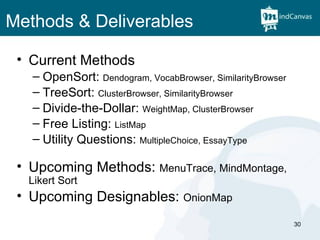
Methods & Deliverables Current Methods OpenSort:  Dendogram, VocabBrowser, SimilarityBrowser TreeSort:  ClusterBrowser, SimilarityBrowser Divide-the-Dollar:  WeightMap, ClusterBrowser Free Listing:  ListMap Utility Questions:  MultipleChoice, EssayType Upcoming Methods:  MenuTrace, MindMontage, Likert Sort Upcoming Designables:  OnionMap
Collaborative Research Process High quality research needs expertise research design + statistics Service should enable high quality research Structured research process Templates for study design Help with data collection
What is MindCanvas An innovative research platform for high quality research Game-like elicitation methods Interactive visualizations (designables-to-go) Research expertise

Rashmi Xerox Parc

  • 1.
    MindCanvas: Reimagining onlineresearch Rashmi Sinha Uzanto www.uzanto.com www.themindcanvas.com
  • 2.
    Duct-tape research! (inthe trenches - Information Architecture Redesign of eBay.com)
  • 3.
    Background to IAredesign eBay.com has grown in organic fashion – inconsistent, fractured user experience Separate design / usability efforts for parts of eBay first effort to focus on user experience for entire site Basic eBay facts World’s largest online marketplace (79 million in US) Types of users Buyers & sellers New & experienced Individuals & corporations Different countries & cultures
  • 4.
    Challenges NewIA would need to Serve diverse user group varying goals / mental models Be future-oriented, allow for change & growth Changes needed to be evolutionary not revolutionary accommodate users familiar with current site Senior management at eBay needed proof Is there need for such drastic restructuring? Research to be completed in 6 weeks!
  • 5.
    Goals of researchResearch has multiple goals Need successful design, not just good design Serves user Satisfies business goals Is accepted by management 3-stage research method Stages: Exploration  Understanding  Verification Stages complement & build upon each other Mix of qualitative & quantitative methods Qualitative: rich, open-ended understanding of users / domain Quantitative: recommendations grounded in data (help make case to management)
  • 6.
    3-stage user research Stage 1: Explore Interviews, free-listing Stage 3: Verify / Refine Large-sample closed card-sorting 3 stages Stakeholders User thinking / categorization Preliminary IA Stage 2: Understand Open card-sorting Verify categorization Top-level categories Scope of content & functionality ebay.com Community Buy Sell Sub cat1 SubCat2 SubCat3 xx SubCat1 Subcat4 Subcat3 Subcat2 xx xx xxx SubCat3 SubCat5 SubCat4 SubCat6 SubCat4 xx xxx xx xxx xxx xxx SubCat4 SubCat5 SubCat1 SubCat2 xxx xx xx
  • 7.
    Stage 1: Exploredomain with Freelisting Goals Explore domain in open-ended fashion, map scope. Generate list of current & “Horizon Tasks” (planned for future) Method Interviews & Freelisting With eBay users, stakeholders & designers Freelisting tasks (eBay is about tasks!) What are all the tasks users can do on eBay.com List an item, Pay for it What else will users be able to do on eBay.com 2-5 years that they can’t do today? Results: List of 100 representative tasks (25 Horizon)
  • 8.
    Stage 2: Exploreuser categorizations Goals: Gain insight into user thinking about eBay Identify top-level categories for ALL site content and functionality Method: Interviews & Open card sorting List of 100 tasks (including 20 Horizon Tasks). 35 participants (including sellers & buyers; new and advanced users).
  • 9.
    Identify top levelsof hierarchy Hierarchical Cluster analysis to generate aggregate user categorizations. Separate analysis for 4 user groups Identify inconsistencies in categorizations Reconcile to create one scheme. Result: Preliminary IA 5 top-level categories accounting for all site content and functionality. Dendogram
  • 10.
    Stage 3: Verify& refine scheme Goals: Verify 5-category scheme covers all of eBay. What tasks/concepts don’t fit? Where do users expect this info? Input from larger, more diverse set of users. Establish method for future verification of IA. and to generalize scheme to international eBays. Method: closed card sorting Large sample (~ 1,000) representing all eBay user types. Study conducted using online survey. Participants categorized tasks into one of categories (or selected Other if it didn’t belong) Result Site-map showing the structure for all main parts of the eBay.com
  • 11.
  • 12.
  • 13.
    eBay redesigned successfully!Three-stage methodology Understand business context Delineate user categorizations Create IA blueprint Deliverable: site-map with structure for main parts of eBay.com. map used as blueprint of IA redesign (took 2 years). Generalized to international eBays. Positive business implications (ROI)! Users did not protest! site.com Top Category 3 Top Category1 Top Category 2 Top Category 4 SubCat1 Sub cat1 SubCat2 xx SubCat3 xx xx SubCat2 SubCat3 SubCat5 xx xx xx xx SubCat1 Subcat4 Subcat3 Subcat2 xx xx xxx SubCat3 SubCat5 SubCat4 SubCat6 SubCat4 xxx xx xx xxx xx xxx xxx xxx SubCat7 SubCat4 SubCat5 SubCat6 SubCat1 SubCat2 xx xx xxx xx xxx xx xx SubCat4 xx Preliminary IA
  • 14.
    Duct-tape research! Therehas to be a better way - fast, cheap (relatively) & online…
  • 15.
    Why we builtMindCanvas Qualitative research is great, takes a lot of time Online tools suck, get used anyway (users not engaged) Business stakeholders respond to quantitative analysis & large sample sizes Deliverables do not cater to designers Research findings remain locked up with analyst
  • 16.
    Inspiration Luis VonAhn’s ESP Game Rely on games to label the web PopCap Games Quick, short, engaging games Visualization research bringing statistics to designers
  • 17.
  • 18.
    back to thefuture! MindCanvas interpretation
  • 19.
    What is MindCanvas?Remote research methods Statistical Analysis & Data Mining Interactive Visualizations loosely coupled, use as qualitative or quantitative
  • 20.
    Game-like elicitation methodsSurveys do not engage people. Games are fun! People engage in complex tasks willingly Do game-like methods work better? MindCanvas has game-like elements (its not a game) Interactive, visual, screen build up, fun For both qualitative & quantitative Remote moderated for qualitative Remote unmoderated for quantitative
  • 21.
    Rich interactive visualizationsLarge datasets need statistical analysis & data mining Visualizations-to-go Self-contained files - embedded into PowerPoint, emailed, shared Interactive visualizations with slides & knobs! Easy to share with team Visualization posters Designers want printouts to hang on walls, and scribble on
  • 22.
    MindCanvas research focuseson the mind Inspiration from cognitive anthropology, psychology, market research Semi-structured methods Quantitative aggregation & visualization Categorizations Preferences Language
  • 23.
    Who we builtfor: designer persona Needs convenient methods to do research Does not want to spend time learning statistics The busy designer / researcher who wants to look at patterns visually Want to directly interact with users, does not have time
  • 24.
    Who we builtfor: participant persona “ This was the most fun I have had in a while!” “ It is very easy to complete the task. In fact, I had fun doing this.” The not-tech savvy person who occasionally takes surveys “ I think there are too many cards. But it was kind of fun.”
  • 25.
    Where MindCanvas couldhelp Product Development: Finding the right feature-set for the right users (or personas) Information Architecture: Understanding how people think for information design. Early visual design validation: Understanding what people think & feel about a design when its just an image.
  • 26.
    MindCanvas in productdevelopment Initial understanding of domain What’s important to people? What words do they use? Method: Freelisting Deliverable: ListMap Prioritizing features / outcomes users care about Method: Divide-the-dollar Deliverable: WeightMap ClusterBrowser
  • 27.
    MindCanvas in InformationArchitecture How do people think about a domain? Method: OpenSort Deliverable Dendogram SimilarityBrowser VocabularyBrowser 1, 2 Is your information architecture effective? Is one scheme more effective than another? Method: TreeSort Deliverable: ClusterBrowser
  • 28.
  • 29.
    Questions? MindCanvas teamis… Delhi Kapil Mohan Kamalmeet Singh Debasish Biswas Sunil Gupta Amit Ranjan Mountain View Jon Boutelle Rashmi Sinha [email_address]
  • 30.
    Methods & DeliverablesCurrent Methods OpenSort: Dendogram, VocabBrowser, SimilarityBrowser TreeSort: ClusterBrowser, SimilarityBrowser Divide-the-Dollar: WeightMap, ClusterBrowser Free Listing: ListMap Utility Questions: MultipleChoice, EssayType Upcoming Methods: MenuTrace, MindMontage, Likert Sort Upcoming Designables: OnionMap
  • 31.
    Collaborative Research ProcessHigh quality research needs expertise research design + statistics Service should enable high quality research Structured research process Templates for study design Help with data collection
  • 32.
    What is MindCanvasAn innovative research platform for high quality research Game-like elicitation methods Interactive visualizations (designables-to-go) Research expertise