T12: Exploitation testing For testing Service Level Agreements 1 december 2009 based on a best practice at
Agenda Understanding Exploitation testing Best practice at APG Service Level Management and Testing Using State Transition Test to test Availability
Understanding Exploitation testing Based on Dutch term ‘Exploitatie test’ Definition: Check whether the agreed or expected  Service level related to IT infrastructures  can be achieved. Those agreements and/or expectations  are formalized in Service Level Agreements (SLA) Represents a group of quality attributes
Service Level Agreement (SLA) A  negotiated agreement  between two parties customer and service provider Containing measurable KPI’s, such as: 99.9% uptime per month => max. downtime: 43.2 minutes 95% of transactions completed within 1 second Mean Time To Recovery of 4 hours 98% of batch jobs executed within batch window Maximum response time of 30 minutes
Trends in IT service providing Formalization of SLA’s, due to:  Increased Integration of systems Globalization (higher availability demands) Third party involvement Growing complexity of infrastructures and architectures Etc…
Agenda Understanding Exploitation testing Best practice at APG Service Level Management and Testing Using State Transition Test to test Availability
All Pension Group Pension provider for international pension funds Approximately 4000 staff provide pensions  for around 4 million participants Internal IT department (CIS) exists of:  Application Services (AS) – Software development Exploitation Services (ES) – Service management And others, like QA and Financial control Mission of CIS: Allow business to excel by delivering ICT services
Test optimization  One of the optimization targets:  Involve ES in an earlier stage in project and incorporate  a formal test approach Implemented elements: Involvement at reviews of specifications  Introduction of Test specification techniques at Exploitation tests Result: Improved the quality of advice given to stakeholders Better understanding of the software and daily tasks Increased confidence
Agenda Understanding Exploitation testing Best practice at APG Service Level Management and Testing Using State Transition Test to test Availability
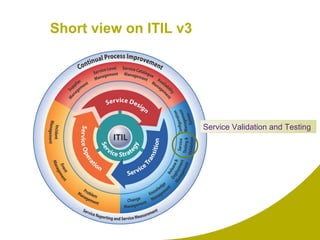
Short view on ITIL v3 Service Validation and Testing
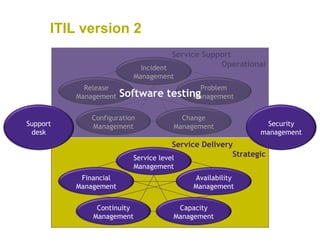
ITIL version 2 Service Support Operational Service Delivery Strategic Software testing Incident Management Problem Management Configuration Management Change Management Release Management Service level Management Availability Management Continuity Management Capacity Management Financial Management Security management Support desk
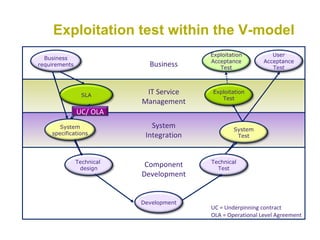
System Integration Component Development Business System Integration IT Service Management UC = Underpinning contract OLA = Operational Level Agreement Exploitation test within the V-model System specifications System Test Business requirements System specifications Technical  design Development Technical Test System Test Exploitation Test Exploitation Acceptance Test SLA UC/ OLA User Acceptance Test
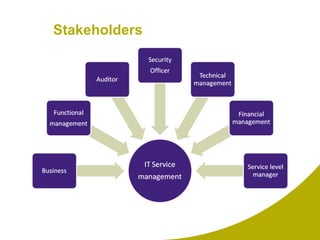
Stakeholders
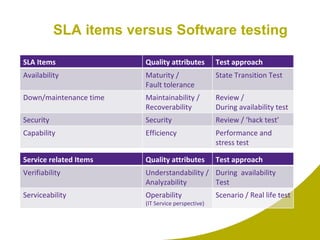
SLA items versus Software testing SLA Items Quality attributes Test approach Availability Maturity / Fault tolerance State Transition Test Down/maintenance time Maintainability / Recoverability Review /  During availability test Security Security Review / ‘hack test’  Capability Efficiency Performance and  stress test Service related Items Quality attributes Test approach Verifiability  Understandability / Analyzability During  availability Test Serviceability Operability (IT Service perspective) Scenario / Real life test
Agenda Understanding Exploitation testing Best practice at APG Service Level Management and Testing Using State Transition Test to test Availability
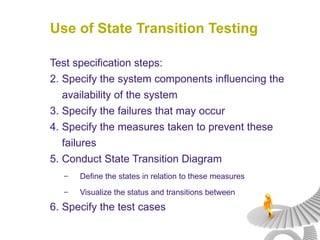
Use of State Transition Testing Test specification steps: Specify the system components influencing the availability of the system Specify the failures that may occur Specify the measures taken to prevent these failures Conduct State Transition Diagram Define the states in relation to these measures Visualize the status and transitions between Specify the test cases
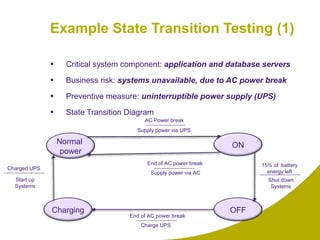
Example State Transition Testing (1) Critical system component:  application and database servers Business risk:  systems unavailable, due to AC power break Preventive measure:  uninterruptible power supply (UPS) State Transition Diagram AC Power break 15% of  battery energy left Shut down Systems Supply power via UPS End of AC power break Charge UPS End of AC power break Supply power via AC Charged UPS Start up Systems Normal  power ON OFF Charging
Example State Transition Testing (2) Specify test cases [Based on a 0-switch coverage] TC1 TC2 TC3 TC4 TC5 Start State Normal power ON OFF CHARGING ON Trigger AC Power break 15% energy left End of AC power break 20% charged UPS End of AC power break Action Supply power via UPS Shut down systems Charge of UPS Start up systems Supply power via AC End State ON OFF CHARGING Normal power Stand By Expectation Servers are operating Routers are operating UPS is active Administrator is notified Related systems are notified Routers are shutdown Active processes are stopped Temporary data is saved Servers are shut down UPS is charging  Systems are down Routers are down Servers are started up Temp. data is reprocessed Routers are started up Related systems are notified Servers are operating Routers are operating UPS is in standby modus
Questions

T12 Exploitation Testing Presentation 1.2

  • 1.
    T12: Exploitation testingFor testing Service Level Agreements 1 december 2009 based on a best practice at
  • 2.
    Agenda Understanding Exploitationtesting Best practice at APG Service Level Management and Testing Using State Transition Test to test Availability
  • 3.
    Understanding Exploitation testingBased on Dutch term ‘Exploitatie test’ Definition: Check whether the agreed or expected Service level related to IT infrastructures can be achieved. Those agreements and/or expectations are formalized in Service Level Agreements (SLA) Represents a group of quality attributes
  • 4.
    Service Level Agreement(SLA) A negotiated agreement between two parties customer and service provider Containing measurable KPI’s, such as: 99.9% uptime per month => max. downtime: 43.2 minutes 95% of transactions completed within 1 second Mean Time To Recovery of 4 hours 98% of batch jobs executed within batch window Maximum response time of 30 minutes
  • 5.
    Trends in ITservice providing Formalization of SLA’s, due to: Increased Integration of systems Globalization (higher availability demands) Third party involvement Growing complexity of infrastructures and architectures Etc…
  • 6.
    Agenda Understanding Exploitationtesting Best practice at APG Service Level Management and Testing Using State Transition Test to test Availability
  • 7.
    All Pension GroupPension provider for international pension funds Approximately 4000 staff provide pensions for around 4 million participants Internal IT department (CIS) exists of: Application Services (AS) – Software development Exploitation Services (ES) – Service management And others, like QA and Financial control Mission of CIS: Allow business to excel by delivering ICT services
  • 8.
    Test optimization One of the optimization targets: Involve ES in an earlier stage in project and incorporate a formal test approach Implemented elements: Involvement at reviews of specifications Introduction of Test specification techniques at Exploitation tests Result: Improved the quality of advice given to stakeholders Better understanding of the software and daily tasks Increased confidence
  • 9.
    Agenda Understanding Exploitationtesting Best practice at APG Service Level Management and Testing Using State Transition Test to test Availability
  • 10.
    Short view onITIL v3 Service Validation and Testing
  • 11.
    ITIL version 2Service Support Operational Service Delivery Strategic Software testing Incident Management Problem Management Configuration Management Change Management Release Management Service level Management Availability Management Continuity Management Capacity Management Financial Management Security management Support desk
  • 12.
    System Integration ComponentDevelopment Business System Integration IT Service Management UC = Underpinning contract OLA = Operational Level Agreement Exploitation test within the V-model System specifications System Test Business requirements System specifications Technical design Development Technical Test System Test Exploitation Test Exploitation Acceptance Test SLA UC/ OLA User Acceptance Test
  • 13.
  • 14.
    SLA items versusSoftware testing SLA Items Quality attributes Test approach Availability Maturity / Fault tolerance State Transition Test Down/maintenance time Maintainability / Recoverability Review / During availability test Security Security Review / ‘hack test’ Capability Efficiency Performance and stress test Service related Items Quality attributes Test approach Verifiability Understandability / Analyzability During availability Test Serviceability Operability (IT Service perspective) Scenario / Real life test
  • 15.
    Agenda Understanding Exploitationtesting Best practice at APG Service Level Management and Testing Using State Transition Test to test Availability
  • 16.
    Use of StateTransition Testing Test specification steps: Specify the system components influencing the availability of the system Specify the failures that may occur Specify the measures taken to prevent these failures Conduct State Transition Diagram Define the states in relation to these measures Visualize the status and transitions between Specify the test cases
  • 17.
    Example State TransitionTesting (1) Critical system component: application and database servers Business risk: systems unavailable, due to AC power break Preventive measure: uninterruptible power supply (UPS) State Transition Diagram AC Power break 15% of battery energy left Shut down Systems Supply power via UPS End of AC power break Charge UPS End of AC power break Supply power via AC Charged UPS Start up Systems Normal power ON OFF Charging
  • 18.
    Example State TransitionTesting (2) Specify test cases [Based on a 0-switch coverage] TC1 TC2 TC3 TC4 TC5 Start State Normal power ON OFF CHARGING ON Trigger AC Power break 15% energy left End of AC power break 20% charged UPS End of AC power break Action Supply power via UPS Shut down systems Charge of UPS Start up systems Supply power via AC End State ON OFF CHARGING Normal power Stand By Expectation Servers are operating Routers are operating UPS is active Administrator is notified Related systems are notified Routers are shutdown Active processes are stopped Temporary data is saved Servers are shut down UPS is charging Systems are down Routers are down Servers are started up Temp. data is reprocessed Routers are started up Related systems are notified Servers are operating Routers are operating UPS is in standby modus
  • 19.

Editor's Notes

  • #20 Turned to power down during a test?