QA Center Of Excellence (TCoE)
for JITC

Should be led from top down
and

implemented from bottom up.
Agenda

•
•
•
•
•
•

What is the QA Center of Excellence (TCoE)
Why implementing TCoE
Benefits of TCoE
Key Strategies/ Tactics/ Approach
Challenges and Opportunities
Business case

• Q&A

• Name – Moti Demri
• Email – mdofqa@gmail.com
• Phone - 904- 386 -6620

2
What is QA Center of Excellence (TCoE)?

• TCoE

is a centralized solution that brings into a shared services
function, people, processes, tools and infrastructure. Standardizing processes
and optimizing resource utilization is to bring in maturity.
• The Test Center of Excellence (TCoE) solution is targeted towards customer
who are challenged with decentralized and under-performing testing functions,
under utilization of testing people, inconsistent test processes and are looking
to move up the maturity ladder towards a standardized testing function, and at
the same time improve efficiency, optimize people and tool utilization and
lower testing costs
• A TCoE may define a best or commonly accepted practice and encourage
adoption of that practice
• A TCoE may govern or enforce standards

3
This is NOT a one person job…it is the entire organization’s effort

4
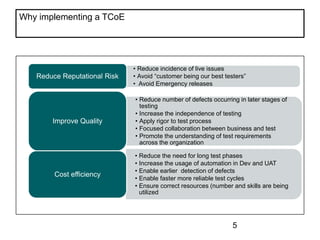
Why implementing a TCoE?

Reduce Reputational Risk

• Reduce incidence of live issues
• Avoid “customer being our best testers”
• Avoid Emergency releases

Improve Quality

• Reduce number of defects occurring in later stages of
testing
• Increase the independence of testing
• Apply rigor to test process
• Focused collaboration between business and test
• Promote the understanding of test requirements
across the organization

Cost efficiency

• Reduce the need for long test phases
• Increase the usage of automation in Dev and UAT
• Enable earlier detection of defects
• Enable faster more reliable test cycles
• Ensure correct resources (number and skills are being
utilized

5
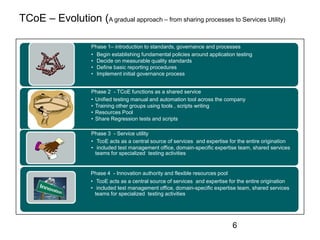
TCoE – Evolution (A gradual approach– from sharing processes to Services Utility)

Phase 1– introduction to standards, governance and processes
• Begin establishing fundamental policies around application testing
• Decide on measurable quality standards
• Define basic reporting procedures
• Implement initial governance process
Phase 2 - TCoE functions as a shared service
• Unified testing manual and automation tool across the company
• Training other groups using tools , scripts writing
• Resources Pool
• Share Regression tests and scripts

Phase 3 - Service utility
• TcoE acts as a central source of services and expertise for the entire origination
• included test management office, domain-specific expertise team, shared services
teams for specialized testing activities

Phase 4 - Innovation authority and flexible resources pool
• TcoE acts as a central source of services and expertise for the entire origination
• included test management office, domain-specific expertise team, shared services
teams for specialized testing activities

6
Why do we need TCoE (Benefits)

TCoE can accrue many benefits to an organization
•
Define and promote testing standards
•
Improve quality
•
Define testing boundaries and provide specialized testing services
•
Faster time to market
•
Reduce testing costs
•
Bring together different testing organizations to align their test processes and technical disciplines
•
Increase the testing value to external groups
•
Insure best practices are in place
•
Better ways to control training and knowledge transfer
•
Provide a practical approach to testing and QA functions
•
Consolidation and test process improvement
•
TCoE are becoming increasingly common within large and medium scale businesses
•
TCoE is a centralized solution that brings together people, processes, tools and infrastructure into a
shared services function
•
Standardize processes and optimizing resource utilization
•
Everyone on the same page!!!!

7
Why do we need TCoE (Benefits)

• Optimized use of existing resources:
• QA budgets, tools, environments and people
•Faster time-to-market:
• Test times reduce manual by 30%
• and increase test automation levels of 50-70%
•Cost efficiency:
• Typical resource cost reduction is 35% over a 2-year time frame
•Optimized application quality and performance:
• Reduce risk of failure and leakage of high-severity defects to under 2% and improved
customer experience
•Tighter alignment:
• Align quality effort more tightly with business needs by defining and measuring KPIs (Key
performance indicator)

8
Quality Process Reduce Cost of Error

Cost of Error Correction

Quality
Process

$2000

$1
Time

9
Key Strategies and Tactics

•

•
•
•
•
•
•
•
•
•
•
•
•
•
•
•

Senior management involvement
Find a key champions that care about quality and process
Chose doer NOT talker
Start working as team not as individual
Develop very clear vision
Define clear and achievable goals
Define tactics and strategies
Full integration between all departments and business
Work and think on the enterprise level, not local
Scalability, usability and
Semi- integrated model / approach
Pilot it first on a smaller scale project
Establishing a TCoE is a phased approach
Market the TCoE concepts
Training across the company
Define measurements and matrixes

10
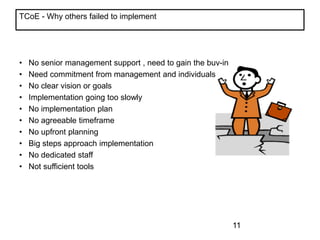
TCoE - Why others failed to implement?

•
•
•
•
•
•
•
•
•
•

No senior management support , need to gain the buy-in
Need commitment from management and individuals
No clear vision or goals
Implementation going too slowly
No implementation plan
No agreeable timeframe
No upfront planning
Big steps approach implementation
No dedicated staff
Not sufficient tools

11
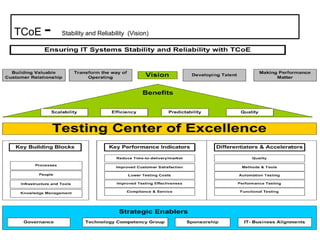
TCoE

-

Stability and Reliability (Vision)

12
Governance and Collaboration Aspect

(between IT and Business)

Alignment
Business

Coordination

Company strategy
And
Operation

Business unit
strategy and
Operation

IT

Companywide
IT Governance

Linking Mechanism

Project Plan
Project Management

Enterprise
Architecture

Business unit
architecture

Project IT
Architecture

13

Company
Level

Business
Unit level

Project team
level
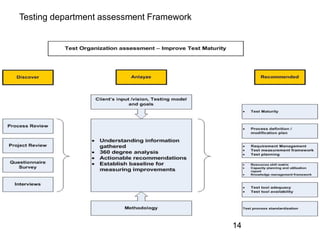
Testing department assessment Framework

14
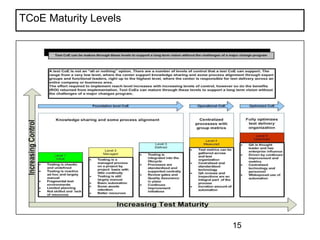
TCoE Maturity Levels

15
TCoE - Metrics program is essential to measure QA effectiveness
The standard definition of test metrics allows an organization to provide visibility into test effectiveness, demonstrate
delivery excellence, track key goals, and enable efficient management and control through business analytics and
predictive management.
Value Delivered
Benefit Type

Best Practice Metrics

Calculation

Effort / Cost

Test Effort Rate (Cost of Quality)

(Total Test Effort / Total Effort) * 100

Effort / Cost

Cost of Poor Quality

(Total Rework Effort / Total Effort) * 100

Quality

Defect Rate

(Total # of Development Defects / Effort Total)

Quality

Test Effectiveness

(Total # of Development Defects / (Total # of Development Defects
+ Total # of Delivery Defects)) * 100

Quality

Defect Ratio

(Total # of Development Defects CLOSED / Total # of Development
Defects) * 100

Quality

Pass Rate

(# of test scripts PASSED / total # of test scripts)

Quality

Defect Arrival Rate

# of defects OPENED / day

Productivity

Defect Closure Rate

# of defects CLOSED / day

Productivity

Retest Backlog

# of defects FIXED (ready for retest) / day

Productivity

Defect Turnaround Time

# of total CLOSED (fixed + retested) defects / Total Rework Effort

Productivity
Cycle Time

Test Script Development Rate

# of scripts APPROVED / day

Productivity
Cycle Time

Test Script Execution Rate

# of scripts EXECUTED / day

Cycle Time

Test Duration

# of days / cycle

Indicates whether
strategy and execution
are contributing to the
bottom line and meeting
financial expectations

16

Service
Excellence
Indicates how well the
organization meets client
and customer needs and
their expectations

Process
Excellence
Indicates whether the
organization has the
process capability,
maturity and quality to
deliver business value

Organizational
Excellence
Indicates how well the
organization meets
employee needs and
their expectations
QA Center Of Excellence (TCoE)

QA Center Of Excellence (TCoE)

  • 1.
    QA Center OfExcellence (TCoE) for JITC Should be led from top down and implemented from bottom up.
  • 2.
    Agenda • • • • • • What is theQA Center of Excellence (TCoE) Why implementing TCoE Benefits of TCoE Key Strategies/ Tactics/ Approach Challenges and Opportunities Business case • Q&A • Name – Moti Demri • Email – mdofqa@gmail.com • Phone - 904- 386 -6620 2
  • 3.
    What is QACenter of Excellence (TCoE)? • TCoE is a centralized solution that brings into a shared services function, people, processes, tools and infrastructure. Standardizing processes and optimizing resource utilization is to bring in maturity. • The Test Center of Excellence (TCoE) solution is targeted towards customer who are challenged with decentralized and under-performing testing functions, under utilization of testing people, inconsistent test processes and are looking to move up the maturity ladder towards a standardized testing function, and at the same time improve efficiency, optimize people and tool utilization and lower testing costs • A TCoE may define a best or commonly accepted practice and encourage adoption of that practice • A TCoE may govern or enforce standards 3
  • 4.
    This is NOTa one person job…it is the entire organization’s effort 4
  • 5.
    Why implementing aTCoE? Reduce Reputational Risk • Reduce incidence of live issues • Avoid “customer being our best testers” • Avoid Emergency releases Improve Quality • Reduce number of defects occurring in later stages of testing • Increase the independence of testing • Apply rigor to test process • Focused collaboration between business and test • Promote the understanding of test requirements across the organization Cost efficiency • Reduce the need for long test phases • Increase the usage of automation in Dev and UAT • Enable earlier detection of defects • Enable faster more reliable test cycles • Ensure correct resources (number and skills are being utilized 5
  • 6.
    TCoE – Evolution(A gradual approach– from sharing processes to Services Utility) Phase 1– introduction to standards, governance and processes • Begin establishing fundamental policies around application testing • Decide on measurable quality standards • Define basic reporting procedures • Implement initial governance process Phase 2 - TCoE functions as a shared service • Unified testing manual and automation tool across the company • Training other groups using tools , scripts writing • Resources Pool • Share Regression tests and scripts Phase 3 - Service utility • TcoE acts as a central source of services and expertise for the entire origination • included test management office, domain-specific expertise team, shared services teams for specialized testing activities Phase 4 - Innovation authority and flexible resources pool • TcoE acts as a central source of services and expertise for the entire origination • included test management office, domain-specific expertise team, shared services teams for specialized testing activities 6
  • 7.
    Why do weneed TCoE (Benefits) TCoE can accrue many benefits to an organization • Define and promote testing standards • Improve quality • Define testing boundaries and provide specialized testing services • Faster time to market • Reduce testing costs • Bring together different testing organizations to align their test processes and technical disciplines • Increase the testing value to external groups • Insure best practices are in place • Better ways to control training and knowledge transfer • Provide a practical approach to testing and QA functions • Consolidation and test process improvement • TCoE are becoming increasingly common within large and medium scale businesses • TCoE is a centralized solution that brings together people, processes, tools and infrastructure into a shared services function • Standardize processes and optimizing resource utilization • Everyone on the same page!!!! 7
  • 8.
    Why do weneed TCoE (Benefits) • Optimized use of existing resources: • QA budgets, tools, environments and people •Faster time-to-market: • Test times reduce manual by 30% • and increase test automation levels of 50-70% •Cost efficiency: • Typical resource cost reduction is 35% over a 2-year time frame •Optimized application quality and performance: • Reduce risk of failure and leakage of high-severity defects to under 2% and improved customer experience •Tighter alignment: • Align quality effort more tightly with business needs by defining and measuring KPIs (Key performance indicator) 8
  • 9.
    Quality Process ReduceCost of Error Cost of Error Correction Quality Process $2000 $1 Time 9
  • 10.
    Key Strategies andTactics • • • • • • • • • • • • • • • • Senior management involvement Find a key champions that care about quality and process Chose doer NOT talker Start working as team not as individual Develop very clear vision Define clear and achievable goals Define tactics and strategies Full integration between all departments and business Work and think on the enterprise level, not local Scalability, usability and Semi- integrated model / approach Pilot it first on a smaller scale project Establishing a TCoE is a phased approach Market the TCoE concepts Training across the company Define measurements and matrixes 10
  • 11.
    TCoE - Whyothers failed to implement? • • • • • • • • • • No senior management support , need to gain the buy-in Need commitment from management and individuals No clear vision or goals Implementation going too slowly No implementation plan No agreeable timeframe No upfront planning Big steps approach implementation No dedicated staff Not sufficient tools 11
  • 12.
  • 13.
    Governance and CollaborationAspect (between IT and Business) Alignment Business Coordination Company strategy And Operation Business unit strategy and Operation IT Companywide IT Governance Linking Mechanism Project Plan Project Management Enterprise Architecture Business unit architecture Project IT Architecture 13 Company Level Business Unit level Project team level
  • 14.
  • 15.
  • 16.
    TCoE - Metricsprogram is essential to measure QA effectiveness The standard definition of test metrics allows an organization to provide visibility into test effectiveness, demonstrate delivery excellence, track key goals, and enable efficient management and control through business analytics and predictive management. Value Delivered Benefit Type Best Practice Metrics Calculation Effort / Cost Test Effort Rate (Cost of Quality) (Total Test Effort / Total Effort) * 100 Effort / Cost Cost of Poor Quality (Total Rework Effort / Total Effort) * 100 Quality Defect Rate (Total # of Development Defects / Effort Total) Quality Test Effectiveness (Total # of Development Defects / (Total # of Development Defects + Total # of Delivery Defects)) * 100 Quality Defect Ratio (Total # of Development Defects CLOSED / Total # of Development Defects) * 100 Quality Pass Rate (# of test scripts PASSED / total # of test scripts) Quality Defect Arrival Rate # of defects OPENED / day Productivity Defect Closure Rate # of defects CLOSED / day Productivity Retest Backlog # of defects FIXED (ready for retest) / day Productivity Defect Turnaround Time # of total CLOSED (fixed + retested) defects / Total Rework Effort Productivity Cycle Time Test Script Development Rate # of scripts APPROVED / day Productivity Cycle Time Test Script Execution Rate # of scripts EXECUTED / day Cycle Time Test Duration # of days / cycle Indicates whether strategy and execution are contributing to the bottom line and meeting financial expectations 16 Service Excellence Indicates how well the organization meets client and customer needs and their expectations Process Excellence Indicates whether the organization has the process capability, maturity and quality to deliver business value Organizational Excellence Indicates how well the organization meets employee needs and their expectations