CORTICOSTEROIDS
Assistant Professor
Dr. Hayder B Sahib
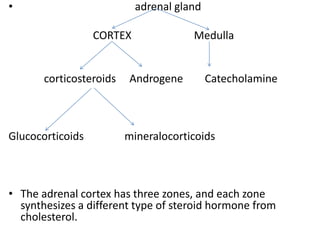
• adrenal gland
CORTEX Medulla
corticosteroids Androgene Catecholamine
Glucocorticoids mineralocorticoids
• The adrenal cortex has three zones, and each zone
synthesizes a different type of steroid hormone from
cholesterol.
• The outer zona glomerulosa produces mineralocorticoids (for
example, aldosterone) that are responsible for regulating salt
and water metabolism.
• Production of aldosterone is regulated primarily by the renin–
angiotensin system.
• The middle zona fasciculata synthesizes glucocorticoids (for
example, cortisol) that are involved with metabolism and
response to stress.
• The inner zona reticularis secretes adrenal androgens
• Secretion by the two inner zones and, to a lesser extent, the
outer zone is controlled by pituitary adrenocorticotropic
hormone (ACTH; also called corticotropin), which is released in
response to hypothalamic corticotropin-releasing hormone
(CRH). Glucocorticoids serve as feedback inhibitors of ACTH and
CRH secretion.
• The corticosteroids bind to specific intracellular
cytoplasmic receptors in target tissues.
• Glucocorticoid receptors are widely distributed
throughout the body, whereas mineralocorticoid
receptors are confined mainly to excretory organs, such
as the kidney, colon, salivary glands and sweat glands.
• Both types of receptors are found in the brain. After
dimerizing, the receptor– hormone complex recruits
coactivator (or corepressor) proteins and translocates
into the nucleus, where it attaches to gene promoter
elements. There it acts as a transcription factor to turn
genes on (when complexed with coactivators) or off
(when complexed with corepressors), depending on the
tissue.
• This mechanism requires time to produce an
effect.
• However, other glucocorticoid effects are
immediate, such as the interaction with
catecholamines to mediate relaxation of bronchial
musculature.
• A. Glucocorticoids
• Cortisol is the principal human glucocorticoid.
Normally, its production is diurnal, with a peak
early in the morning followed by a decline and
then a secondary, smaller peak in the late
afternoon.
• Factors such as stress and levels of the circulating
steroid influence secretion.
• The effects of cortisol are many and diverse. In
general, all glucocorticoids:
• 1. Promote normal intermediary metabolism:
Glucocorticoids favor gluconeogenesis through
increasing amino acid uptake by the liver and
kidney and elevating activities of gluconeogenic
enzymes.
• They stimulate protein catabolism (except in the
liver) and lipolysis, thereby providing the building
blocks and energy that are needed for glucose
synthesis.
• [Note: Glucocorticoid insufficiency may result in
hypoglycemia (for example, during stressful periods
or fasting).]
• 2. Increase resistance to stress: By raising plasma glucose
levels, glucocorticoids provide the body with energy to
combat stress caused by trauma, fright, infection, bleeding,
or debilitating disease.
• 3. Alter blood cell levels in plasma: Glucocorticoids cause a
decrease in eosinophils, basophils, monocytes, and
lymphocytes by redistributing them from the circulation to
lymphoid tissue. Glucocorticoids also increase hemoglobin,
erythrocytes, platelets, and polymorphonuclear leukocytes.
• 4. Have anti-inflammatory action: The most important
therapeutic properties of the glucocorticoids are their potent
anti-inflammatory and immunosuppressive activities. These
therapeutic effects of glucocorticoids are the result of a
number of actions
•
• The lowering of circulating lymphocytes is known to play
a role. In addition, these agents inhibit the ability of
leukocytes and macrophages to respond to mitogens and
antigens. Glucocorticoids also decrease the production
and release of proinflammatory cytokines.
• They inhibit phospholipase A2, which blocks the release
of arachidonic acid (the precursor of the prostaglandins
and leukotrienes) from membrane-bound phospholipid.
The decreased production of prostaglandins and
leukotrienes is believed to be central to the anti-
inflammatory action.
• Lastly, these agents influence the inflammatory response
by stabilizing mast cell and basophil membranes,
resulting in decreased histamine release.
• 5. Affect other systems: High levels of
glucocorticoids serve as feedback inhibitors of
ACTH production and affect the endocrine system
by suppressing further synthesis of glucocorticoids
and thyroid-stimulating hormone.
• In addition, adequate cortisol levels are essential
for normal glomerular filtration.
• The effects of corticosteroids on other systems are
mostly associated with adverse effects of the
hormones.
• Mineralocorticoids
• Mineralocorticoids help to control fluid status and
concentration of electrolytes, especially sodium and
potassium.
• Aldosterone acts on distal tubules and collecting ducts
in the kidney, causing reabsorption of sodium,
bicarbonate, and water.
• Conversely, aldosterone decreases reabsorption of
potassium, which, with H+, is then lost in the urine.
• Enhancement of sodium reabsorption by aldosterone
also occurs in gastrointestinal mucosa and in sweat and
salivary glands.
• Therapeutic uses of the corticosteroids
• 1. Replacement therapy for primary adrenocortical
insufficiency (Addison disease): Addison disease is caused by
adrenal cortex dysfunction (as diagnosed by the lack of
response to ACTH administration).
• Hydrocortisone which is identical to natural cortisol, is given
to correct the deficiency. Failure to do so results in death.
• The dosage of hydrocortisone is divided so that two-thirds of
the daily dose is given in the morning and one-third is given in
the afternoon.
• Administration of fludrocortisone a potent synthetic
mineralocorticoid with some glucocorticoid activity, may also
be necessary to supplement mineralocorticoid deficiency.
• 2. Replacement therapy for secondary or tertiary
adrenocortical insufficiency: These disorders are
caused by a defect in CRH production by the
hypothalamus or in ACTH production by the
pituitary.
• [Note: Under these conditions, the synthesis of
mineralocorticoids in the adrenal cortex is less
impaired than that of glucocorticoids.]
• Hydrocortisone is used for treatment of these
deficiencies.
• 3. Diagnosis of Cushing syndrome: Cushing syndrome is
caused by hypersecretion of glucocorticoids
(hypercortisolism) that results from excessive release of ACTH
by the anterior pituitary or an adrenal tumor.
• [Note: Chronic treatment with high doses of glucocorticoids
is a frequent cause of iatrogenic Cushing syndrome.]
• Cortisol levels (urine, plasma, and saliva) and the
dexamethasone suppression test are used to diagnose
Cushing syndrome.
• The synthetic glucocorticoid dexamethasone suppresses
cortisol release in normal individuals, but not those with
Cushing syndrome.
• 4. Replacement therapy for congenital adrenal hyperplasia
(CAH): CAH is a group of diseases resulting from an enzyme
defect in the synthesis of one or more of the adrenal steroid
hormones.
• CAH may lead to virilization in females due to
overproduction of adrenal androgens.
• Treatment of the condition requires administration of
sufficient corticosteroids to normalize hormone levels by
suppressing release of CRH and ACTH.
• This decreases production of adrenal androgens.
• The choice of replacement hormone depends on the
specific enzyme defect.
• 5. Relief of inflammatory symptoms:
• A- significantly reduce the manifestations of
inflammation associated with rheumatoid arthritis and
inflammatory skin conditions, including redness,
swelling, heat, and tenderness that may be present at
the site of inflammation.
• B- maintenance of symptom control in persistent
asthma, as well as management of asthma
exacerbations
• C- active inflammatory bowel disease.
• D- In noninflammatory disorders such as osteoarthritis,
intra-articular corticosteroids may be used for
treatment of a disease flare. Corticosteroids are not
curative in these disorders.
• 6. Treatment of allergies: Corticosteroids are beneficial in the
treatment of allergic rhinitis, as well as drug, serum, and
transfusion allergic reactions. [Note: In the treatment of
allergic rhinitis and asthma
• fluticasone and others are applied topically to the
respiratory tract through inhalation from a metered dose
dispenser.
• This minimizes systemic effects and allows the patient to
reduce or eliminate the use of oral corticosteroids.]
• 7. Acceleration of lung maturation: Respiratory distress
syndromeis a problem in premature infants. Fetal cortisol is a
regulator of lung maturation. Consequently, a regimen of
betamethasone or dexamethasone administered
intramuscularly to the mother within the 48 hours proceeding
premature delivery can accelerate lung maturation in the
fetus.
• D. Pharmacokinetics
• 1. Absorption and fate:
• A- Orally administered corticosteroid preparations are readily
absorbed.
• B-Selected compounds can also be administered intravenously,
intramuscularly, intra-articularly (for example, into arthritic joints),
topically, or via inhalation or intranasal delivery.
• All topical and inhaled glucocorticoids are absorbed to some
extent and, therefore, have the potential to cause hypothalamic–
pituitary–adrenal (HPA) axis suppression.
• C- Greater than 90% of absorbed glucocorticoids are bound to
plasma proteins, mostly corticosteroid-binding globulin or
albumin.
• Corticosteroids are metabolized by the liver microsomal oxidizing
enzymes. The metabolites are conjugated to glucuronic acid or
sulfate, and the products are excreted by the kidney.
• [Note: The half-life of corticosteroids may
increase substantially in hepatic dysfunction.]
Prednison is preferred in pregnancy because it
minimizes steroid effects on the fetus.
• It is a prodrug that is not converted to the active
compound, prednisolone, in the fetal liver.
• Any prednisolone formed in the mother is
biotransformed to prednisone by placental
enzymes.
• 2. Dosage: Many factors should be considered in
determining the dosage of corticosteroids
• 1- glucocorticoid versus mineralocorticoid activity
• 2-duration of action
• 3- type of preparation
• 4- time of day when the drug is administered.
• When large doses of the hormone are required for
more than 2 weeks, suppression of the HPA axis occurs.
• Alternate-day administration of the corticosteroid may
prevent this adverse effect by allowing the HPA axis to
recover/function on days the hormone is not taken.
• E. Adverse effects
• 1- Osteoporosis is the most common adverse effect due to the
ability of glucocorticoids to suppress intestinal Ca2+ absorption,
• 2- inhibit bone formation
3- decrease sex hormone synthesis.
• Patients are advised to take calcium and vitamin D supplements.
• Bisphosphonates may also be useful in the treatment of
glucocorticoid- induced osteoporosis.
• [Note: Increased appetite is not necessarily an adverse effect. In
fact, it is one of the reasons for the use of prednisone in cancer
chemotherapy.]
• 4- The classic Cushing-like syndrome (redistribution of body fat,
puffy face, hirsutism, and increased appetite) is observed in
excess corticosteroid replacement.
• 5- Cataracts may also occur with long-term
corticosteroid therapy.
• 6- Hyperglycemia may develop and lead to
diabetes mellitus.
• 7- Coadministration of medications that induce or
inhibit the hepatic mixed-function oxidases may
require adjustment of the glucocorticoid dose.
• 8- Topical therapy can also cause skin atrophy,
• ecchymosis, and purple striae.
• F. Discontinuation
• Sudden discontinuation of these drugs can be a serious
problem if the patient has suppression of the HPA axis. In
this case, abrupt removal of corticosteroids causes acute
adrenal insufficiency that can be fatal.
• This risk, coupled with the possibility that withdrawal might
cause an exacerbation of the disease, means that the dose
must be tapered slowly according to individual tolerance.
The patient must be monitored carefully.
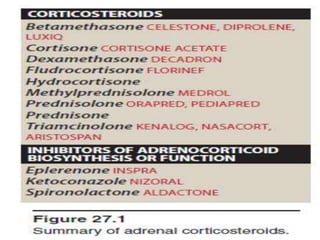
• G. Inhibitors of adrenocorticoid biosynthesis or function
Several substances have proven to be useful as inhibitors of
the synthesis or function of adrenal steroids: ketoconazole,
spironolactone, and eplerenone.
• 1. Ketoconazole: Ketoconazole [kee-toe-KON-ah-zole] is an antifungal
• agent that strongly inhibits all gonadal and adrenal steroid
• hormone synthesis. It is used in the treatment of patients with
• Cushing syndrome.
• 2. Spironolactone: This antihypertensive drug competes for the
• mineralocorticoid receptor and, thus, inhibits sodium reabsorption
• in the kidney. It can also antagonize aldosterone and testosterone
• synthesis. It is effective for hyperaldosteronism and is used along
• with other standard therapies for the treatment of heart failure with
• reduced ejection fraction. Spironolactone [speer-oh-no-LAK-tone]
• is also useful in the treatment of hirsutism in women, probably due
• to interference at the androgen receptor of the hair follicle. Adverse
• effects include hyperkalemia, gynecomastia, menstrual irregularities,
• and skin rashes.
• 3. Eplerenone: Eplerenone [e-PLER-ih-none] specifically binds to
• the mineralocorticoid receptor, where it acts as an aldosterone
• antagonist. This specificity avoids the side effect of gynecomastia
• that is associated with the use of spironolactone. It is approved
• for the treatment of hypertension and also for heart failure with
• reduced ejection fraction.

16-CORTICOSTEROIDS.ppt

  • 1.
  • 2.
    • adrenal gland CORTEXMedulla corticosteroids Androgene Catecholamine Glucocorticoids mineralocorticoids • The adrenal cortex has three zones, and each zone synthesizes a different type of steroid hormone from cholesterol.
  • 3.
    • The outerzona glomerulosa produces mineralocorticoids (for example, aldosterone) that are responsible for regulating salt and water metabolism. • Production of aldosterone is regulated primarily by the renin– angiotensin system. • The middle zona fasciculata synthesizes glucocorticoids (for example, cortisol) that are involved with metabolism and response to stress. • The inner zona reticularis secretes adrenal androgens • Secretion by the two inner zones and, to a lesser extent, the outer zone is controlled by pituitary adrenocorticotropic hormone (ACTH; also called corticotropin), which is released in response to hypothalamic corticotropin-releasing hormone (CRH). Glucocorticoids serve as feedback inhibitors of ACTH and CRH secretion.
  • 4.
    • The corticosteroidsbind to specific intracellular cytoplasmic receptors in target tissues. • Glucocorticoid receptors are widely distributed throughout the body, whereas mineralocorticoid receptors are confined mainly to excretory organs, such as the kidney, colon, salivary glands and sweat glands. • Both types of receptors are found in the brain. After dimerizing, the receptor– hormone complex recruits coactivator (or corepressor) proteins and translocates into the nucleus, where it attaches to gene promoter elements. There it acts as a transcription factor to turn genes on (when complexed with coactivators) or off (when complexed with corepressors), depending on the tissue.
  • 5.
    • This mechanismrequires time to produce an effect. • However, other glucocorticoid effects are immediate, such as the interaction with catecholamines to mediate relaxation of bronchial musculature.
  • 7.
    • A. Glucocorticoids •Cortisol is the principal human glucocorticoid. Normally, its production is diurnal, with a peak early in the morning followed by a decline and then a secondary, smaller peak in the late afternoon. • Factors such as stress and levels of the circulating steroid influence secretion. • The effects of cortisol are many and diverse. In general, all glucocorticoids:
  • 8.
    • 1. Promotenormal intermediary metabolism: Glucocorticoids favor gluconeogenesis through increasing amino acid uptake by the liver and kidney and elevating activities of gluconeogenic enzymes. • They stimulate protein catabolism (except in the liver) and lipolysis, thereby providing the building blocks and energy that are needed for glucose synthesis. • [Note: Glucocorticoid insufficiency may result in hypoglycemia (for example, during stressful periods or fasting).]
  • 9.
    • 2. Increaseresistance to stress: By raising plasma glucose levels, glucocorticoids provide the body with energy to combat stress caused by trauma, fright, infection, bleeding, or debilitating disease. • 3. Alter blood cell levels in plasma: Glucocorticoids cause a decrease in eosinophils, basophils, monocytes, and lymphocytes by redistributing them from the circulation to lymphoid tissue. Glucocorticoids also increase hemoglobin, erythrocytes, platelets, and polymorphonuclear leukocytes. • 4. Have anti-inflammatory action: The most important therapeutic properties of the glucocorticoids are their potent anti-inflammatory and immunosuppressive activities. These therapeutic effects of glucocorticoids are the result of a number of actions •
  • 10.
    • The loweringof circulating lymphocytes is known to play a role. In addition, these agents inhibit the ability of leukocytes and macrophages to respond to mitogens and antigens. Glucocorticoids also decrease the production and release of proinflammatory cytokines. • They inhibit phospholipase A2, which blocks the release of arachidonic acid (the precursor of the prostaglandins and leukotrienes) from membrane-bound phospholipid. The decreased production of prostaglandins and leukotrienes is believed to be central to the anti- inflammatory action. • Lastly, these agents influence the inflammatory response by stabilizing mast cell and basophil membranes, resulting in decreased histamine release.
  • 11.
    • 5. Affectother systems: High levels of glucocorticoids serve as feedback inhibitors of ACTH production and affect the endocrine system by suppressing further synthesis of glucocorticoids and thyroid-stimulating hormone. • In addition, adequate cortisol levels are essential for normal glomerular filtration. • The effects of corticosteroids on other systems are mostly associated with adverse effects of the hormones.
  • 12.
    • Mineralocorticoids • Mineralocorticoidshelp to control fluid status and concentration of electrolytes, especially sodium and potassium. • Aldosterone acts on distal tubules and collecting ducts in the kidney, causing reabsorption of sodium, bicarbonate, and water. • Conversely, aldosterone decreases reabsorption of potassium, which, with H+, is then lost in the urine. • Enhancement of sodium reabsorption by aldosterone also occurs in gastrointestinal mucosa and in sweat and salivary glands.
  • 14.
    • Therapeutic usesof the corticosteroids • 1. Replacement therapy for primary adrenocortical insufficiency (Addison disease): Addison disease is caused by adrenal cortex dysfunction (as diagnosed by the lack of response to ACTH administration). • Hydrocortisone which is identical to natural cortisol, is given to correct the deficiency. Failure to do so results in death. • The dosage of hydrocortisone is divided so that two-thirds of the daily dose is given in the morning and one-third is given in the afternoon. • Administration of fludrocortisone a potent synthetic mineralocorticoid with some glucocorticoid activity, may also be necessary to supplement mineralocorticoid deficiency.
  • 15.
    • 2. Replacementtherapy for secondary or tertiary adrenocortical insufficiency: These disorders are caused by a defect in CRH production by the hypothalamus or in ACTH production by the pituitary. • [Note: Under these conditions, the synthesis of mineralocorticoids in the adrenal cortex is less impaired than that of glucocorticoids.] • Hydrocortisone is used for treatment of these deficiencies.
  • 16.
    • 3. Diagnosisof Cushing syndrome: Cushing syndrome is caused by hypersecretion of glucocorticoids (hypercortisolism) that results from excessive release of ACTH by the anterior pituitary or an adrenal tumor. • [Note: Chronic treatment with high doses of glucocorticoids is a frequent cause of iatrogenic Cushing syndrome.] • Cortisol levels (urine, plasma, and saliva) and the dexamethasone suppression test are used to diagnose Cushing syndrome. • The synthetic glucocorticoid dexamethasone suppresses cortisol release in normal individuals, but not those with Cushing syndrome.
  • 17.
    • 4. Replacementtherapy for congenital adrenal hyperplasia (CAH): CAH is a group of diseases resulting from an enzyme defect in the synthesis of one or more of the adrenal steroid hormones. • CAH may lead to virilization in females due to overproduction of adrenal androgens. • Treatment of the condition requires administration of sufficient corticosteroids to normalize hormone levels by suppressing release of CRH and ACTH. • This decreases production of adrenal androgens. • The choice of replacement hormone depends on the specific enzyme defect.
  • 18.
    • 5. Reliefof inflammatory symptoms: • A- significantly reduce the manifestations of inflammation associated with rheumatoid arthritis and inflammatory skin conditions, including redness, swelling, heat, and tenderness that may be present at the site of inflammation. • B- maintenance of symptom control in persistent asthma, as well as management of asthma exacerbations • C- active inflammatory bowel disease. • D- In noninflammatory disorders such as osteoarthritis, intra-articular corticosteroids may be used for treatment of a disease flare. Corticosteroids are not curative in these disorders.
  • 19.
    • 6. Treatmentof allergies: Corticosteroids are beneficial in the treatment of allergic rhinitis, as well as drug, serum, and transfusion allergic reactions. [Note: In the treatment of allergic rhinitis and asthma • fluticasone and others are applied topically to the respiratory tract through inhalation from a metered dose dispenser. • This minimizes systemic effects and allows the patient to reduce or eliminate the use of oral corticosteroids.] • 7. Acceleration of lung maturation: Respiratory distress syndromeis a problem in premature infants. Fetal cortisol is a regulator of lung maturation. Consequently, a regimen of betamethasone or dexamethasone administered intramuscularly to the mother within the 48 hours proceeding premature delivery can accelerate lung maturation in the fetus.
  • 20.
    • D. Pharmacokinetics •1. Absorption and fate: • A- Orally administered corticosteroid preparations are readily absorbed. • B-Selected compounds can also be administered intravenously, intramuscularly, intra-articularly (for example, into arthritic joints), topically, or via inhalation or intranasal delivery. • All topical and inhaled glucocorticoids are absorbed to some extent and, therefore, have the potential to cause hypothalamic– pituitary–adrenal (HPA) axis suppression. • C- Greater than 90% of absorbed glucocorticoids are bound to plasma proteins, mostly corticosteroid-binding globulin or albumin. • Corticosteroids are metabolized by the liver microsomal oxidizing enzymes. The metabolites are conjugated to glucuronic acid or sulfate, and the products are excreted by the kidney.
  • 21.
    • [Note: Thehalf-life of corticosteroids may increase substantially in hepatic dysfunction.] Prednison is preferred in pregnancy because it minimizes steroid effects on the fetus. • It is a prodrug that is not converted to the active compound, prednisolone, in the fetal liver. • Any prednisolone formed in the mother is biotransformed to prednisone by placental enzymes.
  • 22.
    • 2. Dosage:Many factors should be considered in determining the dosage of corticosteroids • 1- glucocorticoid versus mineralocorticoid activity • 2-duration of action • 3- type of preparation • 4- time of day when the drug is administered. • When large doses of the hormone are required for more than 2 weeks, suppression of the HPA axis occurs. • Alternate-day administration of the corticosteroid may prevent this adverse effect by allowing the HPA axis to recover/function on days the hormone is not taken.
  • 23.
    • E. Adverseeffects • 1- Osteoporosis is the most common adverse effect due to the ability of glucocorticoids to suppress intestinal Ca2+ absorption, • 2- inhibit bone formation 3- decrease sex hormone synthesis. • Patients are advised to take calcium and vitamin D supplements. • Bisphosphonates may also be useful in the treatment of glucocorticoid- induced osteoporosis. • [Note: Increased appetite is not necessarily an adverse effect. In fact, it is one of the reasons for the use of prednisone in cancer chemotherapy.] • 4- The classic Cushing-like syndrome (redistribution of body fat, puffy face, hirsutism, and increased appetite) is observed in excess corticosteroid replacement.
  • 24.
    • 5- Cataractsmay also occur with long-term corticosteroid therapy. • 6- Hyperglycemia may develop and lead to diabetes mellitus. • 7- Coadministration of medications that induce or inhibit the hepatic mixed-function oxidases may require adjustment of the glucocorticoid dose. • 8- Topical therapy can also cause skin atrophy, • ecchymosis, and purple striae.
  • 26.
    • F. Discontinuation •Sudden discontinuation of these drugs can be a serious problem if the patient has suppression of the HPA axis. In this case, abrupt removal of corticosteroids causes acute adrenal insufficiency that can be fatal. • This risk, coupled with the possibility that withdrawal might cause an exacerbation of the disease, means that the dose must be tapered slowly according to individual tolerance. The patient must be monitored carefully. • G. Inhibitors of adrenocorticoid biosynthesis or function Several substances have proven to be useful as inhibitors of the synthesis or function of adrenal steroids: ketoconazole, spironolactone, and eplerenone.
  • 27.
    • 1. Ketoconazole:Ketoconazole [kee-toe-KON-ah-zole] is an antifungal • agent that strongly inhibits all gonadal and adrenal steroid • hormone synthesis. It is used in the treatment of patients with • Cushing syndrome. • 2. Spironolactone: This antihypertensive drug competes for the • mineralocorticoid receptor and, thus, inhibits sodium reabsorption • in the kidney. It can also antagonize aldosterone and testosterone • synthesis. It is effective for hyperaldosteronism and is used along • with other standard therapies for the treatment of heart failure with • reduced ejection fraction. Spironolactone [speer-oh-no-LAK-tone] • is also useful in the treatment of hirsutism in women, probably due • to interference at the androgen receptor of the hair follicle. Adverse • effects include hyperkalemia, gynecomastia, menstrual irregularities, • and skin rashes. • 3. Eplerenone: Eplerenone [e-PLER-ih-none] specifically binds to • the mineralocorticoid receptor, where it acts as an aldosterone • antagonist. This specificity avoids the side effect of gynecomastia • that is associated with the use of spironolactone. It is approved • for the treatment of hypertension and also for heart failure with • reduced ejection fraction.