Sponsored & Brought to you by
Introduction to Integration
Technologies
Arunkumar Kumaresan
Director - Product Engineering
https://in.linkedin.com/in/arunkumarkumaresan
https://twitter.com/arunkumaresan
Disclaimer
All content in this presentation are referred from resources available on the internet. They
are being used for non-profit and education purposes only. No resources are used for
commercial or brand promotional purposes, nor the presenter intend to infringe content
copyright by making false representations, claims or modifications.
Introduction to Microsoft Integration Technologies
Arunkumar Kumaresan
Director, Product Engineering
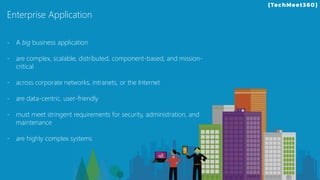
Enterprise Application
- A big business application
- are complex, scalable, distributed, component-based, and mission-
critical
- across corporate networks, intranets, or the Internet
- are data-centric, user-friendly
- must meet stringent requirements for security, administration, and
maintenance
- are highly complex systems
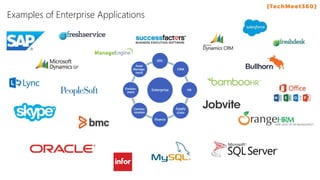
Examples of Enterprise Applications
EAI
- Enterprise Application Integration
- is related to middleware technologies
- Intercommunication between enterprise applications (EA), such as customer relations management
(CRM), supply chain management (SCM) and business intelligence
Why EAI?
- sharing of processes and data among different applications in an enterprise
- to simplify and automate business processes without applying excessive application or data structure
changes
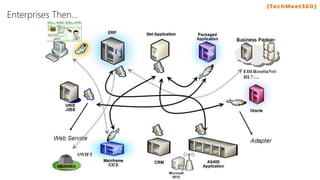
Enterprises Then…
EAI Benefits
System interconnectivity
Connect people, processes, systems, and technologies within your enterprise ecosystem
Improved productivity throughout the company
Enable communication across differing systems to permit everyone access to the information they need, anytime
The right information when you need it
Provide accurate data regardless of what system you are deploying
Real-time updates
Ensure that you are always up to date on your business needs with real-time updates
Coordinate business processes
Automate business processes, further improving productivity across your company
With system integration across your enterprise, your business can move forward,
stay agile, and continue to innovate.
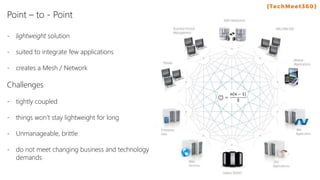
Point – to - Point
- lightweight solution
- suited to integrate few applications
- creates a Mesh / Network
Challenges
- tightly coupled
- things won’t stay lightweight for long
- Unmanageable, brittle
- do not meet changing business and technology
demands
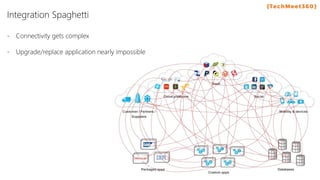
Integration Spaghetti
- Connectivity gets complex
- Upgrade/replace application nearly impossible
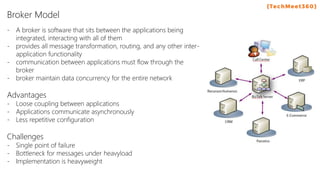
Broker Model
- A broker is software that sits between the applications being
integrated, interacting with all of them
- provides all message transformation, routing, and any other inter-
application functionality
- communication between applications must flow through the
broker
- broker maintain data concurrency for the entire network
Advantages
- Loose coupling between applications
- Applications communicate asynchronously
- Less repetitive configuration
Challenges
- Single point of failure
- Bottleneck for messages under heavyload
- Implementation is heavyweight
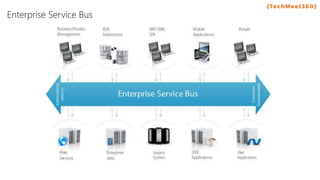
Enterprise Service Bus
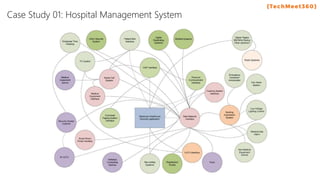
Case Study 01: Hospital Management System
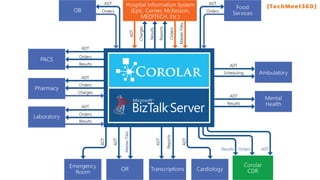
Microsoft Customer Story: Hospital Management System
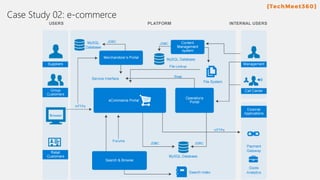
Case Study 02: e-commerce
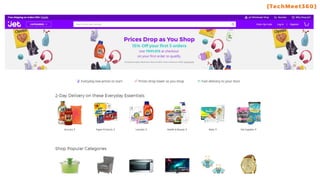
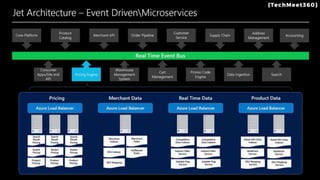
Microsoft Customer Story: e-commerce Industry
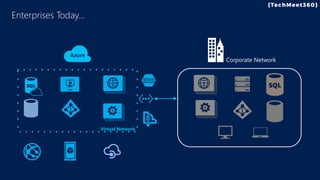
Corporate Network
Virtual Network
Enterprises Today…
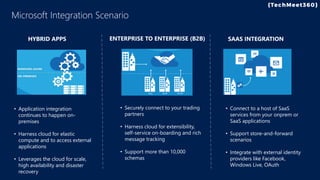
• Connect to a host of SaaS
services from your onprem or
SaaS applications
• Support store-and-forward
scenarios
• Integrate with external identity
providers like Facebook,
Windows Live, OAuth
• Securely connect to your trading
partners
• Harness cloud for extensibility,
self-service on-boarding and rich
message tracking
• Support more than 10,000
schemas
• Application integration
continues to happen on-
premises
• Harness cloud for elastic
compute and to access external
applications
• Leverages the cloud for scale,
high availability and disaster
recovery
HYBRID APPS ENTERPRISE TO ENTERPRISE (B2B) SAAS INTEGRATION
Microsoft Integration Scenario
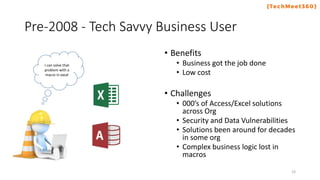
Pre-2008 - Tech Savvy Business User
• Benefits
• Business got the job done
• Low cost
• Challenges
• 000’s of Access/Excel solutions
across Org
• Security and Data Vulnerabilities
• Solutions been around for decades
in some org
• Complex business logic lost in
macros
23
I can solve that
problem with a
macro in excel
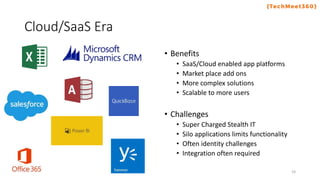
Cloud/SaaS Era
• Benefits
• SaaS/Cloud enabled app platforms
• Market place add ons
• More complex solutions
• Scalable to more users
• Challenges
• Super Charged Stealth IT
• Silo applications limits functionality
• Often identity challenges
• Integration often required
24
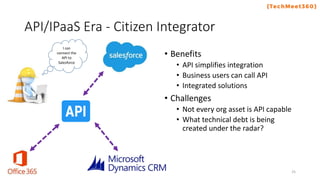
API/IPaaS Era - Citizen Integrator
• Benefits
• API simplifies integration
• Business users can call API
• Integrated solutions
• Challenges
• Not every org asset is API capable
• What technical debt is being
created under the radar?
25
I can
connect the
API to
Salesforce
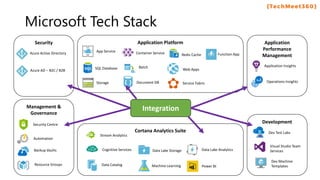
Microsoft Tech Stack
Application
Performance
Management
IntegrationManagement &
Governance
Cortana Analytics Suite
App Service
Development
Application Platform
Azure Active Directory
Azure AD – B2C / B2B
Automation
Cognitive Services
Dev Test Labs
Application Insights
Operations Insights
Security Centre
Resource Groups
Backup Vaults
Data Catalog
Data Lake Storage
Machine Learning
Data Lake Analytics
Power BI
Stream Analytics
Visual Studio Team
Services
SQL Database
Storage
Container Service
Batch
Document DB
Redis Cache
Web Apps
Service Fabric
Function App
Dev Machine
Templates
Security
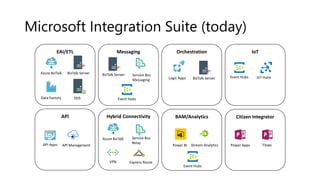
Microsoft Integration Suite (today)
IoT
API ManagementAPI Apps
Service Bus
Relay
Service Bus
Messaging
Azure BizTalk
Logic Apps
Event Hubs
BizTalk Server
EAI/ETL
API Hybrid Connectivity BAM/Analytics Citizen Integrator
Messaging
BizTalk Server
Azure BizTalk
Orchestration
BizTalk Server
VPN Express Route
Event Hubs IoT Hubs
Power BI Stream Analytics Power Apps
Data Factory SSIS
Event Hubs
Flows
https://www.facebook.com/arunkumarkumaresan
@arunkumaresan
https://in.linkedin.com/in/arunkumarkumaresan

Introduction to Integration Technologies

  • 1.
    Sponsored & Broughtto you by Introduction to Integration Technologies Arunkumar Kumaresan Director - Product Engineering https://in.linkedin.com/in/arunkumarkumaresan https://twitter.com/arunkumaresan
  • 2.
    Disclaimer All content inthis presentation are referred from resources available on the internet. They are being used for non-profit and education purposes only. No resources are used for commercial or brand promotional purposes, nor the presenter intend to infringe content copyright by making false representations, claims or modifications.
  • 3.
    Introduction to MicrosoftIntegration Technologies Arunkumar Kumaresan Director, Product Engineering
  • 4.
    Enterprise Application - Abig business application - are complex, scalable, distributed, component-based, and mission- critical - across corporate networks, intranets, or the Internet - are data-centric, user-friendly - must meet stringent requirements for security, administration, and maintenance - are highly complex systems
  • 5.
  • 6.
    EAI - Enterprise ApplicationIntegration - is related to middleware technologies - Intercommunication between enterprise applications (EA), such as customer relations management (CRM), supply chain management (SCM) and business intelligence Why EAI? - sharing of processes and data among different applications in an enterprise - to simplify and automate business processes without applying excessive application or data structure changes
  • 7.
  • 8.
    EAI Benefits System interconnectivity Connectpeople, processes, systems, and technologies within your enterprise ecosystem Improved productivity throughout the company Enable communication across differing systems to permit everyone access to the information they need, anytime The right information when you need it Provide accurate data regardless of what system you are deploying Real-time updates Ensure that you are always up to date on your business needs with real-time updates Coordinate business processes Automate business processes, further improving productivity across your company With system integration across your enterprise, your business can move forward, stay agile, and continue to innovate.
  • 9.
    Point – to- Point - lightweight solution - suited to integrate few applications - creates a Mesh / Network Challenges - tightly coupled - things won’t stay lightweight for long - Unmanageable, brittle - do not meet changing business and technology demands
  • 10.
    Integration Spaghetti - Connectivitygets complex - Upgrade/replace application nearly impossible
  • 11.
    Broker Model - Abroker is software that sits between the applications being integrated, interacting with all of them - provides all message transformation, routing, and any other inter- application functionality - communication between applications must flow through the broker - broker maintain data concurrency for the entire network Advantages - Loose coupling between applications - Applications communicate asynchronously - Less repetitive configuration Challenges - Single point of failure - Bottleneck for messages under heavyload - Implementation is heavyweight
  • 12.
  • 13.
    Case Study 01:Hospital Management System
  • 16.
    Microsoft Customer Story:Hospital Management System
  • 17.
    Case Study 02:e-commerce
  • 18.
    Microsoft Customer Story:e-commerce Industry
  • 21.
  • 22.
    • Connect toa host of SaaS services from your onprem or SaaS applications • Support store-and-forward scenarios • Integrate with external identity providers like Facebook, Windows Live, OAuth • Securely connect to your trading partners • Harness cloud for extensibility, self-service on-boarding and rich message tracking • Support more than 10,000 schemas • Application integration continues to happen on- premises • Harness cloud for elastic compute and to access external applications • Leverages the cloud for scale, high availability and disaster recovery HYBRID APPS ENTERPRISE TO ENTERPRISE (B2B) SAAS INTEGRATION Microsoft Integration Scenario
  • 23.
    Pre-2008 - TechSavvy Business User • Benefits • Business got the job done • Low cost • Challenges • 000’s of Access/Excel solutions across Org • Security and Data Vulnerabilities • Solutions been around for decades in some org • Complex business logic lost in macros 23 I can solve that problem with a macro in excel
  • 24.
    Cloud/SaaS Era • Benefits •SaaS/Cloud enabled app platforms • Market place add ons • More complex solutions • Scalable to more users • Challenges • Super Charged Stealth IT • Silo applications limits functionality • Often identity challenges • Integration often required 24
  • 25.
    API/IPaaS Era -Citizen Integrator • Benefits • API simplifies integration • Business users can call API • Integrated solutions • Challenges • Not every org asset is API capable • What technical debt is being created under the radar? 25 I can connect the API to Salesforce
  • 26.
    Microsoft Tech Stack Application Performance Management IntegrationManagement& Governance Cortana Analytics Suite App Service Development Application Platform Azure Active Directory Azure AD – B2C / B2B Automation Cognitive Services Dev Test Labs Application Insights Operations Insights Security Centre Resource Groups Backup Vaults Data Catalog Data Lake Storage Machine Learning Data Lake Analytics Power BI Stream Analytics Visual Studio Team Services SQL Database Storage Container Service Batch Document DB Redis Cache Web Apps Service Fabric Function App Dev Machine Templates Security
  • 27.
    Microsoft Integration Suite(today) IoT API ManagementAPI Apps Service Bus Relay Service Bus Messaging Azure BizTalk Logic Apps Event Hubs BizTalk Server EAI/ETL API Hybrid Connectivity BAM/Analytics Citizen Integrator Messaging BizTalk Server Azure BizTalk Orchestration BizTalk Server VPN Express Route Event Hubs IoT Hubs Power BI Stream Analytics Power Apps Data Factory SSIS Event Hubs Flows
  • 28.