Syntax Score and its Relation to Lipoprotein a –Lp (a) and Extended Lipid Parameters in Non-Diabetic Patients with Acute Coronary Syndrome Having Age below 55 Years
IJCCR
Syntax Score and its Relation to Lipoprotein a –Lp (a) and
Extended Lipid Parameters in Non-Diabetic Patients with Acute
Coronary Syndrome Having Age below 55 Years
*1Dr Tejas Shah (MD, DNB – Cardiology), 2Dr Chaitri Shah (MD Anaesthesiology), 3Dr Jasmin
Jasani (MD Pathology), 4Dr JD Lakhani (MD Medicine), 5Mr. Ronak Shah (M.Sc Clinical
Research)
1Assistant Professor, Department of Cardiology, Sumandeep Vidyapeeth, At & Po Piparia, Ta. Waghodia, Vadodara
391760, Gujarat, India
2,3,4Professor, Sumandeep Vidyapeeth, At & Po Piparia, Ta. Waghodia, Vadodara 391760, Gujarat, India
5Research Assistant, Sumandeep Vidyapeeth, At & Po Piparia, Ta. Waghodia, Vadodara 391760, Gujarat, India
Syntax score is a semi-quantitative visual grading system for complex coronary artery disease
based on angiography findings. We investigated whether the severity of coronary artery disease
(Syntax score) correlates with Lipoprotein (a) {Lp (a)} value and lipid ratios.75 non-diabetic adult
patients, having age below 55 years, who presented with Acute Coronary Syndrome (ACS) were
included. Coronary angiography and Syntax Score calculation was done. Various lipid ratios and
Lp(a) were correlated with syntax score. Out of 75 patients ,61 (81.33%) were males and 14
(18.67%) females, having mean age of 44.37years. Majority (49.34%) having age between 41-50
years. Those 49 (65.4%) had acute myocardial infarction,21 (28%) had unstable angina and 5(6.6%)
had Non-ST-elevation myocardial infarction (NSTEMI). 44(58.67%) patients had one, 18(24%) had
two and 13 (17.33%) had three vessels disease.58 (77.33%) had syntax score ≤22 and 17 (26.67%)
had ≥ 23. Statistically significant difference (p < 0.05) was found in mean values of Total
cholesterol (TC), TC/HDL ratio, LDL, LDL/HDL and Non-HDL cholesterol in patients having syntax
score> 23. Mean values of other parameters like LVEF(Left ventricular ejection fraction),ApoA-1
,Apo B, Apo B/Apo A, Lp(a)/HDL did not differ in two groups. Lp(a) lipoprotein levels did not show
any association with the syntax score and extent of coronary artery disease. This study of western
Indian young non-diabetic patients having acute coronary syndrome found association of syntax
score with high non-HDL, TC, TC/HDL, LDL, LDL/HDL values. It was not correlating with LP (a)
levels.
Key Words: Syntax score, Lipid ratio, Lipoprotein, Acute Coronary Syndrome
INTRODUCTION
To quantify severity and extent of coronary artery disease
(CAD), SYNTAX (Synergy Between PCI With Taxus and
Cardiac Surgery) score was developed. This score was
used in SYNTAX trial which has shown ability to predict
adverse ischemic events in patients undergoing
percutaneous coronary intervention (PCI) [Mayank et al.,
2013]
Lipoprotein (a) [Lp(a)] is a plasma lipoprotein which
consists of elements; a central low-density lipoprotein
(LDL)-like core containing a single of apolipoprotein B100
(apoB) linked by a disulfide bridge to a signature protein
called apolipoprotein(a) [apo(a)] which is similar structure
wise to Plasminogen. [BERG K et al., 1963] It competes
with plasminogen for its binding site, leading to reduced
fibrinolysis, and as a result of the stimulation of secretion
*Corresponding Author: Dr Tejas Shah, Assistant
Professor, Department of Cardiology, Sumandeep
Vidyapeeth, At & Po Piparia, Ta. Waghodia, Vadodara
391760, Gujarat, India.
E-mail: tejaschaitri@gmail.com; Tel: +91 8951274202
Research Article
Vol. 5(2), pp. 096-102, June, 2019. © www.premierpublishers.org, ISSN: 3102-9869
International Journal of Cardiology and Cardiovascular Research
Syntax Score and its Relation to Lipoprotein a –Lp (a) and Extended Lipid Parameters in Non-Diabetic Patients with Acute Coronary Syndrome Having Age below 55 Years
Shah et al. 097
of plasminogen activator inhibitor-1, Lp(a) leads to
thrombogenesis. [Danesh et al., 2000, Bennet et al., 2008,
Clayton et al., 2001, Kamstrup et al., 2009, Clarke et al.,
2009]. Lp(a) has found as a important risk factor for CVD
(Cardiovascular disease) including myocardial infarction
and valvular heart disease ie aortic stenosis. In addition to
the role of high Lp(a) levels in various vascular diseases,
low concentrations also seem to be important in vascular
medicine [Kotani K et al., 2012].Some authors have
suggested the existence of a J-curved phenomenon for
Lp(a)concentration with a slight increase of cardiovascular
andcerebrovascular outcomes in the group of patients with
verylow levels and a larger increase in the group of
patients with significantly increased Lp(a) levels.For
example decreased values of Lp(a) have been associated
with carotid atherosclerosis and have been proposed as
markers of cerebral hemorrhage risk. Thereare several
hypotheses relating to this phenomenon: oneassociated
with the induction of angionecrosis and impaired nutritional
metabolism within the vessels, another with theimpaired
metabolism of scavenging oxidized lipids. [Ishikawa S et
al.,2013]
The aim of the study was to evaluate, in judging the
severity of coronary artery disease, the association
between the level of Lp(a) and various lipid parameters.
METHODS
Study design
This was a cross sectional study in which we enrolled a
total of 75 consecutive patients with ACS, 18 to 55 years
of age, who underwent coronary angiography at
Department of cardiology, Dhiraj General Hospital,
Sumandeep Vidyapeeth between Feb-2017 to June-2018.
Patients who had history of Hypothyroidism, Chronic Liver
& Kidney Disease, Diabetes Mellitus and patients who
were on lipid lowering agents were excluded from the
study. For female patients we have enrolled only non
pregnant and non lactating women.
The study was approved by the Institutional Ethics
Committee, and all patients gave written informed consent.
Angiographic analysis:
Key angiographic features of syntax scoring system
include
- Right or Left dominant system
- Number of artery segments involved per atherosclerotic
lesion.
- Total occlusion:
a) Number of segments involved
b) Age of total occlusion
c) Presence of blunt stump
d) Presence of bridging collaterals
e) Antegrade vs retrograde filling of the first segment
beyond the occlusion.
f) Side branch involvement
- Trifurcation lesion: number of vessel segments
diseased
- Bifurcation lesion: angulation between the distal
main vessel and the side branch <700
- Presence of an aorto-ostial atherosclerotic lesion
- Presence of severe vessel tortuosity at lesion site
- Atherosclerotic lesion length>20 mm
- Presence of heavily calcified plaque
- Presence of thrombus
- Presence of diffuse or small vessel disease
The maximal stenosis in each of 27 coronary-artery
segments was assessed by a cardiologist.“According to
that, Syntax score(On line version 2.28) was calculated
.The score was divided into ≤22 and ≥23.The extent of
angiographically documented coronary artery disease was
quantified as follows: normal coronary arteries (with either
no stenosis or a stenosis of <10 percent of the luminal
diameter), mild disease (a stenosis of 10 to 50 percent of
the luminal diameter in one or more coronary arteries or
their major branches), or one vessel and more than one
vessel ie two or three-vessel disease, defined as a
stenosis of more than 50 percent of the luminal diameter
in one, two, or three coronary arteries or their major
branches.
Laboratory Analyses
For Acute MI patient venous sample was taken in less than
one hour and for other patients, fasting (>12 hour) venous
samples were obtained. Various Extended lipid values
were measured from sample, with Erba EM 200 Analyser.
Normal values for lipid profile which is established at our
institutional laboratory was taken as reference values
:Total cholesterol (TC)-<200 mg/dl, Triglyceride(TG)<160
mg/dl, High Density Lipoprotein(HDL)30-60 mg/dl, Low
Density Lipoprotein(LDL)-<110 mg/dl, Very Low Density
Lipoprotein(VLDL)-<32 mg/dl, Apo A-1 105-205 mg/dl,
Apo B-40-125 mg/dl and Lp(a) <30 mg/dl. Quantitative
determination of Lipoprotein (a) was performed with
turbidimetric immunoassay. LDL cholesterol was
estimated with the use of the Friedewald formula. Non-
HDL cholesterol was measured from Total cholesterol
minus HDL. Various lipid ratios like TC/HDL, LDL/HDL,
Apob/Apoa-1, TG/HDL and Lp(a)/HDL were calculated.
Statistical Analysis
Discrete data are presented as frequencies and
percentages, and continuous variables as mean and
standard deviation. Independent t test was used to find
significant mean difference of various lipid parameters
between two groups. Chi square test was used to find
association between two variables. P value < 0.05 has
been considered as significant value.
Syntax Score and its Relation to Lipoprotein a –Lp (a) and Extended Lipid Parameters in Non-Diabetic Patients with Acute Coronary Syndrome Having Age below 55 Years
Int. J. Cardiol. Cardiovasc. Res. 098
RESULTS
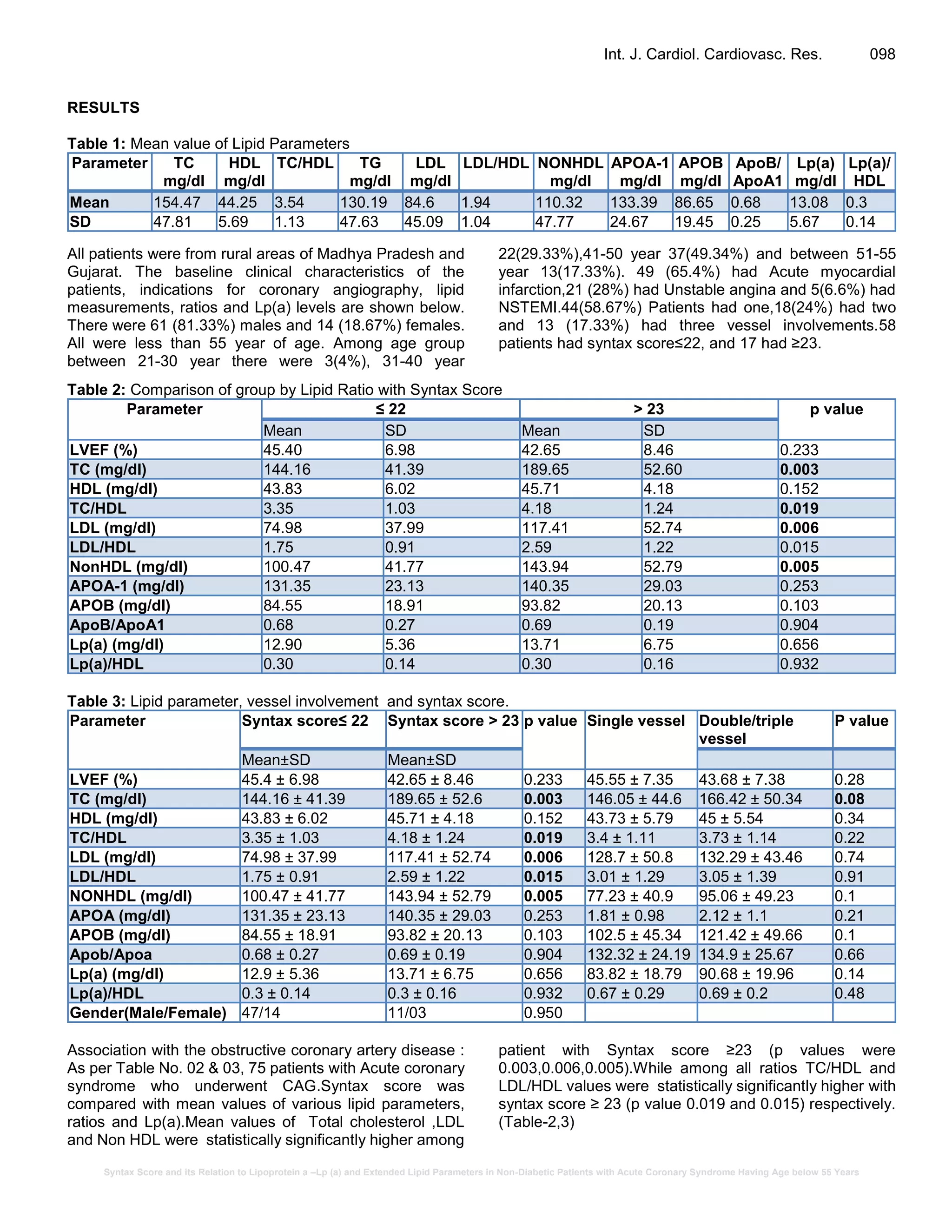
Table 1: Mean value of Lipid Parameters
Parameter TC
mg/dl
HDL
mg/dl
TC/HDL TG
mg/dl
LDL
mg/dl
LDL/HDL NONHDL
mg/dl
APOA-1
mg/dl
APOB
mg/dl
ApoB/
ApoA1
Lp(a)
mg/dl
Lp(a)/
HDL
Mean 154.47 44.25 3.54 130.19 84.6 1.94 110.32 133.39 86.65 0.68 13.08 0.3
SD 47.81 5.69 1.13 47.63 45.09 1.04 47.77 24.67 19.45 0.25 5.67 0.14
All patients were from rural areas of Madhya Pradesh and
Gujarat. The baseline clinical characteristics of the
patients, indications for coronary angiography, lipid
measurements, ratios and Lp(a) levels are shown below.
There were 61 (81.33%) males and 14 (18.67%) females.
All were less than 55 year of age. Among age group
between 21-30 year there were 3(4%), 31-40 year
22(29.33%),41-50 year 37(49.34%) and between 51-55
year 13(17.33%). 49 (65.4%) had Acute myocardial
infarction,21 (28%) had Unstable angina and 5(6.6%) had
NSTEMI.44(58.67%) Patients had one,18(24%) had two
and 13 (17.33%) had three vessel involvements.58
patients had syntax score≤22, and 17 had ≥23.
Table 2: Comparison of group by Lipid Ratio with Syntax Score
Parameter ≤ 22 > 23 p value
Mean SD Mean SD
LVEF (%) 45.40 6.98 42.65 8.46 0.233
TC (mg/dl) 144.16 41.39 189.65 52.60 0.003
HDL (mg/dl) 43.83 6.02 45.71 4.18 0.152
TC/HDL 3.35 1.03 4.18 1.24 0.019
LDL (mg/dl) 74.98 37.99 117.41 52.74 0.006
LDL/HDL 1.75 0.91 2.59 1.22 0.015
NonHDL (mg/dl) 100.47 41.77 143.94 52.79 0.005
APOA-1 (mg/dl) 131.35 23.13 140.35 29.03 0.253
APOB (mg/dl) 84.55 18.91 93.82 20.13 0.103
ApoB/ApoA1 0.68 0.27 0.69 0.19 0.904
Lp(a) (mg/dl) 12.90 5.36 13.71 6.75 0.656
Lp(a)/HDL 0.30 0.14 0.30 0.16 0.932
Table 3: Lipid parameter, vessel involvement and syntax score.
Parameter Syntax score≤ 22 Syntax score > 23 p value Single vessel Double/triple
vessel
P value
Mean±SD Mean±SD
LVEF (%) 45.4 ± 6.98 42.65 ± 8.46 0.233 45.55 ± 7.35 43.68 ± 7.38 0.28
TC (mg/dl) 144.16 ± 41.39 189.65 ± 52.6 0.003 146.05 ± 44.6 166.42 ± 50.34 0.08
HDL (mg/dl) 43.83 ± 6.02 45.71 ± 4.18 0.152 43.73 ± 5.79 45 ± 5.54 0.34
TC/HDL 3.35 ± 1.03 4.18 ± 1.24 0.019 3.4 ± 1.11 3.73 ± 1.14 0.22
LDL (mg/dl) 74.98 ± 37.99 117.41 ± 52.74 0.006 128.7 ± 50.8 132.29 ± 43.46 0.74
LDL/HDL 1.75 ± 0.91 2.59 ± 1.22 0.015 3.01 ± 1.29 3.05 ± 1.39 0.91
NONHDL (mg/dl) 100.47 ± 41.77 143.94 ± 52.79 0.005 77.23 ± 40.9 95.06 ± 49.23 0.1
APOA (mg/dl) 131.35 ± 23.13 140.35 ± 29.03 0.253 1.81 ± 0.98 2.12 ± 1.1 0.21
APOB (mg/dl) 84.55 ± 18.91 93.82 ± 20.13 0.103 102.5 ± 45.34 121.42 ± 49.66 0.1
Apob/Apoa 0.68 ± 0.27 0.69 ± 0.19 0.904 132.32 ± 24.19 134.9 ± 25.67 0.66
Lp(a) (mg/dl) 12.9 ± 5.36 13.71 ± 6.75 0.656 83.82 ± 18.79 90.68 ± 19.96 0.14
Lp(a)/HDL 0.3 ± 0.14 0.3 ± 0.16 0.932 0.67 ± 0.29 0.69 ± 0.2 0.48
Gender(Male/Female) 47/14 11/03 0.950
Association with the obstructive coronary artery disease :
As per Table No. 02 & 03, 75 patients with Acute coronary
syndrome who underwent CAG.Syntax score was
compared with mean values of various lipid parameters,
ratios and Lp(a).Mean values of Total cholesterol ,LDL
and Non HDL were statistically significantly higher among
patient with Syntax score ≥23 (p values were
0.003,0.006,0.005).While among all ratios TC/HDL and
LDL/HDL values were statistically significantly higher with
syntax score ≥ 23 (p value 0.019 and 0.015) respectively.
(Table-2,3)
Syntax Score and its Relation to Lipoprotein a –Lp (a) and Extended Lipid Parameters in Non-Diabetic Patients with Acute Coronary Syndrome Having Age below 55 Years
Shah et al. 099
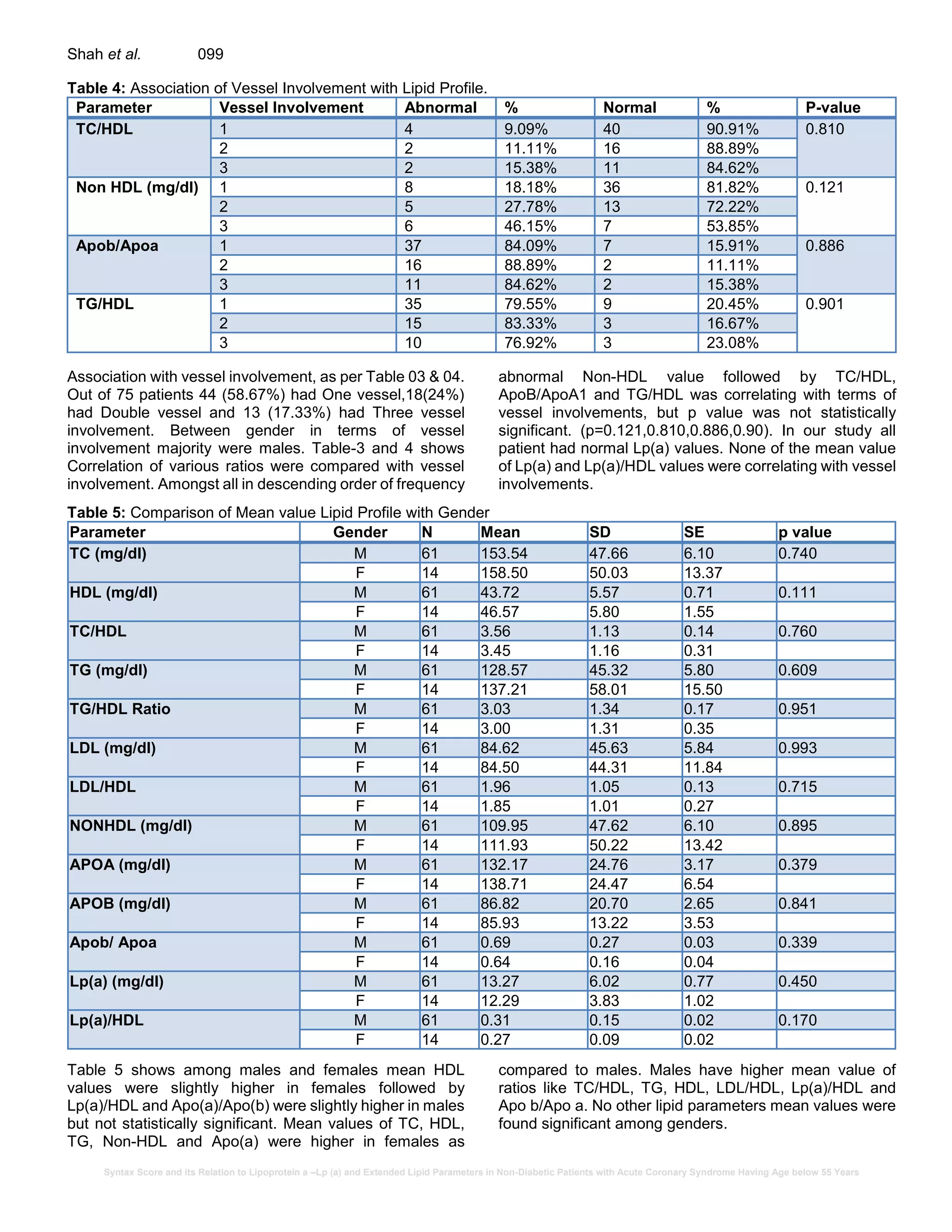
Table 4: Association of Vessel Involvement with Lipid Profile.
Parameter Vessel Involvement Abnormal % Normal % P-value
TC/HDL 1 4 9.09% 40 90.91% 0.810
2 2 11.11% 16 88.89%
3 2 15.38% 11 84.62%
Non HDL (mg/dl) 1 8 18.18% 36 81.82% 0.121
2 5 27.78% 13 72.22%
3 6 46.15% 7 53.85%
Apob/Apoa 1 37 84.09% 7 15.91% 0.886
2 16 88.89% 2 11.11%
3 11 84.62% 2 15.38%
TG/HDL 1 35 79.55% 9 20.45% 0.901
2 15 83.33% 3 16.67%
3 10 76.92% 3 23.08%
Association with vessel involvement, as per Table 03 & 04.
Out of 75 patients 44 (58.67%) had One vessel,18(24%)
had Double vessel and 13 (17.33%) had Three vessel
involvement. Between gender in terms of vessel
involvement majority were males. Table-3 and 4 shows
Correlation of various ratios were compared with vessel
involvement. Amongst all in descending order of frequency
abnormal Non-HDL value followed by TC/HDL,
ApoB/ApoA1 and TG/HDL was correlating with terms of
vessel involvements, but p value was not statistically
significant. (p=0.121,0.810,0.886,0.90). In our study all
patient had normal Lp(a) values. None of the mean value
of Lp(a) and Lp(a)/HDL values were correlating with vessel
involvements.
Table 5: Comparison of Mean value Lipid Profile with Gender
Parameter Gender N Mean SD SE p value
TC (mg/dl) M 61 153.54 47.66 6.10 0.740
F 14 158.50 50.03 13.37
HDL (mg/dl) M 61 43.72 5.57 0.71 0.111
F 14 46.57 5.80 1.55
TC/HDL M 61 3.56 1.13 0.14 0.760
F 14 3.45 1.16 0.31
TG (mg/dl) M 61 128.57 45.32 5.80 0.609
F 14 137.21 58.01 15.50
TG/HDL Ratio M 61 3.03 1.34 0.17 0.951
F 14 3.00 1.31 0.35
LDL (mg/dl) M 61 84.62 45.63 5.84 0.993
F 14 84.50 44.31 11.84
LDL/HDL M 61 1.96 1.05 0.13 0.715
F 14 1.85 1.01 0.27
NONHDL (mg/dl) M 61 109.95 47.62 6.10 0.895
F 14 111.93 50.22 13.42
APOA (mg/dl) M 61 132.17 24.76 3.17 0.379
F 14 138.71 24.47 6.54
APOB (mg/dl) M 61 86.82 20.70 2.65 0.841
F 14 85.93 13.22 3.53
Apob/ Apoa M 61 0.69 0.27 0.03 0.339
F 14 0.64 0.16 0.04
Lp(a) (mg/dl) M 61 13.27 6.02 0.77 0.450
F 14 12.29 3.83 1.02
Lp(a)/HDL M 61 0.31 0.15 0.02 0.170
F 14 0.27 0.09 0.02
Table 5 shows among males and females mean HDL
values were slightly higher in females followed by
Lp(a)/HDL and Apo(a)/Apo(b) were slightly higher in males
but not statistically significant. Mean values of TC, HDL,
TG, Non-HDL and Apo(a) were higher in females as
compared to males. Males have higher mean value of
ratios like TC/HDL, TG, HDL, LDL/HDL, Lp(a)/HDL and
Apo b/Apo a. No other lipid parameters mean values were
found significant among genders.
Syntax Score and its Relation to Lipoprotein a –Lp (a) and Extended Lipid Parameters in Non-Diabetic Patients with Acute Coronary Syndrome Having Age below 55 Years
Int. J. Cardiol. Cardiovasc. Res. 100
DISCUSSION
In our study, ACS patients having age < 55 years with high
syntax score (≥ 23) had elevated lipid parameters like Total
cholesterol, TC/HDL ratio, LDL, LDL/HDL ratio and Non-
HDL. Irrespective of syntax score, i.e. Low or high Lp(a)
was not elevated in our ACS patients.
The extent of coronary disease affects clinical outcomes
and may predict the effectiveness of coronary
revascularization with either coronary artery bypass graft
(CABG) surgery or percutaneous coronary intervention
(PCI). The SYNTAX (Synergy Between Percutaneous
Coronary Intervention with Taxus and Cardiac Surgery)
score quantifies the extent of coronary disease. The
SYNTAX score was designed to predict outcomes related
to anatomical characteristics and, to a lesser extent, the
functional risk of occlusion for any segment of the
coronary-artery bed.
Human coronary atherosclerosis is a chronic inflammatory
disease that issuperimposed on a background of lipid
abnormalities. The Total cholesterol/High-density
lipoprotein (HDL) cholesterol ratio, known as the
atherogenic or Castelli index and the LDL/HDL cholesterol
ratio are two important components and indicators of
vascular risk, the predictive value of which is greater than
the isolated parameters. An increase in Total cholesterol
concentration, and specifically LDL cholesterol, is an
atherogenic lipid marker.[Ascaso J et al., 2007] When
Total cholesterol, HDL cholesterol, and Total/HDL
cholesterol ratio are compared between an apparently
healthy population and myocardial infarction survivors, the
Total/HDL cholesterol ratio is found to present less
superposition of populations.This illustrates the high
discriminatory power for coronary heart disease presented
by the Total/HDL cholesterol ratio, as well as its great
predictive capacity.
The LDL/HDL cholesterol ratio appears to be as useful as
the Total/HDL cholesterol ratio. Their similarity can be
explained by the fact that approximately two thirds of
plasma cholesterol are found in LDL and, Total and LDL
cholesterol are closely related. Like the Total/HDL
cholesterol ratio, LDL/HDL cholesterol may have more
predictive power if hypertriglyceridemia is taken into
account. Although, the increase in these ratios predicted a
greater cardiovascular risk in a wide range of cholesterol
or triglyceride concentrations, the risk is significantly
higher when hypertriglyceridemia is present, as shown by
the Helsinki Heart Study.[ Manninen V et al., 1992] when
there is no reliable calculation of LDL cholesterol, as when
triglyceridemia exceeds 300mg/dL (3.36 mmol/L), it is
preferable to use the Total/HDL cholesterol ratio. So
individuals with a high Total/HDL cholesterol or LDL/HDL
cholesterol ratio have greater cardiovascular risk due to
an increase in the atherogenic component contained in the
numerator, a decrease in the anti-atherosclerotic trait of
the denominator, or both.[Criqui MH et al., 1998]
ApoB/ApoA-I ratio
Apolipoprotein (apo) B represents most of the protein
content in LDL and intermediate-density lipoproteins (IDL)
and VLDL. ApoA-I is the principal apolipoprotein in HDL.
Both apolipoproteins, therefore, separately provide
information for detecting high-risk individuals. ApoA-I is
also believed to be a more reliable parameter for
measuring HDL than cholesterol content since it is not
subject to variation. Therefore, the apoB/apoA-I ratio is
also highly valuable for detecting atherogenic risk, and
there is currently sufficient evidence to demonstrate that it
is better for estimating vascular risk than the Total/HDL
cholesterol ratio. [Walldius et al 2004, Sniderman AD et al.,
2006, Wallidius G et al., 2006, Holme I et al.,2008] The
greater the ApoB/ApoA-I ratio, the larger will be the
amount of cholesterol from atherogenic lipoproteins
circulating through the plasma compartment and likely to
induce endothelial dysfunction and trigger the atherogenic
process. On the other hand, a lower ApoB/ApoA-I ratio will
lead to less vascular aggression by plasma cholesterol
and increased and more effective reverse transport of
cholesterol, as well as other beneficial effects, thereby
reducing the risk of cardiovascular disease.
The association between triglycerides and HDL
cholesterol reflected by this ratio (TG/HDL) depicts the
balance between atherogenic and protective lipoproteins.
Known as the atherogenic plasma index, it shows a
positive correlation with the HDL esterification rate
(FERHDL) and an inverse correlation with LDL size.
[Dobiásová M et al., 2001] Hypoalphalipoproteinemia and
hypertriglyceridemia both induce an increase in the
percentage of small HDL and small, dense LDL particles.
Ultimately, the simultaneous use of triglycerides and HDL
cholesterol in this ratio reflects the complex interactions of
lipoprotein metabolism overall and can be useful for
predicting plasma atherogenicity.[ Dobiásová M et al.,
2004] An atherogenic plasma index [log (triglycerides/HDL
cholesterol)] over 0.5 has been proposed as the cut-off
point indicating atherogenic risk.[ Dobiásová M et al.,
2001]
Non-HDL cholesterol
Non-HDL cholesterol, which is total cholesterol minus HDL
cholesterol, is a measure of the cholesterol in LDL, IDL and
VLDL particles. Non-HDL cholesterol has been
recommended as a secondary therapeutic target in
individuals with high triglyceride concentration, and it has
been suggested that it could be a surrogate marker of
serum apoB concentration. However, non-HDL cholesterol
is not always strongly associated with apoB, particularly in
the presence of hypertriglyceridemia. [Sniderman AD et
al., 2003] In patients with elevated TG levels (200-499
mg/dL), treatment of the non-HDL-C level is a secondary
target after the LDL-C target has been reached.
Syntax Score and its Relation to Lipoprotein a –Lp (a) and Extended Lipid Parameters in Non-Diabetic Patients with Acute Coronary Syndrome Having Age below 55 Years
Shah et al. 101
Lp(a)
The study [Afshar M et al., 2016] verified the current
recommendations for Lp(a)and suggested that treatment
should focus on the control ofother risk factors first,
including lowering LDL-C, andassumed that identifying
interactions between Lp(a) and other risk factors could
identify individuals at increased risk for Lp(a)-mediated
disease. There was higher prevalence of elevated Lp(a)
levels (>50 mg/dL) in study participants as compared to
the general population. Young ACS patients (<55 years),
high Lp(a) was strongly associated with high LDL-C levels,
and Lp(a) confers greater risk forpremature ACS when
LDL-C is elevated. [Afshar et al. 2016] This study clearly
confirms that elevated Lp(a) might often be present in
relatively young individuals without any other important
risk factors. Lp(a) and LDL-Care strongly associated in
young ACS individuals suggest that Lp(a) excess may
promote initiation and early development ofatheromatous
plaques, which may be accelerated by the presence of a
high level of LDL-C (especially above 3.5 mmol/L).
[Sniderman AD et al., 2003]
Study conducted by Dr Ashfaq F. et al from North India
found significant correlation of Lp(a) value with syntax
score and vessel involvement.[ Fauzia Ashfaq et al., 2012]
While Recent study publish in JACC by Nancy et al
concluded that Lp(a) was associated with CVD only
among those with high TC and improvement in prediction
was minimal particularly in women.[ Nancy R et al., 2018]
Study conducted by Sotirios Tsimikas et al, which was
published in NEJM 2005 [Sotirios Tsimikas et al., 2005]
showed High Lp(a) with oxidized phospholipid of LDL with
significant coronary artery disease with age less than 60.
The guidelines have recommended Lp(a)measurement to
be done in patients having pre mature CAD, high
cholesterol level especially females as well as in cases
having family history of CAD. Though we recommend
broad base study to find out association between Lp(a)
levels and severity as well as extent of coronary artery
disease in patients with/without comorbidities, our study
found normal Lp(a) levels in our non diabetic CAD patients
who were below 55 years of age.
CONCLUSION
LDL cholesterol is the main risk factor for cardiovascular
disease. It should be measured in patient with CAD. In our
population with syntax score ≥23both ratios TC/HDL and
LDL/HDL were higher. Though in our study higher syntax
score i.e. ≥ 23 was associated with higher mean TC, Non-
HDL and LDL values but Lp(a) was relatively normal in all
population. Lp(a) was not able to predict severityof
coronary artery disease.
STUDY LIMITATIONS
Sample size is very small. No control population was
taken.
REFERENCES
Afshar M, Pilote L, Dufresne L, Engert JC, Thanassoulis
G. Lipoprotein(a) interactions with low-density
lipoprotein cholesterol and other cardiovascular risk
factors in premature acute coronary syndrome (ACS).
J Am Heart Assoc.2016;5:e003012 doi:
10.1161/JAHA.115.003012.
Ascaso J, González Santos P, Hernández Mijares A, et al.
Management of dyslipidemia in the metabolic
syndrome. Recommendations of the Spanish HDL
Forum. Am J Cardiovasc Drugs. 2007;7:39–58.
Bennet, A., E. Di Angelantonio, S. Erqou, G. Eiriksdottir,
G. Sigurdsson, M. Woodward, A. Rumley, G. D. O.
Lowe, J. Danesh, and V. Gudnason.. Lipoprotein(a)
levels and risk of future coronary heart disease: large-
scale prospective data. Arch Intern Med. 2008 Mar
24;168(6):598-608.
BERG K. A NEW SERUM TYPE SYSTEM IN MAN—THE
LP SYSTEM. Acta Pathol Microbiol Scand. 1963; 59:
369-82.
Clarke, R., J. F. Peden, J. C. Hopewell, T. Kyriakou, A.
Goel, S. C. Heath, S. Parish, S. Barlera, M. G. Franzosi,
S. Rust, D. Bennett, A. Silveira, A. Malarstig, F. R.
Green, M. Lathrop, B. Gigante, K. Leander, U. De Faire,
U. Seedorf, A. Hamsten, R. Collins, H. Watkins, M.
Farrall, and PROCARDIS Consortium. Genetic variants
associated with Lp(a) lipoprotein level and coronary
diseaseNEngl J Med. 2009 Dec 24;361(26):2518-28.
Clayton, D., and P. M. McKeigue. Epidemiological
methods for studying genes and environmental factors
in complex diseases. Lancet. 2001 Oct 20; 358 (9290):
1356-60.
Criqui MH, Golom BA. Epidemiologic aspects of lipid
abnormalities. Am J Med. 1998;105(Suppl 1A):48S–
57S.
Danesh, J., R. Collins, and R. Peto. Lipoprotein(a) and
coronary heart disease. Meta-analysis of prospective
studies. Circulation. 2000 Sep 5;102(10):1082-5.
Dobiásová M, Frohlich J. The plasma parameter log
(TG/HDL-C) as an atherogenic index: correlation with
lipoprotein particle size and esterification rate in apoB-
lipoprotein-depleted plasma (FERHDL). Clin Biochem.
2001;34:583–588.
Dobiásová M. Atherogenic index of plasma [Log
(triglycerides/ HDL-cholesterol)]: theoretical and
practical implications. Clin Chem. 2004;50:1113–1115.
Fauzia Ashfaq,P.K. Goel, Nagraja Moorthy,1 Rishi
Sethi,2Mohammed Idrees Khan, Mohammed Zafar
Idris. Lipoprotein(a) and SYNTAX Score Association
with Severity of Coronary Artery Atherosclerosis in
North India. Clinical and basic research, Sultan Qaboos
Syntax Score and its Relation to Lipoprotein a –Lp (a) and Extended Lipid Parameters in Non-Diabetic Patients with Acute Coronary Syndrome Having Age below 55 Years
Int. J. Cardiol. Cardiovasc. Res. 102
University Med J, November 2012, Vol. 12, Iss. 4, pp.
465-472, Epub. 20th Nov 12.
Holme I, Aastveit AH, Junger I, Walldius G. Relationships
between lipoprotein components and risk of myocardial
infarction: age, gender and short versus longer follow-
up periods in the Apolipoprotein MOrtalityRISk study
(AMORIS). J Intern Med. 2008;264:30–38.
Ishikawa S, Kotani K, Kario K, Kayaba K, Gotoh T,
Nakamura Y, Kajii E; JichiMedical School (JMS) cohort
study group. Inverse association between serum
lipoprotein(a) and cerebral hemorrhage in the
Japanese population. Thromb Res. 2013;131:e54–e58.
Kamstrup, P. R., A. Tybjaerg-Hansen, R. Steffensen, and
B. G. Nordestgaard. Genetically elevated lipoprotein(a)
and increased risk of myocardial infarction.
JAMA. 2009 Jun 10;301(22):2331-9.
Kotani K, Sakane N. Carotid intima-media thickness in
asymptomatic subjects with low lipoprotein(a) levels. J
Clin Med Res. 2012;4:130–134.
Manninen V, Tenkanen L, Koskinen P, et al. Joint effects
of serum triglyceride and LDL cholesterol and HDL
cholesterol concentrations on coronary heart disease
risk in the Helsinki Heart Study. Implications for
treatment. Circulation. 1992;85:37–45.
Mayank Yadav, Tullio Palmerini, Adriano Caixeta et al.
Prediction of Coronary Risk by Syntax and Derived
Scores. JACC 2013;Vol 62,1214-19.
Nancy R Cook, Samia Mora and Paul M Ridker.
Lipoprotein(a) and Cardiovascular Risk Prediction
Among Women. JACC, Volume 72, Issue 3,July 2018.
Sniderman AD, Junger I, Holme I, Aastveit A, Walldius G.
Errors that result from using the apoB/apoA-I ratio to
identify the lipoprotein-related risk of vascular disease.
J Intern Med. 2006;259: 455–461.
Sniderman AD, St-Pierre AC, Cantin B, Dagenais GR,
Despres JP, Lamarche B. Concordance/discordance
between plasma apolipoprotein Blevels and the
cholesterol indexes of atherosclerotic risk. Am J
Cardiol.2003;91:1173–1177.
Sotirios Tsimikas, M.D., Emmanouil S. Brilakis, M.D.,
Elizabeth R. Miller, B.S.,Joseph P. McConnell, Ph.D.,
Ryan J. Lennon, M.S., Kenneth S. Kornman,
Ph.D.,Joseph L. Witztum, M.D., and Peter B. Berger,
M.D. Oxidized Phospholipids, Lp(a) Lipoprotein, and
Coronary Artery Disease N Engl J Med 2005;353:46-
57.
Walldius G, Junger I, Aastveit A, Holme I, Furberg CD,
Sniderman AD. The apoB-apoA-I ratio is better than the
cholesterol ratios to estimate the balance between the
plasma proatherogenic and antiatherogenic
lipoproteins and to predict coronary risk. Clin Chem Lab
Med. 2004;42:1355–1363.
Walldius G, Junger I. The apoB/apoA-I ratio: a strong, new
risk factor for cardiovascular disease and a target for
lipid-lowering therapy – a review of evidence. J Intern
Med. 2006;259:493–519.
Accepted 14 October 2018
Citation: Shah T, Shah C, Jasani J, Lakhani JD, Shah R
(2019). Syntax Score and its Relation to Lipoprotein a –Lp
(a) and Extended Lipid Parameters in Non-Diabetic
Patients with Acute Coronary Syndrome Having Age
below 55 Years. International Journal of Cardiology and
Cardiovascular Research, 5(2): 096-102.
Copyright: © 2019 Shah et al. This is an open-access
article distributed under the terms of the Creative
Commons Attribution License, which permits unrestricted
use, distribution, and reproduction in any medium,
provided the original author and source are cited.

Syntax Score and its Relation to Lipoprotein a –Lp (a) and Extended Lipid Parameters in Non-Diabetic Patients with Acute Coronary Syndrome Having Age below 55 Years

  • 1.
    Syntax Score andits Relation to Lipoprotein a –Lp (a) and Extended Lipid Parameters in Non-Diabetic Patients with Acute Coronary Syndrome Having Age below 55 Years IJCCR Syntax Score and its Relation to Lipoprotein a –Lp (a) and Extended Lipid Parameters in Non-Diabetic Patients with Acute Coronary Syndrome Having Age below 55 Years *1Dr Tejas Shah (MD, DNB – Cardiology), 2Dr Chaitri Shah (MD Anaesthesiology), 3Dr Jasmin Jasani (MD Pathology), 4Dr JD Lakhani (MD Medicine), 5Mr. Ronak Shah (M.Sc Clinical Research) 1Assistant Professor, Department of Cardiology, Sumandeep Vidyapeeth, At & Po Piparia, Ta. Waghodia, Vadodara 391760, Gujarat, India 2,3,4Professor, Sumandeep Vidyapeeth, At & Po Piparia, Ta. Waghodia, Vadodara 391760, Gujarat, India 5Research Assistant, Sumandeep Vidyapeeth, At & Po Piparia, Ta. Waghodia, Vadodara 391760, Gujarat, India Syntax score is a semi-quantitative visual grading system for complex coronary artery disease based on angiography findings. We investigated whether the severity of coronary artery disease (Syntax score) correlates with Lipoprotein (a) {Lp (a)} value and lipid ratios.75 non-diabetic adult patients, having age below 55 years, who presented with Acute Coronary Syndrome (ACS) were included. Coronary angiography and Syntax Score calculation was done. Various lipid ratios and Lp(a) were correlated with syntax score. Out of 75 patients ,61 (81.33%) were males and 14 (18.67%) females, having mean age of 44.37years. Majority (49.34%) having age between 41-50 years. Those 49 (65.4%) had acute myocardial infarction,21 (28%) had unstable angina and 5(6.6%) had Non-ST-elevation myocardial infarction (NSTEMI). 44(58.67%) patients had one, 18(24%) had two and 13 (17.33%) had three vessels disease.58 (77.33%) had syntax score ≤22 and 17 (26.67%) had ≥ 23. Statistically significant difference (p < 0.05) was found in mean values of Total cholesterol (TC), TC/HDL ratio, LDL, LDL/HDL and Non-HDL cholesterol in patients having syntax score> 23. Mean values of other parameters like LVEF(Left ventricular ejection fraction),ApoA-1 ,Apo B, Apo B/Apo A, Lp(a)/HDL did not differ in two groups. Lp(a) lipoprotein levels did not show any association with the syntax score and extent of coronary artery disease. This study of western Indian young non-diabetic patients having acute coronary syndrome found association of syntax score with high non-HDL, TC, TC/HDL, LDL, LDL/HDL values. It was not correlating with LP (a) levels. Key Words: Syntax score, Lipid ratio, Lipoprotein, Acute Coronary Syndrome INTRODUCTION To quantify severity and extent of coronary artery disease (CAD), SYNTAX (Synergy Between PCI With Taxus and Cardiac Surgery) score was developed. This score was used in SYNTAX trial which has shown ability to predict adverse ischemic events in patients undergoing percutaneous coronary intervention (PCI) [Mayank et al., 2013] Lipoprotein (a) [Lp(a)] is a plasma lipoprotein which consists of elements; a central low-density lipoprotein (LDL)-like core containing a single of apolipoprotein B100 (apoB) linked by a disulfide bridge to a signature protein called apolipoprotein(a) [apo(a)] which is similar structure wise to Plasminogen. [BERG K et al., 1963] It competes with plasminogen for its binding site, leading to reduced fibrinolysis, and as a result of the stimulation of secretion *Corresponding Author: Dr Tejas Shah, Assistant Professor, Department of Cardiology, Sumandeep Vidyapeeth, At & Po Piparia, Ta. Waghodia, Vadodara 391760, Gujarat, India. E-mail: tejaschaitri@gmail.com; Tel: +91 8951274202 Research Article Vol. 5(2), pp. 096-102, June, 2019. © www.premierpublishers.org, ISSN: 3102-9869 International Journal of Cardiology and Cardiovascular Research
  • 2.
    Syntax Score andits Relation to Lipoprotein a –Lp (a) and Extended Lipid Parameters in Non-Diabetic Patients with Acute Coronary Syndrome Having Age below 55 Years Shah et al. 097 of plasminogen activator inhibitor-1, Lp(a) leads to thrombogenesis. [Danesh et al., 2000, Bennet et al., 2008, Clayton et al., 2001, Kamstrup et al., 2009, Clarke et al., 2009]. Lp(a) has found as a important risk factor for CVD (Cardiovascular disease) including myocardial infarction and valvular heart disease ie aortic stenosis. In addition to the role of high Lp(a) levels in various vascular diseases, low concentrations also seem to be important in vascular medicine [Kotani K et al., 2012].Some authors have suggested the existence of a J-curved phenomenon for Lp(a)concentration with a slight increase of cardiovascular andcerebrovascular outcomes in the group of patients with verylow levels and a larger increase in the group of patients with significantly increased Lp(a) levels.For example decreased values of Lp(a) have been associated with carotid atherosclerosis and have been proposed as markers of cerebral hemorrhage risk. Thereare several hypotheses relating to this phenomenon: oneassociated with the induction of angionecrosis and impaired nutritional metabolism within the vessels, another with theimpaired metabolism of scavenging oxidized lipids. [Ishikawa S et al.,2013] The aim of the study was to evaluate, in judging the severity of coronary artery disease, the association between the level of Lp(a) and various lipid parameters. METHODS Study design This was a cross sectional study in which we enrolled a total of 75 consecutive patients with ACS, 18 to 55 years of age, who underwent coronary angiography at Department of cardiology, Dhiraj General Hospital, Sumandeep Vidyapeeth between Feb-2017 to June-2018. Patients who had history of Hypothyroidism, Chronic Liver & Kidney Disease, Diabetes Mellitus and patients who were on lipid lowering agents were excluded from the study. For female patients we have enrolled only non pregnant and non lactating women. The study was approved by the Institutional Ethics Committee, and all patients gave written informed consent. Angiographic analysis: Key angiographic features of syntax scoring system include - Right or Left dominant system - Number of artery segments involved per atherosclerotic lesion. - Total occlusion: a) Number of segments involved b) Age of total occlusion c) Presence of blunt stump d) Presence of bridging collaterals e) Antegrade vs retrograde filling of the first segment beyond the occlusion. f) Side branch involvement - Trifurcation lesion: number of vessel segments diseased - Bifurcation lesion: angulation between the distal main vessel and the side branch <700 - Presence of an aorto-ostial atherosclerotic lesion - Presence of severe vessel tortuosity at lesion site - Atherosclerotic lesion length>20 mm - Presence of heavily calcified plaque - Presence of thrombus - Presence of diffuse or small vessel disease The maximal stenosis in each of 27 coronary-artery segments was assessed by a cardiologist.“According to that, Syntax score(On line version 2.28) was calculated .The score was divided into ≤22 and ≥23.The extent of angiographically documented coronary artery disease was quantified as follows: normal coronary arteries (with either no stenosis or a stenosis of <10 percent of the luminal diameter), mild disease (a stenosis of 10 to 50 percent of the luminal diameter in one or more coronary arteries or their major branches), or one vessel and more than one vessel ie two or three-vessel disease, defined as a stenosis of more than 50 percent of the luminal diameter in one, two, or three coronary arteries or their major branches. Laboratory Analyses For Acute MI patient venous sample was taken in less than one hour and for other patients, fasting (>12 hour) venous samples were obtained. Various Extended lipid values were measured from sample, with Erba EM 200 Analyser. Normal values for lipid profile which is established at our institutional laboratory was taken as reference values :Total cholesterol (TC)-<200 mg/dl, Triglyceride(TG)<160 mg/dl, High Density Lipoprotein(HDL)30-60 mg/dl, Low Density Lipoprotein(LDL)-<110 mg/dl, Very Low Density Lipoprotein(VLDL)-<32 mg/dl, Apo A-1 105-205 mg/dl, Apo B-40-125 mg/dl and Lp(a) <30 mg/dl. Quantitative determination of Lipoprotein (a) was performed with turbidimetric immunoassay. LDL cholesterol was estimated with the use of the Friedewald formula. Non- HDL cholesterol was measured from Total cholesterol minus HDL. Various lipid ratios like TC/HDL, LDL/HDL, Apob/Apoa-1, TG/HDL and Lp(a)/HDL were calculated. Statistical Analysis Discrete data are presented as frequencies and percentages, and continuous variables as mean and standard deviation. Independent t test was used to find significant mean difference of various lipid parameters between two groups. Chi square test was used to find association between two variables. P value < 0.05 has been considered as significant value.
  • 3.
    Syntax Score andits Relation to Lipoprotein a –Lp (a) and Extended Lipid Parameters in Non-Diabetic Patients with Acute Coronary Syndrome Having Age below 55 Years Int. J. Cardiol. Cardiovasc. Res. 098 RESULTS Table 1: Mean value of Lipid Parameters Parameter TC mg/dl HDL mg/dl TC/HDL TG mg/dl LDL mg/dl LDL/HDL NONHDL mg/dl APOA-1 mg/dl APOB mg/dl ApoB/ ApoA1 Lp(a) mg/dl Lp(a)/ HDL Mean 154.47 44.25 3.54 130.19 84.6 1.94 110.32 133.39 86.65 0.68 13.08 0.3 SD 47.81 5.69 1.13 47.63 45.09 1.04 47.77 24.67 19.45 0.25 5.67 0.14 All patients were from rural areas of Madhya Pradesh and Gujarat. The baseline clinical characteristics of the patients, indications for coronary angiography, lipid measurements, ratios and Lp(a) levels are shown below. There were 61 (81.33%) males and 14 (18.67%) females. All were less than 55 year of age. Among age group between 21-30 year there were 3(4%), 31-40 year 22(29.33%),41-50 year 37(49.34%) and between 51-55 year 13(17.33%). 49 (65.4%) had Acute myocardial infarction,21 (28%) had Unstable angina and 5(6.6%) had NSTEMI.44(58.67%) Patients had one,18(24%) had two and 13 (17.33%) had three vessel involvements.58 patients had syntax score≤22, and 17 had ≥23. Table 2: Comparison of group by Lipid Ratio with Syntax Score Parameter ≤ 22 > 23 p value Mean SD Mean SD LVEF (%) 45.40 6.98 42.65 8.46 0.233 TC (mg/dl) 144.16 41.39 189.65 52.60 0.003 HDL (mg/dl) 43.83 6.02 45.71 4.18 0.152 TC/HDL 3.35 1.03 4.18 1.24 0.019 LDL (mg/dl) 74.98 37.99 117.41 52.74 0.006 LDL/HDL 1.75 0.91 2.59 1.22 0.015 NonHDL (mg/dl) 100.47 41.77 143.94 52.79 0.005 APOA-1 (mg/dl) 131.35 23.13 140.35 29.03 0.253 APOB (mg/dl) 84.55 18.91 93.82 20.13 0.103 ApoB/ApoA1 0.68 0.27 0.69 0.19 0.904 Lp(a) (mg/dl) 12.90 5.36 13.71 6.75 0.656 Lp(a)/HDL 0.30 0.14 0.30 0.16 0.932 Table 3: Lipid parameter, vessel involvement and syntax score. Parameter Syntax score≤ 22 Syntax score > 23 p value Single vessel Double/triple vessel P value Mean±SD Mean±SD LVEF (%) 45.4 ± 6.98 42.65 ± 8.46 0.233 45.55 ± 7.35 43.68 ± 7.38 0.28 TC (mg/dl) 144.16 ± 41.39 189.65 ± 52.6 0.003 146.05 ± 44.6 166.42 ± 50.34 0.08 HDL (mg/dl) 43.83 ± 6.02 45.71 ± 4.18 0.152 43.73 ± 5.79 45 ± 5.54 0.34 TC/HDL 3.35 ± 1.03 4.18 ± 1.24 0.019 3.4 ± 1.11 3.73 ± 1.14 0.22 LDL (mg/dl) 74.98 ± 37.99 117.41 ± 52.74 0.006 128.7 ± 50.8 132.29 ± 43.46 0.74 LDL/HDL 1.75 ± 0.91 2.59 ± 1.22 0.015 3.01 ± 1.29 3.05 ± 1.39 0.91 NONHDL (mg/dl) 100.47 ± 41.77 143.94 ± 52.79 0.005 77.23 ± 40.9 95.06 ± 49.23 0.1 APOA (mg/dl) 131.35 ± 23.13 140.35 ± 29.03 0.253 1.81 ± 0.98 2.12 ± 1.1 0.21 APOB (mg/dl) 84.55 ± 18.91 93.82 ± 20.13 0.103 102.5 ± 45.34 121.42 ± 49.66 0.1 Apob/Apoa 0.68 ± 0.27 0.69 ± 0.19 0.904 132.32 ± 24.19 134.9 ± 25.67 0.66 Lp(a) (mg/dl) 12.9 ± 5.36 13.71 ± 6.75 0.656 83.82 ± 18.79 90.68 ± 19.96 0.14 Lp(a)/HDL 0.3 ± 0.14 0.3 ± 0.16 0.932 0.67 ± 0.29 0.69 ± 0.2 0.48 Gender(Male/Female) 47/14 11/03 0.950 Association with the obstructive coronary artery disease : As per Table No. 02 & 03, 75 patients with Acute coronary syndrome who underwent CAG.Syntax score was compared with mean values of various lipid parameters, ratios and Lp(a).Mean values of Total cholesterol ,LDL and Non HDL were statistically significantly higher among patient with Syntax score ≥23 (p values were 0.003,0.006,0.005).While among all ratios TC/HDL and LDL/HDL values were statistically significantly higher with syntax score ≥ 23 (p value 0.019 and 0.015) respectively. (Table-2,3)
  • 4.
    Syntax Score andits Relation to Lipoprotein a –Lp (a) and Extended Lipid Parameters in Non-Diabetic Patients with Acute Coronary Syndrome Having Age below 55 Years Shah et al. 099 Table 4: Association of Vessel Involvement with Lipid Profile. Parameter Vessel Involvement Abnormal % Normal % P-value TC/HDL 1 4 9.09% 40 90.91% 0.810 2 2 11.11% 16 88.89% 3 2 15.38% 11 84.62% Non HDL (mg/dl) 1 8 18.18% 36 81.82% 0.121 2 5 27.78% 13 72.22% 3 6 46.15% 7 53.85% Apob/Apoa 1 37 84.09% 7 15.91% 0.886 2 16 88.89% 2 11.11% 3 11 84.62% 2 15.38% TG/HDL 1 35 79.55% 9 20.45% 0.901 2 15 83.33% 3 16.67% 3 10 76.92% 3 23.08% Association with vessel involvement, as per Table 03 & 04. Out of 75 patients 44 (58.67%) had One vessel,18(24%) had Double vessel and 13 (17.33%) had Three vessel involvement. Between gender in terms of vessel involvement majority were males. Table-3 and 4 shows Correlation of various ratios were compared with vessel involvement. Amongst all in descending order of frequency abnormal Non-HDL value followed by TC/HDL, ApoB/ApoA1 and TG/HDL was correlating with terms of vessel involvements, but p value was not statistically significant. (p=0.121,0.810,0.886,0.90). In our study all patient had normal Lp(a) values. None of the mean value of Lp(a) and Lp(a)/HDL values were correlating with vessel involvements. Table 5: Comparison of Mean value Lipid Profile with Gender Parameter Gender N Mean SD SE p value TC (mg/dl) M 61 153.54 47.66 6.10 0.740 F 14 158.50 50.03 13.37 HDL (mg/dl) M 61 43.72 5.57 0.71 0.111 F 14 46.57 5.80 1.55 TC/HDL M 61 3.56 1.13 0.14 0.760 F 14 3.45 1.16 0.31 TG (mg/dl) M 61 128.57 45.32 5.80 0.609 F 14 137.21 58.01 15.50 TG/HDL Ratio M 61 3.03 1.34 0.17 0.951 F 14 3.00 1.31 0.35 LDL (mg/dl) M 61 84.62 45.63 5.84 0.993 F 14 84.50 44.31 11.84 LDL/HDL M 61 1.96 1.05 0.13 0.715 F 14 1.85 1.01 0.27 NONHDL (mg/dl) M 61 109.95 47.62 6.10 0.895 F 14 111.93 50.22 13.42 APOA (mg/dl) M 61 132.17 24.76 3.17 0.379 F 14 138.71 24.47 6.54 APOB (mg/dl) M 61 86.82 20.70 2.65 0.841 F 14 85.93 13.22 3.53 Apob/ Apoa M 61 0.69 0.27 0.03 0.339 F 14 0.64 0.16 0.04 Lp(a) (mg/dl) M 61 13.27 6.02 0.77 0.450 F 14 12.29 3.83 1.02 Lp(a)/HDL M 61 0.31 0.15 0.02 0.170 F 14 0.27 0.09 0.02 Table 5 shows among males and females mean HDL values were slightly higher in females followed by Lp(a)/HDL and Apo(a)/Apo(b) were slightly higher in males but not statistically significant. Mean values of TC, HDL, TG, Non-HDL and Apo(a) were higher in females as compared to males. Males have higher mean value of ratios like TC/HDL, TG, HDL, LDL/HDL, Lp(a)/HDL and Apo b/Apo a. No other lipid parameters mean values were found significant among genders.
  • 5.
    Syntax Score andits Relation to Lipoprotein a –Lp (a) and Extended Lipid Parameters in Non-Diabetic Patients with Acute Coronary Syndrome Having Age below 55 Years Int. J. Cardiol. Cardiovasc. Res. 100 DISCUSSION In our study, ACS patients having age < 55 years with high syntax score (≥ 23) had elevated lipid parameters like Total cholesterol, TC/HDL ratio, LDL, LDL/HDL ratio and Non- HDL. Irrespective of syntax score, i.e. Low or high Lp(a) was not elevated in our ACS patients. The extent of coronary disease affects clinical outcomes and may predict the effectiveness of coronary revascularization with either coronary artery bypass graft (CABG) surgery or percutaneous coronary intervention (PCI). The SYNTAX (Synergy Between Percutaneous Coronary Intervention with Taxus and Cardiac Surgery) score quantifies the extent of coronary disease. The SYNTAX score was designed to predict outcomes related to anatomical characteristics and, to a lesser extent, the functional risk of occlusion for any segment of the coronary-artery bed. Human coronary atherosclerosis is a chronic inflammatory disease that issuperimposed on a background of lipid abnormalities. The Total cholesterol/High-density lipoprotein (HDL) cholesterol ratio, known as the atherogenic or Castelli index and the LDL/HDL cholesterol ratio are two important components and indicators of vascular risk, the predictive value of which is greater than the isolated parameters. An increase in Total cholesterol concentration, and specifically LDL cholesterol, is an atherogenic lipid marker.[Ascaso J et al., 2007] When Total cholesterol, HDL cholesterol, and Total/HDL cholesterol ratio are compared between an apparently healthy population and myocardial infarction survivors, the Total/HDL cholesterol ratio is found to present less superposition of populations.This illustrates the high discriminatory power for coronary heart disease presented by the Total/HDL cholesterol ratio, as well as its great predictive capacity. The LDL/HDL cholesterol ratio appears to be as useful as the Total/HDL cholesterol ratio. Their similarity can be explained by the fact that approximately two thirds of plasma cholesterol are found in LDL and, Total and LDL cholesterol are closely related. Like the Total/HDL cholesterol ratio, LDL/HDL cholesterol may have more predictive power if hypertriglyceridemia is taken into account. Although, the increase in these ratios predicted a greater cardiovascular risk in a wide range of cholesterol or triglyceride concentrations, the risk is significantly higher when hypertriglyceridemia is present, as shown by the Helsinki Heart Study.[ Manninen V et al., 1992] when there is no reliable calculation of LDL cholesterol, as when triglyceridemia exceeds 300mg/dL (3.36 mmol/L), it is preferable to use the Total/HDL cholesterol ratio. So individuals with a high Total/HDL cholesterol or LDL/HDL cholesterol ratio have greater cardiovascular risk due to an increase in the atherogenic component contained in the numerator, a decrease in the anti-atherosclerotic trait of the denominator, or both.[Criqui MH et al., 1998] ApoB/ApoA-I ratio Apolipoprotein (apo) B represents most of the protein content in LDL and intermediate-density lipoproteins (IDL) and VLDL. ApoA-I is the principal apolipoprotein in HDL. Both apolipoproteins, therefore, separately provide information for detecting high-risk individuals. ApoA-I is also believed to be a more reliable parameter for measuring HDL than cholesterol content since it is not subject to variation. Therefore, the apoB/apoA-I ratio is also highly valuable for detecting atherogenic risk, and there is currently sufficient evidence to demonstrate that it is better for estimating vascular risk than the Total/HDL cholesterol ratio. [Walldius et al 2004, Sniderman AD et al., 2006, Wallidius G et al., 2006, Holme I et al.,2008] The greater the ApoB/ApoA-I ratio, the larger will be the amount of cholesterol from atherogenic lipoproteins circulating through the plasma compartment and likely to induce endothelial dysfunction and trigger the atherogenic process. On the other hand, a lower ApoB/ApoA-I ratio will lead to less vascular aggression by plasma cholesterol and increased and more effective reverse transport of cholesterol, as well as other beneficial effects, thereby reducing the risk of cardiovascular disease. The association between triglycerides and HDL cholesterol reflected by this ratio (TG/HDL) depicts the balance between atherogenic and protective lipoproteins. Known as the atherogenic plasma index, it shows a positive correlation with the HDL esterification rate (FERHDL) and an inverse correlation with LDL size. [Dobiásová M et al., 2001] Hypoalphalipoproteinemia and hypertriglyceridemia both induce an increase in the percentage of small HDL and small, dense LDL particles. Ultimately, the simultaneous use of triglycerides and HDL cholesterol in this ratio reflects the complex interactions of lipoprotein metabolism overall and can be useful for predicting plasma atherogenicity.[ Dobiásová M et al., 2004] An atherogenic plasma index [log (triglycerides/HDL cholesterol)] over 0.5 has been proposed as the cut-off point indicating atherogenic risk.[ Dobiásová M et al., 2001] Non-HDL cholesterol Non-HDL cholesterol, which is total cholesterol minus HDL cholesterol, is a measure of the cholesterol in LDL, IDL and VLDL particles. Non-HDL cholesterol has been recommended as a secondary therapeutic target in individuals with high triglyceride concentration, and it has been suggested that it could be a surrogate marker of serum apoB concentration. However, non-HDL cholesterol is not always strongly associated with apoB, particularly in the presence of hypertriglyceridemia. [Sniderman AD et al., 2003] In patients with elevated TG levels (200-499 mg/dL), treatment of the non-HDL-C level is a secondary target after the LDL-C target has been reached.
  • 6.
    Syntax Score andits Relation to Lipoprotein a –Lp (a) and Extended Lipid Parameters in Non-Diabetic Patients with Acute Coronary Syndrome Having Age below 55 Years Shah et al. 101 Lp(a) The study [Afshar M et al., 2016] verified the current recommendations for Lp(a)and suggested that treatment should focus on the control ofother risk factors first, including lowering LDL-C, andassumed that identifying interactions between Lp(a) and other risk factors could identify individuals at increased risk for Lp(a)-mediated disease. There was higher prevalence of elevated Lp(a) levels (>50 mg/dL) in study participants as compared to the general population. Young ACS patients (<55 years), high Lp(a) was strongly associated with high LDL-C levels, and Lp(a) confers greater risk forpremature ACS when LDL-C is elevated. [Afshar et al. 2016] This study clearly confirms that elevated Lp(a) might often be present in relatively young individuals without any other important risk factors. Lp(a) and LDL-Care strongly associated in young ACS individuals suggest that Lp(a) excess may promote initiation and early development ofatheromatous plaques, which may be accelerated by the presence of a high level of LDL-C (especially above 3.5 mmol/L). [Sniderman AD et al., 2003] Study conducted by Dr Ashfaq F. et al from North India found significant correlation of Lp(a) value with syntax score and vessel involvement.[ Fauzia Ashfaq et al., 2012] While Recent study publish in JACC by Nancy et al concluded that Lp(a) was associated with CVD only among those with high TC and improvement in prediction was minimal particularly in women.[ Nancy R et al., 2018] Study conducted by Sotirios Tsimikas et al, which was published in NEJM 2005 [Sotirios Tsimikas et al., 2005] showed High Lp(a) with oxidized phospholipid of LDL with significant coronary artery disease with age less than 60. The guidelines have recommended Lp(a)measurement to be done in patients having pre mature CAD, high cholesterol level especially females as well as in cases having family history of CAD. Though we recommend broad base study to find out association between Lp(a) levels and severity as well as extent of coronary artery disease in patients with/without comorbidities, our study found normal Lp(a) levels in our non diabetic CAD patients who were below 55 years of age. CONCLUSION LDL cholesterol is the main risk factor for cardiovascular disease. It should be measured in patient with CAD. In our population with syntax score ≥23both ratios TC/HDL and LDL/HDL were higher. Though in our study higher syntax score i.e. ≥ 23 was associated with higher mean TC, Non- HDL and LDL values but Lp(a) was relatively normal in all population. Lp(a) was not able to predict severityof coronary artery disease. STUDY LIMITATIONS Sample size is very small. No control population was taken. REFERENCES Afshar M, Pilote L, Dufresne L, Engert JC, Thanassoulis G. Lipoprotein(a) interactions with low-density lipoprotein cholesterol and other cardiovascular risk factors in premature acute coronary syndrome (ACS). J Am Heart Assoc.2016;5:e003012 doi: 10.1161/JAHA.115.003012. Ascaso J, González Santos P, Hernández Mijares A, et al. Management of dyslipidemia in the metabolic syndrome. Recommendations of the Spanish HDL Forum. Am J Cardiovasc Drugs. 2007;7:39–58. Bennet, A., E. Di Angelantonio, S. Erqou, G. Eiriksdottir, G. Sigurdsson, M. Woodward, A. Rumley, G. D. O. Lowe, J. Danesh, and V. Gudnason.. Lipoprotein(a) levels and risk of future coronary heart disease: large- scale prospective data. Arch Intern Med. 2008 Mar 24;168(6):598-608. BERG K. A NEW SERUM TYPE SYSTEM IN MAN—THE LP SYSTEM. Acta Pathol Microbiol Scand. 1963; 59: 369-82. Clarke, R., J. F. Peden, J. C. Hopewell, T. Kyriakou, A. Goel, S. C. Heath, S. Parish, S. Barlera, M. G. Franzosi, S. Rust, D. Bennett, A. Silveira, A. Malarstig, F. R. Green, M. Lathrop, B. Gigante, K. Leander, U. De Faire, U. Seedorf, A. Hamsten, R. Collins, H. Watkins, M. Farrall, and PROCARDIS Consortium. Genetic variants associated with Lp(a) lipoprotein level and coronary diseaseNEngl J Med. 2009 Dec 24;361(26):2518-28. Clayton, D., and P. M. McKeigue. Epidemiological methods for studying genes and environmental factors in complex diseases. Lancet. 2001 Oct 20; 358 (9290): 1356-60. Criqui MH, Golom BA. Epidemiologic aspects of lipid abnormalities. Am J Med. 1998;105(Suppl 1A):48S– 57S. Danesh, J., R. Collins, and R. Peto. Lipoprotein(a) and coronary heart disease. Meta-analysis of prospective studies. Circulation. 2000 Sep 5;102(10):1082-5. Dobiásová M, Frohlich J. The plasma parameter log (TG/HDL-C) as an atherogenic index: correlation with lipoprotein particle size and esterification rate in apoB- lipoprotein-depleted plasma (FERHDL). Clin Biochem. 2001;34:583–588. Dobiásová M. Atherogenic index of plasma [Log (triglycerides/ HDL-cholesterol)]: theoretical and practical implications. Clin Chem. 2004;50:1113–1115. Fauzia Ashfaq,P.K. Goel, Nagraja Moorthy,1 Rishi Sethi,2Mohammed Idrees Khan, Mohammed Zafar Idris. Lipoprotein(a) and SYNTAX Score Association with Severity of Coronary Artery Atherosclerosis in North India. Clinical and basic research, Sultan Qaboos
  • 7.
    Syntax Score andits Relation to Lipoprotein a –Lp (a) and Extended Lipid Parameters in Non-Diabetic Patients with Acute Coronary Syndrome Having Age below 55 Years Int. J. Cardiol. Cardiovasc. Res. 102 University Med J, November 2012, Vol. 12, Iss. 4, pp. 465-472, Epub. 20th Nov 12. Holme I, Aastveit AH, Junger I, Walldius G. Relationships between lipoprotein components and risk of myocardial infarction: age, gender and short versus longer follow- up periods in the Apolipoprotein MOrtalityRISk study (AMORIS). J Intern Med. 2008;264:30–38. Ishikawa S, Kotani K, Kario K, Kayaba K, Gotoh T, Nakamura Y, Kajii E; JichiMedical School (JMS) cohort study group. Inverse association between serum lipoprotein(a) and cerebral hemorrhage in the Japanese population. Thromb Res. 2013;131:e54–e58. Kamstrup, P. R., A. Tybjaerg-Hansen, R. Steffensen, and B. G. Nordestgaard. Genetically elevated lipoprotein(a) and increased risk of myocardial infarction. JAMA. 2009 Jun 10;301(22):2331-9. Kotani K, Sakane N. Carotid intima-media thickness in asymptomatic subjects with low lipoprotein(a) levels. J Clin Med Res. 2012;4:130–134. Manninen V, Tenkanen L, Koskinen P, et al. Joint effects of serum triglyceride and LDL cholesterol and HDL cholesterol concentrations on coronary heart disease risk in the Helsinki Heart Study. Implications for treatment. Circulation. 1992;85:37–45. Mayank Yadav, Tullio Palmerini, Adriano Caixeta et al. Prediction of Coronary Risk by Syntax and Derived Scores. JACC 2013;Vol 62,1214-19. Nancy R Cook, Samia Mora and Paul M Ridker. Lipoprotein(a) and Cardiovascular Risk Prediction Among Women. JACC, Volume 72, Issue 3,July 2018. Sniderman AD, Junger I, Holme I, Aastveit A, Walldius G. Errors that result from using the apoB/apoA-I ratio to identify the lipoprotein-related risk of vascular disease. J Intern Med. 2006;259: 455–461. Sniderman AD, St-Pierre AC, Cantin B, Dagenais GR, Despres JP, Lamarche B. Concordance/discordance between plasma apolipoprotein Blevels and the cholesterol indexes of atherosclerotic risk. Am J Cardiol.2003;91:1173–1177. Sotirios Tsimikas, M.D., Emmanouil S. Brilakis, M.D., Elizabeth R. Miller, B.S.,Joseph P. McConnell, Ph.D., Ryan J. Lennon, M.S., Kenneth S. Kornman, Ph.D.,Joseph L. Witztum, M.D., and Peter B. Berger, M.D. Oxidized Phospholipids, Lp(a) Lipoprotein, and Coronary Artery Disease N Engl J Med 2005;353:46- 57. Walldius G, Junger I, Aastveit A, Holme I, Furberg CD, Sniderman AD. The apoB-apoA-I ratio is better than the cholesterol ratios to estimate the balance between the plasma proatherogenic and antiatherogenic lipoproteins and to predict coronary risk. Clin Chem Lab Med. 2004;42:1355–1363. Walldius G, Junger I. The apoB/apoA-I ratio: a strong, new risk factor for cardiovascular disease and a target for lipid-lowering therapy – a review of evidence. J Intern Med. 2006;259:493–519. Accepted 14 October 2018 Citation: Shah T, Shah C, Jasani J, Lakhani JD, Shah R (2019). Syntax Score and its Relation to Lipoprotein a –Lp (a) and Extended Lipid Parameters in Non-Diabetic Patients with Acute Coronary Syndrome Having Age below 55 Years. International Journal of Cardiology and Cardiovascular Research, 5(2): 096-102. Copyright: © 2019 Shah et al. This is an open-access article distributed under the terms of the Creative Commons Attribution License, which permits unrestricted use, distribution, and reproduction in any medium, provided the original author and source are cited.