Journal ClubJournal Club
INTRODUCTION
 Both systolic blood pressure and low density lipoprotein
(LDL) cholesterol show graded associations with
cardiovascular disease.
 Account for two thirds of the population-attributable risk
of cardiovascular disease.
 Combined lowering of LDL cholesterol and blood pressure
can potentially have a bigger effect in reducing
cardiovascular events than either intervention alone.
 Majority of cardiovascular events occur in persons at
average risk with no previous cardiovascular disease.
 Strategy of broad population-based treatment of LDL
cholesterol and blood pressure could be more effective
than targeting only high-risk persons.
 Investigators evaluated the effects of a MODERATE
DOSE OF A POTENT STATIN VS PLACEBO,
 A FIXED COMBINATION OF MODERATE DOSES
OF AN ARB DIURETIC VS PLACEBO,
and THE COMBINATION OF BOTH TREATMENTS
VS DUAL PLACEBO on the prevention of major
cardiovascular events.
METHODS
TRIAL DESIGN AND OVERSIGHT
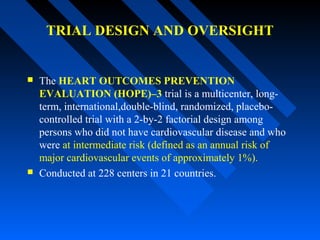
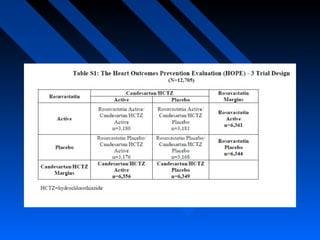
 The HEART OUTCOMES PREVENTION
EVALUATION (HOPE)–3 trial is a multicenter, long-
term, international,double-blind, randomized, placebo-
controlled trial with a 2-by-2 factorial design among
persons who did not have cardiovascular disease and who
were at intermediate risk (defined as an annual risk of
major cardiovascular events of approximately 1%).
 Conducted at 228 centers in 21 countries.
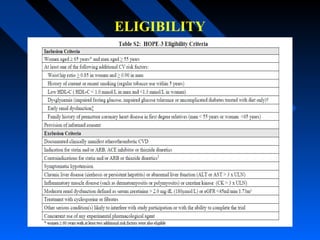
ELIGIBILITY
TRIAL PROCEDURES
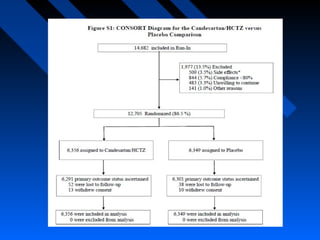
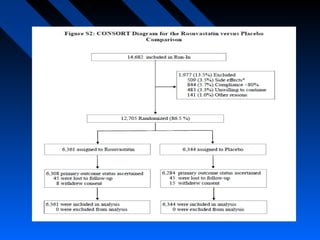
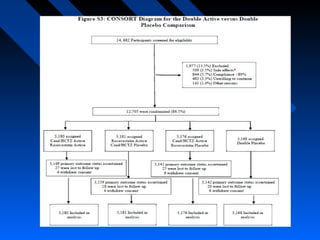
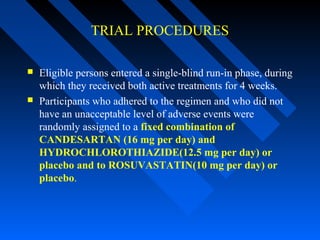
 Eligible persons entered a single-blind run-in phase, during
which they received both active treatments for 4 weeks.
 Participants who adhered to the regimen and who did not
have an unacceptable level of adverse events were
randomly assigned to a fixed combination of
CANDESARTAN (16 mg per day) and
HYDROCHLOROTHIAZIDE(12.5 mg per day) or
placebo and to ROSUVASTATIN(10 mg per day) or
placebo.
 Follow-up visits occurred at 6 weeks and 6 months after
randomization and every 6 months thereafter.
 Blood pressure was recorded at each visit in the first year
and then annually.
 Lipid levels were measured at baseline in all participants
and at 1 year, at 3 years, and at the end of the trial.
OUTCOMES
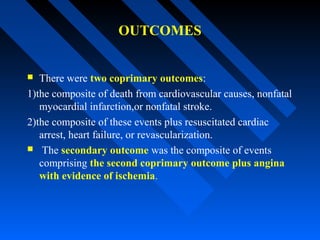
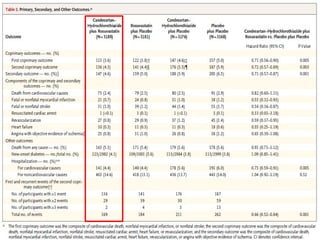
 There were two coprimary outcomes:
1)the composite of death from cardiovascular causes, nonfatal
myocardial infarction,or nonfatal stroke.
2)the composite of these events plus resuscitated cardiac
arrest, heart failure, or revascularization.
 The secondary outcome was the composite of events
comprising the second coprimary outcome plus angina
with evidence of ischemia.
RESULTS
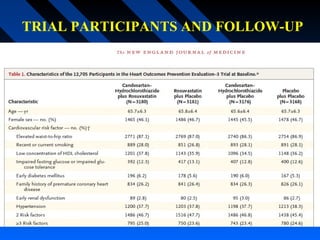
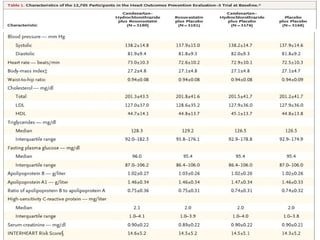
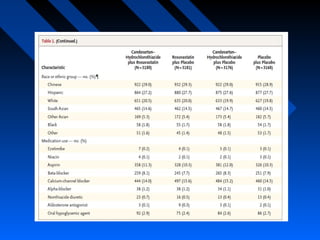
TRIAL PARTICIPANTS AND FOLLOW-UP
ADHERENCE TO TRIAL DRUGS
BLOOD PRESSURE AND LIPID
LEVELS
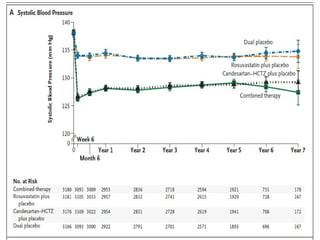
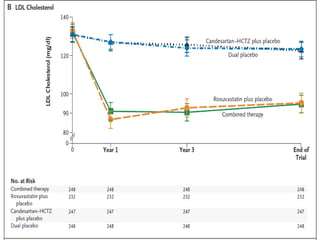
 On average , the mean SBP was lower by 6.2 mm Hg in
the combined-therapy group than in the dual placebo
group, the mean DBP was lower by 3.2 mm Hg, and the
mean LDL cholesterol level was lower by 33.7 mg per
deciliter .
 The difference in blood pressure was similar for
participants assigned to candesartan– hydrochlorothiazide
alone versus placebo.
 The difference in LDL cholesterol level was similar for
participants assigned to rosuvastatin alone versus placebo.
CLINICAL OUTCOMES
Clinical outcomesClinical outcomes
DISCUSSION
 In the HOPE-3 trial, which involved a primary prevention
population at intermediate risk and with average lipid and
blood pressure levels,combination therapy with
rosuvastatin (10 mg per day), candesartan (16 mg per day),
and hydrochlorothiazide(12.5 mg per day) for a median of
5.6 years was associated with a significantly lower risk of
cardiovascular events than dual placebo (29% lower
relative risk and 1.4-percentage-point lower absolute risk
of the first primary outcome).
 The number needed to treat for 5.6 years to prevent one
event of the first coprimary outcome was 72.
 The number needed to treat to prevent one event of the
second coprimary outcome was 63.
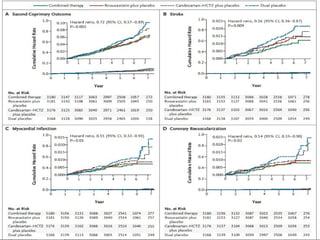
 In post hoc recurrent-events analysis, the benefit was
slightly larger.
 The reduction in LDL cholesterol concentration was
approx. 33.7 mg per dl over the course of the trial and the
reduction in SBP was 6.2 mm Hg.
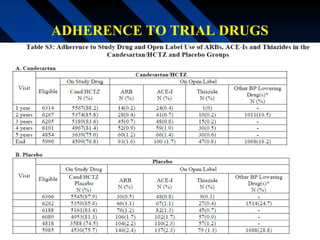
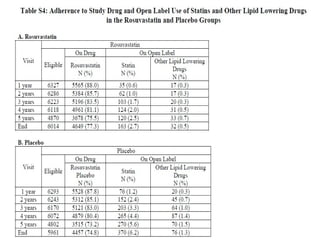
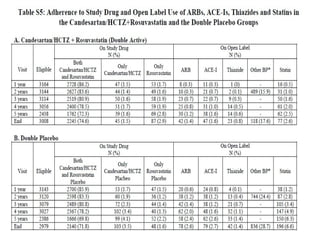
 Rates of adherence to drugs were high, and so the degree
of cholesterol and blood-pressure lowering , in a large
population treated over a median of 5.6 years, is probably
more representative than that observed in small, short-term
trials involving persons with elevated blood pressure or
high lipid levels.
 Post hoc subgroup analysis was performed comparing
participants in the upper third of baseline SBP with those
in the lower two thirds.
 In the upper third, the risk of the two coprimary
outcomes was approx.40% lower with combined therapy
than with dual placebo, whereas the relative risk was
only about 20% lower among participants with lower
SBP.
 The effects of rosuvastatin in the HOPE-3 trial were
independent of blood-pressure or lipid levels.
 These different lines of evidence suggest that
combination therapy (with a statin and blood-pressure-
lowering treatment) would perform best in persons with
elevated blood pressure, whereas statins alone would
perform best in those without elevated blood pressure.
 No significant differences between the combined-therapy
group and the dual placebo group were seen in the rate of
new-onset diabetes, renal dysfunction, syncope, liver-
function abnormalities,eye problems, or cancers.
 The rates of muscle weakness or pain and of dizziness
were higher in the combined-therapy group than in the
dual-placebo group.
 These effects were reversible by temporary discontinuation
of the trial drug.
 Investigators approach of selecting persons on the basis of
age and easily measured risk factors meant that neither
complex screening nor blood tests are required to initiate
treatment with low doses of combination therapy.
 Trial included persons of diverse racial and ethnic groups
from 21 countries with broadly consistent benefits and
safety.
CONCLUSION
 Treatment with fixed doses of rosuvastatin and two
antihypertensive agents was associated with a significantly
lower risk of cardiovascular events than the risk with
placebo among intermediate-risk persons without previous
cardiovascular disease.
INTRODUCTION
 Many studies have shown that clinic blood pressure (CBP)
is a useful predictor of cardiovascular events, such as
stroke and coronary artery disease (CAD).
 But in some of these studies, the relationship between CBP
and stroke events and between CBP and CAD events was
investigated separately.
 The results showed that although CBP is a strong predictor
of stroke events, it might not be effective in predicting
CAD events.
 The relationship between out-of-office blood pressure
(BP), such as ambulatory BP and home blood pressure
(HBP), and cardiovascular events has been investigated in
several studies but there is insufficient evidence as yet
regarding which BP measurement predicts CAD events
most strongly.
 Among out-of-office BP measurements, HBP has the
advantage of being easy to measure, allowing multiple
measurements and long-term monitoring.
 However, it remains unclear as to which time of day
HBP should be measured to predict CAD events
effectively.
 Investigators found that morning hypertension predicts
cardiovascular events because both incidence of
cardiovascular events and BP peak in the early morning.
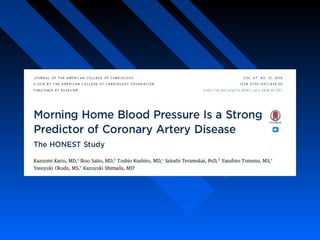
 In theIn the HONEST (Home blood pressure measurement
with Olmesartan Naïve patients to Establish Standard
Target blood pressure)study , authors investigated the
relationship between morning HBP and the incidence of
CAD events and stroke events using data from the largest
real-world prospective study.
METHODS
PATIENTS
 Olmesartan-naive outpatients with a diagnosis of essential
hypertension,who already owned a validated and approved
electronic device for measuring HBP using the cuff-
oscillometric principle, and who had recorded their
morning HBP on 2 of the 28 days before starting
olmesartan therapy, were eligible to participate.
 No BP range was specified as a criterion for eligibility.
 Patients were registered after being prescribed olmesartan
in the period between October 1, 2009 and September 30,
2010.
BP TARGETS AND ANTIHYPERTENSIVE
DRUG THERAPY.
 BP targets and olmesartan dose (administered orally,
generally 10 or 20 mg once daily) were at the discretion of
individual physicians.
 Prior olmesartan therapy was an exclusion criterion.
 No restrictions were placed on the use of combination
antihypertensive drug therapy during the study period.
HBP MEASUREMENT.
 Patients were asked to measure their HBP twice in the
morning and twice at bedtime on 2 different days for
each measurement point.
 During the follow-up period, HBP was measured at 1, 4,
and 16 weeks, and at 6, 12, 18, and 24 months.
 The average of the 2 HBP measurements at each time was
calculated.
 For each measurement point, authors used the average
HBP over 2 days.
 Average HBP measurements during follow-up, were used
in the analysis of their relationship with incidence of
stroke and CAD events.
CBP MEASUREMENT
 CBP was measured according to the usual methods of each
institution.
 During the follow-up period, CBP was measured at 4 and
16 weeks, and at 6, 12, 18, and 24months.
 For each measurement point, 1 measurement was reported.
 Average CBP measurements during follow-up, excluding
baseline values, were used in the analysis.
EVALUATION OF STROKE AND CAD
EVENTS.
 All ischemic and hemorrhagic cerebrovascular events,
except for transient ischemic attacks, were defined as
stroke events.
 Myocardial infarction and angina pectoris with coronary
revascularization procedure were defined as CAD events.
RESULTS
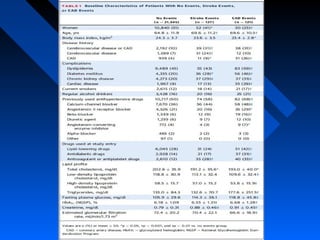
 Data from 21,591 participants were included in the
analysis.
 The mean follow-up period was 2.02 ± 0.50 years.
 10,921 (51%) were women, and the mean age was 64.9 ±
11.9 years.
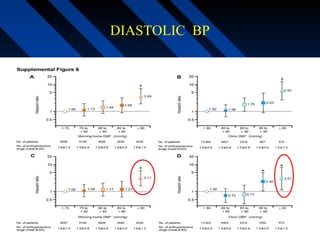
DIASTOLIC BP
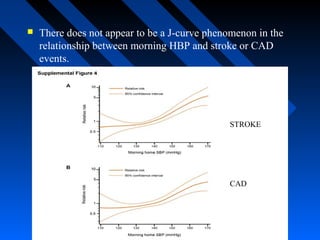
 There does not appear to be a J-curve phenomenon in the
relationship between morning HBP and stroke or CAD
events.
STROKE
CAD
DISCUSSION
 HONEST study, which included >20,000 Japanese
hypertensive patients,shows that morning HBP is a strong
predictor of future CAD events, as well as stroke events,
and may be superior to CBP.
 The analysis also showed that there does not appear to be
a J-curve in the relationship between morning HBP and
stroke or CAD events.
 The relationship between HBP, compared with CBP, and
cardiovascular events has been investigated in several
studies ,but few studies have investigated the relationship
between HBP and CAD events.
RELATIONSHIP BETWEEN HSBP AND STROKE
EVENTS.
 This analysis of data from the HONEST study has shown
that morning and evening HSBP,like CSBP, are strong
predictors for stroke.
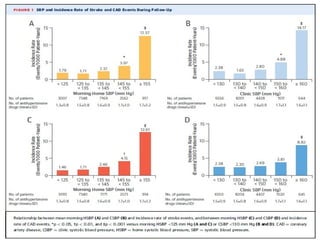
 The incidence of stroke events was 2.92 per 1,000 patient-
years, similar to that found in previous studies, like
HOMED-BP and J-HEALTH.
RELATIONSHIP BETWEEN HSBP AND CAD
EVENTS
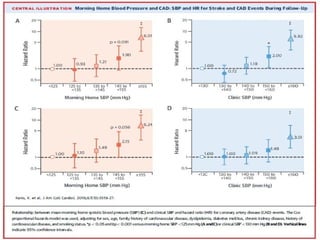
 Analysis showed that morning HBP is a strong predictor of
future CAD events and may be superior to CBP or evening
HBP.
 The incidence of CAD events was significantly higher in
patients with morning HSBP ≥145 mm Hg than in
those with morning HSBP <125 mm Hg.
 However, for CSBP, the incidence of CAD events was
higher only in patients with CSBP ≥160 mm Hg
compared with <130 mm Hg.
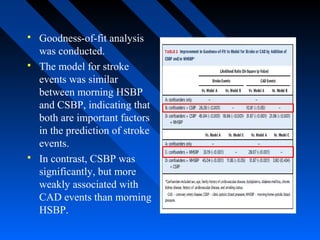
 Goodness-of-fit analysis
was conducted.
 The model for stroke
events was similar
between morning HSBP
and CSBP, indicating that
both are important factors
in the prediction of stroke
events.
 In contrast, CSBP was
significantly, but more
weakly associated with
CAD events than morning
HSBP.
 Present study is the first to show that morning HSBP may
be superior to CSBP for the prediction of CAD events.
 CAD events occur most frequently in the morning as there
is an increase in BP and BP variability in the morning,
resulting from:
 A) increased activity of the renin-angiotensin system.
 B) increased platelet function activity.
 C)a thrombotic tendency at this time of the day.
HOME DBP
 The relationship between morning HDBP or CDBP and
CAD events was investigated in study.
 Both morning HDBP and CDBP may underestimate the
risk of CAD events compared with morning HSBP or
CSBP..
CONCLUSIONS
 Morning HBP is a strong predictor of future CAD
events, as well as stroke events, and may be superior to
CBP in this regard.
 Furthermore, there does not appear to be a J-curve in the
relationship between morning HBP and stroke or CAD
events.

hope 3 and honest study

  • 1.
  • 3.
  • 4.
     Both systolicblood pressure and low density lipoprotein (LDL) cholesterol show graded associations with cardiovascular disease.  Account for two thirds of the population-attributable risk of cardiovascular disease.
  • 5.
     Combined loweringof LDL cholesterol and blood pressure can potentially have a bigger effect in reducing cardiovascular events than either intervention alone.  Majority of cardiovascular events occur in persons at average risk with no previous cardiovascular disease.  Strategy of broad population-based treatment of LDL cholesterol and blood pressure could be more effective than targeting only high-risk persons.
  • 6.
     Investigators evaluatedthe effects of a MODERATE DOSE OF A POTENT STATIN VS PLACEBO,  A FIXED COMBINATION OF MODERATE DOSES OF AN ARB DIURETIC VS PLACEBO, and THE COMBINATION OF BOTH TREATMENTS VS DUAL PLACEBO on the prevention of major cardiovascular events.
  • 7.
  • 8.
    TRIAL DESIGN ANDOVERSIGHT  The HEART OUTCOMES PREVENTION EVALUATION (HOPE)–3 trial is a multicenter, long- term, international,double-blind, randomized, placebo- controlled trial with a 2-by-2 factorial design among persons who did not have cardiovascular disease and who were at intermediate risk (defined as an annual risk of major cardiovascular events of approximately 1%).  Conducted at 228 centers in 21 countries.
  • 13.
  • 14.
    TRIAL PROCEDURES  Eligiblepersons entered a single-blind run-in phase, during which they received both active treatments for 4 weeks.  Participants who adhered to the regimen and who did not have an unacceptable level of adverse events were randomly assigned to a fixed combination of CANDESARTAN (16 mg per day) and HYDROCHLOROTHIAZIDE(12.5 mg per day) or placebo and to ROSUVASTATIN(10 mg per day) or placebo.
  • 15.
     Follow-up visitsoccurred at 6 weeks and 6 months after randomization and every 6 months thereafter.  Blood pressure was recorded at each visit in the first year and then annually.  Lipid levels were measured at baseline in all participants and at 1 year, at 3 years, and at the end of the trial.
  • 16.
    OUTCOMES  There weretwo coprimary outcomes: 1)the composite of death from cardiovascular causes, nonfatal myocardial infarction,or nonfatal stroke. 2)the composite of these events plus resuscitated cardiac arrest, heart failure, or revascularization.  The secondary outcome was the composite of events comprising the second coprimary outcome plus angina with evidence of ischemia.
  • 17.
  • 18.
  • 21.
  • 24.
    BLOOD PRESSURE ANDLIPID LEVELS  On average , the mean SBP was lower by 6.2 mm Hg in the combined-therapy group than in the dual placebo group, the mean DBP was lower by 3.2 mm Hg, and the mean LDL cholesterol level was lower by 33.7 mg per deciliter .  The difference in blood pressure was similar for participants assigned to candesartan– hydrochlorothiazide alone versus placebo.  The difference in LDL cholesterol level was similar for participants assigned to rosuvastatin alone versus placebo.
  • 27.
  • 28.
  • 30.
    DISCUSSION  In theHOPE-3 trial, which involved a primary prevention population at intermediate risk and with average lipid and blood pressure levels,combination therapy with rosuvastatin (10 mg per day), candesartan (16 mg per day), and hydrochlorothiazide(12.5 mg per day) for a median of 5.6 years was associated with a significantly lower risk of cardiovascular events than dual placebo (29% lower relative risk and 1.4-percentage-point lower absolute risk of the first primary outcome).
  • 31.
     The numberneeded to treat for 5.6 years to prevent one event of the first coprimary outcome was 72.  The number needed to treat to prevent one event of the second coprimary outcome was 63.  In post hoc recurrent-events analysis, the benefit was slightly larger.
  • 32.
     The reductionin LDL cholesterol concentration was approx. 33.7 mg per dl over the course of the trial and the reduction in SBP was 6.2 mm Hg.  Rates of adherence to drugs were high, and so the degree of cholesterol and blood-pressure lowering , in a large population treated over a median of 5.6 years, is probably more representative than that observed in small, short-term trials involving persons with elevated blood pressure or high lipid levels.
  • 33.
     Post hocsubgroup analysis was performed comparing participants in the upper third of baseline SBP with those in the lower two thirds.  In the upper third, the risk of the two coprimary outcomes was approx.40% lower with combined therapy than with dual placebo, whereas the relative risk was only about 20% lower among participants with lower SBP.
  • 34.
     The effectsof rosuvastatin in the HOPE-3 trial were independent of blood-pressure or lipid levels.  These different lines of evidence suggest that combination therapy (with a statin and blood-pressure- lowering treatment) would perform best in persons with elevated blood pressure, whereas statins alone would perform best in those without elevated blood pressure.
  • 35.
     No significantdifferences between the combined-therapy group and the dual placebo group were seen in the rate of new-onset diabetes, renal dysfunction, syncope, liver- function abnormalities,eye problems, or cancers.  The rates of muscle weakness or pain and of dizziness were higher in the combined-therapy group than in the dual-placebo group.  These effects were reversible by temporary discontinuation of the trial drug.
  • 36.
     Investigators approachof selecting persons on the basis of age and easily measured risk factors meant that neither complex screening nor blood tests are required to initiate treatment with low doses of combination therapy.  Trial included persons of diverse racial and ethnic groups from 21 countries with broadly consistent benefits and safety.
  • 37.
    CONCLUSION  Treatment withfixed doses of rosuvastatin and two antihypertensive agents was associated with a significantly lower risk of cardiovascular events than the risk with placebo among intermediate-risk persons without previous cardiovascular disease.
  • 39.
  • 40.
     Many studieshave shown that clinic blood pressure (CBP) is a useful predictor of cardiovascular events, such as stroke and coronary artery disease (CAD).  But in some of these studies, the relationship between CBP and stroke events and between CBP and CAD events was investigated separately.  The results showed that although CBP is a strong predictor of stroke events, it might not be effective in predicting CAD events.
  • 41.
     The relationshipbetween out-of-office blood pressure (BP), such as ambulatory BP and home blood pressure (HBP), and cardiovascular events has been investigated in several studies but there is insufficient evidence as yet regarding which BP measurement predicts CAD events most strongly.
  • 42.
     Among out-of-officeBP measurements, HBP has the advantage of being easy to measure, allowing multiple measurements and long-term monitoring.  However, it remains unclear as to which time of day HBP should be measured to predict CAD events effectively.  Investigators found that morning hypertension predicts cardiovascular events because both incidence of cardiovascular events and BP peak in the early morning.
  • 43.
     In theInthe HONEST (Home blood pressure measurement with Olmesartan Naïve patients to Establish Standard Target blood pressure)study , authors investigated the relationship between morning HBP and the incidence of CAD events and stroke events using data from the largest real-world prospective study.
  • 44.
  • 45.
    PATIENTS  Olmesartan-naive outpatientswith a diagnosis of essential hypertension,who already owned a validated and approved electronic device for measuring HBP using the cuff- oscillometric principle, and who had recorded their morning HBP on 2 of the 28 days before starting olmesartan therapy, were eligible to participate.  No BP range was specified as a criterion for eligibility.  Patients were registered after being prescribed olmesartan in the period between October 1, 2009 and September 30, 2010.
  • 46.
    BP TARGETS ANDANTIHYPERTENSIVE DRUG THERAPY.  BP targets and olmesartan dose (administered orally, generally 10 or 20 mg once daily) were at the discretion of individual physicians.  Prior olmesartan therapy was an exclusion criterion.  No restrictions were placed on the use of combination antihypertensive drug therapy during the study period.
  • 47.
    HBP MEASUREMENT.  Patientswere asked to measure their HBP twice in the morning and twice at bedtime on 2 different days for each measurement point.  During the follow-up period, HBP was measured at 1, 4, and 16 weeks, and at 6, 12, 18, and 24 months.  The average of the 2 HBP measurements at each time was calculated.  For each measurement point, authors used the average HBP over 2 days.  Average HBP measurements during follow-up, were used in the analysis of their relationship with incidence of stroke and CAD events.
  • 48.
    CBP MEASUREMENT  CBPwas measured according to the usual methods of each institution.  During the follow-up period, CBP was measured at 4 and 16 weeks, and at 6, 12, 18, and 24months.  For each measurement point, 1 measurement was reported.  Average CBP measurements during follow-up, excluding baseline values, were used in the analysis.
  • 49.
    EVALUATION OF STROKEAND CAD EVENTS.  All ischemic and hemorrhagic cerebrovascular events, except for transient ischemic attacks, were defined as stroke events.  Myocardial infarction and angina pectoris with coronary revascularization procedure were defined as CAD events.
  • 50.
  • 51.
     Data from21,591 participants were included in the analysis.  The mean follow-up period was 2.02 ± 0.50 years.  10,921 (51%) were women, and the mean age was 64.9 ± 11.9 years.
  • 55.
  • 56.
     There doesnot appear to be a J-curve phenomenon in the relationship between morning HBP and stroke or CAD events. STROKE CAD
  • 57.
    DISCUSSION  HONEST study,which included >20,000 Japanese hypertensive patients,shows that morning HBP is a strong predictor of future CAD events, as well as stroke events, and may be superior to CBP.  The analysis also showed that there does not appear to be a J-curve in the relationship between morning HBP and stroke or CAD events.  The relationship between HBP, compared with CBP, and cardiovascular events has been investigated in several studies ,but few studies have investigated the relationship between HBP and CAD events.
  • 58.
    RELATIONSHIP BETWEEN HSBPAND STROKE EVENTS.  This analysis of data from the HONEST study has shown that morning and evening HSBP,like CSBP, are strong predictors for stroke.  The incidence of stroke events was 2.92 per 1,000 patient- years, similar to that found in previous studies, like HOMED-BP and J-HEALTH.
  • 59.
    RELATIONSHIP BETWEEN HSBPAND CAD EVENTS  Analysis showed that morning HBP is a strong predictor of future CAD events and may be superior to CBP or evening HBP.  The incidence of CAD events was significantly higher in patients with morning HSBP ≥145 mm Hg than in those with morning HSBP <125 mm Hg.  However, for CSBP, the incidence of CAD events was higher only in patients with CSBP ≥160 mm Hg compared with <130 mm Hg.
  • 60.
     Goodness-of-fit analysis wasconducted.  The model for stroke events was similar between morning HSBP and CSBP, indicating that both are important factors in the prediction of stroke events.  In contrast, CSBP was significantly, but more weakly associated with CAD events than morning HSBP.
  • 61.
     Present studyis the first to show that morning HSBP may be superior to CSBP for the prediction of CAD events.  CAD events occur most frequently in the morning as there is an increase in BP and BP variability in the morning, resulting from:  A) increased activity of the renin-angiotensin system.  B) increased platelet function activity.  C)a thrombotic tendency at this time of the day.
  • 62.
    HOME DBP  Therelationship between morning HDBP or CDBP and CAD events was investigated in study.  Both morning HDBP and CDBP may underestimate the risk of CAD events compared with morning HSBP or CSBP..
  • 63.
    CONCLUSIONS  Morning HBPis a strong predictor of future CAD events, as well as stroke events, and may be superior to CBP in this regard.  Furthermore, there does not appear to be a J-curve in the relationship between morning HBP and stroke or CAD events.