Coronary Dialysis SystemCoronary Dialysis System
 Atherosclerosis and its consequencesAtherosclerosis and its consequences
 Atherosclerosis and inflammationAtherosclerosis and inflammation
 Inflammatory markersInflammatory markers
 The role of HDL and its apo A-1The role of HDL and its apo A-1
 LDL aphaeresisLDL aphaeresis
 Designed Coronary Dialysis SystemDesigned Coronary Dialysis System
Atherosclerosis and itsAtherosclerosis and its
consequences (plaque rupture andconsequences (plaque rupture and
thrombosis) are the leading causethrombosis) are the leading cause
of morbidity and mortality in the USof morbidity and mortality in the US
and other industrialized countriesand other industrialized countries
The exact mechanism ofThe exact mechanism of
atherosclerosis is unknown, butatherosclerosis is unknown, but
evidence suggest that lipoproteinevidence suggest that lipoprotein
pathway, injury to the vessel wallpathway, injury to the vessel wall
from various stimuli and responsefrom various stimuli and response
to injury that include inflammatoryto injury that include inflammatory
and immune system responseand immune system response
seems to play key roles.seems to play key roles.
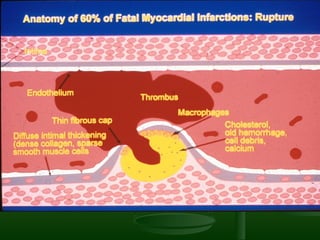
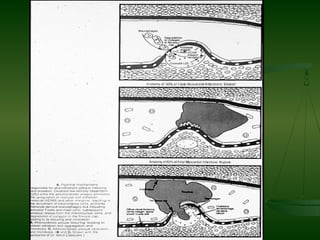
Major modes of plaqueMajor modes of plaque
disruption:disruption:
**The rupture (fracture) of theThe rupture (fracture) of the
plaque’s fibrous cap accountingplaque’s fibrous cap accounting
for some two thirds of ACSfor some two thirds of ACS
**The second mode involves aThe second mode involves a
superficial erosion of the intimasuperficial erosion of the intima
Based on Biochemical and EpidemiologicalBased on Biochemical and Epidemiological
evidences:evidences:
Atherosclerosis is an inflammatoryAtherosclerosis is an inflammatory
diseasedisease
Although Acute phase reactantAlthough Acute phase reactant
such as CRP is non-specific butsuch as CRP is non-specific but
it is very sensitive marker ofit is very sensitive marker of
inflammationinflammation
Prospective studies haveProspective studies have
consistently demonstrated aconsistently demonstrated a
positive association betweenpositive association between
hs-CRP and the future coronaryhs-CRP and the future coronary
eventsevents
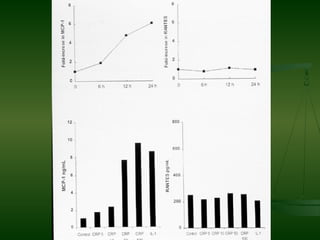
CRP, is not only anCRP, is not only an
epiphenomenon of atherosclerosisepiphenomenon of atherosclerosis
but a casual relationship has beenbut a casual relationship has been
suggested between CRP andsuggested between CRP and
inflammatory reaction in the vesselinflammatory reaction in the vessel
wallwall
Inflammatory roles of CRPInflammatory roles of CRP
activation of complement pathwayactivation of complement pathway
enhancement of thrombosisenhancement of thrombosis
enhancement of tissue injuryenhancement of tissue injury
chemo tactic for monocyteschemo tactic for monocytes
facilitation uptake of LDL by MACfacilitation uptake of LDL by MAC
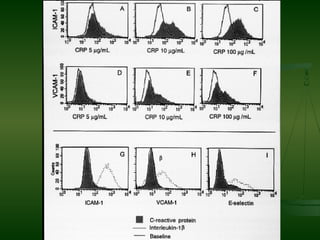
induction of adhesion moleculesinduction of adhesion molecules
impairment endothelial functionimpairment endothelial function
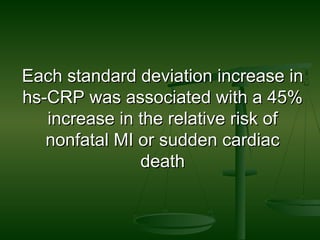
Each standard deviation increase inEach standard deviation increase in
hs-CRP was associated with a 45%hs-CRP was associated with a 45%
increase in the relative risk ofincrease in the relative risk of
nonfatal MI or sudden cardiacnonfatal MI or sudden cardiac
deathdeath
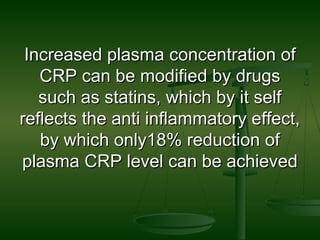
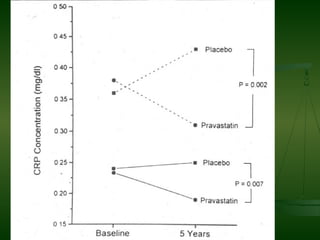
Increased plasma concentration ofIncreased plasma concentration of
CRP can be modified by drugsCRP can be modified by drugs
such as statins, which by it selfsuch as statins, which by it self
reflects the anti inflammatory effect,reflects the anti inflammatory effect,
by which only18% reduction ofby which only18% reduction of
plasma CRP level can be achievedplasma CRP level can be achieved
Potential preventive therapies for highPotential preventive therapies for high
CRP-levelCRP-level
Although no specific therapies haveAlthough no specific therapies have
been developed to decrease hs-CRPbeen developed to decrease hs-CRP
****************************************
ButBut AspirinAspirin andand statinsstatins are effectiveare effective
in decreasing the incidence of futurein decreasing the incidence of future
coronary events in those with highcoronary events in those with high
CRPCRP
These findings suggest:These findings suggest:
 Aspirin is not only anti platelet agent butAspirin is not only anti platelet agent but
also is an anti-inflammatoryalso is an anti-inflammatory
 statins also my has anti-inflammatorystatins also my has anti-inflammatory
characteristics in addition to its anti-hypercharacteristics in addition to its anti-hyper
lipidemic potentiallipidemic potential
Meta analysis of five primary andMeta analysis of five primary and
secondary trials demonstrated thatsecondary trials demonstrated that
statin therapy reduces the risk ofstatin therapy reduces the risk of
major coronary events by 31% andmajor coronary events by 31% and
all cause mortality by 21%.all cause mortality by 21%.
Trials which focused primarily on LDL-Trials which focused primarily on LDL-
C and its lowering modalities (dietaryC and its lowering modalities (dietary
counseling, pharmacotherapy, life stylecounseling, pharmacotherapy, life style
modification, and surgery) revealedmodification, and surgery) revealed
only a relative risk reduction in CVonly a relative risk reduction in CV
mortality of 20% to 40%, so theremortality of 20% to 40%, so there
should be other potential reasons forshould be other potential reasons for
CV events.CV events.
One such potential target is HDLOne such potential target is HDL
and its apoprotein (Apo-A1).and its apoprotein (Apo-A1).
The protective role of HDL againstThe protective role of HDL against
atherosclerosis is widely accepted andatherosclerosis is widely accepted and
is generally attributed to reverseis generally attributed to reverse
cholesterol transport, by which excesscholesterol transport, by which excess
cholesterol in peripheral tissues ischolesterol in peripheral tissues is
conveyed to the liver for excretionconveyed to the liver for excretion
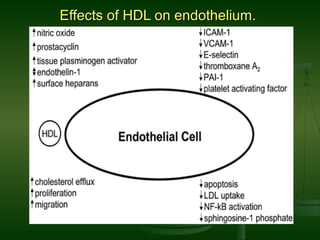
Effects of HDL on endothelium.Effects of HDL on endothelium.
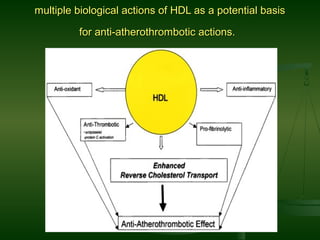
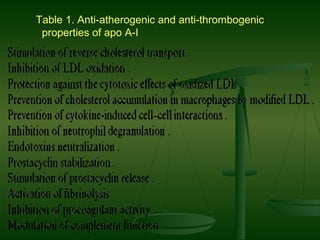
multiple biological actions of HDL as a potential basismultiple biological actions of HDL as a potential basis
for anti-atherothrombotic actions.for anti-atherothrombotic actions.
Table 1. Anti-atherogenic and anti-thrombogenic
properties of apo A-I
There is an inverse relation betweenThere is an inverse relation between
HDL levels and coronary heart disease.HDL levels and coronary heart disease.
There is a similar inverse relationThere is a similar inverse relation
between HDL and restenosis afterbetween HDL and restenosis after
PTCA.PTCA.
Every 1mg/dl increase in HDL isEvery 1mg/dl increase in HDL is
associated with a 2% to 3% lowerassociated with a 2% to 3% lower
risk of CAD. Also there is inverserisk of CAD. Also there is inverse
relationship between the level ofrelationship between the level of
APOA-1 and CAD.APOA-1 and CAD.
Experimental studies have shownExperimental studies have shown
that intravenous injection of HDL,that intravenous injection of HDL,
inhibited the progression andinhibited the progression and
induced regression of early aorticinduced regression of early aortic
fatty streaks in cholesterol fedfatty streaks in cholesterol fed
rabbitrabbit
In another experimental studyIn another experimental study
similar results were achieved insimilar results were achieved in
cholesterol fed rabbit receivingcholesterol fed rabbit receiving
intravenous apo A-1.intravenous apo A-1.
Intravenous HDL containingIntravenous HDL containing
recombinant apoA-1milano alsorecombinant apoA-1milano also
showed to prevent progressionshowed to prevent progression
or promote regression of aorticor promote regression of aortic
atherosclerosis in apoE-nullatherosclerosis in apoE-null
micemice
In another experimental study inIn another experimental study in
apoE-deficient mice with advancedapoE-deficient mice with advanced
atherosclerotic lesion elevatingatherosclerotic lesion elevating
HDL-C remodel the plaque byHDL-C remodel the plaque by
decreasing MAC and increasingdecreasing MAC and increasing
SMCSMC
NOW:NOW: It is the time of development,It is the time of development,
implementation, and clinical trials ofimplementation, and clinical trials of
this new frontier anti -atherogenicthis new frontier anti -atherogenic
policy.policy.
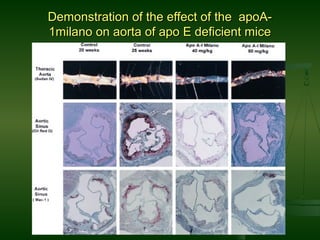
Demonstration of the effect of the apoA-Demonstration of the effect of the apoA-
1milano on aorta of apo E deficient mice1milano on aorta of apo E deficient mice
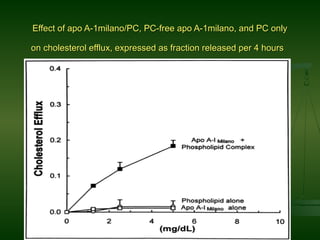
Effect of apo A-1milano/PC, PC-free apo A-1milano, and PC onlyEffect of apo A-1milano/PC, PC-free apo A-1milano, and PC only
on cholesterol efflux, expressed as fraction released per 4 hourson cholesterol efflux, expressed as fraction released per 4 hours
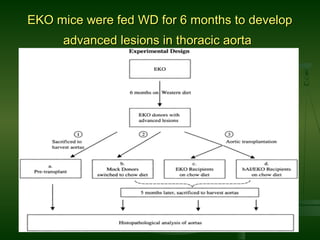
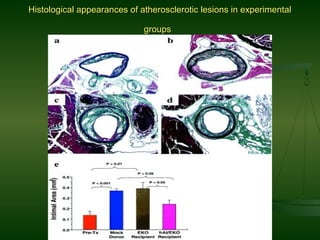
EKO mice were fed WD for 6 months to developEKO mice were fed WD for 6 months to develop
advanced lesions in thoracic aortaadvanced lesions in thoracic aorta
Histological appearances of atherosclerotic lesions in experimentalHistological appearances of atherosclerotic lesions in experimental
groupsgroups
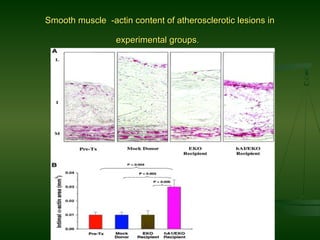
Smooth muscle -actin content of atherosclerotic lesions inSmooth muscle -actin content of atherosclerotic lesions in
experimental groupsexperimental groups..
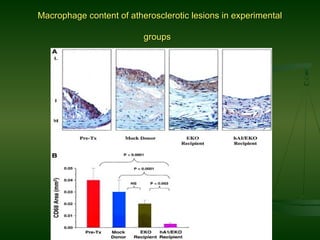
Macrophage content of atherosclerotic lesions in experimentalMacrophage content of atherosclerotic lesions in experimental
groupsgroups
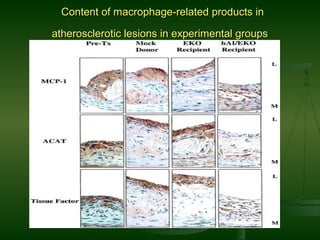
Content of macrophage-related products inContent of macrophage-related products in
atherosclerotic lesions in experimental groupsatherosclerotic lesions in experimental groups
NO standard treatment has beenNO standard treatment has been
established for patient who continues toestablished for patient who continues to
maintain LDL-c level in excess of 160 mg/dlmaintain LDL-c level in excess of 160 mg/dl
after diet and drug therapy. To date therapyafter diet and drug therapy. To date therapy
has consisted of a variety of measureshas consisted of a variety of measures
including combination drug therapy,including combination drug therapy,
plasmapheresis, and partial ileal by passplasmapheresis, and partial ileal by pass
and even liver transplantation.and even liver transplantation.
The LDL aphaeresis wasThe LDL aphaeresis was
developed to provide therapy fordeveloped to provide therapy for
patients who fail to responds topatients who fail to responds to
provided therapy especiallyprovided therapy especially
when patients who have existingwhen patients who have existing
CAD.CAD.
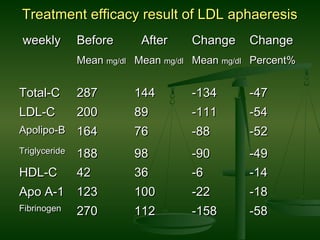
Treatment efficacy result of LDL aphaeresisTreatment efficacy result of LDL aphaeresis
weeklyweekly BeforeBefore AfterAfter ChangeChange ChangeChange
MeanMean mg/dlmg/dl MeanMean mg/dlmg/dl MeanMean mg/dlmg/dl Percent%Percent%
Total-CTotal-C 287287 144144 -134-134 -47-47
LDL-CLDL-C 200200 8989 -111-111 -54-54
Apolipo-BApolipo-B 164164 7676 -88-88 -52-52
TriglycerideTriglyceride
188188 9898 -90-90 -49-49
HDL-CHDL-C 4242 3636 -6-6 -14-14
Apo A-1Apo A-1 123123 100100 -22-22 -18-18
FibrinogenFibrinogen
270270 112112 -158-158 -58-58
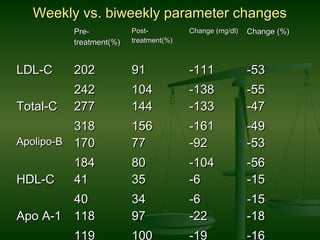
Weekly vs. biweekly parameter changesWeekly vs. biweekly parameter changes
Pre-Pre-
treatment(%)treatment(%)
Post-Post-
treatment(%)treatment(%)
Change (mg/dl)Change (mg/dl) Change (%)Change (%)
LDL-CLDL-C 202202
242242
9191
104104
-111-111
-138-138
-53-53
-55-55
Total-CTotal-C 277277
318318
144144
156156
-133-133
-161-161
-47-47
-49-49
Apolipo-BApolipo-B 170170
184184
7777
8080
-92-92
-104-104
-53-53
-56-56
HDL-CHDL-C 4141
4040
3535
3434
-6-6
-6-6
-15-15
-15-15
Apo A-1Apo A-1 118118
119
9797
100
-22-22
-19
-18-18
-16
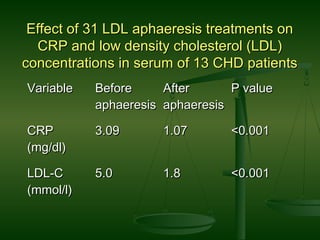
Effect of 31 LDL aphaeresis treatments onEffect of 31 LDL aphaeresis treatments on
CRP and low density cholesterol (LDL)CRP and low density cholesterol (LDL)
concentrations in serum of 13 CHD patientsconcentrations in serum of 13 CHD patients
VariableVariable BeforeBefore
aphaeresisaphaeresis
AfterAfter
aphaeresisaphaeresis
P valueP value
CRPCRP
(mg/dl)(mg/dl)
3.093.09 1.071.07 <0.001<0.001
LDL-CLDL-C
(mmol/l)(mmol/l)
5.05.0 1.81.8 <0.001<0.001
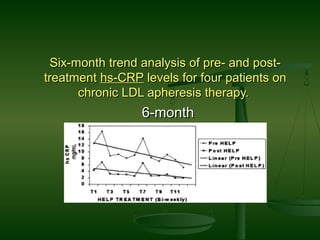
Six-month trend analysis of pre- and post-Six-month trend analysis of pre- and post-
treatmenttreatment hs-CRPhs-CRP levels for four patients onlevels for four patients on
chronic LDL apheresis therapy.chronic LDL apheresis therapy.
6-month6-month
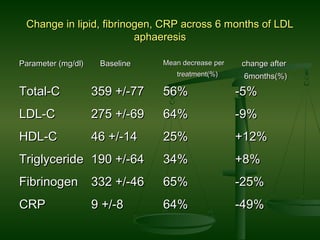
Change in lipid, fibrinogen, CRP across 6 months of LDLChange in lipid, fibrinogen, CRP across 6 months of LDL
aphaeresisaphaeresis
Parameter (mg/dl)Parameter (mg/dl) BaselineBaseline Mean decrease perMean decrease per
treatment(%)treatment(%)
change afterchange after
6months(%)6months(%)
Total-CTotal-C 359 +/-77359 +/-77 56%56% -5%-5%
LDL-CLDL-C 275 +/-69275 +/-69 64%64% -9%-9%
HDL-CHDL-C 46 +/-1446 +/-14 25%25% +12%+12%
TriglycerideTriglyceride 190 +/-64190 +/-64 34%34% +8%+8%
FibrinogenFibrinogen 332 +/-46332 +/-46 65%65% -25%-25%
CRPCRP 9 +/-89 +/-8 64%64% -49%-49%
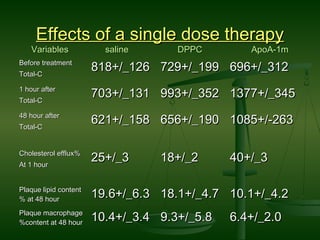
Effects of a single dose therapyEffects of a single dose therapy
Variables saline DPPC ApoA-1mVariables saline DPPC ApoA-1m
Before treatmentBefore treatment
Total-CTotal-C
818+/_126818+/_126 729+/_199729+/_199 696+/_312696+/_312
1 hour after1 hour after
Total-CTotal-C
703+/_131703+/_131 993+/_352993+/_352 1377+/_3451377+/_345
48 hour after48 hour after
Total-CTotal-C
621+/_158621+/_158 656+/_190656+/_190 1085+/-2631085+/-263
Cholesterol efflux%Cholesterol efflux%
At 1 hourAt 1 hour
25+/_325+/_3 18+/_218+/_2 40+/_340+/_3
Plaque lipid contentPlaque lipid content
% at 48 hour% at 48 hour 19.6+/_6.319.6+/_6.3 18.1+/_4.718.1+/_4.7 10.1+/_4.210.1+/_4.2
Plaque macrophagePlaque macrophage
%content at 48 hour%content at 48 hour 10.4+/_3.410.4+/_3.4 9.3+/_5.89.3+/_5.8 6.4+/_2.06.4+/_2.0
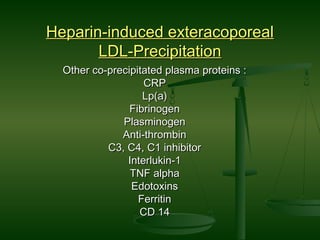
Heparin-induced exteracoporealHeparin-induced exteracoporeal
LDL-PrecipitationLDL-Precipitation
Other co-precipitated plasma proteins :Other co-precipitated plasma proteins :
CRPCRP
Lp(a)Lp(a)
FibrinogenFibrinogen
PlasminogenPlasminogen
Anti-thrombinAnti-thrombin
C3, C4, C1 inhibitorC3, C4, C1 inhibitor
Interlukin-1Interlukin-1
TNF alphaTNF alpha
EdotoxinsEdotoxins
FerritinFerritin
CD 14CD 14
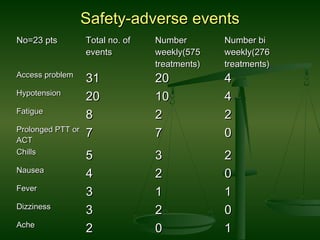
Safety-adverse eventsSafety-adverse events
No=23 ptsNo=23 pts Total no. ofTotal no. of
eventsevents
NumberNumber
weekly(575weekly(575
treatments)treatments)
Number biNumber bi
weekly(276weekly(276
treatments)treatments)
Access problemAccess problem
3131 2020 44
HypotensionHypotension
2020 1010 44
FatigueFatigue
88 22 22
Prolonged PTT orProlonged PTT or
ACTACT
77 77 00
ChillsChills
55 33 22
NauseaNausea
44 22 00
FeverFever
33 11 11
DizzinessDizziness
33 22 00
AcheAche
22 00 11
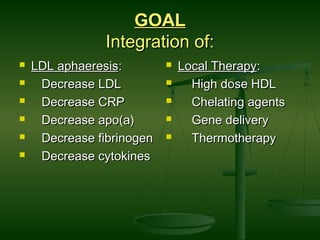
GOALGOAL
Integration of:Integration of:
 LDL aphaeresisLDL aphaeresis::
 Decrease LDLDecrease LDL
 Decrease CRPDecrease CRP
 Decrease apo(a)Decrease apo(a)
 Decrease fibrinogenDecrease fibrinogen
 Decrease cytokinesDecrease cytokines
 Local TherapyLocal Therapy::
 High dose HDLHigh dose HDL
 Chelating agentsChelating agents
 Gene deliveryGene delivery
 ThermotherapyThermotherapy
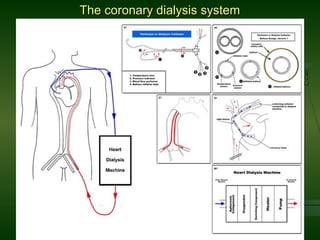
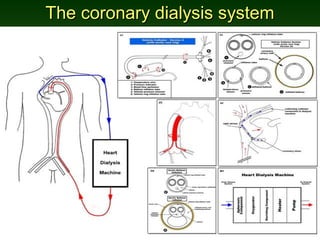
The coronary dialysis systemThe coronary dialysis system

Atherosclerosis and its consequences (plaque rupture and

  • 1.
    Coronary Dialysis SystemCoronaryDialysis System  Atherosclerosis and its consequencesAtherosclerosis and its consequences  Atherosclerosis and inflammationAtherosclerosis and inflammation  Inflammatory markersInflammatory markers  The role of HDL and its apo A-1The role of HDL and its apo A-1  LDL aphaeresisLDL aphaeresis  Designed Coronary Dialysis SystemDesigned Coronary Dialysis System
  • 2.
    Atherosclerosis and itsAtherosclerosisand its consequences (plaque rupture andconsequences (plaque rupture and thrombosis) are the leading causethrombosis) are the leading cause of morbidity and mortality in the USof morbidity and mortality in the US and other industrialized countriesand other industrialized countries
  • 3.
    The exact mechanismofThe exact mechanism of atherosclerosis is unknown, butatherosclerosis is unknown, but evidence suggest that lipoproteinevidence suggest that lipoprotein pathway, injury to the vessel wallpathway, injury to the vessel wall from various stimuli and responsefrom various stimuli and response to injury that include inflammatoryto injury that include inflammatory and immune system responseand immune system response seems to play key roles.seems to play key roles.
  • 4.
    Major modes ofplaqueMajor modes of plaque disruption:disruption: **The rupture (fracture) of theThe rupture (fracture) of the plaque’s fibrous cap accountingplaque’s fibrous cap accounting for some two thirds of ACSfor some two thirds of ACS **The second mode involves aThe second mode involves a superficial erosion of the intimasuperficial erosion of the intima
  • 7.
    Based on Biochemicaland EpidemiologicalBased on Biochemical and Epidemiological evidences:evidences: Atherosclerosis is an inflammatoryAtherosclerosis is an inflammatory diseasedisease
  • 8.
    Although Acute phasereactantAlthough Acute phase reactant such as CRP is non-specific butsuch as CRP is non-specific but it is very sensitive marker ofit is very sensitive marker of inflammationinflammation
  • 9.
    Prospective studies haveProspectivestudies have consistently demonstrated aconsistently demonstrated a positive association betweenpositive association between hs-CRP and the future coronaryhs-CRP and the future coronary eventsevents
  • 10.
    CRP, is notonly anCRP, is not only an epiphenomenon of atherosclerosisepiphenomenon of atherosclerosis but a casual relationship has beenbut a casual relationship has been suggested between CRP andsuggested between CRP and inflammatory reaction in the vesselinflammatory reaction in the vessel wallwall
  • 11.
    Inflammatory roles ofCRPInflammatory roles of CRP activation of complement pathwayactivation of complement pathway enhancement of thrombosisenhancement of thrombosis enhancement of tissue injuryenhancement of tissue injury chemo tactic for monocyteschemo tactic for monocytes facilitation uptake of LDL by MACfacilitation uptake of LDL by MAC induction of adhesion moleculesinduction of adhesion molecules impairment endothelial functionimpairment endothelial function
  • 14.
    Each standard deviationincrease inEach standard deviation increase in hs-CRP was associated with a 45%hs-CRP was associated with a 45% increase in the relative risk ofincrease in the relative risk of nonfatal MI or sudden cardiacnonfatal MI or sudden cardiac deathdeath
  • 15.
    Increased plasma concentrationofIncreased plasma concentration of CRP can be modified by drugsCRP can be modified by drugs such as statins, which by it selfsuch as statins, which by it self reflects the anti inflammatory effect,reflects the anti inflammatory effect, by which only18% reduction ofby which only18% reduction of plasma CRP level can be achievedplasma CRP level can be achieved
  • 17.
    Potential preventive therapiesfor highPotential preventive therapies for high CRP-levelCRP-level Although no specific therapies haveAlthough no specific therapies have been developed to decrease hs-CRPbeen developed to decrease hs-CRP **************************************** ButBut AspirinAspirin andand statinsstatins are effectiveare effective in decreasing the incidence of futurein decreasing the incidence of future coronary events in those with highcoronary events in those with high CRPCRP
  • 18.
    These findings suggest:Thesefindings suggest:  Aspirin is not only anti platelet agent butAspirin is not only anti platelet agent but also is an anti-inflammatoryalso is an anti-inflammatory  statins also my has anti-inflammatorystatins also my has anti-inflammatory characteristics in addition to its anti-hypercharacteristics in addition to its anti-hyper lipidemic potentiallipidemic potential
  • 19.
    Meta analysis offive primary andMeta analysis of five primary and secondary trials demonstrated thatsecondary trials demonstrated that statin therapy reduces the risk ofstatin therapy reduces the risk of major coronary events by 31% andmajor coronary events by 31% and all cause mortality by 21%.all cause mortality by 21%.
  • 20.
    Trials which focusedprimarily on LDL-Trials which focused primarily on LDL- C and its lowering modalities (dietaryC and its lowering modalities (dietary counseling, pharmacotherapy, life stylecounseling, pharmacotherapy, life style modification, and surgery) revealedmodification, and surgery) revealed only a relative risk reduction in CVonly a relative risk reduction in CV mortality of 20% to 40%, so theremortality of 20% to 40%, so there should be other potential reasons forshould be other potential reasons for CV events.CV events.
  • 21.
    One such potentialtarget is HDLOne such potential target is HDL and its apoprotein (Apo-A1).and its apoprotein (Apo-A1).
  • 22.
    The protective roleof HDL againstThe protective role of HDL against atherosclerosis is widely accepted andatherosclerosis is widely accepted and is generally attributed to reverseis generally attributed to reverse cholesterol transport, by which excesscholesterol transport, by which excess cholesterol in peripheral tissues ischolesterol in peripheral tissues is conveyed to the liver for excretionconveyed to the liver for excretion
  • 23.
    Effects of HDLon endothelium.Effects of HDL on endothelium.
  • 24.
    multiple biological actionsof HDL as a potential basismultiple biological actions of HDL as a potential basis for anti-atherothrombotic actions.for anti-atherothrombotic actions.
  • 25.
    Table 1. Anti-atherogenicand anti-thrombogenic properties of apo A-I
  • 26.
    There is aninverse relation betweenThere is an inverse relation between HDL levels and coronary heart disease.HDL levels and coronary heart disease. There is a similar inverse relationThere is a similar inverse relation between HDL and restenosis afterbetween HDL and restenosis after PTCA.PTCA.
  • 27.
    Every 1mg/dl increasein HDL isEvery 1mg/dl increase in HDL is associated with a 2% to 3% lowerassociated with a 2% to 3% lower risk of CAD. Also there is inverserisk of CAD. Also there is inverse relationship between the level ofrelationship between the level of APOA-1 and CAD.APOA-1 and CAD.
  • 28.
    Experimental studies haveshownExperimental studies have shown that intravenous injection of HDL,that intravenous injection of HDL, inhibited the progression andinhibited the progression and induced regression of early aorticinduced regression of early aortic fatty streaks in cholesterol fedfatty streaks in cholesterol fed rabbitrabbit
  • 29.
    In another experimentalstudyIn another experimental study similar results were achieved insimilar results were achieved in cholesterol fed rabbit receivingcholesterol fed rabbit receiving intravenous apo A-1.intravenous apo A-1.
  • 30.
    Intravenous HDL containingIntravenousHDL containing recombinant apoA-1milano alsorecombinant apoA-1milano also showed to prevent progressionshowed to prevent progression or promote regression of aorticor promote regression of aortic atherosclerosis in apoE-nullatherosclerosis in apoE-null micemice
  • 31.
    In another experimentalstudy inIn another experimental study in apoE-deficient mice with advancedapoE-deficient mice with advanced atherosclerotic lesion elevatingatherosclerotic lesion elevating HDL-C remodel the plaque byHDL-C remodel the plaque by decreasing MAC and increasingdecreasing MAC and increasing SMCSMC
  • 32.
    NOW:NOW: It isthe time of development,It is the time of development, implementation, and clinical trials ofimplementation, and clinical trials of this new frontier anti -atherogenicthis new frontier anti -atherogenic policy.policy.
  • 33.
    Demonstration of theeffect of the apoA-Demonstration of the effect of the apoA- 1milano on aorta of apo E deficient mice1milano on aorta of apo E deficient mice
  • 34.
    Effect of apoA-1milano/PC, PC-free apo A-1milano, and PC onlyEffect of apo A-1milano/PC, PC-free apo A-1milano, and PC only on cholesterol efflux, expressed as fraction released per 4 hourson cholesterol efflux, expressed as fraction released per 4 hours
  • 35.
    EKO mice werefed WD for 6 months to developEKO mice were fed WD for 6 months to develop advanced lesions in thoracic aortaadvanced lesions in thoracic aorta
  • 36.
    Histological appearances ofatherosclerotic lesions in experimentalHistological appearances of atherosclerotic lesions in experimental groupsgroups
  • 37.
    Smooth muscle -actincontent of atherosclerotic lesions inSmooth muscle -actin content of atherosclerotic lesions in experimental groupsexperimental groups..
  • 38.
    Macrophage content ofatherosclerotic lesions in experimentalMacrophage content of atherosclerotic lesions in experimental groupsgroups
  • 39.
    Content of macrophage-relatedproducts inContent of macrophage-related products in atherosclerotic lesions in experimental groupsatherosclerotic lesions in experimental groups
  • 40.
    NO standard treatmenthas beenNO standard treatment has been established for patient who continues toestablished for patient who continues to maintain LDL-c level in excess of 160 mg/dlmaintain LDL-c level in excess of 160 mg/dl after diet and drug therapy. To date therapyafter diet and drug therapy. To date therapy has consisted of a variety of measureshas consisted of a variety of measures including combination drug therapy,including combination drug therapy, plasmapheresis, and partial ileal by passplasmapheresis, and partial ileal by pass and even liver transplantation.and even liver transplantation.
  • 41.
    The LDL aphaeresiswasThe LDL aphaeresis was developed to provide therapy fordeveloped to provide therapy for patients who fail to responds topatients who fail to responds to provided therapy especiallyprovided therapy especially when patients who have existingwhen patients who have existing CAD.CAD.
  • 42.
    Treatment efficacy resultof LDL aphaeresisTreatment efficacy result of LDL aphaeresis weeklyweekly BeforeBefore AfterAfter ChangeChange ChangeChange MeanMean mg/dlmg/dl MeanMean mg/dlmg/dl MeanMean mg/dlmg/dl Percent%Percent% Total-CTotal-C 287287 144144 -134-134 -47-47 LDL-CLDL-C 200200 8989 -111-111 -54-54 Apolipo-BApolipo-B 164164 7676 -88-88 -52-52 TriglycerideTriglyceride 188188 9898 -90-90 -49-49 HDL-CHDL-C 4242 3636 -6-6 -14-14 Apo A-1Apo A-1 123123 100100 -22-22 -18-18 FibrinogenFibrinogen 270270 112112 -158-158 -58-58
  • 43.
    Weekly vs. biweeklyparameter changesWeekly vs. biweekly parameter changes Pre-Pre- treatment(%)treatment(%) Post-Post- treatment(%)treatment(%) Change (mg/dl)Change (mg/dl) Change (%)Change (%) LDL-CLDL-C 202202 242242 9191 104104 -111-111 -138-138 -53-53 -55-55 Total-CTotal-C 277277 318318 144144 156156 -133-133 -161-161 -47-47 -49-49 Apolipo-BApolipo-B 170170 184184 7777 8080 -92-92 -104-104 -53-53 -56-56 HDL-CHDL-C 4141 4040 3535 3434 -6-6 -6-6 -15-15 -15-15 Apo A-1Apo A-1 118118 119 9797 100 -22-22 -19 -18-18 -16
  • 44.
    Effect of 31LDL aphaeresis treatments onEffect of 31 LDL aphaeresis treatments on CRP and low density cholesterol (LDL)CRP and low density cholesterol (LDL) concentrations in serum of 13 CHD patientsconcentrations in serum of 13 CHD patients VariableVariable BeforeBefore aphaeresisaphaeresis AfterAfter aphaeresisaphaeresis P valueP value CRPCRP (mg/dl)(mg/dl) 3.093.09 1.071.07 <0.001<0.001 LDL-CLDL-C (mmol/l)(mmol/l) 5.05.0 1.81.8 <0.001<0.001
  • 45.
    Six-month trend analysisof pre- and post-Six-month trend analysis of pre- and post- treatmenttreatment hs-CRPhs-CRP levels for four patients onlevels for four patients on chronic LDL apheresis therapy.chronic LDL apheresis therapy. 6-month6-month
  • 46.
    Change in lipid,fibrinogen, CRP across 6 months of LDLChange in lipid, fibrinogen, CRP across 6 months of LDL aphaeresisaphaeresis Parameter (mg/dl)Parameter (mg/dl) BaselineBaseline Mean decrease perMean decrease per treatment(%)treatment(%) change afterchange after 6months(%)6months(%) Total-CTotal-C 359 +/-77359 +/-77 56%56% -5%-5% LDL-CLDL-C 275 +/-69275 +/-69 64%64% -9%-9% HDL-CHDL-C 46 +/-1446 +/-14 25%25% +12%+12% TriglycerideTriglyceride 190 +/-64190 +/-64 34%34% +8%+8% FibrinogenFibrinogen 332 +/-46332 +/-46 65%65% -25%-25% CRPCRP 9 +/-89 +/-8 64%64% -49%-49%
  • 47.
    Effects of asingle dose therapyEffects of a single dose therapy Variables saline DPPC ApoA-1mVariables saline DPPC ApoA-1m Before treatmentBefore treatment Total-CTotal-C 818+/_126818+/_126 729+/_199729+/_199 696+/_312696+/_312 1 hour after1 hour after Total-CTotal-C 703+/_131703+/_131 993+/_352993+/_352 1377+/_3451377+/_345 48 hour after48 hour after Total-CTotal-C 621+/_158621+/_158 656+/_190656+/_190 1085+/-2631085+/-263 Cholesterol efflux%Cholesterol efflux% At 1 hourAt 1 hour 25+/_325+/_3 18+/_218+/_2 40+/_340+/_3 Plaque lipid contentPlaque lipid content % at 48 hour% at 48 hour 19.6+/_6.319.6+/_6.3 18.1+/_4.718.1+/_4.7 10.1+/_4.210.1+/_4.2 Plaque macrophagePlaque macrophage %content at 48 hour%content at 48 hour 10.4+/_3.410.4+/_3.4 9.3+/_5.89.3+/_5.8 6.4+/_2.06.4+/_2.0
  • 48.
    Heparin-induced exteracoporealHeparin-induced exteracoporeal LDL-PrecipitationLDL-Precipitation Otherco-precipitated plasma proteins :Other co-precipitated plasma proteins : CRPCRP Lp(a)Lp(a) FibrinogenFibrinogen PlasminogenPlasminogen Anti-thrombinAnti-thrombin C3, C4, C1 inhibitorC3, C4, C1 inhibitor Interlukin-1Interlukin-1 TNF alphaTNF alpha EdotoxinsEdotoxins FerritinFerritin CD 14CD 14
  • 49.
    Safety-adverse eventsSafety-adverse events No=23ptsNo=23 pts Total no. ofTotal no. of eventsevents NumberNumber weekly(575weekly(575 treatments)treatments) Number biNumber bi weekly(276weekly(276 treatments)treatments) Access problemAccess problem 3131 2020 44 HypotensionHypotension 2020 1010 44 FatigueFatigue 88 22 22 Prolonged PTT orProlonged PTT or ACTACT 77 77 00 ChillsChills 55 33 22 NauseaNausea 44 22 00 FeverFever 33 11 11 DizzinessDizziness 33 22 00 AcheAche 22 00 11
  • 50.
    GOALGOAL Integration of:Integration of: LDL aphaeresisLDL aphaeresis::  Decrease LDLDecrease LDL  Decrease CRPDecrease CRP  Decrease apo(a)Decrease apo(a)  Decrease fibrinogenDecrease fibrinogen  Decrease cytokinesDecrease cytokines  Local TherapyLocal Therapy::  High dose HDLHigh dose HDL  Chelating agentsChelating agents  Gene deliveryGene delivery  ThermotherapyThermotherapy
  • 51.
    The coronary dialysissystemThe coronary dialysis system
  • 52.
    The coronary dialysissystemThe coronary dialysis system