Morphology
and Language Teaching & Learning
Sakar Hussein Ali
M.A Student in ELT
University of Sulemani
School of Basic Education
Department of English
May 20th , 2021
20/05/2021
CHOMSKY SAYS:
Sakar Hussein > M.A > ELT
2
It is necessary to reject this [Saussure's] concept of
langue as merely a systematic inventory of items
and to return rather to the Humboldtian conception
of underlying competence as a system of
generative process.
 anti-missile missile, anti-anti-missile
missile missileÂť
MORPHOLOGY AND WHAT IS INSIDE IT:
 Morphology comes from Greek word; Morph means
form or shape and –ology means the study of
something.
 Bauer (1988) mentions that morphology is the study
of the forms of words. In other words, Morphology is
the study on how words are created from smaller
elements, and the changes made to those smaller
elements in the process of building lexemes and
word-forms.
 In linguistics point of view, many experts define
morphology as the study of the internal structure of
words. 20/05/2021
Sakar Hussein > M.A > ELT
3
LEXEMES AND WORD-FORMS
20/05/2021
Sakar Hussein > M.A > ELT
4
 The most basic concept of morphology is the concept
‘word’.
 When a word is used in some text or in speech, that
occurrence of the word is sometimes referred to as a
word token.
 A lexeme is a word in an abstract sense. live is a verb
lexeme. It represents the core meaning shared by forms
such as live, lives, lived and living
 a word-form is a word in a concrete sense. It is a
sequence of sounds that expresses the combination of a
lexeme (e.g. live) and a set of grammatical meanings
appropriate to that lexeme.
AFFIXES, BASES AND ROOTS
20/05/2021
Sakar Hussein > M.A > ELT
5
 Word-forms in an inflectional paradigm generally share (at
least) one longer morpheme with a concrete meaning and are
distinguished from each other in that they additionally contain
different shorter morphemes, called affixes.
 An affix attaches to a word or a main part of a word. It usually
has an abstract meaning, and an affix cannot occur by itself.
 Types of affixes Examples
 suffix: follows the base -ful in eventful
 prefix: precedes the base un- in unhappy
 infix: occurs inside the base Arabic -t- in (i)š-t-ag∙ala ‘be
occupied’ (base: šag∙ala)
 circumfix: occurs on both sides German ge-…-en,
 e.g. ge-fahr-en ‘driven’ of the base (base: fahr)
20/05/2021
Sakar Hussein > M.A > ELT
6
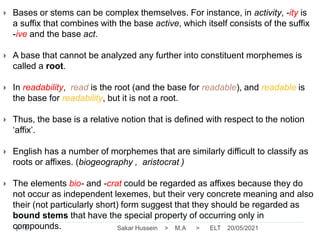
 Bases or stems can be complex themselves. For instance, in activity, -ity is
a suffix that combines with the base active, which itself consists of the suffix
-ive and the base act.
 A base that cannot be analyzed any further into constituent morphemes is
called a root.
 In readability, read is the root (and the base for readable), and readable is
the base for readability, but it is not a root.
 Thus, the base is a relative notion that is defined with respect to the notion
‘affix’.
 English has a number of morphemes that are similarly difficult to classify as
roots or affixes. (biogeography , aristocrat )
 The elements bio- and -crat could be regarded as affixes because they do
not occur as independent lexemes, but their very concrete meaning and also
their (not particularly short) form suggest that they should be regarded as
bound stems that have the special property of occurring only in
compounds.
MORPHEMES AND ALLOMORPHS
20/05/2021
Sakar Hussein > M.A > ELT
7
 When a single affix has more than one shape,
linguists use the term allomorph.
 For instance, the plural morpheme in English is
sometimes pronounced [s] (as in cats [kaets]),
sometimes [z] (as in dogs [dɒgz]), and sometimes [-
əz] (as in faces [feisəz]).
 Not only affixes, but also roots and stems may have
different allomorphs.
 For instance, English verbs such as sleep, keep,
deal, whose root has the long vowel [i:] in the
present-tense forms, show a root allomorph with
short [Îľ] in the past-tense forms (slept, kept, dealt).
SUPPLETION
20/05/2021
Sakar Hussein > M.A > ELT
8
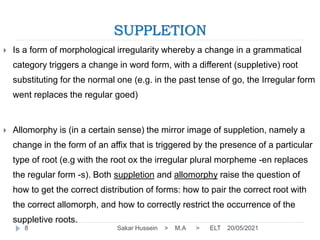
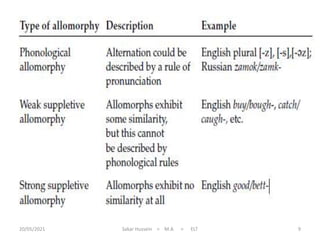
 Is a form of morphological irregularity whereby a change in a grammatical
category triggers a change in word form, with a different (suppletive) root
substituting for the normal one (e.g. in the past tense of go, the Irregular form
went replaces the regular goed)
 Allomorphy is (in a certain sense) the mirror image of suppletion, namely a
change in the form of an affix that is triggered by the presence of a particular
type of root (e.g with the root ox the irregular plural morpheme -en replaces
the regular form -s). Both suppletion and allomorphy raise the question of
how to get the correct distribution of forms: how to pair the correct root with
the correct allomorph, and how to correctly restrict the occurrence of the
suppletive roots.
20/05/2021 Sakar Hussein > M.A > ELT 9
MORPHOLOGICAL PATTERNS
20/05/2021
Sakar Hussein > M.A > ELT
10
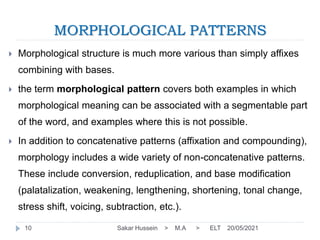
 Morphological structure is much more various than simply affixes
combining with bases.
 the term morphological pattern covers both examples in which
morphological meaning can be associated with a segmentable part
of the word, and examples where this is not possible.
 In addition to concatenative patterns (affixation and compounding),
morphology includes a wide variety of non-concatenative patterns.
These include conversion, reduplication, and base modification
(palatalization, weakening, lengthening, shortening, tonal change,
stress shift, voicing, subtraction, etc.).
AFFIXATION
20/05/2021
Sakar Hussein > M.A > ELT
11
 Linguists often distinguish two basic types of
morphological patterns:
 concatenative, which is when two morphemes are
ordered one after the other, and non-concatenative,
which is everything else.
 Most of the examples of morphologically complex words
that we have seen so far can be neatly segmented into
roots and affixes, and are therefore concatenative
patterns.
 In process terms, these can be described as derived by
affixation (subtypes suffixation, prefixation, etc.) and
compounding.
20/05/2021
Sakar Hussein > M.A > ELT
12
 Affixation involves more than just combining two
morphemes. A rule of affixation is also a statement about
which types of morphemes may combine.
 For example, un- and intelligent may combine via
affixation to form unintelligent, but it is not the case that
any affix and any base can combine. The suffix -able
attaches only to verbs; *intelligentable is not a potential
word of English because intelligent is an adjective, not a
verb. And un- can attach to adjectives, but does not
generally attach to nouns
 The combinatory potential of an affix cannot be entirely
predicted from its meaning. For example, the prefix non-
is virtually identical in meaning to un-, but it commonly
attaches to nouns (e.g., non-achiever) and less readily to
adjectives (non-circular, but *non-kind, ??non-intelligent).
BASE MODIFICATION
20/05/2021
Sakar Hussein > M.A > ELT
13
 Base modification also commonly takes the form of a
tonal change or stress shift.
 English has verbs that differ from their corresponding
nouns only by stress placement (e.g. di’scount
(noun) ´ > disco’unt (verb), I’mport (noun) > ´ impo’rt
(verb).
 English also has a few cases where a verb is derived
from a noun by a different operation – voicing the
last consonant of the root (e.g. hou[s]e (noun) >
hou[z]e (verb), thie[f] (noun) > thie[v]e (verb)).
CONVERSION
20/05/2021
Sakar Hussein > M.A > ELT
14
 the limiting case of a morphological pattern is
conversion, in which the form of the base remains
unaltered. A standard example is the relationship
between some verbs and nouns in English:
 Noun verb
 water water
 plant plant
 Conversion is generally invoked only for derivational
morphology, and primarily for relating two lexemes
that differ only in lexical class.
20/05/2021
Sakar Hussein > M.A > ELT
15
 In fusional or inflectional languages single morphemes
simultaneously combine or fuse several meanings in one form. Indo-
European languages are familiar examples of this type. For instance,
in the verbal morphology of many such languages, tense, person, and
number are realized as a single affix on the verb.
 Spanish: habl—o habl—as habl—a
speak-1 speak speak-
‘I speak’ ‘you speak’ ‘he/she speaks’
 Morphophonemics involves an investigation of the phonological
variations within morphemes, usually marking different grammatical
functions; e.g., the vowel changes in “sleep” and “slept,” and the
consonant alternations in “knife” and “knives,”.
20/05/2021
Sakar Hussein > M.A > ELT
16
 Semantic change : BOYFRIEND > ( a friend who is a boy)
vs
 ( a male with whom a woman has relationship with)
 Borrowing : KINDERGARTEN from German
 Compounding: PLAYGROUND > play + ground.
 Blending :SCREENAGER ( screen + teenager)
 Back-formation: TO EDIT (v) > editor (n)
OTHER LEXEME FORMATION PATTERNS
Sign Language Morphology
20/05/2021 Sakar Hussein > M.A > ELT 17
• Individual signs in a signed language are the basic equivalent of words
in a spoken language. Each signed language has a vocabulary of
conventional lexical signs which are often mono-morphemic.
• The type of morphological processes commonly found in signed
languages seems to be influenced by the fact that most lexical signs
are monosyllabic or, at most, bisyllabic
• If segments are added to a stem, producing a multisyllabic sign,
processes of assimilation and deletion tend to restructure the
resulting sign into a bisyllabic or monosyllabic one with
simultaneously expressed morphemes.
20/05/2021 Sakar Hussein > M.A > ELT 18
• It is often difficult to clearly distinguish between stem modification or
suprasegmental modification in signed languages. In many respects,
modifying the movement parameter of a sign is akin to changing a vowel
(a stem modification); however, in others, modifying for manner of
movement is akin to tone (a suprasegmental modification).
• The derivation of nouns from verbs in some signed languages: this
morphological process, in which nouns are derived from verbs by a sign-
internal
modification of movement, also has
parallels in other signed languages.
The continuous single movement
found in the verb is modified
to be restrained and tense, and
often repeated, in the noun.
MORPHOLOGICAL AWARENESS
 Is the individuals’ conscious comprehension of the particular
word morphemic structure and their ability to imitate and
manipulate that structure.
 the ability to recognize the existence of morphemes in
words
 the ability to focus on morphological structure of words, the
relations between base words, and their inflectional and
derivational forms.
 when an individual can recognize the appearance of
morphological structure of words such as affix attached on
words (prefix and suffix) and then modify and manipulate
that structure, he or she are engaging in morphological
20/05/2021
Sakar Hussein > M.A > ELT
19
20/05/2021
Sakar Hussein > M.A > ELT
20
 Morphological awareness provides a powerful tool for improving
many areas of literacy such as vocabulary comprehension, reading
aloud, spelling, phonological awareness, reading comprehension
and writing development
 enables the language learners to clarify the pronunciation of certain
sound. For example, the boundary between the prefix “mis-” and the
root “hear”, it is more likely that they would correctly pronounce the
/s/ and /h/ separately, rather than incorrectly as a combination like
“sh” as in “ship”.
 In spelling, morphological awareness helps the students to spell the
complex words and to remember its spelling easily. It influences the
other linguistic awareness, phonological awareness.
MORPHOLOGY IN ESL / EFL
20/05/2021
Sakar Hussein > M.A > ELT
21
 one of the purposes of studying morphology is the
innovation of words and the remaking of the existing
ones.
 Besides, they can apply some word formations such as
compounding, blending, clipping to coin the new words.
 Numerous vocabulary size and ability of predicting
meaning give significant contribution in English language
skill such as reading, speaking, and writing.
 morphology is also useful for the learners when they deal
with sentence structures or grammar.
 The study of English morphology can help us notify the
connection between English and other languages such
as the relation of English and Greek.
CLASSROOM INSTRUCTION IN MORPHOLOGY
20/05/2021
Sakar Hussein > M.A > ELT
22
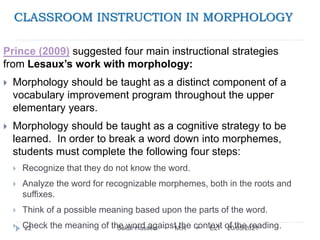
Prince (2009) suggested four main instructional strategies
from Lesaux’s work with morphology:
 Morphology should be taught as a distinct component of a
vocabulary improvement program throughout the upper
elementary years.
 Morphology should be taught as a cognitive strategy to be
learned. In order to break a word down into morphemes,
students must complete the following four steps:
 Recognize that they do not know the word.
 Analyze the word for recognizable morphemes, both in the roots and
suffixes.
 Think of a possible meaning based upon the parts of the word.
 Check the meaning of the word against the context of the reading.
20/05/2021
Sakar Hussein > M.A > ELT
23
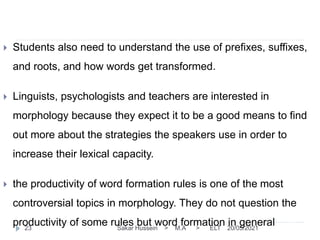
 Students also need to understand the use of prefixes, suffixes,
and roots, and how words get transformed.
 Linguists, psychologists and teachers are interested in
morphology because they expect it to be a good means to find
out more about the strategies the speakers use in order to
increase their lexical capacity.
 the productivity of word formation rules is one of the most
controversial topics in morphology. They do not question the
productivity of some rules but word formation in general
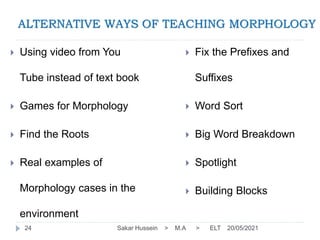
ALTERNATIVE WAYS OF TEACHING MORPHOLOGY
 Using video from You
Tube instead of text book
 Games for Morphology
 Find the Roots
 Real examples of
Morphology cases in the
environment
 Fix the Prefixes and
Suffixes
 Word Sort
 Big Word Breakdown
 Spotlight
 Building Blocks
20/05/2021
Sakar Hussein > M.A > ELT
24

Morphology. sakar

  • 1.
    Morphology and Language Teaching& Learning Sakar Hussein Ali M.A Student in ELT University of Sulemani School of Basic Education Department of English May 20th , 2021
  • 2.
    20/05/2021 CHOMSKY SAYS: Sakar Hussein> M.A > ELT 2 It is necessary to reject this [Saussure's] concept of langue as merely a systematic inventory of items and to return rather to the Humboldtian conception of underlying competence as a system of generative process.  anti-missile missile, anti-anti-missile missile missile
  • 3.
    MORPHOLOGY AND WHATIS INSIDE IT:  Morphology comes from Greek word; Morph means form or shape and –ology means the study of something.  Bauer (1988) mentions that morphology is the study of the forms of words. In other words, Morphology is the study on how words are created from smaller elements, and the changes made to those smaller elements in the process of building lexemes and word-forms.  In linguistics point of view, many experts define morphology as the study of the internal structure of words. 20/05/2021 Sakar Hussein > M.A > ELT 3
  • 4.
    LEXEMES AND WORD-FORMS 20/05/2021 SakarHussein > M.A > ELT 4  The most basic concept of morphology is the concept ‘word’.  When a word is used in some text or in speech, that occurrence of the word is sometimes referred to as a word token.  A lexeme is a word in an abstract sense. live is a verb lexeme. It represents the core meaning shared by forms such as live, lives, lived and living  a word-form is a word in a concrete sense. It is a sequence of sounds that expresses the combination of a lexeme (e.g. live) and a set of grammatical meanings appropriate to that lexeme.
  • 5.
    AFFIXES, BASES ANDROOTS 20/05/2021 Sakar Hussein > M.A > ELT 5  Word-forms in an inflectional paradigm generally share (at least) one longer morpheme with a concrete meaning and are distinguished from each other in that they additionally contain different shorter morphemes, called affixes.  An affix attaches to a word or a main part of a word. It usually has an abstract meaning, and an affix cannot occur by itself.  Types of affixes Examples  suffix: follows the base -ful in eventful  prefix: precedes the base un- in unhappy  infix: occurs inside the base Arabic -t- in (i)š-t-ag∙ala ‘be occupied’ (base: šag∙ala)  circumfix: occurs on both sides German ge-…-en,  e.g. ge-fahr-en ‘driven’ of the base (base: fahr)
  • 6.
    20/05/2021 Sakar Hussein >M.A > ELT 6  Bases or stems can be complex themselves. For instance, in activity, -ity is a suffix that combines with the base active, which itself consists of the suffix -ive and the base act.  A base that cannot be analyzed any further into constituent morphemes is called a root.  In readability, read is the root (and the base for readable), and readable is the base for readability, but it is not a root.  Thus, the base is a relative notion that is defined with respect to the notion ‘affix’.  English has a number of morphemes that are similarly difficult to classify as roots or affixes. (biogeography , aristocrat )  The elements bio- and -crat could be regarded as affixes because they do not occur as independent lexemes, but their very concrete meaning and also their (not particularly short) form suggest that they should be regarded as bound stems that have the special property of occurring only in compounds.
  • 7.
    MORPHEMES AND ALLOMORPHS 20/05/2021 SakarHussein > M.A > ELT 7  When a single affix has more than one shape, linguists use the term allomorph.  For instance, the plural morpheme in English is sometimes pronounced [s] (as in cats [kaets]), sometimes [z] (as in dogs [dɒgz]), and sometimes [- əz] (as in faces [feisəz]).  Not only affixes, but also roots and stems may have different allomorphs.  For instance, English verbs such as sleep, keep, deal, whose root has the long vowel [i:] in the present-tense forms, show a root allomorph with short [ε] in the past-tense forms (slept, kept, dealt).
  • 8.
    SUPPLETION 20/05/2021 Sakar Hussein >M.A > ELT 8  Is a form of morphological irregularity whereby a change in a grammatical category triggers a change in word form, with a different (suppletive) root substituting for the normal one (e.g. in the past tense of go, the Irregular form went replaces the regular goed)  Allomorphy is (in a certain sense) the mirror image of suppletion, namely a change in the form of an affix that is triggered by the presence of a particular type of root (e.g with the root ox the irregular plural morpheme -en replaces the regular form -s). Both suppletion and allomorphy raise the question of how to get the correct distribution of forms: how to pair the correct root with the correct allomorph, and how to correctly restrict the occurrence of the suppletive roots.
  • 9.
  • 10.
    MORPHOLOGICAL PATTERNS 20/05/2021 Sakar Hussein> M.A > ELT 10  Morphological structure is much more various than simply affixes combining with bases.  the term morphological pattern covers both examples in which morphological meaning can be associated with a segmentable part of the word, and examples where this is not possible.  In addition to concatenative patterns (affixation and compounding), morphology includes a wide variety of non-concatenative patterns. These include conversion, reduplication, and base modification (palatalization, weakening, lengthening, shortening, tonal change, stress shift, voicing, subtraction, etc.).
  • 11.
    AFFIXATION 20/05/2021 Sakar Hussein >M.A > ELT 11  Linguists often distinguish two basic types of morphological patterns:  concatenative, which is when two morphemes are ordered one after the other, and non-concatenative, which is everything else.  Most of the examples of morphologically complex words that we have seen so far can be neatly segmented into roots and affixes, and are therefore concatenative patterns.  In process terms, these can be described as derived by affixation (subtypes suffixation, prefixation, etc.) and compounding.
  • 12.
    20/05/2021 Sakar Hussein >M.A > ELT 12  Affixation involves more than just combining two morphemes. A rule of affixation is also a statement about which types of morphemes may combine.  For example, un- and intelligent may combine via affixation to form unintelligent, but it is not the case that any affix and any base can combine. The suffix -able attaches only to verbs; *intelligentable is not a potential word of English because intelligent is an adjective, not a verb. And un- can attach to adjectives, but does not generally attach to nouns  The combinatory potential of an affix cannot be entirely predicted from its meaning. For example, the prefix non- is virtually identical in meaning to un-, but it commonly attaches to nouns (e.g., non-achiever) and less readily to adjectives (non-circular, but *non-kind, ??non-intelligent).
  • 13.
    BASE MODIFICATION 20/05/2021 Sakar Hussein> M.A > ELT 13  Base modification also commonly takes the form of a tonal change or stress shift.  English has verbs that differ from their corresponding nouns only by stress placement (e.g. di’scount (noun) ´ > disco’unt (verb), I’mport (noun) > ´ impo’rt (verb).  English also has a few cases where a verb is derived from a noun by a different operation – voicing the last consonant of the root (e.g. hou[s]e (noun) > hou[z]e (verb), thie[f] (noun) > thie[v]e (verb)).
  • 14.
    CONVERSION 20/05/2021 Sakar Hussein >M.A > ELT 14  the limiting case of a morphological pattern is conversion, in which the form of the base remains unaltered. A standard example is the relationship between some verbs and nouns in English:  Noun verb  water water  plant plant  Conversion is generally invoked only for derivational morphology, and primarily for relating two lexemes that differ only in lexical class.
  • 15.
    20/05/2021 Sakar Hussein >M.A > ELT 15  In fusional or inflectional languages single morphemes simultaneously combine or fuse several meanings in one form. Indo- European languages are familiar examples of this type. For instance, in the verbal morphology of many such languages, tense, person, and number are realized as a single affix on the verb.  Spanish: habl—o habl—as habl—a speak-1 speak speak- ‘I speak’ ‘you speak’ ‘he/she speaks’  Morphophonemics involves an investigation of the phonological variations within morphemes, usually marking different grammatical functions; e.g., the vowel changes in “sleep” and “slept,” and the consonant alternations in “knife” and “knives,”.
  • 16.
    20/05/2021 Sakar Hussein >M.A > ELT 16  Semantic change : BOYFRIEND > ( a friend who is a boy) vs  ( a male with whom a woman has relationship with)  Borrowing : KINDERGARTEN from German  Compounding: PLAYGROUND > play + ground.  Blending :SCREENAGER ( screen + teenager)  Back-formation: TO EDIT (v) > editor (n) OTHER LEXEME FORMATION PATTERNS
  • 17.
    Sign Language Morphology 20/05/2021Sakar Hussein > M.A > ELT 17 • Individual signs in a signed language are the basic equivalent of words in a spoken language. Each signed language has a vocabulary of conventional lexical signs which are often mono-morphemic. • The type of morphological processes commonly found in signed languages seems to be influenced by the fact that most lexical signs are monosyllabic or, at most, bisyllabic • If segments are added to a stem, producing a multisyllabic sign, processes of assimilation and deletion tend to restructure the resulting sign into a bisyllabic or monosyllabic one with simultaneously expressed morphemes.
  • 18.
    20/05/2021 Sakar Hussein> M.A > ELT 18 • It is often difficult to clearly distinguish between stem modification or suprasegmental modification in signed languages. In many respects, modifying the movement parameter of a sign is akin to changing a vowel (a stem modification); however, in others, modifying for manner of movement is akin to tone (a suprasegmental modification). • The derivation of nouns from verbs in some signed languages: this morphological process, in which nouns are derived from verbs by a sign- internal modification of movement, also has parallels in other signed languages. The continuous single movement found in the verb is modified to be restrained and tense, and often repeated, in the noun.
  • 19.
    MORPHOLOGICAL AWARENESS  Isthe individuals’ conscious comprehension of the particular word morphemic structure and their ability to imitate and manipulate that structure.  the ability to recognize the existence of morphemes in words  the ability to focus on morphological structure of words, the relations between base words, and their inflectional and derivational forms.  when an individual can recognize the appearance of morphological structure of words such as affix attached on words (prefix and suffix) and then modify and manipulate that structure, he or she are engaging in morphological 20/05/2021 Sakar Hussein > M.A > ELT 19
  • 20.
    20/05/2021 Sakar Hussein >M.A > ELT 20  Morphological awareness provides a powerful tool for improving many areas of literacy such as vocabulary comprehension, reading aloud, spelling, phonological awareness, reading comprehension and writing development  enables the language learners to clarify the pronunciation of certain sound. For example, the boundary between the prefix “mis-” and the root “hear”, it is more likely that they would correctly pronounce the /s/ and /h/ separately, rather than incorrectly as a combination like “sh” as in “ship”.  In spelling, morphological awareness helps the students to spell the complex words and to remember its spelling easily. It influences the other linguistic awareness, phonological awareness.
  • 21.
    MORPHOLOGY IN ESL/ EFL 20/05/2021 Sakar Hussein > M.A > ELT 21  one of the purposes of studying morphology is the innovation of words and the remaking of the existing ones.  Besides, they can apply some word formations such as compounding, blending, clipping to coin the new words.  Numerous vocabulary size and ability of predicting meaning give significant contribution in English language skill such as reading, speaking, and writing.  morphology is also useful for the learners when they deal with sentence structures or grammar.  The study of English morphology can help us notify the connection between English and other languages such as the relation of English and Greek.
  • 22.
    CLASSROOM INSTRUCTION INMORPHOLOGY 20/05/2021 Sakar Hussein > M.A > ELT 22 Prince (2009) suggested four main instructional strategies from Lesaux’s work with morphology:  Morphology should be taught as a distinct component of a vocabulary improvement program throughout the upper elementary years.  Morphology should be taught as a cognitive strategy to be learned. In order to break a word down into morphemes, students must complete the following four steps:  Recognize that they do not know the word.  Analyze the word for recognizable morphemes, both in the roots and suffixes.  Think of a possible meaning based upon the parts of the word.  Check the meaning of the word against the context of the reading.
  • 23.
    20/05/2021 Sakar Hussein >M.A > ELT 23  Students also need to understand the use of prefixes, suffixes, and roots, and how words get transformed.  Linguists, psychologists and teachers are interested in morphology because they expect it to be a good means to find out more about the strategies the speakers use in order to increase their lexical capacity.  the productivity of word formation rules is one of the most controversial topics in morphology. They do not question the productivity of some rules but word formation in general
  • 24.
    ALTERNATIVE WAYS OFTEACHING MORPHOLOGY  Using video from You Tube instead of text book  Games for Morphology  Find the Roots  Real examples of Morphology cases in the environment  Fix the Prefixes and Suffixes  Word Sort  Big Word Breakdown  Spotlight  Building Blocks 20/05/2021 Sakar Hussein > M.A > ELT 24